For many multi-location businesses, ReviewTrackers has served as a launchpad into online reputation management, thanks to its intuitive dashboard, helpful alerts, and reliable review aggregation across major platforms. Many marketing leaders appreciate ReviewTrackers for automating routine review invites and surfacing basic sentiment trends that help you keep a pulse on what customers are saying.
Yet, as customer experience becomes a true growth driver and competitive differentiator, teams often find that ReviewTrackers is just the start, not the finish line. While the platform’s strengths in review collection and monitoring are clear. Still, modern enterprises increasingly crave deeper automation, unified communications, advanced reporting, and seamless local SEO tools to match their scale and complexity. Slow innovation cycles, manual workflows, and limited AI functionality force managers to patch together multiple tools for messaging, surveys, listings, and analytics.
If your business is ready for a future-facing, all-in-one reputation engine, it’s time to explore the top alternatives for 2025—where leaders like Birdeye are setting new standards in CX automation and enterprise outcomes.
7 reasons why you might need a ReviewTrackers alternative?
Many growing brands start with ReviewTrackers for its reliable centralized review monitoring and clear reporting. It brings all review data into one platform, making it easier to track reputation trends, alert location managers, and benchmark against competitors.
Teams value how ReviewTrackers streamlines collecting, responding to, and analyzing customer feedback at scale—a must for local visibility and trust. But as brands mature, requirements also change.
Gaps in automation, limitations in listings and social, and manual workflows often become challenges for organizations pursuing holistic CX, richer insights, and faster growth. Recognizing these limits is a crucial first step toward finding a platform that truly fuels enterprise reputation strategy.
The pointers below highlight the most common signals that it’s time to explore a ReviewTrackers alternative that aligns with your business’s ambition and operational complexity.
1) Limited to reviews, not true CX
ReviewTrackers is excellent for monitoring and responding to online reviews. Still, it stops short of being a unified customer experience hub—missing key tools for surveys, omnichannel messaging, or social management.
The price was not optimal, and that's why we moved to another tool. – 3/5 – Verified G2 user
2) Manual workflows and siloed processes
Many actions still require manual effort —from assigning reviews to routing follow-ups, slowing down large or distributed teams. Most tasks—like multi-site reporting or analytics need extra steps or exports.
ReviewTrackers doesn't lead to clients leaving reviews - 0.5/5 Verified G2 users
3) Basic AI and analytics
Sentiment analysis and basic keyword alerts are available, but the platform lacks the deep, predictive analytics and benchmarking found in leaders like Birdeye. There’s limited ability to surface insights across locations or customer segments.
4) No listings or local SEO management
If you need to update your Google Business Profile, manage NAP consistency, or optimize for “near me” searches at scale, ReviewTrackers requires separate tools and manual interventions.
5) Scalability challenges
ReviewTrackers is optimized for single brands or SMBs. Enterprises and franchises report struggles with coordinating permissions, analytics, and integrations when rolling out across dozens or hundreds of locations.
Unless youʻre a BIG company, itʻs not really worth the time to get. You also need someone on your team who is willing to look at and respond to every outlet, since the software doesn't allow you to do so - 0/5 Verified G2 users
6) API and integration gaps
While ReviewTrackers offers API and Zapier access, the integrations for payments, industry-specific CRM, and multi-platform marketing remain limited versus platforms that natively handle omnichannel orchestration.
7) Slow feature upgrades and support response
Growth-minded businesses need rapid innovation, especially as AI, compliance, and customer expectations shift. Users say ReviewTrackers’ roadmap and support lag behind those of enterprise-first competitors.
First time it worked great! I was able to respond to reviews. Then they all disappeared. Now I can't respond to Google reviews. I would like to respond to both good and bad reviews, but I am having a hard time doing so. Now I can see the reviews, but last month, none were there. I would love for someone to call me and explain to me how it works. Thank you! – Verified G2 user
As expectations rise, review management alone isn’t enough. Businesses now need platforms that unify reputation, communication, and insights into a single intelligent system.
Businesses ready to boost efficiency, unify customer communications, and leverage advanced automation are now turning to alternatives like Birdeye, Reputation.com, SOCi, Yext, etc. These solutions break the cycle of “too many tools, too little insight” in your reputation strategy as you scale.
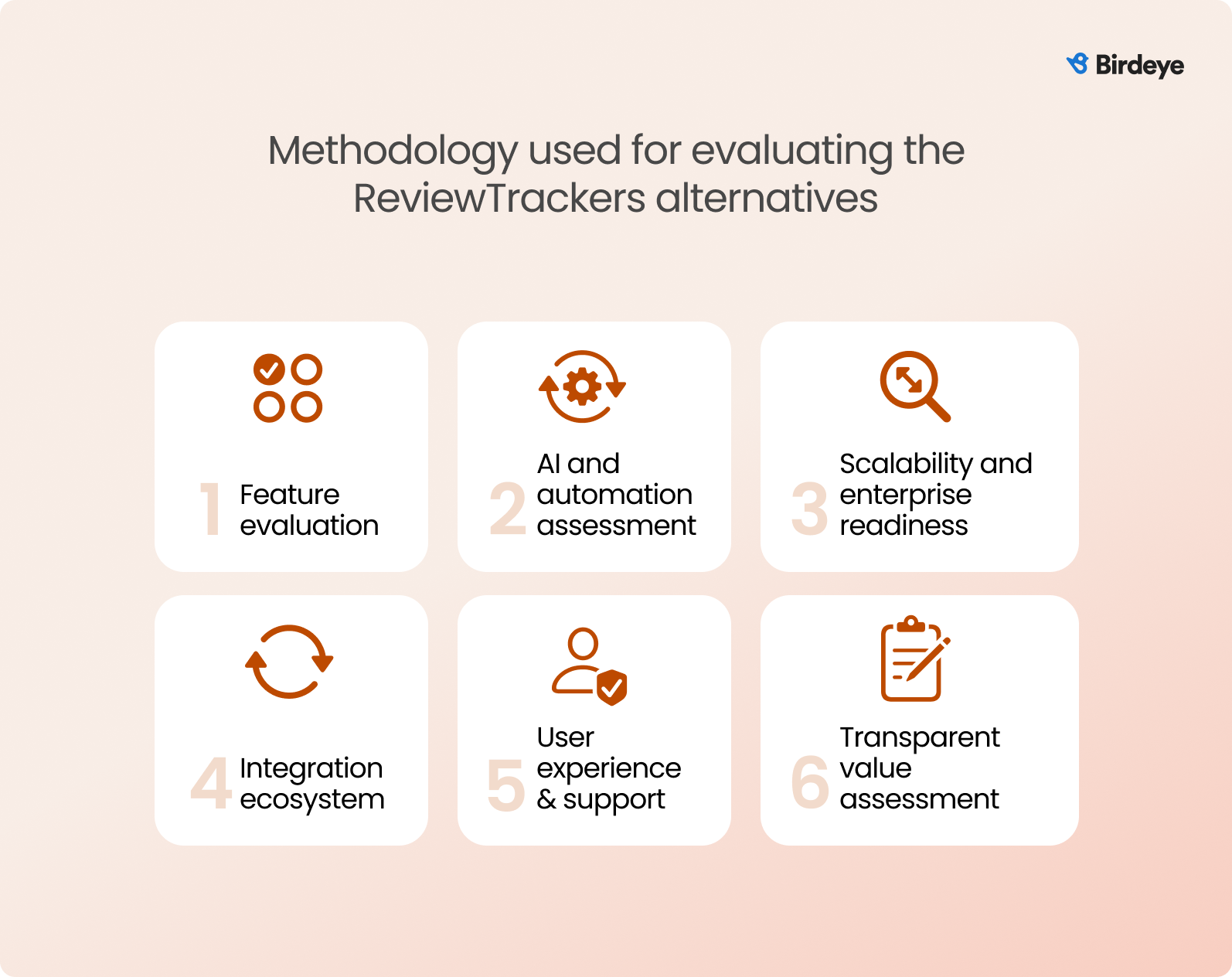
Methodology used for evaluating the ReviewTrackers alternatives
To ensure this guide provides accurate, actionable recommendations for enterprise and multi-location brands, each ReviewTrackers alternative was assessed using a proven, research-driven methodology.
Our process included:
Feature evaluation
Each platform was mapped against ReviewTrackers on the breadth and depth of review management, multi-channel engagement, listings, survey tools, analytics, and automation. We conducted hands-on trials and sourced feature documentation for comparison.
AI and automation assessment
Vendors were scored on their use of AI for sentiment analysis, predictive insights, automation of responses and invites, and advanced reporting—an area where ReviewTrackers’ basic AI is a frequent limitation.
Scalability and enterprise readiness
Platforms were evaluated based on their ability to serve franchises, regionals, and distributed teams, including dashboard usability, permissions control, role management, and reporting at scale.
Integration ecosystem
We prioritized tools with deep CRM, marketing automation, EMR, POS, and directory integrations to support real-time data flow, omnichannel engagement, and campaign orchestration—key for businesses moving beyond ReviewTrackers’ API/Zapier model.
User experience & support
Reviews and testimonials from brands in similar verticals provided insight into onboarding, support responsiveness, training, and long-term customer satisfaction.
Transparent value assessment
All pricing, licensing, and TCO (total cost of ownership) data were confirmed when possible through sales demos, published plans, or user feedback, giving readers an honest snapshot of what to expect when switching from ReviewTrackers.
This methodology helps enterprise decision-makers quickly identify ReviewTrackers alternatives built not just for easier review management, but for holistic, growth-driven customer experience transformation.
Top 7 ReviewTrackers alternatives comparison at a glance
Multi-location review, local SEO, benchmarking, Pulse AI, social
Sentiment + CX scoring AI
Custom, enterprise/multi-site
Top 7 ReviewTrackers alternatives (detailed reviews)
1. Birdeye (Recommended)
Birdeye is engineered for multi-location enterprises and ambitious brands looking for more than basic review monitoring. Unlike simple aggregators, it unites reputation, communication, and marketing—delivering advanced automation, local SEO, real-time analytics, and unified oversight in a single, AI-fueled dashboard.
With broad integration support and proactive AI agents, Birdeye transforms fragmented reputation tools into a coordinated growth engine.
Review Management: Collect, monitor, and respond to reviews from 200+ platforms; AI agents craft context-aware replies and identify sentiment trends.
Directory & Listings Management: Maintain and update business info across Google, Yelp, Apple, and more; agents proactively identify and correct inconsistencies for local SEO.
Inbox & Omnichannel Messaging: One inbox captures SMS, web chat, WhatsApp, email, and socials; AI agents smart-route, respond, and escalate customer interactions in real time.
Social Media Suite: AI agents schedule and post content, reply to social engagements, and recommend posts based on engagement analytics and competitive trends.
Search AI Discovery: Track and visualize how your brand appears on major AI-powered search engines (ChatGPT, Gemini, Perplexity); specialized agents monitor search summaries and rankings.
Insights & Sentiment Analytics: AI aggregates reviews, chats, and surveys; agents surface actionable insights, spot emerging issues, and automate follow-ups to improve CX.
Surveys & Referrals: Launch intelligent surveys post-transaction; automate referral outreach and tracking to facilitate word-of-mouth growth.
Competitive Intelligence: Benchmark against rivals—location by location—with AI surfacing gaps, strengths, and local threats in reputation and marketing share.
Contact Segmentation & Campaigns: AI creates dynamic segments from customer data, plugging them into targeted campaigns for better engagement and ROI.
Pros
Centralized CX control for reviews, messaging, social, surveys, and listings.
Over 3,000 prebuilt integrations streamline data flows and automate tasks.
Robust AI agents automate everything from review responses to analytics and reputation insights.
Enterprise-grade reliability, security (HIPAA/SOC 2/GDPR), and detailed permission controls.
Transparent, scalable pricing to suit startups, growing brands, and global enterprises.
Industry accolades from G2, Capterra, Forbes, and Google for excellence in unified reputation management.
Cons
Birdeye’s advanced features and robust automation can create a steep learning curve for teams transitioning from simpler tools; expert-led onboarding helps accelerate adoption.
The platform’s most sophisticated AI modules, such as Search AI and Competitors AI, are geared for multi-location or enterprise use, so some onboarding investment is needed to unlock full ROI.
Pricing and value
Birdeye offers tiered plans tailored to brand size and complexity. Pricing is transparent and volume-discounted for multi-location operations, with options for bundled add-ons and custom integrations.
Awards & recognition
G2 2025: #1 in “Reputation and Customer Experience Management”
Forbes Advisor: “Best AI Marketing Platform for Multi‑location Brands”
Capterra: “Leader in Reviews, Messaging, and Social Integration 2025”
Google Premier Partner Program: Recognized for enhancing brands’ local search performance.
What Birdeye customers say
Easy-to-use platform, fast and friendly customer service, and flexible in catering to your needs
It is very easy to get started in BirdEye without any formal training. Everything is self-explanatory. The site combines all the information and presents clear graphs and data so you can really see where your company stands. Their staff is always available to answer any questions and give great suggestions on how to maximize your reputation based on the data. They can also make alterations to the site based on your needs - 5/5 – Verified G2 user
Why Birdeye stands out
Birdeye unifies every reputation, messaging, and local marketing process into one intelligent platform, allowing multi-location brands to streamline management, automate manual tasks, and reveal customer insights hidden across dozens or thousands of locations.
For enterprise teams ready to move beyond review aggregation and manual reporting, Birdeye stands out as the system that transforms CX from operational cost to a true driver of growth and differentiation.
Birdeye vs ReviewTrackers
Category
Birdeye AI Suite (Preferred)
ReviewTrackers
Who it’s for
Multi-location enterprises (10-10,000+ location), franchises, and growth-focused brands
Suited for small/mid-scale, multi-location management limited
Compliance/security
HIPAA, SOC 2, GDPR certified; built for healthcare and regulated industries
General compliance, not vertical-specific
Awards/recognition
G2, Capterra, Forbes, Google Premier; market leader in 2025
Review management category leader for SMB/regional ops
2. Reputation.com
Who is it for: Established enterprises and compliance-heavy sectors (like healthcare, finance, and automotive) that need central oversight and rigorous reporting for a wide-reaching online presence.
Star Rating: G2: 4.6/5, Capterra: 4.4/5
Key features
Reputation.com delivers a centralized operating system for customer sentiment, allowing organizations to control every site, branch, and location from a secure environment.
Live review stream: Instantly captures customer reviews from review sites, maps, and directories, updating dashboards in real time.
Automated, rules-driven review invitations: Send targeted requests and reminders via SMS or email, improving volume and quality of feedback for every branch or service line.
Customized internal and external feedback: Combines public review collection with private, in-depth surveys for continuous CX and employee improvement.
On-demand managed response: Let's large organizations supplement their own efforts with a dedicated team to handle inbound feedback or reputation crises.
Modular platform integrations: Connects seamlessly with your CRM, analytics, helpdesk, and listings software for accurate closed-loop attribution and case management.
Pros
Unmatched in scope for reporting, NPS monitoring, and governance at scale
Integrated workflow automation ensures fast triage and financial impact tracking
Offers both AI and professional human review response services
Cons
Interface is utilitarian and may slow adoption for non-technical teams
High cost, custom contracts, and complexity are best justified for organizations with many locations or compliance requirements
Lacks some social marketing and next-gen automation modules found in newer platforms
Pricing and value
Custom, built to enterprise and industry specifications. Strong ROI for compliance-driven orgs and those managing large networks, but often unnecessary for leaner, SMB-focused operations.
3. SOCi
Who is it for: SOCi is the strongest fit for businesses that need both corporate-level control and location-level flexibility, where permissions, campaign approvals, and localized engagement are mission-critical.
Star Rating: G2: 4.5/5, Capterra: 4.5/5
Key features
SOCi’s strength is orchestration—automating posting, reviews, and messaging across hundreds of profiles while enabling local customization. Its streamlined inbox, hierarchical permissions, and smart content library empower teams with tailored messaging, while AI predicts campaign performance and schedules to maximize impact.
Unified Response Center: Manage reviews, social posts, and incoming messages for all locations through a single, streamlined dashboard, supporting high-volume, multi-brand teams.
Content Library & Campaign Automation: Store pre-approved assets, automate bulk scheduling, and allow regional or franchise managers to localize and launch content on their own time.
Layered Permissions & Compliance: Sophisticated access controls and approval flows enable the corporate set to define brand rules while empowering local teams.
Location Analytics Suite: Monitor reputation health, engagement velocity, and response compliance at the branch or market level—spotting trends early.
Pros
Power and scale for distributed marketing, co-op creative, and franchise growth
Standout permissions and bulk-action controls for agency use
Reputation monitoring and social posting together, not in silos
Cons
Small businesses may find it too complex and expensive
Not designed as a complete CX or survey automation suite
Modular pricing—fees accrue quickly if you need all features
Pricing and value
Negotiated tiered pricing by feature and location; often best-in-class for scaled portfolio management, but not ideal for single-site operations.
4. Yext
Who is it for: Multi-location brands, national chains, and retailers who treat data accuracy, listing control, and “findability” as their top local marketing priorities.
Star Rating: G2: 4.4/5, Capterra: 4.2/5
Key features
Yext remains the global leader for business listings and local SEO, ensuring brands show up consistently across specialty sites. Recently, Yext’s AI-powered site search and analytics have enabled brands to drive website conversions and measure voice or chatbot readiness.
Real-Time Bulk Listings Sync: Pushes verified business info to 200+ local search sites, maps, voice platforms, and directories with a single click.
Knowledge Graph Engine: Organizes brand data, FAQs, and assets into a structured source of truth for both SEO and internal teams.
AI Search & Answer Bars: Instantly answers customer website or portal queries with branded, authoritative responses.
Automated Review Aggregation: Pulls every new review, Q&A, and feedback from across the web into a single feed with robust alerting.
Competitor & Presence Analytics: Explores your “digital footprint,” showing missing listings, ranking weaknesses, and review sentiments compared to rivals.
Pros
Directory accuracy and update speed are unmatched
Ahead of the curve in “voice search” and knowledge graph readiness
Easy for digital agencies to plug and play for enterprise clients
Cons
No omnichannel messaging or survey/feedback suite—must pair with other tools for complete CX.
Interface and analytics are best suited for SEO and tech-savvy teams.
The cost structure scales rapidly with the number of locations and the use of advanced modules.
Requires technical setup and internal ownership for full value.
Some advanced modules and analytics can increase the overall cost for small businesses.
Pricing and value
Scaled by location, directory count, and feature selection. Investment is worth it for national and global brands invested in local ranking and presence management.
5. Broadly
Who is it for: Independent home services, local businesses, and field-based companies needing user-friendly review automation, payment, and client communication without an IT team.
Star Rating: G2: 4.6/5, Capterra: 4.7/5
Key features
Broadly emphasizes simplicity. Automated review invitations and reminder campaigns can be sent by text or email. Its CRM and webchat make lead capture and follow-up natural, while click-to-pay invoicing enables instant payment at the point of service. Teams manage messaging, basic scheduling, and customer replies in a single interface.
Automated Review Triggers: Instantly texts or emails every job customer to ask for a review post-service—no manual steps required.
Built-In Lite CRM: Tracks every customer, job, payment, and follow-up, helping smaller teams stay organized.
Web Chat-to-Lead: Website visitor messages are converted to contacts and jobs right inside the same platform.
Fast Payment Tools: Enables direct invoicing, pay-by-text links, and payment status updates, closing the loop from feedback to payment.
Customer Satisfaction Surveys: A Simple survey builder helps measure NPS and resolve issues before they go public.
Pros
Onboarding takes days, not weeks—strong for teams modernizing fast
Highly affordable package allows small businesses to punch above their weight
Integrated payments and reviews in one clear view
Cons
Minimal multi-location and enterprise reporting
Lacks sophisticated analytics, social publishing, or survey workflows
Customization is limited compared to full CX platforms
Pricing and value
Transparent monthly pricing, industry-specific packages, and a strong fit for small business owners focused on core CX basics rather than feature sprawl.
6. Podium
Who is it for: Multi-location businesses, franchises, and modern service brands seeking centralized review management, 1:1 messaging, payments, and real-time customer interaction in a single interface.
Star Rating: G2: 4.6/5, Capterra: 4.3/5
Key features
Podium has recently reimagined its platform with advanced AI models it calls “AI Employees,” turning traditional review and messaging automation into a 24/7 digital workforce. Smart, industry-trained, and business-specific, these AI capabilities now power core sales, scheduling, marketing, and review workflows.
AI Employee Suite: Podium’s configurable, patent-pending AI acts as salesperson, scheduler, marketer, and concierge—responding instantly to leads, booking appointments, and handling inquiries with real-time business context and industry-trained intelligence.
Instant Review Requests: Automates sending review invites via text at key customer moments, boosting response rates.
Digital Interaction Tools: Offers appointment reminders, updates, and feedback surveys with unified follow-up.
Analytics & Integrations: Delivers reporting by location, employee, and channel with seamless CRM and POS connections.
Pros
Empowers local teams to reply and act from any device
Combines two-way messaging, reviews, and payment in one login.
Robust integrations with major business systems.
Cons
Lacks extensive social media scheduling/publishing and deep survey analytics.
Some advanced features are gated behind higher-tier pricing.
Customer support responsiveness varies by plan.
Bulk actions/features may require premium upgrades.
Reporting is less granular than that of some enterprise CX leaders.
Pricing and value
Custom quote, tiered by number of locations/features. Best for brands that want fast feedback and payments, not complex marketing automation..
7. Chatmeter
Who is it for: Regional chains, national brands, and franchise organizations managing reputation, rankings, and customer engagement across dozens—or thousands—of local business locations.
Star Rating: G2: 4.5/5, Capterra: 4.5/5
Key features
Chatmeter is purpose-built for multi-location complexity, with real-time reputation monitoring, competitive benchmarking, and actionable CX intelligence—all in one dashboard.
Multi-Location Review Monitoring: Instantly tracks and alerts you to new reviews and ratings across Google, Yelp, Facebook, and more, for every location at once.
AI-Powered Sentiment Analysis: Uses advanced AI to extract trending issues, customer sentiment shifts, and hidden operational gaps from reviews and unstructured feedback.
Listings & Local SEO Management: Keeps all business listings accurate across directories and boosts Google Business Profile visibility, ensuring every branch is easy to find.
Competitor Benchmarking: Reveals how each location is performing against local and national competitors, using proprietary scoring and KPIs.
Social Publishing & Engagement: Schedule, manage, and analyze social posts across networks for every business under your umbrella.
Pros
Masterful at scaling review, listing, and social workflows for large, distributed teams.
Pulse AI surfaces recurring problems or wins quickly, enabling fast operational action.
Integrates with business intelligence tools for holistic reporting and deeper insights.
Cons
More advanced configuration means a learning curve for new users.
Premium pricing relative to basic review platforms.
Focused on B2B and large-scale—can be “too much” for smaller, single-location businesses.
Some advanced analytics features require setup with additional support.
Lacks built-in payments or direct invoicing features.
Pricing and value
Custom pricing by scale; delivers top value for franchises and national brands aiming to connect local reputation with real business results and enterprise-level analytics.
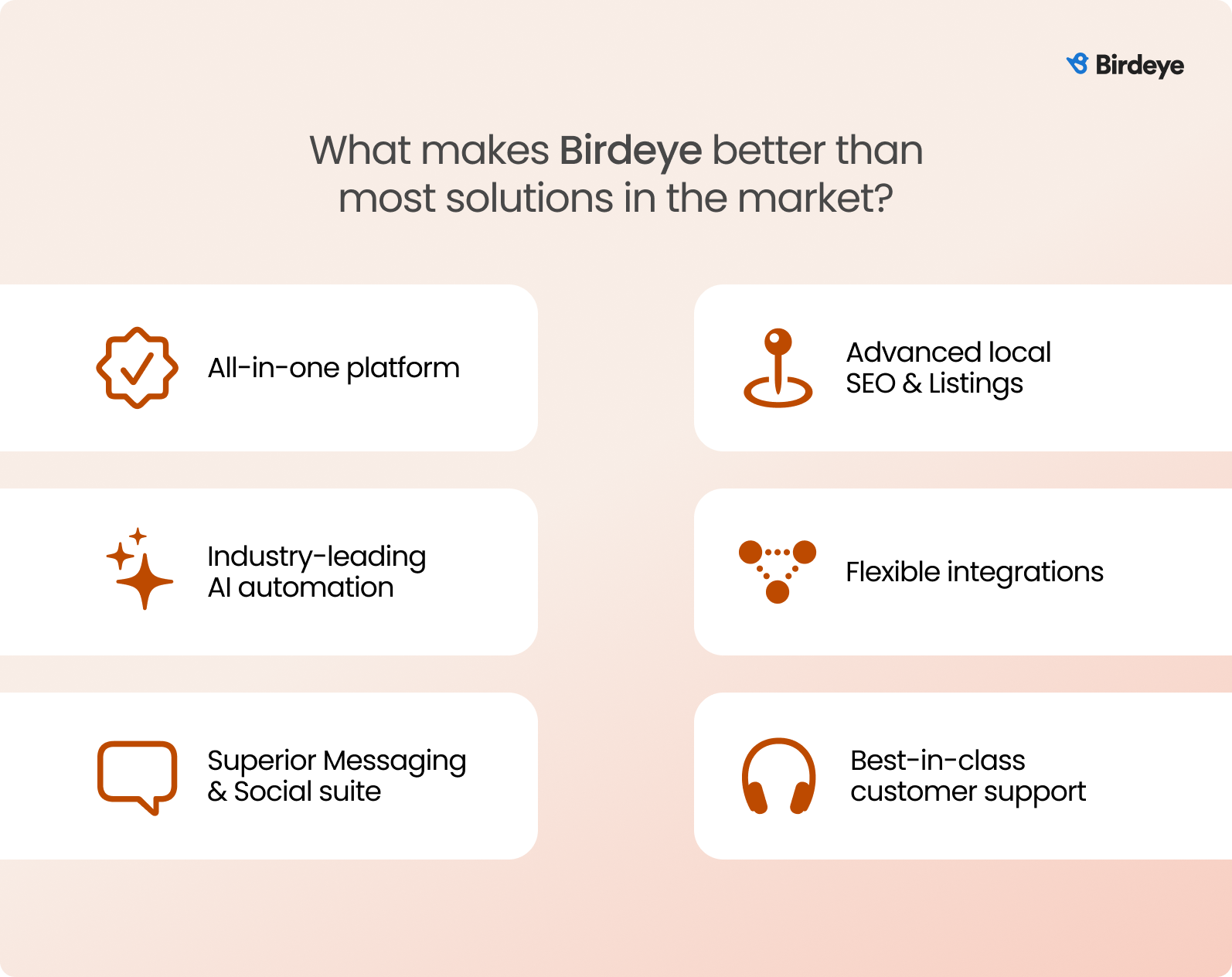
What makes Birdeye better than most solutions in the market?
Birdeye stands out as the most comprehensive reputation and customer experience platform for brands that want every aspect of customer feedback, messaging, and local engagement managed under a single, AI-powered roof.
All-in-one platform
Birdeye is not just a review tool—it integrates reviews, listings, social, webchat, text, surveys, referrals, payments, and analytics. Brands get rid of siloed apps, benefit from a unified dashboard, and gain end-to-end customer insights that single-focus competitors lack.
Industry-leading AI automation
Birdeye automates review responses, survey design, competitor tracking, and reputation benchmarking across all channels. The platform’s proprietary AI delivers timely, natural, and brand-aligned communication, while surfacing actionable insights and trends without manual effort.
Superior Messaging & Social suite
Birdeye’s inbox brings together email, SMS, webchat, WhatsApp, and social messaging, unlike platforms that silo reviews and communications. This means no lost leads, faster response times, and seamless customer conversations at scale.
Advanced local SEO & Listings
As a Google Premier Partner, Birdeye syncs location data to 100+ directories, manages Google Business Profile updates, and supports local search performance with a dedicated Listings module—while some platforms only push to a handful of sites.
Flexible integrations
With more than 3,000 built-in integrations, Birdeye easily connects to the systems (CRMs, EMRs, POS, marketing automation) you already use—eliminating data silos and saving IT resources from painful custom development.
Best-in-class customer support
24/7 support, dedicated onboarding, and regular strategy sessions mean brands of any size realize value faster and adapt to new features easily—far outpacing most legacy competitors for service quality and CX transformation.
Outstanding Partner in Listings, Social, and Online Review Management!Birdeye has been an exceptional partner for our business. Their listings management, social media management, and online review platforms are highly effective, reliable, and continuously evolving. The onboarding process was professional and thorough, ensuring a smooth implementation across our team. Their support staff is responsive, knowledgeable, and efficient. Birdeye is committed to innovation and consistently advancing the capabilities of its products to meet the evolving needs of businesses - 5/5 Verified G2 users
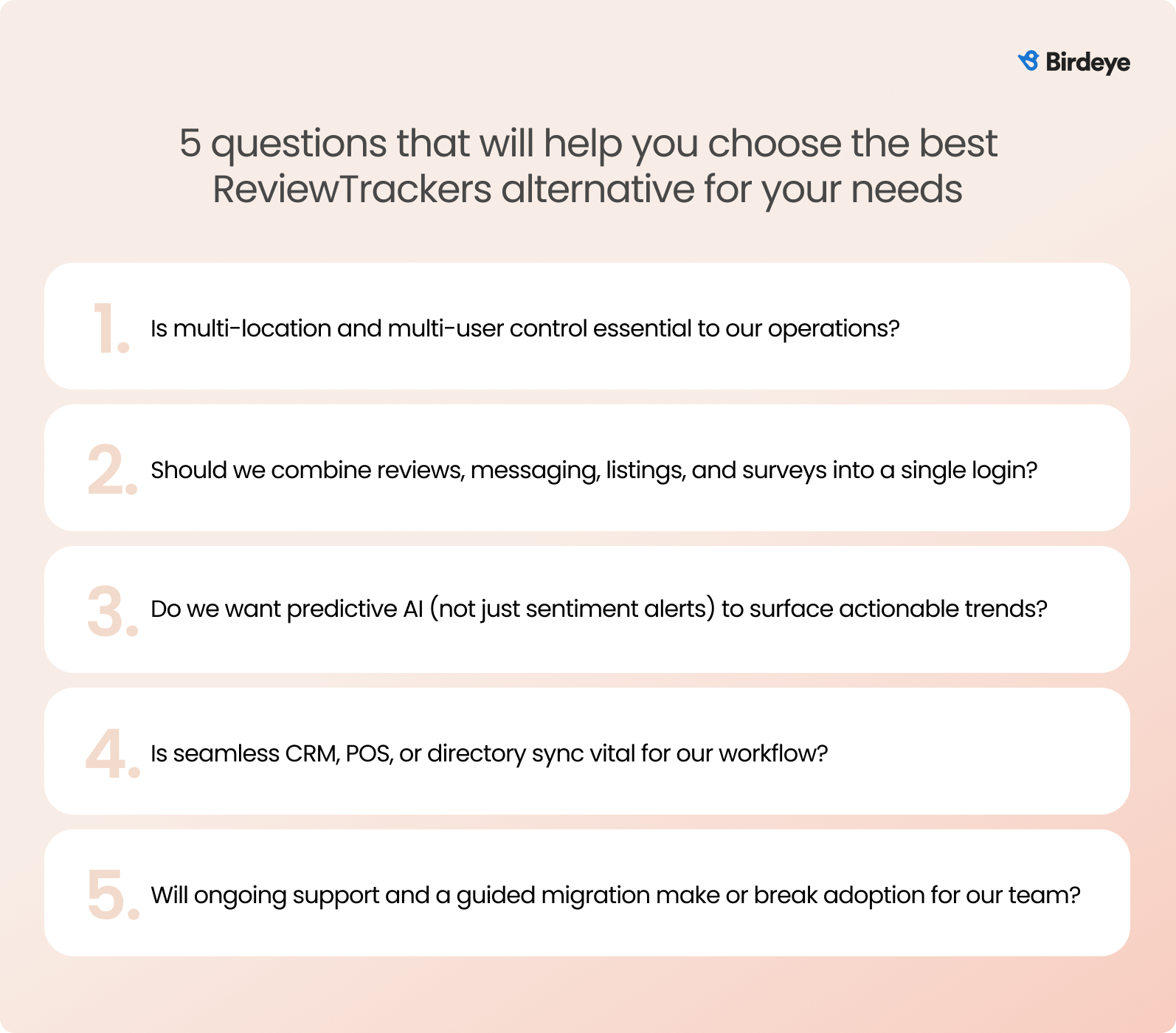
How to choose the best ReviewTrackers alternative for your needs
Finding a replacement for ReviewTrackers starts by mapping your actual customer experience management requirements, not just your review-collection goals. The most effective move is to match the platform’s core capabilities to your company’s size, operational model, and future ambitions, ensuring you won’t need to replatform again as you grow.
Step 1: Map your customer journey gaps Ask: Where are we losing time or missing insight in our feedback loop? If your biggest challenge is merging review data with messages, surveys, and visit analytics, seek a platform with seamless multi-channel tracking and analytics dashboards. If listing accuracy or competitive insights are weaknesses, focus on solutions that handle SEO, directory updates, and benchmarking in a single interface.
Step 2: Assess your automation goals Modern reputation platforms now range from basic alerts to predictive, AI-driven recommendations and auto-responses. Decide whether you need advanced workflow automation (triggered actions, reminders, auto-replies) or simply want intelligent suggestions for responses and follow-up.
Step 3: Gauge scalability and permissions Managing 10 locations is profoundly different than managing 200. Choose tools that offer granular access controls, robust group-level reporting, and location-by-location breakdowns—plus flexible onboarding so regional teams can scale up or down with minimal disruption.
Step 4: Prioritize integration and data flow Don't overlook native integrations with your CRM, POS, or marketing suite. Platforms that sync in real time keep your analytics up to date and reduce duplicate data entry, letting you leverage reputation data across everything from customer support to campaign attribution.
Step 5: Consider the support ecosystem and training Switching from ReviewTrackers is smooth only when a vendor offers proactive onboarding, regular success check-ins, and a responsive support desk. Review vendor response speed, migration support, and community forums to ensure you’ll never be left with unanswered questions.
Step 6: Calculate Total Value, Not Just Price A low monthly cost is tempting, but it often misses AI, analytics, or support that add real value. Score each option based on included modules—not extras. This way, you introduce less complexity and achieve a higher ROI than with your current solution.
Answering "yes" to most of these means you're ready for a comprehensive, future-ready ReviewTrackers alternative—one that turns fragmented feedback into rich, actionable customer strategy.
Migration checklist: How to switch from ReviewTrackers to Birdeye in 5 easy steps
Switching from ReviewTrackers to Birdeye is smooth, secure, and fully managed by our onboarding experts, so your team can stay focused on growth while we handle the migration behind the scenes.
Simple 5-step migration
Step 1: Assess – Start by reviewing your existing ReviewTrackers setup, including integrations, data sources, and active review campaigns. Identify what needs to be carried over and outline your migration objectives.
Step 2: Collect – Export your historical reviews, customer records, locations, and any survey data from ReviewTrackers. Our team will help you ensure that all critical information is captured without gaps.
Step 3: Transfer – Birdeye’s implementation specialists securely import and organize your data into the right modules—Reviews, Inbox, Listings, Surveys, and Messaging—maintaining complete data accuracy.
Step 4: Integrate – Reconnect key tools such as CRM, PMS, or POS systems. Then, enable review requests, surveys, and messaging automations within Birdeye to streamline engagement across every channel.
Step 5: Launch – Once everything’s connected, test your workflows, train teams, and go live. Birdeye experts stay with you through each phase to ensure a seamless, zero-downtime transition.
Why migrating to Birdeye is a smarter move
Seamless migration experience: Dedicated onboarding and migration teams ensure a fast, secure switch with no loss of reviews, customer data, or analytics.
Enterprise-grade automation: Gain intelligent workflows, AI-powered insights, and automated review and messaging tools that go beyond ReviewTrackers’ manual processes.
Top-rated usability and support: Birdeye consistently outperforms ReviewTrackers for ease of use, setup, and support, helping teams adopt faster and deliver impact sooner.
Future-ready scalability: Whether you manage 5 or 500 locations, Birdeye’s modular platform grows with your business, simplifying reputation and customer experience management at scale.
Best customer service and support, plus great software! Our business has been using Birdeye for several years, and we've experienced great success with it. We particularly appreciate the Reviews feature, which has played a significant role in supporting our reputation management efforts and has helped us increase both the frequency and quality of our Google reviews. Additionally, the chat widget stands out as an excellent tool that is straightforward and user-friendly for both our customers and prospects and for our staff. The interface is user-friendly and easy to integrate and implement. Lastly, the customer service and support are outstanding—thank you, Birdeye! - 5/5 Verified G2 users
FAQ: Birdeye vs ReviewTrackers
1. Is Birdeye more affordable than ReviewTrackers?
Birdeye’s pricing is designed to scale for businesses of all sizes—from SMBs to national brands and typically offers more value for money by bundling advanced features—like AI-driven responses, listings, and messaging that often cost extra or aren’t available in ReviewTrackers plans.
2. How easy is it to migrate from ReviewTrackers to Birdeye?
Switching is streamlined: Birdeye’s onboarding team offers secure data migrations, personalized setup, tailored training, and white-glove support to ensure a seamless transition with no data loss or downtime for your reputation workflow.
3. Does Birdeye integrate with my CRM and business apps?
With more than 3,000 integrations, Birdeye connects to virtually any CRM or operational system—HubSpot, Salesforce, healthcare EMRs, and more—enabling fully connected workflows that go far beyond basic review management.
4. Can Birdeye automate review generation and responses better than ReviewTrackers?
Yes. Birdeye uses advanced AI to automate outreach (via SMS, email, and QR codes), personalize follow-ups, and generate review responses at scale, outperforming ReviewTrackers’ more manual and email-first processes.
5. How does Birdeye help with local SEO and discoverability?
Birdeye’s Listings module syncs your business data to 100+ directories—including Google and Apple, driving higher map rankings and customer visibility. ReviewTrackers requires separate tools or manual updates to manage complete listings.
Ready to switch from ReviewTrackers to Birdeye?
Making the leap from ReviewTrackers to Birdeye is more than just improving how you track reviews; it's a transformation of your brand’s entire reputation and customer experience strategy.
With Birdeye, you unlock automation across reviews, messaging, and social, allowing your team to move faster, reach more customers on their preferred channels, and turn every customer touchpoint into actionable insights.
Birdeye has been instrumental in streamlining our online business operations.I really enjoy the platform's layout and its customization for each business. I've also been so thankful for the entire Birdeye team. They are very responsive and helpful anytime we have a question or issue. Verified G2 users
Disclaimer: The content on this page is based on research compiled from publicly available information. Birdeye does not warrant the completeness or correctness of the information and cannot be held liable for its use.
Start growing with Birdeye today
See what makes Birdeye the clear choice for today's leading enterprises. Get a firsthand look at the capabilities of the all-in-one Birdeye Platform.