Search Atlas helps teams automate core SEO tasks like keywords, content, technical fixes, and reporting. It streamlines how SEO work gets executed and scaled. However, as AI assistants increasingly shape discovery, rankings, and site audits alone no longer tell the full story. Brands now need to know how AI systems describe them, which sources they trust, and where inconsistencies across locations weaken credibility. This shift has made AEO and GEO essential, not optional, for teams focused on AI-driven visibility.
This guide explains the strongest Search Atlas alternatives in 2026, including Birdeye, Semrush, Ahrefs, SE Ranking, Moz Pro, BrightLocal, and Similarweb. Birdeye leads this group by focusing on enterprise AI discovery. With Search AI, Birdeye enables multi-location brands to see how they appear across ChatGPT, Gemini, and Perplexity, measure sentiment and citation coverage, and act on clear recommendations powered by BirdAI and 3,000+ integrations.
7 reasons you might need a Search Atlas alternative
Marketing and SEO teams often adopt Search Atlas, expecting dependable automation and faster SEO execution. As AI engines reshape how customers find and evaluate brands, gaps start to appear, especially for organizations managing dozens or hundreds of locations. In practice, many users report issues that go far beyond learning curves or feature gaps.
Below are the most common reasons enterprises begin evaluating Search Atlas alternatives in 2026.
1. Platform instability that disrupts live websites
Multiple users report that Search Atlas technology fails to work reliably, even in production environments. Glitches, broken functionality, and unexpected system behavior pose a serious risk to brands that depend on inbound traffic.
I installed Search Atlas via Google Tag Manager… I later discovered that my site had been broken the entire time. As a business that relies heavily on inbound traffic, this was incredibly damaging.- Verified User in Marketing and AdvertisingVerified G2 review
For multi-location brands and agencies, unreliable tooling introduces exposure that outweighs any SEO efficiency gains.
2. Persistent bugs that drain time, money, and team morale
Several customers report long-standing technical issues that have persisted for months. These failures directly impact productivity, client trust, and internal confidence.
Persistent glitches and system breakdowns squandered thousands of dollars in lost productivity… clients grew dissatisfied and departed, while my team faced immense stress.- Verified User in Marketing and Advertising Verified G2 review
Instead of accelerating SEO workflows, teams find themselves firefighting tool-related issues.
3. Support teams that struggle to resolve real problems
A recurring complaint centers on customer support that fails to diagnose or fix issues. Users report slow responses, shallow troubleshooting, and stalled conversations without resolution.
I dislike that Search Atlas's technology is absolutely dreadful. It often doesn't work as advertised, which is frustrating. The service seems unreliable, with functionality failing half of the time. It takes forever to resolve issues, which can be very inconvenient. Furthermore, I’m frustrated by the unhelpful customer service, which offers no real solutions to the problems I encounter.-Joe A.Verified G2 review
For enterprise teams operating at scale, slow or ineffective support compounds operational risk.
4. Escalation-heavy support with poor communication
When issues require deeper technical help, customers say they often get stuck in escalation loops with little transparency or follow-up.
You often end up with your issue escalated and not knowing when, or if, you’re actually going to get a reply.”-Othy M. Verified G2 review
This lack of clarity makes it difficult for leaders to plan timelines or to rely on the platform with confidence.
5. Steep learning curve without clear differentiation
Agencies and SEO specialists note that Search Atlas requires significant training time but does not clearly outperform established SEO tools in day-to-day use.
You would need to spend a lot of time on the platform learning it and training your team on it. As an agency, it's not much better or different than SEMrush or Ahrefs.- Verified User in Marketing and Advertising Verified G2 review
For teams already fluent in SEO platforms, this raises questions about ROI and long-term value.
6. Limited innovation beyond traditional SEO workflows
Some users express frustration that Search Atlas prioritizes revenue over meaningful platform advancement, especially around communication, feature updates, and customer enablement.
They don’t do a great job communicating new account features and updates… very much profits first and customers second.-Othy M. Verified G2 review
As AI-driven discovery becomes central to search, teams increasingly expect tools to evolve faster and deliver clearer differentiation.
7. Declining confidence in AI-driven outcomes
Multiple reviews highlight growing concern when AI outputs become repetitive, rankings drop, and support responses slow or stop. When promised automation fails to deliver unique insights or measurable improvement, teams are left questioning reliability.
The AI just kept repeating the same thing, and my site's rankings actually decreased. It promised to help with keywords but didn't provide any real insights or unique titles, descriptions, or content. Everything was just bland and repetitive. I also had many issues with customer support. Although the first time they were quick to help, the other four times I reached out, I never received any answers.-Jason R. Verified G2 review
For brands that depend on consistent search performance, unreliable results and unresolved support issues create real risk. Once confidence falters, teams begin evaluating alternative platforms that offer more dependable visibility and guidance.
Methodology: How we evaluate Search Atlas alternatives
To identify the most credible Search Atlas alternatives, we evaluated platforms through the lens of how modern marketing and SEO teams actually operate in 2026. Our goal was not to compare feature lists in isolation, but to assess which tools help multi-location brands win visibility in AI-driven discovery while maintaining scale, governance, and reliability.
Search Atlas positions itself as a comprehensive SEO platform, so we measured Search Atlas competitors against a higher bar. Each tool had to demonstrate value beyond traditional SEO automation, especially in areas like AI search visibility, AEO insights, and enterprise execution.
How we assessed the best alternatives to Search Atlas
AI search visibility and AEO readiness
We prioritized platforms that help teams understand how their brands appear in AI-generated answers. This includes visibility across ChatGPT, Gemini, and Perplexity, clarity into citation sources, and tools to improve answer accuracy at the location level. In Search Atlas alternatives in 2026, AEO and GEO capabilities are no longer optional.
Enterprise-scale execution
Multi-location brands need systems that perform consistently across hundreds or thousands of locations. We examined how each platform handles scale, including automation depth, governance controls, role-based access, and auditability.
Reliability and operational stability
Based on customer feedback and market usage, we evaluated platform stability, uptime, and the ability to operate without introducing risk to live websites or active campaigns. For teams replacing Search Atlas, reliability is often a top driver.
Integration ecosystem and automation
SEO rarely runs in isolation. We assessed how well each platform integrates with CRMs, CMSs, analytics tools, listings providers, and marketing systems. The strongest Search Atlas alternatives reduce manual handoffs and keep data flowing without custom workarounds.
Reporting that supports executive decisions
We looked for reporting that goes beyond rankings and traffic. The best tools connect visibility and engagement to outcomes, offering insights leaders can act on quickly across brands, regions, and locations.
Customer support and long-term partnership
Support quality matters when platforms sit at the core of discovery and demand generation. We factored in onboarding experience, response quality, escalation transparency, and customer sentiment when comparing Search Atlas competitors.
Total cost of ownership
Finally, we evaluated pricing models, add-ons, and whether teams need multiple tools to cover gaps. The best alternatives to Search Atlas consolidate capabilities while keeping costs predictable as programs scale.
By applying this framework, we surfaced platforms that meet the real needs of marketing leaders and SEO specialists navigating AI-first discovery in 2026. The result is a practical comparison designed to help you choose a platform that delivers clarity, consistency, and measurable impact.
Top Search Atlas alternatives at a glance
Platform
Best for
Core strengths
AI features
Pricing
Birdeye (Recommended)
Multi-location enterprises prioritizing AI discovery and AEO
AI search visibility, unified CX workflows, enterprise governance, 3,000+ integrations
BirdAI agents including Search AI, Reviews AI, Listings AI, Social AI, and Insights AI
Value-based enterprise pricing tailored by locations, features, and scale
Semrush
SEO teams focused on keyword research and competitive SEO
SEO specialists and agencies focused on technical SEO
Backlink intelligence, site audits, keyword tracking
Limited AI features
Usage-based pricing tied to credits and data limits
SE Ranking
SMBs and mid-market teams needing affordable SEO tools
Rank tracking, site audits, reporting
Basic AI assistance
Budget-friendly subscription plans
Moz Pro
SMBs looking for straightforward SEO insights
Keyword tracking, domain authority metrics
Limited AI capabilities
Fixed monthly or annual subscriptions
BrightLocal
Local SEO agencies and SMBs
Citation building, local rank tracking, GBP audits
Minimal AI
Low-cost local SEO plans
Similarweb
Enterprises analyzing market and traffic intelligence
Traffic insights, competitor benchmarking
AI-assisted analytics and insights
Premium enterprise pricing
Top 7 Search Atlas alternatives: Detailed reviews
1. Birdeye – Best overall Search Atlas alternative
Birdeye is the leading agentic marketing platform built for multi-location enterprises and growing brands. Trusted by brands globally, Birdeye uses GenAI agents to run marketing workflows end to end, strengthening reputation, improving visibility across search, social, and the web, and converting real-time customer and competitor signals into action. The result is faster growth with less manual effort, powered by BirdAI.
Best for: Multi-location brands that want a single system to maintain listing accuracy, manage and respond to reviews, publish and optimize social content, engage customers, collect feedback, and automate execution with agentic AI.
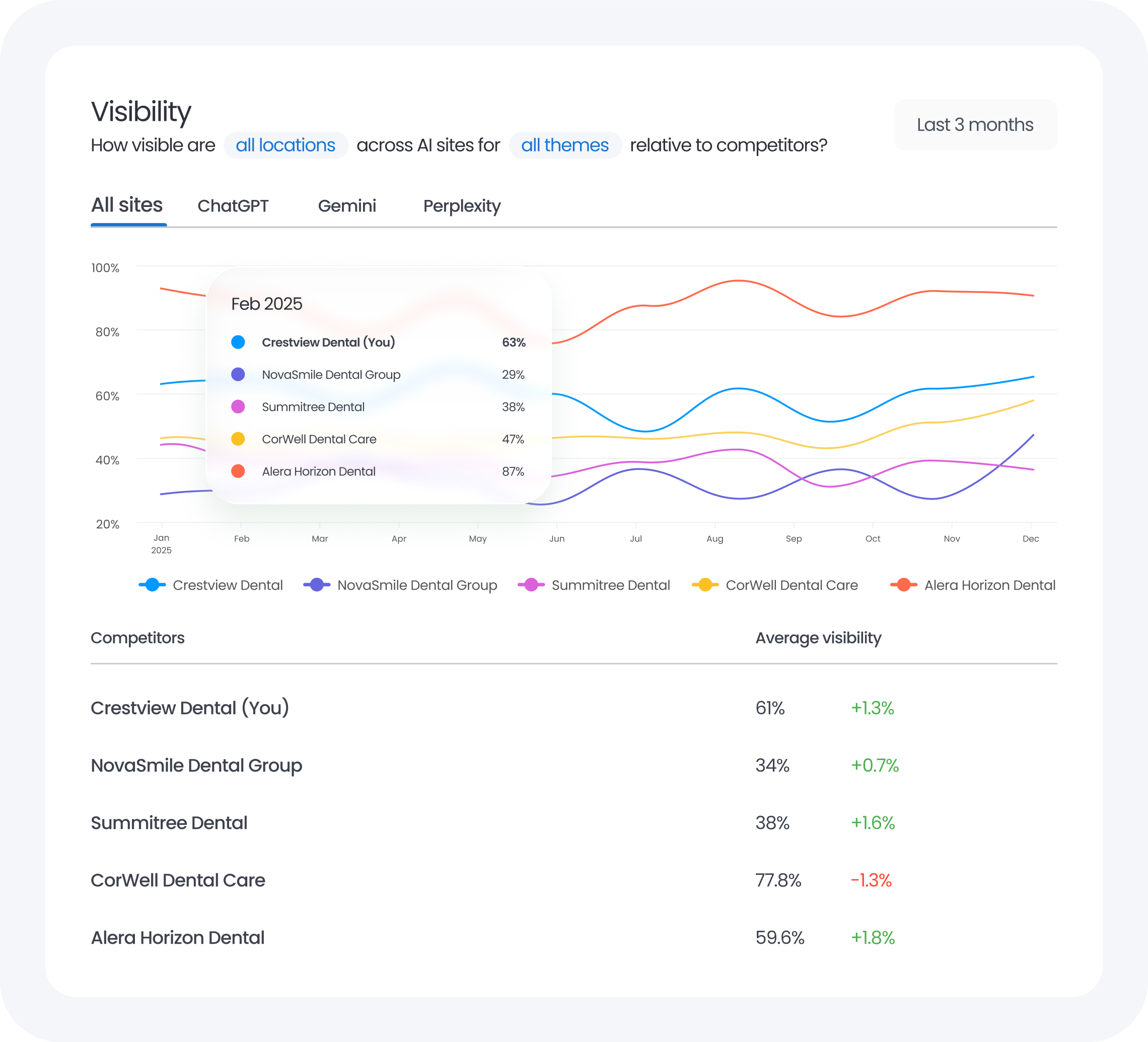
Purpose-built AEO platform: Birdeye Search AI goes beyond traditional SEO monitoring. It tracks brand visibility across ChatGPT, Gemini, Perplexity, and other answer engines, showing how AI systems describe your business and where representation needs improvement.
Share of Answer visibility: Instead of relying solely on keyword rankings, Birdeye measures how often your brand appears in AI-generated answers, giving teams a clearer signal of real discovery and influence.
Multi-location visibility scoring: Birdeye evaluates AI visibility at both brand and location levels, helping enterprise teams maintain consistency while identifying local gaps that impact performance.
Actionable BirdAI recommendations: Insights are paired with clear, prioritized actions. BirdAI tells teams what to fix, where to focus, and how to improve AI-driven discovery without guesswork.
Unified customer experience engine: Listings, reviews, social, messaging, and surveys operate together in one workspace, reducing tool sprawl and operational friction.
Centralized engagement: A single inbox for SMS, Google Messages, web chat, and social DMs ensures every customer inquiry is acknowledged, routed, and resolved.
Revenue-first outcomes: Birdeye connects visibility and engagement to measurable business impact, helping teams move from monitoring activity to driving growth.
Clear, predictable pricing: Straightforward packaging with transparent inclusions eliminates surprise costs and simplifies buying decisions.
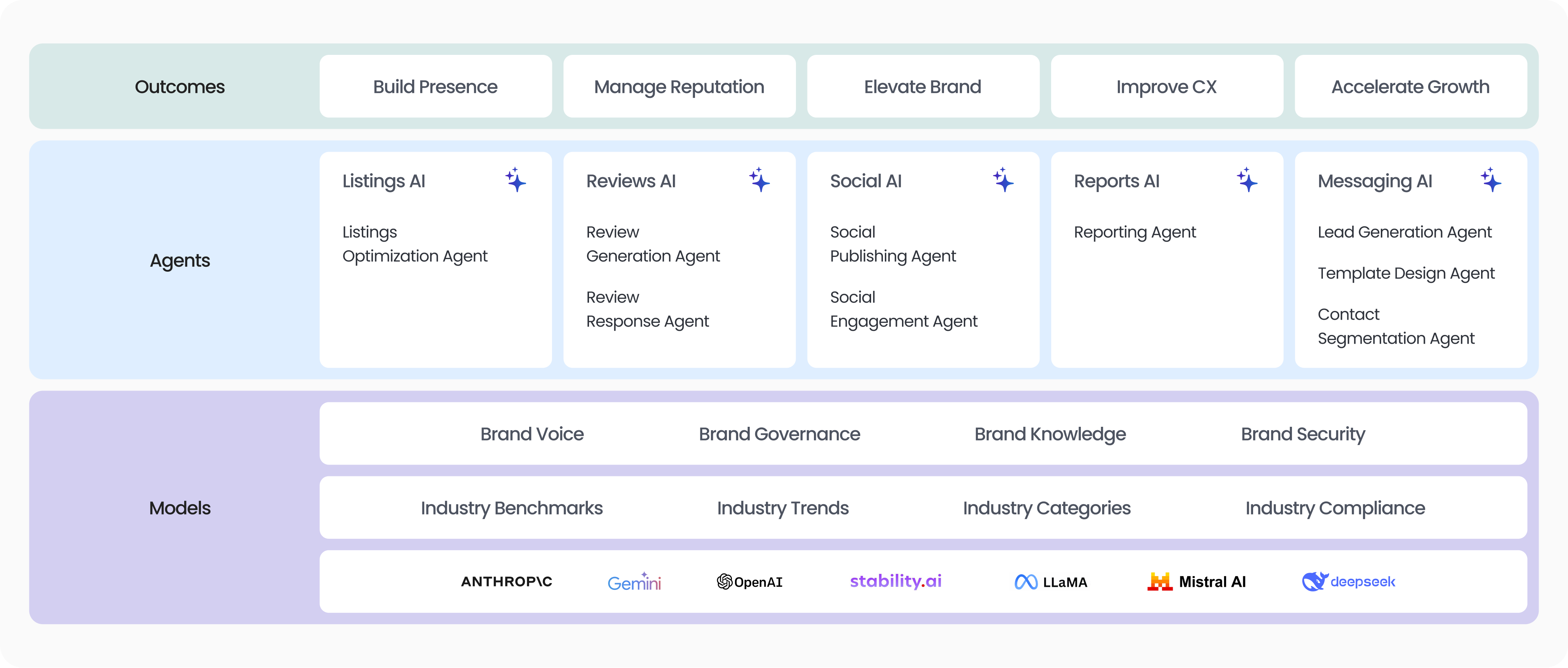
Birdeye AI agents
BirdAI agents function like a coordinated digital team, supporting brands globally.
Together, they keep businesses visible, trusted, and responsive across every AI discovery and engagement channel.
Pros
Birdeye Search AI takes action automatically, not just insights, so visibility issues get fixed without manual handoffs.
Built for multi-location scale, giving each location clear visibility, performance signals, and next steps.
Connects AI presence directly to factors teams can control, like reviews, listing accuracy, and content.
Birdeye Search AI closes the gap between finding a problem and fixing it by triggering updates across profiles, reviews, and content.
It reveals both customer demand and operational issues that shape how AI engines describe your brand.
Scales easily across dozens or thousands of locations without losing local detail or consistency.
Cons
Some specialized tools may require integrations. Open APIs and 3,000+ connectors typically address these needs quickly.
New users may need a short onboarding period, supported by guided training and an intuitive interface.
Awards and recognition
2025 BIG Awards for Business – New Product of the Year: Honored for Birdeye’s Agentic Marketing Platform, built to automate marketing at scale for multi-location brands.
G2 2025 Best Software Awards: Ranked #47 Best Software Product overall based on verified customer feedback.
G2 Category Leader – Online Reputation Management: Recognized as a category leader every quarter since Spring 2019, reflecting sustained customer trust and performance.
SoftwareReviews 2025 Data Quadrant Champion: Top-rated for service experience, product impact, and contract negotiation.
Globee® Business Awards – Silver Winner: Awarded in the Business-to-Business Products (Interactions) category.
B&T Awards: Official sponsor of the Marketing Team of the Year category, supporting marketing excellence.
Birdeye has been a key differentiator in our ability to scale and maintain a strong online presence. The automation and insights they provide have made a significant impact on our marketing and member experience strategy.- Elizabeth Short, Chartway Credit Union
Birdeye pricing
Birdeye pricing scales with your locations, reporting needs, and AI search goals. Plans are built around measurable outcomes like AI visibility, citation coverage, and Share of Answer, not feature overload. Connect with our team to receive a customized quote and clear recommendations on the features that fit your strategy.
Birdeye vs. Search Atlas: AI search and AEO feature comparison (2026)
Category
Birdeye
Search Atlas
Primary AI focus
AI visibility and AEO for multi-location brands
SEO automation with limited AI visibility
AI approach
Agentic AI that analyzes, executes, and improves AI discovery
AI automates SEO tasks and workflows
AI engine coverage
Optimizes visibility across ChatGPT, Gemini, Perplexity, and more
Limited LLM tracking, mostly reporting
AEO measurement
Native Share of Answer with brand- and location-level scoring
No Share of Answer or AEO scoring
Location-level visibility
Tracks AI discovery per location and intent
Domain-level insights, not location-first
Prompt and intent signals
Uses real user prompts grouped by semantic themes
Keyword-based analysis
Citation and data influence
Identifies sources and data signals shaping AI answers
Minimal citation insight
Unified AI execution signals
Connects AI visibility to listings, reviews, social, messaging, surveys, and competitors
SEO-only execution signals
Competitive AI presence
Measures competitor share in AI answers by theme and engine
Competitor data focused on SEO
Governance at scale
Brand and Industry AI enforce consistency automatically
Manual workflow controls
Best fit
Enterprises optimizing AI answers and multi-location discovery
Teams automating traditional SEO
2. Semrush
Best for: SEO teams and agencies focused on keyword strategy and competitive research.
Star Rating: 4.5/5 (G2), 4.7/5 (Capterra)
Key features
Keyword research and competitor analysis.
Content optimization and SEO reporting.
Site audits and rank tracking.
Pros
Large keyword and backlink databases.
Strong competitive intelligence tools.
Mature SEO reporting capabilities.
Cons
Limited AI answer visibility and AEO insights.
Not built for multi-location governance or AI discovery workflows.
Pricing and Value: Tiered subscription pricing; strong value for SEO execution, limited for AI-driven discovery.
3. Ahrefs
Best for: Technical SEO specialists and agencies focused on backlinks and site health.
Star Rating: 4.6/5 (G2), 4.7/5 (Capterra)
Key features
Backlink intelligence and analysis.
Site audits and keyword tracking.
Competitive SEO insights.
Pros
Industry-leading backlink data.
Reliable technical SEO analysis.
Trusted by advanced SEO teams.
Cons
Minimal AI-driven insights.
No AEO, GEO, or multi-location execution features.
Pricing and Value: Usage-based pricing; high value for link analysis, limited beyond technical SEO.
4. SE Ranking
Best for: SMBs and mid-market teams seeking affordable SEO tools.
Star Rating: 4.8/5 (G2), 4.9/5 (Capterra)
Key features
Rank tracking and site audits.
Basic keyword research.
Simple SEO reporting.
Pros
Easy to use and quick to adopt.
Competitive pricing for core SEO needs.
Cons
Basic AI capabilities only.
Not designed for enterprise or AI-first discovery.
Pricing and Value: Budget-friendly plans; good value for basic SEO, limited scalability.
5. Moz Pro
Best for: SMBs looking for straightforward SEO insights and metrics.
Star Rating: 4.2/5 (G2), 4.5/5 (Capterra)
Key features
Keyword tracking and domain authority metrics.
Site optimization and reporting.
Beginner-friendly SEO tools.
Pros
Simple interface and onboarding.
Clear, easy-to-understand metrics.
Cons
Limited automation and AI support.
No AEO, GEO, or AI answer monitoring.
Pricing and Value: Subscription-based pricing; suitable for entry-level SEO needs.
6. BrightLocal
Best for: Local SEO agencies and SMBs focused on listing accuracy.
Star Rating: 4.6/5 (G2), 4.8/5 (Capterra)
Key features
Citation building and cleanup.
Local rank tracking.
Google Business Profile audits.
Pros
Strong local SEO execution tools.
Affordable and easy to deploy.
Cons
Minimal AI capabilities.
Not suitable for enterprise-scale AI discovery.
Pricing and Value: Low-cost pricing; high value for local SEO tasks, narrow scope.
7. Similarweb
Best for: Enterprises focused on market, traffic, and competitor intelligence.
Star Rating: 4.4/5 (G2), 4.6/5 (Capterra)
Key features
Website traffic and audience insights.
Competitive benchmarking.
Market trend analysis.
Pros
Deep visibility into digital behavior.
Strong competitive and market-level insights.
Cons
No SEO or AEO execution capabilities.
Complements, but does not replace, SEO platforms.
Pricing and Value
Premium enterprise pricing; high value for intelligence, not execution.
Why Birdeye is the enterprise choice among Search Atlas alternatives
Enterprise teams evaluating Search Atlas alternatives need a platform that unifies AI visibility, execution, governance, and reporting across every location. Birdeye meets that requirement by design.
While many Search Atlas competitors focus on optimizing pages and tracking rankings, Birdeye focuses on how brands actually get discovered in 2026. With Search AI, Birdeye shows how your brand appears across ChatGPT, Gemini, and Perplexity, which sources AI engines trust, and where inaccuracies weaken credibility at the location level.
This is where Birdeye clearly separates from the best alternatives to Search Atlas:
Visibility into AI-generated answers, not just SERPs.
Prompt-level insights into citations, sentiment, and accuracy.
Location-aware analysis to detect inconsistencies at scale.
Clear recommendations to improve AEO and GEO performance.
Birdeye also eliminates operational fragmentation. Listing accuracy, review generation and responses, social publishing, messaging, surveys, and insights all live in one governed workspace. For multi-location brands, this consolidation reduces handoffs, lowers risk, and gives leaders a consistent view of performance across regions and brands.
Enterprise teams choose Birdeye because it supports execution, not just insight:
One unified platform instead of stitched-together tools.
Role-based access, approvals, and audit trails for governance.
Executive-ready reporting tied to outcomes, not vanity metrics.
What truly differentiates Birdeye among Search Atlas alternatives in 2026 is execution at scale. BirdAI agents do more than assist. They plan, draft, route, analyze, and report across channels while enforcing brand and industry rules.
Birdeye AI enables teams to:
Automate review requests and compliant responses.
Publish and optimize multi-location social content.
Route and respond to customer messages instantly.
Translate feedback and performance data into clear next steps.
Enterprise buyers also choose Birdeye for reliability and long-term fit. With SOC 2–aligned operations, role-based controls, audit trails, and 3,000+ integrations, Birdeye supports mission-critical workflows without custom builds or fragile workarounds.
For organizations moving beyond rankings toward AI-first discovery, Birdeye delivers what most Search Atlas competitors cannot: AI answer visibility, unified execution, and enterprise-grade governance in one platform. That combination makes Birdeye the most future-ready choice for multi-location growth.
How to choose the right Search Atlas alternative
As AI reshapes how customers discover brands, marketing leaders and SEO specialists need platforms that support visibility, accuracy, and scale across every location.
Use the framework below to evaluate Search Atlas competitors that reflect real-world operating needs in 2026.
1. Prioritize AI discovery, not just SEO outputs
The best alternatives to Search Atlas help you understand how AI assistants describe, cite, and recommend your brand. Ask vendors to show visibility across ChatGPT, Gemini, and Perplexity, including citation sources, sentiment, and location-level accuracy. Rankings alone no longer tell the full story.
2. Demand AEO and GEO insight at scale
In 2026, AEO and GEO are foundational. Look for platforms that reveal how answers differ by location, surface inconsistencies quickly, and provide clear recommendations to correct them across hundreds or thousands of sites.
3. Operate from a unified platform
Avoid stacking tools to fill gaps. Strong Search Atlas alternatives centralize listings, reputation, engagement, analytics, and AI insights in one workspace. A single command center reduces errors, shortens response times, and improves executive visibility.
4. Make AI prove its value
Do not settle for “AI-assisted” features. Ask vendors to demonstrate how AI plans actions, drafts responses, routes conversations, analyzes changes, and explains results. The most effective Search Atlas competitors reduce manual work instead of adding new dashboards.
5. Validate reliability and support quality
Stability matters when tools sit at the core of discovery. Review uptime, escalation processes, and real customer sentiment. Many teams leave Search Atlas due to reliability and support gaps, so evaluate how alternatives perform under real operational pressure.
6. Insist on executive-ready reporting
Leaders need answers, not raw data. The best alternatives to Search Atlas deliver reporting that explains what changed, why it matters, and what action to take next, with rollups by brand, region, and location.
7. Evaluate the total cost of ownership
Compare pricing beyond the headline number. Some Search Atlas alternatives reduce costs by consolidating SEO, AI visibility, and engagement into a single platform, while others require add-ons as needs expand. Look for predictable pricing aligned to outcomes.
8. Look for proof, not promises
Finally, weigh independent recognition, customer reviews, and long-term performance. Consistent results over multiple years matter more than one-time awards when choosing among Search Atlas competitors.
When teams apply this approach, the gap between traditional SEO tools and AI-first platforms becomes clear. The strongest Search Atlas alternatives in 2026 help brands stay accurate, visible, and trusted wherever customers search, including inside AI-generated answers.
Migration checklist: How to switch from Search Atlas to Birdeye in 5 simple steps
Moving from Search Atlas to Birdeye is straightforward, organized, and fully guided. Birdeye’s onboarding team manages the transition so your marketing and SEO teams can stay focused on performance, not platform logistics.
A simple 5-step migration
Plan: Assess your current Search Atlas configuration, including active features, integrations, and data sources. Define what you want to migrate, your rollout timeline, and which Birdeye modules you’ll activate first.
Export: Collect the essential data from Search Atlas, such as locations, users, connected properties, SEO insights, and historical benchmarks needed for continuity.
Import: Birdeye’s onboarding specialists securely map and load your data into the appropriate modules, including Listings, Reviews, Search AI, Social, Messaging, and Insights.
Connect: Reconnect your core systems and channels, such as CRM, CMS, analytics tools, Google Business Profile, social accounts, and website touchpoints. Activate automations so workflows begin running immediately.
Go live: Validate data accuracy, train users, and launch across all locations with Birdeye experts supporting every stage of rollout.
Why the move to Birdeye feels easier
Guided migration with zero disruption: Birdeye provides hands-on onboarding to securely transition your data from Search Atlas while keeping systems live and intact throughout the switch.
One unified platform, fewer tools: Replace fragmented SEO workflows with a single workspace that brings together listings, reviews, social, surveys, messaging, and AI search visibility.
Stronger customer validation on G2: Birdeye earns a higher overall G2 rating at 4.7/5 from 3,712 reviews, compared to Search Atlas’s smaller review footprint and lower aggregate score (4.6/5 from 101 reviews).
Faster, easier setup: Independent G2 reviewers consistently rate Birdeye higher for Ease of Setup (9.1 vs 7.6), reflecting quicker onboarding and less operational friction for teams.
The result: Your locations, teams, and discovery workflows come together in one platform built for AI-first visibility, strong integrations, and executive-ready reporting, without the friction that often comes with platform changes.
Birdeye has really made a difference for our business. It's easy to use, and our team got the hang of it quickly with minimal training. Setting it up was very easy, and their support team is always available to answer our questions and guide us through the process. We use it every day, mainly for managing reviews and messaging customers, and it's full of features that actually make our jobs easier. It also works smoothly with our existing systems, so everything works together without any headaches. Overall, it’s been a great tool for staying connected with our customers.-Lesly B. Verified G2 review
FAQs: Birdeye vs. Search Atlas
1. What are the best Search Atlas alternatives in 2026?
The best Search Atlas alternatives in 2026 include Birdeye, Semrush, Ahrefs, SE Ranking, Moz Pro, BrightLocal, and Similarweb. Birdeye leads for multi-location brands because it combines AI search visibility, AEO insights, and enterprise execution in one platform.
2. How is Birdeye different from Search Atlas?
In a Birdeye vs Search Atlas comparison, the key difference is focus. Search Atlas supports traditional SEO tasks, while Birdeye shows how brands appear in AI-generated answers across ChatGPT, Gemini, and Perplexity.
3. Does Search Atlas support AI search visibility and AEO?
Search Atlas offers limited AI visibility. It does not clearly show how AI assistants describe a brand, which sources they cite, or how answers vary by location. Birdeye fills this gap with Search AI.
4. Why are companies replacing Search Atlas?
Companies are replacing Search Atlas due to platform reliability concerns, limited AEO and GEO insights, fragmented workflows, and a need for better AI-first discovery tools.
5. Which AI visibility platform is better for multi-location brands?
Birdeye is better for multi-location brands because it provides location-level AI visibility, governance controls, and unified workflows across listings, reviews, and engagement.
6. Can Birdeye replace SEO and reputation tools?
Yes. Birdeye replaces multiple tools by combining listings, reviews, social, messaging, surveys, insights, and AI search visibility in one platform.
7. How does Birdeye help with AI-generated answers?
Birdeye Search AI tracks how brands appear in AI answers, monitors citations and sentiment, and identifies accuracy issues across locations.
8. Is it hard to migrate from Search Atlas to Birdeye?
No. Migrating from Search Atlas to Birdeye is structured and supported, with guided onboarding and minimal downtime.
9. Which tool is best for AI-first discovery?
For AI-first discovery, Birdeye is the stronger option. It provides prompt-level AI visibility and actionable AEO insights, which traditional SEO platforms lack.
10. Is Birdeye an enterprise-grade alternative to Search Atlas?
Yes. Birdeye is built for enterprise use, offering scalability, governance, integrations, and executive-ready reporting.
When AI discovery, listings, and engagement matter, enterprises choose Birdeye
While Search Atlas focuses on SEO workflows and site optimization, Birdeye delivers unified execution across listings, reviews, social, messaging, surveys, and AI-driven discovery. On third-party review platforms, this difference shows up consistently in user satisfaction.
G2 scorecard (Birdeye vs Search Atlas)
Ease of use: 9.3 vs 7.4
Ease of setup: 9.1 vs 7.6
Ease of admin: 9.3 vs 6.7
Quality of support: 9.4 vs 7.5
Proven business support: 9.4 vs 4.3
Birdeye brings the entire customer and discovery journey into one platform. Teams manage listing accuracy, generate and respond to reviews, publish and engage on social, handle customer messages, collect feedback, and gain AI-ready insights without switching tools.
If your organization needs a faster rollout, clearer AI visibility, stronger governance, and a single place to run daily marketing and customer engagement work, Birdeye is built for that scale.
Ready to move beyond Search Atlas?
Request a demo to see how Birdeye helps your brand stay visible, accurate, and trusted across every location.
Disclaimer: The content on this page is based on research compiled from publicly available information. Birdeye does not warrant the completeness or correctness of the information and cannot be held liable for its use.
Start growing with Birdeye today
See what makes Birdeye the clear choice for today's leading enterprises. Get a firsthand look at the capabilities of the all-in-one Birdeye Platform.