Yext Scout helps brands monitor how they show up across AI search platforms like ChatGPT, Gemini, Perplexity, Grok, and Google, with hyper-local benchmarking and optimization tips inside the Yext ecosystem. But many multi-location and enterprise teams now need deeper Share of Answer insight, richer citation tracking, and more actionable AEO (Answer Engine Optimization) recommendations than Scout alone can provide.
This guide explores the best Yext Scout alternatives for 2026 and why Birdeye Search AI stands out as the most complete, enterprise-ready AI search visibility solution.
I love how Yext makes it easy to reply to reviews across platforms like Google Business, BBB, and Yelp. The AI software is great at reviewing the verbiage from the initial participant and crafting a dynamic response while also informing us where the review originated and who it is from.– Domonique M., Assistant Community Manager 4/5, Verified G2 reviewer
7 Reasons why you might need a Yext Scout alternative
While Yext Scout offers a helpful entry point for brands already using the Yext Knowledge Graph, its current architecture has specific limitations for teams prioritizing a dedicated AI search strategy. Based on Yext’s own support documentation and the current state of AEO, here are seven reasons why enterprise teams are looking for alternatives.
The limitations below summarize the most common reasons teams consider Yext Scout as an alternative.
1. Hybrid focus dilutes AI-specific strategy
Yext Scout is a hybrid solution that mixes traditional Google search rankings with AI platform results. For businesses that want a dedicated AI-first strategy, this "all-in-one" view can be counterproductive. If your goal is to isolate and dominate performance on LLMs like ChatGPT, Gemini, or Perplexity, a hybrid tool can clutter your data, making it difficult to extract pure AI visibility metrics.
We didn't see our business on Yahoo map anymore like it used to be for 13 years. Yahoo directed us to Yext. We got talked into subscribing. We told them what we wanted. We filled out everything they asked. They told us it would take 30 days to see our business on the map and other things to match up. After about a month, we did finally see our business there. Problem is, it didn't last. I think it lasted a total of 2 months, we even kept our Yext info site and acct updated for months following and still nothing.– Holly G. 0/5, Verified G2 reviewer
2. Over-reliance on "ranking" in a non-linear AI world
Scout’s reporting places heavy emphasis on traditional "ranking" (1–10). However, AI engines do not always return ranked lists. Often, an LLM provides a single authoritative paragraph or a narrative summary. Relying on "rank" metrics fails to capture the true Share of Answer—how often your brand is the only answer provided versus being buried in a list of competitors.
Lately there has been a shift where it is more difficult to reach support and get our answers. It feels there has been a lot of shifting in Yext and our account reps were changing often. We need additional support and help for the amount we pay. 2/5, Verified G2 review
3. Diagnostic-only: No content generation for citations
A major gap in Yext Scout is its inability to generate the content required to improve visibility. While it can suggest review or listing fixes, it offers no agentic content generation capabilities to create the blog posts, FAQs, or landing page copy needed to increase your website's citation share. It identifies the "what" but lacks the "how" to actually fix on-site AEO gaps.
I am sometimes bothered that I cannot see the changes I have made in the Knowledge Graph reflected in our listings (e.g., adding a video or pictures).– Riley W., Digital Marketing Specialist 3/5, Verified G2 reviewer
4. Beta status limits enterprise maturity
As of March 2026, Yext’s support documentation still classifies Scout as a Beta product. For mature enterprise organizations that require stable, battle-tested reporting, high-uptime SLAs, and a finalized feature set, a beta-stage tool introduces unnecessary risk. Businesses looking for a platform that is fully integrated and out of "testing mode" often find Birdeye a more reliable partner.
Like any platform of this type, Yext's portfolio of linked sites includes some relatively low-quality options (e.g., listing sites that aren't applicable to most industries). We had to make a platform change simply because things changed at our agency, and we could no longer justify the cost.– Gregory J., Associate Director of Digital Advertising 1/5, Verified G2 reviewer
5. Complex setup for non-Yext customers
The barrier to entry for Yext Scout is high. If your business doesn't already use Yext for Listings or Reviews, the setup process is notoriously complex. Scout is built as a feature of the Yext ecosystem rather than a flexible, standalone tool. This makes it a heavy, expensive lift for teams that want AI visibility insights without migrating their entire digital presence management to Yext.
Unfortunately, we were not a fan of this product. The business I work for used this to try to make all of our website presence cohesive. It definitely did what it said; however, as soon as we stopped actively using the product, we got call after call about our address not matching on Google Maps. It was extremely frustrating and seemed like the two things were related.– Chelsea W., Marketing & Account Manager 1.5/5, Verified G2 reviewer
6. Limited source-level transparency
While Yext Scout incorporates Google Business Profile data and schema health, it provides fewer controls for analyzing specific third-party URLs. Modern AEO requires knowing exactly which domains and citations AI engines are "reading" to form their narratives. Without deep, source-level intelligence, marketing teams cannot effectively influence the external sites that shape their brand's AI persona.
Yext seems to have a monopoly on this system. When Yext came about, you could no longer individually update a business' address, info, etc... you had to "pay to play" so to speak. I also am not a fan of the 2 week lag in reporting and somewhat confusing dashboard.– Sally B., Digital Marketing Manager 3/5, Verified G2 reviewer
7. Insights-focused rather than execution-ready
Yext Scout functions primarily as an intelligence engine—it shows you the problem, but it doesn't solve it. The actual execution (updating profiles, launching campaigns, or adjusting content) depends on manual coordination across other Yext products or external tools. Teams looking for an agentic marketing platform that identifies a gap and automatically deploys a fix across listings, reviews, and social channels will find Scout's manual workflow limiting.
They have you at a disadvantage, and they know it. They don't do a lot of SEO the 'right' way and just shortcut by feeding directly into search engine APIs. But this means if you ever stop working with them, your progress instantly vanishes.– Paul N., Director of Marketing 3/5, Verified G2 reviewer
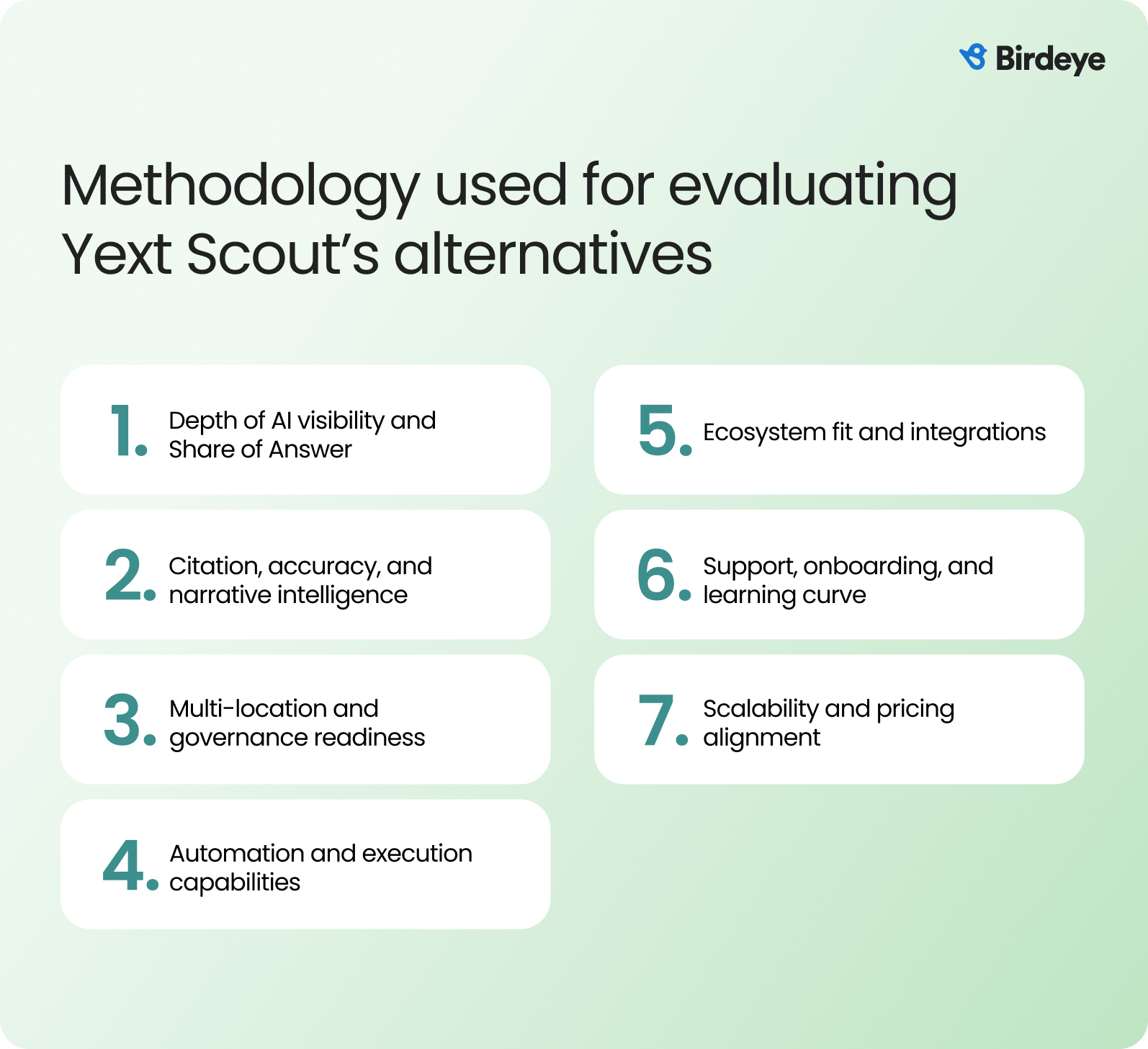
Methodology used for evaluating Yext Scout’s alternatives
Selecting the right Yext Scout alternative means looking beyond surface-level dashboards and asking how each platform will support AI visibility and AEO over the next several years. The criteria below were used to identify tools that are both stronger than Yext Scout in key areas and realistic fits for multi-location brands.
Depth of AI visibility and Share of Answer
Yext Scout tracks how often brands appear in AI platforms like ChatGPT, Gemini, Perplexity, and Grok, primarily through category-based scans and hyperlocal competitive benchmarks.
Alternatives were evaluated on whether they provide additional granularity, such as Share of Answer percentages, prompt-level theme tracking, and engine-specific performance trends that help teams understand not just presence but dominance across queries.
Citation, accuracy, and narrative intelligence
Yext Scout considers Google Business Profile data, schema markup, and listings health, but offers less visibility into which specific domains, URLs, and content types AI engines cite most frequently.
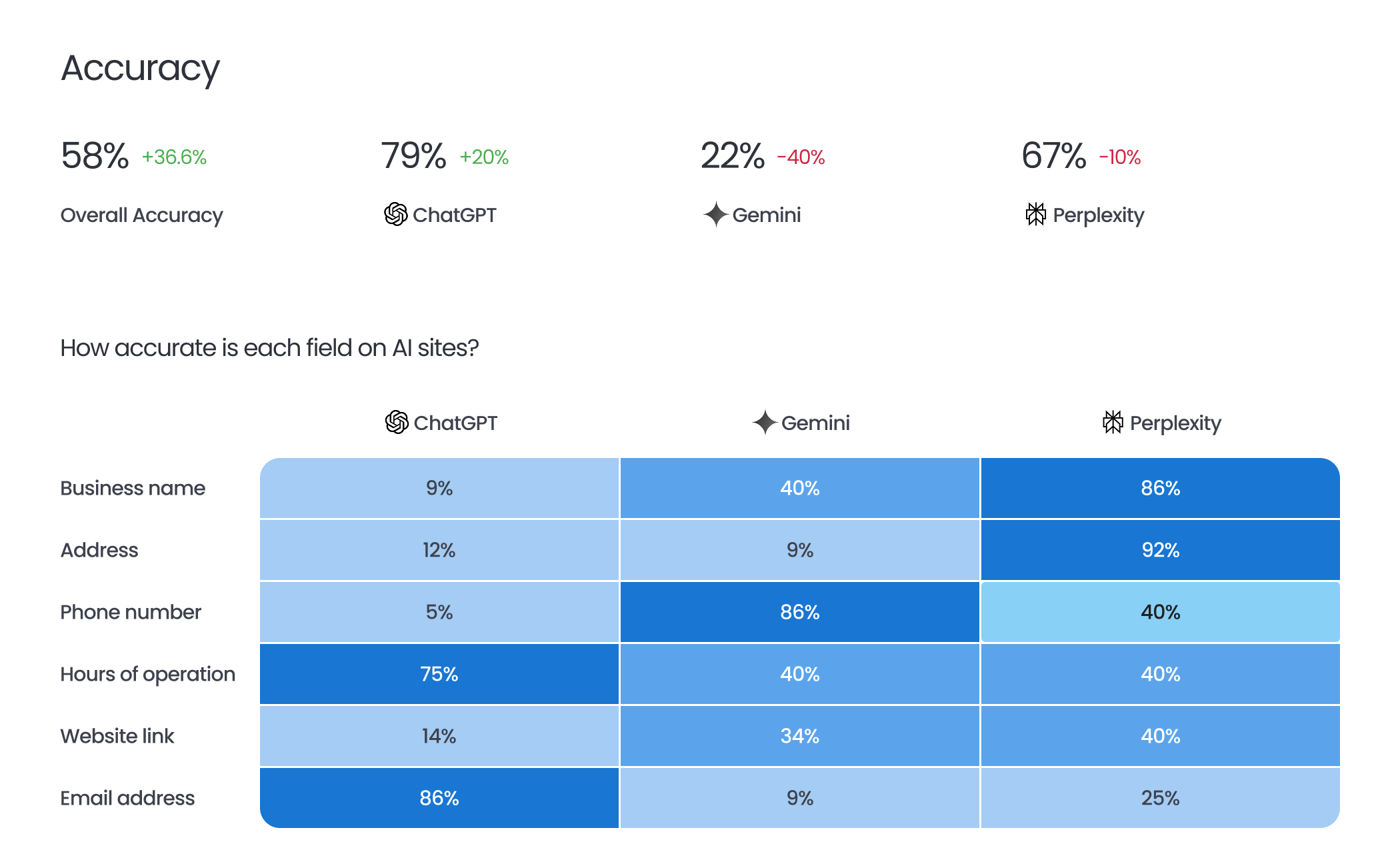
Each alternative was assessed on how clearly it maps citation sources, scores business data accuracy across fields like hours and phone numbers, and surfaces AI-generated narratives about brand strengths, weaknesses, and sentiment.
Multi-location and governance readiness
Yext Scout provides hyperlocal competitive benchmarking and shows which nearby brands are winning, but its reporting model is anchored to the Yext platform's location structure.
Alternatives were reviewed for their ability to support complex location hierarchies, role-based access for corporate and regional teams, and per-location diagnostics that work independently of a single listings vendor.
Automation and execution capabilities
Yext Scout delivers clear optimization recommendations, but acting on them depends on how teams use other Yext products and external tools in their stack. Each platform was compared on whether it can help execute changes directly, such as updating profiles, launching review campaigns, or pushing content improvements, rather than leaving execution entirely to separate systems.
Ecosystem fit and integrations
Yext Scout is tightly integrated with the broader Yext platform, which is powerful when Yext is already the system of record for location data and pages. Alternatives were assessed for their ability to connect with a wider range of CRM, marketing automation, CX, analytics, and data warehouse tools, so that AI visibility can be tied to leads, revenue, and customer outcomes across different technology stacks.
Support, onboarding, and learning curve
Yext Scout benefits from Yext's established enterprise support model, but its functionality is still evolving, with features like custom keyword tracking and expanded data sources on the roadmap. Each alternative was evaluated on the maturity of its onboarding resources, the quality of its training, and how quickly non-technical marketing and SEO teams can become productive with the platform.
Scalability and pricing alignment
Yext Scout is bundled with the broader Yext platform and priced per location, which makes sense for brands already invested in Yext's ecosystem.Alternatives were compared on how transparently their pricing and feature tiers scale with additional locations, AI engines, and team members, and whether they remain cost-effective as AI visibility programs grow beyond initial pilots.
Top Yext Scout alternatives at a glance
Here are 7 leading Yext Scout alternatives for 2026, with Birdeye Search AI as the recommended pick for most multi-location and enterprise brands.
Platform
Best for
Core strengths
AI features and engines
Pricing
Birdeye Search AI (Recommended)
Multi location and enterprise brands
Unified AI visibility with reviews, listings, NAP, messaging, social, and surveys in one agentic platform.
Tracks leading AI search platforms like Gemini, ChatGPT, Perplexity, and more, with location-level visibility, rankings, sentiment, citations, and accuracy scoring.
Custom, scalable plans based on locations and modules.
Profound
Enterprise AEO specialists, B2B SaaS, large brands
Deep AI visibility with Answer Engine Insights, Agent Analytics, Prompt Volumes, and AEO content workflows.
Up to 10 engines on Enterprise, strong prompt and citation analytics, plus log-based crawler insights.
Tiered: Starter, Growth, Enterprise with custom terms.
Otterly AI
Budget-conscious teams starting with AEO
Affordable AI visibility tracking with daily monitoring across key engines, visual dashboards, and competitor benchmarking.
Tracks ChatGPT, Perplexity, Google AI Overviews, Gemini, Copilot, plus add-ons for additional platforms.
Starting at $29 per month, scales to $489 per month for Premium plans.
Search Atlas
Agencies and SEO teams needing automation
LLM Visibility tool integrated with OTTO SEO agent for automated optimization, tracks AI and traditional search performance.
Tracks ChatGPT, Claude, Gemini, Perplexity, Grok, Copilot, and includes visibility, sentiment, and share of voice dashboards.
Tiered plans, part of the broader Search Atlas SEO suite, offer custom enterprise pricing.
Peec AI
Global brands needing multilingual coverage
Industry-leading 115-plus language support with competitive benchmarking at the entry tier, accessible pricing for regional teams.
Tracks ChatGPT, Perplexity, AI Overviews, Claude, Gemini, DeepSeek, Grok, Llama, 3 platforms at base tier.
Starting at Starter $95 per month and Advanced $495.
Nightwatch
SEO teams adding AI visibility to existing workflows
Unified traditional SEO rank tracking plus AI and LLM visibility, 15 plus AI engines tracked with prompt-level focus.
Tracks ChatGPT, Claude, Gemini, Perplexity, includes sentiment analysis, share of voice, and citation tracking.
Tiered plans starting at mid-market rates scale to millions of keywords.
Scrunch AI
Brand perception management and journey mapping
Focuses on how AI portrays brands through hallucination detection, knowledge hub features, and journey mapping from discovery to decision.
Tracks ChatGPT, Perplexity, Meta AI, Claude, Gemini, maps user paths, and competitive positioning.
Pricing starts from $250/month (Core) for 125 prompts.
*Pricing is indicative and varies by seats, locations, and feature mix.
Top 7 Yext Scout alternatives: (detailed reviews)
1. Birdeye Search AI (Recommended)
Birdeye Search AI is built for multi-location and enterprise brands that want a single, agentic marketing platform to understand AI visibility and take action to fix listings and reviews across locations.
Star Ratings:
G2: 4.7/5 (3,700+ reviews)
Capterra: 4.7/5 (700+ reviews)
Standout features
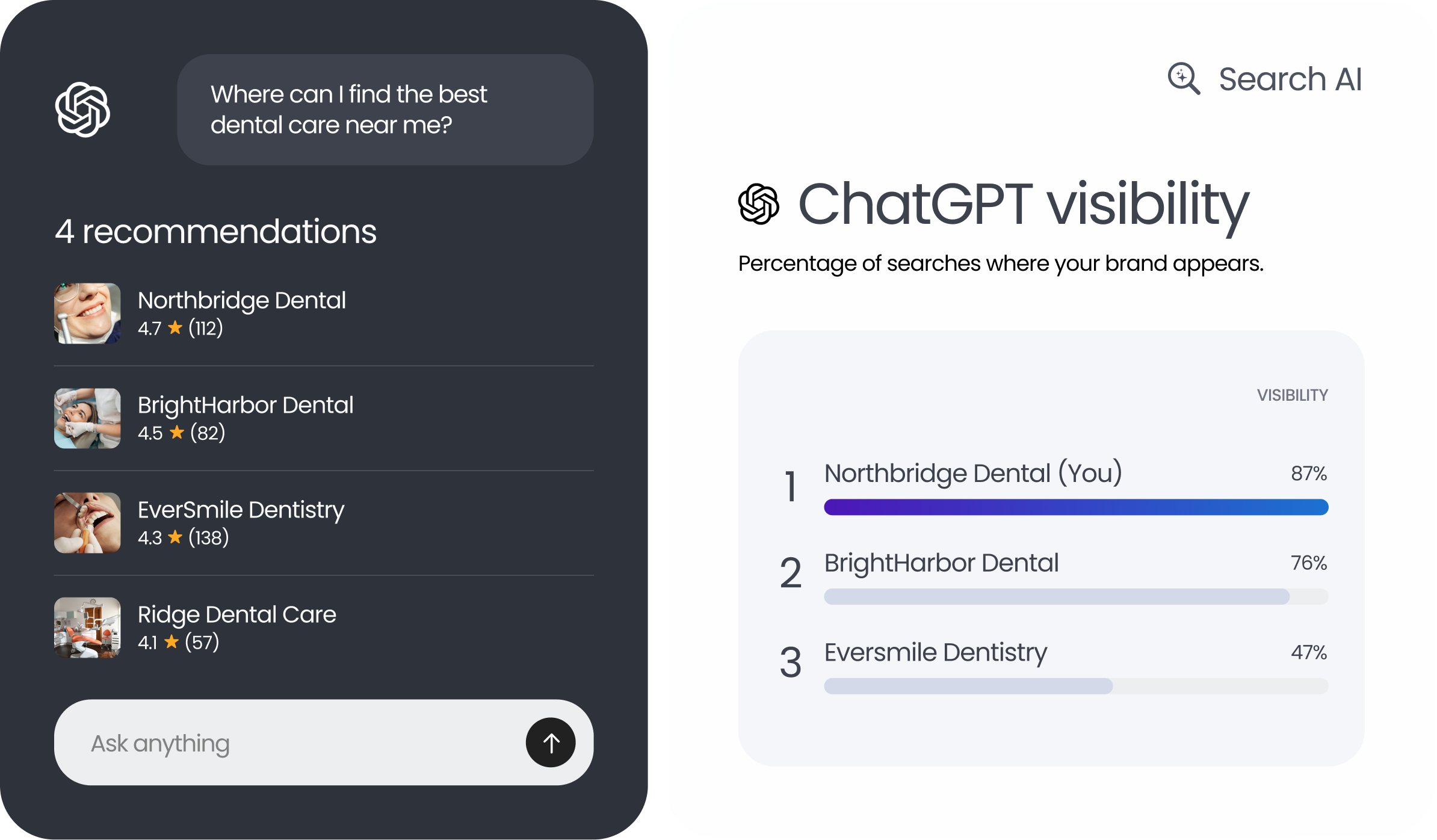
Unlike Yext Scout's category-based brand scanning, Birdeye Search AI delivers visibility diagnostics at the individual location level, showing which specific store or clinic appears in ChatGPT, Gemini, Perplexity, and other AI platforms, along with the customer intents for which it appears. The platform goes deeper by mapping real user prompts into semantic themes, tracking how each location ranks for those themes across engines, and pinpointing exactly which citation sources and business data fields are helping or hurting visibility.
Per location AI discovery tracking: Measure visibility, rankings, and competitive standing at each address, not just aggregate brand metrics.
Real prompt analysis from AI interactions: Uncover the actual questions customers ask across ChatGPT, Gemini, Perplexity, broken into searchable themes.
Share of voice by theme and engine: See which topics your locations dominate, which ones lag, and how performance shifts across different AI platforms.
Brand narrative and sentiment tracking: Understand how AI engines characterize your business, including reputation strengths and operational weak spots thatinfluence answers.
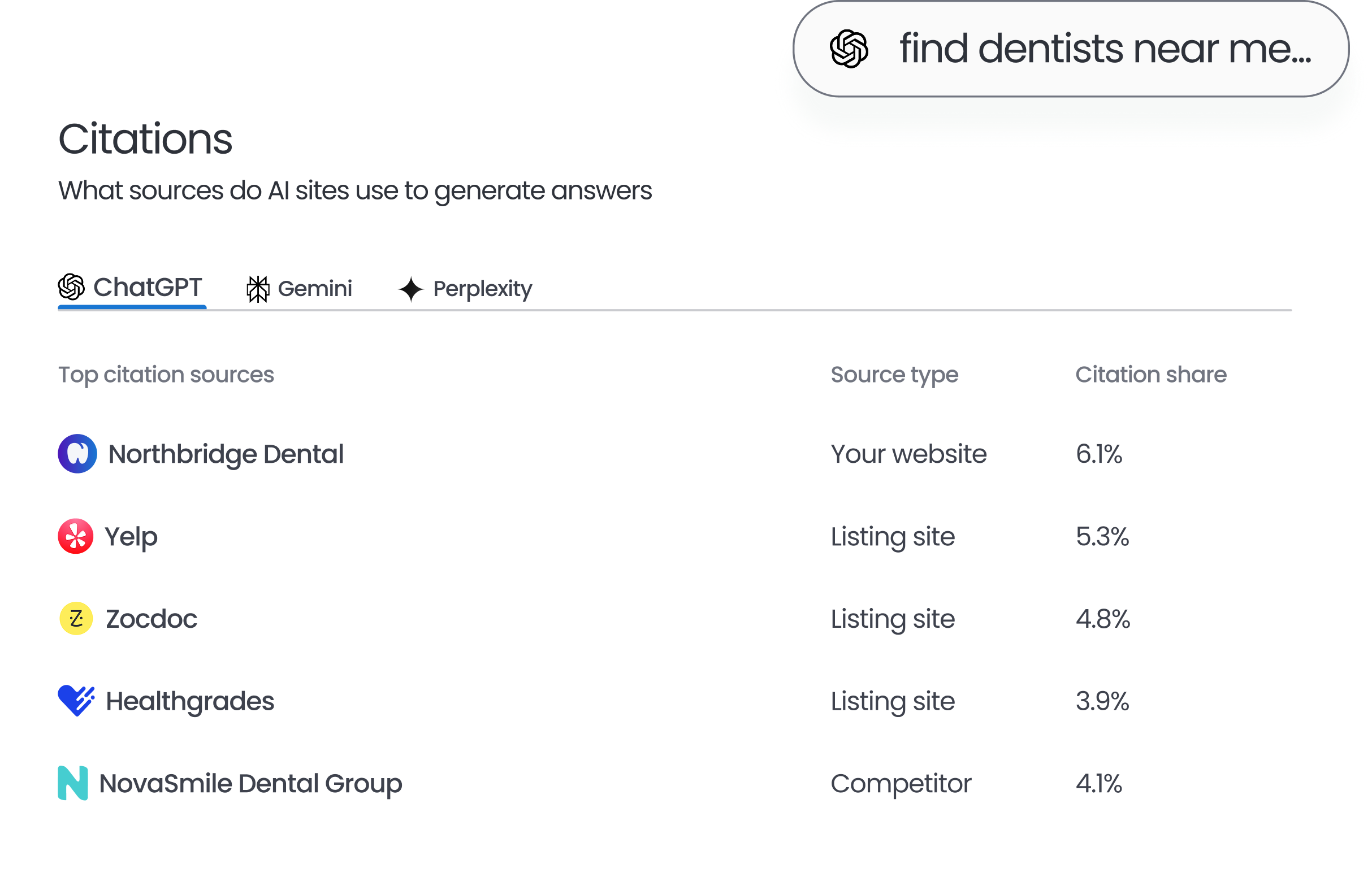
Citation source mapping and data quality audits: Identify which websites AI relies on most, then spot missing or incorrect business data that blocks visibility.
Actionable, prioritized improvement roadmap: Receive a per-location action list ranked by impact so teams know exactly what to fix and why.
Integrated CX execution: Connect every AI insight to reviews, listings, NAP updates, content, and social, all within one platform.
Agentic marketing advantage
Birdeye Search AI is not a dashboarding tool that stops at recommendations; it is part of an agentic system that acts on what it finds. When the platform identifies that a location has outdated hours in AI's view, or that a competitor's positive reviews are boosting their AI presence, Birdeye agent can immediately push corrections to business profiles, trigger review-generation campaigns, or publish content improvements, all without requiring manual coordination between teams.
Pros
Purpose-built for franchise and multi-location operations, with per-location visibility, rankings, sentiment, and roadmaps.
Shows the exact link between AI visibility and controllable factors such as reviews, business data accuracy, and content quality.
Reduces the operational lag between discovering a visibility issue and deploying fixes through automated, coordinated actions across the Birdeye suite.
Surfaces both marketing insights, such as prompt demand and operational insights, and recurring complaints that shape AI narratives.
Handles enterprise scale, supporting brands with dozens to thousands of locations without fragmenting reporting or losing local context.
Cons
Most suited to brands that view AI visibility and customer experience as an interdependent strategy; not very suitable for smaller teams seeking only a reporting dashboard.
Unlocking full ROI typically means adopting other Birdeye products for reviews, listings, and messaging, which requires some organizational consolidation.
Awards and recognition
G2 2025: #1 in "Reputation and Customer Experience Management"
Forbes Advisor: "Best AI Marketing Platform for Multi-location Brands."
Capterra: "Leader in Reviews, Messaging, and Social Integration 2025"
Google Premier Partner Program: Recognized for enhancing brands' local search performance.
Pricing and value: offers flexible, location-based pricing that scales with the number of sites and AI modules activated. Custom enterprise quotes are available for large brands.
Birdeye Search AI vs Yext Scout
Category
Birdeye Search AI
Yext Scout
Core focus
AI visibility plus execution tied to reviews, listings, NAP, social, and messaging in one agentic platform.
Brand intelligence engine integrated into the Yext platform, focused on AI and traditional search visibility with hyperlocal competitive benchmarks.
Primary users
Multi-location and enterprise brands that need location-level insights and automated CX plus AEO fixes.
Marketing and SEO teams already using Yext for listings and pages, wanting to add AI search visibility to existing workflows.
Visibility granularity
Brand- and location-level visibility, rankings, sentiment, citations, and recommendations per address.
Primarily brand and category level scanning with location-specific competitive benchmarking in local markets.
Prompts and themes
Groups real customer prompts into semantic themes by location and competitor, with demand pattern insights.
Scans based on the primary Google Business Profile category, with custom keyword tracking on the roadmap.
Sentiment and narrative
Analyzes how AI platforms describe the brand, and links it directly to CX levers such as reviews, ops, and content.
Shows how AI platforms see and summarize the brand, with optimization recommendations to improve visibility and sentiment.
Citations and data accuracy
Maps specific citation sources and business data accuracy by field, then routes fixes through Listings AI and Reviews AI.
Considers Google Business Profile data, schema markup, and listings health as inputs to AI visibility.
Automation model
Agentic marketing: AI agents update listings, launch review campaigns, and publish content based on Search AI insights.
Insight-driven, surfaces prioritized recommendations, but execution depends on how teams use other Yext tools or external systems.
CX stack integration
Natively integrated with reviews, messaging, surveys, social, and listings inside one platform.
Tightly integrated with the Yext ecosystem, such as Knowledge Graph, pages, listings, and reviews, if using Yext CX products.
Multi location readiness
Designed for multi-location with per-location filters, local rankings, and location-specific action roadmaps.
Provides hyperlocal competitive analysis showing which nearby brands win, anchored to Yext location data structure.
Engine coverage
Tracks leading AI search platforms such as Gemini, ChatGPT, Perplexity, and more with ongoing expansion.
Tracks ChatGPT, Gemini, Perplexity, Grok, and traditional Google search in a unified view.
Traditional search coverage
Primarily focused on AI visibility, with traditional SEO and local presence managed through broader Birdeye tools.
Combines AI search and traditional Google search visibility in one intelligence layer.
Category and keyword flexibility
Supports flexible theme and prompt tracking across multiple intents and categories.
Currently scans based on primary GBP category, with plans to add custom keyword and additional category tracking.
Content workflows
Uses insights to inform FAQs, page updates, and profile content, then pushes changes via connected Birdeye modules.
Delivers optimization recommendations to improve visibility, with execution handled in Yext Pages or external content systems.
Best fit
Brands wanting AI visibility, CX levers, and automation under one roof for faster, location-level AEO impact.
Teams already invested in Yext who want to layer AI search intelligence on top of their existing listings and pages foundation.
Birdeye is a valued partner for our business listings consistency and integrations. Their Listings AI, Social AI, and Reviews AI are integral to our overall marketing and brand strategy. The team is professional, and the support is best-in-class! The dashboard is easy to navigate, and our implementation and integration were seamless. Our team utilizes Birdeye daily for our social strategy and reputation management. Highly Recommended!– Patti M., Vice President of Marketing 5/5, Verified G2 reviewer
Why Birdeye stands out
Birdeye Search AI closes the gap between measurement and action that haunts most Yext Scout alternatives. While competitors show you where you rank or whether you appear, Birdeye connects those visibility gaps directly to the reviews, data, and content you control, then deploys agents to fix them in a coordinated way.
For multi-location brands, this means AI visibility stops being a marketing reporting layer and becomes a business operations driver that ties local performance, CX health, and search dominance together.
2. Profound
Profound is a specialist AI visibility platform built for enterprise AEO teams that want to go deep on answer engine analytics, prompt research, and content optimization recommendations.
Star rating:G2: 4.6/5
Key features
Real-time tracking of brand visibility, Share of Voice, and citations.
Server log-based crawler tracking that shows how AI engines crawl your site.
Proprietary dataset revealing what users ask across 10+ AI engines.
Built-in content generation and optimization tools tailored to answer engine factors.
Pros
Deepest analytics available for AI visibility
Strong for content-led teams and PR professionals
Cons
Execution depends on separate tools for listings, reviews, and content publishing.
Steep learning curve for non-technical teams.
Custom keyword and theme tracking, plus Prompt Volumes data, require an upgrade.
Pricing and value: Profound offers tiered plans: Starter ($99/month, ChatGPT only), Growth ($399/month, 3 engines, 100 prompts), and Enterprise (custom pricing, 10+ engines, unlimited prompts, dedicated support). Best value for teams that prioritize measurement depth over multi-location CX execution.
3. Otterly AI
Otterly AI is a specialized AI search visibility platform that tracks how brands appear across multiple AI engines, offering detailed analytics on citations, sentiment, and competitive positioning in AI-generated answers.
Star rating: G2: 4.9/5
Key features
Monitor brand visibility across major AI platforms with unified reporting.
Identify websites and content AI engines reference when they mention your brand.
Understand how AI platforms describe your brand with context and comparisons.
Set up custom queries to monitor specific topics, products, or competition.
Pros
Dedicated focus on AI search visibility.
Clean, intuitive interface designed specifically for tracking AI mentions.
Transparent pricing structure with clear tiers.
Cons
Purely a monitoring and analytics tool with no execution capabilities.
Limited multi-location functionality; better suited for single-brand tracking.
No agentic automation or workflow integration.
Smaller team and newer platform compared to established players.
Pricing and value: Otterly AI offers tiered pricing, starting at $29/month for basic plans that scale based on query volume and engine coverage, with a premium plan at $489/month. Custom enterprise plans are available for larger organizations.
4. Search Atlas
Search Atlas is an all-in-one SEO platform that has integrated AI search visibility tracking into its comprehensive suite of rank tracking, content optimization, and technical SEO tools.
Star rating:
G2: 4.6/5
TrustRadius: 3.6/5
Key features
Monitor keyword rankings within Google AI Overviews alongside traditional SERP positions
AI-powered content recommendations designed to increase citation probability
Visualize content gaps that influence AI platform citation decisions.
Track signals with AI citation frequency and brand authority in generated answers.
Pros
SEO toolkit covering keyword research, rank tracking, content strategy, and AI visibility.
Strong for content-driven teams that want to optimize for both organic search.
More affordable than enterprise AEO platforms while offering broader functionality.
Cons
AI search tracking focuses primarily on Google AI Overviews.
Built as an SEO-first platform with AI features layered on.
Lacks specialized AEO analytics such as prompt volume data or AI crawler diagnostics.
Designed for domain-level SEO rather than franchise or chain operations.
No integrated execution for reviews, listings, or business data management with separate CX platforms.
Pricing and value: Search Atlas offers tiered plans starting around $99/month for individual users, with agency and enterprise tiers scaling based on projects and user seats. AI visibility features are included across most tiers.
5. Peec AI
Peec AI is an emerging AI search optimization platform focused on helping brands understand and improve their visibility across conversational AI engines through prompt analysis and content recommendations.
Star rating:
G2: 5/5 (2 reviews)
Capterra: NO REVIEWS YET
Key features
Analyze what users ask AI assistants in your industry and identify high-value questions.
Track brand-mention rates and positioning across multiple AI platforms.
Discover topics where competitors appear in AI-generated answers.
Evaluate how accurately AI engines describe your brand when citations occur.
Pros
Emphasis on conversational search behavior and natural language queries.
Emerging platform with agile development.
Typically, more affordable than enterprise AEO platforms.
Cons
Limited track record and a smaller customer base compared to established SEO or AEO platforms.
Requires separate tools for listings management and review generation.
Limited customer reviews are available, making it harder to evaluate effectiveness before committing.
Not designed for multi-location operations; lacks per-location tracking./li>
Pricing and value: Peec AI offers subscription plans starting around ~€89/month for basic tracking, with higher tiers adding more engines, queries, and competitive tracking. Custom enterprise pricing available.
6. Nightwatch
Nightwatch is a rank-tracking and SEO reporting platform that has expanded to include AI-powered search visibility monitoring alongside its core SERP tracking and analytics capabilities. It is particularly popular with agencies that need to blend traditional organic metrics with new AI discovery data.
Star rating:
G2: 4.9/5
Capterra: 4.8/5
Key features
AI/LLM visibility tracking across ChatGPT, Claude, Perplexity, and Gemini.
Automated reports that include AI visibility metrics alongside traditional SEO KPIs.
Organize keywords by intent, funnel stage, or business unit to understand AI visibility.
Connect Google Search Console data to correlate organic traffic patterns.
Pros
Clean interface with visualization that makes AI visibility trends easy to spot.
White-label reporting, client access controls, and multi-client management workflows.
More affordable than enterprise SEO suites.
Cons
AI tracking is an add-on, not a GEO-first architecture.
Primarily a tracking tool; it lacks built-in content optimization agents or automated technical SEO audits.
No specialized multi-location or franchise-level visibility tracking for hyper-local "near me" AI queries.
Smaller overall feature set compared to comprehensive CX and agentic marketing platforms like Birdeye.
Pricing and value: Pricing starts as low as $32/month for 250 keywords, making it accessible for smaller teams. For high-volume tracking, the AI-specific tiers scale up to $559/month for 10,000 prompts, providing one of the most cost-effective "per-prompt" rates in the market.
7. Scrunch AI
Scrunch AI focuses on how brands are portrayed in AI-generated content, with strong emphasis on narrative quality, hallucination detection, and competitive positioning.
Star rating:
G2: 4.7/5
Key features
Track brand mentions in AI-created articles, summaries, and recommendations.
Analyze how brand citation and social mentions contribute to AI answers.
Monitor tone and positioning when AI platforms discuss your brand with competitors.
Measure how PR campaigns and influencer partnerships affect AI search visibility.
Pros
Unique angle connecting social proof and AI visibility that other AEO platforms overlook.
Combines brand monitoring across social media, news, blogs, and AI platforms.
Helps identify misrepresentations or harmful framings quickly.
Cons
AI search tracking is a secondary feature built with less depth than dedicated AEO tools.
Not designed for local or multi-location businesses; focus is on brand-level visibility.
Analytics-heavy; teams still need separate tools to act on insights.
Early-stage product with fewer long-term case studies than mature platforms.
Pricing and value: The Scrunch AI pricing starts at $250/month (Core) for 125 prompts and $500/month (Agency) for 250 prompts and 3 brand workspaces. Custom quotes include 9 LLMs and API access.
What makes Birdeye better than most solutions in the market?
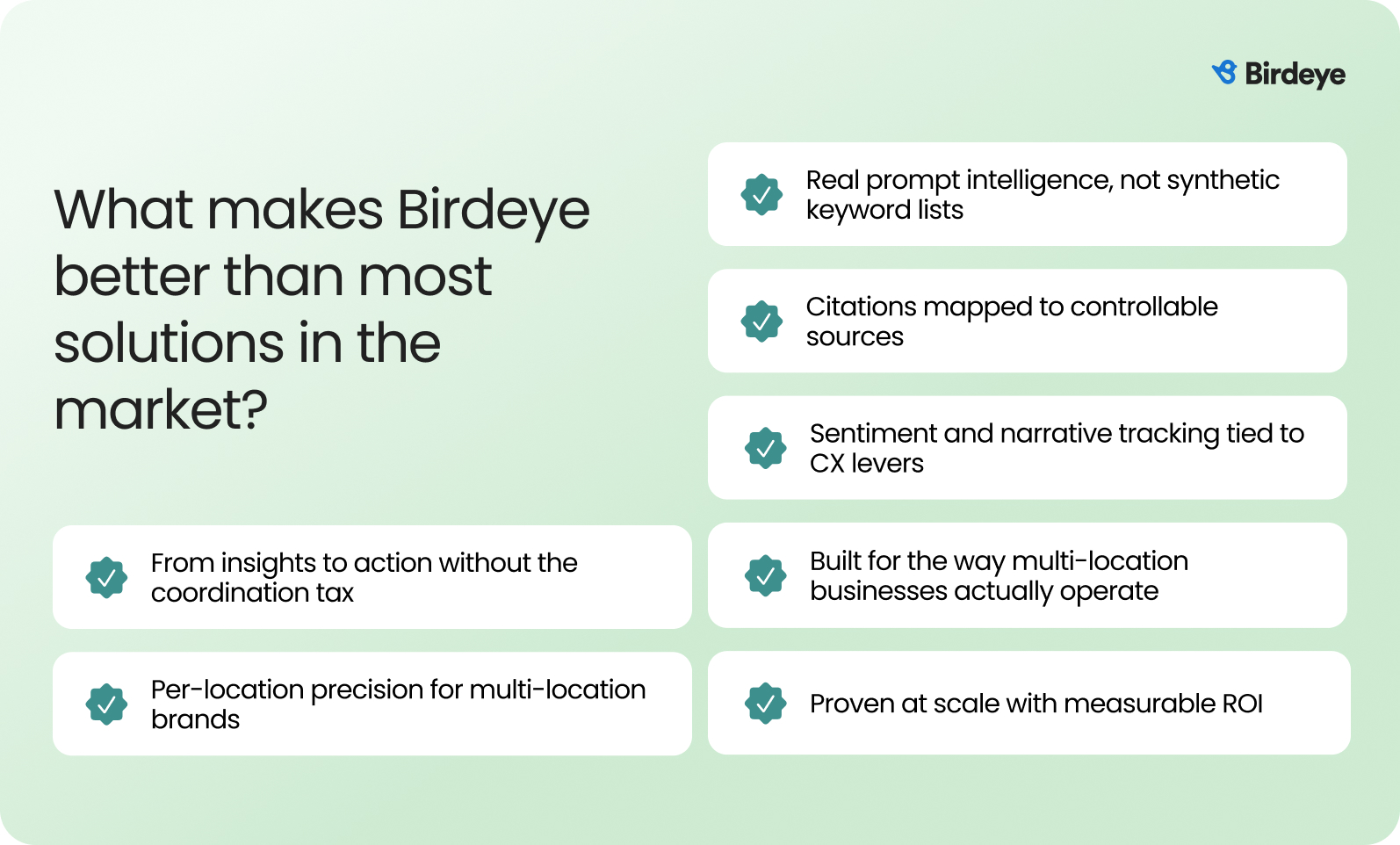
Most AI search visibility platforms stop at measurement, showing you where you rank or whether you appear in AI-generated answers. Birdeye Search AI goes further by connecting those visibility gaps directly to the customer experience factors you can control and then automating the fixes through an integrated agentic system.
From insights to action without the coordination tax
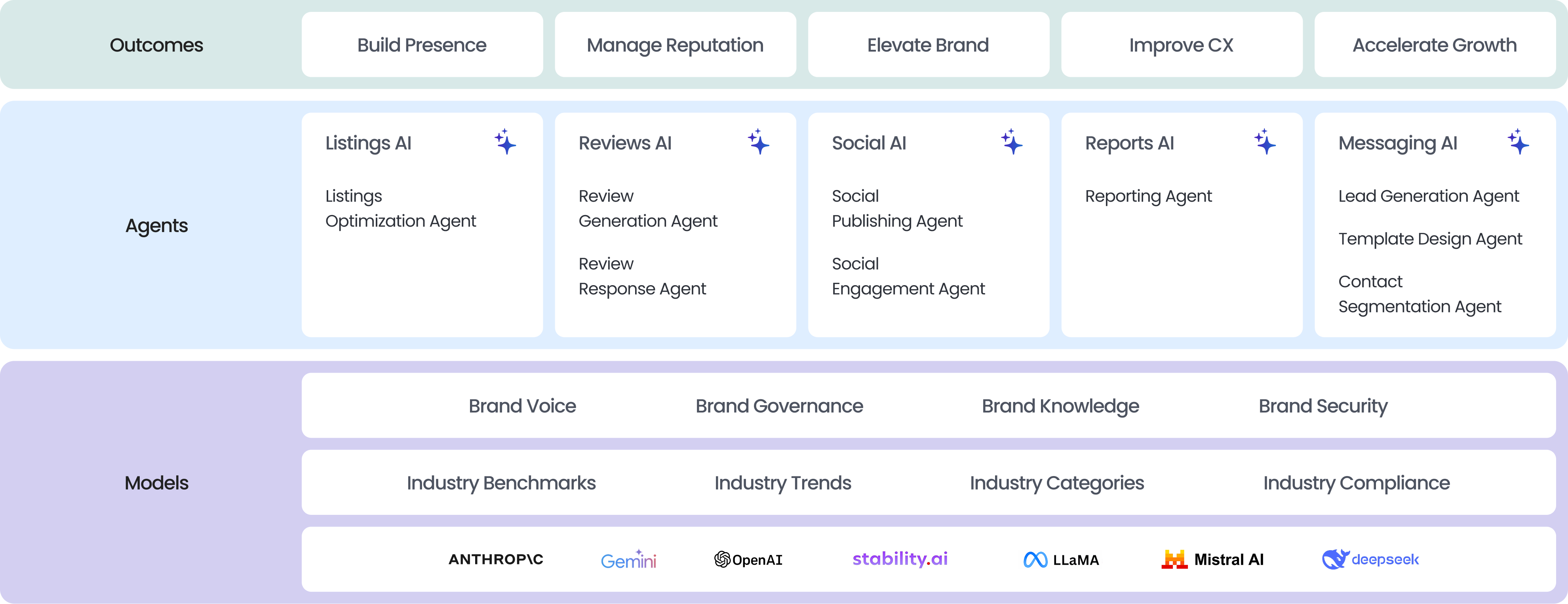
Birdeye integrates all necessary tools and uses agentic automation to execute fixes across channels simultaneously. When Search AI identifies visibility gaps, Birdeye agents automatically coordinate across its suite:
Listings AI pushes corrected business data to 100+ directories.
Reviews AI triggers automated review request campaigns.
Insights AI surfaces real customer sentiment patterns.
Social AI suggests location-specific social media content.
Messaging AI strengthens brand presence through consistent engagement.
Reports AI consolidates visibility and competitive data into actionable dashboards.
Competitors’ AI reveals which competitors dominate AI answers by theme.
When one tool surfaces a problem, others respond automatically. This agentic coordination across tools is what turns AI visibility from a reporting exercise into a driver of business operations.
Ease of use to get solid 5-star reviews from our customers. We are recommending it to all of our customers so they can gain huge improvements in their SEO.– Kris A., Co-Owner, Marketing and Advertising 5/5, Verified G2 reviewer
Per-location precision for multi-location brands
Competitors show brand-wide or category-level tracking; Birdeye delivers visibility, rankings, sentiment, and action plans at each individual location. For multi-location brands, this granularity reveals which stores underperform in AI discovery and why, enabling location-specific improvements rather than one-size-fits-all strategies.
Real prompt intelligence, not synthetic keyword lists
Birdeye Search AI analyzes actual questions users ask AI assistants and groups them into semantic themes, revealing true intent rather than relying on predefined keyword lists that miss how people actually query AI engines.
Citations mapped to controllable sources
When visibility gaps exist, Birdeye Search AI shows exactly which websites, directories, and content pieces AI engines cite instead. This enables teams to prioritize fixes based on impact rather than guessing what to improve.
Sentiment and narrative tracking tied to CX levers
AI platforms don't just mention brands—they characterize them, summarizing reputation, strengths, weaknesses, and operational issues based on reviews, news, and content they've crawled. Birdeye Search AI analyzes these narratives to show how AI engines describe your brand, including recurring themes.
Built for the way multi-location businesses actually operate
Birdeye empowers all businesses with access to 3,000+ pre-built integrations to POS, CRM, and martech systems. This reduces implementation friction, along with franchise-friendly permissions and regional rollout capabilities.
Proven at scale with measurable ROI
Birdeye has been serving over 200,000 locations and the biggest brands globally across franchises, healthcare systems, retail chains, hospitality groups, and financial services networks.
The real competitive advantage isn't any single feature—it's the compounding effect of unified data, coordinated execution, and agentic automation working together.
I use Birdeye in my role managing negative reviews across more than a dozen platforms, and it’s been a game-changer. I love how streamlined it is — I can view all my reviews in one place and connect multiple platforms, seeing updates in real time (though some platforms take about 24 hours to sync).– Shannon S., Negative Review Social Media Specialist 5/5, Verified G2 reviewer
How to choose the best Yext Scout alternative for your needs
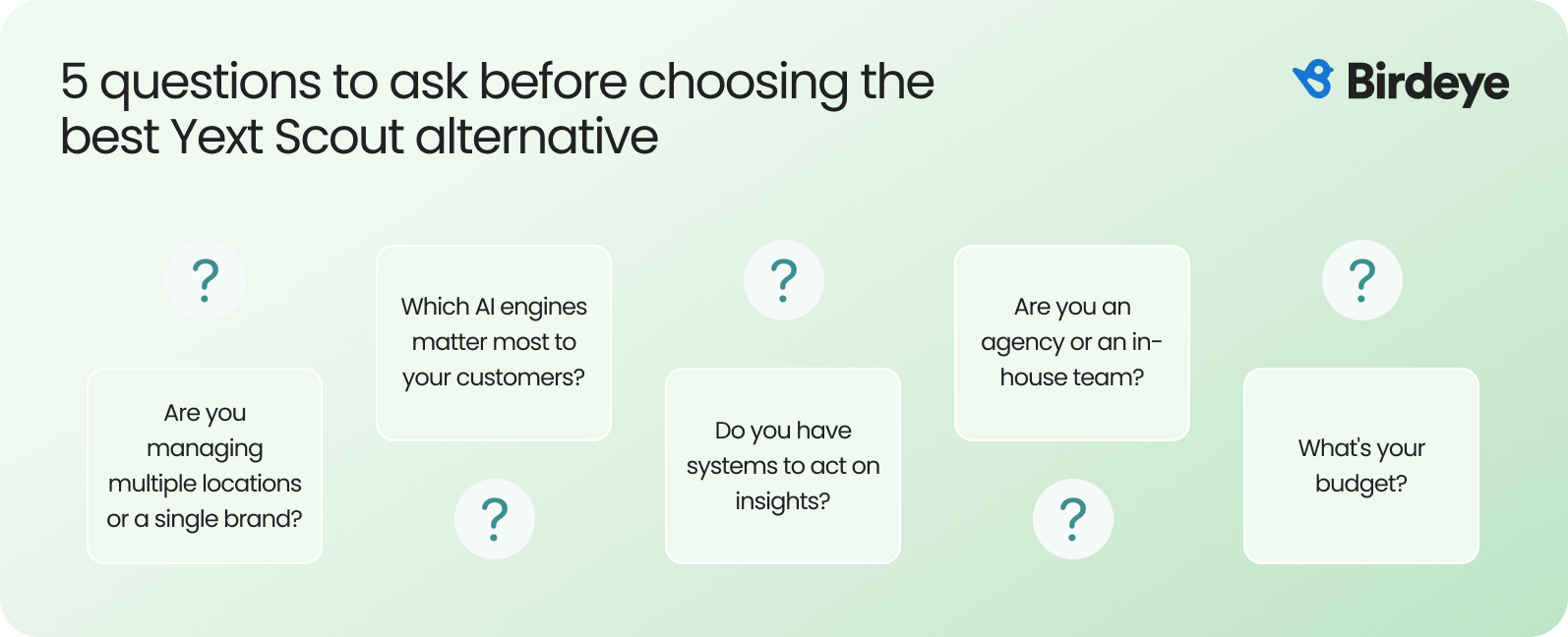
Selecting the right platform requires evaluating five critical dimensions: your business model, operational capacity, budget constraints, implementation timeline, and feature priorities.
Here are the key questions to assess before committing to a Yext Scout alternative:
Q1. Are you managing multiple locations or a single brand?
Single-brand companies can leverage most platforms, but multi-location operations require per-location visibility tracking, local competitive analysis, and location-specific action plans. Birdeye Search AI is purpose-built for franchises and chains with this architecture; alternatives like Profound and Otterly AI work better for centralized brands.
Q2. Which AI engines matter most to your customers?
If your audience primarily uses ChatGPT, Perplexity, or Gemini, verify engine coverage before committing. Platforms like Birdeye, Profound, and Otterly track 5+ independent AI engines; Search Atlas and Nightwatch focus mainly on Google AI Overviews.
Q3. Do you have systems to act on insights?
Measurement-only platforms (Profound, Otterly AI, Scrunch AI) require separate tools for listings, reviews, and content publishing. Integrated platforms like Birdeye reduce friction by automating fixes across all channels.
Q4. Are you an agency or an in-house team?
Agencies need white-label reporting and multi-client scaling. Nightwatch excels for agencies with white-label reporting and multi-client scaling capabilities; enterprise platforms like Profound and Birdeye require custom quotes and longer implementation cycles.
Q5. What's your budget?
Search Atlas and Nightwatch offer basic AI visibility tracking at accessible price points. Mid-tier pricing by Otterly AI and Peec AI provides a dedicated AI search focus with moderate scaling costs. Custom enterprise pricing is provided by Birdeye Search AI and Profound, which deliver advanced capabilities but require significant investment and are best suited for large organizations.
Migration checklist: How to switch from Yext Scout to Birdeye in 7 easy steps
Transitioning from Yext Scout to Birdeye is simple and well-structured. Birdeye’s onboarding experts manage the migration so your teams can stay focused on results, not platform logistics.
Step-by-step migration from Yext Scout to Birdeye
Step 1: Establish migration priorities
Clarify what you want to achieve: stronger AI search presence, improved local discoverability, or centralized multi-location management.
Step 2: Review your Yext Scout configuration
Assess tracked AI answers, competitive benchmarks, monitored queries, and reporting outputs to determine which insights and data should carry forward.
Step 3: Link business profiles and data sources
Connect Google Business Profiles, Apple Business Connect, Facebook, and other key platforms to Birdeye for centralized control.
Step 4: Transfer locations and business details
Import all locations, categories, services, and core business information into Birdeye’s listings and location management system.
Step 5: Bring over reviews and history
Sync existing reviews, ratings, and response records to maintain performance baselines and trend analysis.
Step 6: Set up workflows, access, and dashboards
Configure AI-powered response templates, automation rules, role-based permissions, SSO, and performance dashboards tailored to corporate and local teams.
Step 7: Validate, train, and launch
Run final quality checks, train teams on Birdeye workflows, and roll out across locations with ongoing support from Birdeye experts.
Birdeye is an excellent way to drive patient reviews to the review sites of your choice. The dashboard offers several useful features to help you manage reviews and gain insights into your business. The customer service is outstanding.– Verified G2 reviewer 5/5 rating
FAQs about Birdeye Search AI, the #1 Yext Scout alternative
1. How is Birdeye Search AI different from Yext Scout?
Birdeye combines AI visibility tracking with built-in tools for reviews, listings, social, messaging, and reporting, so teams can both see issues and fix them in the same platform. This reduces the “insights-only” problem where brands know what’s wrong but lack a coordinated way to act.
2. Does Birdeye track more than just Google AI Overviews?
Birdeye Search AI monitors visibility across leading AI platforms such as ChatGPT, Gemini, Perplexity, and others, not just Google’s AI experiences. This helps brands understand how they show up across the full AI discovery journey, not only in traditional search.
3. Can Birdeye help improve my reviews and local profiles as part of AI optimization?
Yes—Birdeye ties AI visibility insights directly to reviews, listings, and local pages, then uses its AI-powered CX tools to update profiles, generate new reviews, and strengthen location-level presence. This closed loop is what turns AI visibility into a measurable growth lever instead of just another dashboard.
Ready to switch from Yext Scout to Birdeye?
Switching from Yext Scout to Birdeye starts with a clear side-by-side audit of what you’re getting today: visibility tracking only, or visibility plus execution.
Birdeye is easy to navigate, and I love that it consolidates all review channels into a user-friendly dashboard. I also appreciate how it automatically updates listings across multiple platforms, allowing me to edit and publish directly within the dashboard. The platform offers a wide range of tools and consistently keeps up with industry trends, recently providing solutions for how businesses can be discovered through AI chat functions.– Caitlin P., Marketing Director Verified G2 reviewer
Birdeye’s advantage is that it doesn’t just show where your brand is missing in AI answers; it routes fixes through Reviews, Listings, Social, Messaging, and Reporting, so gaps actually close at the location level.
Disclaimer: The content on this page is based on research compiled from publicly available information. Birdeye does not warrant the completeness or correctness of the information and cannot be held liable for its use.
Start growing with Birdeye today
See what makes Birdeye the clear choice for today's leading enterprises. Get a firsthand look at the capabilities of the all-in-one Birdeye Platform.