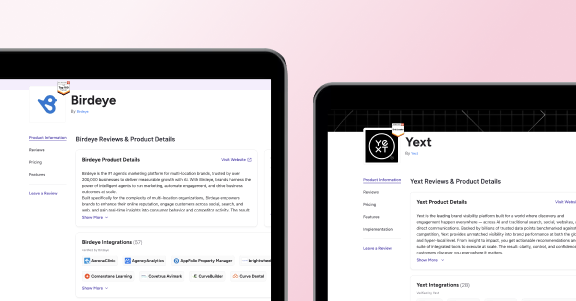
The search for a Yext alternative often starts when businesses realize they need more than listing accuracy; they need control, agility, and real-time visibility across every customer touchpoint. While Yext offers strong directory coverage, many users struggle with rigid contracts, limited customization, and slower innovation around AI-driven insights.
The leading Yext alternatives for 2025 go beyond data consistency to deliver smarter AI automation, faster integrations, and a unified approach to online reputation.
While we cover BrightLocal, Reputation, SOCi, Podium, Uberall, and Moz Local, Birdeye stands out for its enterprise-grade user experience, deep analytics, and agentic automation that turns every customer interaction into measurable growth.
Time to take control of visibility, reviews, and ROI. Start with the comparisons and pricing below, then choose the partner built for scale.
7 Reasons why you might need a Yext alternative?
Many brands start with Yext, expecting simplicity and automation, but quickly encounter limitations that slow growth. From rigid contracts and steep pricing to unintuitive workflows and minimal engagement tools, users report frustration with the platform’s usability, integrations, and support.
Below are the most common reasons businesses are exploring better options in 2025.
1. Directory-first approach that reduces visibility
Many listing companies still promote “200+ directories,” but many of those sites keep losing traffic. You can be “synced” everywhere and still not be found. Real discovery happens on Google, Facebook, Apple, and on industry-specific platforms like Zillow, Healthgrades, and Tripadvisor. Focusing on the proper channels reduces waste and improves calls, directions, and bookings.
The status of a listing is often not correct ... it says ‘synced’ but not actually synced.- Dan M Source G2
2. Complicated reporting and analytics tools
Yext’s reporting features often require training to interpret, leaving users struggling to extract actionable insights or track ROI efficiently. Yext caps brand-level review response instructions at 5,000 characters, which can limit the ability to address complex tone/compliance requirements.
The platform's reporting features can be overwhelming for new users...— Leon L. Source G2
3. Steep learning curve and setup challenges
While Yext offers a wide range of features, users often find the platform complex to navigate at first. Initial setup and integrations can take extra time, and smaller businesses may find the pricing high for the value delivered. Even with new utilities like Listings Recommendations, teams still manage many tasks manually across modules.
The platform can feel a little overwhelming at first with the number of features available, and the pricing can be a bit high for smaller businesses. Some integrations take a little extra setup time. However, once you’re familiar with it, the benefits outweigh these challenges.— Audrey S. Source G2
4. High cost and redundant manual effort
Even with a premium subscription, users still manually update Google listings, which defeats automation and adds extra work. Yext’s integrations footprint for review generation is comparatively small (12+ CRMs), which can force manual workarounds for triggers and data syncs.
Yext is very costly, and I’ve found I still need to update and upload to Google anyway. I sometimes do double work to make sure it’s done.”— Taylor B. Source G2
5. Poor onboarding and unintuitive interface
Several users cite inconsistent onboarding, a confusing interface, and complex workflows that make everyday operations inefficient and hard to scale.
Onboarding was all over the place. How we had to use the software was laughable. The interface was anything but intuitive, queries were difficult to run, and training staff was nearly impossible.— David Source Capterra
6. Outdated functionality and weak analytics
Users report that Yext lacks intelligent industry filtering and delivers minimal analytics beyond surface-level Google data, limiting its strategic value. Yext Analytics unifies data, but it’s not a conversational AI that answers “why” questions or provides prescriptive, theme-level recommendations.
As far as listings go, the thing I like least about Yext is that it's not intuitive enough to understand which publishers they work with that don't support a particular industry. The platform is old enough to have that baked into it and automatically eliminate those publishers from the mix. Another thing that has always perplexed me about Yext is that it doesn't seem to actually do much in the way of data analytics besides grab readily available information from Google. Aside from having Google data inside the Yext platform, that's not much of a feature. As far as reputation management is concerned, Yext doesn't play well with the way our company uses Yelp, and as a restaurant chain, that's not really helpful.— Roger Source Capterra
7. Customer support and communication issues
Delayed responses and limited direct support options make Yext platforms difficult for teams to resolve technical or data-related issues quickly.
Customer support challenges: Delayed responses and a lack of direct communication options.— Leon L. Source G2
Methodology: How we analyze and select Yext alternatives
We prioritize platforms that deliver full customer experience management, not just clean data or listing accuracy. Our goal is to help multi-location brands pick systems they can run at scale, with clear outcomes: more visibility, more engagement, faster response times, and measurable revenue impact.
What we evaluate (and how):
Depth of feature-set: We verify that core CX workflows live in one workspace: review generation and responses, social publishing and engagement, unified messaging (SMS, webchat, social DMs, email), surveys/feedback, and decision-ready insights. We check for role-based approvals, location templates, audit trails, and multi-brand controls. Platforms score higher when teams can launch, govern, and optimize without stitching tools together.
AI capabilities: We look for automation that executes end-to-end: sends review requests, drafts compliant replies, plans social calendars, triages and routes messages, segments audiences, and explains performance changes. Bonus points for AI search readiness (prompt-level insight, citation intelligence, prescriptive fixes) and guardrails (brand/industry models) that keep tone and compliance consistent across locations.
Integrations: We assess the number and quality of native integrations with CRMs, POS/EMR systems, call tracking, and industry software. We test event-based triggers (e.g., visit complete → review ask), two-way sync, identity matching, and error handling. Higher scores go to platforms that reduce IT lift, shrink manual effort, and keep data flowing reliably at 10 to 10,000+ locations.
Customer support: We examine onboarding playbooks, go-live timelines, SLA clarity, live channel coverage (email/chat/phone), escalation paths, and CSM consistency. We favor vendors with white-glove rollout, proactive health checks, and fast resolution, because adoption dies when support stalls.
Verified user reviews: We weigh recent G2/Capterra ratings and category grids for usability, setup, admin, support, product direction, and results. We prioritize multi-location feedback and proof of sustained satisfaction over one-off wins. This evaluation favors platforms that prove adoption speed, measurable growth, and enterprise reliability, so multi-location brands get a unified CX engine, not just accurate listings.
Top Yext alternatives comparison at a glance
Platform
Best For
Core strengths
AI features & pricing
Birdeye
Multi-location enterprises that want one platform for listings, reviews, social, messaging, and surveys
Unified CX workspace, 3,000+ integrations, enterprise roles/approvals, reporting that ties to revenue
Large enterprises seeking advanced reputation analytics and governance
Enterprise dashboards, sentiment insights, secure workflows, and broad integrations
Moderate AI; higher-tier enterprise pricing
SOCi
Franchises and distributed brands prioritizing localized social
Centralized social calendar, approval workflows, co-op/templating; basic listings
Basic AI for scheduling/assist; mid-to-high pricing by seats/locations
Podium
Service businesses prioritizing messaging, leads, and payments
SMS/webchat lead capture, text payments, simple review asks
Basic AI assistance; per-seat/per-location style pricing
Uberall
Global enterprises focused on wide listings coverage and local visibility
Strong international directory network, presence analytics, bulk updates
Basic AI; enterprise pricing
Moz Local
SMBs requiring straightforward listings sync without enterprise overhead
Automated listings sync, duplicate suppression, and a clean interface
Minimal to no AI; low-cost plans
7 best Yext alternatives (detailed reviews)
1. Birdeye – Best overall Yext alternative
Birdeye, the #1 agentic marketing platform for multi-location enterprises and brands. Trusted by 200,000+ locations, our AI agents run marketing end-to-end, strengthening reputation, engaging customers across social, search, and the web, and delivering real-time consumer and competitor insights. Teams use Birdeye to grow revenue and engagement while reducing cost and time.
Best for: Multi-location brands that want one place to keep listings accurate, manage reviews, publish to social, engage customers, and automate their work with agentic AI, powered by Birdeye, the #1 agentic marketing platform.
Star Rating: 4.9/5 (G2), 4.8/5 (Capterra)
Key advantages over Yext
Complete Customer Experience Platform: Listings + reviews + social + messaging + surveys in one place.
Agentic AI (BirdAI): A connected suite of intelligent AI agents that automate customer interactions, insights, and engagement.
Better ROI: Proven 300% average ROI through review growth, customer acquisition, and retention.
Search AI advantage: Track visibility and performance across ChatGPT, Gemini, and Perplexity to understand where your brand appears in AI search.
Unified engagement: Centralized inbox for every channel, Google Messages, SMS, webchat, and social DMs, ensuring no lead or customer inquiry goes unanswered.
Business growth focus: Birdeye goes beyond data accuracy, delivering tools that drive real engagement and measurable revenue outcomes.
Transparent pricing: Customizable, value-based pricing with all features included, no setup fees, hidden add-ons, or consulting costs.
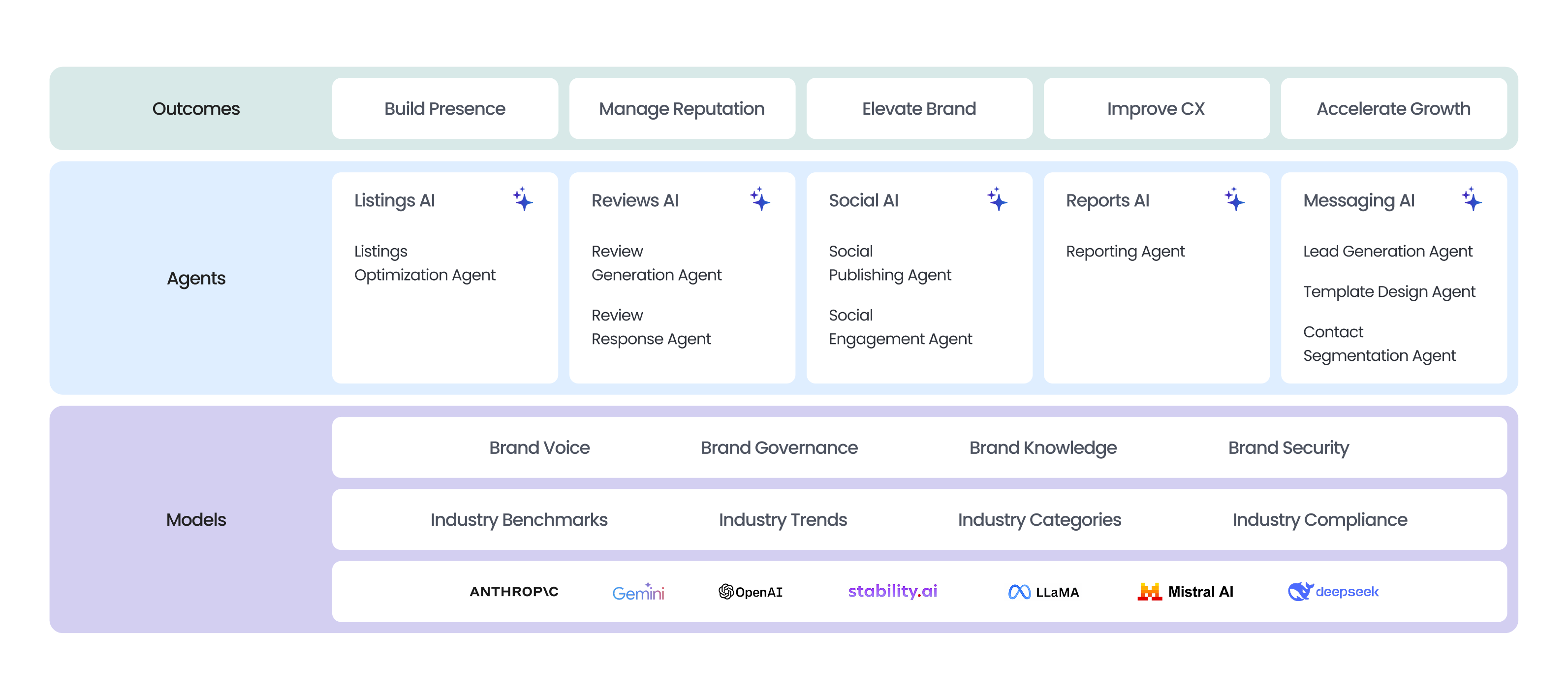
Birdeye AI agents: Birdeye Reviews AI, Birdeye Listings AI, Birdeye Social AI (Publishing & Engagement), Birdeye Messaging AI, Birdeye Search AI, Birdeye Insights AI, Birdeye Competitors AI, Reporting, Lead Generation, Birdeye Contact Segmentation, Template Design, Brand AI, Industry AI work like a reliable digital team. They plan, create, reply, route, and report across every channel so your locations show up, earn trust, and turn conversations into real revenue.
Pros
Birdeye synchronizes accurate listings with enterprise-grade roles, approvals, and audit trails, keeping every location consistent while giving central teams the control they need.
The platform timely sends review requests over email and SMS based on real customer moments, then uses AI to draft on-brand, context-aware responses that protect reputation and speed up follow-through.
Provides a Social AI calendar that ideates, drafts, and schedules posts across locations, learning from top performers and competitor trends to raise engagement without extra manual effort.
It unifies conversations with Messaging AI that instantly acknowledges, routes by topic or location, and maintains a complete customer thread, reducing missed messages and repeat work.
The platform turns unstructured feedback into clear Insights AI reports, prioritizing issues and wins at the location level so operators know exactly what to fix and what to scale.
The platform supports rollout with white-glove onboarding, clear training paths, and measurable outcomes, shortening time-to-value for both corporate teams and local staff.
Cons
Some niche tools may not be prebuilt. Open APIs and a broad integration ecosystem, plus connections to 3,000+ CRM, EMR, and business systems, keep rollouts smooth and scalable.
New users may need a brief acclimation period. An intuitive dashboard and hands-on training help teams ramp quickly, while the unified workspace speeds day-to-day execution.
Awards and recognitions
Great products earn trust over time. Birdeye has done precisely that, year after year, across categories that matter to growth-minded brands.
Trusted market leader: Since Spring 2019, Birdeye has been named a leader on G2’s Online Reputation Management Grid every single quarter, six years and counting. That consistency reflects innovation, customer satisfaction, and real business impact.
Proven business outcomes: Repeated wins for Best Results show that Birdeye delivers measurable ROI. At the same time, Best Usability confirms teams can adopt it fast and work efficiently, whether you run one brand or hundreds of locations.
Fast time-to-value: Honors for Most Implementable and Fastest Implementation across payment processing, live chat, and feedback analytics mean you get value quickly, not after a long rollout.
Loved by users: Recognition for Easiest To Do Business With and Users Most Likely to Recommend in competitive fields like SMS marketing, social media management, and customer advocacy demonstrates how consistently Birdeye removes friction and drives adoption.
Customer feedback leadership: Birdeye earned the Silver Globee Award for Best of Category in Customer Feedback Software, recognizing how we turn feedback into real-time action and help brands build their reputation across every digital touchpoint while building trust at scale.
Also, Yext is recognized for listings and search innovation. Yet customers frequently cite lower perceived value in support, breadth of CX features, and product direction than Birdeye’s multi-category leadership on G2.
All these Birdeye recognitions are the baseline we bring to every feature and every rollout, setting you up to turn accurate listings and always-on engagement into repeatable growth.
Birdeye gives us a great portal that we can manage over 400 locations individually, even locations that are separately branded; everything is stored and uploaded. So we have consistent surveys with location branding. We can see survey results in a snapshot. The ticketing system is amazing, and it has helped us improve our customer experience in just under a year of using Birdeye. We have also increased our online reputation by about two points, which has been amazing.— Brandon Hegland, The Michaels Organization
Birdeye pricing
Birdeye provides flexible, value-based pricing tailored to your needs and scale, maximizing ROI. Please reach out to our team for a personalized quote and guidance on plans and features.
Birdeye vs. Yext: Feature comparison 2025
Category
Birdeye
Yext
AI-driven platform
Purpose-built agentic AI platform with Brand AI, Industry AI, Birdeye Search AI, Birdeye Reviews AI, Birdeye Social AI, and Birdeye Messaging AI working together to drive discovery, engagement, and growth.
Offers structured data search and content solutions, but AI capabilities are limited to semantic and generative search. It monitors brand appearance across AI engines; however, outputs are assistive and still require manual follow-through, not agentic execution.
Listings management
Centralized listings management with real-time sync, accuracy monitoring, and AI-driven visibility insights.
Strong data control and distribution network, but lacks integrated engagement or review workflows. Listings Recommendations help identify empty fields, yet they don’t provide field-level optimization guidance or one-click bulk improvements.
Review generation & response
Birdeye Reviews AI automates review requests, personalizes timing, and crafts on-brand, compliant replies at scale.
Basic review monitoring and response; no end-to-end automation or tone compliance tools. Brand instructions are capped at 5,000 characters; 80+ supported review sources; website widgets promote only first-party reviews; 12+ CRM integrations limit automated triggers.
Social media & content publishing
Birdeye Social AI ideates, drafts, schedules, and optimizes posts for engagement across all major networks, with approval workflows for teams.
Basic posting and monitoring capabilities; no GenAI-driven content optimization or multi-location learning. No autonomous engagement agent; inbox relies on workflows versus intent-aware AI triage.
Messaging & engagement
Unified inbox powered by Birdeye Messaging AI for instant replies, routing, and escalation across text, webchat, and social DMs.
No centralized engagement hub; messaging handled via third-party integrations. No unified, AI-routed inbox across SMS, webchat, and social DMs.
Search visibility & AI discovery
Birdeye Search AI shows how your brand appears inside ChatGPT, Gemini, and other AI Overviews with recommendations to improve accuracy and reach.
Focuses on website and internal search; lacks visibility into insights across external AI platforms. Scout provides high-level monitoring but lacks prompt-level visibility, citation intelligence, or SWOT-style sentiment analysis.
Surveys & feedback analytics
Integrated surveys with Birdeye Insights AI that turn customer feedback into action plans and measurable ROI.
Offers feedback collection tools, but analytics are not AI-driven or cross-channel. No survey-to-review nudge capability.
Implementation speed
Recognized by G2 for Fastest Implementation and Most Implementable across multiple categories, with an average onboarding <30 days.
Enterprise-scale setup with more complex configurations and longer time-to-value.
Ease of use & adoption
Repeated G2 winner for Best Usability, Easiest To Do Business With, and Users Most Likely to Recommend.
Well-documented, but often cited as requiring technical resources for maintenance.
Multi-location scalability
Built for enterprises with 10 to 10,000+ locations; single dashboard for reviews, listings, social, messaging, and surveys.
Supports large networks but with siloed tools across different modules.
Analytics & ROI tracking
Unified analytics across listings, reviews, social, and messaging with AI-powered insights for every location.
Provides analytics for search and listings, but has limited omnichannel visibility.
Compliance & brand control
Brand AI and Industry AI enforce tone, accuracy, and legal compliance across all customer communications.
Relies on manual governance and approval flows.
Awards & recognition
G2 Leader every quarter since 2019, six years straight for Online Reputation Management, Best Results, and Best Usability.
Recognized for listings and search innovation, but lacks consistent cross-category leadership.
2. BrightLocal
Best for: Small to medium businesses focused primarily on local SEO and listings management.
Star Rating: 4.5/5 (Capterra), 4.6/5 (G2)
Key features
Citation building and cleanup for consistent NAP data
Rank tracking and local search audits
Google Business Profile performance tracking
Basic review monitoring across key platforms
Pros
Affordable entry point for SMBs
Solid reporting tools for SEO agencies
Simple interface that requires minimal training
Cons
No direct customer engagement or messaging capabilities
Lacks AI-powered automation and advanced review response tools
Not designed for multi-location enterprise scalability
Pricing and Value: Budget-friendly tiers for SMBs and agencies; strong for citations and tracking, limited for engagement, AI, and enterprise workflows.
3. Reputation (formerly Reputation.com)
Best for: Large enterprises needing advanced reputation management with secure integrations and comprehensive analytics.
Star Rating: 4.4/5 (G2), 4.3/5 (Capterra)
Key features
Enterprise-grade review monitoring and response
Listings management and local visibility tracking
Competitive benchmarking and sentiment insights
API integrations with CRM and business intelligence tools
Pros
Robust reporting with advanced analytics dashboards
Strong enterprise data governance and compliance controls
Multi-location reputation tracking with robust workflow approvals
Cons
Limited social media management tools
Higher cost compared to Yext
Complex onboarding for smaller teams
Lacks multi-agent AI automation seen in platforms like Birdeye
Pricing and Value: Starting at $899/month; excellent for deep analytics and governance, lighter on social and messaging relative to cost.
4. SOCi
Best for: Multi-location franchises and brands focused on localized social media marketing with basic listings management.
Star Rating: 4.5/5 (G2), 4.4/5 (Capterra)
Key features
Centralized social publishing calendar
Localized social ad campaigns
Basic listings sync and management
Co-op marketing tools for franchises
Pros
Strong social media management capabilities
Designed for distributed franchise teams
Efficient approval workflows and content localization
Cons
Basic review and listings tools compared to Birdeye
Expensive scaling for multi-location enterprises
Limited AI features beyond scheduling automation
No AI search optimization like Birdeye’s Search AI
Pricing and Value: Starting at $500/month per location; powerful for social operations, gets expensive at scale, and when reputation depth is needed.
5. Podium
Best for: Service-based businesses that prioritize messaging and lead response over listings or social engagement.
Star Rating: 4.4/5 (G2), 4.5/5 (Capterra)
Key features
SMS-first communication platform
Webchat and lead capture forms
Basic review generation and follow-ups
Payment collection via text
Pros
Excellent text messaging and conversation tracking
Easy to use for smaller teams
Fast setup and friendly support
Cons
No listings management or SEO visibility
Lacks unified customer experience capabilities
Limited AI features, focuses on lead handling only
Not suited for enterprises seeking all-in-one growth solutions
Pricing and Value: Starting at $399/month per location; high messaging ROI for lead-driven teams, limited beyond messaging and basic reviews.
6. Uberall
Best for: Enterprises focused on listing accuracy and local SEO visibility with basic engagement capabilities.
Star Rating: 4.3/5 (G2), 4.4/5 (Capterra)
Key features
Centralized listings and directory management
Local SEO optimization and performance insights
Basic review collection and monitoring
Store locator and presence management tools
Pros
Excellent coverage across global directories and platforms
Strong analytics for local search performance
Helpful automation for updating listings at scale
Supports multi-location brands with regional structures
Cons
Limited engagement and social management features
No AI-driven review responses or sentiment insights
Can feel complex during setup for smaller teams
Doesn’t connect listings to customer experience metrics
Pricing and Value: Custom enterprise pricing; great global reach and analytics, add-ons often required for deeper engagement and reporting.
7. Moz Local
Best for: Small to medium businesses that want straightforward listings management and SEO improvement without enterprise complexity.
Star Rating: 4.2/5 (G2), 4.3/5 (Capterra)
Key features
Listings synchronization across Google, Apple, and key directories
Local SEO health checks and score tracking
Duplicate suppression and review alerts
Integration with Moz’s SEO tools for keyword insights
Pros
Simple, affordable option for smaller businesses
Clean interface with automated updates
Reliable reputation in local SEO
Useful for agencies managing multiple small clients
Cons
No social, messaging, or survey capabilities
Lacks advanced reporting and multi-location scalability
No AI or automation beyond basic SEO tasks
Limited global reach compared to enterprise solutions
Pricing and Value: Low-cost annual plans per location; ideal for basic listings and SEO upkeep, not suited for end-to-end CX or automation at scale.
How to pick the right Yext alternative for your needs
The right platform helps you clean up your data and help real people find you, trust you, and contact you. Here’s a simple way to decide with confidence:
1. Define the win
Is your primary goal accuracy, review growth, AI search visibility, or multi-location engagement? Rank these 1–3 so vendors map to outcomes, not demos.
2. Insist on one workspace
Listings, reviews, social, messaging, surveys, one login, one source of truth. Fragmented tools create blind spots and extra cost.
3. Test AI where it matters
Look for task-level agents (e.g., Reviews AI, Social AI, Messaging AI) plus guardrails like Brand AI/Industry AI for tone and compliance. Ask for live, real-data examples.
4. Measure time to first value
How fast can you launch 50–5000 locations? Who does the technical lift, the vendor or your team? Ask for implementation SLAs and customer references.
5. Check visibility in AI search
Can the platform show how you appear in ChatGPT, Gemini, and AI Overviews and recommend fixes? Discovery without proof is guesswork.
6. Demand location-level ROI
Dashboards should tie reviews, posts, calls, and bookings to revenue per location. If you can’t measure it, you can’t scale it.
7. Validate compliance and control
Role-based approvals, audit trails, HIPAA/FINRA-ready content rules, and on-brand responses across 100+ local accounts, non-negotiable.
8. Proof from the market
Look for multi-year leadership on G2, “Fastest Implementation,” “Best Usability,” and “Best Results.” Consistency beats one-off trophies.
If you’re moving from Yext, ask vendors to demonstrate survey-to-review flows, multi-source website widgets, prompt-level AI search visibility, and agentic social engagement, areas where Yext is limited or only assistive.
Choose the platform that makes you findable, trusted, and responsive at scale. That’s where Birdeye outperforms: unified workspace, task-level Agentic AI, AI search visibility, fast go-live, and better ROI.
What makes Birdeye the superior choice for growing brands
Yext remains strong at data management, but its limited scope is restricted to accuracy. Modern enterprises need a platform that not only ensures listing consistency but also drives measurable business growth through automation, engagement, and AI.
Birdeye is the clear choice for enterprises that want to:
Manage accurate listings across 150+ directories
Automate review generation, response, and analysis through Reviews AI
Publish AI-optimized social content via Social AI
Engage customers directly with a unified inbox and Messaging AI
Gain insights and recommendations from Insights AI
Optimize visibility in AI search engines through Search AI
Maintain brand consistency with Brand AI and Industry AI models
Analyze prompts, sentiment, and citation share across ChatGPT, Gemini, and Perplexity with Search AI
Use Agentic AI to automate repetitive CX workflows
Birdeye customers commonly see rapid review volume growth (e.g., 128% within 90 days) due to automation and deep integrations, while Yext customers often report slower value realization and support friction.
Birdeye delivers everything Yext does, and more: the automation, insights, and engagement enterprises need to stay visible and grow in an AI-first world.
Migration checklist: How to switch from Yext to Birdeye in 5 easy steps
Migrating to Birdeye is fast, structured, and fully supported, so your teams stay focused while we handle the heavy lifting.
Simple 5-step migration
Plan: Review your current Yext setup, integrations, and data to define the scope, timeline, and key modules to migrate.
Export: Gather your existing contacts, reviews, conversations, and location data from Podium.
Import: Birdeye’s onboarding team securely maps and uploads your data into the appropriate modules (Reviews, Inbox, Listings, Messaging).
Connect: Re-link your CRM, chat, and social integrations, then activate automations and review requests directly in Birdeye.
Go-Live: Test, train, and launch across all locations — with Birdeye experts guiding every step of the process.
Why it’s easier with Birdeye
Dedicated migration support ensures zero data loss or downtime during the switch from Yext.
All-in-one Birdeye platform consolidates reviews, listings, social, surveys, and messaging — replacing multiple tools with a single dashboard.
Intuitive setup rated higher for Ease of Setup and Ease of Administration on G2 (Birdeye = 9.1 vs Yext = 8.7 based on independent user reviews).
Faster adoption through simplified workflows and built-in onboarding resources for local teams.
Result: Move all your data, teams, and customer interactions into a smarter, unified platform — without the stress.
Our business has been using Birdeye for several years, and we've experienced great success with it. We particularly appreciate the Reviews feature, which has played a significant role in supporting our reputation management efforts and has helped us see an increase in both the frequency and quality of our Google reviews. Additionally, the chat widget stands out as an excellent tool that is straightforward and user-friendly for both our customers and prospects, as well as our staff. The interface is user-friendly and easy to integrate and implement. Lastly, the customer service and support are outstanding - thank you, Birdeye!— Paula Source G2
FAQs: Birdeye vs Yext
1. How does Birdeye’s AI differ from Yext’s automation?
Birdeye uses Agentic AI, specialized AI agents that act across listings, reviews, social, and messaging. Yext automates data updates, but Birdeye’s AI engages customers, analyzes sentiment, and optimizes brand visibility across search and AI engines.
2. What is Birdeye’s Search AI, and how does it benefit enterprises?
Search AI tracks how your brand appears on AI-driven search platforms such as ChatGPT, Gemini, and Perplexity. It helps you analyze prompts, citations, and sentiment, so you can control how your business is represented across new discovery surfaces.
3. How do Brand and Industry AI models maintain compliance?
Birdeye’s custom AI models ensure every interaction, review response, post, or message follows your brand tone and industry regulations (HIPAA, FINRA, etc.), keeping all customer communication compliant and on-brand.
4. Can Birdeye handle multi-location management better than Yext?
Yes. Birdeye supports centralized control across thousands of locations with templates, permissions, and AI-powered workflows, while Yext’s focus remains limited to listing accuracy.
5. How quickly can enterprises migrate from Yext to Birdeye?
Most businesses transition within 30–45 days, guided by Birdeye’s dedicated onboarding team. Data migration, integration setup, and AI activation occur in parallel to minimize disruption.
6. Does Birdeye “whitelabel” Yext for listings?
No. Birdeye integrates natively with core directories such as Google, Apple, Bing, and Facebook, and selectively partners with long-tail sites. Yext’s strength is broad distribution; Birdeye focuses on the high-impact sources driving 80–90% of local traffic.
7. Will our rankings drop if we switch from Yext to Birdeye?
No. Birdeye Listings syncs to core sites quickly and adds review signals, AI-guided optimizations, and industry directories. Yext is breadth-first; Birdeye prioritizes quality, completeness, and review momentum on the sources that matter most.
8. How is Birdeye’s AI different from Yext’s AI?
Birdeye uses agentic AI, specialized agents that plan, publish, respond, route, and report. Yext offers assistive AI (e.g., generative replies, Listings Recommendations, Scout monitoring) that still relies on manual follow-through.
9. What about CRM integrations for automated review campaigns?
Birdeye connects with 3,000+ systems, enabling event-based review and message triggers at scale. Yext supports 12+ CRM integrations for review invites, which can limit automation in complex stacks.
10. Can Yext show how my brand appears in ChatGPT or Gemini like Birdeye Search AI?
Yext Scout provides high-level monitoring across AI engines, but it doesn’t deliver prompt-level visibility, citation intelligence, SWOT sentiment, or prescriptive fixes. Birdeye Search AI covers those areas to help you take action, not just observe.
Choose Birdeye for enterprise growth that goes beyond listings
When it comes to helping multi-location businesses grow, Birdeye outperforms Yext in every area that matters: AI automation, usability, support, and measurable ROI.
G2 scorecard (Birdeye vs. Yext)
Online reputation management: 9.4 vs. 8.8
Quality of support: 9.4 vs. 8.7
Ease of use: 9.3 vs. 8.6
Yext centers on listing accuracy. Birdeye connects the entire journey, from reviews, social engagement, messaging, and surveys to insights and AI search visibility, all in one platform. That’s why 200,000+ businesses use Birdeye to earn more reviews, show up across AI discovery, and respond faster with consistency.
If your business needs more than data accuracy, if you want growth, intelligence, and simplicity at scale, Birdeye is the smarter choice.
Ready to switch from Yext?
Request a demo today and discover how Birdeye helps brands turn visibility into real, measurable growth.
Disclaimer: The content on this page is based on research compiled from publicly available information. Birdeye does not warrant the completeness or correctness of the information and cannot be held liable for its use.
Start growing with Birdeye today
See what makes Birdeye the clear choice for today's leading enterprises. Get a firsthand look at the capabilities of the all-in-one Birdeye Platform.