The win no longer goes to the best keyword; it goes to the best-documented solution. AI search for home services has shifted from “rank a page” to “recommend a provider.” To be recommended for a noisy furnace, a burst pipe, or a failing HVAC system, multi-location home services brands must give AI the trust signals it needs: granular service data, hyper-local proof, and real-time urgency. Their digital footprint must prove they aren’t just a category entry but the answer to a crisis.
Summary of the blog
Homeowners have moved from short keyword queries to conversational, problem-based searches. AI assistants now respond by recommending a single provider they can justify with citations, making AI search a verification game, not a visibility game.

For enterprise home services brands, the immediate priorities are: audit every location page for service-level specificity, shift review request language to prompt job-specific detail, and measure citation share by location and service line — not just organic traffic.
This article unpacks the logic behind AI recommendations in home services, identifies the data gaps that cost multi-location brands the top citation, and lays out a portfolio-wide strategy for closing them.
Table of contents
- Summary of the blog
- How are homeowners searching for home services in 2026?
- Why does zero-click visibility matter in home services?
- What does AI look for when recommending a home services brand?
- Where do multi-location home services brands typically fall short?
- What should enterprise home services brands prioritize?
- How do leading home services brands act on these signals at scale?
- AI search readiness checklist for home services brands
- What does this mean for lead generation?
- FAQs about AI search for home services
- The next battleground is not ranking. It’s recommendation
How are homeowners searching for home services in 2026?
Homeowners are searching by describing the problem, the urgency, and the context, all in a single query. Google’s own guidance confirms that AI search experiences are designed for queries where users need help getting to the gist of complex topics, not just quick lookups.
That shift matters more in home services than in most other verticals.
A homeowner with no hot water at 9:30 p.m. is not thinking in keyword buckets. They ask something like: “Who can replace a water heater tonight in North Dallas and has good reviews?”That single question bundles together service need, urgency, geography, trust, and availability. A short query like “best plumber near me” leaves most of that unsaid. A conversational query gives AI far more to work with, and that’s precisely why AI search for home services behaves differently from older local search patterns.
The new query patterns are easy to spot
Most home services AI queries fall into four types:
1. Problem-based:
- “My AC is blowing warm air.”
- “Why is my breaker tripping every night?”
- “My water heater is making a banging sound.”
2. Urgency-based:
- “Emergency plumber available tonight.”
- “Same-day HVAC repair near me.”
- “24/7 electrician open now.”
3. Trust-based:
- “Licensed roofer with the best reviews in Phoenix.”
- “Best-reviewed pest control company for recurring service.”
4. Life-stage or scenario-based:
- “Best HVAC company for a first-time homeowner.”
- “Who should I call before listing my house for electrical work?”
These queries sound like conversations, not keyword lists. The brand that provides the clearest, most specific answer, not just the best link, wins the recommendation.
Data from Birdeye’s State of AI Search 2026 report confirms that showing up is no longer the benchmark. While 80% of brands were cited by AI, only 15% secured the top recommendation. That creates a winner-take-most dynamic where the #1 citation is the only one that matters in practice.
Why does zero-click visibility matter in home services?
AI has become the shortlist filter, curating options before a customer ever clicks a link. Google AI Overviews now answer queries directly on the results page, and because these impressions appear in Search Console reporting, “visibility” has been redefined. If a brand’s locations are absent from AI-generated recommendations, it’s losing both traffic and the first moment of consideration.
In emergency-driven categories like home services, this is especially consequential. When a problem is urgent, customers want the fastest credible answer, not a long research process.
Google’s trajectory toward agent-mediated flows, where AI actively contacts businesses for pricing and availability, signals how far this can go. If a brand’s digital signals don’t satisfy the AI’s need for speed, price, and availability data, it doesn’t just rank lower; it also risks being excluded from the AI’s recommendations.
What does AI look for when recommending a home services brand?
AI looks for evidence that a specific location can solve a specific problem for a specific customer in a specific place. For multi-location home services brands, that evidence must exist at the location and service levels, not just on the corporate homepage.
Five signals drive most of that decision.
1. Does AI know exactly what the location does?
Service specificity is the first filter. A profile that says “plumbing services” gives AI far less confidence than one that clearly lists:
- Water heater replacement
- Tankless installation
- Sewer line repair
- Emergency leak detection
- Sump pump repair
- Drain cleaning
The same applies to HVAC, electrical, roofing, and pest control. Conversational home services queries are detailed. Therefore, AI requires a high level of specificity to accurately match a customer’s problem to the correct service and location.
Although most enterprise brands benefit from strong brand awareness and well-structured location pages, their current digital presence often fails to adequately detail the specific services offered at each individual location.
2. Can AI verify exactly where you operate?
Home services are inherently local. That’s why achieving visibility requires adhering to Google’s clear guidance: a complete and accurate set of business data, including service-area boundaries and appropriate categories, is the fundamental requirement for local presence.
For a portfolio-wide brand, that means consistent synchronization of:
- Verified service areas: Precise digital boundaries, not broad regions
- Local-level specificity: Location-specific contact data and real-time hours
- Operational readiness: Explicit emergency availability, stated where true
When a brand’s website, Google Business Profile, and directory listings conflict, AI gets an ambiguous picture. And when AI can’t verify details with confidence, it passes on that brand for one with cleaner signals.
3. Are your reviews educating the AI?
In an agentic search environment, AI doesn’t just count stars; it reads review text to verify operational capability. For a homeowner with a burst pipe, generic praise is useless. AI needs semantic proof.
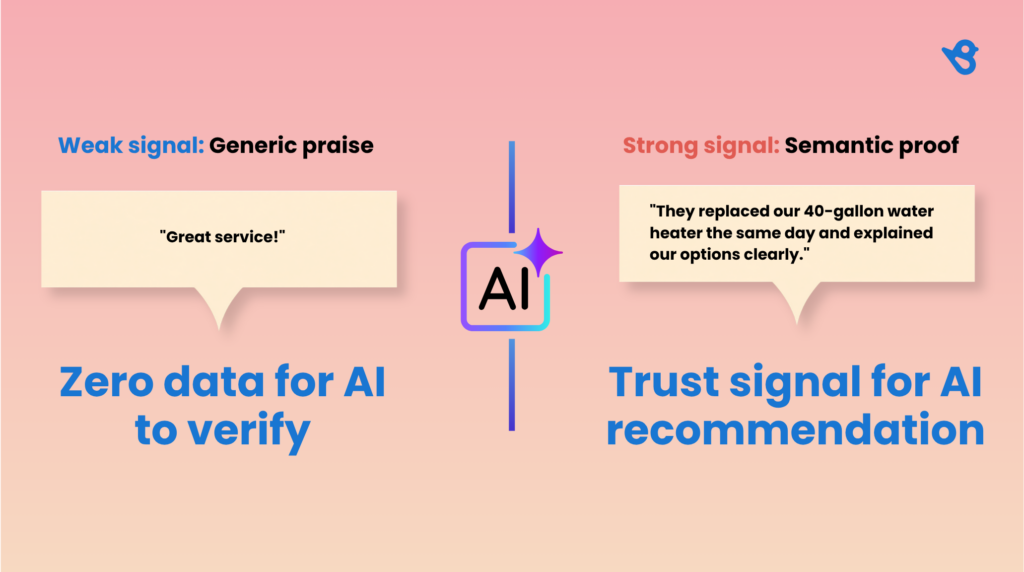
The second review tells AI exactly what was performed, how fast the team responded, and why the brand is credible for that job type. That specificity is what triggers a recommendation for high-intent plumbing and HVAC queries.
The numbers reflect how much this has shifted. According to Birdeye’s State of Online Reviews 2025 report:
- Reviews with written comments grew from 79% to 81%, giving AI a larger narrative dataset to analyze
- Review response rates rose from 63% to 73%, a 15% increase, as brands recognize that engagement itself is a visibility signal
- 81% of all home services reviews now sit on Google, making response speed and detail central to how AI reads a brand’s operational credibility
Your reputation has moved from a score to a data stream. If your reviews don’t demonstrate operational competence in specific terms, AI has no basis to recommend you with confidence.
4. Can AI see urgency and availability signals?
The home services sector has a high concentration of urgent intent. A leaking pipe, a dead furnace, or a broken garage door are “solve this now” problems.
AI cannot infer emergency capabilities unless a brand’s digital presence explicitly states them. That means surfacing urgency signals across:
- Service pages
- Location pages
- Business profiles
- Directory listings
- Review content and responses
Language like “24/7 emergency service,” “same-day repair,” “after-hours dispatch,” and “weekend availability” helps AI distinguish a general provider from one equipped to handle an urgent job.
5. Can AI validate professional credibility?
Home services customers want reassurance before letting someone into their home. AI looks for the same credibility markers people do:
- Licenses and insurance
- Certifications
- Years in operation
- Technician credentials
- Recent, detailed reviews
For multi-location brands, this is where portfolio-wide inconsistency becomes expensive. One region may have rich trust signals. Another may have thin profiles, outdated hours, and generic reviews. AI treats those two locations very differently, and so will the customer who never sees the weaker one.
Contractors looking to strengthen their broader digital presence can also explore these marketing strategies for contractors
Where do multi-location home services brands typically fall short?
Most enterprise home services brands don’t suffer from a lack of presence. They suffer from a lack of problem-level clarity.
Corporate sites are polished. Paid search programs are mature. But the granular evidence AI requires is often missing at the local layer. To an AI assistant, a well-designed page is secondary to a highly informative one.
The gaps that consistently reduce AI readiness include:
- Category pages that are too broad
- Location pages with thin service detail
- Incomplete service-area data
- Missing urgency language
- Generic reviews with little job specificity
- Inconsistent credentials across platforms
- Uneven review recency across locations
This is the shift marketing leaders need to internalize. AI search is not about whether the brand exists online; it's about whether the brand is legible to AI in the exact context of the customer's problem.
What should enterprise home services brands prioritize?
For enterprise home services brands managing 50, 200, or 500 locations, AI optimization is an operating model, not a one-time sprint. The goal is to make every location easy for AI to understand, trust, and recommend.
Priority 1: Speak the language of the problem
General “HVAC Services” pages are no longer sufficient. AI rewards specificity. Build service-specific pages that mirror how homeowners describe their situations:
- Use problem-based language: Write “AC blowing warm air” or “furnace replacement” rather than broad category terms.
- Add diagnostic depth: Explain symptoms, likely causes, and local urgency context to build the confidence AI needs to recommend a specific location.
Priority 2: Bridge the gap with problem-based FAQs
FAQs are among the strongest structural links between conversational search and AI retrieval. Prioritize “complex intent” questions that Google’s AI Overviews favor:
- “Is a sparking outlet an emergency?”
- “Why is my AC running but not cooling?”
The objective is to move from providing information to providing decisions, in a form clear enough that AI can cite the answer directly.
Priority 3: Shape the narrative in your reviews
Volume is the entry fee. Specificity is the win. A generic “Great job” tells AI nothing. Shift your review request approach to prompt for:
- The job: What was actually fixed
- The response time: How quickly the team arrived
- The resolution: Whether it was same-day
Priority 4: Standardize operational readiness data
Completeness and accuracy are Google’s stated baseline for local visibility. For large networks, this requires consistent synchronization of:
- Emergency availability, same-day status, and service-area boundaries
- Matching credentials and contact data across every directory
Inconsistent data produces ambiguous signals, and ambiguity is a reason for AI to skip a location entirely.
Priority 5: Measure AI visibility directly
Stop treating organic traffic as a proxy for AI performance. The metrics that matter now are:
- Citation share: Which locations hold the #1 AI citation in their market?
- Coverage gaps: Which service categories are absent from AI Overviews?
Signal quality: What specifically is driving top-performing locations, and what’s missing at the rest?
How do leading home services brands act on these signals at scale?
For brands managing hundreds of locations, the challenge is not knowing what to fix. It’s closing the gaps consistently across the entire portfolio without manual intervention at every location.
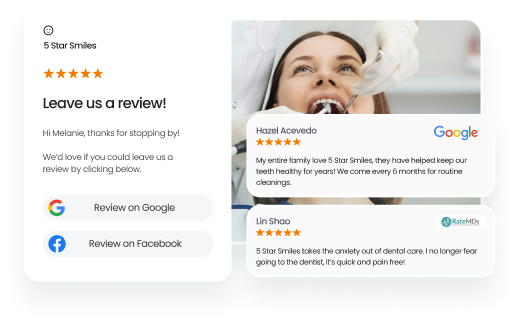
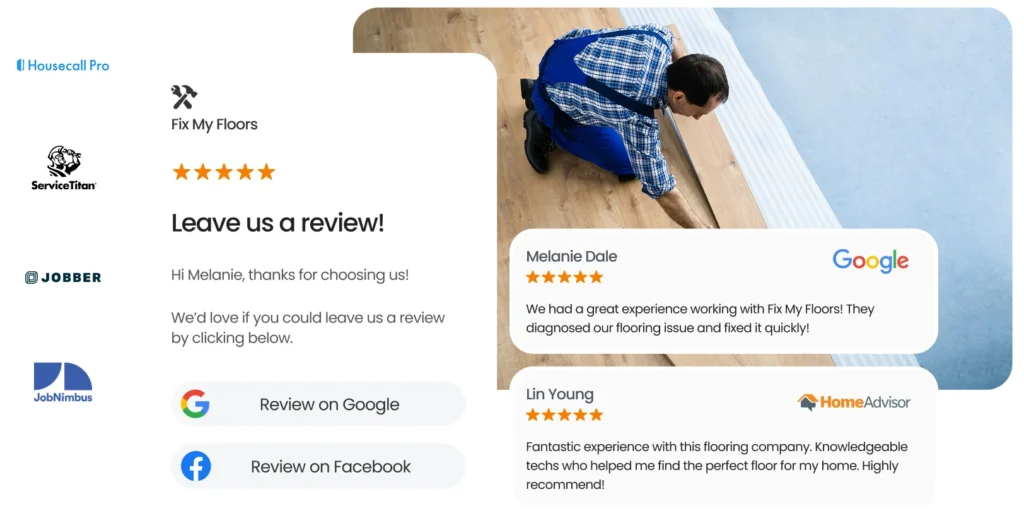
Birdeye’s Review Generation Agent helps brands collect more operationally detailed reviews across 100-10,000+ locations while maintaining human-in-the-loop control. In home services, richer review text gives AI stronger evidence of what each location did, how quickly it responded, and how the job was handled.
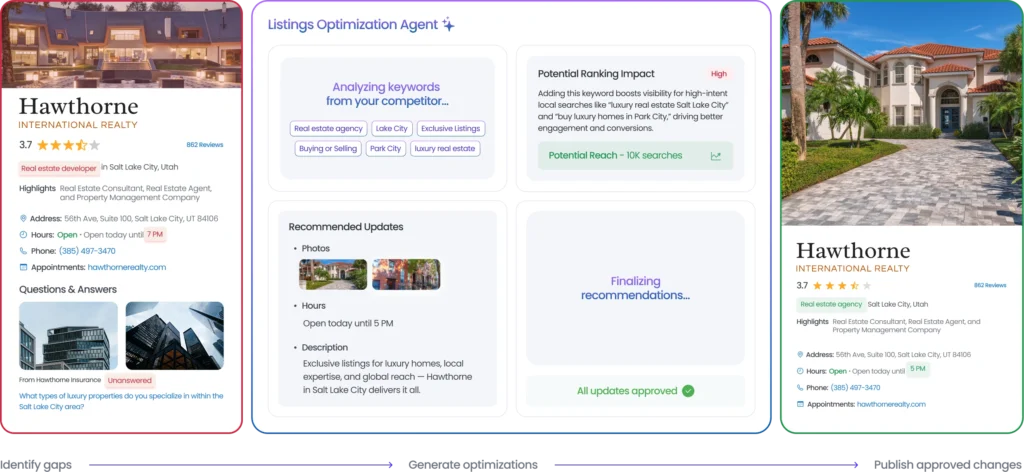
Listings AI and the Listings Optimization Agent improve the completeness and consistency of structured location data across the platforms AI systems rely on. When a brand needs AI to correctly read service areas, hours, categories, and emergency availability across thousands of locations, structured data accuracy is the foundation.
Search AI adds the visibility layer. It helps brands monitor how they appear across AI search experiences, identify where locations or service lines are missing, and determine whether stronger reviews, richer listings, or clearer location signals are needed to close the gap.
For large home services brands, that’s the practical value of a full-cycle agentic marketing platform like Birdeye. It connects signal-building work with monitoring, so teams can act on visibility gaps rather than just observe them.
AI search readiness checklist for home services brands
Use this checklist as a working audit across your portfolio.
- Each core service has its own page. Avoid grouping everything under “HVAC” or “Plumbing.”
- Location pages name the services that the location actually performs. Don’t rely on a generic brand template.
- Service areas are complete and consistent across platforms. AI needs geographic certainty.
- Emergency and same-day availability are clearly stated where true. Don’t leave AI to infer urgency capability.
- Licenses, certifications, and insurance details are easy to find. Professional credibility should be visible, not buried.
- Review requests prompt customers to mention the job performed. Generic sentiment leaves signal value on the table.
- Every location has a steady flow of recent reviews. Capital One Shopping Research found that 77% of consumers prefer reviews no older than three months, and 44% want reviews from the past month.
- Review responses add useful context, not just acknowledgment. Responses reinforce service specificity and signal responsiveness.
- Business profiles are complete, up to date, and aligned with the website. Google states that completeness and accuracy improve local visibility.
- The brand measures AI visibility by location and service line. Rankings alone don’t reveal how AI describes or recommends the brand.
What does this mean for lead generation?
The old model treated search visibility as a keyword acquisition problem. The new model treats it as a recommendation problem.
That distinction matters for enterprise home services marketing teams because recommendation systems compress the research phase. When AI can summarize a problem and narrow the choice set, the brand that appears first with the clearest evidence has a conversion advantage before any click happens.
This doesn’t make traditional SEO obsolete. It changes what strong SEO must feed.
Content, business profiles, and reviews still matter. But they matter as inputs to an answer engine, not only to a ranking engine.
The enterprise home services brands that adapt fastest won’t just chase more traffic. They’ll build a stronger, more specific case for why each location should be recommended when a customer describes a real-world problem. That translates to protected lead volume, better conversion efficiency, and a stronger position as AI becomes a more decisive custodian in local discovery.
It’s worth noting that AI-sourced leads are also largely invisible in standard analytics. Most platforms attribute them as direct or branded search traffic, which means the impact of AI on your current pipeline is probably already larger than your dashboards suggest.
So, the opportunity isn’t just to keep pace with a new search behavior. It’s to influence the recommendation layer before it consolidates around a smaller set of trusted brands.
FAQs about AI search for home services
No, not directly or immediately. But AI influences the shortlist before a customer clicks into any directory. That means brands need to ensure their own listings, reviews, and service content are strong enough to earn AI recommendations independently of directory presence.
Specific reviews help AI understand what actually happened. A review that mentions the service performed, response time, technician behavior, and outcome gives AI far stronger evidence than a generic five-star comment.
Explicit urgency language. If your site, profiles, and reviews don’t state emergency availability, same-day service, or after-hours response, AI has no basis to recommend you for urgent queries.
By improving the signals AI reads and by monitoring how those signals appear. Review Generation Agent supports richer, more specific reviews. Listings AI and the Listings Optimization Agent maintain structured location data accuracy. Search AI gives teams visibility into where citation gaps exist and what’s driving them.
Yes. Local SEO provides the underlying data AI systems rely on. The difference is that brands now need to optimize for interpretation, not just for ranking.
Yes. Conversational queries carry more context, urgency, and purchase intent than short keyword searches. When a customer describes the actual problem, the path from discovery to booking is often much shorter.
The next battleground is not ranking. It’s recommendation
AI search is moving from an assistive layer to a decision-shaping layer. As that shift accelerates, competitive advantage will come from how clearly a brand communicates service capability, local relevance, and operational trust at the location level.
That raises the bar for home services marketing leaders. Visibility will depend less on broad category presence and more on whether AI can confidently connect a real customer problem to the right provider in the right market.
Leading home services brands are already treating AI search as a recommendation problem. Birdeye’s Agentic Marketing Platform connects review signal quality, listings accuracy, and AI visibility monitoring across every location. Watch a demo to see how.

About the Author

Kukil Bora
Birdeye
Originally published