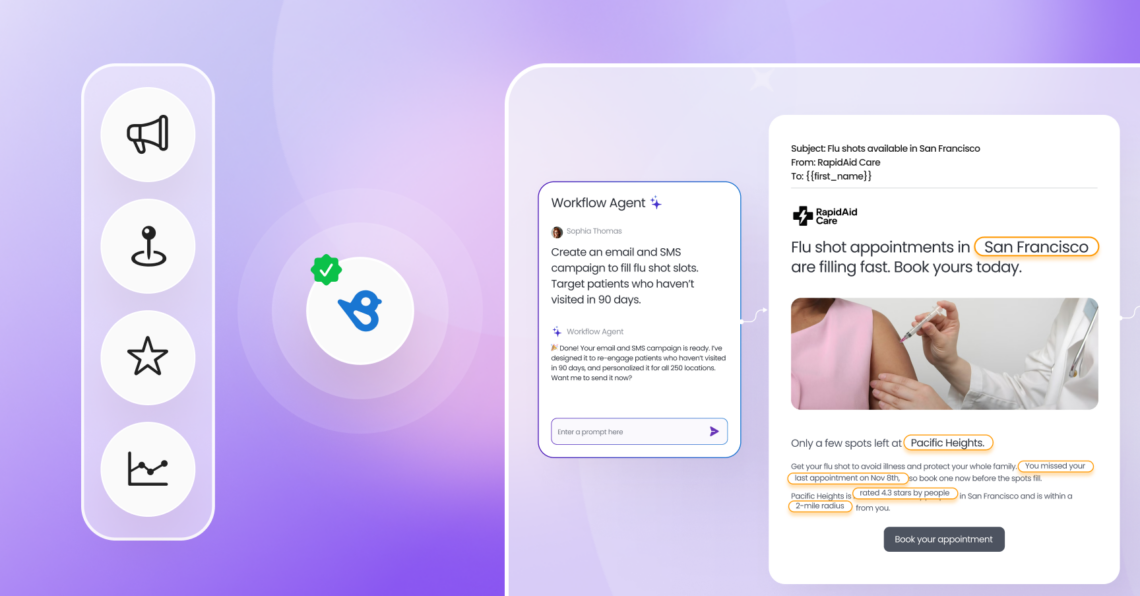
Traditional marketing automation has helped brands send more messages for years, but it rarely keeps up with the messy reality of multi-location businesses, where each site has different demand, reputation, and customer behavior. AI agents change that by watching what customers actually do, listening to real-time signals like reviews and survey responses, and then deciding who to reach, with what message, and when, all based on the goals you set in plain language.
Summary of the blog
Multi-location brands struggle with traditional marketing automation because it was never built for their disorganized data, local differences, and operational load. AI agents offer a better model: you set the goal in plain English, and campaigns can adapt by location using signals like reviews, ratings, and customer behavior, all while you stay in control. This blog post breaks down what that agent-driven approach looks like in practice, and how Birdeye Marketing Automation brings it to life for multi-location teams.
Table of contents
- Summary of the blog
- What multi-location problems does traditional marketing automation usually fail to solve?
- Why traditional marketing automation fails multi-location brands
- How does Birdeye Marketing Automation solve multi-location complexity?
- How is Birdeye Marketing Automation different from competitors?
- How does Birdeye Marketing Automation help enterprises stay compliant and in control?
- How Birdeye’s agentic marketing platform connects the dots with Marketing Automation
- FAQs about Birdeye Marketing Automation
Let’s start with why traditional marketing automation breaks down when you’re running dozens or hundreds of locations.
What multi-location problems does traditional marketing automation usually fail to solve?
Most marketing automation tools were built for one business, one funnel, one set of customers, and one marketing calendar. Multi-location brands don’t live in that world.
At the corporate level, you’re trying to run a consistent brand. At the location level, you’re dealing with local demand, staff, competition, and reputation. The gap between those two realities is where traditional marketing automation tools struggle.
Here are common symptoms you’ve probably seen:
1. Built for e-commerce and B2B assumptions
Most marketing automation tools were designed for e-commerce and B2B teams. They assume one brand, one funnel, and one set of rules, which works when your business runs as one unified motion.
2. Multi-location reality doesn’t behave like one “funnel”
Multi-location brands operate with real variation. One location may be recovering from poor reviews, another is focused on driving repeat visits, and a third is reacting to seasonal or local demand.
3. “Automation” exists, but it can’t handle location-level variation
You can automate sends, but many systems can’t adapt the campaign strategy by location. That’s when teams end up copying a “winning” campaign everywhere, even when it doesn’t fit.
4. Customer and location data are spread across systems
In multi-location setups, customer data and location signals live in different tools. That makes targeting and personalization at the location level harder than it should be and slower to execute.
5. Manual workarounds become the default
When the system can’t connect data or adapt campaigns, people step in. Teams start pulling lists, stitching segments, duplicating workflows, and doing last-minute fixes, just to get something out the door.
6. Engagement and conversions usually take the hit
The cost of all that manual work is not just time. Campaigns become less relevant, timing slips, and performance gets uneven, causing engagement and conversion rates to suffer across locations.
Why traditional marketing automation fails multi-location brands
While the symptoms above are painful, they stem from four fundamental structural failures. When you try to force a single-location tool to manage 50, 200, or 500 locations, it breaks down in these specific ways:
1. Built for one brand
Traditional tools assume every part of your business is in the same stage of growth. They force you to treat every location as if it were identical.
Consider a dental group with 50 clinics. One location might be fully booked for weeks, while another across town is struggling to fill chairs. Traditional tools force you to push one blanket campaign to all 50. You end up wasting budget marketing to the fully booked location while failing to drive necessary traffic to the struggling one.
2. Scaling = Cloning
To “scale” in legacy platforms, marketing teams are often forced to manually duplicate campaigns and workflows across locations because there is no central brain that adapts local details automatically.
Take a fitness brand with 500+ locations. Some gyms offer yoga, while others offer Pilates. To send relevant messages, the corporate marketing team ends up managing hundreds of campaign variants via spreadsheets. Scaling becomes an operational nightmare rather than a growth engine.
3. Fragmented data
In a multi-location setup, customer and location data live in different systems. Appointments are in your EHR or PMIS, feedback is in survey tools, reviews are on Google, and campaign history is in your marketing tool.
For a healthcare provider with 200+ locations, this fragmentation breaks the customer experience. Because there is no unified customer context, you might send a promotional email to a patient who just left a negative review or fail to follow up with a patient who is overdue for an appointment.
4. Static workflows
Legacy marketing automation runs on rigid, unchangeable rules. but not in a good way. Once configured, workflows run the same way everywhere, regardless of how a specific location is performing or how customer sentiment shifts.
Imagine a wellness and spa brand where a specific location’s rating drops from 4.6 to 4.2, or survey sentiment turns negative. A static workflow keeps sending the same “Refer a Friend” campaign, completely ignoring the dip in quality. The campaign doesn’t change to address the issue, leading to inappropriate messaging and higher churn.
This is why marketing automation for multi-location brands must be location-aware, not merely automated. Automation only works if it understands what is actually happening at each front desk.
How does Birdeye Marketing Automation solve multi-location complexity?
Birdeye Marketing Automation is designed around a simple idea: your campaigns should reflect what’s happening locally while still staying on-brand and under your control.
It does that through three pillars:
- Location intelligence
- Agentic automation
- Unified customer data
1. Location intelligence
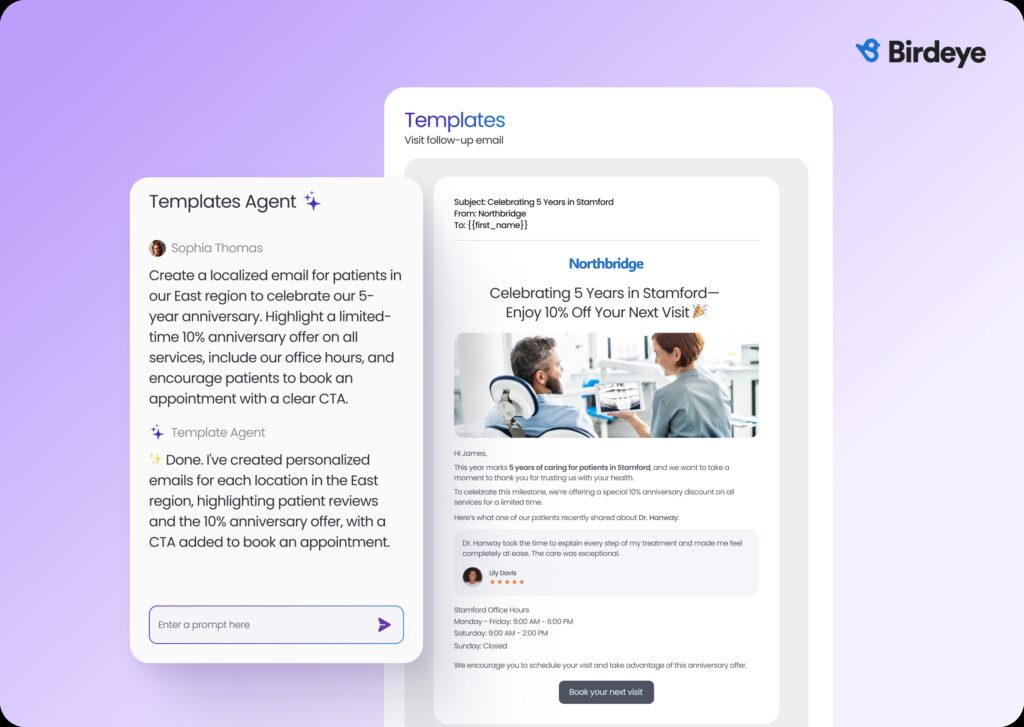
Location intelligence is what makes marketing automation work for multi-location brands. Birdeye Marketing Automation uses AI agents to personalize campaigns by location using real location context, such as:
- Business hours and services
- Current offers
- Ratings and review signals
- Brand and location context
This helps your emails and SMS stay accurate and relevant. Messages can automatically reflect the right office hours and services for each location, and they can include details that match what’s happening locally.
What works for one location isn’t copied to another. Every campaign adapts by location. For example:
- Some locations may promote memberships
- Others may run discounts
- A third segment may send informational messages
Execution is guided by experience signals, such as reviews, ratings, Birdeye Score, and survey ratings, so outreach reflects what customers are seeing and saying at each location. And, performance and ROI are tracked at both the location and campaign levels, so you can quickly see what’s working, where it’s working, and what needs to change.
2. Agentic automation
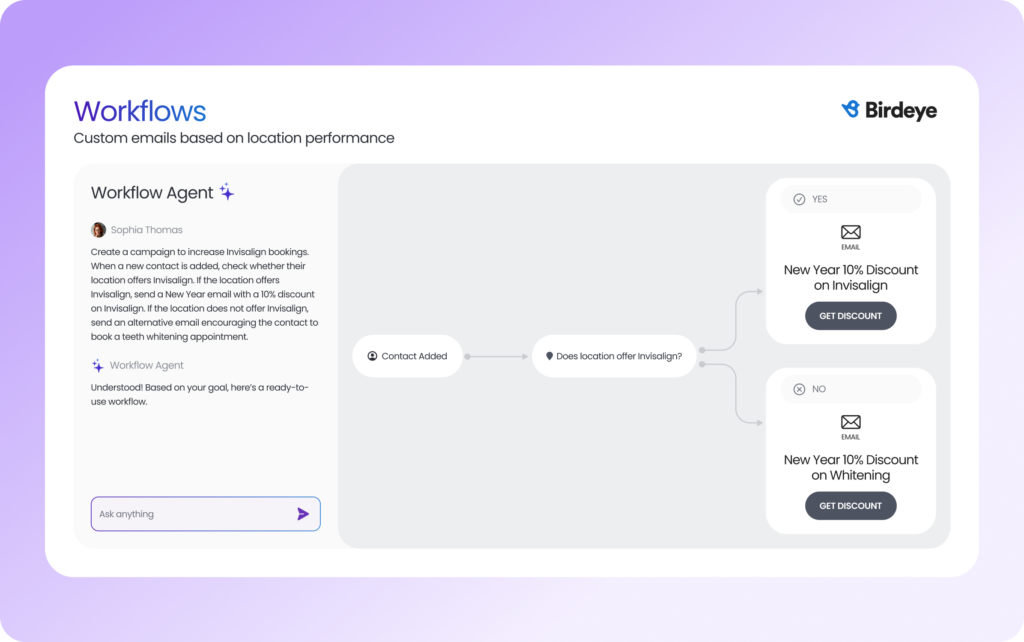
Most platforms still treat marketers as the “workflow builders.” You drag boxes on a canvas, wire up triggers, and then spend time checking whether it’s running the way you intended.
With Birdeye’s agentic automation, the work shifts from building workflows to stating goals. You tell AI agents what you want to achieve, and they design and run the campaign for you.
You start with a plain-English goal, like:
- “Re-engage members in Florida who haven’t visited in 90 days.”
- “Drive appointments for new locations this month.”
- “Follow up with customers who left 3-star reviews.”
From there, agents handle the setup and execution steps, including building the segment, drafting emails and SMS, setting schedules, choosing the right channel, and improving performance based on live results. In fact, early adopters of agents in marketing automation report up to 15x faster campaign creation and execution.
It’s also worth calling out what this is not. AI agents aren’t just copy helpers. They can support end-to-end campaign work, including:
- Creating segments based on behavior, sentiment, and location
- Generating campaigns that stay within brand rules
- Adjusting timing and content based on engagement signals
However, you’re not handing over the keys. Your team stays in control through review and approval of the parts that matter, like segments, messages, and key templates or settings. You also set the guardrails: what offers are allowed, how often people can be contacted, and what consent or compliance guidelines to follow.
The end result is simple: less time wiring workflows and cleaning data, and more time spent on strategy, testing, and creative work that actually moves the needle.
3. Unified customer data
If your customer and location data are split across tools, even the best campaign ideas fall flat. You lose hours compiling lists instead of reaching people, and without a unified view, personalization becomes guesswork. It’s a widespread struggle: about two in five marketers still lack the real-time data needed for basic tasks, forcing teams to rely on manual workarounds rather than actual customer signals.
Unified customer data brings your key signals into one profile per customer, per location. That profile can pull together the context marketers actually need, such as:
- Reviews and ratings
- Survey responses
- Past visits or appointments
- Engagement with past emails and SMS
- CRM data and other connected systems
Once that context lives in one place, targeting becomes much easier. Instead of exporting and cleaning CSVs, agents can build segments based on real behavior and experience—like “customers who visited twice in the last year but not in the last 90 days,” or “patients who left a 3-star review and didn’t get a follow-up,” or “members who clicked a pricing email but never booked.”
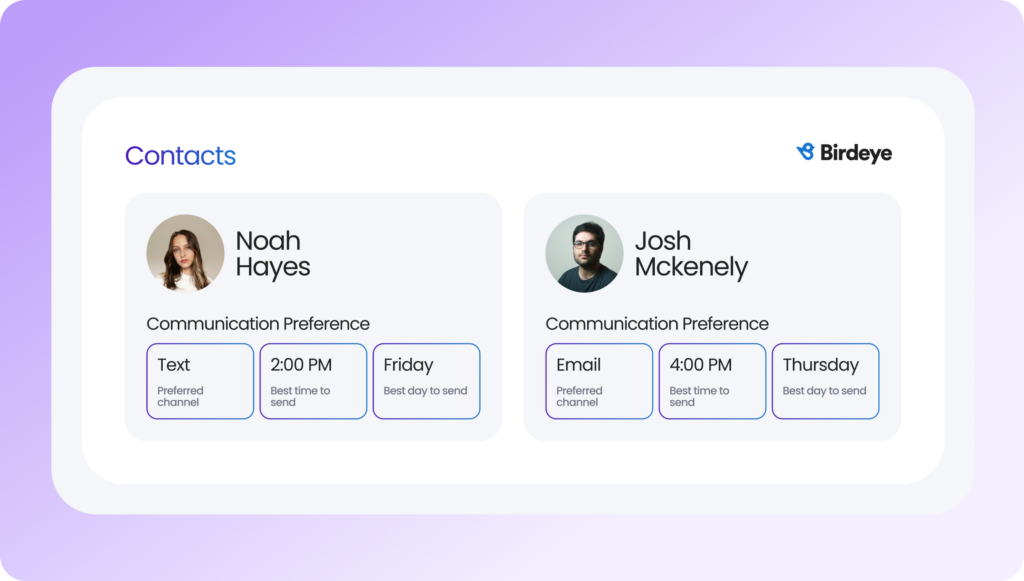
Unified data also helps with timing and channel choices. The system can analyze each person’s engagement history to determine when they’re most likely to open or respond, and whether email or SMS is a better fit. Two people in the same city might get the same message at different times, or via different channels, because their behavior is different.
The result is simple: less guesswork and more relevance. With unified data, agents can use the full customer context to make smarter targeting and delivery decisions for every location and every contact.
If you’ve evaluated automation platforms before, you’ll notice that many of them solve pieces of this, but not the full multi-location problem.
How is Birdeye Marketing Automation different from competitors?
Most marketing automation platforms can send emails and texts. The real question is whether they can do it well across 50, 500, or 5,000 locations, without forcing your team to copy workflows, constantly maintain data, and fight inconsistency.
Here are five practical differences that set Birdeye Marketing Automation apart from other tools in the market.
1. Location-aware triggers, not just CRM events
Most tools trigger workflows when a contact field changes or a form is submitted.
Birdeye starts one level higher: with the health of each location.
If your Birdeye Score drops below 60, negative reviews spike, or survey ratings dip, that becomes a trigger for targeted campaigns. That means your automation reacts to what’s actually happening on the ground, not just to static contact properties. Competitors trigger on contacts. Birdeye also triggers on location health.
2. AI agents that actually simplify work
Competitors often position AI as a helper, something that suggests a subject line, rewrites a paragraph, or generates a few variants of copy. That’s useful, but it doesn’t remove much of the grind. You still have to build the workflow, create the segment, schedule the sends, and keep everything up to date across 100-10,000+ locations.
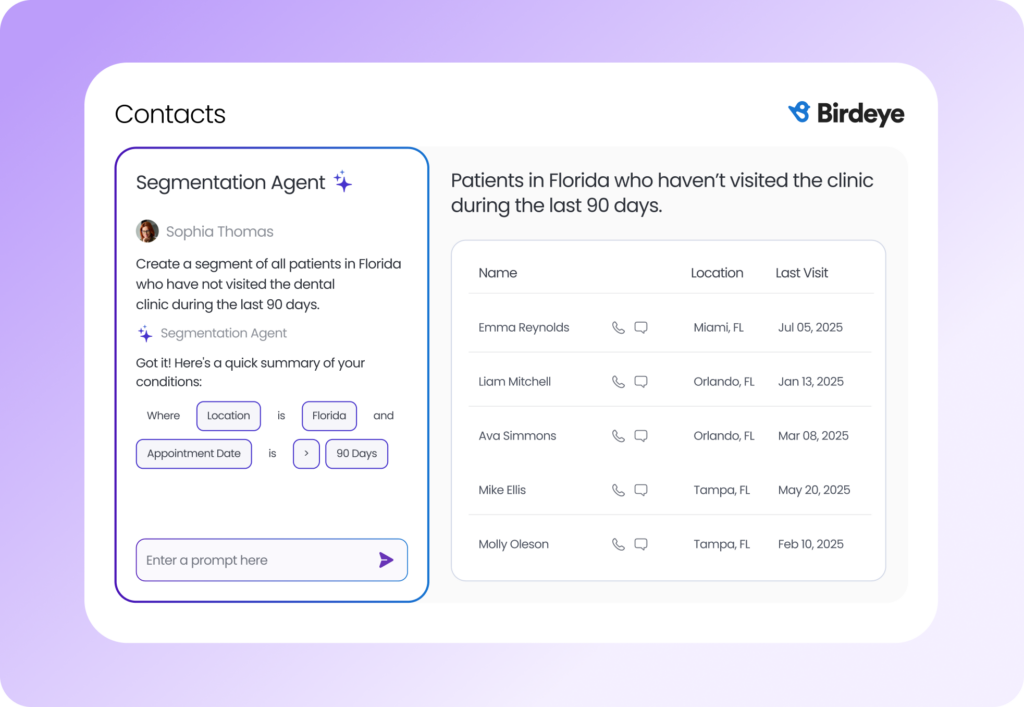
Birdeye uses AI agents to own the entire workflow. You write a prompt in natural language. The agent handles everything else: building segments, drafting messages, setting the schedule, picking the channel, and optimizing over time. Instead of you wiring up dozens of steps, you focus on the goal and the guardrails.
3. Localized content, with spam detection
In many competitor platforms, personalization often stays at the token level (name, city, last service date) and broad segments. Birdeye goes deeper into the local context.
With Birdeye Marketing Automation, emails don’t just pull in the first name. They also obtain location-level reviews, ratings, hours, and offers, so each message that goes out feels relevant to that location and that customer. Even better, attachments are also scanned for spam detection to protect deliverability, which matters because a beautifully written campaign is useless if it lands in spam.
4. Smart channel and time selection for each person
Most competitors send the same message to everyone at once. Their features for better timing still focus on the entire campaign rather than the individual customer.
Birdeye Marketing Automation is different. It uses a person’s past activity to figure out the best time and channel (email or SMS) for every message. For example, if a customer usually engages with SMS at 5 pm and another customer prefers email at 10 am, they’ll each receive the message in their preferred channel at the time that works best for them, even if they visit the same location.
By learning and adapting to each customer individually rather than relying solely on list-based data, the Birdeye system ensures that every customer receives the message at their optimal open time.
5. Location-level reporting, not just campaign rollups
Most competitors report primarily at the campaign level, which isn’t enough when you need to manage performance across dozens or hundreds of locations.
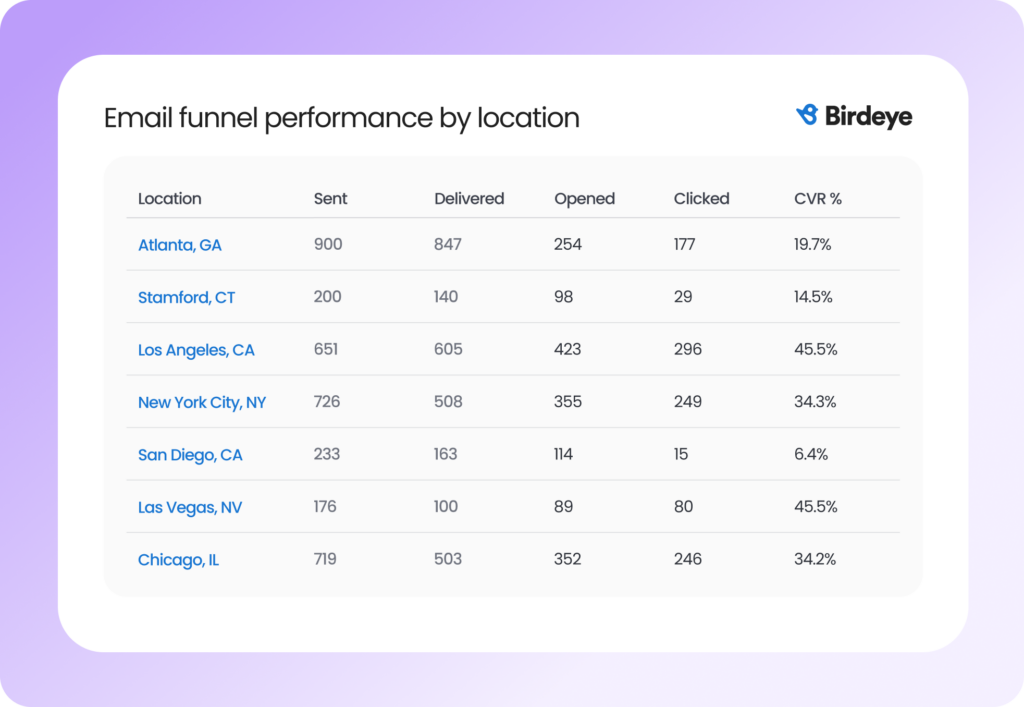
Birdeye lets you track performance and ROI—opens, clicks, conversions, appointments, and revenue—by location. You can immediately spot which locations are outperforming, which ones are struggling, and where a good campaign needs a different local version.
Once teams see how the system works, the next question is: “How do we keep brand control and meet compliance requirements at scale?”
How does Birdeye Marketing Automation help enterprises stay compliant and in control?
For global enterprises, the goal isn’t to send more campaigns. It’s to run the right campaigns across different locations, without losing control. Marketing Automation supports such enterprise-grade enablement with reusable templates and location-level reporting, allowing leadership to monitor performance across the network and keep campaigns consistent as they roll out.
For regulated industries like Healthcare and Finance, you need strong governance just as much as speed. Marketing Automation is designed to support industry compliance needs, such as HIPAA and FINRA, so teams can run campaigns with the right controls in place without slowing execution.
Governance is easier when your campaigns, customer context, and experience signals live in the same place. That’s where the bigger Birdeye platform comes into play.
Birdeye Marketing Automation has been seamless to use. It gives us confidence that the right messages are reaching the right customers at the right time.
— Matthew Peterburs, Marketing Manager at KO Storage, 200+ locations.
How Birdeye’s agentic marketing platform connects the dots with Marketing Automation
Marketing Automation is a key part of Birdeye’s larger agentic marketing platform. The platform gives multi-location brands a single system to drive awareness, conversion, and customer experience without having to juggle many tools.
At the awareness stage, products like Search AI help your locations appear when people use AI engines such as ChatGPT and Gemini, so more local customers find you.
At the conversion stage, Marketing Automation turns that demand into actual visits and appointments. It uses the same data as your reviews, surveys, listings, and messaging, ensuring every email and SMS reflects what is truly happening at each location.
At the experience stage, signals from reviews and surveys are fed directly into campaigns. If ratings drop or feedback changes, agents can automatically launch recovery or education journeys.
Because everything runs on a single platform with shared data, AI agents can work together across the entire customer journey. This provides you with consistent branding, common controls, and clear location-level reporting, while the agents manage the heavy lifting behind the scenes.
FAQs about Birdeye Marketing Automation
Marketing Automation is designed for CMOs and marketing teams at multi-location brands across industries like healthcare, dental, storage, retail, home services, recreation, wellness, automotive, financial services, and restaurants.
Traditional platforms assume a single brand, funnel, and database with clean data, which breaks down in multi-location environments and creates operational burden. Birdeye’s solution is AI-native, agent-first, and built specifically for the complexity of distributed locations, fragmented data, and the need for local personalization with central control.
Marketing Automation currently supports email and SMS campaigns orchestrated by AI Agents, using unified customer and location data to personalize each touchpoint.
No. Marketers stay in control by setting objectives, reviewing agent-created segments and content, using templates and guardrails, and monitoring location-level reporting. Agents remove repetitive work, but strategy, governance, and final approvals remain with the marketing team.
Birdeye Marketing Automation is built for enterprise needs and supports industry-specific requirements such as HIPAA and FINRA, while integrating with existing systems through governed connections. Centralized templates, permissions, and auditability help brands maintain compliance without slowing down execution.
Want to see how Birdeye Marketing Automation can revolutionize your enterprise marketing strategy? Schedule your demo today.
About the Author

Kukil Bora
Birdeye
Originally published