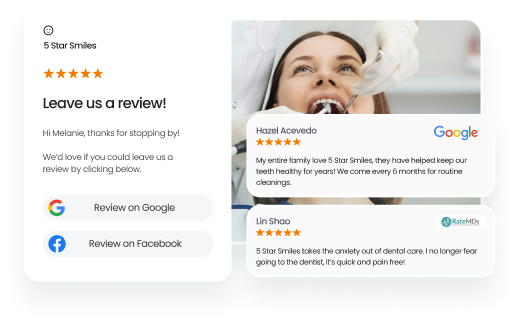
Do you remember a time when you were so impressed with a brand that you willingly left a five-star review?
A couple of days later, a generic survey lands in your inbox. No mention of the review you just wrote. A week after that, a promotional email shows up asking if you’ve ever visited before.
Individually, each message makes sense. But together, they feel like the brand isn’t really paying attention.
For many brands, this is how marketing actually plays out. Reviews live in one system. Surveys in another. Reminder campaigns follow their own schedules. As locations, teams, and customer interactions grow, these gaps become harder to manage.
Summary
Omnichannel marketing automation connects customer interactions across channels and automates next-best-response. Instead of treating every touchpoint as a fresh start, marketing teams can stay in sync, respond with context, and deliver a more consistent customer experience at scale.
In the sections ahead, we’ll break down what omnichannel marketing automation actually means today, where most teams struggle, why AI agents are becoming essential, and how Birdeye helps multi-location brands make it all work.
Table of contents
- What does omnichannel marketing automation actually mean today?
- Omnichannel vs multichannel marketing automation: What’s the real difference?
- How do teams know if omnichannel marketing automation is working?
- How does omnichannel marketing automation improve customer engagement?
- How Black Bear Diner manages guest feedback across 160+ locations
- FAQs on omnichannel marketing automation
- Birdeye: The platform multi-location brands trust for omnichannel marketing automation
What does omnichannel marketing automation actually mean today?
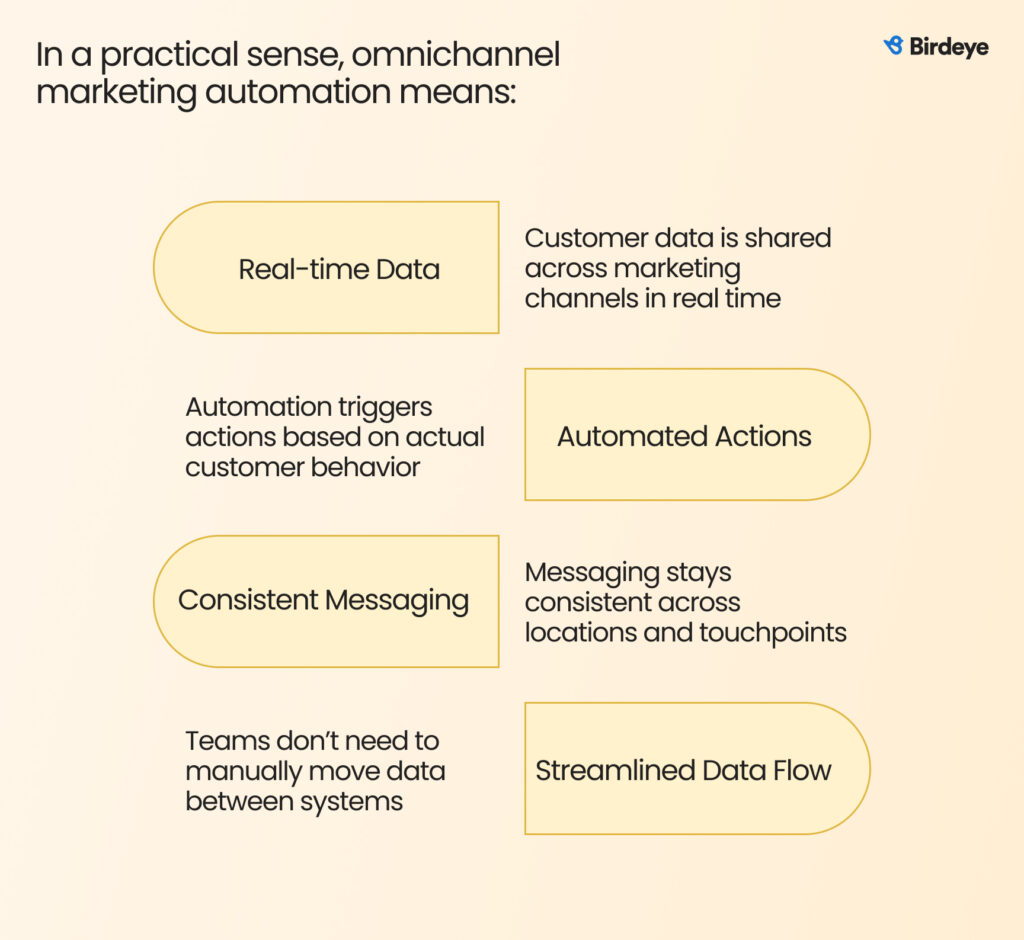
Omnichannel marketing automation is the ability to manage customer interactions across multiple channels using connected data and automated workflows. Instead of treating reviews, surveys, messages, emails, and campaigns as separate activities, everything is informed by the same customer context.
This means marketing systems don’t just collect data, they share it.
Why does omnichannel marketing automation matter so much for multi-location brands?
At this point, many teams assume they already have omnichannel marketing in place because they’re active across multiple channels. That assumption is exactly where confusion begins.
As multi-location brands grow, complexity increases quickly. Customer interactions multiply across locations, regions, and channels. Without a connected system, inconsistencies become inevitable.
Common challenges multi-location brands face without omnichannel automation include:
- Inconsistent follow-ups across locations
- Slow response times to customer feedback
- Limited visibility for leadership teams
- Disconnected data across marketing operations
Omnichannel marketing automation brings structure to this complexity. It enables multi-location brands to operate with consistency, speed, and clarity as they scale. Marketing efforts become easier to manage, performance becomes easier to measure, and customer experience becomes more reliable across all locations.
Once teams understand this, a natural question follows: how is this different from what most brands are already doing?
The next phase of omnichannel marketing automation: Agentic platform
Want to see the impact of Birdeye on your business? Watch the Free Demo Now.
Omnichannel vs multichannel marketing automation: What’s the real difference?
On the surface, omnichannel and multichannel marketing can look similar. Both involve using multiple marketing channels, such as email, text, social media, reviews, and surveys. The difference lies in how those channels work together.
Multichannel marketing automation focuses on presence. Each channel runs its own campaigns, often with its own tools, timelines, and rules. The goal is to reach customers in more places, but the channels don’t share much context.
Omnichannel marketing automation focuses on connection. Channels are linked through shared customer data and automation, so each interaction builds on the last one.
| Aspect | Multichannel marketing automation | Omnichannel marketing automation |
| Customer data | Stored separately in each system | Unified across channels and locations |
| Campaign timing | Runs on fixed schedules | Triggers based on real customer behavior |
| Customer experience | Feels fragmented across touchpoints | Feels continuous and connected |
| Team workflows | Managed separately by channel | Aligned across teams and locations |
| Local execution | Varies by location and team | Standardized with room for local action |
| Visibility for leadership | Fragmented reporting | Unified view across locations and channels |
| Scalability | Gets harder as locations increase | Designed to scale with multi-location growth |
Why this difference matters for multi-location brands
As the number of locations grows, small disconnects turn into big problems:
- Customers receive mixed or repetitive messages
- Local teams lack context when responding
- Leadership sees fragmented performance data
- Marketing operations become harder to manage
Understanding the difference is important. But for leadership teams, clarity only matters if it leads to measurable outcomes.
How do teams know if omnichannel marketing automation is working?
For multi-location brands, success isn’t about running more campaigns. It’s about whether teams can see what’s happening, act faster, and stay consistent across locations.
When omnichannel marketing automation is working well:
- Customer interactions feel connected across channels
- Follow-ups reflect recent reviews, surveys, or messages
- Local teams respond faster, with better context
- Leadership has visibility without manual reporting
For multi-location brands, the most reliable indicators of success include:
- Customer engagement across multiple channels
- Response times to reviews, messages, and feedback
- Consistency of messaging across locations
- Trends in customer satisfaction
- Signals tied to loyalty and repeat visits
Omnichannel measurement doesn’t stop at email clicks and review response time anymore. Customers now ask AI tools questions like “best option near me” or “which brand has the best reviews,” and those answers shape decisions before a customer ever reaches your site.
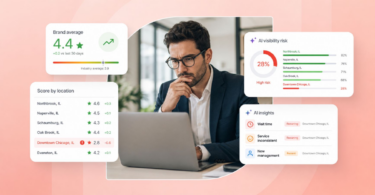
Birdeye Search AI helps multi-location brands track how often they appear in AI-generated answers, how they’re described, and whether key details like hours and phone numbers remain accurate across platforms like ChatGPT, Gemini, and Perplexity.

With connected systems, measurement becomes part of daily decision-making, not a monthly reporting exercise. When teams can measure what’s happening across channels, they also start to see how those connections affect customer behavior.
How does omnichannel marketing automation improve customer engagement?
Customer engagement improves when brands stop treating every interaction as a one-off.
With omnichannel marketing automation, what a customer says in a review, survey, or message directly influences how the brand responds next, regardless of channel.
Teams start to see improvements like:
- Responses that reflect recent customer feedback
- Follow-ups that feel timely instead of random
- Fewer repetitive or conflicting messages
- Smoother handoffs between channels and teams
Why this matters for multi-location brands
When customers feel recognized and responded to, engagement naturally leads to loyalty. Instead of generic outreach, interactions feel purposeful and informed.
Over time, this consistency shows up in higher customer satisfaction, repeat visits, and stronger customer lifetime value.
This shift becomes easier to understand when you see how it works in practice. Let’s see how a multi-location brand used omnichannel marketing automation to its benefit.
How Black Bear Diner manages guest feedback across 160+ locations
As Black Bear Diner expanded across the country, guest feedback grew just as fast. With 160+ locations, reviews, surveys, and comments were coming in from everywhere. The challenge wasn’t listening. It was acting on feedback quickly and consistently across every location.
Location managers needed timely alerts and clear ownership. Leadership needed a way to spot trends without digging through reports. Manual processes couldn’t keep up.
Black Bear Diner turned to Birdeye, the #1 agentic marketing platform for multi-location brands, to support omnichannel marketing automation across reviews, surveys, and insights.
Good to know: What is an agentic marketing platform?
An agentic marketing platform uses AI agents to continuously monitor customer interactions, prioritize actions, and support decision-making across channels. Unlike traditional automation, it helps teams decide what to do next, not just execute predefined rules.
Using Reviews AI, the team consolidates feedback from 150+ review sites into a single platform. Negative reviews automatically trigger alerts and support tickets, which are routed to the appropriate location manager for follow-up.
With Surveys AI and Insights AI, guest feedback is analyzed across locations to surface real patterns. In one case, Insights AI revealed that a menu item receiving complaints actually had twice as many positive mentions, preventing unnecessary operational changes.
Leadership teams also use Competitors AI to benchmark reputation and sentiment by market, supported by role-based dashboards and automated reporting.
This example highlights a broader shift happening across multi-location brands.
Why are AI agents becoming essential for omnichannel marketing automation?
As brands scale, the challenge isn’t just more channels. It’s more decisions, more signals, and more moments that require action.
Traditional automation relies on fixed rules. AI agents move beyond that, shifting from task automation to decision support.
In omnichannel marketing automation, AI agents help teams answer:
- What needs attention right now
- Where patterns are forming across locations
- Which actions will have the biggest impact
What AI agents actually do in omnichannel marketing automation
AI agents continuously monitor customer interactions across channels and decide what action makes sense next, based on context.
AI agents can:
- Detect sentiment in reviews, surveys, and messages
- Identify urgency and prioritize responses
- Route issues to the right team or location automatically
- Adjust messaging based on recent customer activity
- Surface patterns and trends without manual analysis
This level of intelligence only works when AI agents operate inside a connected platform built for scale.
How does Birdeye support omnichannel marketing automation for multi-location brands?
Omnichannel marketing automation only works when all customer interactions flow through a connected system. That’s exactly what Birdeye is built to do.
One platform for connected customer interactions
Birdeye replaces fragmented marketing tools with a single system that unifies customer data across channels. With Birdeye, multi-location brands can manage:
- Reviews from 200+ review sites
- Surveys and direct customer feedback
- Integrations with 3,000+ CRM and marketing automation software
- Messaging across text, web chat, and social media
- Social publishing and engagement
- Insights, reporting, and competitive benchmarking
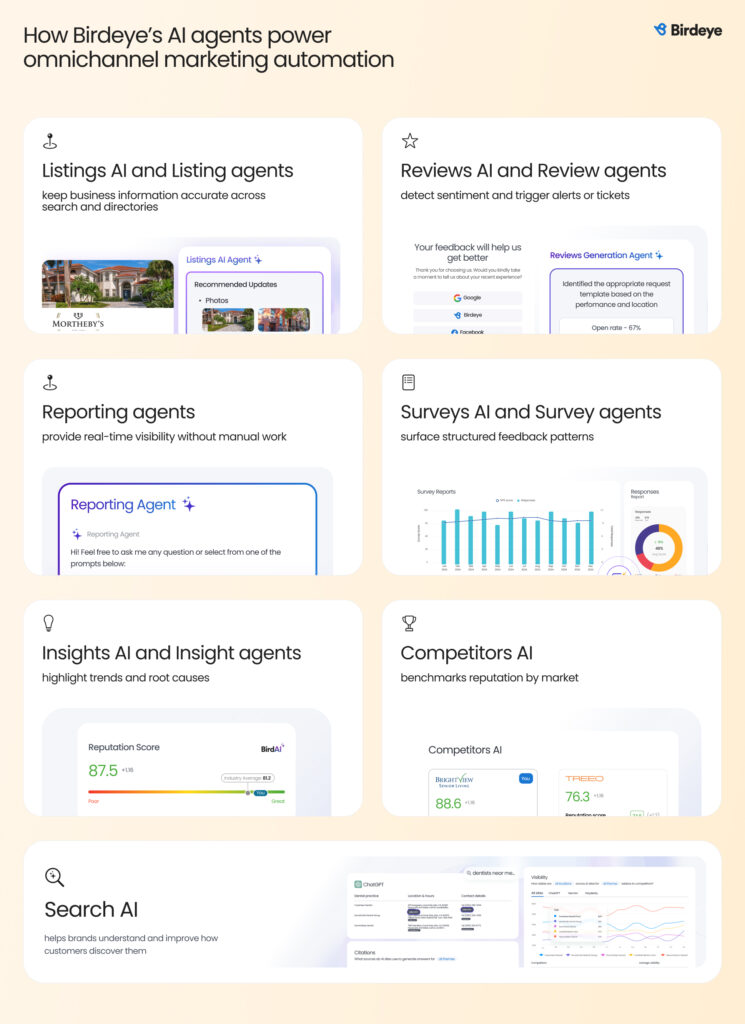
Omnichannel automation also depends on how customers discover you. As search shifts from keywords to AI-driven questions, brands need visibility and accuracy on the engines generating answers, not just the channels sending messages.
Birdeye Search AI helps you track, optimize, and improve how your brand appears on next-generation platforms while strengthening traditional local SEO.
- Track your AI visibility vs competitors across key prompts.
- Spot negative or inaccurate AI descriptions before they spread.
- Fix issues faster by improving listing accuracy, review signals, and the AI’s content sources.

FAQs on omnichannel marketing automation
Multi-location brands deal with higher volumes of customer interactions across many teams and locations. Omnichannel marketing automation helps maintain consistent messaging, faster responses, and better visibility across locations without relying on manual coordination.
AI agents monitor customer interactions across channels, detect sentiment and urgency, surface trends, and trigger actions automatically. This helps teams respond faster, reduce manual work, and make better decisions at scale.
No. While it’s especially valuable for multi-location brands, omnichannel marketing automation benefits any organization that manages customer interactions across multiple channels and wants to improve consistency and efficiency as it grows.
Birdeye is the #1 agentic marketing platform for multi-location brands. It unifies customer data across reviews, surveys, messaging, social, listings, and search, and uses AI agents to help teams manage customer interactions, insights, and reporting in one connected system.
Birdeye: The platform multi-location brands trust for omnichannel marketing automation
As customer interactions increase across channels and locations, the brands that succeed will be the ones that can respond quickly, stay consistent, and act on feedback without adding more tools or manual work.
That’s where Birdeye stands apart.
As the #1 agentic marketing platform for multi-location brands, Birdeye was built to handle the real complexity of omnichannel marketing automation. It unifies customer data, supports automation across reviews, surveys, messaging, social, and insights, and uses AI agents to help teams decide what needs attention next.

About the Author

Shruti Dugar
Birdeye
Originally published