A law firm SEO company is a specialized partner that helps large and multi-location law firms win more qualified cases by improving visibility, reputation, and client experience across search, reviews, and local listings.
Summary
Multi-location law firms now compete in a search environment where prospects compare rankings, reviews, and experience signals in seconds before deciding whom to contact. Choosing the right law firm SEO company directly shapes lead quality, case volume, and profitability across every office. The strongest partners blend technical SEO, local optimization, and content with enterprise-grade reputation management and listings control. Platforms like Birdeye extend this further by giving firms a single, AI-powered system to manage reviews, local presence, and marketing performance in one place.
Table of contents
- Why isn’t traditional SEO enough for law firms?
- What do most law firm SEO companies actually provide?
- Where do traditional law firm SEO services fall short?
- The essential role of reputation and local SEO
- How do leading law firm SEO companies use reputation and local SEO?
- How does Birdeye support modern law-firm SEO and online reputation management?
- Core SEO capabilities that multi-location law enterprises must prioritize
- Choosing your ideal law firm SEO solution: Agency, platform, or hybrid?
- What should you ask before choosing an SEO company for a law firm?
- Why Birdeye is the best choice for multi-location law firms
- FAQs for law firm SEO companies
- Building a strong, scalable local presence for every location
Why isn’t traditional SEO enough for law firms?
Most people seeking legal help don’t just click the first organic result. They compare multiple firms based on rankings, proximity, reviews, and visible proof of expertise before they ever call or complete a form. Traditional SEO tactics like keyword placement, meta tags, and blog posts alone don’t reflect how real clients make decisions today.
Large and multi-location firms have an added layer of complexity:
- Local competition varies significantly by region
- Regulatory and bar compliance affects messaging
- Intake workflows and conversion quality differ across offices
Without a strategy that connects visibility + reputation + client experience, firms may see higher traffic but not necessarily more (or better) cases. Leaders still struggle to answer critical questions:
- Are enquiries growing in the right practice areas and locations?
- Which SEO investments are generating signed matters?
- How do reviews and local presence impact conversion?
Modern SEO integrates content, listings, reviews, and experience signals into one connected system. When aligned correctly, this approach builds trust at the moment it matters most, when a prospective client is deciding whom to contact.
What do most law firm SEO companies actually provide?
Many such companies offer a familiar core set of services:
- Technical SEO to ensure search engines can crawl and index the site properly
- Keyword and on-page optimization for priority practice areas
- Content creation and link acquisition to build authority
- Analytics and reporting on traffic and rankings
While these improve visibility, they’re often measured and managed in isolation, with emphasis on search metrics rather than business outcomes. As a result, rankings may rise without corresponding growth in high-value matters.
This gap becomes especially clear for multi-location firms. Without connecting SEO efforts to review growth, local listing accuracy, and the quality of client interactions, it’s difficult to see what is driving enquiries and what needs to change to outperform local competitors.
Where do traditional law firm SEO services fall short?
The breaking point for traditional SEO occurs when firms attempt to link rankings and traffic to closed cases. Even if a website gains visibility, prospects also notice:
- Star ratings and review volume
- How recent and relevant the feedback is
- Whether office details appear accurate and trustworthy
- Signals of expertise (e.g., case types, responsiveness, outcomes)
If your SEO partner treats reviews, listings, and local search visibility as separate from strategy, you may see partial progress: Better positions in search, but no predictable increase in enquiries or retained clients.
To avoid that disconnect, a strong SEO partner should clearly define:
- Ownership: Which touchpoints they influence (e.g., website, listings, client feedback).
- Local support: How each office’s presence will remain accurate and visible.
- Measurement: How results map to meaningful business metrics like enquiries and case value.
This clarity keeps the focus on outcomes, not just activity, and ensures your SEO efforts align with how prospects actually choose representation.
The essential role of reputation and local SEO
For legal services, trust is the deciding factor, and today, that trust is built directly in search results. When someone looks for a lawyer, they don’t just see your ranking; they see:
- Recent activity that signals responsiveness and credibility
- Star ratings and number of reviews
- Proximity and office accuracy in map listings
Each of these elements shapes whether you receive the next enquiry. If your reputation signals are weak or inconsistent across locations, even strong rankings won’t translate into signed matters.
The foundation of effective local SEO today
To ensure every office performs well in local search:
- Accurate listings everywhere: Consistent name, address, phone (NAP), hours, and services across Google Business Profiles and key legal directories.
- Location-based content and targeting: Each office must reflect the real practice areas and geographies you want to grow.
- Steady flow of authentic reviews: Clients need current proof of professionalism, responsiveness, and outcomes, for each location, not just the brand overall.
When these fundamentals operate together, firms show up where it matters and persuade prospective clients to take the next step.
How do leading law firm SEO companies use reputation and local SEO?
Top law firm SEO companies treat local presence and reputation as core strategies—not secondary tasks. They build structured processes that ensure every location shows up credibly and consistently in search:
- Proactive listing management: Monitoring and correcting office information to prevent outdated or conflicting data.
- Built-in review generation workflows: Systematically requesting feedback after key milestones to maintain review volume and recency.
- Reputation insights: Analyzing reviews to understand what clients value and where experience gaps exist.
- Strategic use of social proof: Highlighting strong reviews and testimonials on high-intent pages and campaigns to increase conversion.
This approach not only improves rankings but also strengthens trust when prospects are making a high-stakes decision. When reputation and local visibility reinforce each other, firms convert a higher share of the opportunities they earn.
How does Birdeye support modern law-firm SEO and online reputation management?
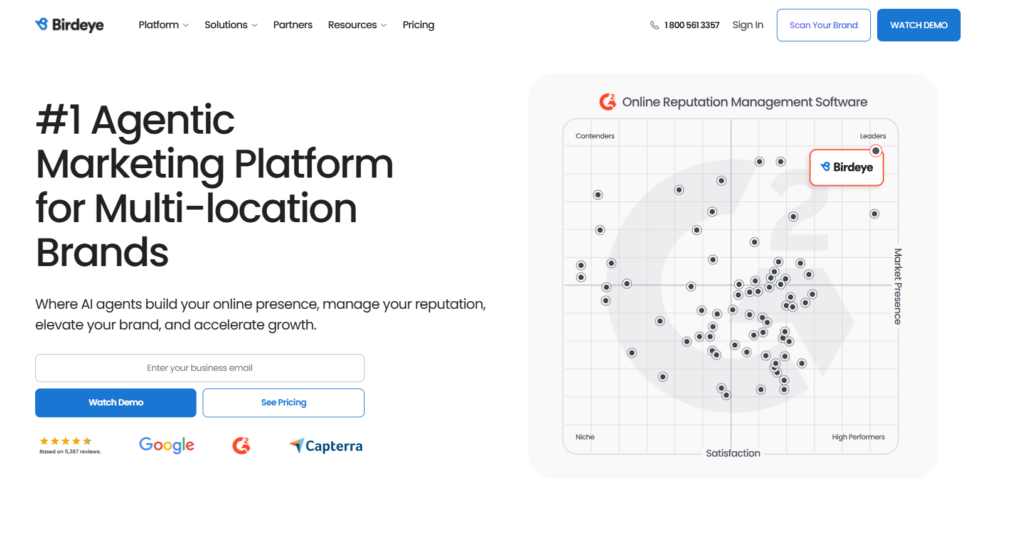
For law firms operating across multiple locations, reputation, accuracy, and consistency are just as important as ranking well. Birdeye helps support those core elements by bringing key SEO-related signals into one platform:
- Centralized review and listing management: Manage reviews across 200+ platforms and keep Google Business Profiles and directories accurate for every office from one dashboard.
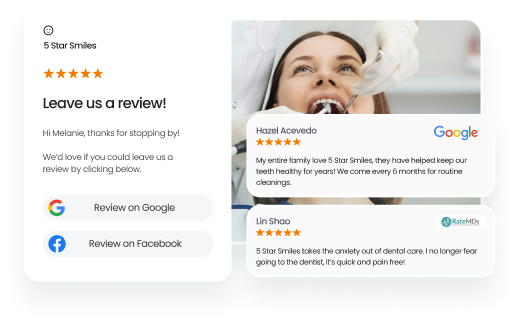
- Automated review generation: Trigger review requests after key client milestones to maintain a steady flow of current, credible feedback.
- Location-level visibility and reputation insights: See how each office performs in local search, identify competitive gaps, and focus effort where it will drive the best results.
- Scalability for multi-office operations: Ensure compliant, consistent communication and brand presence while giving local teams the flexibility to respond quickly.
Birdeye provides the infrastructure that supports local SEO at scale, reducing manual work and helping firms strengthen trust and visibility where clients make decisions.
Core SEO capabilities that multi-location law enterprises must prioritize
A top law firm SEO company should be able to elevate not just visibility but also credibility and conversion rates across every location you operate in. That requires excellence in four critical areas:
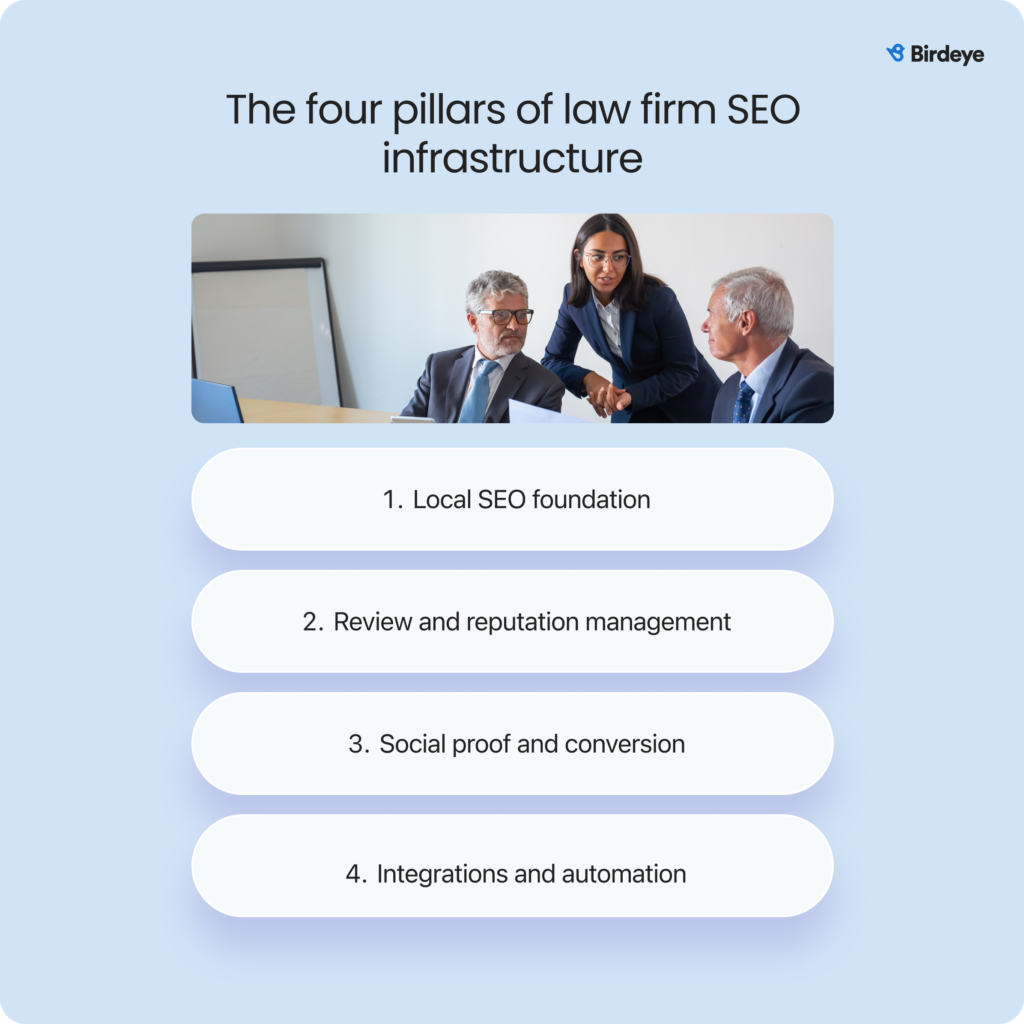
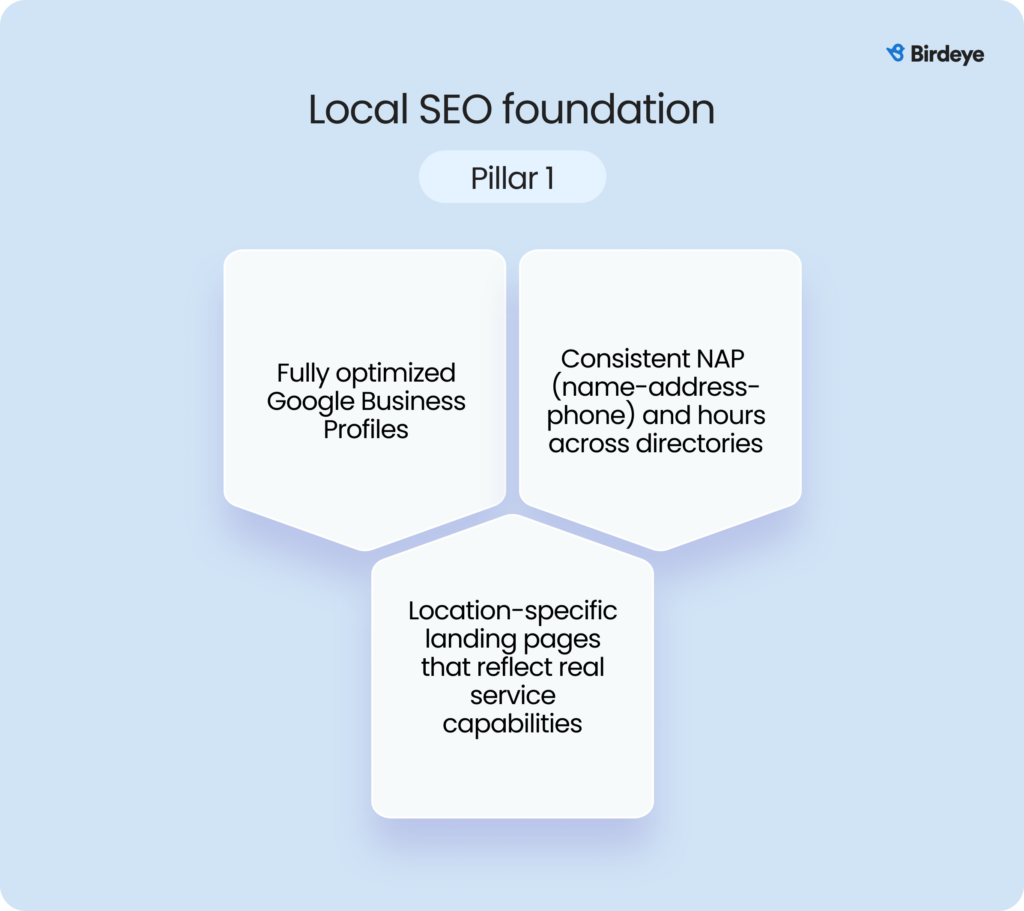
Pillar 1: Local SEO foundation
Each office must be easy to find, with clear signals of what services it provides and where. This includes:
- Fully optimized Google Business Profiles for every office, including services, photos, and FAQs.
- Consistent name-address-phone (NAP) and hours across Google and key legal/local directories.
- Location pages that accurately reflect each office’s services, geographies, and differentiators.
Pillar 2: Review and reputation management
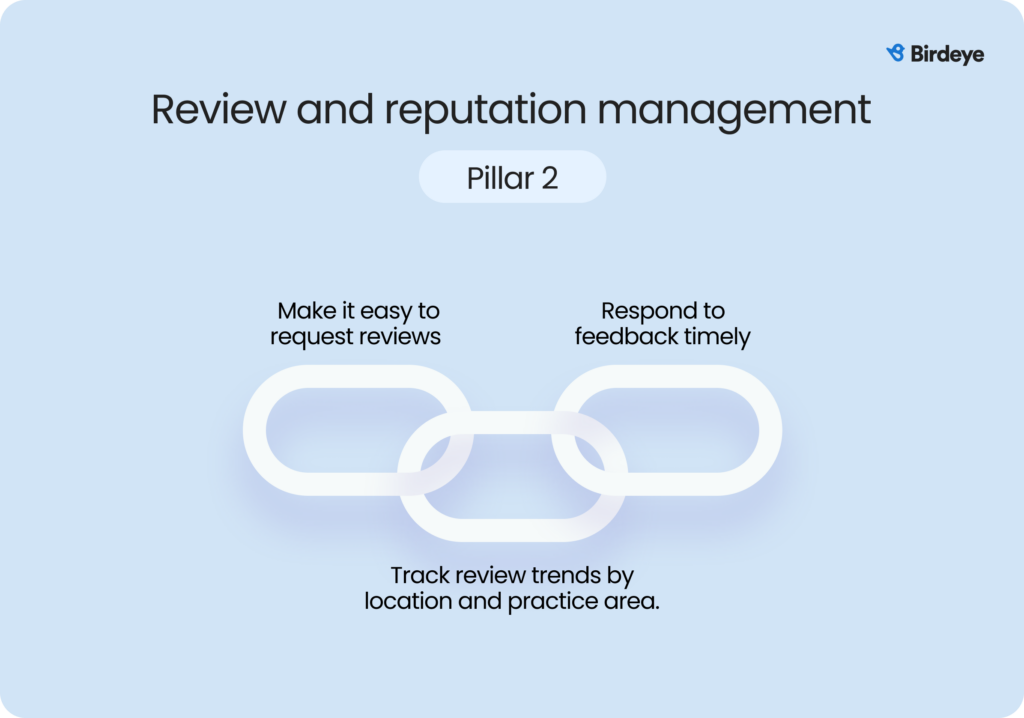
Reviews influence both ranking and trust. Your partner should help:
- Streamline review requests tied to real client milestones
- Monitor and respond to feedback across all platforms, including review sites for lawyers and law firms
- Track review trends by location and practice area
Pillar 3: Social proof and conversion
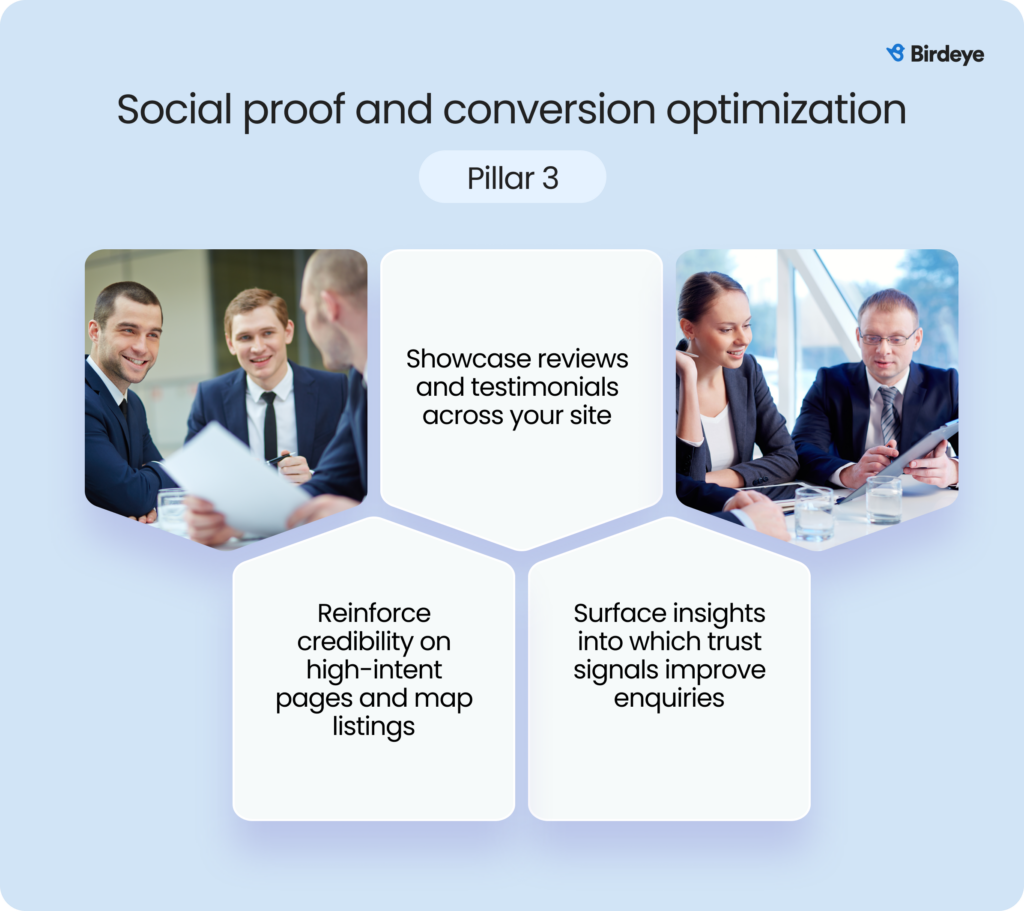
Visibility only matters if prospects convert. Look for capabilities that:
- Showcase top reviews and testimonials on key web and landing pages.
- Bring social proof into your site, emails, and social channels at the moment of decision.
- Measure how these elements influence engagement, calls, and form submissions
Pillar 4: Integrations and automation
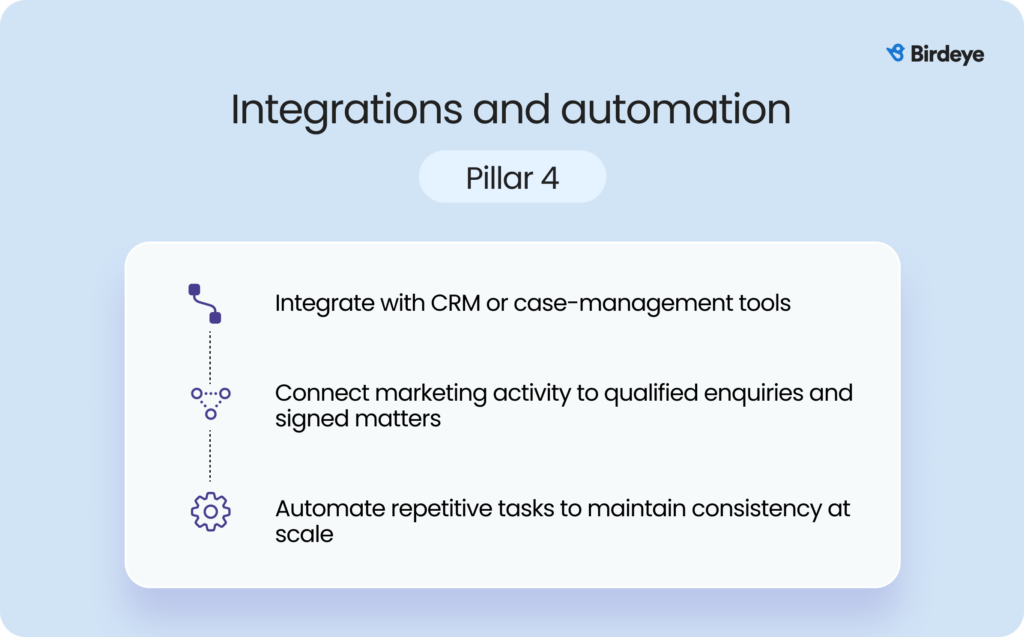
Multi-location firms thrive when systems work together. Your SEO approach should mandate:
- Automatic triggers: Integrates with CRMs and practice management software to automate review requests and patient follow-ups.
- Clear ROI tracking: Provides unified reporting that directly links marketing spend to signed matters.
- Operational efficiency: Implements workflows that minimize staff manual tasks and ensure superior data quality.
Choosing your ideal law firm SEO solution: Agency, platform, or hybrid?
When you evaluate solutions for your firm’s multi-location SEO and reputation needs, there are three broad paths, each with strengths and trade-offs. The right choice often depends on your law firm’s size, internal resources, and growth goals.
Here’s a simple way to think about the three models:
- Agency-only
- Pros: You get access to strategists, content creators, and technical SEO specialists without adding in-house headcount.
- Cons: Agencies often rely on a patchwork of tools for reviews, listings, and reporting; this can lead to fragmented data, inconsistent local presence, and limited visibility into what drives actual signed cases.
- Platform-only (a unified system for local SEO, listings, reviews, and reputation)
- Pros: Direct control over the core systems that influence visibility, reputation, and client trust. Good for firms that want consistency across offices and minimal dependence on vendors.
- Cons: Requires internal time, discipline, and expertise to manage the platform, including lawyer review management workflow, content upkeep, and local presence. A platform alone doesn’t generate strategy or content.
- Hybrid (platform + agency or in-house specialists)
- Pros: Combines the stability and consistency of a core platform with the creativity, strategy, and execution capabilities of an agency or in-house team. This gives you the best of both worlds: scalable infrastructure plus tactical flexibility.
- Cons: Requires coordination between the platform and your content/marketing team; duplication or conflicts may arise if roles aren’t clearly defined.
For many ambitious, multi-location firms, the hybrid model offers the most balanced path forward. The core infrastructure ensures consistent management of local presence and reputation, while your agency or in-house team drives content, campaigns, and growth strategies in the markets that matter most.
What should you ask before choosing an SEO company for a law firm?
The fastest way to distinguish a true strategic partner from a tactical vendor is by asking questions that tie their work to business performance, not just rankings. These benchmarks help clarify whether a provider can support your footprint, practice mix, and intake needs.
Strategy and scope
Start by clarifying how they think about strategy:
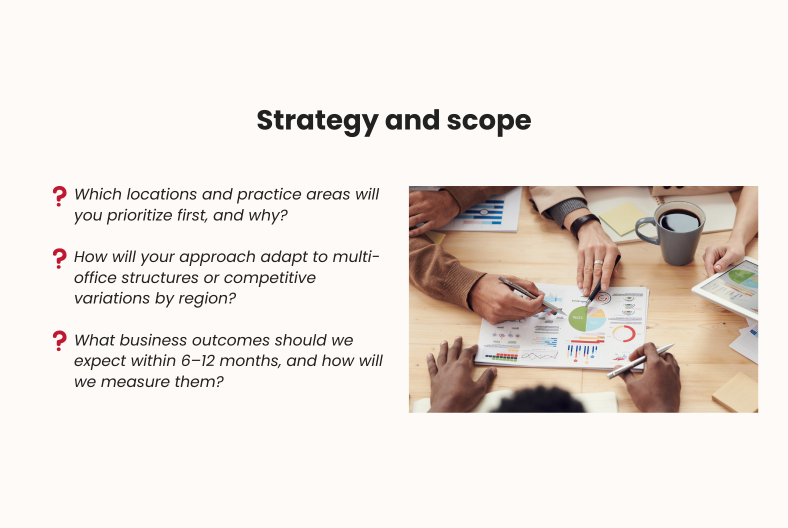
These questions reveal whether the provider understands legal-specific growth levers and decision criteria.
Reputation, listings, and integrations
Next, dig into how they will handle reputation and local presence at scale:
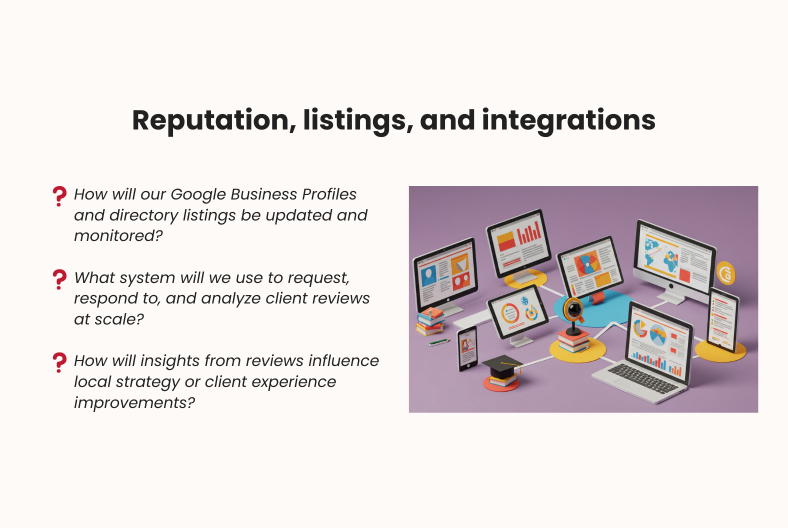
This reveals whether they view reviews and listings as core SEO inputs rather than afterthoughts.
Collaboration and transparency
Finally, confirm how they will communicate and collaborate with your team:

Clear roles and shared visibility prevent duplicated effort and ensure accountability.
Why Birdeye is the best choice for multi-location law firms
For law firms operating across many offices, where consistency, visibility, and trust matter deeply, using a platform that handles reputation, listings, and feedback at scale makes strategic sense. Birdeye is one such platform, and here’s how it aligns with what multi-location firms need:
- Consolidated reputation and listings management across locations: Rather than juggling multiple tools or spreadsheets, Birdeye provides a single dashboard to manage reviews, listings, and local presence across all offices. This reduces the risk of inconsistent information or outdated office details.
- Automated and scalable review workflows: Birdeye automates review requests and responses, ensuring a steady stream of client feedback and timely responses as volume grows. This helps make reviews a repeatable asset rather than a one-off effort.
- Insight-driven feedback and performance tracking: The platform tracks review trends, sentiment, listing status, and presence at the location level, helping firms identify underperforming offices or markets and adapt where needed.
- Support for multi-location scale and compliance needs: For firms with many offices, possibly spread across cities or regions, Birdeye offers a scalable platform to maintain consistent information and reputation standards across all locations without additional administrative burden.
In effect, for a law firm that values brand integrity, compliance, and a consistent client experience across all its offices, Birdeye provides a solid infrastructure, making review generation, listing accuracy, and reputation monitoring manageable and measurable.
FAQs for law firm SEO companies
A law firm SEO company helps your firm appear more prominently when prospects search for your services, locations, and practice areas online. Typically, this includes technical SEO, local SEO, content strategy, and analytics, and at the higher end of the market, it also covers reviews, listings, and client experience signals that influence both rankings and conversion.
Many firms begin to see improved visibility within a few months; more meaningful results, such as new enquiries or signed matters, often take 6 to 18 months (or longer, depending on competition, volume of reviews, and consistency of execution)
A law-firm SEO company addresses not only standard SEO (technical fixes, on-page optimization, content, backlinks) but also the unique requirements of legal practices: local presence management (for multiple offices), listing consistency across directories, compliance with ethical/advertising rules, reputation management, and sometimes review and intake workflows.
Not entirely. A platform can stabilize and scale reviews, listings, and local presence — important foundation work. But it doesn’t substitute for content creation, link-building, ongoing content strategy, or technical SEO. For most firms, the best result comes from combining a platform (for consistency and scale) with a strategy-driven agency or internal team (for content, outreach, and growth-oriented work).
Very important. Local SEO guides for attorneys highlight reviews, accurate business listings, NAP (name/address/phone) consistency, and localized content as essential to appear in both map and organic results for location-based searches. Moreover, reputation-management platforms like Birdeye emphasise that reviews provide social proof and help convert search visibility into client enquiries.
You are ready when you operate across multiple locations or practice areas, rely heavily on inbound enquiries, and need consistent visibility and reputation across markets. If you are already investing in SEO or paid acquisition and want clearer insight into which locations, channels, and experience changes drive signed matters, adopting a platform like Birdeye as your foundation is typically the next logical step.
Building a strong, scalable local presence for every location
Choosing a law firm is ultimately about more than improving rankings. It’s about creating a scalable foundation where every office is visible, trusted, and easy for prospective clients to contact. Firms that treat SEO, reputation, and local experience as a single, connected system tend to see more of the outcomes that matter: higher-quality enquiries and stronger long-term growth.
As you assess your options, consider whether your current setup provides:
- Accurate listings and consistent information for every office
- A continuous flow of authentic, high-quality reviews
- Clear visibility into enquiries and signed matters by location
- A scalable approach that supports future expansion
If there are gaps, evaluating an enterprise-grade platform like Birdeye can help. Birdeye offers a unified solution for managing reviews, listing accuracy, and multi-location performance insights in one place. It also automates review generation and simplifies location-level reputation workflows, helping legal teams strengthen trust signals that influence client decisions.
See your local presence in one view. Watch a free demo of Birdeye to explore how reviews, listings, and reputation can be managed consistently across offices.

About the Author

Shaifali Parihar
Originally published




![[Feature image] The Best Marketing Platforms for Multi-Location Brands](https://birdeye.com/blog/wp-content/uploads/Feature-image-The-Best-Marketing-Platforms-for-Multi-Location-Brands-375x195.png)