CRM vs marketing automation are two terms that often sound interchangeable, but serve very different purposes. One manages relationships. The other scales them. In today’s world of customer data, timing, and personalization, understanding that difference can directly shape the customer journey.
Summary

Think of it this way: customer relationship management (CRM) software helps enterprises remember their customers, while marketing automation helps them reach those customers at the right moment. Both systems are essential for enterprise businesses, but they play distinct roles. Confusion arises when organizations expect one platform to do the job of another, or, worse, choose one and delay the other.

This guide moves beyond the CRM vs marketing automation debate. It explains how each system works, where they differ, and why growth depends on using CRM and marketing automation together. It also shows how enterprise brands use Birdeye to connect customer engagement, reputation, and insights into a foundation for scalable growth.
Table of contents
- What is customer relationship management software?
- What is marketing automation?
- CRM vs marketing automation: The differences that impact real workflows
- CRM and marketing automation together: How their integration drives better outcomes
- How Birdeye brings CRM and marketing automation together at scale
- FAQs about CRM vs marketing automation
- CRM vs marketing automation works best when Birdeye connects the experience
A real enterprise scenario that explains CRM vs marketing automation
A national marketing team launches a multi-channel campaign. Leads pour in through email, SMS, and forms, all tracked inside a marketing automation platform. When those leads reach the sales team, the CRM shows contact details but not the engagement history that explains intent:
- The sales team follows up late or with the wrong message.
- The marketing team cannot see which campaigns influence the sales pipeline.
Customer data often lives in two systems, telling two incomplete stories. As a result, the CRM vs marketing automation debate stops being theoretical and starts affecting revenue.
To understand why this disconnect happens so often, it helps to look at what each system is actually designed to do, starting with the foundation most enterprises already rely on: customer relationship management software.
What is customer relationship management software?
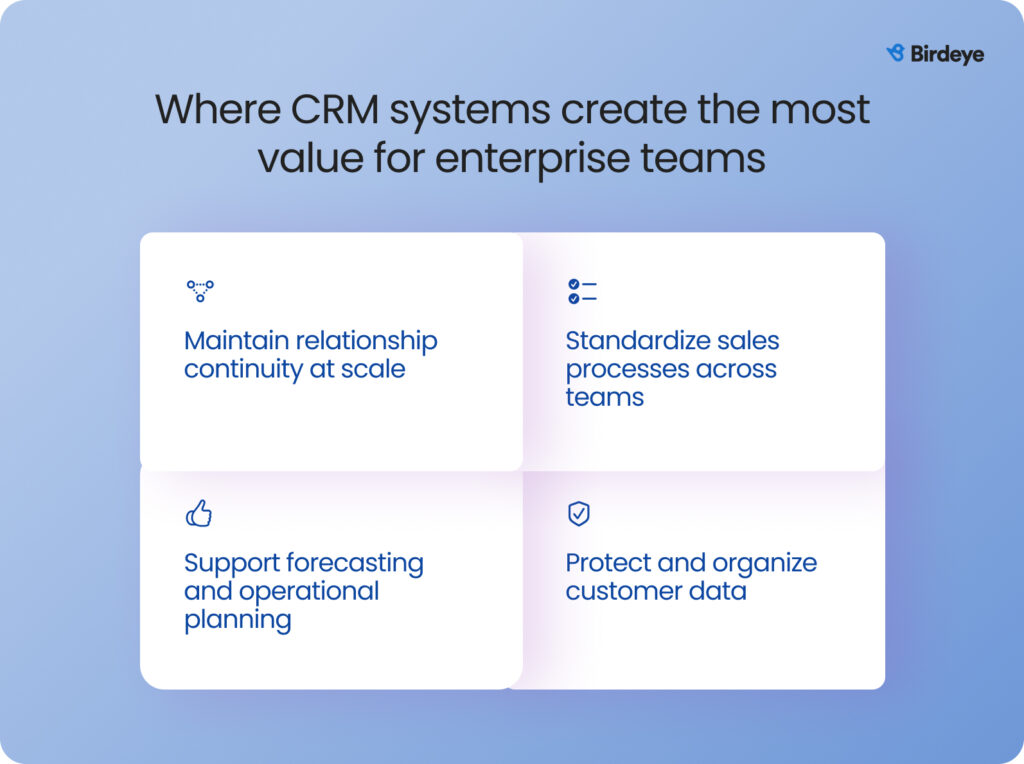
Customer relationship management software is the system that stores, organizes, and maintains customer information across every stage of the relationship. It tracks contacts, accounts, conversations, and deal activity so teams have a consistent, accurate view of who the customer is and how the relationship is progressing.
A CRM system creates a single source of truth for customer data. It ensures interactions are documented, relationships are preserved over time, and sales activity is visible across the organization.
What a CRM system is not designed to do
Understanding CRM boundaries is just as important as understanding its strengths. Even at the enterprise level, a CRM system is not built to:
- Run engagement campaigns across marketing channels
CRM platforms record interactions, but they do not manage how, when, or where customers are engaged at scale across email, SMS, social, or advertising channels. - Adapt outreach based on behavioral signals in real time
While CRM systems store outcomes, they do not continuously adjust messaging or timing based on live engagement data, website behavior, or campaign interaction patterns. - Run complex, branching workflows for lead nurturing
Advanced sequencing, conditional paths, and lifecycle-based journeys fall outside the primary function of customer relationship management software. - Provide deep insight into marketing performance
CRM tools connect activity to pipeline movement, but they are not designed to analyze campaign-level engagement or unstructured customer sentiment at scale.
This gap is becoming more significant as customer feedback grows richer: Birdeye’s 2025 State of Online Reviews report found that 81% of online reviews now include written comments, making sentiment and experience signals far more nuanced than the structured fields a CRM is designed to store.
Why do these boundaries matter?
When enterprises attempt to stretch CRM platforms beyond their intended role, execution gaps appear. Sales teams retain ownership of relationships, but marketing teams lack the tools needed to scale engagement and personalization. The result is friction, slower follow-ups, and fragmented visibility into the customer journey.
Once CRM responsibilities are clearly defined, the next question becomes execution. If CRM systems manage relationships and structure, how do enterprises scale engagement, timing, and personalization without manual effort? That role belongs to marketing automation.
What is marketing automation?
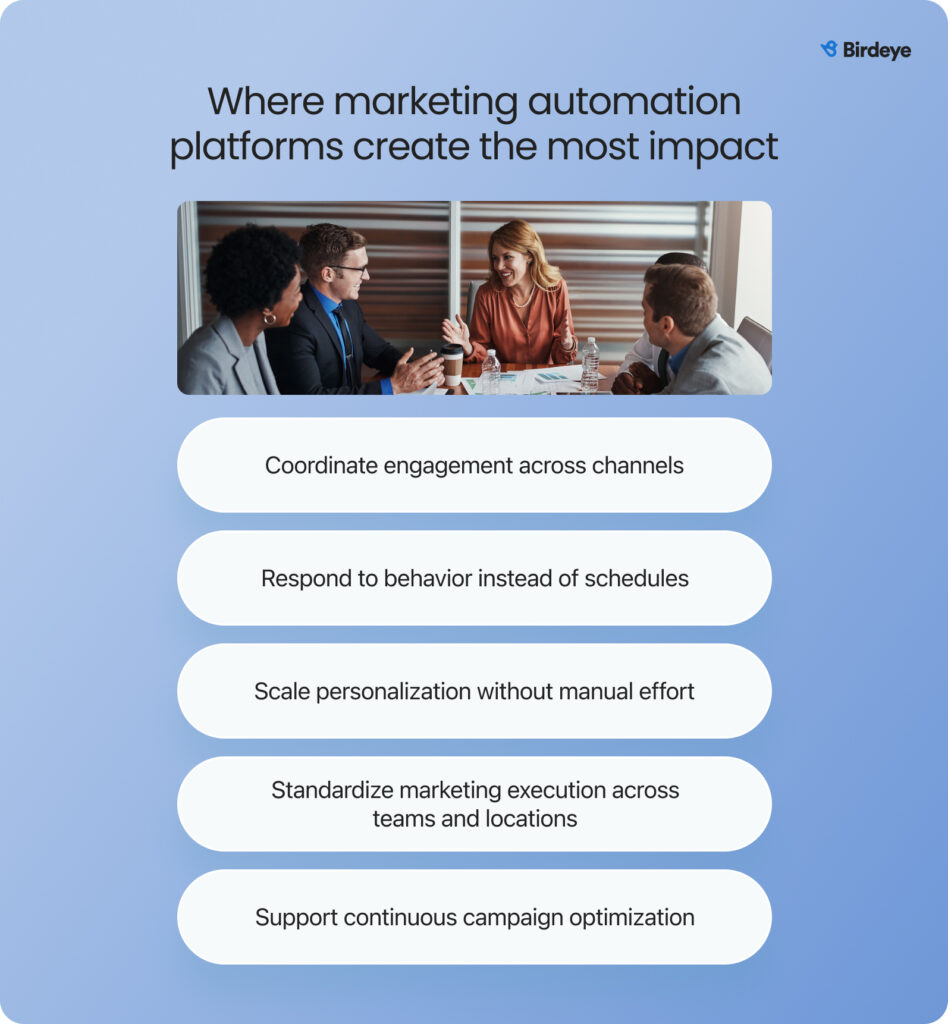
Marketing automation is software that automates the triggering, delivery, and sequencing of marketing messages based on customer behavior and predefined rules. It controls when communication happens, through which channel, and in what order, without requiring manual execution for every interaction.
A marketing automation system uses data such as form submissions, website activity, engagement history, and lifecycle stage to determine the next action. Instead of sending one-off messages, it enables structured, repeatable workflows that guide prospects and customers through consistent engagement paths.
What marketing automation is not designed to do
Clear boundaries matter here as well. A marketing automation tool is not built to:
- Own customer relationships long-term
It executes engagement but does not serve as the authoritative record for customer history or account-level context. - Replace a CRM system
While it can sync data and enrich profiles, it depends on CRM platforms for relationship ownership, pipeline tracking, and sales accountability. - Manage sales processes or deal progression
Opportunity stages, forecasting, and revenue reporting remain outside its core function. - Provide a complete picture of customer health
Engagement signals alone do not capture sentiment, satisfaction, or reputation across touchpoints.
Why marketing automation depends on other systems
Marketing automation systems work best when they are connected to platforms that provide context and continuity. Without access to reliable customer data, sales outcomes, and real-world feedback, automation becomes efficient but incomplete.
This is why marketing automation platforms are most effective when paired with CRM systems and customer experience platforms.
When both systems are viewed side by side, their differences become easier to understand, not as competing tools, but as complementary engines designed for different types of work.
CRM vs marketing automation: The differences that impact real workflows
The difference between CRM and marketing automation becomes clear when you look at how work actually moves through an organization, not how tools are marketed. Each system is optimized for a different kind of decision, a different pace, and a different owner.
System of record vs system of execution
CRM systems exist to preserve truth over time. They track what has already happened, what is currently in progress, and what is expected next in a customer relationship. Accuracy, continuity, and accountability matter more than speed.
Marketing automation systems exist to initiate action. They decide when to send a message, which path a contact should follow, and how engagement should unfold based on behavior. Speed, responsiveness, and scale matter more than permanence.
This distinction explains why CRM data is stable and auditable, while marketing automation data is dynamic and event-driven.
CRM vs marketing automation is the wrong question. Growth depends on using both
Want to see the impact of Birdeye on your business? Watch the Free Demo Now.
How customer data is used differently in each system
CRM platforms treat customer data as a long-term asset. Records are updated deliberately, often tied to confirmed interactions such as meetings, calls, deal progression, or account changes.
Marketing automation platforms treat customer data as a stream of signals. Engagement events like clicks, visits, downloads, and inactivity continuously influence what happens next, even if those signals never become permanent records.
One system protects data integrity. The other converts data into motion.
Ownership across sales and marketing teams
CRM systems are owned operationally by the sales team. Pipeline stages, opportunity health, and forecast accuracy depend on disciplined CRM usage. The system enforces structure so leadership can trust what they see.
Marketing teams own marketing automation systems. Campaign logic, segmentation, and sequencing live there. Success is measured by reach, engagement, and progression through defined journeys.
When these systems are disconnected, sales and marketing teams optimize independently. When they are connected, both teams work from the same reality.
Birdeye’s Social Performance Gap research shows that brands often invest in channels and workflows misaligned with actual consumer behavior, leading to lower engagement and missed intent signals when systems are not connected across teams.
How each system supports a different stage of the customer journey
CRM systems perform best once intent has been established. They support qualification, negotiation, onboarding, retention, and expansion by maintaining context and accountability.
Marketing automation systems perform best before and between sales interactions. They sustain momentum, educate prospects, re-engage inactive contacts, and ensure no opportunity is lost due to timing gaps.
Together, they prevent the customer journey from stalling, whether due to a lack of follow-up or structure.
CRM and marketing automation together: How their integration drives better outcomes
Ultimately, integration only matters when it solves real operational problems. In many cases, multi-location enterprises face fragmented customer data, inconsistent engagement, and limited visibility. This is where CRM systems, marketing automation, and customer experience platforms must work together, not as standalone tools, but as a connected operating layer.
Quick Care Med offers a clear example of how this plays out in practice.
How Quick Care Med built a connected digital growth engine with Birdeye
Since opening in 2010, Quick Care Med has grown steadily across North Central Florida, expanding to nine locations. As they scaled, their leadership team recognized a familiar challenge. Patient interactions were increasingly starting online, but the systems managing those interactions were not fully connected.
- Customer records lived in their core systems.
- Engagement happened across Google, Facebook, websites, and chat.
- Reviews, listings, and patient inquiries were managed manually or in silos.
This made it difficult to maintain accuracy, respond consistently, and understand how digital touchpoints influenced patient decisions.
Where Birdeye filled the gaps, CRM and marketing automation could not
Quick Care Med implemented Birdeye as the layer that connected engagement, reputation, and visibility across locations, complementing their existing systems rather than replacing them.
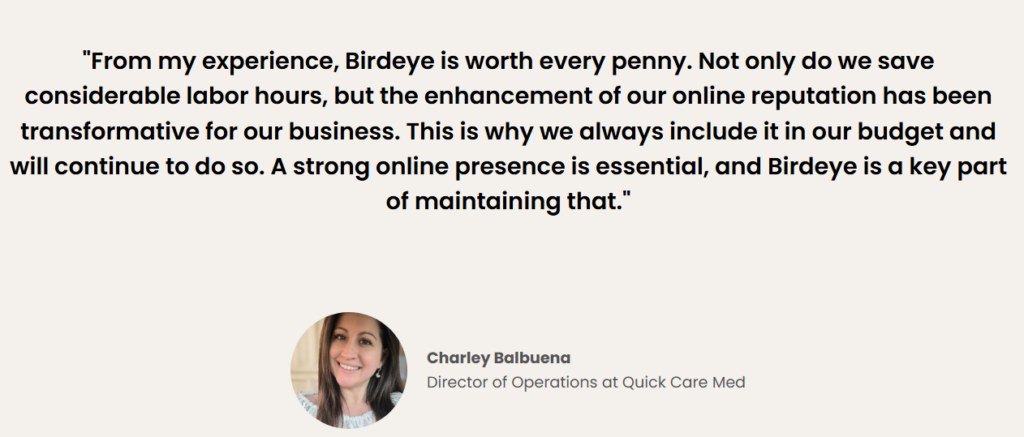
Listings management became centralized. With Birdeye Listings AI, Quick Care Med gained control over more than 150 digital listings from a single dashboard. Updates that once required manual effort across platforms could now be made once and reflected everywhere, reducing errors and freeing staff time. Accurate listings ensured that patient journeys starting on Google, Facebook, Bing, or Apple Maps led to the right information every time.
This visibility directly impacted growth. Since becoming a Birdeye customer, Quick Care Med has recorded:
- 98.5K mobile Google Maps impressions
- 94.7K “Call” button clicks from Google
- 24.7K Facebook page interactions
With over 81% of their website traffic originating from Google, accurate listings became a growth lever, not just an operational fix.
Reputation management and automation addressed another critical gap. By integrating Birdeye with their electronic medical records system, Quick Care Med automated review requests after patient visits. This removed manual follow-ups while ensuring consistent outreach.
Over time, this approach generated more than 15.3K reviews and an average rating of 4.6 stars.
For Quick Care Med, integration was not about adding another tool. It was about closing the gaps between systems, aligning engagement with reality, and ensuring every patient interaction contributed to growth and experience quality.
How Birdeye brings CRM and marketing automation together at scale
CRM systems manage records. Marketing automation systems manage execution. What’s often missing is a layer that captures how customers actually experience the brand across search, reviews, messaging, and social. Birdeye fills that gap by turning customer interactions into structured signals that sales and marketing teams can act on.
Instead of replacing CRM or marketing automation platforms, Birdeye strengthens both by connecting visibility, reputation, communication, and insight into a single customer experience layer.
Listings AI: where customer journeys begin
Before a customer enters a CRM system or a marketing automation workflow, they search. Listings AI ensures business information is accurate and consistent across Google, Facebook, Bing, Apple Maps, and hundreds of directories.
Accurate listings:
- Improve discoverability and local search performance
- Reduce friction at the first touchpoint
- Ensure CRM and marketing automation systems receive clean, reliable lead data
Reviews: Turning feedback into trust and intelligence
Reviews captures what CRM and marketing automation cannot: customer sentiment. Automated review requests, AI-generated responses, and sentiment analysis turn feedback into a measurable signal.
Reviews enables teams to:
- Build trust at scale through consistent, timely responses
- Identify trends across locations and categories
- Enrich customer context beyond transactional data
Messaging AI and Webchat: Real-time engagement without friction
Messaging AI and Webchat support immediate, two-way communication across SMS, web, and chat. Automated responses handle common inquiries, while smart handoff routes complex conversations to the right teams.
This layer:
- Prevents lead drop-off between marketing and sales
- Captures intent signals that CRM systems alone cannot detect
- Complements marketing automation workflows with real-time responsiveness
Social AI: Extending engagement beyond campaigns
Social AI helps marketing teams publish, monitor, and respond consistently across social platforms. Engagement is centralized, sentiment is visible, and responses remain on-brand.
Instead of fragmented social activity, Social AI:
- Strengthens brand presence across locations
- Surfaces engagement patterns that inform campaigns
- Feeds insights back into broader customer strategies
Insights AI and Reports AI: turning signals into decisions
Insights AI analyzes feedback, engagement, and sentiment to surface patterns that matter. Reports AI explains performance changes, highlights trends, and answers the “why” behind results.
Together, they provide:
- Clarity across locations and channels
- Faster decision-making without manual analysis
- A shared view of performance for sales and marketing leaders
Why Birdeye completes the CRM and marketing automation stack
CRM systems provide structure. Marketing automation platforms drive scale. Birdeye adds context.
By unifying listings, reviews, messaging, social engagement, and insights, Birdeye ensures CRM and marketing automation systems operate with real-world signals, not assumptions. The result is better alignment, stronger customer experiences, and growth driven by reality, not guesswork.
FAQs about CRM vs marketing automation
The main difference is ownership and purpose. A CRM system manages customer records, relationships, and sales processes over time. Marketing automation software manages how outreach is triggered, sequenced, and scaled based on customer behavior. CRM preserves context, while marketing automation drives engagement.
No. Marketing automation cannot replace a CRM system. While marketing automation platforms can store contacts and track engagement, they are not designed to own customer relationships, manage the sales pipeline, or support forecasting. CRM systems remain the system of record for customer data and revenue activity.
Birdeye complements CRM and marketing automation by capturing real-world customer signals that neither system tracks well. Listing accuracy, reviews, sentiment, messaging, and social engagement influence decisions long before a lead enters the sales pipeline. Birdeye connects those signals to CRM and marketing automation workflows, giving teams a more complete view of the customer journey.
No. Framing the decision as CRM vs marketing automation misses the point. Enterprises grow faster when both systems are used together, supported by platforms like Birdeye that connect engagement, reputation, and insight across the customer experience.
CRM vs marketing automation works best when Birdeye connects the experience
Traditional customer relationship management systems manage historical records, while basic marketing automation software manages email execution. What remains missing is an operational layer that captures how consumers discover, evaluate, and choose a brand in the real world across maps, directories, and search streams.
As customer expectations rise, engagement itself has become a growth signal: Birdeye’s 2025 State of Online Reviews report shows that businesses now respond to 73% of reviews, reflecting how experience management has become inseparable from revenue outcomes.
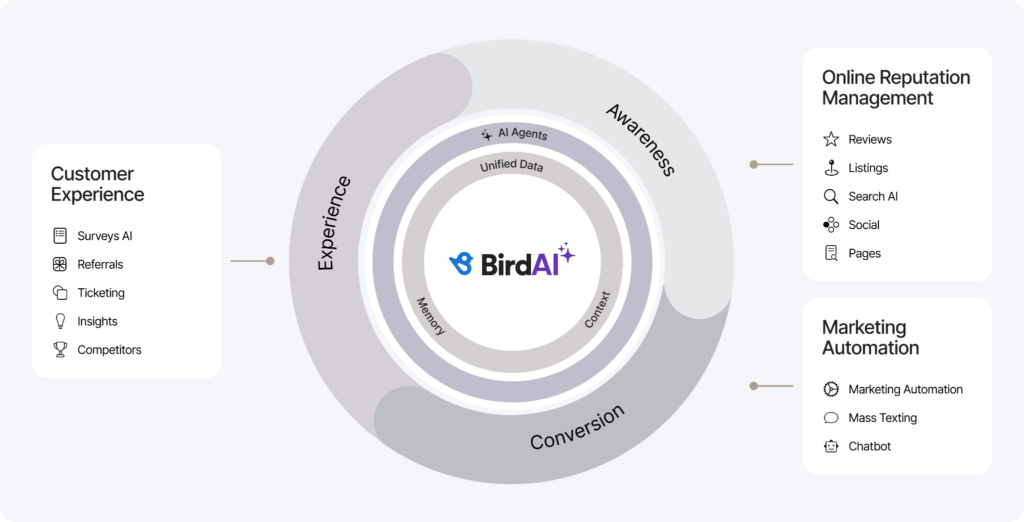
Birdeye agentic marketing platform solves this multi-location complexity by functioning as a unified operating system, driving localized execution through specialized marketing agents:
- Consolidate: Pull customer reviews, business listings, social publishing, and customer messaging into one full-cycle platform layer. By connecting directly to existing CRM or EHR infrastructure via 3,000+ integrations, enterprise brands replace disconnected tools with a continuous marketing loop that manages the customer journey from awareness to long-term advocacy.
- Think: Leverage a unified data layer to convert unstructured customer interactions into true local intelligence. Instead of relying on blind corporate averages, leadership can track location-specific sentiment and pinpoint exactly why certain branches face operational friction or shifts in local search rankings.
- Act: Deploy brand-trained marketing agents to automatically handle brand-safe, compliant execution. Operating on a strict “AI recommends, you approve” framework, these autonomous workers execute daily tasks within your precise corporate governance guardrails, keeping a human-in-the-loop for final corporate sign-off:
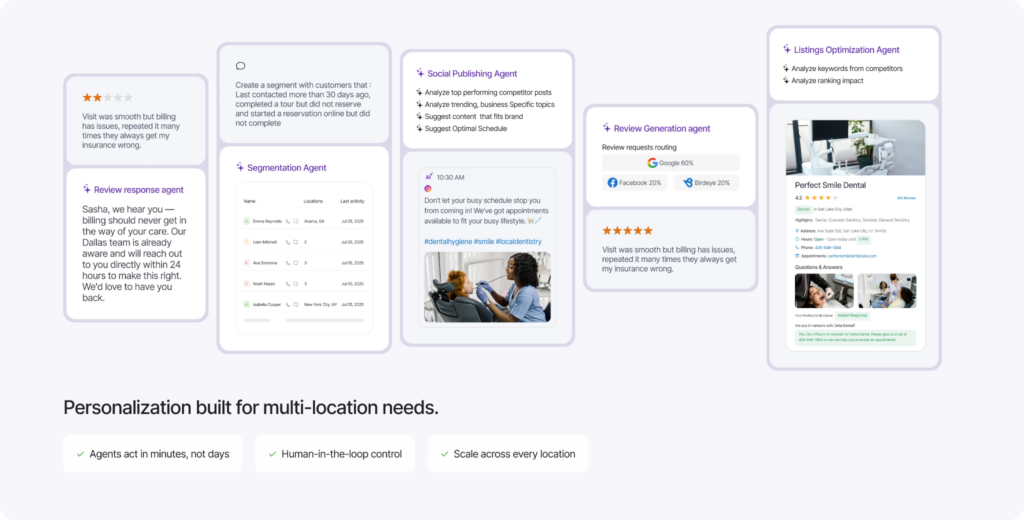
- Listings Optimization Agent: Continuously monitors directory accuracy across Google, Apple Business Connect, Facebook, and Bing to automatically overwrite data drift and remove duplicate entries.
- Review Generation Agent: Identifies new customer transactions in real time to trigger personalized feedback requests via text or email at the highest-converting moment.
- Review Response Agent: Interprets incoming customer review sentiment and urgency across 200+ sites to instantly draft nuanced, context-aware replies.
- Social Publishing Agent: Unearths top-performing local content themes to generate, schedule, and publish platform-optimized posts across hundreds of local feeds simultaneously.
- Social Engagement Agent: Monitors direct messages and comments across channels, filtering out spam and triaging inbound customer service or sales inquiries contextually.
- Reporting Agent: Evaluates performance changes cross-platform to proactively deliver clear, natural-language summaries explaining why local metrics shifted.

About the Author

Shruti Dugar
Birdeye
Originally published