AI in multi-location marketing isn’t about creating posts faster. It’s about executing and governing marketing across hundreds to thousands of locations.
Summary about the blog:

For enterprise teams, AI maturity isn’t how much AI you use; it’s how much you can safely delegate without creating audit, compliance, or brand risk. At 100, 500, or 1,000+ locations, marketing stops being creative work and becomes an operational system. Every review response, listing update, social post, and search signal compounds risk or trust. This is where basic AI-assisted tools reach their limits, and where Agentic AI becomes essential.
In this guide, we explain how AI maturity evolves in multi-location marketing, why AI-assisted tools fail at scale, and how platforms like Birdeye enable enterprise teams to operate with control, consistency, and confidence.
Table of contents
- What really changes operationally at 100, 500, and 1,000+ locations?
- What is the AI Maturity Ladder, and why does it matter for multi-location brands?
- What are the top 6 Agentic AI use cases for multi‑location marketing?
- How do you vet vendors before choosing an AI Marketing Platform?
- What makes Birdeye the #1 Agentic Marketing Platform to run your operations across 1,000+ locations?
- FAQs about AI Maturity Ladder for multi-location brands
- Agentic Marketing Platform is the new standard for multi-location brands
What really changes operationally at 100, 500, and 1,000+ locations?
At a handful of locations, spreadsheets, Slack messages, and ad‑hoc approvals might be frustrating, but they’re still doable; the pressure shows up when you cross 100 locations and never lets up. The breaking point isn’t just volume—it’s the compounding effect of inconsistent execution, fragmented data, and zero real governance.
At 100 locations, brand drift quietly starts
One region learns how to handle a tough review. Another region never hears about it. One agency follows your voice and legal rules. Another improvises.
Local teams begin tweaking offers and responses, and before you know it, Google Business Profiles, Apple Place Cards, Yelp pages, and social feeds all look slightly different.
However, template-based, AI-assisted tools can only suggest content, but they can’t enforce brand standards or ensure every listing, social post, and review reply stays on‑voice and on‑policy.
The real issue isn’t effort. It’s that you can’t prove consistency across dozens of semi-independent teams.
At 500 locations, data silos hide local revenue drops
As teams and tools multiply, issues begin to look local rather than systemic.
Teams delay reporting. Slow approval processes create bottlenecks. By the time patterns emerge, the revenue impact has already spread.
The danger here is not ignorance — it’s lag. When a location’s ratings dip or a customer review goes viral, finding out days later is no longer acceptable. Real-time visibility into brand health becomes non-negotiable.
Without an AI-governed, unified customer data platform (CDP), you don’t see the pattern until it shows up in quarterly revenue.
Publicis Sapient’s Guide to Next 2026 research points to the same scaling gap in a different form: Only 31% feel “very prepared” for agent-driven commerce, and only about one-third describe AI as scaled enterprise-wide. Most enterprises are still stuck between experimentation and true rollout.
At 1,000+ locations, governance becomes risk #1
At 1,000+, the risk isn’t one bad post.
Instead, the real risk is a bad action repeated across hundreds of locations before anyone catches it. Rogue local social posts, unapproved offers, inaccurate hours, and unanswered 1‑star reviews stop being “exceptions” and become systemic brand risk.
So, the bridge to the ladder is straightforward: At this scale, only hyper-marketing AI agents can execute under strict guardrails with full auditability to keep every listing, post, and response compliant in real time.
These breaking points all point to the same underlying issue: most marketing systems were never designed for delegation at scale. When execution depends on humans remembering rules, passing context, or manually approving every action, consistency collapses as volume grows. That’s why enterprise teams need a way to measure not just AI capability, but AI readiness. This is where the AI Maturity Ladder becomes useful.
What is the AI Maturity Ladder, and why does it matter for multi-location brands?
The AI Maturity Ladder is a framework that measures how much marketing execution a brand can safely delegate to AI without creating brand, compliance, or operational risk.
- At lower levels, AI improves productivity.
- At higher levels, AI reduces enterprise risk.
- At the highest level, AI enables governed delegation — where agents execute repeatable workflows inside defined guardrails, with clear ownership, reversibility, and full audit trails.
This matters for multi-location brands because scale amplifies inconsistency. At 10 locations, manual oversight works. When at 100, cracks appear. At 1,000+, inconsistent execution becomes systemic risk. Without a maturity model, teams often mistake “using AI” for being ready to delegate it. The ladder clarifies the difference between experimentation and operational readiness.
To make that distinction practical, the four levels below show what AI does at each stage, where it works, and where it breaks under multi-location scale.
What are the four levels of AI maturity in marketing?
| Level | Name | Description | Works for | Fails when |
| 1 | AI‑Assisted (Content help) | Teams use generic LLM prompts to write posts, emails, and replies. Heavy human input, manual execution, no guardrails beyond brand guidelines docs. | Single locations, small networks | Hundreds of locations, because every action still depends on human follow‑through. |
| 2 | AI‑Guided (Insights) | Dashboards and AI summaries highlight what’s happening: review sentiment, search rankings, social performance, and competitive trends. | Brands that want better reporting | Execution remains manual; knowing what to do doesn’t mean it gets done. |
| 3 | AI‑Governed (Policy & compliance) | RBAC, Single Sign‑On, and approvals ensure the right people can act, with policy baked into workflows. AI helps draft responses and posts, but humans still press “publish.” | Brands are serious about risk management | Scale, because human bottlenecks slow everything down. |
| 4 | Agentic AI (Execution under governance) | Purpose‑built AI agents execute full workflows—like optimizing listings, publishing local social posts, responding to reviews, and generating reports-autonomously, using Local Intelligence within strict enterprise guardrails. | Enterprise multi‑location brands (100-10,000+ locations) | This is the top tier, where assistance becomes automated execution. |
The four levels of AI maturity in marketing explained:
At Level 1, AI helps individuals do individual tasks. You’ll see generic prompts, draft captions, rewritten blurbs, and summaries of feedback. It makes people faster.
At Level 2, AI-guided systems surface patterns across locations, spot themes, and recommend where to act first. They can help you compare sentiment and feedback trends across markets.
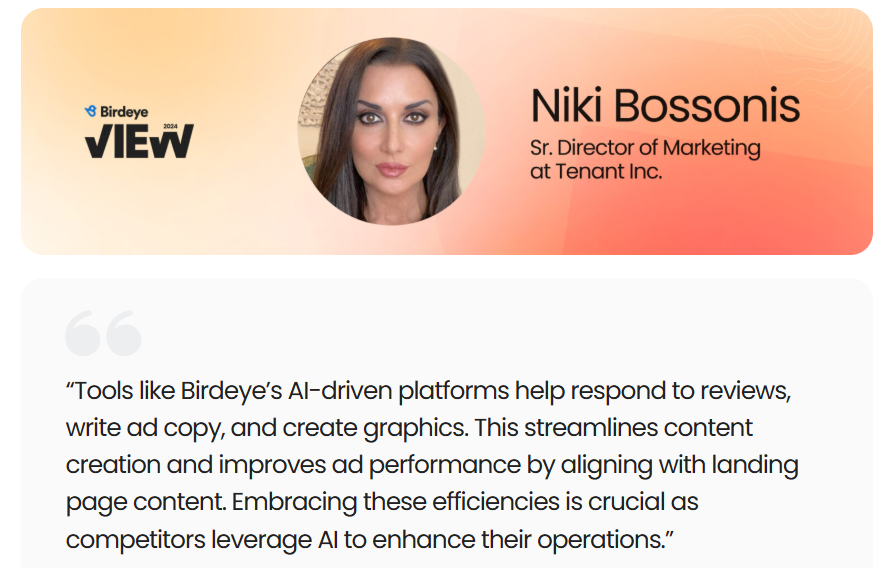
One example of Level 2 value (cross-location intelligence) is competitive context. Niki Bossonis, Senior Director of Marketing at Tenant, who was one of our chief guests at Birdeye VIEW 2024, put it this way:
At Level 3, AI maturity becomes an enterprise conversation: permissions stop being informal, approvals become part of the workflow, and audit trails become non-negotiable.
Level 4 is the highest maturity tier for multi-location marketing: Agentic AI.
Here, execution is repeatable, end-to-end workflows that stay within your policies, permissions, and escalation rules. Humans handle exceptions and sensitive cases.
The takeaway for enterprise teams: You don’t win by adopting “AI.” You win by operationalizing it safely.

The ladder answers how mature your AI program is. The next question enterprise leaders ask is more practical: where should AI actually be allowed to act? Not every workflow is a good candidate for autonomy, and delegating the wrong tasks can increase risk rather than reduce it.
For a deeper look at that transition, see how Agentic AI differs from AI-assisted marketing for multi-location enterprises, including where assistance ends and autonomous execution begins.
What are the top 6 Agentic AI use cases for multi‑location marketing?
Agentic AI does not belong everywhere – and Birdeye is explicit about that.
At enterprise scale, autonomy works best in repeatable, high-volume workflows where consistency, speed, and auditability matter more than creative discretion. High-risk scenarios — crisis communications, regulated claims, or legal responses — must still escalate to humans by design.
This is the operating model behind Birdeye’s Agentic Marketing Platform: AI agents execute end-to-end workflows, but only within predefined brand, policy, and permission guardrails. Below are the workflows where Birdeye’s agentic approach delivers the most value — and the least risk — for multi-location brands.
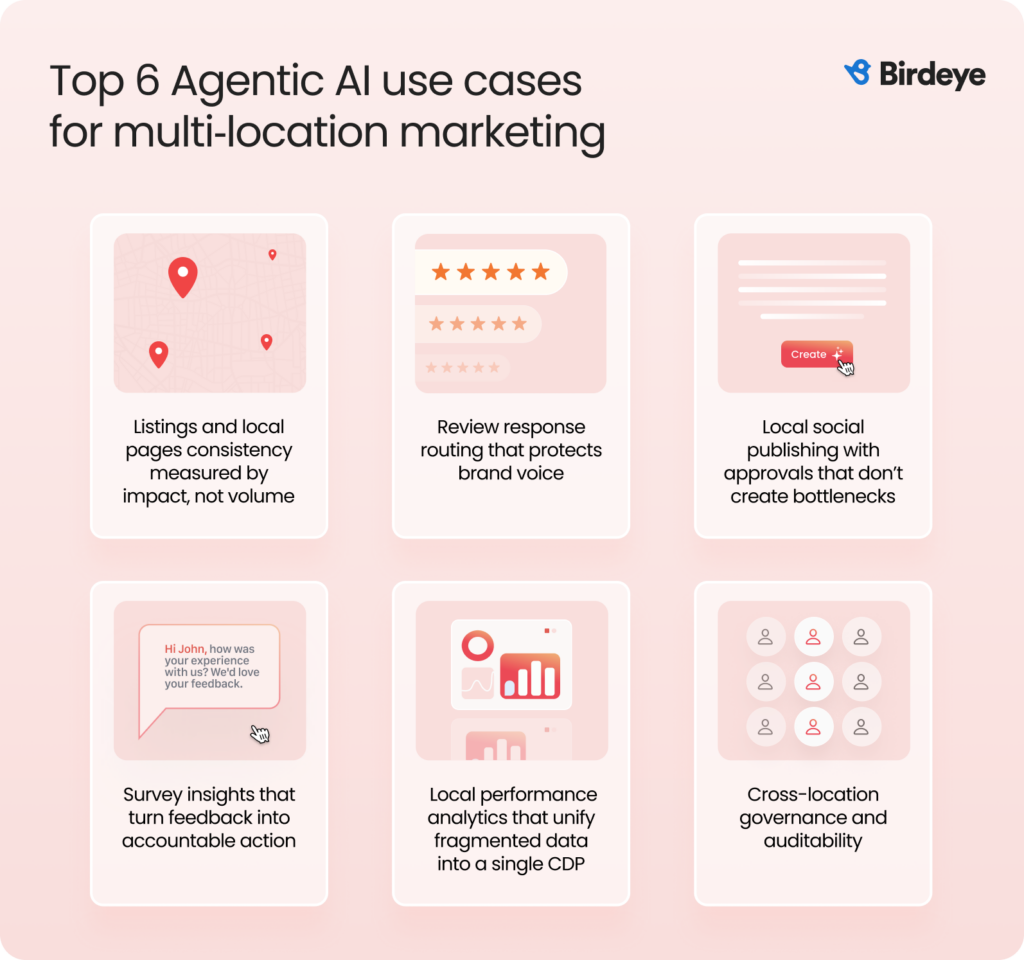
1. Listings and local pages consistency measured by impact, not volume
Birdeye’s Listings Optimization Agent continuously monitors and updates location data across the platforms that actually drive discovery, such as Google, Apple, Facebook, and Yelp. The platform logs and attributes, and allows teams to reverse every change.
Outcome: Always-accurate listings where customers search, without wasting cycles on low-impact directories.
2. Review response routing that protects brand voice
Birdeye’s Reviews AI Agents are purpose-built for high-volume review environments. Agents analyze sentiment, urgency, and context, draft on-brand responses, publish within guardrails, and escalate sensitive reviews with clear ownership and audit trails.
Outcome: Faster response coverage across locations, without sacrificing trust, tone, or accountability.
3. Local social publishing with approvals that don’t create bottlenecks
With Birdeye, Social AI Agents draft, localize, schedule, and queue posts across thousands of locations, while enforcing brand voice rules and approval workflows. High-risk or exception content is automatically routed to the appropriate approvers, preventing clogging of central teams.
Outcome: Central brand standards, local relevance at scale, and fewer last-minute escalations — without slowing execution.
4. Survey insights that turn feedback into accountable action
Instead of producing static insight reports, Birdeye’s Insights AI converts survey feedback and customer sentiment into routed follow-ups and operational actions. Teams own each action, track progress, and close the loop visibly.
Outcome: Customer feedback drives real change, not just internal reporting.
5. Local performance analytics that unify fragmented data into a single CDP
Birdeye’s unified analytics layer surfaces location-level performance issues early. It connects reviews, listings, social, surveys, and search visibility in one system. This reduces reliance on manual reporting cycles and disconnected tools.
Outcome: Faster detection of local issues and clearer executive visibility across the entire brand footprint.
6. Cross-location governance and auditability
Governance is where Birdeye’s Agentic Marketing Platform truly differentiates itself: every AI agent operates within Role‑Based Access Control (RBAC) and Single Sign‑On (SSO), and approval workflows, with full audit logs across locations and channels. You can see which agent or user published a post, updated a listing, responded to a review, or changed a setting—and roll that back or adjust policies as needed.
Outcome: Agentic execution that scales safely. This assures CMOs and compliance leaders the confidence to let AI execute autonomously without sacrificing control.
This is the difference between AI-assisted tools and a true Agentic Marketing Platform. Birdeye does not ask enterprises to trust AI blindly. It gives them the controls to delegate with confidence — turning agentic execution into an operational advantage.
Once teams identify which workflows are safe to delegate, the platform choice becomes critical. The same use case can either reduce risk or amplify it, depending on how governance, permissions, and auditability are implemented. That’s why enterprise teams must evaluate AI vendors through a different lens.
Birdeye is the #1 Agentic Marketing Platform for Global Multi-locations Brands
Want to see the impact of Birdeye on your business? Watch the Free Demo Now.
How do you vet vendors before choosing an AI Marketing Platform?
For multi‑location brands, the right questions immediately separate true Agentic AI platforms from AI‑assisted point tools.
Don’t look just for features. Look for proofs. Your procurement and risk teams will care about different questions than your content team. That’s normal. The goal is to force clarity before you delegate execution.
Check whether your vendor is truly enterprise-ready or just “AI‑flavored.” So, ask:
- Do you support RBAC?
- Do you offer SSO to centrally manage access through an identity provider?
- Are you SOC 2 Type II compliant, and can you provide documentation?
- Do you support HIPAA compliance and PHI‑safe workflows for healthcare and similar regulated industries?
- Can true bulk actions (publishing, updates, responses) be executed across hundreds/thousands of locations simultaneously with approvals?
- Is your CDP unified across all locations for reviews, listings, social, search, surveys, and operational data?
- What guardrails govern your AI agents, and what audit logs track their every action?
If a vendor can’t answer these questions clearly, they’re not ready for enterprise‑level Agentic AI.
If you want a broader overview of AI use cases, you can find the fundamentals in our AI marketing strategy blog.
What makes Birdeye the #1 Agentic Marketing Platform to run your operations across 1,000+ locations?
In contrast, some comparisons describe platforms as ‘AI-assisted. For multi-location brands, assistance is not enough—you need agentic execution and governance. Birdeye’s Agentic Marketing Platform is built specifically to handle the scale and security requirements of the biggest brands globally.
Birdeye was not designed as a content tool that later added AI. The platform was built to solve one problem enterprise brands face every day: execute marketing across 100-10,000+ locations, process millions of customer interactions, so teams can see everything, act everywhere, and stay within enterprise guardrails.
At the core of Birdeye’s Agentic Marketing Platform is a coordinated system of purpose-built AI agents, each responsible for a critical, repeatable marketing workflow.
One platform. Multiple agents. One control layer.
Birdeye’s platform brings together specialized AI agents that each own a critical, repeatable marketing workflow — all operating inside the same governance framework:
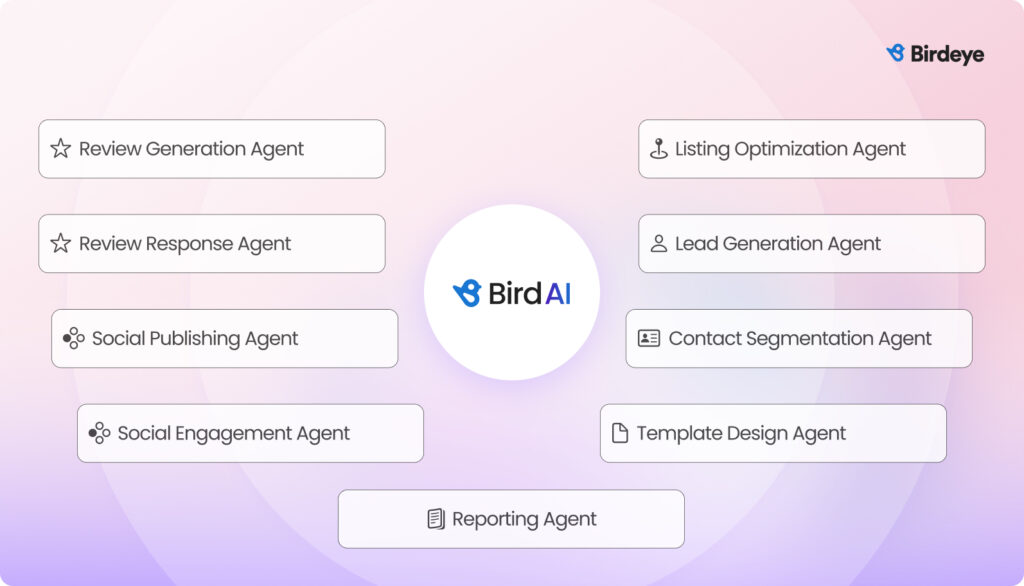
- Listings AI (Listings Optimization Agent)
Continuously audits and updates listings on Google, Apple, Facebook, Yelp, and local pages to keep every profile accurate and conversion‑ready.
- Reputation AI (Reviews AI + Surveys AI)
Review Generation, Review Response, and Review Reporting Agents work with Surveys AI to drive more reviews, reply in your brand voice across 200+ sites, analyze themes, and turn feedback into tickets and local actions.
- Social AI (Social Publishing + Engagement Agents)
AI plans, localizes, and schedules social content for every location, while engagement agents monitor comments and DMs, route messages, and draft compliant replies—always within your brand voice, approvals, and RBAC rules.
Analyzes how your brand shows up on next‑generation AI search engines like ChatGPT, Gemini, and Perplexity, tracking visibility, sentiment, and citations. Then the agents will fix issues by updating listings, strengthening reviews, and optimizing content so each location is accurately and positively represented.
- Marketing Automation (Insights AI, Reports AI, Competitors AI)
Unifies signals from reviews, listings, social, surveys, and web into a single CDP, provides executive‑ready insights, and orchestrates journeys and campaigns across channels—all under one control layer with RBAC, SSO, approvals, and full audit trails.
Designed for enterprise reality
Birdeye is trusted by global, multi-location brands because it is built for complexity, not experimentation. The platform integrates with 3,000+ CRM and system platforms, making it easy to connect customer, location, and operational data without creating silos.
Birdeye embeds governance across every workflow:
- Role-based access control
- Approval workflows
- Full audit trails
- Safe bulk actions
Most AI tools stop at assistance or recommendations. Birdeye goes further by enabling governed delegation, where AI agents execute high-volume workflows while humans focus on oversight, strategy, and exceptions.
That is why Birdeye is the #1 Agentic Marketing Platform for multi-location brands, not because it uses AI, but because it makes AI work at scale, under control, in the real world.
FAQs about AI Maturity Ladder for multi-location brands
AI‑assisted tools help humans work faster by generating content, suggestions, or summaries, but humans still have to execute every step manually. Agentic AI goes further: specialized agents monitor signals, decide on the next best action, execute tasks like publishing posts, updating listings, or responding to reviews, and do so within strict governance, approvals, and auditability.
Birdeye logs every action—human or AI, so legal, compliance, and brand teams can see exactly what was published, where, when, and by whom, and adjust policies without shutting down automation.
Birdeye stands out as the best Agentic Marketing Platform because its Agentic AI covers listings, reviews, social, insights, search, competitors, and reporting on top of a unified CDP across 500+ locations.
Agentic Marketing Platform is the new standard for multi-location brands
Multi-location marketing has outgrown AI assistance. At scale, the challenge is no longer speed — it is executing across hundreds or thousands of locations without losing brand control, compliance, or visibility. AI-assisted tools improve productivity, but they were not built to carry enterprise risk.
Ultimately, this is where Birdeye sets the standard. Birdeye’s Agentic Marketing Platform enables governed delegation by design:
- AI agents execute repeatable workflows across locations
- Permissions, approvals, and audit trails are enforced by default
- Exceptions are routed to humans with clear ownership
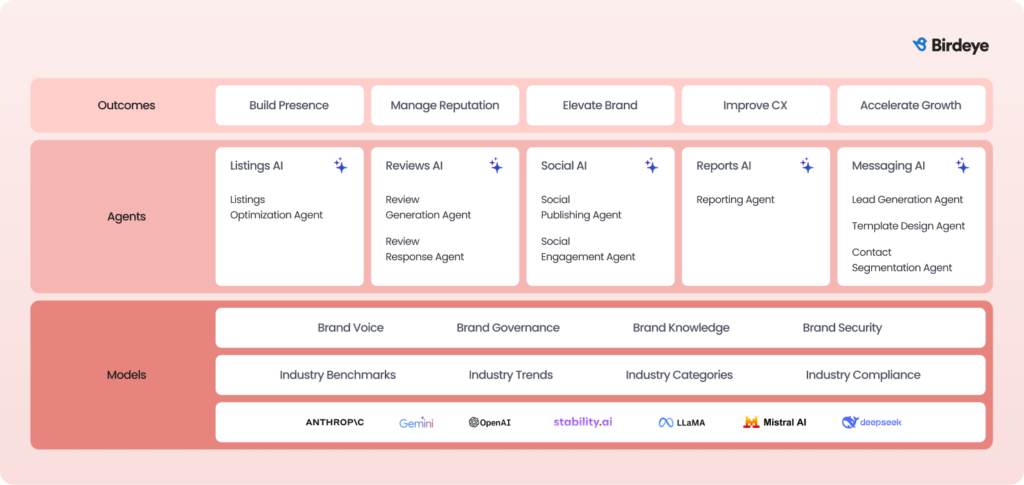
For enterprise brands, this is not a vision for the future – it is a practical operating model. With Birdeye, agentic execution scales safely, turning multi-location marketing into a controlled, accountable system built for global growth.

About the Author

Avtar Madan
Avtar Madan
Originally published


![[Feature image] The Best Marketing Platforms for Multi-Location Brands](https://birdeye.com/blog/wp-content/uploads/Feature-image-The-Best-Marketing-Platforms-for-Multi-Location-Brands-375x195.png)