Today, customers do not discover brands the way they used to. They ask questions in search engines and AI tools, compare options on maps and review sites, scroll through social platforms, and form opinions long before they visit a website.
Summary
A structured AI marketing strategy brings order to that complexity. It helps teams understand what influences discovery, monitor reputation across locations, and act quickly when performance shifts. In this guide, you will learn how an AI marketing strategy helps businesses:

- Strengthen visibility across search engines, review platforms, and AI-driven results
- Manage trust signals consistently across multiple locations
- Use AI agents to execute faster without losing control
Table of contents
- What is an AI marketing strategy?
- What are the main benefits of using AI in marketing strategy
- How multi-location brands benefit from an AI marketing strategy
- How to create an AI digital marketing strategy?
- How Birdeye’s tools and Agents help in executing AI marketing strategies: Real business case studies
- How Window Nation turned AI marketing into measurable growth
- What are the best AI marketing tools for different business needs
- What are the AI marketing trends shaping 2026
- What are the common mistakes to avoid when implementing AI marketing strategies?
- FAQ about AI marketing strategy
- Scale your business with Birdeye’s AI marketing tools
What is an AI marketing strategy?
An AI marketing strategy is how businesses use artificial intelligence to manage visibility, customer trust, and engagement across channels without relying on manual effort or disconnected tools.
It is not about running more campaigns or replacing people with software. It is about handling complexity. Especially when that complexity comes from dozens or hundreds of locations, thousands of customer interactions, and constantly changing search behavior.
What an AI marketing strategy looks like for multi-location brands
An AI marketing strategy helps multi-location teams answer questions they could not answer easily before. Not once a month. Not through static reports. But continuously.
Questions like:
- Where are customers discovering our brand right now?
- Which locations are gaining visibility and which are slipping?
- What themes keep showing up in reviews and messages?
- Which issues are hurting trust before customers contact us?
- What should we prioritize this week to improve performance?
Gartner predicts that traditional search engine volume will decline by 25% by 2026 as users increasingly turn to AI chatbots and virtual agents for answers, signaling a structural shift in how brands are discovered.
An AI marketing strategy brings these answers together across search, reviews, listings, social, and messaging. Instead of fragmented data, teams get a shared view of what is happening and why it matters. This clarity is what allows marketing leaders to make faster, more confident decisions.
Once teams have clarity, the next challenge is execution at scale. This is where AI takes over the operational load.
For example:
- Reviews are monitored automatically, with patterns surfaced instead of being buried
- Listings are kept accurate across platforms without manual updates
- Customer messages receive timely, on-brand responses
- Performance changes are explained, not just reported
What are the main benefits of using AI in marketing strategy
AI in marketing isn’t just about automation – it’s about transforming how businesses understand and connect with their target audience.
Here are the key benefits that make an AI marketing strategy essential for modern businesses:
1. Clear visibility into how customers find your brand
2. Consistent trust signals across all locations
3. Faster decisions without manual analysis
4. Personalization that does not slow teams down
5. Stronger performance across search and engagement
6. Scalable execution as the business grows
Let’s explore each in detail.
1. Clear visibility into how customers find your brand
A multi-location brand often assumes customers discover it through search alone. In reality, discovery happens across many paths.
With AI, teams can see how customers arrive through maps, reviews, social platforms, and AI-generated answers. They can spot which locations rely heavily on Google reviews, which markets lose visibility due to outdated information, and where engagement drops before a customer ever clicks a website.
Instead of guessing where attention comes from, teams finally know where discovery starts and where it breaks.
2. Consistent trust signals across all locations
Trust is fragile at scale. One slow response or inaccurate listing can undo strong brand perception.
AI helps businesses continuously monitor reviews, responses, and listings. When a location starts showing negative patterns or slower engagement, it shows up early. Teams can step in before customers lose confidence or choose a competitor.
Trust stops being reactive. It becomes something teams manage intentionally across every market.
Birdeye’s State of Online Reviews 2025 found that locations with consistent review activity and timely responses maintain stronger visibility and customer engagement than locations where review momentum stalls or feedback goes unanswered.
3. Faster decisions without manual analysis
Marketing leaders often know something is wrong before they know why.
AI shortens that gap. Instead of pulling reports from multiple tools, teams get clear explanations of what changed, where it happened, and what likely caused it. A drop in ratings, a spike in complaints, or a dip in engagement becomes understandable within minutes.
This shift turns reporting into action and improves customer experience.
4. Personalization that does not slow teams down
Personalization used to mean more effort from already stretched teams.
AI changes this by adapting messages, responses, and content to local context while keeping brand voice consistent. A customer inquiry in one market can sound relevant without being rewritten manually. Review responses stay human without being copied and pasted.
Customers feel seen, and teams stay efficient with such AI-driven customer feedback insights.
5. Stronger performance across search and engagement
When listings stay accurate, reviews are active, and responses are timely, performance improves naturally.
AI helps keep these fundamentals in place every day. Locations show up correctly in search. Customers see recent, credible feedback. Conversations move faster.
The result is better visibility, higher engagement, and stronger customer confidence without constant manual tuning. This leads to a more effective marketing funnel.
6. Scalable execution as the business grows
As locations increase, complexity grows faster than headcount.
A streamlined marketing automation workflow supports scale by handling high-volume tasks in the background while keeping execution coordinated. Marketing teams can support new markets without starting from scratch each time.
AI Marketing Strategy: Build, Launch, and Succeed
Want to see the impact of Birdeye on your business? Watch the Free Demo Now.
How multi-location brands benefit from an AI marketing strategy
Multi-location brands do not face a marketing problem. They face a coordination problem.
Each location generates its own reviews, listings, search visibility, and customer conversations. Without structure, performance varies widely from market to market. Strong locations hide weak ones. Issues go unnoticed until they escalate.
An AI marketing strategy brings control to that scale. Here is how it helps in practice:
1. Central control with local flexibility
AI allows corporate teams to maintain standards across reviews, listings, and messaging while giving locations room to reflect local context. Brand voice stays consistent without forcing identical execution everywhere.
2. Early detection of underperforming markets
Performance gaps between locations are often hidden in spreadsheets. AI surfaces declining sentiment, slower responses, or visibility drops before they affect revenue.
3. Faster issue containment
When a problem starts in one market, it does not stay local for long. AI flags patterns early so teams can intervene before reputation damage spreads.
4. Smarter expansion decisions
AI helps leadership compare visibility, sentiment, and engagement across regions. Expansion and investment decisions are based on performance data, not assumptions.
5. Operational leverage as locations grow
Each new location increases complexity. AI absorbs that operational load by automating monitoring, analysis, and routine execution so growth does not overwhelm the team.
How to create an AI digital marketing strategy?
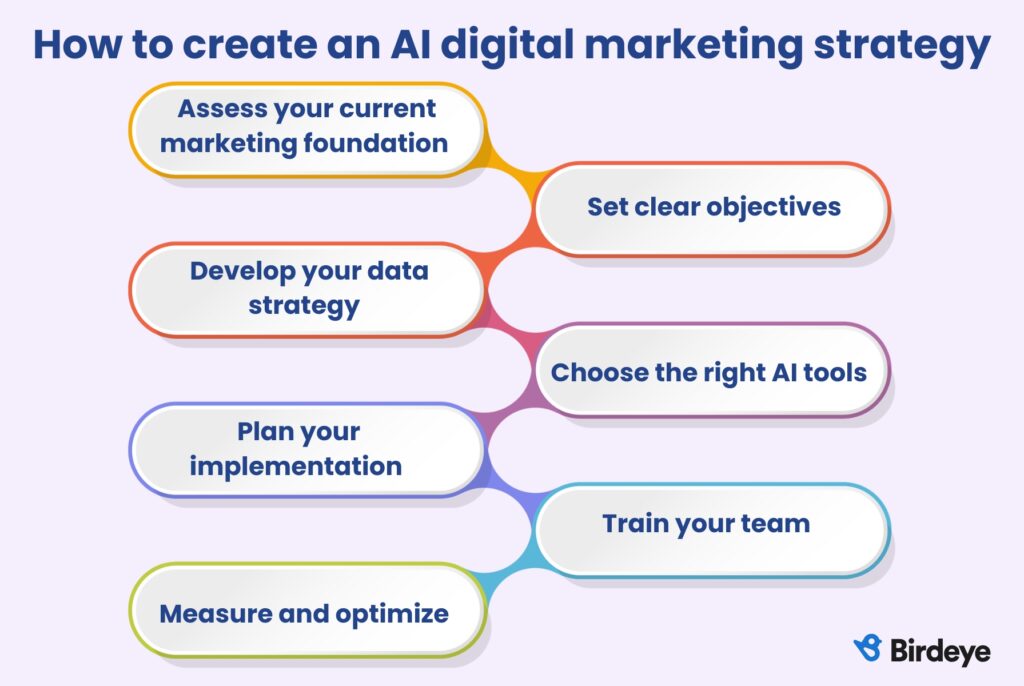
Transforming your marketing with AI doesn’t happen overnight. Like any strategic shift, it requires careful planning and systematic execution. While many businesses rush to adopt AI tools, successful implementation demands a structured approach that aligns technology with business goals.
The following eight steps provide a proven framework for building and implementing an AI marketing strategy that delivers measurable results. Each step builds on the previous one, creating a solid foundation for long-term success.
Let’s explore each step in detail.
1. Assess your current marketing foundation
Before diving into AI tools, examine your existing marketing efforts. Understanding your current processes, strengths, and pain points helps identify where AI can most impact:
- Which tasks consume most of your team’s time
- Current customer engagement metrics
- Areas where personalized content could drive better results
- Existing data collection and analysis processes
2. Set clear objectives
Success with AI marketing requires specific, measurable goals. Don’t implement AI just because it’s trendy – identify how it will improve your marketing customer experience strategy.
- Increase customer engagement through automated interactions
- Improve content creation efficiency
- Enhance analytics capabilities
- Streamline social media management
- Automate repetitive tasks
3. Develop your data strategy
AI’s effectiveness depends entirely on the quality of your data. Create a robust framework for collecting, organizing, and analyzing data across all touchpoints.
- Setting up proper data collection methods
- Ensuring data privacy compliance
- Creating a unified platform
4. Choose the right AI tools
AI tools should solve specific problems in your marketing workflow. Focus on solutions that integrate well with your existing technology stack and provide clear value to your marketing efforts.
- Content creation tools for marketing materials
- Social media management platforms
- Customer engagement solutions
- Marketing automation software
5. Plan your implementation
A successful AI marketing strategy requires careful planning. Start small and scale gradually, ensuring each step delivers measurable results before expanding further.
- Start with one key marketing workflow
- Test AI-generated content quality
- Monitor customer feedback
- Adjust based on results
6. Train your team
Your marketing team’s comfort with AI tools directly impacts success. Create a comprehensive training program that builds confidence and competence with new technologies.
- Use AI for local SEO to increase your search findability
- Provide tool-specific training
- Define roles and responsibilities
- Create standard operating procedures
7. Measure and optimize
Regular performance assessment ensures your AI marketing strategy delivers results. Set clear metrics and review them consistently to guide optimization efforts.
- Analyze customer experience improvements
- Track ROI on AI investments
- Gather team feedback
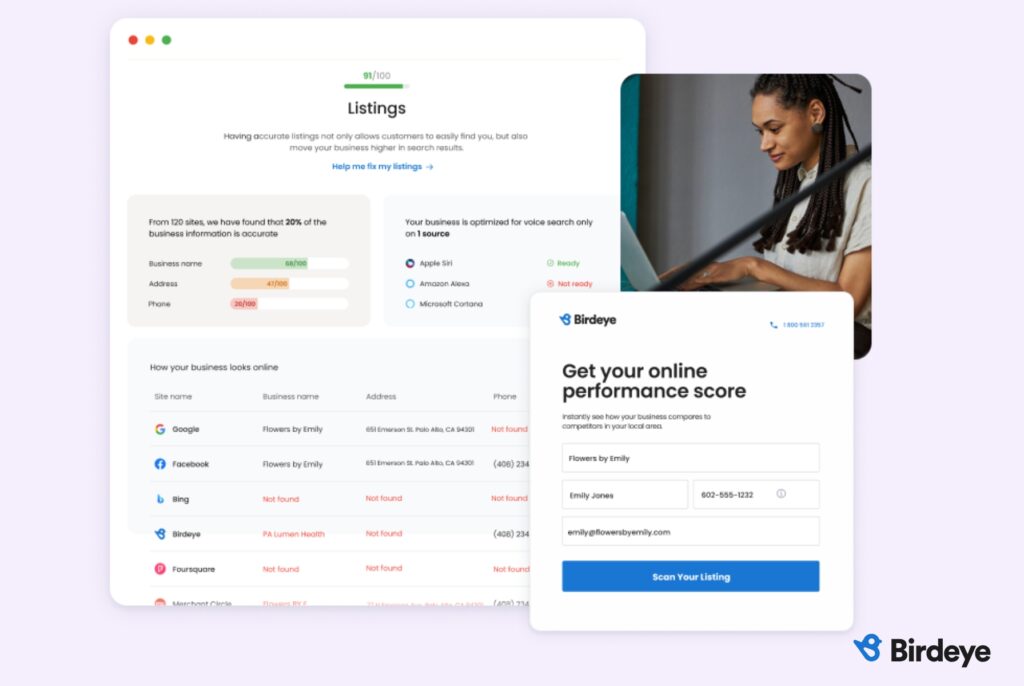
How Birdeye’s tools and Agents help in executing AI marketing strategies: Real business case studies
Once teams understand what is happening across locations, the next challenge is acting on it consistently. This is where AI marketing shifts from insight to execution.
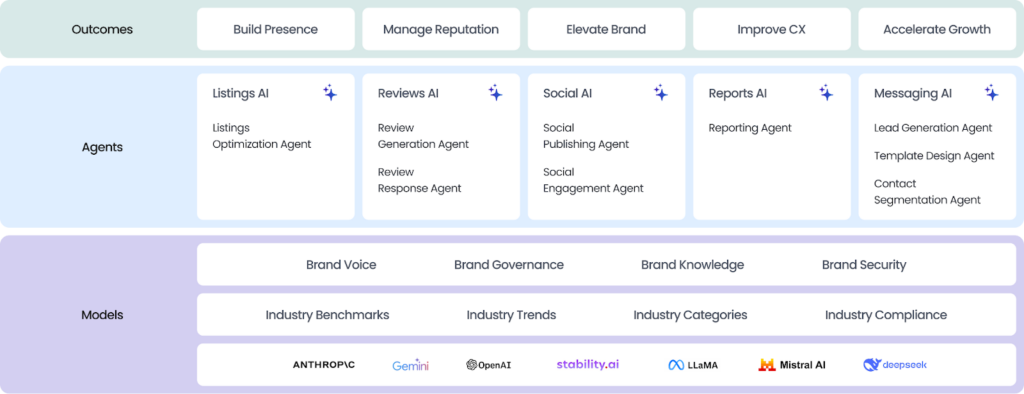
For multi-location brands, execution breaks down into a few repeatable needs. Birdeye addresses each one with a dedicated AI agent built for scale.
Each BirdAI agent is built for a specific execution problem. Together, Birdeye AI agents support one AI marketing strategy. Not more tools. Not more dashboards. Just consistent execution across every location.
Reviews AI
Reviews remain the cornerstone of true customer experience and business growth. Birdeye’s Reviews AI transforms how businesses handle customer feedback, moving beyond basic review management to intelligent response generation and sentiment analysis. Here’s how it benefits you:
- The Review Generation Agent sends review requests at the right moment, using messages that are more likely to get responses on the platforms that matter most.
- The Review Response Agent drafts on-brand replies by understanding tone, sentiment, images, and context. Teams stay in control, but response speed and consistency improve across locations.
Result: Higher review volume, faster responses, and stronger trust signals everywhere customers look.
Customer success story: Fireman Hospitality Group
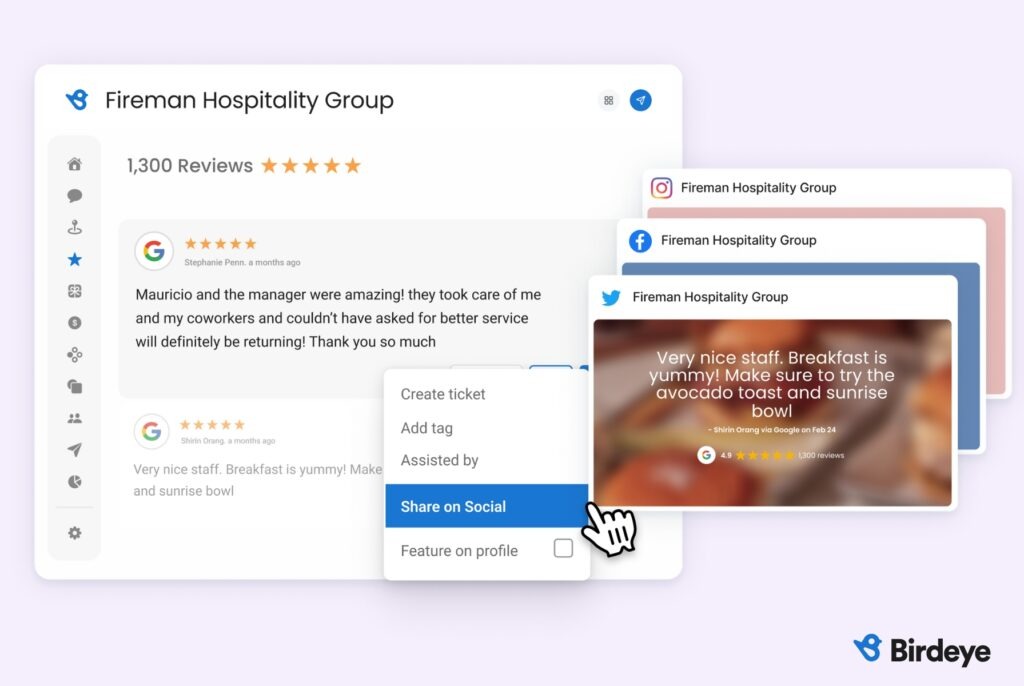
Challenge: Fireman Hospitality Group, with 13 restaurants in New York City and Maryland, struggled to manage its online presence and guest feedback across multiple locations. They needed an automated solution to collect, manage, and leverage guest reviews while maintaining their reputation for exceptional hospitality.
Solution: Implemented Birdeye’s integrated solution:
- Integrated with one of Birdeye’s 3,000+ CRMs (Toast POS)
- Automated review collection via text/email
- Streamlined review response system
- Social media integration for review sharing
- Consolidated reporting dashboard
Results:
- Generated 8,900+ new reviews across platforms
- Collected 4,000+ new Google reviews
- Maintained 4.3-star average rating
- Achieved 97% review response rate
- Gained 63,000 new Instagram followers
"Thanks to Birdeye, we can keep our restaurant top-of-mind for our guests, making us their go-to choice for future visits.” Stephanie Holmes, Director of Guest Services, Fireman Hospitality Group
Listing AI
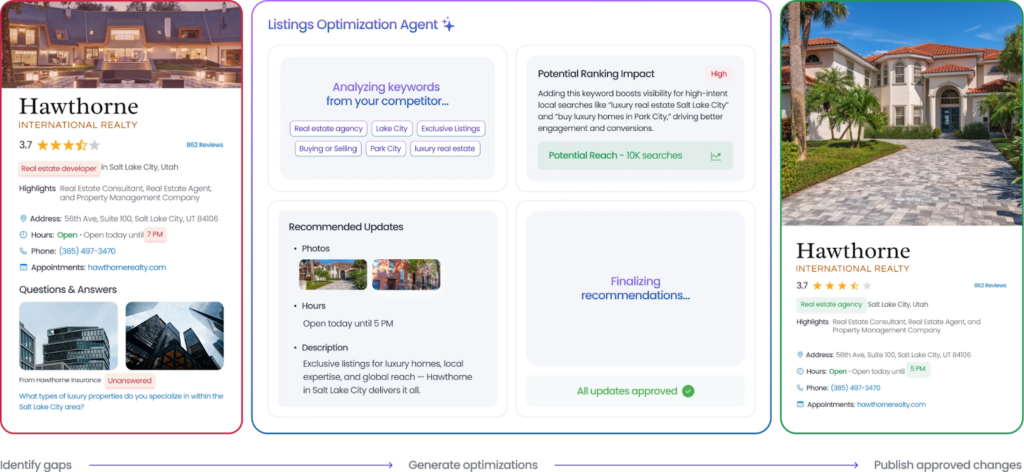
Accurate business listing management is crucial for maintaining a strong local presence. Otherwise, customers and search engines lose trust quickly when hours, addresses, or services are incorrect
Birdeye Listings AI helps multi-location brands maintain a consistent brand presence at scale by using the Listings Optimization Agent to:
- Continuously analyze business listings across platforms
- Improve local search visibility for each location
- Monitor customer behavior by location
- Recommend location-specific updates that can be applied with built-in guardrails
In Birdeye’s 2025 Local Search Accuracy Benchmark, AI search engines frequently omitted or misclassified businesses due to stale hours, incorrect categories, or conflicting listing data—showing that AI systems suppress uncertainty rather than ranking around it.
Social AI
Social media marketing demands constant attention and creative content. Birdeye Social AI is your intelligent social media manager, handling everything from content creation to performance analysis, and empowers you with
- Social Publishing Agent that generates on-brand posts tailored to each platform and location.
- Social Engagement Agent that triages incoming messages, routes them correctly, and drafts replies so no interaction is missed.
- Analyzing social media performance
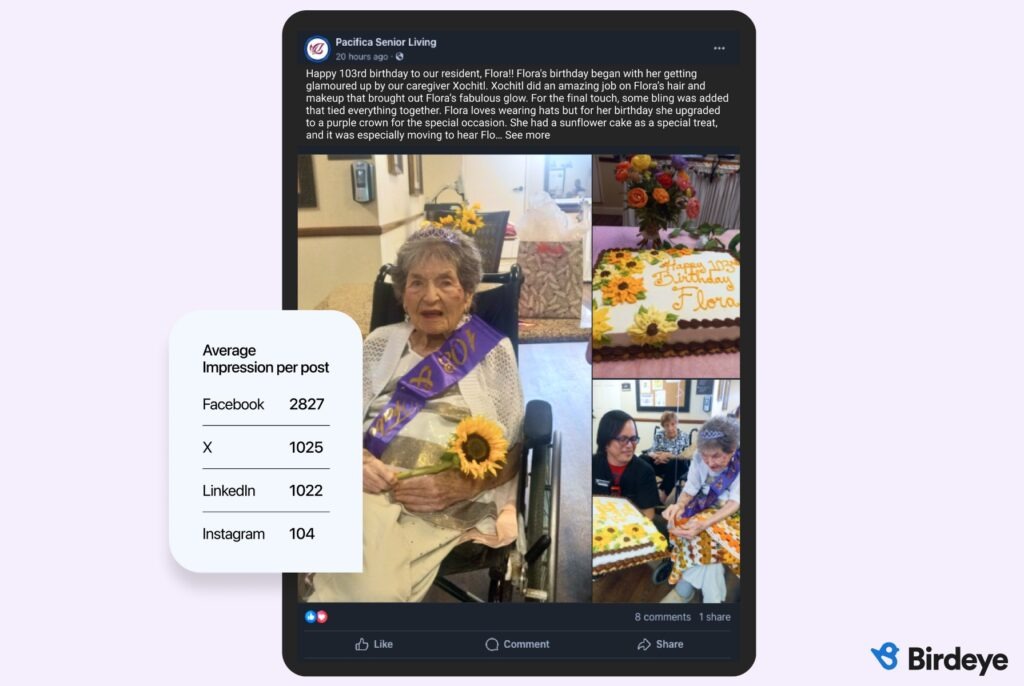
Customer success story: Pacifica Senior Living
Challenge: Pacifica Senior Living, with 96 senior living communities across the US, struggled to manage social media content across multiple locations while maintaining brand consistency. They needed a centralized solution to manage content creation, approval workflows, and engagement for approximately 300 users.
They implemented Birdeye Social to streamline their social media management and clocked the following results:
- Centralized dashboard for content management
- Mobile app for real-time content capture
- Streamlined approval workflows
- Automated posting schedules
- Unified engagement monitoring across platforms
Results:
- Published 11,200 posts across locations in 9 months
- Averaged 4 posts per week per location
- Achieved a 25% increase in engagement across digital platforms in 6 months
- Streamlined content approval process for 300+ users
“Implementing Birdeye Social AI has been a game-changer for us. Since its rollout across our communities, we've seen a surge in engaging content, particularly short-form videos that excel on our corporate platforms." – Sarah Schlosberg, Social Media Coordinator, Pacifica Senior Living
Insights AI
Understanding consumer data is key to effective marketing campaigns. Insights AI turns complex customer data into actionable marketing strategies through advanced analytics and machine learning to:
- Process data to reveal actionable insights
- Tracks performance across channels
- Provide competitive intelligence
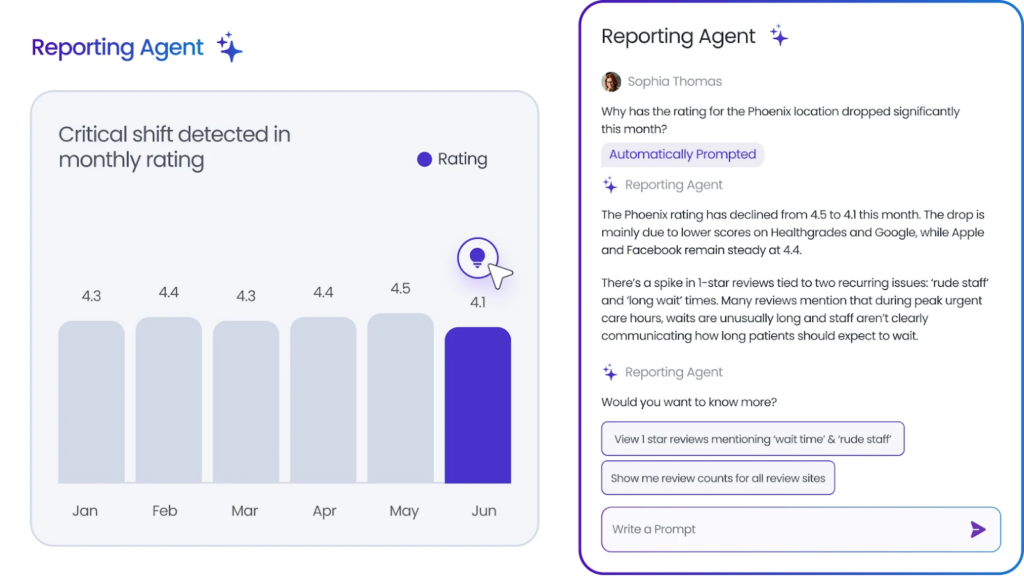
Birdeye’s very dynamic Reporting Agent answers performance questions using natural language. It explains what changed, why it changed, and where teams should act next.
Seach AI
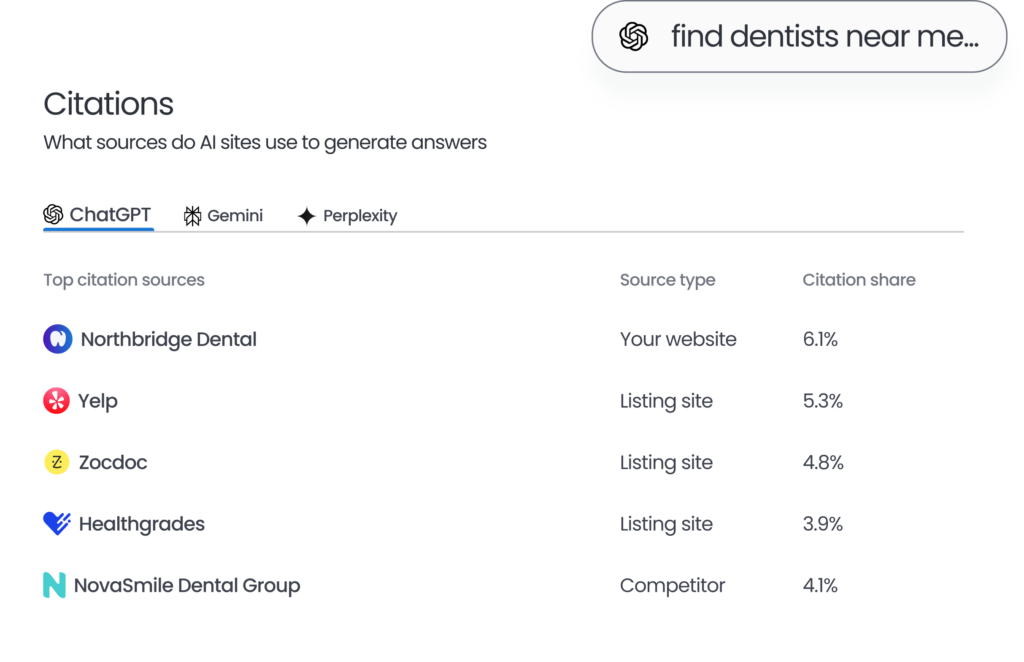
As customer discovery shifts toward AI-driven search and recommendations, Birdeye Search AI helps brands understand and improve how they appear in AI-powered answers by:
- Tracking where and how brands and locations show up across AI search platforms
- Identifying the prompts and questions customers use to find businesses like yours
- Analyzing brand sentiment in AI-generated responses to uncover trust gaps
- Flagging citation and business information inaccuracies that affect visibility
- Recommending prioritized actions to improve presence and authority across AI search
Competitors AI
Staying ahead requires understanding your brand position through market mapping.
Competitors AI monitors your competitive landscape, helping you identify opportunities and optimize your marketing efforts by:
- Monitoring competitor marketing efforts
- Identifying market opportunities
- Analyzing competitive marketing strategies
- Optimizing marketing campaigns
Messaging AI
Effective customer communication drives business growth. Messaging AI supports this by enabling prompt, personalized responses while maintaining a consistent brand voice through:
- The Contact Segmentation Agent, which builds and updates customer segments automatically using real-time data.
- The Template Design Agent, which creates brand-aligned templates for emails, texts, newsletters, and landing pages without design bottlenecks.
- The Lead Generation Agent qualifies leads, follows up instantly, and escalates conversations when human involvement is needed.

These extremely streamlined marketing automation workflows help teams launch, manage, and scale campaigns with less manual effort.
How Window Nation turned AI marketing into measurable growth
Window Nation operates in 32 markets nationwide, with 22 showrooms across the U.S. As the business scaled, managing reviews, listings, and customer communication across platforms became increasingly difficult.

Before Birdeye, the team had to log into multiple tools every day to manage reviews, update listings, and respond to customer messages. This slowed response times, limited visibility into performance, and made it harder to act on customer feedback.
By adopting Birdeye’s AI-powered platform, Window Nation centralized reviews, listings, messaging, and insights into a single system. This shift allowed the team to move faster and operate with clarity across every location.
Results achieved with Birdeye
Since implementing Birdeye, Window Nation has seen measurable improvements across trust, engagement, and operational efficiency:
- 40,200 new customer reviews generated across platforms
- 21,800 new Google reviews, increasing their average Google rating to 4.8 stars
- Over 80% conversion rate on 21,500 review requests
- Average response time of just 33 minutes across customer messages
- Reviews monitored and responded to within 24 hours

What are the best AI marketing tools for different business needs
Beyond Birdeye’s Agentic Marketing platform, which helps multi-location brands manage visibility, trust, and customer engagement at scale, many teams can also use specialized AI tools for business that help boost your productivity and growth. Here’s a curated selection of AI-powered marketing tools for different marketing tasks:
AI tools for content creation
The content creation landscape has evolved with AI tools that help marketers efficiently produce high-quality, personalized content.
1. ChatGPT: Powers everything from marketing campaigns to social media posts with AI. Marketers use it to:
- Generate creative content ideas
- Generate marketing content
- Create personalized content variations
- Develop social media content
2. Jasper: Specializes in long-form marketing content:
- Produces blog posts and articles
- Creates marketing materials
- Generates product descriptions
- Writes compelling ad copy
3. Copy.ai: Focuses on conversion-oriented content:
- Crafts marketing campaigns
- Creates landing page copy
- Generates email sequences
- Develops social media captions
AI tools for predictive analytics
These tools help teams analyze data and predict customer behavior.
1. Google Analytics 4: Uses AI to:
- Track user behavior
- Analyze web traffic patterns
- Measure campaign performance
- Provide user insights
2. Tableau: Offers advanced data analysis:
- Creates predictive models
- Visualizes marketing data
- Tracks customer journey
- Monitors market trends
3. Adobe Analytics: Specializes in:
- Customer behavior analysis
- Marketing campaign tracking
- Data processing
- Performance forecasting

AI tools for customer engagement
These tools enhance customer experience through automated interactions.
1. Intercom: Powers customer communication:
- Handles customer feedback
- Automates repetitive tasks
- Provides personalized responses
2. HubSpot: Offers comprehensive customer engagement:
- Automates marketing workflows
- Manages email marketing campaigns
- Tracks customer interactions
- Provides customer insights
3. Salesforce Marketing Cloud: A sales engagement platform that focuses on:
- Customer journey mapping
- Personalized marketing campaigns
- Customer data management
What are the AI marketing trends shaping 2026
AI marketing in 2026 looks very different from what it was just a few years ago. The biggest change is not better tools. It is how customers make decisions and how brands are evaluated before any direct interaction.
Here are the trends shaping how AI marketing strategies need to be built today:
Trust signals are becoming ranking signals
In 2026, visibility and trust are tightly connected. Brands are surfaced based on reviews, sentiment, response behavior, and accuracy, not just keywords or spend.
The 2025 Edelman Trust Barometer reports that 81% of consumers say they must trust a brand before making a purchase, reinforcing that credibility now directly influences visibility and conversion.
As a result, AI marketing strategies are evolving to actively manage trust signals at scale. Brands can no longer treat reputation as a passive outcome. Review volume, sentiment trends, and response consistency are now operational inputs that directly affect discovery.
This is where tools like AI review generators play a role, not by manufacturing feedback, but by helping businesses consistently request reviews, analyze sentiment, and respond thoughtfully at scale.
Discovery optimization is moving ahead of conversion optimization
Most strategies still focus too heavily on what happens after a customer clicks. By then, the decision is often already made. If a strategy only optimizes landing pages and ads, it is incomplete.
AI marketing needs to support the earlier stages of discovery. This is where AI search optimization becomes critical, ensuring brands are accurately represented, consistently cited, and trusted across AI-driven answers, maps, reviews, and search summaries before customers ever click. This also changes how teams measure performance. The AI search ROI is no longer limited to clicks alone. It now includes visibility in AI answers, stronger brand trust, and earlier influence on buying decisions.
Continuous AI workflows are replacing one-time automations
One-off automation creates short-term efficiency but long-term fragility.
Effective AI marketing strategies rely on ongoing workflows. Reviews are monitored continuously. Listings stay accurate automatically. Messages are handled in real time. Performance is explained as it changes.
This keeps execution consistent even as teams and locations grow.
AI is becoming the execution layer, not the decision-maker
As AI becomes more capable, successful brands are drawing a clear line between strategy and execution. AI should not decide brand voice, priorities, or values. That responsibility stays with people.
Where AI adds value is in execution. Handling volume. Spotting patterns. Acting faster than humans can. The best strategies make this boundary clear from the start.
Together, these trends show that AI marketing is no longer about isolated tools or experiments. It’s about building systems that manage trust, discovery, and execution continuously, across every customer touchpoint.
What are the common mistakes to avoid when implementing AI marketing strategies?

Many businesses rush into an AI marketing strategy without proper planning, wasting resources and missing opportunities. Understanding these common pitfalls helps you navigate your AI implementation more effectively. Here are the top mistakes to avoid when implementing AI marketing strategies:
1. The “AI will fix everything” mindset
Many businesses view AI as a magical solution that will instantly transform their marketing efforts. This mindset creates unrealistic expectations and implementation issues.
Common misconceptions:
- “Just add AI to our marketing, and everything will improve”
- “The AI will figure out our messy data”
- “The tools are intuitive, our team will figure it out”
- “We’ll see ROI immediately after implementation”
How to avoid this:
- Set specific, measurable objectives for each AI implementation
- Create a structured data preparation plan before adopting AI tools
- Invest in comprehensive team training programs
- Develop realistic timelines with phased implementation goals
2. Disconnected technology adoption
Organizations often rush to adopt AI tools without considering their existing technology ecosystem, leading to fragmented systems and inefficient workflows.
Integration issues:
- Poor integration with the current strategy
- Incompatible AI tools and platforms that create data silos
- Unable to create unified customer views
- Redundant tools and processes causing confusion
Solution approach:
- Audit your current marketing technology stack
- Create an integration roadmap before implementation
- Choose AI tools that complement existing systems
- Regularly review and optimize your AI marketing workflow
3. Overautomation syndrome
In their excitement to leverage AI, many companies automate everything possible, forgetting that effective marketing requires a human touch.
Common mistakes:
- Over-relying on AI for creative decisions
- Automated responses for every customer touchpoint
- Publishing AI-generated content without review
- Generic marketing messages across channels
Solution approach:
- Define clear boundaries for AI automation
- Maintain human oversight for creative and strategic decisions
- Create quality control processes for AI-generated content
- Develop channel-specific content strategies
4. Data quality issues
Many organizations underestimate the importance of clean, organized data in AI marketing success.
Data challenges:
- Using unorganized customer records
- Ignoring data privacy requirements like GDPR
- Inconsistent or incomplete data gathering
- Lack of standardized data handling procedures
Best practices:
- Implement data cleaning and organization protocols
- Establish clear data privacy guidelines
- Create standardized data collection processes
- Regular data audits and maintenance
5. Inadequate team preparation
Success with AI tools requires more than just purchasing software—it needs prepared teams.
Common issues:
- Insufficient training on AI tools
- Confusion about who manages what
- Lack of standard operating procedures (SOPs) for using AI tools
- Not addressing team concerns and resistance
Solution strategy:
- Develop comprehensive training programs
- Create clear role definitions and responsibilities
- Establish detailed operating procedures
- Implement effective change management practices
6. Missing performance metrics
Without proper measurement, you can’t validate AI marketing success or identify areas for improvement.
Measurement gaps:
- No clear KPIs for AI implementation
- Poor tracking of marketing efforts
- Lack of regular performance reviews
- Ineffective ROI measurement
Our recommended approach:
- Establish clear KPIs (like customer lifetime value)
- Set up comprehensive tracking systems
- Schedule regular performance reviews
- Develop ROI measurement frameworks

FAQ about AI marketing strategy
An AI marketing strategy is a powerful approach that leverages AI technologies to improve targeting and personalization, streamline operations, and maximize business success. Embrace this innovation, and watch your marketing efforts soar.
AI boosts customer engagement by delivering personalized messages, automating tasks, and analyzing data to enhance marketing strategies. Embrace these technologies to connect with your customers like never before.
To succeed in AI marketing, prioritize data privacy, transparency, and bias reduction. This not only fosters customer trust but also builds a responsible brand image.
To measure the success of your AI marketing strategy, track key performance indicators (KPIs) such as conversions, customer lifetime value, and return on investment (ROI) using tools like Salesforce and Google Analytics.
Multi-location brands build trust locally but manage it centrally. AI marketing helps monitor reviews, listings, and engagement across all locations, surface issues early, and maintain consistent trust signals without manual effort.
No. AI handles execution at scale, monitoring, analysis, and response speed. Humans set strategy, brand voice, and priorities. The most effective AI marketing strategies clearly separate direction from execution.
AI search optimization focuses on improving how brands appear in AI-generated answers, maps, and summaries. It prioritizes accuracy, reviews, sentiment, and consistency so AI systems can confidently recommend a business.
Scale your business with Birdeye’s AI marketing tools
The future of marketing lies in intelligently combining AI capabilities with human expertise. Birdeye’s Agentic marketing platform provides the foundation for this transformation:
- Enhanced customer insights through advanced analytics
- Automated yet personalized customer interactions
- Streamlined marketing workflows
- Data-driven decision making
- Scalable personalization across channels
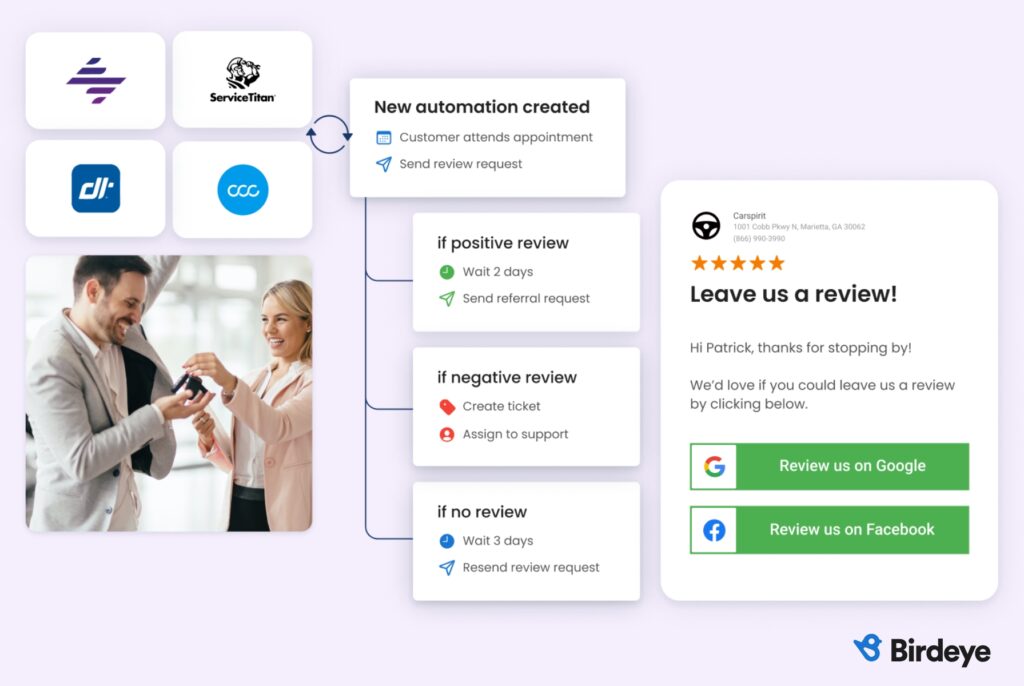
Start your AI marketing journey with Birdeye’s proven platform. Our tools help you deliver exceptional customer experiences while maximizing marketing team efficiency.

About the Author

Shruti Dugar
Birdeye
Originally published