For multi-location brands, the greatest reputation risk is often a struggling site hidden behind healthy brand averages. While your corporate scorecards show stability, local sentiment and visibility may already be slipping. Brands must stop relying on these masking metrics and adopt early warning systems to catch local demand loss before AI search engines amplify the damage.
Summary of the blog
Multi-location reputation crises rarely begin with a public blowup. They start silently as local sentiment and visibility erode despite passing corporate benchmarks. This article examines how underperforming locations can quietly degrade brand equity, particularly in AI search results, and outlines how marketing leaders can mitigate this risk by using Birdeye Reviews and Search AI to build a proactive weak-link detection system.
Table of contents
- Summary of the blog
- How do brand-level reputation averages hide the locations that matter most?
- Why brand equity is shifting to the local level
- Why do aggregate metrics create a false sense of safety?
- What review insights actually surface (vs. what a star rating tells you)
- How AI search makes the weak link more urgent
- How to build a weak-link detection system
- Why this is a 2026 priority, not a nice-to-have
- FAQs about AI search and identifying underperforming locations
- Secure your reputation across every location
How do brand-level reputation averages hide the locations that matter most?
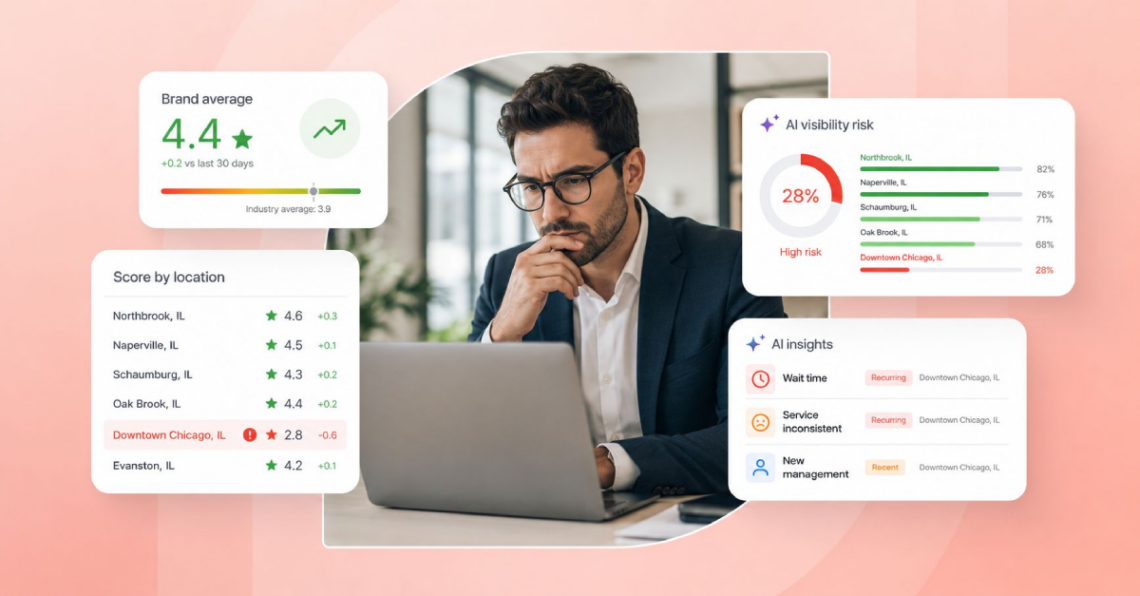
Imagine your brand having an overall healthy rating of 4.4 stars. Your regional executive dashboards look completely green, and your marketing team is actively focused on rolling out the next national campaign.
Meanwhile, your downtown Chicago location has been generating a steady stream of 2-star reviews for three consecutive months. The comments are not random. They keep mentioning the same issue: new management. Customers are saying the staff feels rushed. Service feels inconsistent. Long-time customers are noticing a change.
To your brand-level reporting, this localized dip is practically invisible. But to a prospective customer in Chicago, the reality is entirely different. When that customer asks ChatGPT to recommend the best option in your category within their neighborhood, the AI engine is now quietly routing them directly to your competitor.
This isn’t a hypothetical. Birdeye’s 2026 Location Disparity Inside AI Visibility report, which analyzed 1,762 multi-location brands, found that individual locations are roughly three times more visible in AI answers than the brand-level score suggests, and that 46.7% of brands have a 50-point-or-larger visibility gap between their best and worst locations.
You won’t see this failure reflected in your aggregate reporting until it inevitably shows up as bleeding local revenue.
Why brand equity is shifting to the local level
Multi-location enterprises have spent the last decade building massive operational infrastructures designed to manage reputation from a top-down, brand-level perspective. But in the era of AI search, brand equity is only as strong as its weakest location.
That weakness now carries two compounding layers of risk:
- What your customers are currently experiencing and saying.
- What AI engines are consequently telling your future customers.
The weak link is no longer just a local operations issue; it is actively undermining your brand-wide AI search equity. The same report found 18.6% of locations never appeared in AI answers at all, effectively invisible to any customer asking about that category in that market. The reviews sitting under a struggling location don’t just influence people scrolling through Google. They are becoming part of the broader information layer AI engines use to describe, compare, and recommend businesses.
When someone asks ChatGPT, Gemini, Perplexity, or an AI-powered search experience for the best option in that market, those recurring review themes can shape the answer.
That is the new risk for multi-location brands. A weak location does not just lose customers locally. It can start teaching AI engines that your brand is inconsistent, slow, poorly staffed, or not the best choice in a specific market.
Why do aggregate metrics create a false sense of safety?
Most multi-location brands do not ignore reputation. They track it closely. They monitor average star ratings, review volume, response rates, and overall sentiment. The problem is not a lack of data. The problem is the level at which the data is managed.
Brand-level reporting is useful for seeing the big picture. But it’s dangerous when it becomes the only picture. A 500-location brand can have a 4.4-star average and still have a location sitting at 2.8 stars. The bigger the brand gets, the easier it becomes for a struggling location to disappear inside the average. Scale does not protect you from location-level failure. It just hides it longer.
This isn’t unique to star ratings. The same visibility gap shows up at the brand level too. In seven sectors, including Construction, Business Services, Manufacturing, Transportation, Finance, Legal, and Insurance, brand-level AI visibility scores meet or beat the industry benchmark even as one in five locations remains nearly invisible to AI. A healthy brand number in these categories isn’t reassurance. It’s often the exact thing keeping a broken location strategy off the executive agenda.
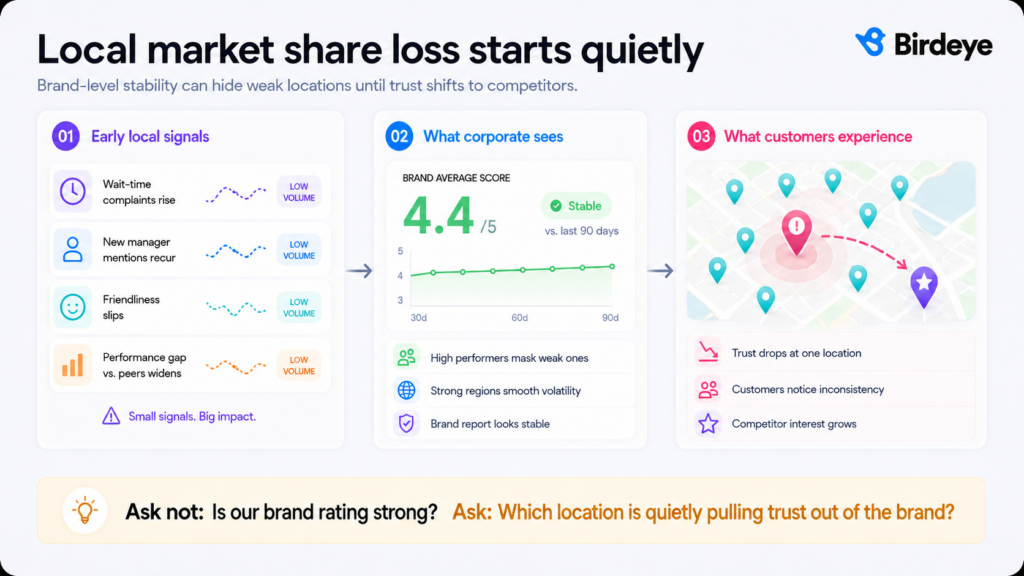
A single declining location might not sway the national average, but to a local customer, that location is the brand. Customers don’t experience a corporate average; they experience the reality of their specific visit, call, or appointment. When that experience fails, the brand fails, regardless of what the national metrics report.
This is why aggregate dashboards can create false confidence. They tell leadership that the brand is healthy, even as one location is losing trust. The same study found this holds true even for AI sentiment specifically: scores stay around 80 out of 100 almost regardless of whether an industry’s locations are highly visible to AI or nearly absent from it. AI can sound confident and positive about a location it can barely find. If sentiment is the number you’re watching, it will report the brand as healthy while visibility quietly collapses underneath it.
Local market share loss rarely erupts as a brand-level event. Instead, it begins as a pattern: a slight uptick in wait-time complaints, recurring mentions of a new manager, a dip in friendliness, or a widening performance gap between a location and its peers. Ultimately, it fuels customer interest in your competitors.
By the time brand-level reports surface a problem, the local damage has already compounded. For large enterprises, this delay is critical because averages systematically conceal volatility. Strong regions mask struggling markets, creating a dangerous illusion of stability for corporate teams, even as customers continue to experience the reality of inconsistency.
What review insights actually surface (vs. what a star rating tells you)
Traditional star ratings are a lagging indicator. They can only tell you that something is wrong, whereas true insights from Birdeye Reviews uncover exactly what is wrong and where it is happening at a local level.
The Reporting Agent sits atop this foundation, allowing enterprise teams to query those insights in plain English and instantly reveal hidden network trends without scanning a single dashboard.
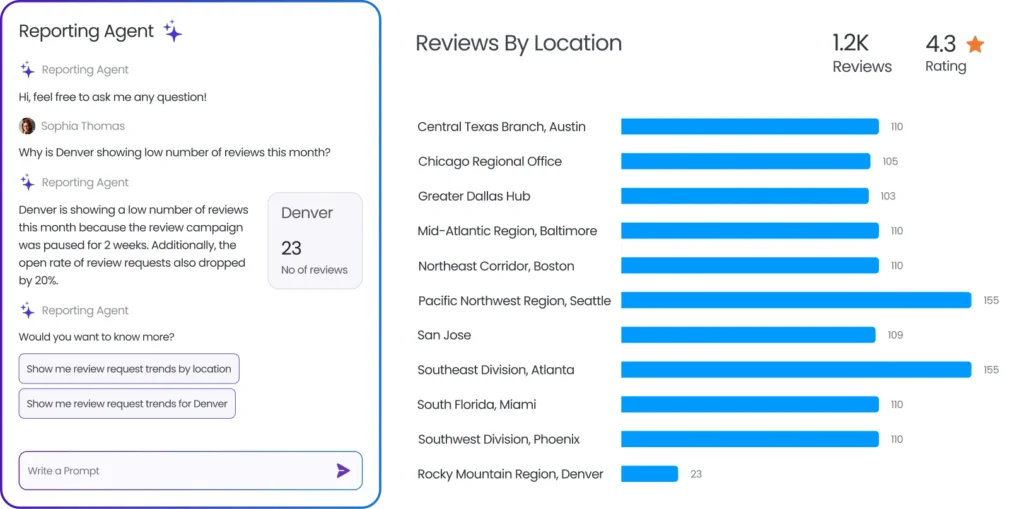
When multi-location enterprises move beyond tracking static star ratings to deploying advanced review insights, they unlock the ability to conduct theme clustering across their entire footprint. For example, if “wait time” complaints suddenly spike at one specific location but remain stable across the rest of the region, that is an immediate operational signal rather than a vague marketing problem.
Furthermore, sentiment trajectory matters far more than a point-in-time rating. A location trending from a 4.2 rating down to a 3.6 rating over a 90-day period is a five-alarm fire that a static snapshot completely misses.
Cross-location benchmarking is the only way to identify these underperformers, as it requires comparing locations with one another rather than relying solely on an absolute corporate standard.
For example, Window Nation, a prominent home improvement company with over 30 locations across the U.S., used Birdeye Reviews and Insights to identify which areas required operational focus and where improvements were needed across the business.
By identifying specific positive and negative keyword themes in reviews, the company’s leadership could benchmark location-specific performance to determine what to promote and what needs immediate intervention. This data-driven approach helped Window Nation manage over 40,200 reviews to maintain a 4.5-star rating across their markets.
In traditional reporting metrics, these granular issues often remain invisible because they are masked by strong performance elsewhere. Only by utilizing theme-based insights can leadership uncover these specific operational details before they impact the broader brand reputation.
How AI search makes the weak link more urgent
A location’s bad reviews no longer just sit passively on Google Maps waiting for a human to scroll past them. Today, AI search engines use a process called Retrieval-Augmented Generation (RAG) to actively pull in real-time external sources into their answers. And when your own reviews and content aren’t the source, someone else’s are. Across location-level AI answers, competitor and third-party editorial content outnumber brand-owned sites by roughly 10:1, with competitors alone accounting for a 6:1 disparity.
AI engines like ChatGPT, Gemini, and Perplexity do not simply count your star ratings. They synthesize information by reading patterns across public content, business profiles, review text, third-party mentions, listings, and other available sources to form their fundamental description of your business. In fact, recent industry benchmarks from G2 show that actively building your profile from zero to over 500 reviews can increase a product’s median AI citations by more than 800 times.
When a location starts generating recurring negative themes in its reviews, it begins to be described differently by AI, even if its historical star rating remains acceptable. Since AI models analyze specific text rather than aggregate scores, your customers’ complaints effectively become the AI’s talking points.
Birdeye Search AI tracks exactly this phenomenon. It maps your visibility across AI-generated answers, revealing the exact local sentiment signals search engines use to formulate recommendations, so you can optimize what drives local choice.
This capability is essential, as the compounding problem for enterprises is severe: while a weak location may begin as an operational issue, AI broadcasts that underperformance to every prospective customer who asks an AI assistant for a local recommendation in that market.
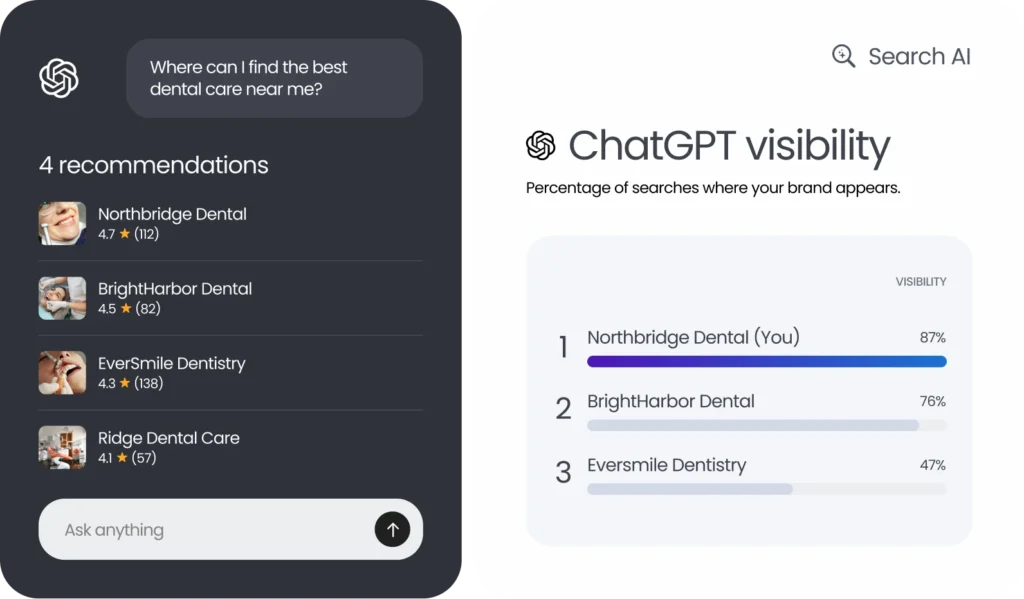
A prime example of this in action is Arrow Senior Living. With over 40 locations to manage, they leveraged Birdeye Search AI to gain visibility into how AI models evaluated and recommended their individual locations. By identifying exactly which sentiment signals and source data AI engines like ChatGPT and Gemini were scraping, the company was able to systematically correct data gaps and optimize local performance.
As a result, they turned AI visibility into a competitive advantage, driving a 9.2% increase in AI search visibility and a 52.8% surge in qualified leads in just one month.
The key insight that must be made explicit across your organization is this: insights from Birdeye Reviews show you the “input” (what your customers are saying on the ground). Search AI shows you the “output” (what AI is subsequently telling future customers based on what was said). You need both to see the full damage loop.
Try Birdeye's free AI visibility checker to see where your local signals currently stand.
How to build a weak-link detection system
To protect your brand equity in the generative search era, you must build and implement a systematic detection system that can identify the weak link before the damage compounds. Here are the steps for achieving that:
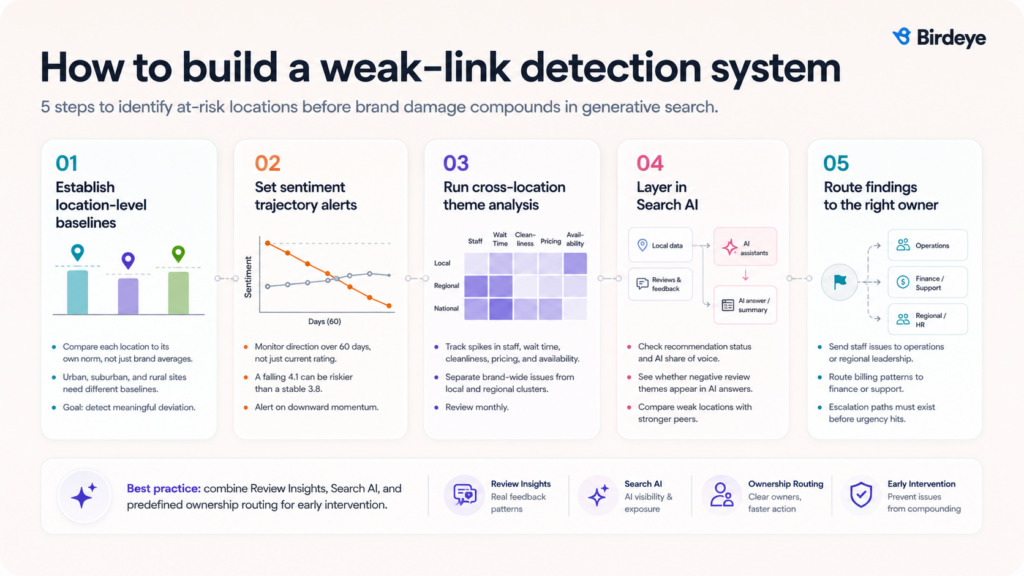
1. Establish location-level baselines, not just brand averages
Do not manage every location only against the brand average. Each location needs its own baseline because every market is different. A flagship urban location, a suburban franchise site, and a rural branch may have different review volumes, customer expectations, staffing models, and competitive pressures.
The goal is not to flatten every location into the same benchmark. The goal is to detect meaningful deviation.
2. Set sentiment trajectory alerts, not just rating thresholds
A location that currently sits at 4.1 stars but is trending rapidly downward over a 60-day period is a far more urgent threat than a location sitting at a stable 3.8 that hasn’t fluctuated in a year.
You must monitor the direction of the sentiment, not just the absolute number.
3. Run cross-location theme analysis monthly
Which locations are seeing a rise in complaints about staff? Where are customers mentioning long waits? Which markets are seeing more negative comments about cleanliness, communication, pricing, or availability? You need to know which specific themes are spiking at specific locations but not systemically across your brand.
If a theme appears everywhere, it may be a brand, policy, or messaging issue. Should it surface in only one location, the cause is likely a local operations issue. Finally, if it spans a cluster of nearby sites, you may be facing a regional leadership, staffing, or training challenge.
4. Layer in Search AI to assess downstream AI representation
Once Review Insights has helped you identify a struggling location, you must immediately check how that specific location is being represented in AI search ecosystems using Search AI.
Is the location still being recommended for relevant category searches? Is its AI share of voice declining compared with local competitors? Are negative review themes showing up in AI-generated answers? Are AI engines describing the location differently than they describe stronger locations in the same brand network?
A weak location can fail this check in two distinct ways, and both matter.
The first is a sentiment problem: negative review themes, thin local content, inconsistent listings, or poor third-party signals give AI systems more room to form an unfavorable picture.
The second is a data problem, separate from sentiment entirely: the same report found ChatGPT had the wrong business hours 97% of the time and the wrong website for 57% of locations, with fewer than 1 in 100 locations returning a fully accurate AI profile.
A location can have strong sentiment and still lose customers if AI is sending them to the wrong address, the wrong hours, or a dead link. Search AI needs to catch both, not just the sentiment side.
This is where citation visibility becomes important. Birdeye's 2026 Location Disparity Inside AI Visibility report found that while business websites account for 48% of AI answers, they rarely favor your brand. Competitors claim 41% of these citations, compared to just 7% for your own sites. With directories (25%) and editorial content filling the gap, your competitors are currently authoring the majority of your brand narrative.

AI search engines synthesize your entire digital footprint, and right now, your brand is being overshadowed. For multi-location brands, that creates two responsibilities:

1. First, ensure every location’s owned presence is complete, accurate, and locally specific.
2. Second, monitor the external sources that AI engines may use to validate or describe that location.
5. Route findings to the right owner
This is where the majority of enterprise brands fail. Findings from review insights and Search AI require a clear, predefined escalation path to the right owner.
A review theme about staff behavior should not sit only with marketing. A pattern around wait times may need operations. Repeated complaints about billing may need to be directed to finance or customer support. A cluster of negative comments after a leadership change may need regional management or HR.
The cross-departmental workflow matters as much as the insight. And you must build it before the issue becomes urgent.
Why this is a 2026 priority, not a nice-to-have
AI search has evolved from an experimental channel to a primary discovery engine. With 50% of consumers already using AI-powered search, a location’s AI representation directly and immediately affects local foot traffic and lead generation, not just abstract sentiment scores.
Furthermore, the review-to-AI-answer pipeline is faster than ever before. A recent G2 analysis found that the median lag between a spike in new reviews and a measurable lift in AI citations was just four days, with one in four products seeing impact within 24 hours.
Because AI ecosystems are volatile, a shift in the models can cause referral traffic to drop dramatically if your underlying local signals are weak. Multi-location brands that deploy the right tools to catch these weak links early will protect both their local market share and their brand-wide AI search equity.
In a world where AI decides who gets recommended, a single underperforming location isn’t just a local operations problem. It’s a brand-wide AI search liability, which makes location-level reputation more important, not less.
For multi-location brands, the old reputation question was, “What is our average rating?” The new question is, “Which location is creating signals that AI can turn into lost demand?”
FAQs about AI search and identifying underperforming locations
Track trendlines, not just current ratings. Repeated review themes, declining sentiment, slower response rates, and widening gaps relative to peer locations often precede a location’s drop in star rating.
Location-level signals matter most: recurring complaints, sentiment shifts, review-response gaps, local competitor activity, and AI search visibility. A strong brand average can still hide a location that is losing trust in its market.
Yes. A location can have an acceptable rating and still show early warning signs, such as negative review themes, a downward sentiment trend, weaker response discipline, or declining AI visibility in local recommendation searches.
Quarterly checks are a useful baseline. High-volume brands or priority markets should review AI visibility monthly, especially when review sentiment shifts or competitors gain visibility in AI-generated answers.
Marketing often detects the signal, but the fix usually sits with operations, regional leadership, HR, or customer experience teams. The key is to route the issue to the team that can address the root cause, not just respond to the review.
Secure your reputation across every location
In the age of AI search, the strength of your brand is effectively defined by the performance of your most vulnerable individual locations. Relying on aggregate scorecards to measure brand health is a strategy from a pre-AI era. Today, those averages are simply hiding the very signals that AI engines use to determine your market relevance.
The risk is no longer just local customer dissatisfaction. It’s the algorithmic amplification of that dissatisfaction. When AI assistants parse your digital footprint, they don’t see an “overall 4.4-star rating”; they see individual patterns of inconsistency, slow service, or unresolved complaints.
To stay ahead, you must bridge the gap between what your customers are experiencing on the ground and what AI is telling your future customers about those experiences. By implementing an early warning system that tracks sentiment shifts and cross-location themes, you stop the damage before it compounds.
Don’t wait for your local revenue to reflect a crisis that is already visible to AI. Request an enterprise demo of Birdeye to discover how to strengthen visibility across your entire footprint.

About the Author

Kukil Bora
Birdeye
Originally published