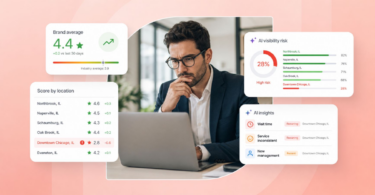
Most multi-location brands treat AI visibility as a single question: ‘Do we show up?’ But showing up is table stakes, and it’s the wrong question. The real question is whether AI and Google accurately recommend the specific location a customer is near, with the right hours, services, and reviews.
Summary of the blog
AI visibility does not hold because a strategy exists. It holds when the inputs that AI systems check first are governed consistently across every location. The issue is drift: slowing review velocity, weakening sentiment, stale location pages, and inconsistent profile data that quietly make some locations less eligible to appear in AI-driven discovery. The brands that stay visible make drift visible early, assign clear ownership, and treat local presence as an operating discipline.
Table of contents
- Summary of the blog
- How is AI changing where local decisions get made?
- Why is a single-platform AI visibility strategy a trap for multi-location brands?
- How can “we show up in ChatGPT” hide real local revenue risk?
- How are AI engines live-checking your location data today?
- Why is AI visibility bigger than chat assistants?
- Which sources do AI engines trust in your vertical – and why do “comfort metrics” mislead?
- Why is review drift now a visibility problem, not just a reputation problem?
- Which location inputs can you actually govern at scale?
- How should you measure AI visibility without turning citations into the scoreboard?
- How does governance stop 500 locations from becoming 500 different brands?
- Stop buying mentions. Start buying consistency at the decision surface
- What should you do next to fix your AI visibility?
- FAQs about AI visibility for multi-location brands
Note: This is Part 2 of Birdeye’s AI Visibility series, following Part 1 on the measurement gap. This article focuses on the optimization gap: why brand-level AI visibility can hide serious location-level risk.
How is AI changing where local decisions get made?
According to a recent survey, 37% of consumers start their searches with AI tools rather than Google or Bing, and 60% say AI gives them clearer answers than traditional search.
For multi-location brands, this shift creates a specific kind of risk because both AI assistants and Google’s own surfaces – Maps, AI Overviews, and Business Profiles are now pulling from the same underlying data to answer local queries in real time.
That means the question has fundamentally changed from “Are we showing up in AI search?” to “Is each location being recommended accurately when buyers are ready to act?” Those are two very different problems, and most brands are managing only the first.

Birdeye’s agentic marketing platform is built for this second problem, giving multi-location brands the tools to control the trust signals that AI engines and Google use to recommend (or skip) individual locations.
Why is a single-platform AI visibility strategy a trap for multi-location brands?
ChatGPT became shorthand for “AI search” because it was the first tool most executives recognized. That made sense in 2023. In 2026, it’s no longer an accurate map of where AI decisions are being made.
According to recent behavioral data, ChatGPT has plateaued in user share while Gemini has grown rapidly to become the clear number-two AI platform, and Claude has more than doubled its user share in a single quarter across both the US and Europe. Building your AI visibility strategy around ChatGPT mentions alone is like measuring your TV performance solely by whether people saw your ad on one channel while ignoring where your buyers actually watch.
Here’s a scenario that plays out more often than most brands realize. You pull up a national dashboard, your brand is showing up in AI results, and leadership is happy. But zoom into individual markets, and a handful of locations are quietly invisible, not because their data is wrong, but because their review content isn’t giving AI anything useful to work with. No dramatic failure. No alert. Just a slow bleed in markets that matter.
That’s the real failure mode for multi-location brands, and it’s more of a sentiment problem than a data problem.
When AI assistants decide which locations to recommend, they’re not just running a quick check to see if your hours are up to date. They’re reading what customers have actually written: how recent those reviews are, whether the language in them directly answers the kind of questions buyers are asking, and whether the overall picture of a location feels credible and alive.
A location with spotless profile data can still lose out to a newer competitor whose reviews happen to contain the exact phrases AI is looking for. That gap between how visible your brand looks nationally and how eligible each location actually is at the local level is where most of the revenue risk lives, and it rarely shows up in a screenshot.
How can “we show up in ChatGPT” hide real local revenue risk?
Brand-level AI visibility can look healthy in a national dashboard while individual locations quietly lose customers. Two common failure patterns explain how this happens, and both can stay hidden in that aggregated view.
1. The stale hours problem – primarily a Google surfaces risk
Picture this: a patient searches “urgent care open now,” your location comes up, they drive over, and the doors are locked. Holiday hours were never updated in Google Business Profile. The visit is lost, and nothing in your AI visibility metrics flags it.
Google’s local surfaces, such as Maps, AI Overviews, and Business Profile, perform live data checks at the time of the query. Whatever your profile says is what AI cites. That’s where the stale hours risk is most acute.
LLM assistants like ChatGPT or Gemini work differently. There’s no sync mechanism, and you can’t push a correction to an LLM the way you update a listing. They pull from training data and retrieval context, not a live feed of your profile.
So the fix here is straightforward: keep your Google Business Profile current. That’s where the live lookup happens, and for most local queries, it’s where the customer journey ends in an actual visit.
According to Data Axle, 66% of consumers have already experienced showing up at a business to find wrong hours or a closed location. Most don’t troubleshoot; they leave and don’t return.
2. Why the same location data problem shows up differently in LLMs
Category fragmentation and inconsistent profile data hurt you on Google’s local surfaces in ways that are relatively straightforward to diagnose and fix. In LLMs, the same underlying problems cause a different kind of damage that’s harder to see.
LLMs don’t check a directory. They read everything that has been written about your business and synthesize a picture of each location from that. If that picture is thin, inconsistent, or low on sentiment, the location gets deprioritized. Not because a field is missing, but because the overall signal isn’t strong enough to recommend with confidence.
That shifts the priority order. For LLM visibility, review content and sentiment carry more weight than profile completeness. A location with rich, recent reviews that directly answer buyer questions will consistently outrank one with cleaner data but generic or sparse review content. Data accuracy remains the foundation, but sentiment drives the recommendation.

How are AI engines live-checking your location data today?
For Google’s local surfaces like Maps, AI Overviews, and Business Profile, live data checks happen at the moment of the query. When someone searches “urgent care near me” or “open now,” Google pulls directly from your Business Profile, Maps listings, and review platforms in real time. Your location either clears that check, or it doesn’t.
That makes profile optimization a real-time eligibility gate, not a background hygiene task. If your data is inaccurate, incomplete, or inconsistent at the moment of the query, Google won’t recommend you, and you won’t know why.
The disconnect is significant. This is a widespread problem: most consumers have already encountered location inaccuracies when acting on AI-surfaced information. The gap between what your profiles say and what is actually true is the most direct barrier between being recommended and being invisible on Google’s surfaces.
LLM assistants like ChatGPT and Gemini approach this differently, as covered earlier. They don’t perform live profile lookups. They synthesize from training data and retrieval context. That’s why the fix for Google surfaces is profile accuracy, while the fix for LLMs is sentiment and review content.
Why is AI visibility bigger than chat assistants?
When most executives think about AI search, they picture a chat window. For multi-location brands, that framing underestimates where the highest-volume decisions actually happen. The surfaces that drive the most local conversion aren’t chat assistants. They’re Google Business Profile, Maps, AI Overviews, and category-specific vertical platforms.
Behavioral data from the Datos Q1 2026 State of Search report puts this in perspective: despite relentless attention and rapid growth, AI tools still account for less than 2% of total desktop browsing activity. Google’s local surfaces handle the overwhelming majority of moments when local decisions are actually made.
Birdeye’s State of Google Business Profile 2026 report found that customers are increasingly finalizing their choices directly on Google-native surfaces, often without visiting a brand’s website. Between 2023 and 2025, search impressions per location dropped by more than half, while customer actions, such as calls, directions requests, and bookings, declined modestly.
This means Google is surfacing profiles less often, but in moments of significantly higher purchase intent. Visibility volume is contracting while decision-stage traffic holds its value, which is why these surfaces matter most.
Chat assistants increasingly handle discovery. Google-native surfaces and your own properties handle verification and conversion. If you’re absent or inaccurate in either layer, you are effectively removed from the customer journey.
Which sources do AI engines trust in your vertical – and why do “comfort metrics” mislead?
Two primary dynamics govern the sources of proof that an AI engine relies upon.
1. The source of truth changes by vertical
In real estate, AI systems rely heavily on listing sites and rental marketplaces. In healthcare, the preference shifts to specialist directories, insurance platforms, and review sites.
But across verticals, one finding stands out. Birdeye’s own research found that over 80% of domains used as citations by AI engines were business websites, not third-party directories or review platforms. That means your own site is the single highest-leverage asset for LLM citation confidence. Location pages that clearly describe services, specialties, and local context give AI concrete, authoritative information to reference. Thin pages, duplicate content, or pages that haven’t been updated give AI nothing to work with, and a competitor with richer onsite content wins the citation.
A Google Business Profile is necessary but not sufficient. Genuine citation confidence requires presence across the specific domains AI uses to corroborate answers for your query type, and those domains are vertical-specific. But the starting point is almost always your own website.
2. Directory count is a comfort metric, not a strategy
The old local SEO playbook said “maximize coverage”— a lot of work for little impact. Birdeye’s listings research shows that leading brands are now strategically pruning low-impact directories and focusing on a smaller set of high-signal sources that Google and AI systems actively crawl, rather than the long tail of low-traffic directories most brands have dutifully maintained.
Why is review drift now a visibility problem, not just a reputation problem?
Here’s something we found while testing Google’s Ask Maps:
A new burger restaurant with only a handful of reviews outranked established brands for “best burger in [city]”, because a single detailed review explicitly called it “the best burger in [city]” and included rich photos. The restaurant was newer, smaller, and less well-known. It won because its review content contained the answer AI was looking for.
That experiment reveals how local search has changed: AI-shaped discovery doesn’t just look at star averages. It scans the actual review text for phrases that directly answer a user’s question and surfaces them as local recommendations. A location with sparse, generic reviews doesn’t just have a reputation problem; it’s invisible to the AI when a buyer is looking for a direct answer.

The data from Birdeye’s State of Online Reviews 2026 report confirms this is moving fast. Review volume grew by more than 30% year over year in 2025, the fastest rate since 2021. Competitors are accumulating review signals quickly, so a location that was competitive last year can fall behind on AI citation confidence in a single quarter if its review velocity slows.
The consumer threshold is also hardening: more than half of buyers won’t consider a business rated below four stars. That threshold now directly influences how AI assembles local shortlists, which heavily favor locations with robust ratings and recent activity.
For multi-location brands, review generation and response are now core to AI visibility—not just protecting reputation, but staying in the consideration set at all.
Start with a query portfolio instead of a tool list
The right starting point isn’t “which AI platforms should we be on?” It’s “what are the specific questions that drive revenue for our category, and where are those questions being answered?”
Most multi-location brands encounter three types of buyer prompts:
- Local intent: “near me,” “in [city],” “open now,” “same-day.”
- Shortlist building: “best [category],” “top-rated [service] near [location].”
- Risk reduction: “reviews,” “complaints,” “pricing,” “is it worth it.”
One practical way to operationalize this is to build an answer library from real prompts. A law firm, for example, might audit how people actually search for its services, then publish one new answer per day – a short summary, a video of an attorney explaining it, a simple visual – until it has hundreds of well-organized answers that AI engines can cite with confidence.
One nuance worth knowing is that LLMs layer unstated context into queries. A user who has told their AI assistant they’re vegan might type “best burger near me,” but the system interprets it as “best vegan-friendly burger near me.” If you’re only optimizing for visible keywords, that kind of silent personalization will favor competitors who surface those details in their profiles and review content.
Map buyer prompts to the surfaces that actually answer them
Once you have your query portfolio, the next step is simple: match each prompt type to where it realistically resolves.
- Local intent primarily resolves in Google Business Profile, Google Maps, and a small set of core listings.
- Shortlist building pulls from local surfaces, review platforms, and category-specific sites.
- Risk reduction is shaped by review content, recurring themes, and recent experience signals.
The goal isn’t comprehensive presence across every platform. It’s dominance on the specific surfaces where your buyers make their final decisions.
Which location inputs can you actually govern at scale?
When you’re managing hundreds to thousands of locations, things drift. Hours change, new services get added locally, staff rotate, and suddenly you have gaps in who owns the online profiles.
The brands that maintain AI visibility at scale aren’t the ones that create the most content. They’re the ones that govern the inputs AI systems check most often:
- Review volume and recency that reflects the actual customer experience
- Accurate hours, categories, and attributes across all profiles
- Location pages that are current, non-duplicate, and not thin
- Photos and FAQs that reflect what each specific location offers
Reviews lead because that’s where most of the LLM visibility leverage lives. A location with rich, recent review content that directly answers buyer questions will consistently outperform one with cleaner profile data but sparse or generic reviews. The other inputs matter too, but they set the floor. Reviews are what drive the recommendation.
Control these consistently, and you stay visible. Let them drift, and you disappear, location by location, market by market, without any single dramatic event to point to.
How should you measure AI visibility without turning citations into the scoreboard?
Citations are useful early signals because they confirm that your data and content are credible enough for AI to reference. However, a citation alone doesn’t tell you whether it led to a call, a direction request, or a booking. Anchor your KPIs in location-level actions, and treat citations as one of several leading indicators rather than the ultimate measure of success.
For a multi-location brand, the practical measurement model has three components:
1. Prompt coverage rate (visibility)
Track the percentage of a fixed set of buyer prompts where your brand or a specific location is cited across key AI engines and surfaces. Keep it internal, as this isn’t an industry standard; it’s your scorecard. Break it out by location and market, not national averages. When coverage shifts in a market, you want to know which locations are driving that movement.
2. Action alignment (business outcome)
When prompt coverage moves in a market, check for corresponding movement in Google Business Profile actions – calls, direction requests, and bookings. The goal isn’t to prove perfect causality. It’s operational alignment: if visibility rises but actions don’t, you may be optimizing a surface that buyers aren’t using at the moment of decision.
3. Drift indicators (root cause)
Drift is how multi-location brands quietly lose eligibility before it shows up in revenue. Track the precursors:
- Hours, services, and attribute gaps across locations
- Category discrepancies and unauthorized profile edits
- Review velocity and recency differences by location
These signals tell you where local execution is diverging, usually weeks or months before the impact appears in business results.
How does governance stop 500 locations from becoming 500 different brands?
Governance can sound like corporate overhead, but it’s the only way to scale AI visibility because the forces that cause drift are constant and predictable.
Every multi-location brand faces the same tension: give local teams complete freedom, and inconsistencies will appear within months; centralize all control, and local teams resort to workarounds that create the same unauthorized edits and category drift you’re trying to prevent.
Guardrails are the answer: a model that standardizes the inputs AI cares most about while leaving room for the local relevance that makes individual locations credible.
Standardize at the corporate level:
- Location data rules – name format, hours protocol, core categories, service taxonomy
- Approval rights for profile edits and clear ownership of updates
- Location page standards that prevent thin, duplicated, or outdated pages
Localize with guardrails:
- Photos, FAQs, and local proof points that reflect what each location actually offers
- Service nuances that vary legitimately by market
Review response rate is one of the cleanest health checks for governance. Birdeye’s data shows that leading brands responded to over 75% of reviews in 2025, with roughly 60% of responses human-assisted and 40% AI-assisted. A sharp decline in response rate within a specific market is usually one of the first visible signs of local team disengagement or ownership gaps, both of which predict wider data drift.
Stop buying mentions. Start buying consistency at the decision surface
The appeal of ChatGPT-focused GEO is understandable. Screenshots are easy to share in a board meeting. But for multi-location brands, optimizing for a single assistant’s mention rate is a precision problem: you can look visible nationally while being invisible in the metros where revenue is actually decided.
A genuinely defensible AI visibility strategy is simpler than most playbooks suggest:
- Allocate resources based on buyer intent and vertical requirements, not based on which AI platform is easiest to screenshot.
- Measure visibility in ways that expose market variance, not just national averages.
- Govern hard enough to prevent data drift across hundreds of locations.
The right question isn’t “how do we win AI search?” It’s “where are we already losing visibility because we’re not looking at the right surfaces, and which locations are bleeding right now because of it?”
What should you do next to fix your AI visibility?
Put a fixed portfolio of 25–50 buyer prompts that demonstrably drive revenue in your category at the center of your AI visibility plan. Test these prompts across all relevant AI engines and local surfaces. Review the market-specific results weekly in top-tier markets and monthly in all others, on a sustainable cadence.
The markets with the largest coverage gaps will almost always be the same ones with the most severe data drift. That’s where your next dollar will generate the most return.
FAQs about AI visibility for multi-location brands
Not necessarily. A ChatGPT mention tells you your brand can be cited, not which locations are actually being recommended. Brand-level visibility and location-level eligibility are different, and most of the revenue risk lives in the second.
Citations are a useful signal, not a KPI. Track them alongside prompt coverage as leading indicators, but manage performance to location actions like calls, direction requests, and bookings.
It’s almost certainly drift. AI answer engines perform live checks and exclude locations that fail the confidence threshold due to inconsistent data, such as missing attributes, stale categories, thin content, or uneven review velocity. The fix is systematic audits and governance, not more content.
Test your highest-value buyer prompts across AI engines and local surfaces, reporting results by market to surface gaps. Then, prioritize the vertical-specific sources that matter most, such as healthcare specialist directories or real estate marketplaces, while recognizing that this hierarchy shifts faster than most strategies.
About the Author

Ruchika Batra
Originally published