AI search is already influencing how customers discover brands, but most analytics tools still misclassify that activity as direct traffic or branded search. In June 2025 alone, AI platforms drove over 1.13 billion referral visits, underscoring how fast AI-driven discovery is growing, even as much of its impact doesn’t show up in standard reporting.
Summary
With over 60% of Google searches ending in “zero clicks,” AI-powered answers provide users with what they need directly on the results page. This shift is creating a significant tracking gap: customers tell brands they found them through AI, yet outdated analytics platforms incorrectly attribute that traffic to "direct" or "branded" search. In this post, we’ll show multi-location enterprises how to fix their data pipelines and attribution models to finally see how AI is actually driving discovery and sales.
Table of contents
- Summary
- What is AI search attribution, and why does it matter for enterprises?
- The AI attribution black hole: Why AI search breaks traditional tracking
- Enterprise solutions: How to measure AI influence across the customer journey
- How to build the AI attribution stack
- Proxy signals: How to measure AI influence when tracking fails
- Mapping AI-influenced customer journeys
- Actionable tactics for capturing AI attribution data
- The AI search attribution dashboard: How to report AI’s impact
- AI search is shaping demand—attribution must catch up
- FAQs about AI search attribution for enterprises
- How Birdeye Search AI helps
What is AI search attribution, and why does it matter for enterprises?
AI search attribution is the practice of measuring how AI-driven answers (from tools like ChatGPT, Perplexity, Gemini, and AI Overviews) influence customer decisions, even when conversions show up as direct traffic, branded search, phone calls, or in‑store visits.
AI search attribution starts with a simple idea: when a customer first sees your brand in an AI answer, that moment should count as a real touchpoint in their journey. It links that AI discovery to what happens next, like a branded Google search, a website visit, a phone call, or a visit to a specific location.
This matters because many customer journeys now start in AI tools that do not send clear referral data into your analytics. Your dashboards often give all the credit to the last step, such as branded search or direct traffic, and ignore the AI answer that actually guided the choice.
For multi-location brands, a single AI response can push a customer toward one brand or one location over another in the same area. With AI search attribution in place, leaders can see where AI is driving new calls, bookings, and visits across markets, and make better decisions on spend, staffing, and growth.
The AI attribution black hole: Why AI search breaks traditional tracking
AI search creates invisible paths from discovery to conversion that standard analytics cannot see. The main issues fall into a few clear technical and behavioral gaps.
1. No referral data from AI platforms
Most AI tools do not pass referrer information into your analytics. When a customer starts in AI, that activity usually shows up as direct traffic, “none,” or gets credited to the last step, often a branded search, instead of the AI interaction that started the journey.
2. Multi-session, multi-device journeys
AI discovery rarely happens in one visit. A customer might find a brand through AI on a phone, research later on a laptop, and then convert by calling or visiting a location. These steps are hard to connect, so AI influence is often lost.
3. UTM tracking doesn’t carry over from AI
When users copy your brand name from ChatGPT and type it into Google, or act on a voice assistant reading your name aloud, no tracking parameters are carried over, so standard campaign tracking does not capture the AI step.
4. The “research-to-branded search” pattern
Many customers use AI to compare options and narrow choices. When they are ready to act, they search for the brand by name in Google, which causes analytics tools to credit branded search instead of the AI research that created demand.
5. Cookie and cross-domain limits
Shorter cookie lifespans and gaps in cross-domain tracking make it harder to follow customers across sessions and tools. Early AI touchpoints are often the first to disappear, even if later actions are captured.
6. Multi-location attribution gaps
AI usually recommends your brand, not a specific location. When customers later choose a nearby store, office, or clinic, it becomes difficult to see which locations benefited from AI without location-level tracking.
7. Time-lag between AI discovery and conversion
AI discovery often happens days or weeks before a call, booking, or visit. Standard 30-day attribution windows miss many of these delayed conversions, so AI’s role never gets tied back to revenue.
Enterprise solutions: How to measure AI influence across the customer journey
Enterprises need to shift attribution from tracking clicks to measuring influence. AI-driven discovery happens early, often without a visible referral, so attribution models must account for how intent is shaped over time, across channels, and at the location level.
1. Move beyond last-click attribution
Last-click attribution gives credit only to the final step, such as a branded search or direct visit. This approach hides AI’s role because AI usually influences the decision earlier, not at the moment of conversion. Multi-touch attribution works better by acknowledging AI as part of the journey, not just the last action.
2. Use AI-aware multi-touch models
Some attribution models are better suited for AI-driven discovery because they reflect how customers actually move from research to action.
- Time-decay attribution: These attribution models give more credit to actions closer to conversion while still recognizing early AI discovery. For example, a customer discovers a brand through AI, visits the website a week later, and books an appointment after another search. The final booking gets the most credit, but the AI discovery still receives partial credit for starting the journey.
- Position-based (U-shaped) attribution: These attribution models give credit to both AI discovery and the final conversion step. In this case, AI discovery is counted as the first touch, and the final call or booking is counted as the last touch. Both receive meaningful credit, while the steps in between receive less weight.
- Data-driven attribution: These models use machine learning to estimate the AI’s contribution across channels, locations, and time. By reviewing thousands of customer paths, the model identifies that journeys involving AI discovery convert at a higher rate and assigns AI a greater contribution across specific locations and markets.
3. Extend attribution windows
AI discovery often happens well before a customer takes action. Expanding attribution windows from 30 days to 60 or 90 days helps capture longer decision cycles and prevents AI influence from dropping out of the analysis too early.
4. Separate AI-influenced branded search
Branded search often looks like demand capture, but AI may have created that demand earlier. By tagging branded searches that follow AI discovery as “AI-influenced,” teams can improve accuracy without changing how existing reports are structured.
5. Attribute outcomes at the location level
For multi-location brands, tracking brand-level performance alone is not enough. Attribution needs to show which locations received calls, visits, or bookings after AI discovery, using location-specific tracking and reporting.
Together, these changes help you see how AI contributes to revenue, not just traffic, and make better decisions across channels and markets.
How to build the AI attribution stack
The right tools make AI attribution work in the real world. Let’s take a look at the core systems and data you need to connect AI discovery to real revenue.
1. Capture “how they found you” in analytics
Add custom fields in your analytics platform to record the discovery channel, including AI. Mark sessions as AI-influenced when surveys or forms say the customer used ChatGPT, Perplexity, Gemini, or an AI Overview.
2. Use call tracking that works by location
Give each location its own phone numbers, and use dynamic numbers on key pages and profiles. This helps you see which calls came from AI-optimized pages or listings, and which locations are turning those calls into real revenue.
3. Add AI source fields in your CRM
Create simple fields like “AI platform used” and “AI discovery: yes/no” in your CRM. Ask teams to fill these during intake or sales calls so you can tie AI discovery to deals, patients, bookings, or orders.
4. Ask about AI in your surveys and forms
Include “How did you hear about us?” with clear AI options on website forms, post-purchase surveys, and check-in flows. Use the same options across locations so you can roll up AI data by region and brand.
5. Rely more on first-party and server-side data
Shift tracking toward first-party and server-side methods to reduce the impact of cookie loss and browser limits. Use stable identifiers, such as email or phone number, to link AI discovery on one device to subsequent actions on another.
6. Use models when you cannot track directly
When AI platforms do not send clicks or referrers, look at changes in AI visibility or AI Share of Voice alongside changes in calls, bookings, and revenue. Use these trends, along with survey and call data, to estimate the extent to which AI is driving results.
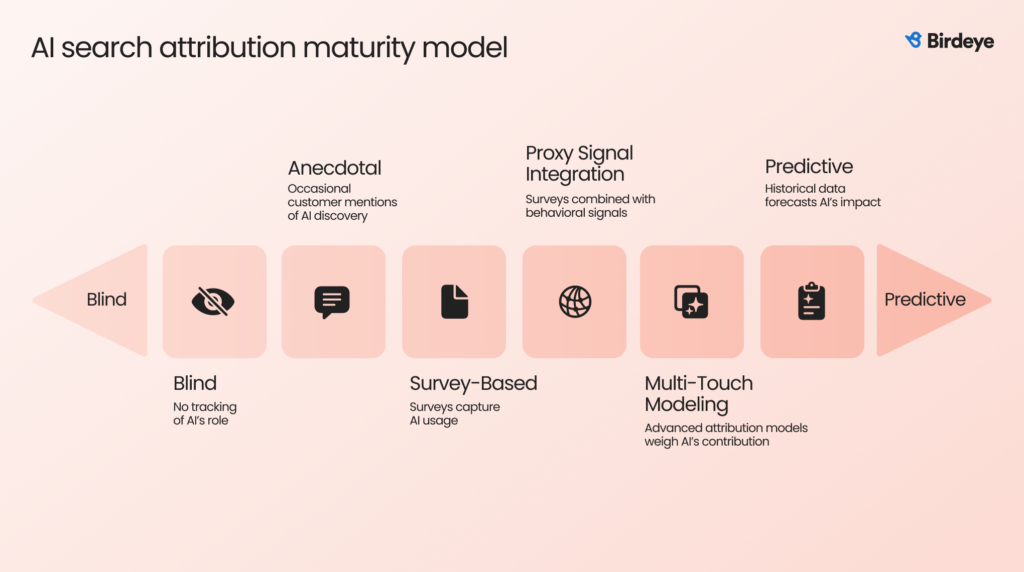
Not every organization is at the same stage of AI attribution maturity. Most enterprises progress through a series of steps as they move from limited visibility to predictive measurement. The model below outlines what that evolution typically looks like.
Proxy signals: How to measure AI influence when tracking fails
Proxy signals help you see AI’s impact and measure ROI from AI search even when you cannot track every click or touchpoint. They point to AI as the likely driver, so your team is not flying blind. Here’s what you need to pay attention to:
1. Branded search increases after AI visibility improves
When AI tools recommend a brand, customers often follow up by searching for the brand name on Google. A steady increase in branded search after stronger AI visibility is a strong sign that AI is creating demand earlier in the journey.
2. Direct traffic patterns that look like AI discovery
Many AI-influenced visits show up as direct traffic. By reviewing direct traffic in Google Analytics 4, especially new users, specific landing pages, and priority markets, you can separate true direct visits from AI-driven discovery.
3. Phone calls that reflect AI recommendations
Customers often act on AI suggestions by calling directly. Call notes and recordings frequently reveal clues, such as callers repeating details mentioned in AI responses or asking about specific locations and services highlighted by AI.
4. Timing patterns that align with AI activity
Changes in AI visibility often show up in performance trends. When increases in AI mentions or citations are followed by higher call volume, bookings, or visits, the timing itself becomes evidence of AI influence.
5. Geographic overlap between AI visibility and results
AI recommendations vary by market. When AI visibility improves in certain cities or regions, and those areas show stronger performance, it suggests AI is helping those sites win more demand. This local pattern mirrors how “near me” and service-intent AI answers are reshaping which brands and locations show up first.
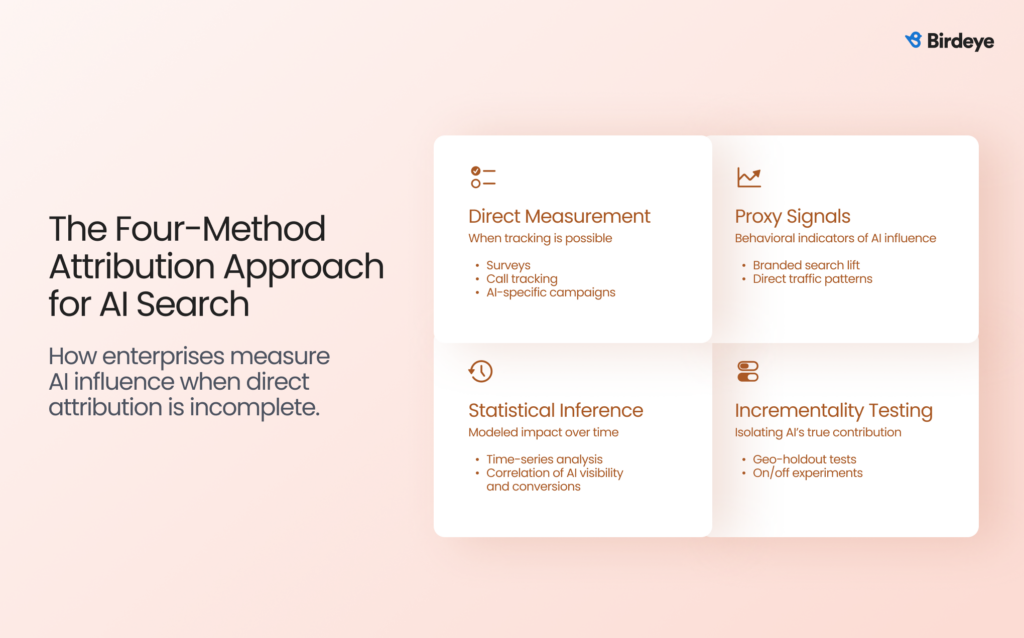
No single method can fully capture AI’s influence. In practice, enterprises rely on a combination of direct measurement, behavioral signals, and modeling techniques to build a credible attribution picture. The framework below outlines the four methods teams use together to measure AI’s true impact.
Mapping AI-influenced customer journeys
AI-driven discovery does not follow a single path. Customers move from AI recommendations to action in several predictable ways, often without leaving a clean digital trail. Mapping these customer journeys helps enterprises design attribution models that reflect real behavior.
Here are some common AI-driven paths:
AI → branded search → website → conversion
A customer finds your brand in an AI answer, then later types your name into Google, clicks your site, and converts. Reports show only a branded search and web conversion, but AI was the actual first touch.
AI → direct phone call
A voice assistant recommends your business and reads out your number, and the customer calls right away without visiting your site. It looks like an offline call with no source, even though AI did the discovery.
AI → saved business → in-store visit
A customer asks an AI tool for a nearby brand, saves your name, and walks into a location the next day. The POS only sees a walk-in, but AI shaped both brand and location choice.
AI comparison → independent research → selection
An AI assistant lists three brands; the customer then searches for each on Google, clicks organic results, and chooses a winner. Analytics shows organic search, while AI quietly built the consideration set.
Voice AI → immediate offline action
A customer asks a smart speaker for a nearby restaurant, clinic, or store, hears your name, and goes there directly without any online search or click. The visit only appears as a walk-in, but the voice assistant’s recommendation drove the choice.
AI overview → deep, multi-session research
A Google AI Overview mentions your brand in an explainer; over several days, the customer returns to your site, compares locations, and books. The data shows multiple direct/branded sessions, but the AI Overview framed the decision.
AI recommends your brand; the customer then searches “[brand] near me” and picks the closest or best-rated location. AI wins the brand, while local factors decide the site, which is why location-level attribution is key.
Actionable tactics for capturing AI attribution data
Enterprises do not need complex models to get started. These practical steps help teams begin capturing AI influence across digital and offline journeys.
1. Update forms and surveys
Add AI tools (ChatGPT, Google AI Overviews, voice assistants) as options in “How did you hear about us?” questions, with simple follow-up fields.
2. Send post-conversion surveys within 24–48 hours
Use email or in-app surveys to capture AI influence while customer recall is still fresh.
3. Standardize call intake questions
Train frontline teams to ask and record how callers discovered the business, including AI recommendations.
4. Create AI-tagged landing pages
Use pages like “domain.com/ai-recommended” to intentionally track traffic and conversions linked to AI mentions.
5. Use AI-specific promo codes
Offer discount codes designed for AI-referenced content and structured data, making AI-driven conversions easy to track through redemptions.
6. Implement QR codes for AI-to-offline tracking
Use QR codes in AI-referenced materials, such as menus, brochures, or signage, to create a measurable bridge between AI discovery and offline actions.
7. Add attribution links or codes to review responses
Include trackable links or codes when responding to reviews to identify conversions driven by review readers influenced by AI summaries.
8. Assign location-specific phone numbers
Use unique numbers for locations referenced in AI answers to attribute calls accurately at the market level.
The AI search attribution dashboard: How to report AI’s impact
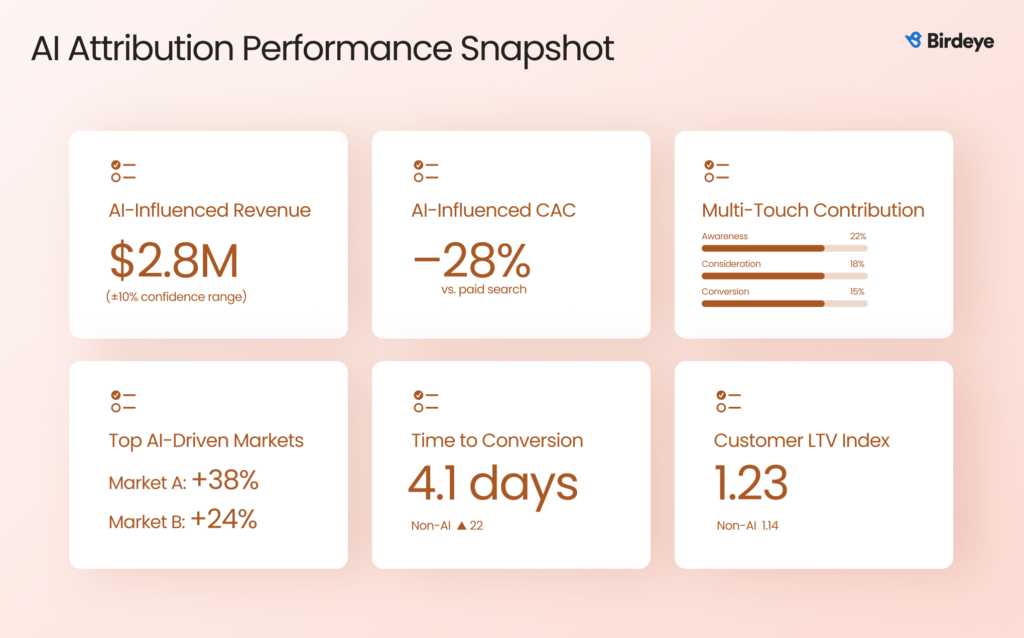
AI attribution matters only if leaders can clearly see its business impact. A board-ready attribution dashboard connects AI discovery to revenue, efficiency, and growth using a mix of modeled data, surveys, and behavioral signals. Here’s what to focus on:
1. AI-influenced revenue: Show an estimated revenue number tied to AI discovery using surveys, call data, and proxy signals, backed by basic modeling.
2. Customer acquisition cost (CAC) by channel: Compare AI-influenced CAC with paid search, social, and traditional SEO to understand where AI improves efficiency across the funnel.
3. AI’s role across the funnel: Show how AI contributes to awareness, consideration, and conversion, rather than assigning all credit to the last interaction.
4. Location-level performance: Highlight which markets and locations are winning AI-driven customers and how that visibility translates into revenue.
5. Time to conversion and lifetime value: Compare how quickly AI-discovered customers convert and whether they deliver higher long-term value.
6. Incremental impact and confidence: Isolate revenue that would not have occurred without AI visibility improvements and present results with clear confidence ranges to support informed decisions.
AI search is shaping demand—attribution must catch up
AI search has changed how customers discover brands, but attribution has not kept pace. When AI influence is hidden behind direct traffic, branded search, or offline actions, teams risk investing in the wrong channels and missing what actually drives demand.
The goal is not perfect tracking for every AI journey, but better decisions based on AI-aware measurement. Multi-location brands that win in an AI-first discovery world, supported by platforms designed for AI discovery and location-level reporting, will stop asking, “Where did the click come from?” and start asking, “What influenced the customer to choose us?”
FAQs about AI search attribution for enterprises
By combining surveys, call tracking, branded search analysis, and proxy signals, businesses can reliably infer AI influence even when direct referral data is missing.
After seeing an AI recommendation, customers often search for the brand by name, call directly, or visit in person. Since AI platforms rarely pass referrer data, these actions are credited to the last visible step.
GA4 is a strong foundation, but it works best when paired with CRM data, call tracking, surveys, and location-level analysis to capture AI-influenced journeys more completely.
AI discovery often happens well before conversion. Many enterprises use 60- to 90-day attribution windows to account for longer consideration cycles influenced by AI.
AI usually influences brand discovery first, while the choice of location happens later. Attribution models should connect both steps to show which locations benefit from AI visibility.
Add AI options to “How did you hear about us?” questions and call intake scripts. These small changes surface AI-driven demand quickly and create a foundation for deeper measurement.
How Birdeye Search AI helps
As AI becomes a primary discovery layer, enterprises need visibility into how their brands and locations appear in AI-generated answers. Birdeye Search AI is built to support this shift by helping multi-location businesses understand and manage AI-driven discovery as part of their broader measurement strategy.
Key Birdeye Search AI capabilities that support AI attribution include:
- AI Share of Voice tracking across platforms: See how often and where your brand appears in AI answers for key categories and markets.
- Location-level AI visibility insights: Break down AI presence and recommendations by location so you can connect AI discovery to local calls, visits, and revenue.
- Integration with reviews and reputation data: Link AI visibility with ratings, reviews, and sentiment to understand how reputation affects which locations AI chooses to recommend.
- Dashboards for enterprise and regional leaders: Give executives and field teams a clear view of AI-driven demand, including trends, top markets, and locations that are over- or under-performing in AI search.
When combined with the AI search attribution frameworks and measurement tactics, Birdeye Search AI helps teams replace guesswork with a clearer understanding of how AI influences customer decisions.

About the Author

Kukil Bora
Birdeye
Originally published
![[Feature image] From SEO to GEO- Why brands must optimize for AI search now](https://birdeye.com/blog/wp-content/uploads/Feature-image-From-SEO-to-GEO-Why-brands-must-optimize-for-AI-search-now-375x195.png)
![[Feature image] The Best Marketing Platforms for Multi-Location Brands](https://birdeye.com/blog/wp-content/uploads/Feature-image-The-Best-Marketing-Platforms-for-Multi-Location-Brands-375x195.png)