Most dealerships are chasing the wrong number. A dealer with 4.2 stars and hundreds of reviews is more likely to win in AI search for automotive dealerships than a 5‑star dealer with only a handful, because AI is looking for proof, not polish. That one shift changes how enterprise dealer groups should think about generating, governing, and measuring reviews across their entire portfolio.
Summary of the blog
Here’s what most enterprise dealer-group leaders get wrong in automotive marketing about reviews: the 5-star obsession. AI search doesn’t reward perfection; it rewards credibility built from steady review volume, fresh feedback, detailed content, and consistent responses. Dealer groups that keep every rooftop in the 4.1–4.6 range, with steady reviews flowing in across Google and other core sites, and quick responses to every customer, are the ones showing up in AI-generated shortlists.

This blog post covers how AI scores credibility across multi-location, enterprise dealership brands, what a trustworthy review profile looks like across locations, and the tactics dealer-group leaders can use to win in AI search.
Table of contents
- Summary of the blog
- How can a 4.2-star dealer beat a 5-star dealer in AI search?
- How do AI models evaluate dealership credibility?
- What does an AI-trusted dealership review profile actually look like?
- AI-trusted vs. common dealer review profile
- How is AI search for automotive dealerships changing how car buyers choose dealers?
- How should dealer groups build a review profile that wins AI search?
- What is a Dealership AI Credibility Scorecard?
- How Birdeye helps dealer groups turn review signals into AI visibility
- FAQs about AI search for automotive dealerships
- The bottom line: Scale your trust, not just your stars
How can a 4.2-star dealer beat a 5-star dealer in AI search?
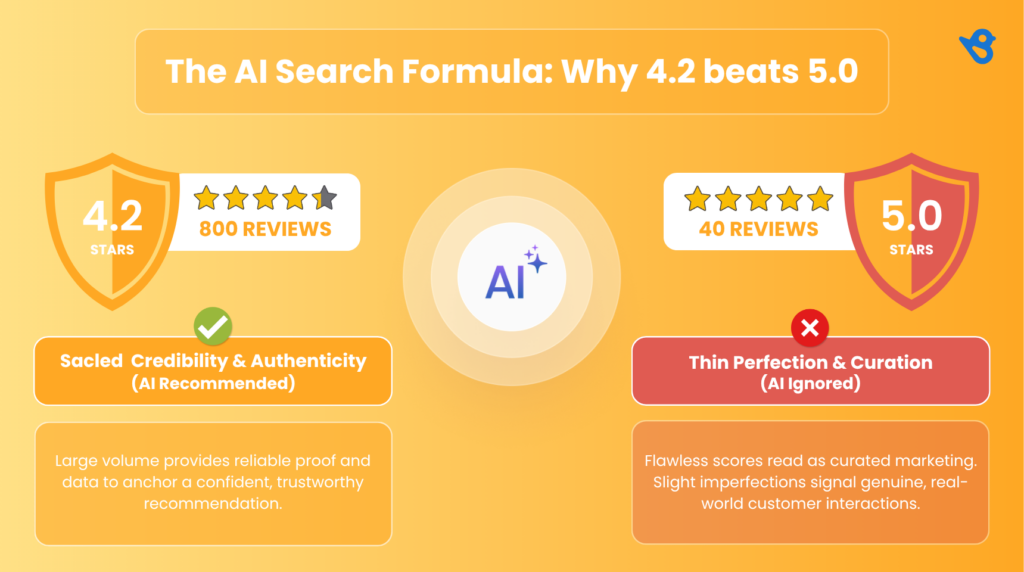
To understand how AI search for automotive dealerships works, take two dealerships in the same ZIP code. Dealer A has 5.0 stars and 40 reviews. Dealer B has 4.2 stars and 800 reviews. A car buyer asks ChatGPT for a trustworthy Toyota dealer in Phoenix. The AI system recommends Dealer B.
That’s not a bug or an edge case. It’s exactly how AI search is designed to work.
Forty reviews aren’t enough data to trust a 5.0 rating. The sample is too thin. Dealer B’s 4.2 from 800 reviews, spread over months of real customer interactions, gives AI something to verify.
Research from Northwestern University’s Spiegel Research Center backs this up: purchase likelihood peaks at ratings between 4.2 and 4.5 stars, then actually drops as scores approach a perfect 5.0. A little imperfection reads as authenticity. A flawless score reads as curation.
None of this means you should aim for lower ratings. It means you should stop treating a perfect score as the clearest trust signal. In AI search, thin perfection loses to scaled credibility.
How do AI models evaluate dealership credibility?
AI evaluates dealership groups across five signals: review volume, recency, content specificity, response pattern, and rating stability. The star rating is just one small input, carrying far less weight than most current dealer marketing strategies assign it.
Real buyers behave the same way at scale across markets — they trust volume, freshness, and specific detail over generic praise. AI trained on that behavior does the same, reading your whole review history as a dataset to decide whether you’re worth recommending to a buyer.
Here’s what each signal actually means:
1. Review volume: “Is this dealer statistically real?”
More reviews give AI more to work with. A dealer with hundreds of reviews provides enough material to compare, cross-check, and summarize. A small batch of 25 or 40 reviews, even if they’re 5-star, is too thin to anchor a confident recommendation.
AI finds patterns in data, not just rewards for perfection. A rich review history is always more credible than a small, spotless sample. Google also confirms that high review volume and strong ratings are factors in local rankings.
2. Review recency: “Is this experience still true today?”
Volume alone isn’t enough. Both AI and real customers care about what’s true right now, not what was true two years ago. An 800-review history starts looking stale the moment fresh reviews stop coming in, especially when a competitor down the street is generating new ones every week.
Google doesn’t have a hard rule on review freshness, but its local ranking guidance consistently favors active review generation. Dealers who treat review recency as optional are effectively opting out of AI visibility.
3. Content specificity: “Does the narrative feel real?”
Short generic praises like “Great experience!” give the AI model nothing to work with. A review that says “The finance manager explained every fee, the paperwork was finished in under two hours, and the service advisor followed up the next morning,” is far more useful. It gives AI context on transparency, turnaround speed, staff behavior, and post-sale follow-through.
Google confirms this: their AI-generated review summaries are built from synthesizing the content and sentiment of user reviews, meaning the model learns from the language, not just the rating.
4. Response pattern: “Is this a professional operation?”
AI doesn’t just read what customers wrote. It notices how you responded. Replying to every review, positive or negative, within 48 hours signals the kind of active management AI treats as a trust signal.
This focus on engagement is becoming standard practice. According to Birdeye’s State of Online Reviews 2025 report, response rates climbed to 73% in 2025 as brands realized that engaging with customers is a reputational asset, not just paperwork.
5. Rating stability: Is this performance sustainable?
AI favors consistency over sudden spikes. A rating that jumps from 3.0 to 5.0 in two months raises a flag. It looks like a campaign push, not a genuine pattern.
A 4.2 rating, held steady over 12 months, tells a different story. It’s repeatable. AI can recommend a store like that with confidence. A wobbly 5.0 that’s one bad month from collapse? Not so much.
The takeaway: stop chasing a perfect score. Build a review profile that looks authentic, up to date, and consistent. And the AI recommendations will follow.
What does an AI-trusted dealership review profile actually look like?
An AI-trusted enterprise dealer isn’t necessarily the one with the cleanest Google listing. It’s the one whose review footprint looks deep, current, and consistent from first visit to repeat service.
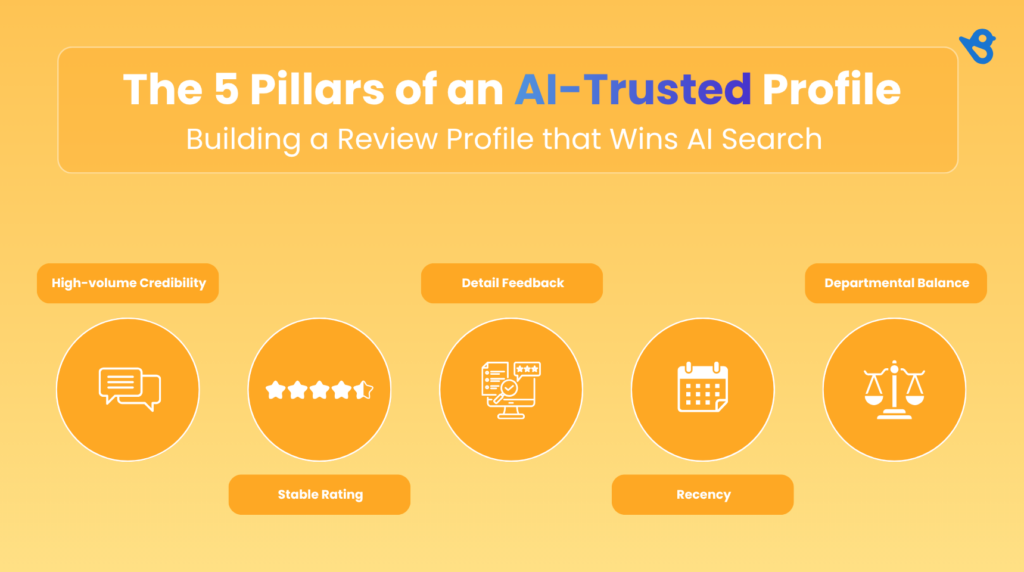
At the store level, a high-performing, AI-ready review profile for an enterprise group looks like this:
- Volume: 200+ Google reviews (recommended baseline), supported by healthy activity on sites like DealerRater and Cars.com.
- Stability: A steady 4.1–4.6 rating maintained over a year. AI finds this more credible than an “unstable” 5.0 that looks manipulated.
- Detail: Reviews that mention specific staff, transparent pricing, and service quality.
- Recency: Consistent feedback from the last 90 days, rather than a single “spike” from a two-year-old campaign.
- Balance: Strong stories across both sales and service to signal a mature, enterprise‑grade operation – not a one‑dimensional brand.
Look beyond Google
AI cross-references the whole web, not just Google. Birdeye’s State of Online Reviews 2025 report shows that Google hosts nearly 87% of automotive reviews, but a profile with strong signals on other platforms carries more weight than Google alone.
In fact, Cars.com has confirmed that its AI prioritizes dealers with strong, trusted reviews on its own platform. Google-only optimization leaves your profile thin. A real multi-platform footprint is what makes your performance look credible, not just visible.
Simply having a presence isn't enough to win the “Share of Answer.” According to Birdeye’s State of AI Search 2026 report, while 80% of brands are cited at least once by AI engines, a mere 15% are authoritative enough to claim the #1 position. To move beyond a “common” profile and join that top 15%, dealerships must build a “controllable moat” of owned content and deep review signals that AI can reuse.
The following table is a direct diagnostic for where your rooftops stand today.
AI-trusted vs. common dealer review profile
| Signal | AI-trusted profile | Common dealer profile |
| Review volume (per rooftop) | 200+ Google reviews per rooftop; strong volume on DealerRater, Cars.com | 40–80 Google reviews; minimal presence on vertical sites |
| Rating range | Ratings in the 4.1–4.6 band, stable over 12+ months | Volatile ratings or sudden jumps toward 5.0 after campaigns |
| Review recency | Steady flow of new reviews every month at each location | Occasional bursts; many rooftops with few or no recent reviews |
| Content quality | High share of detailed, staff‑named, process‑rich reviews | Many short “Great service!” comments with little descriptive detail |
| Response rate | Responses to nearly all reviews within 48 hours across the portfolio | Inconsistent responses; some rooftops with weeks of unanswered reviews |
| Platform spread | Healthy profiles on Google, maps, OEM‑linked sites, and auto marketplaces | Over‑reliance on Google; sparse or outdated profiles elsewhere |
When an AI model scans these two profiles, the first one appears to be a low-risk recommendation. The second profile might look fine in a marketing deck, but it doesn’t give AI enough to go on.
That’s where Birdeye Reviews AI fits in. Its Review Generation Agent handles the execution across every rooftop, identifying the right moments to request feedback and keeping review flow consistent, without it all falling on your staff.
Across every location, the platform tracks real-time signals and surfaces the patterns that actually affect visibility, giving leadership a clearer picture of where the group stands and where it needs attention.
How is AI search for automotive dealerships changing how car buyers choose dealers?
Car buyers are moving away from traditional SEO to AI search optimization. According to the Car Buyer Journey Study by Cox Automotive:
- 19% of all buyers and 25% of new-car buyers now use AI tools like ChatGPT or Google AI Overviews to narrow their options.
- 83% of consumers believe AI will reshape car buying within a decade.
AI has become a pre-filter. Buyers ask conversational questions like which dealer has the best service or who’s most transparent on pricing, and the AI scans your review footprint to build a shortlist before a customer ever clicks to your site.
For dealers, the mission has changed. You need to optimize your review data for AI, not just human readers. Thin, stale, or inconsistent reviews will push you out of the consideration set, no matter how polished your ads or website may be.
How should dealer groups build a review profile that wins AI search?
Winning AI search as an enterprise dealer group isn’t a one-time campaign. It’s an ongoing program across 20, 50, or 100 rooftops. The goal is to keep every location in a credible zone, with repeatable, enterprise‑wide standards for volume, freshness, detail, and stability, so your group becomes the reliable choice in every market it operates in.
To do that, dealer‑group marketing directors and OEM regional leads can focus on five concrete tactics.
1. Set portfolio‑wide volume baselines
Set a strong baseline across every location by targeting at least 200 Google reviews per rooftop, supported by a growing presence on key industry platforms, so your review footprint reflects a scaled, enterprise‑level operation.
Birdeye’s Review Generation Agent manages this in the background, identifying the right moments to reach out to sales and service customers. Your staff doesn’t have to track it manually. The flow stays consistent without the spikes.
The goal is to keep every rooftop above the threshold where AI will confidently recommend it.
2. Make recency a core KPI
Track review velocity, not just totals. Watch reviews per month and the share of feedback written in the last 90 days. That’s how both AI and real customers judge you — so your internal reporting should match.
When volume drops, take it seriously. A dip often means a location is losing momentum or something operational is going wrong. Catching it early gives you a chance to fix it before AI starts treating that store as unreliable.
3. Train for content quality, without scripting
Don’t hand customers a script. Ask for honest, detailed feedback. When someone describes a specific staff member, mentions how the financing worked, or explains what the service advisor did after the appointment, that’s the kind of content that actually builds trust with shoppers and AI alike.
Generic, repetitive reviews are red flags. Specific stories about your service lane or finance process give AI confidence and reassure shoppers that the experience is real. Since 93% of consumers are influenced by online reviews, the words people use matter as much as the stars they leave.
4. Implement a 48‑hour response SLA across the group
Hold every location to a 48-hour response window. Speed matters, but so does tone, swapping defensive, templated replies for genuine thanks on positive reviews and clear accountability on negative ones.
Keeping up with that across multiple locations is where things break down. A centralized enterprise‑grade agentic marketing platform like Birdeye handles the response workflows, so your group stays consistent, regardless of what’s happening at any individual store.
5. Achieve service‑department parity
Service reviews aren’t a secondary concern. Since AI sees your dealership as one entity, a strong sales profile sitting on top of a weak service footprint sends a mixed signal that undermines both.
Run a dedicated review program for your service drive with its own targets. When both departments show consistent strength, AI can recommend you for the sale and the service, which drives new customers in and keeps existing ones coming back.
What is a Dealership AI Credibility Scorecard?
A Dealership AI Credibility Scorecard gives you a quick read on where each store stands from an AI visibility standpoint.
Use it to benchmark every rooftop. Any location flagged as “at-risk” in three or more categories is effectively invisible to AI recommendation engines, no matter how well it performs on the floor.
| Metric | At-risk | Developing | AI-trusted |
| Google review volume | < 100 | 100–199 | 200+ |
| Reviews in the last 90 days | < 10 | 10–29 | 30+ |
| Rating stability (12 months) | < 4.0 or > 4.9 with < 100 reviews | 4.0–4.1 | 4.1–4.6 |
| Response rate | < 50% | 50–79% | 80%+ within 48 hrs |
| Content specificity | Generic only | Some specificity | Regular staff + process + service mentions |
| Platform spread | Google only | Google + 1 platform | Google + DealerRater + Cars.com |
Roll it up across the group, and you get a clear picture: which markets are in good shape, which rooftops are pulling your AI profile down, and where to direct resources next.
With Birdeye’s Agentic Marketing Platform, you can track those metrics in near-real time, with automated alerts and workflows that turn the scorecard into something your team can actually act on, not just review.
How Birdeye helps dealer groups turn review signals into AI visibility
Most dealer groups are already feeling the pressure from AI search, but review management is still scattered. When review generation, response workflows, competitive data, and location-level reporting all live in different tools, keeping a consistent, credible reputation profile across your group is hard.
Birdeye Reviews AI and Search AI bring it together. The full-cycle agentic marketing platform consolidates everything from generation to reporting, so your reputation profile stays consistent across every location, and AI search keeps finding you.
In practice, here’s what that looks like:
- Build review volume across every rooftop: The Review Generation Agent helps optimize when and where requests are sent, so dealerships can maintain a steady flow of sales and service reviews.
- Keep feedback fresh across sales and service: Reviews AI helps groups sustain review cadence across the showroom and service lane, strengthening the current signals buyers and AI search platforms look for.
- Respond faster without losing control: The Review Response Agent drafts personalized, on-brand replies systematically for every rooftop, helping dealer groups maintain response speed and consistency across all review types.
- Capture feedback that reflects the real dealership experience: Birdeye helps multi-location enterprise brands collect and manage reviews that speak to pricing clarity, trade-ins, financing, delivery, advisor support, and service follow-up.
- Catch rooftop-level issues early: The Review Reporting Agent surfaces location-level trends and gaps, helping teams spot slowing review flow, weakening service sentiment, or underperforming rooftops early.
- Own the “One Answer” in AI Search: Search AI uses your structured review data to ensure your dealerships are the primary answer when customers ask ChatGPT or Google for the “best service department near me”.
- See reputation beyond Google: Birdeye monitors reviews across 200+ sites, giving dealer groups a broader view of the signals shaping trust across their footprint.
Paired with the credibility framework above, Birdeye Reviews AI gives dealer groups a way to make reputation management something they can actually measure and repeat, so every rooftop is working toward stronger visibility in AI search, not just hoping for it.
FAQs about AI search for automotive dealerships
Yes. A perfect rating can still be a weak signal if it is based on a small number of reviews. AI search is more likely to trust a dealership with a larger, more consistent review footprint because it offers more evidence to assess credibility.
Yes. Recent reviews help show that the dealership is still delivering a strong customer experience today. A high review count matters less when most of that feedback is old, and recent activity is limited.
The most important signals are review volume, recency, detail, response rate, sales-to-service balance, and consistency across rooftops. Together, these signals tell AI whether a dealership looks credible, current, and trustworthy.
No. Google is essential, but it is not the only signal that matters. AI search can pull from multiple indexed sources, so dealer groups need a broader review footprint to build stronger credibility across the web
Yes. Detailed reviews give AI more context to work with. Reviews that mention pricing clarity, financing, delivery, service quality, advisor support, or follow-up create a stronger trust signal than generic comments like “Great experience.”
Start by checking whether the review profile is getting deeper, fresher, and more consistent across locations. Then track whether more rooftops are showing up in high-intent discovery moments, non-branded visibility is improving, and competitive gaps are narrowing.
The bottom line: Scale your trust, not just your stars
When someone asks an AI where to buy or service a car, the real question underneath it is: “Who can I trust?” The AI answers by looking beyond surface‑level ratings to the strength of your overall proof: the volume and freshness of your reviews, the specificity of what customers actually wrote, how you handled problems publicly, and whether that pattern has held up over time.
In AI search for automotive dealerships, the dealers who win aren’t the ones chasing a perfect snapshot. They’re the ones building a consistent, growing dataset of real customer experiences. By deploying an agentic marketing platform like Birdeye, you move beyond manual review management to a governed enterprise-wide system that consolidates signals, thinks locally, and acts with AI agents across your entire group, so your brand shows up as the reliable choice in every AI search, in every market.
Want to know how global dealer groups use Birdeye to protect revenue and dominate the new AI search frontier? Watch a demo to find out.

About the Author

Kukil Bora
Birdeye
Originally published
![[Feature image] From SEO to GEO- Why brands must optimize for AI search now](https://birdeye.com/blog/wp-content/uploads/Feature-image-From-SEO-to-GEO-Why-brands-must-optimize-for-AI-search-now-375x195.png)


![[Feature image] The Best Marketing Platforms for Multi-Location Brands](https://birdeye.com/blog/wp-content/uploads/Feature-image-The-Best-Marketing-Platforms-for-Multi-Location-Brands-375x195.png)