
Most multi-location brands now have an AI visibility strategy, but very few have the operating model to keep that visibility stable across every location. That gap, not the strategy itself, is where revenue quietly disappears.
Summary of the blog
AI visibility does not hold because a strategy exists. It holds when the inputs AI systems check first are governed consistently across every location. The issue is drift: slowing review velocity, weakening sentiment, stale location pages, and inconsistent profile data that quietly make some locations less eligible to appear in AI-driven discovery. The brands that stay visible make drift visible early, assign clear ownership, and treat local presence as an operating discipline.
Table of contents
- Summary of the blog
- Where the series has brought us
- Why AI visibility doesn’t fail all at once
- What drift actually looks like, and how fast it compounds
- Five governance moves that separate stable brands from drifting ones
- Why most teams don’t fix this
- What the measurement model looks like when governance is working
- The compounding advantage
- FAQs about AI visibility governance for multi-location brands
- How Birdeye helps build the governance model that holds AI visibility at scale
Note: This is Part 3 of Birdeye’s AI Visibility series, following Part 1 on the measurement gap and Part 2 on the optimization gap. This article focuses on the execution gap: how multi-location brands keep AI visibility from eroding location by location.
Where the series has brought us
Part 1 showed that most brand-level AI visibility dashboards are measuring the wrong thing. Search impressions per location fell 53.8% between 2023 and 2025, while qualified customer actions declined only 5% over the same period (Source: Birdeye’s State of Google Business Profile 2026). The dashboard most leaders rely on was built for a click-first search journey, not an answer-first one. Visibility was still happening. The metrics just stopped capturing it.
Part 2 showed that fixing visibility is not primarily a data problem. It is a sentiment problem. LLMs do not browse a directory checking for naming consistency. They synthesize signals from everything written about a business and construct a recommendation from that. A location with spotless profile data can lose to a newer competitor whose reviews contain the exact phrases AI is looking for. For Google’s local surfaces, profile accuracy is the real-time eligibility gate. For LLM assistants, sentiment and review content drive the recommendation.
That leaves one question unanswered. Knowing what to measure and knowing what to optimize is not the same as keeping it working. This is where most multi-location brands, even the ones that have accepted the first two lessons, fall short.
Why AI visibility doesn’t fail all at once
Most AI visibility failures are not dramatic. There is no single event to point to, no one decision that broke things. What happens is slower and harder to see.
Are the locations with no new reviews in 60 days getting flagged before the gap affects discovery? Is the sentiment in those reviews specific enough for AI to use when answering buyer questions? Did the new franchise location launch with current content on its location page? Did the regional manager who updated holiday hours also change them back?
None of these issues looks like a crisis in a weekly report. But AI engines run live checks against this data on every relevant local query. When a location has thinning review signals, stale pages, or conflicting profile data, it becomes harder for AI systems to recommend that location with confidence. The location may not be penalized. It may simply be bypassed in favor of a competitor with fresher, richer, more consistent signals.
AI visibility is not won once. It has to be defended continuously. That is the execution problem.
💡 The core tension for multi-location brands: giving too much freedom to local teams leads to compounding inconsistencies. Too much central control leads to workarounds that create the same unauthorized edits and category drift you aimed to prevent. Governance is what resolves that tension.
What drift actually looks like, and how fast it compounds
Drift is not a single failure. It is the accumulation of small, individually unremarkable gaps that compound into measurable visibility loss over a quarter or two.
A market loses its review generation rhythm when a coordinator leaves, and review velocity quietly drops across four locations. A franchisee changes a primary category because it sounds more accurate. Three locations never update their service attributes after a new offering launches. Location pages across a region reflect services from two years ago.
None of these issues looks urgent in isolation. Together, they push locations below the confidence threshold AI systems need to recommend them. The visibility loss is real and measurable, but it does not announce itself.
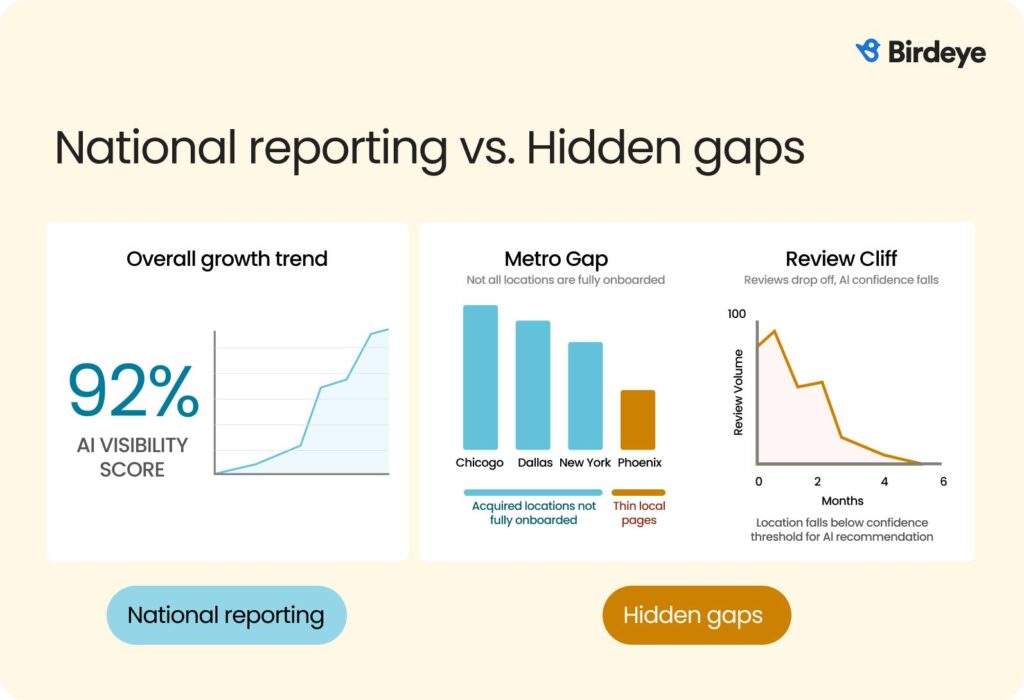
Two drift patterns that hide inside national reporting
Two patterns show up often across large location portfolios:
Pattern 1: The metro gap
A brand performs well in national AI visibility reporting, but a few markets underperform because review velocity has slowed, recently acquired locations were never fully onboarded, or local pages are thinner than competitors. The national score looks healthy. The underperforming markets do not show up in local AI recommendations.
Pattern 2: The review cliff
A location loses its review-generating rhythm because a process breaks, an integration stops working, or a local owner deprioritizes follow-up. Review velocity slows, recency fades, and the sentiment signal weakens. The location becomes less competitive in answer-driven discovery before revenue reports reveal any impact.
Both patterns share the same root: nobody was watching the right signals at the location level. The competitive edge belongs to brands that govern local presence as a systematic operating discipline.
Five governance moves that separate stable brands from drifting ones
The brands that hold AI visibility across hundreds or thousands of locations govern the inputs that matter most. Here are the five moves that make the difference, ordered by impact.
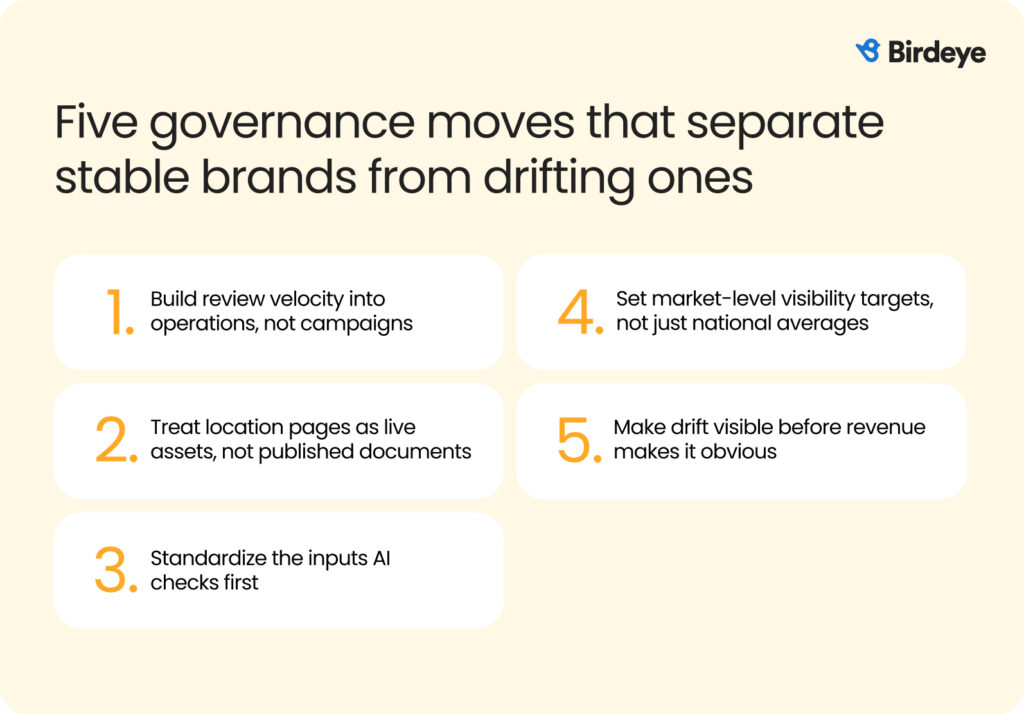
1. Build review velocity into operations, not campaigns
Stable review signals do not come from occasional campaigns. They come from repeatable operations: review requests triggered at the right moment, across every location, as part of the customer journey.
Birdeye’s State of Online Reviews 2026 report found that review volume grew 30.7% year over year in 2025, and roughly 80% of those reviews included written comments. That matters because written reviews give both customers and AI systems more context about what each location is known for. A recent, specific review that mentions a service, a staff member, a wait time, or a local detail is far more useful to an LLM constructing a recommendation than a star rating alone.
The governance question is not simply how to get more reviews. It is which locations have review velocity gaps right now, and who owns the process for closing them.
- Track review volume and recency by location
- Watch for markets where written review volume is thinning
- Monitor response activity as a signal of local ownership
- Flag locations where review generation depends on one person or one manual process
2. Treat location pages as live assets, not published documents
Birdeye’s own research found that over 80% of domains used as citations by AI engines were business websites, not third-party directories or review platforms. That makes your own location pages the single highest-leverage asset for LLM citation confidence.
Many brands publish location pages once and leave them alone. That creates a gap between what the business actually offers and what its owned content says. Location pages should reflect current services, hours, practitioners or staff where relevant, coverage areas, FAQs, and local proof points. They should avoid thin, duplicated copy that gives AI systems little useful information to extract.
A current, well-structured location page gives the brand a stronger owned source for AI systems and search platforms to read. It also reduces the chance that third-party sources define the location more clearly than the brand does.
3. Standardize the inputs AI checks first
Once review and content signals are in order, profile data becomes the floor that prevents disqualification. Hours, primary category, service attributes, NAP consistency, and core profile fields are foundational because they help Google’s local surfaces understand whether a location is accurate and relevant at the moment of the query.
These inputs need a living governance standard, not a one-time cleanup. Brands should define who can change what, which edits require approval, how discrepancies are resolved, and how often key fields are audited across Google Business Profile, the brand website, and core listing platforms.
4. Set market-level visibility targets, not just national averages
National visibility scores are useful for trend reporting, but they hide the markets where customers are actually making decisions. A stronger model tracks visibility and actions by market: which cities are underperforming against competitors, which locations are driving the gap, and which local inputs explain the difference.
For priority markets, prompt coverage should be reviewed more frequently. For the rest of the portfolio, a monthly cadence is usually enough to catch drift before it becomes a revenue issue.
- Run your top buyer prompts across AI engines and local search surfaces
- Filter results by market and compare your presence against key competitors
- Flag markets where the brand is absent, underrepresented, or inaccurately described
- Audit the local inputs behind those gaps: review velocity, page freshness, profile accuracy
5. Make drift visible before revenue makes it obvious
Drift indicators appear before revenue changes do. The brands that govern well monitor those indicators before they show up as lost calls, fewer direction requests, or weaker bookings.
Useful early-warning signals include:
- Review velocity and recency by location
- Response activity by market
- Location page staleness, missing fields, or thin content
- Hours, category, and attribute gaps across locations
- Unauthorized profile edits or unexplained category changes
Birdeye’s data shows that leading brands responded to more than 75% of reviews in 2025, with a mix of human-assisted (60%) and AI-assisted (40%) responses. A sudden drop in response activity within a market is often the first visible sign that local ownership is weakening, and that wider data drift is not far behind.
Why most teams don’t fix this
Most teams understand the problem once they see it. The hard part is ownership.
Location data governance touches marketing, operations, franchisee relations, IT, and sometimes compliance. No single team owns every input. Often, marketing sees the visibility problem first but does not control the operational processes that create drift.
That is the execution gap. It is not just a content issue or a platform issue. It is an ownership issue.
Brands that solve it usually do one of two things. Some create a dedicated local presence function with cross-functional authority. Others use an agentic platform to reduce the manual coordination required across review generation, response workflows, profile monitoring, and listings management.
The common thread is accountability. Someone owns location-level data quality as an ongoing operating discipline, not as a quarterly cleanup project.
💡 The question worth asking in your next leadership meeting: Which team is accountable for the accuracy of location 347's Google Business Profile today, and how would they know if something drifted?
What the measurement model looks like when governance is working
When governance works, reporting becomes more useful. The goal is not to add another dashboard. The goal is to connect visibility, local action, and operational health in one view.
The following three metrics form the backbone of a governance-first measurement model.
1. Prompt coverage rate by market
The percentage of buyer-intent prompts where the brand or specific locations appear across key AI engines and local surfaces. Track this by market, not only as a national average. When coverage shifts in a market, you want to know which locations are driving that movement.
2. Location action rate
Calls, direction requests, bookings, or other qualified actions per verified location, tracked by market. This helps leaders see whether visibility is translating into customer behavior. If prompt coverage rises but actions do not move, you may be optimizing a surface that buyers are not using at the moment of decision.
3. Drift indicator score
A composite view of leading signals: review recency and velocity, response activity, location page completeness, hours accuracy, category consistency, and listing health. Together, these metrics tell a leadership team what the old dashboard could not: which locations are visible, which are accurate, and which are at risk before the next revenue report confirms the problem.
The compounding advantage
This is the answer the series has been building toward. Measurement tells you where the gaps are. Optimization tells you what AI systems actually check and which signals matter most. Execution is what determines whether any of it holds over time.
The brands that build systematic governance now are not just fixing today’s AI visibility problem. They are building an advantage that compounds. A location with steady review activity, current content, accurate profile data, and strong response habits over time is harder to displace than one that only cleaned up its profiles after visibility dropped.
The governance infrastructure built today, including data standards, ownership rules, monitoring cadence, and approval workflows, is the same infrastructure that will help brands adapt as AI search continues to change.
Most brands will keep chasing AI visibility the same way they chased SEO rankings: platform by platform, campaign by campaign, quarter by quarter. The brands that win over the next three years will be the ones that stop treating it as a visibility problem and start treating it as an operating discipline. That shift, from measuring AI presence to governing the signals that create it, is what this series has been about.
Most of the revenue risk in AI visibility does not sit in a brand’s strongest markets. It sits in the locations nobody is watching closely enough: the ones that look fine in a national report, but are quietly becoming less visible where customers are ready to act.
FAQs about AI visibility governance for multi-location brands
AI visibility can degrade because the competitive context around each location changes constantly. Competitors earn new reviews, update content, and improve data quality. If your location signals stay static, they become less competitive even when nothing technically breaks. Visibility is relative, not absolute.
Start with markets where buyer-intent prompt coverage is weakest relative to competitors. Then audit the locations in those markets for review recency, page freshness, and profile accuracy. The biggest visibility gaps usually point to the most urgent signal problems.
Both teams should own it, with clear boundaries. Marketing should define the standards for reviews, content, and visibility reporting. Operations should own the processes that create accurate local data, such as seasonal hours, staff changes, service updates, and new location launches.
Fewer than most teams expect. AI-driven discovery is local, so a small cluster of drifting locations in one market can affect visibility in that market even when national metrics look stable.
Define the location inputs that matter most and assign ownership for each one. Start with review velocity, location page freshness, and profile accuracy for hours, categories, and service attributes. Then build a cadence for monitoring those inputs by market.
How Birdeye helps build the governance model that holds AI visibility at scale
Birdeye is the #1 Agentic Marketing Platform for multi-location brands. It helps teams move from AI visibility reporting to the operating model needed to maintain that visibility across locations.
Reviews AI helps teams generate, manage, and respond to fresh customer feedback across locations, keeping the sentiment signals that drive LLM recommendations healthy and current. Search AI helps teams track prompt coverage, citation presence, source quality, and location-level gaps across AI engines and local discovery surfaces. Listings AI helps keep core business information accurate and consistent, maintaining the profile accuracy that Google’s local surfaces check at the moment of every query.
For enterprise teams, the value is not another disconnected dashboard. It is a way to govern the local signals AI systems read, catch drift earlier, and support execution with AI agents while marketers stay in control.
Watch a free demo to see how Birdeye can help multi-location brands secure their AI presence.

About the Author

Ruchika Batra
Originally published