Answer engine optimization tools help brands track, measure, and improve how they appear in AI-generated answers across platforms like ChatGPT, Gemini, Perplexity, Claude, and Google AI Overviews. These tools help teams monitor AI search visibility, brand citations, prompt visibility, and competitive presence in AI-driven discovery.
Summary
AI search is now a mainstream discovery channel. ChatGPT processes over 2.5 billion prompts per day, while Google AI Overviews appear on roughly 47% of U.S. searches. Birdeye's State of AI Search 2026 report shows that customer discovery is rapidly shifting from traditional search rankings to AI-generated, citation-backed answers. The report found that 80% of brands are cited by AI at least once, but only 15% rank as the top cited source.

Most brands are not answer-visible because AI engines need structured, consistent, and verifiable information to cite. Scattered facts, inconsistent listings, weak reputation signals, and unclear content make it harder for AI answer engines to trust and surface a brand. That is why answer engine optimization tools matter. They help teams track prompt-level visibility, monitor LLM brand mentions, measure AI share of voice, improve citation intelligence, and identify the actions needed to strengthen AI visibility.
In this post, we compare the top 9 answer engine optimization tools in 2026 and explain how each platform helps brands improve visibility across AI-powered search.
Verdict: Birdeye Search AI is the best answer engine optimization tool for multi-location brands because it combines AI visibility tracking with the capabilities needed to improve answer visibility, including listings management, review management, and AI-powered optimization workflows. Other tools on this list are better suited for content optimization, technical SEO, or AI visibility monitoring.
Table of contents
- Summary
- Best AEO Tools Compared: Pricing, Use Cases, and AI Platforms Covered
- 9 best answer engine optimization tools in 2026
- How to Choose the Right AEO Tool
- Why Birdeye is the operational backbone of AEO
- The executive lens: What leaders must understand about Answer engine optimization tools
- FAQs about answer engine optimization tools
- Birdeye makes your brand discoverable in AI-driven search
Best AEO Tools Compared: Pricing, Use Cases, and AI Platforms Covered
When evaluating AEO tools, compare three things first: what the platform is built to do, which AI platforms it monitors, and how pricing is structured. Some tools focus on LLM monitoring and prompt-level analytics, while others support GEO content workflows, citation intelligence, traffic attribution, or operational fixes that improve AI visibility.
The table below compares the top AEO tools by best-fit use case, pricing, and AI platform coverage.
Note: Pricing can change frequently. Always verify current pricing on vendor websites before making a final decision.
| Tool | Best for | AI platforms covered | Pricing |
| Birdeye Search AI | Multi-location brands with 100-10,000+ locations that need AI visibility tracking, citation intelligence, accuracy monitoring, sentiment insights, and agent-led execution across locations | ChatGPT, Gemini, Google AI Overviews, Google AI Mode, Perplexity, Claude, Grok, etc | Custom pricing based on business needs |
| Goodie AI | Marketing teams and agencies that want AI visibility monitoring, prompt research, and AEO content optimization workflows | ChatGPT, Google AI Overviews, and Perplexity; more engines on higher tiers | Tiered plans |
| GetCito | Technical teams wanting a self-hosted, open-source AEO/GEO tool | ChatGPT, Perplexity, Gemini and other AI engines | Free self-hosted and managed plans |
| Gauge | SaaS, B2B and growth teams tracking prompts, citations and competitors | ChatGPT, AI Overviews, AI Mode, Gemini, Perplexity and Copilot | Tiered plans |
| HubSpot AEO Grader | Teams wanting a free, one-time AI brand snapshot | ChatGPT, Perplexity and Gemini | Free grader with paid AEO features |
| Profound | Marketing, content and PR teams tracking AI visibility and citations | Starter tracks ChatGPT; additional engines on higher tiers | Tiered plans |
| OtterlyAI | Content, SEO and agency teams tracking prompts and citations | ChatGPT, Google AI Overviews, Perplexity and Copilot; others available as add-ons | Tiered plans |
| Writesonic GEO/AEO Suite | Content, SEO and growth teams combining AI visibility with content workflows | ChatGPT, Gemini and Google AI Overviews | Tiered plans |
| AEO Vision | Businesses tracking prompts, competitors and content opportunities | ChatGPT, Perplexity, Gemini, Claude, AI Mode and AI Overviews, depending on plan | Tiered plans |
9 best answer engine optimization tools in 2026
The best answer engine optimization tools help teams measure AI search visibility, track LLM brand mentions, monitor citation frequency, and understand which prompts, sources, and competitors shape AI-generated answers.
To build this list, we evaluated each tool based on AI engine coverage, prompt and citation tracking, multi-location capabilities, reporting depth, and whether it helps brands improve AI visibility rather than simply monitor it.
Below are nine AEO tools to consider in 2026, with each section covering best fit, features, pros, cons, and pricing.
1. Birdeye Search AI
Best for: Multi-location brands with 100-10,000+ locations that need to track AI visibility, monitor prompt-level performance, understand citation sources, and improve how they appear across AI search platforms.
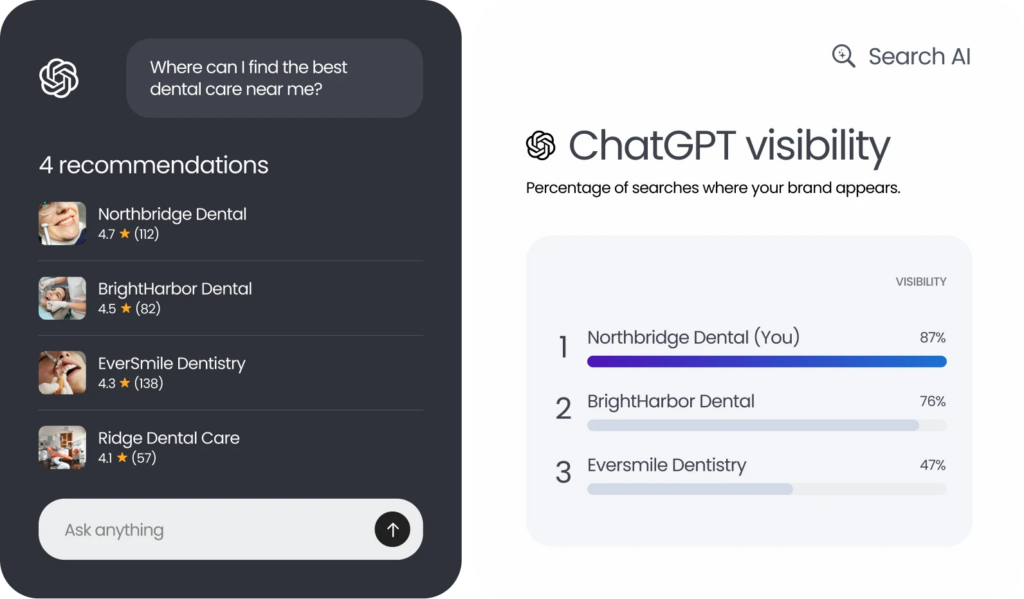
Birdeye Search AI is a purpose-built AI visibility platform for multi-location brands, tracking how businesses surface across major AI search platforms, including ChatGPT, Gemini, Google AI Overviews, Google AI Mode, Perplexity, Claude, and Grok. It helps enterprise teams identify and fix what’s limiting AI visibility at each location.
Search AI tracks which AI-generated answers each location appears in, which competitors are recommended instead, which websites and citations AI uses, and how the brand performs for prompts such as “best [service] in [city]” or “[service] near me.” The platform also measures AI rankings, brand mentions, citation sources, sentiment, and location-level visibility, giving enterprise teams actionable insights to improve answer visibility across every location.
Search AI goes beyond monitoring. It connects AI visibility insights to the operational signals that shape AI answers, including listings, reviews, citations, website content, sentiment, and business information accuracy. This helps brands move from visibility reporting to action across every location.
Key features
- Birdeye AI Visibility Score(0–100): Measures how visible your brand is across AI search platforms and identifies visibility gaps at both the brand and location level.
- AI Share of Answers: Shows the percentage of AI-generated answers that recommend your brand compared with competitors, helping teams benchmark AI visibility across locations and prompts.
- Prompt & Sentiment Analytics: Analyzes prompt-level rankings, local rankings, queries, and emotional themes behind AI responses.
- Citation intelligence: Pinpoints the source citations influencing engine selections.
- Brand mention tracking: Monitors how often AI platforms mention your brand and how your brand ranks across locations, prompts, and themes.
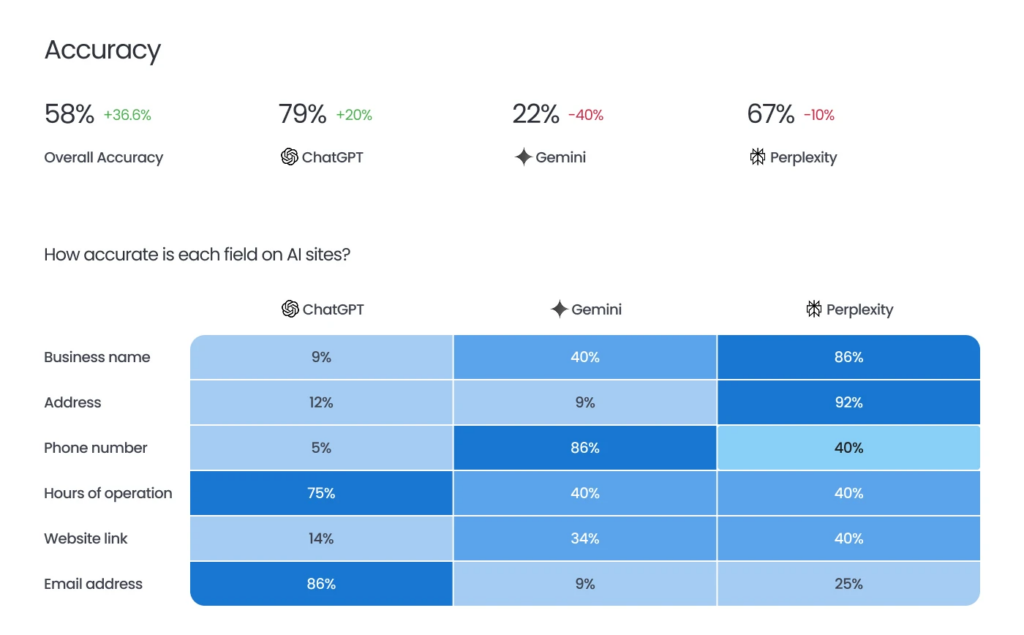
- Accuracy monitoring: Identifies inaccurate or inconsistent business information across locations.
- Agent-led recommendations: Connects visibility gaps to recommended actions, including updating listings, generating reviews, and optimizing website content.
Pros
- The best answer engine optimization platform purpose-built for location-by-location AI visibility, showing how every location performs across AI engines, which prompts generate recommendations, which competitors are surfaced instead, and which citations influence each AI answer.
- Surfaces prompt-level insights across locations, showing which questions trigger brand mentions, how AI describes each location, and where visibility gaps appear in customer discovery journeys.
- Connects AI visibility insights with operational signals such as listings, reviews, citations, website content, sentiment, and business information accuracy.
- Includes agent-led execution, so teams can move from insight to action by fixing listings, generating reviews, and optimizing website content directly from the platform.
Cons
- Teams may need time to configure workflows, permissions, and location-level processes before fully using the platform.
Pricing: Customized pricing based on location count, selected products, and the agents activated.
2. Goodie AI
Best for: Marketing teams and agencies that want AI visibility monitoring, prompt research, and AEO content optimization workflows.
Goodie AI is an answer engine optimization platform that helps marketing teams and agencies monitor how their brand appears across LLMs and AI search platforms. It supports prompt research, citation monitoring, sentiment analysis, optimization workflows, content creation, and attribution, making it useful for teams focused on improving AI search visibility and AEO content performance.
Key features
- Prompt research: Helps teams discover customer prompts and prioritize high-intent AEO opportunities.
- Visibility monitoring: Tracks brand mentions, citations, sentiment, and competitive positioning across major AI models.
- Optimization actions: Provides prioritized recommendations for improving AI search visibility.
- AEO Writer: Helps teams create content for answer engine optimization workflows.
Pros
- Useful for marketing teams and agencies building dedicated AEO workflows.
- Helps teams identify prompt opportunities, citation gaps, and content improvements.
Cons
- Goodie is focused on AI search visibility and AEO, so teams may still need separate tools for traditional SEO tasks such as technical audits, keyword research, or backlink analysis.
- Advanced coverage and larger AEO programs may require higher-tier plans, onboarding, or a demo-based setup, which may be more than very small teams need.
Why Birdeye wins: Birdeye goes beyond AI visibility monitoring by helping multi-location brands improve the listings, reviews, citations, and local content that AI engines rely on when generating answers.
Pricing: Tiered plans with higher tiers for advanced capabilities.
3. GetCito (Open-Source)
Best for: Technical teams, developers, and smaller brands that want an open-source AEO/GEO tool they can self-host and customize.
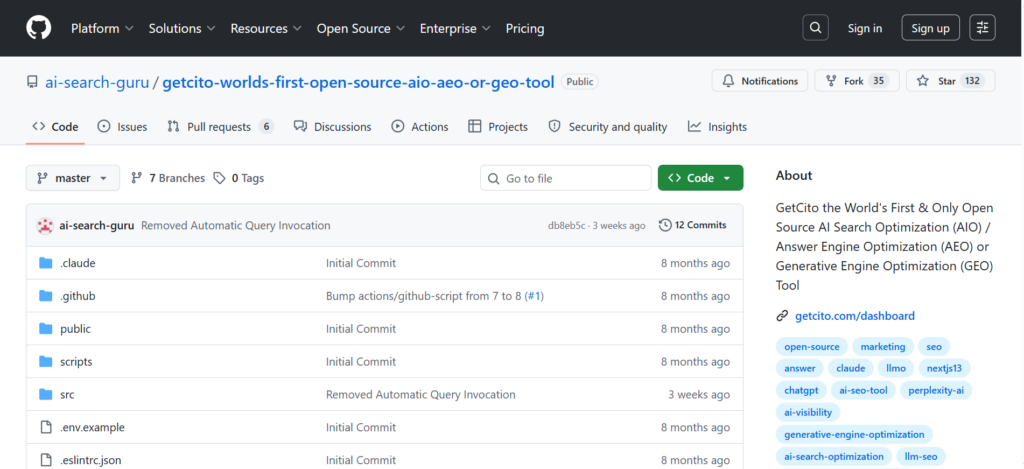
GetCito is an open-source AI optimization tool for AIO, AEO, and generative engine optimization, or GEO. Its GitHub repository is publicly available under an MIT license, making it a flexible option for teams that want to inspect the codebase, self-host the platform, and customize AI visibility workflows around their own requirements.
Key features
- Open-source codebase: Publicly available on GitHub under an MIT license.
- Multi-engine optimization: Supports optimization workflows for ChatGPT, Perplexity, Gemini, and other AI search engines.
- Real-time monitoring: Tracks performance across AI-powered platforms.
- Advanced analytics: Provides visibility insights and ranking-factor analysis.
Pros
- Open-source and customizable for teams that want more control over their AEO/GEO setup.
- Supports AI visibility monitoring, analytics, and content optimization workflows.
Cons
- Requires technical setup, configuration, and ongoing maintenance to use effectively.
- Platform coverage, integrations, and reporting depth may be more limited than more mature paid AEO platforms.
Why Birdeye wins: GetCito is built for technical customization, while Birdeye gives enterprise marketing teams a ready-to-use platform that both measures and improves AI visibility across locations.
Pricing: Free self-hosted option with managed plans available.
4. Gauge
Best for: Growth, SaaS, and B2B teams that want AI visibility tracking, prompt-level analytics, competitor comparisons, and content recommendations.
Gauge is an AI visibility and generative engine optimization platform that helps teams understand how their brand appears across AI-generated answers. It monitors AI responses across platforms such as ChatGPT, Claude, Gemini, Perplexity, Copilot, AI Mode, and AI Overviews, helping teams track brand mentions, citations, competitor presence, and visibility gaps.
Key features
- Prompt tracking: Monitors how AI platforms respond to tracked prompts over time.
- Brand coverage: Shows how often a brand appears in AI-generated answers.
- Citation analysis: Identifies which sources AI search engines cite when generating answers.
- Competitor analysis: Compares brand visibility against competitors across AI answers.
Pros
- Tracks brand mentions, citations, and competitor visibility across major AI platforms.
- Offers prompt-level analytics and recommendations for improving AI search visibility.
Cons
- Teams may still need separate tools for technical SEO, keyword research, and broader site audits.
- The Growth plan is better suited for teams ready to act on AI visibility insights, not those looking for a lightweight snapshot only.
Why Birdeye wins: Gauge focuses on monitoring AI visibility, while Birdeye connects those insights to AI-powered workflows that optimize listings, reviews, citations, and website content across every location.
Pricing: Tiered plans with custom options for larger deployments.
5. HubSpot AEO Grader (Free)
Best for: Teams that want a free, one-time snapshot of how major answer engines describe their brand.
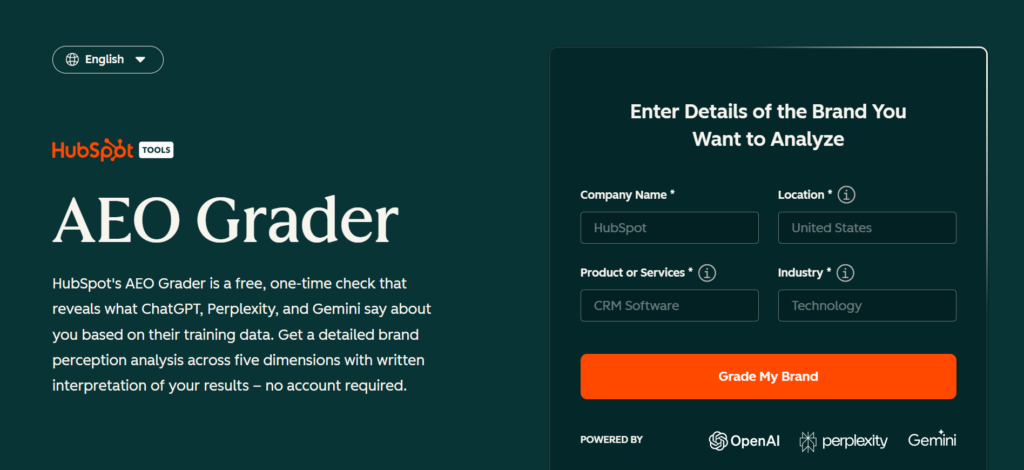
HubSpot AEO Grader is a free diagnostic tool that checks how ChatGPT, Perplexity, and Gemini represent a brand. It analyzes brand perception across five dimensions: sentiment, presence quality, brand recognition, share of voice, and market position. The tool produces a score out of 100 and gives teams a quick way to understand how answer engines currently describe their business.
It is best suited as an entry point into answer engine optimization rather than a full AEO platform. Teams that need ongoing tracking can move to HubSpot AEO, HubSpot’s paid monitoring product for tracking brand visibility over time.\
Key features
- Free AEO brand check: Provides a one-time snapshot of how AI engines describe a brand.
- AEO score: Scores brand visibility and perception out of 100.
- Sentiment analysis: Shows whether AI-generated descriptions are positive, neutral, or negative.
- Share of voice: Compares how the brand appears relative to competitors.
Pros
- Free and easy to use for teams starting with AEO.
- Helps teams quickly understand brand recognition, sentiment, and share of voice in AI answers.
Cons
- Best suited for an initial AEO check rather than deep, ongoing answer engine optimization workflows.
- Teams that need detailed prompt tracking, citation intelligence, and operational execution may need a more advanced AEO platform.
Why Birdeye wins: HubSpot provides a one-time AI visibility snapshot, while Birdeye continuously tracks performance and recommends actions to improve AI visibility over time.
Pricing: Free grader with paid AEO capabilities.
6. Profound
Best for: Marketing, content, and PR teams that want AI visibility monitoring, prompt insights, citation tracking, and AEO content workflows.
Profound is an AI visibility and answer engine optimization platform that helps teams monitor how their brand and competitors appear in AI-generated answers. It includes tools for answer engine insights, prompt tracking, citation analysis, agent analytics, and AEO-focused content workflows, making it useful for teams that want to connect AI search visibility with content and brand strategy.
Key features
- Answer Engine Insights: Analyzes how a brand and its competitors appear in AI platforms.
- Prompt tracking: Tracks prompts to show where a brand appears, how it is described, and which competitors show up.
- Citation tracking: Identifies the sources AI platforms reference in generated answers.
- Prompt Volumes: Helps teams understand what users are asking AI answer engines.
Pros
- Helps teams monitor brand mentions, citations, sentiment, ranking, and competitive presence across AI answers.
- Useful for content and PR teams that need to understand how AI platforms describe their brand.
Cons
- Broader tracking, exports, API access, SSO, and dedicated support are tied to higher-tier or custom plans.
- Focuses on AI visibility intelligence rather than managing the underlying business data, listings, and reputation signals that influence AI citations.
Why Birdeye wins: Profound tells you where you are cited; Birdeye also fixes the cited source by improving listings, reviews, and local pages across every location.
Pricing: Tiered plans with custom options for advanced capabilities.
7. Otterly AI
Best for: Content teams, SEO teams, and agencies that want AI search monitoring, prompt research, citation tracking, and GEO content optimization.
OtterlyAI is a content intelligence platform for AI search that helps teams understand how their brand and website appear in AI-generated answers. It focuses on AI prompt research, AI search analytics, content audits, citation tracking, competitive benchmarking, and generative engine optimization workflows, making it useful for teams that want to connect AI visibility insights with content improvements.
Key features
- AI prompt research: Helps teams identify prompts, topics, and intent patterns in their category.
- AI search analytics: Tracks brand and website visibility across AI-generated answers.
- Citation tracking: Shows which sources, pages, and domains are referenced in AI search results.
- Content audit: Reviews content for crawlability, AI-readiness, and citation potential.
Pros
- Focused platform for teams building AI search and GEO content workflows.
- Useful for agencies and content teams that need prompt research, citation tracking, and competitor visibility in one place.
Cons
- Better suited for AI search monitoring and content optimization than broader operational execution across listings, reviews, and location-level business data.
- Additional prompts or AI engine add-ons may increase total cost depending on the plan.
Why Birdeye wins: OtterlyAI focuses on AI-ready content, while Birdeye strengthens every trust signal AI engines use, including listings, reviews, citations, and location-level content.
Pricing: Tiered plans with optional add-ons.
8. Writesonic GEO / AEO Suite
Best for: Content, SEO, and growth teams that want AI visibility tracking combined with content creation and site audit workflows.
Writesonic is an AI search growth platform that helps teams monitor brand visibility in AI search and create content to improve discoverability. Its platform combines AI visibility tracking, citation and sentiment insights, AI article creation, site audits, and GEO-focused workflows, making it useful for teams that want to connect AEO insights with content execution.
Key features
- AI visibility monitoring: Tracks how a brand appears across selected AI search platforms.
- Prompt tracking: Monitors prompts and responses to show where a brand appears or is missing.
- Citation insights: Shows which sources generative AI platforms reference in generated answers.
- AI article creation: Helps teams create content for SEO and GEO workflows.
Pros
- Combines AI visibility tracking with content creation and site audit workflows.
- Useful for teams that want to move from AEO insights into content updates quickly.
Cons
- AI-generated content still needs human editing, fact-checking, and brand review before publishing.
- Content generation is a core strength, but AI visibility monitoring is secondary to its broader content marketing capabilities.
Why Birdeye wins: Writesonic helps create AI-optimized content, while Birdeye combines AI visibility with operational improvements that make every location more likely to be cited by AI.
Pricing: Tiered plans.
9. AEO Vision
Best for: Brands, agencies, and growth teams that want AI visibility tracking, prompt monitoring, competitor analysis, and content opportunity insights.
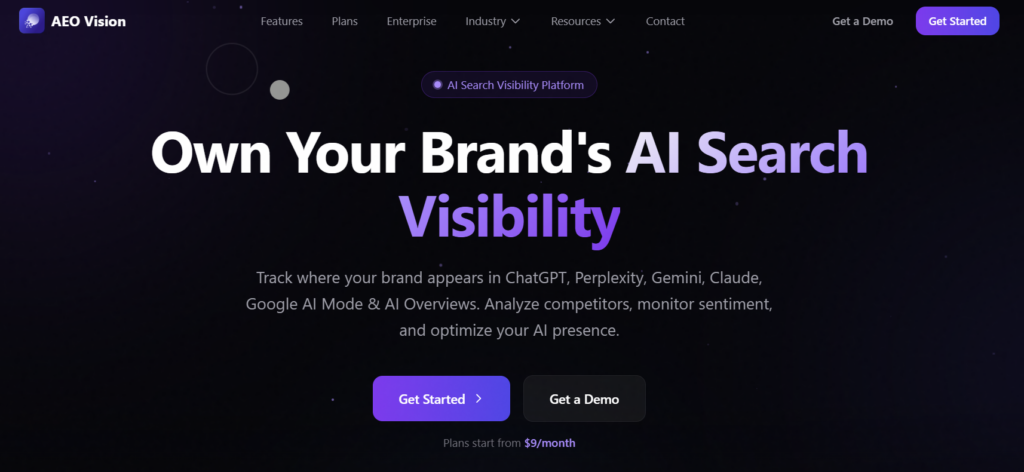
AEO Vision is an AI search visibility platform that helps teams track how their brand appears in AI-generated answers, monitor prompt-level visibility, compare competitor presence, analyze sentiment, and identify optimization tasks from one dashboard. It is useful for teams that want a focused AEO workspace for tracking mentions, citations, sentiment shifts, and content opportunities across AI search platforms.
Key features
- AI prompt tracking: Monitors prompts to show brand mentions, citations, competitor appearances, and visibility changes over time.
- Visibility scores: Tracks AI visibility trends and historical performance.
- Competitor analysis: Compares mention share, cited domains, and competitor visibility.
- Reddit Insights: Shows which Reddit threads AI platforms cite when answering prompts.
Pros
- Provides a focused dashboard for tracking prompt visibility, citations, sentiment, and competitor presence.
- Helps teams identify content and optimization opportunities from AI search visibility data.
Cons
- Lower-tier plans have limits on prompt volume, AI platform coverage, users, and content creation.
- Designed primarily for AI visibility monitoring, with fewer capabilities for turning visibility insights into actionable improvements.
Why Birdeye wins: AEO Vision helps brands understand AI visibility, while Birdeye helps improve the underlying signals that determine whether AI recommends each location.
Pricing: Tiered plans.
How to Choose the Right AEO Tool
When comparing answer engine optimization tools, start by identifying what your team needs to measure, improve, and operationalize. Some platforms are built for LLM monitoring and prompt-level analytics. Others focus on generative engine optimization (GEO) and content workflows. For multi-location brands, the right AEO platform should go beyond a single brand-level visibility score and show how each location performs in AI-generated answers. It should reveal which prompts trigger recommendations, which competitors are surfaced instead, which sources AI cites, and where visibility gaps exist for every location. It should also help teams understand the operational signals that shape AI visibility, including business information accuracy, citations, reviews, sentiment, and local content.
Before choosing an AEO platform, evaluate it across these areas:
- AI platform coverage: Check which answer engines the tool monitors, such as ChatGPT, Gemini, Perplexity, Claude, Google AI Overviews, Google AI Mode, or Copilot. The tool should track the platforms your customers are most likely to use when asking high-intent questions.
- Prompt-level analytics: Look for tools that can track prompt visibility, prompt clusters, ranking changes, and recurring themes across customer questions. Strong prompt-level analytics helps teams understand which queries surface the brand, which ones surface competitors, and where visibility gaps exist.
- Citation intelligence: AEO depends heavily on which sources AI engines trust. The right tool should show brand citation rate, citation frequency, cited domains, third-party sources, and the pages influencing AI-generated answers. This helps teams understand whether AI engines are relying on owned content, directories, review sites, competitors, or other sources.
- Competitive visibility: Choose a platform that can compare your AI share of voice, Answer Share of Voice, LLM brand mentions, citation patterns, and sentiment against competitors. This makes it easier to see whether your brand is gaining or losing visibility in AI-generated recommendations.
- Accuracy and trust signals: AI engines are less likely to surface brands with inconsistent facts, outdated listings, weak reviews, or unclear service information. For multi-location brands, it should identify location-specific trust gaps across business information, reviews, citations, service details, and sentiment, so every location has the best chance of appearing in relevant AI-generated recommendations.
- Content and GEO workflows: If your priority is content, look for tools that help identify fan-out subqueries, content gaps, FAQ opportunities, schema needs, and answer-ready topics. These capabilities help teams create structured content that generative AI platforms can understand, extract, and cite.
- AI crawler analytics: Some tools show how AI crawlers and agents interact with a website. This can help teams understand whether important pages are accessible, crawlable, and useful for AI-generated answers.
- Operational execution: Monitoring alone is not enough. The best AEO tool should help teams move from insight to action, whether that means updating listings, improving review signals, optimizing website content, strengthening citations, or fixing location-level data gaps.
- Reporting and governance: Leaders should be able to measure AI visibility at both the brand and location level, track prompt-level performance, compare locations, and monitor citation and sentiment trends over time.
For smaller teams, a focused AEO monitoring or content optimization tool may be enough. For enterprise and multi-location brands, the stronger choice is usually a platform that connects AI search visibility with the operational workflows that improve the signals answer engines depend on.
Why Birdeye is the operational backbone of AEO
Most AEO tools help teams see where their brand appears in AI-generated answers. That visibility matters, but for multi-location brands, the bigger challenge is what happens next.
Birdeye Search AI is a purpose-built AI visibility platform for multi-location brands that not only measures AI visibility but also helps fix the underlying signals AI engines use to generate answers. A missing citation, a weak AI visibility score, inaccurate location details, or a poor sentiment signal often points to an operational issue across listings, reviews, website content, citations, or local business data. Birdeye Search AI helps close that gap by connecting AI search visibility insights to agents and workflows that enable teams to act across locations.
Built for brands managing hundreds to thousands of locations, Birdeye helps organizations maintain accurate business information, consistent brand representation, and strong trust signals at every location, while giving central teams visibility and control across the entire network. It provides AI coworkers at every location-Jay for marketing, Robin for operations, and Myna for customer experience-to own departmental jobs. These coworkers employ specialized AI agents that automatically consolidate every signal, reason with brand context, and act across locations.
For AEO, this is very important because answer engines evaluate more than website content. They look at whether business information is accurate, reviews are strong and recent, citations are consistent, and customer sentiment supports the recommendation.
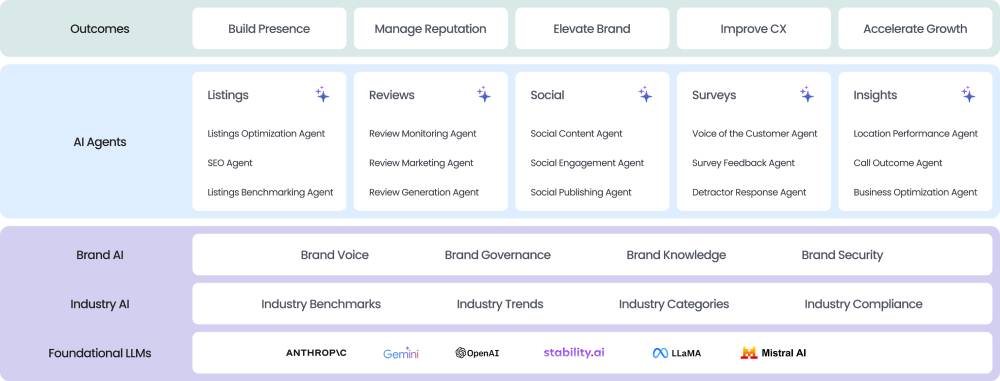
Birdeye helps strengthen those signals through connected agents and workflows:
- Search AI tracks AI search rankings, citations, sentiment, and brand mentions across ChatGPT, Perplexity, Gemini, and other AI search experiences. Most AEO tools stop at the dashboard. Birdeye Search AI closes the loop by enabling AI agents to execute changes at scale.
- Listings Optimization Agent helps keep business information accurate across platforms such as Google, Apple, Facebook, and Yelp.
- Review Generation Agent helps request reviews at the right moment and on the right platform.
- Review Response Agent helps draft and publish on-brand replies, with approval or automation based on team workflows.
- Reporting Agent explains performance changes and flags anomalies in plain language.
- Insights helps teams track sentiment, reputation, and listing accuracy, then act on prioritized recommendations.
Trusted by multi-location enterprise brands such as Aspen Dental, Sutter Health, Sun Auto, etc, Birdeye combines AI visibility with the ability to improve the listings, reviews, citations, and location data that AI engines rely on. With coverage across 200+ review sites and 3,000+ integrations, including Salesforce, HubSpot, and QuickBooks Online, Birdeye helps brands strengthen the trust signals that drive AI-generated recommendations.
The executive lens: What leaders must understand about Answer engine optimization tools
AI-powered search is shifting faster than most teams can adapt. Leadership needs to understand that answer engine optimization tools aren’t optional add-ons, they are the operational infrastructure that determines whether your brand appears in AI-driven customer journeys.
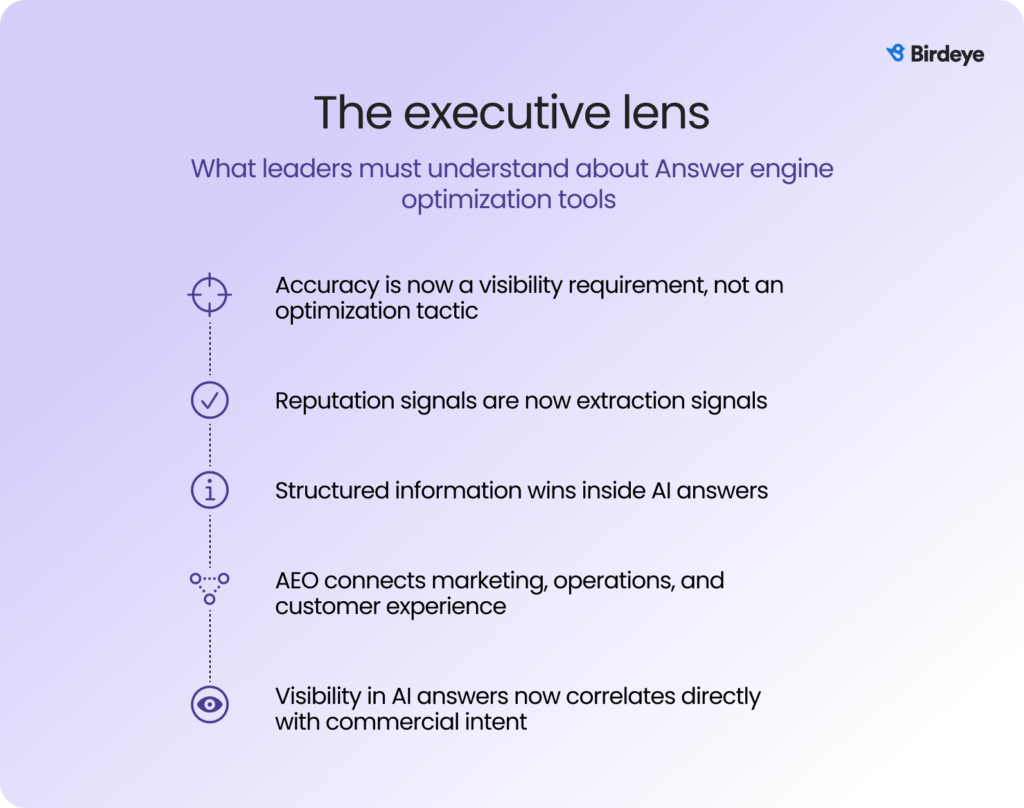
Accuracy is now a visibility requirement, not an optimization tactic
AI engines won’t surface brands with inconsistent or outdated information. Leaders must ensure that listings, categories, hours, and service data stay accurate everywhere, all the time, something only AEO tools can maintain at scale.
Reputation signals are now extraction signals
Reviews, sentiment, and response activity directly influence whether AI considers your brand trustworthy enough to include in an answer. Strong reputation tools aren’t for marketing alone, they are part of your discoverability infrastructure.
Structured information wins inside AI answers
AI engines extract information from a clean structure: FAQs, schema, service descriptions, headings, and consistent data models. Leaders must prioritize structured, machine-readable content, not just traditional blog production.
AEO connects marketing, operations, and customer experience
Visibility in AI answers requires unified accuracy, trust signals, and service consistency, which span across departments. AEO tools bring these signals together into one system that the entire organization can manage and measure.
Visibility in AI answers now correlates directly with commercial intent
AI engines often produce “the shortlist” that customers choose from. If your brand isn’t cited, you’re not considered. Leaders must treat AI visibility the same way they treat lead flow, operational accuracy, and revenue-driving initiatives.
AEO tools are leadership tools. They give executives control over the accuracy, trustworthiness, and visibility signals that shape how AI engines represent or ignore their brand.
FAQs about answer engine optimization tools
AEO tools keep your business information accurate, strengthen your reputation signals, format your content for extraction, and show when AI engines mention your brand. These signals make AI more confident in citing you.
SEO optimizes pages for search rankings. AEO optimizes your business information, reputation, and structure so AI engines can extract and use your brand inside answers. SEO drives visibility in links; AEO drives visibility in AI-generated responses.
Any business that depends on local discovery, service-based demand, or high-intent queries: healthcare, home services, automotive, financial services, real estate, legal, retail, multi-location brands, and SaaS companies.
Only partially. Manual workflows can’t maintain accuracy, citation consistency, review management, and an answer-ready structure across dozens of platforms. AEO tools automate this work and keep your signals updated continuously.
Birdeye Search AI is one of the best AEO tools for multi-location enterprise brands because it goes beyond AI visibility monitoring. It helps brands track how each location appears across ChatGPT, Gemini, Google AI Overviews, Google AI Mode, Perplexity, Claude, Grok, and other AI search platforms and helps improve the trust signals (listings, reviews, citations, local pages, etc) that influence AI-generated recommendations.
Most brands see early improvements within weeks as accuracy, reputation, and structure begin to align. More meaningful visibility gains happen over time as AI engines re-evaluate and re-trust your signals.
Birdeye makes your brand discoverable in AI-driven search
AI engines are becoming a first point of discovery for high-intent customer journeys. They choose which brands to mention, cite, and recommend based on signals like trust, accuracy, consistency, reputation, and source authority. That means AEO requires more than traditional SEO alone.
Birdeye Search AI helps multi-location brands understand how they appear across AI-generated answers, identify visibility gaps, and determine which signals need attention. By connecting AI search visibility with the agents and workflows that improve listings, reviews, citations, sentiment, and website content, Birdeye helps teams move from monitoring to action.
See where your brand stands in AI-powered search and what you can improve with Birdeye. Watch a free demo today!

About the Author

Shruti Dugar
Birdeye
Originally published