Multi-location marketing has changed. It’s no longer about managing listings or replying to reviews. It’s about staying visible, relevant, and trusted across hundreds of locations at once.
Summary: Both Birdeye and SOCi help brands manage this complexity. But they take very different approaches. SOCi focuses on execution through its Genius AI agents, while Birdeye combines execution with deeper visibility, insights, and performance tracking across every location.
If you’re evaluating both platforms, this guide breaks down where each one stands and why multi-location brands increasingly choose Birdeye.
Table of contents
- SOCi vs Birdeye: Two approaches to solving the same problem
- Understanding SOCi Genius Agents (and how they work)
- Where SOCi falls short for multi-location brands
- What makes Birdeye a true Agentic Marketing Platform for multi-location brands
- Major features where Birdeye excels over SOCi
- FAQs about why multi-location brands prefer Birdeye over SOCi
- Choosing between which platform actually drives results: Multi-location brands prefer Birdeye over SOCi
SOCi vs Birdeye: Two approaches to solving the same problem
Multi-location brands face a shared challenge: executing marketing consistently across hundreds of locations without losing control or visibility.
SOCi and Birdeye both address this challenge, but from different starting points.
SOCi, positioned as an “agentic workforce,” is designed to automate day-to-day marketing execution. Its Genius Agents handle listing updates, review responses, and social activity so teams don’t have to manage these tasks manually.
Birdeye combines execution with a connected data layer and AI agents that not only perform tasks but also analyze performance, surface insights, and guide improvements across thousands of locations.
This difference shapes how each platform delivers value.
SOCi helps ensure that marketing tasks are completed consistently. Birdeye helps turn those tasks into better visibility, stronger customer experience, and measurable growth.
Understanding SOCi Genius Agents (and how they work)
SOCi’s platform is built around a simple idea: local marketing work should not depend on manual effort. Instead of teams managing listings, responding to reviews, or publishing social content across locations, SOCi introduces what it calls Genius Agents.
These are brand-trained AI systems designed to perform routine marketing tasks across all locations. Once configured with your brand voice, workflows, and approval rules, they monitor activity, making decisions and executing actions without requiring constant input from your team.
To understand how this works in practice, it’s important to look at the three core agents that power SOCi’s platform.
1. Genius Local Search Agent
The Genius Local Search Agent is responsible for managing business listings and optimizing them for local search. It continuously scans listings across platforms, identifies inconsistencies or gaps, and recommends updates. These updates can include:
- Correcting inaccurate business information
- Adding or refining business categories
- Improving descriptions based on search trends
- Updating attributes that influence discoverability
Limitations: The focus remains on maintaining and updating listings. There is limited visibility into how these changes impact actual performance, such as ranking improvements, traffic shifts, or competitive positioning at the location level.
2. Genius Social Agent
For multi-location brands, social media management often fails because local pages are either inactive or inconsistent. SOCi Genius Social Agent addresses this by automating both content creation and engagement, as it helps:
- Create and publish localized posts
- Generate images and videos
- Responds to comments and engagements
- Uses signals from reviews, engagement, and trends
This reduces response times and ensures that customer interactions are acknowledged consistently across locations.
Limitations: The system prioritizes activity and consistency, but provides limited insight into performance. It does not clearly connect social activity to outcomes such as conversions, foot traffic, or customer acquisition at the location level.
3. Genius Reputation Agent
The Genius Reputation Agent focuses on managing customer reviews across platforms like Google, Facebook, Yelp, and others.
For enterprise brands, the entire review management becomes difficult due to the volume of reviews generated across locations, but SOCi’s agent automates this process end-to-end, including:
- Analyzing review sentiment, intent, and urgency
- Writing on-brand responses automatically
- Escalating sensitive reviews based on rules
- Grouping feedback into themes using Voice of Customer insights
- Tracking sentiment trends across locations
Limitations: While feedback is organized and responses are automated, the system does not fully connect these insights to broader business impact. For example, it does not clearly show how review sentiment influences search visibility, conversion rates, or competitive positioning across markets.
How SOCi’s agentic model works in practice
Across listings, social, and reputation, SOCi’s agents follow a consistent operational model. This means SOCi automates three key categories of work:
- Listings updates (ensuring accuracy and basic optimization)
- Review responses (maintaining response rates and consistency)
- Social publishing and engagement (keeping local pages active)
This is what we mean by execution in SOCi’s context. It refers to completing routine, repeatable marketing tasks across locations without manual effort.
While SOCi is effective at automating execution, enterprise brands require more than task completion. They need to understand performance, identify gaps, and continuously improve outcomes across locations.

This is where limitations begin to surface.
Where SOCi falls short for multi-location brands
SOCi’s Genius Agents streamline listing updates, review responses, and social activity across locations, reducing manual effort and ensuring consistency.
However, enterprise brands need more than execution. As scale increases, visibility into performance and market gaps becomes critical.
This is where limitations begin to emerge.

1. Limited visibility into AI-driven search and discovery
SOCi focuses heavily on traditional local SEO through listings optimization.
However, customer discovery is evolving. Increasingly, customers rely on AI-generated recommendations and summaries when choosing businesses.
SOCi does not have a clearly defined capability for tracking how your brand appears in AI-generated search experiences, such as:
- How it is described
- Which sources influence those descriptions
- Where inconsistencies may exist
2. Review management without a clear business impact linkage
SOCi’s Reputation Agent effectively organizes and responds to reviews. However, it does not fully connect review data to key outcomes such as:
- Local search ranking improvements
- Conversion rates or customer acquisition
- Competitive positioning within specific markets
3. Limited competitive benchmarking at the location level
SOCi primarily focuses on internal activity, what your brand is doing across listings, reviews, and social channels.
Without a competitive context, it becomes difficult to prioritize actions or allocate resources effectively across locations. There is limited visibility into:
- How individual locations perform relative to competitors
- Which competitors are gaining visibility in specific markets
- What differentiates top-performing locations from underperforming ones
4. Integration depth and data connectivity constraints
SOCi integrates with major platforms relevant to local marketing.
However, it does not match the breadth of Birdeye’s integration ecosystem, which connects you with over 3,000 CRMs and software.
While SOCi focuses on automating marketing work, Birdeye is built to connect marketing actions to measurable outcomes. Let’s understand more about it in detail.
What makes Birdeye a true Agentic Marketing Platform for multi-location brands
Birdeye has evolved beyond traditional reputation management into a full-cycle Agentic Marketing Platform. This is not just AI assistance. It is a coordinated system of agents that execute, analyze, and improve performance across 100-10,000+ locations.
Trusted by global multi-location brands across healthcare, automotive, retail, and hospitality, Birdeye’s positioning is simple: One platform to find, convert, and keep every customer at scale.
Birdeye is easy to navigate, and I love that it consolidates all review channels into a user-friendly dashboard. The platform offers a wide range of tools and consistently keeps up with industry trends, recently providing solutions for how businesses can be discovered through AI chat functions. – Caitlin P., Marketing Director (verified G2 reviewer)
Birdeye’s strength comes from breadth and coordination. Let’s understand each of Birdeye’s Agents’ specific functions and how they share data and insights across the platform.
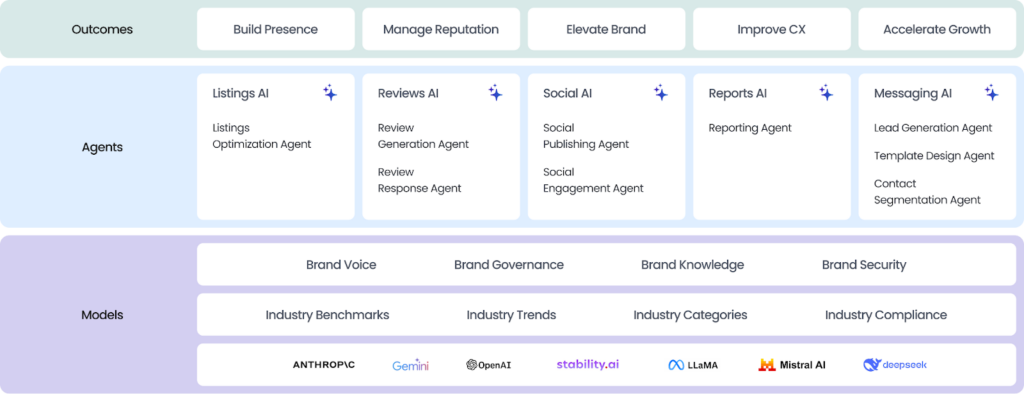
The 9 AI Agents powering Birdeye (and what they actually do)
Birdeye has moved beyond AI features. It doesn’t just offer “agents”; it provides a fully integrated, agentic workforce. These agents allow multi-location brands to scale personalized customer experiences that were previously impossible to manage manually.
Each agent is trained on your specific industry, brand voice, and local data to ensure that automated never means robotic.
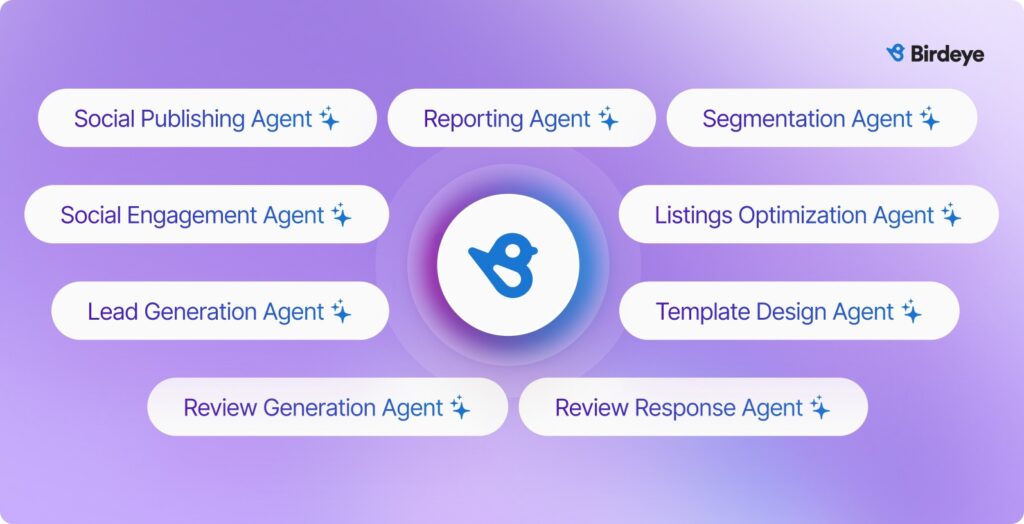
| Agent | Core action | Strategic outcome |
| Listings Optimization | Continuously analyzes listings for high-impact SEO gaps. | Proactive ranking in “near me” searches to drive foot traffic. |
| Review Generation | Triggers personalized requests based on real-time transaction data. | Systematically increases review volume and star ratings at scale. |
| Review Response | Analyzes sentiment and intent to draft contextually accurate replies. | Ensures 100% engagement while maintaining strict brand voice. |
| Social Publishing | Drafts and optimizes platform-specific posts for every local page. | Scales local relevance across hundreds of locations instantly. |
| Social Engagement | Monitors and triages comments and DMs across the entire footprint. | Ensures no lead or customer inquiry is ignored, 24/7. |
| Lead Generation | Engages, qualifies, and captures visitor details via chat and SMS. | Converts passive web traffic into actionable leads around the clock. |
| Contact Segmentation | Builds precise audience cohorts via natural language queries. | Eliminates manual list-building for hyper-targeted re-engagement. |
| Template Design | Generates brand-aligned email and SMS assets from simple prompts. | Removes creative bottlenecks, enabling campaigns to launch in seconds. |
| Reporting Agent | Translates complex datasets into plain-English answers. | Immediate, actionable insights that enable rapid strategic pivots. |
The difference isn’t the number of agents. It’s how they work together to drive outcomes. In Birdeye, everything is connected:
- Reviews influence listings optimization
- Listings affect search visibility
- Feedback shapes social content
- Competitive insights guide strategy
This creates a full-cycle system that captures demand, converts customers, and improves the experience across every location. That loop is what drives growth at scale.
Birdeye is a valued partner for our business listings consistency and integrations. Their Listings AI, Social AI, and Reviews AI are integral to our overall marketing and brand strategy. The team is professional, and the support is best in class! The dashboard is easy to navigate, and our implementation and integration were seamless. Our team utilizes Birdeye daily for our social strategy and reputation management. Highly Recommended! – Patti M., Vice President of Marketing (5/5, Verified G2 reviewer)
What makes Birdeye unique beyond execution
What truly separates Birdeye from SOCi is the depth of connectivity and local intelligence. Birdeye is built to support thousands of locations with centralized control and location-level execution.
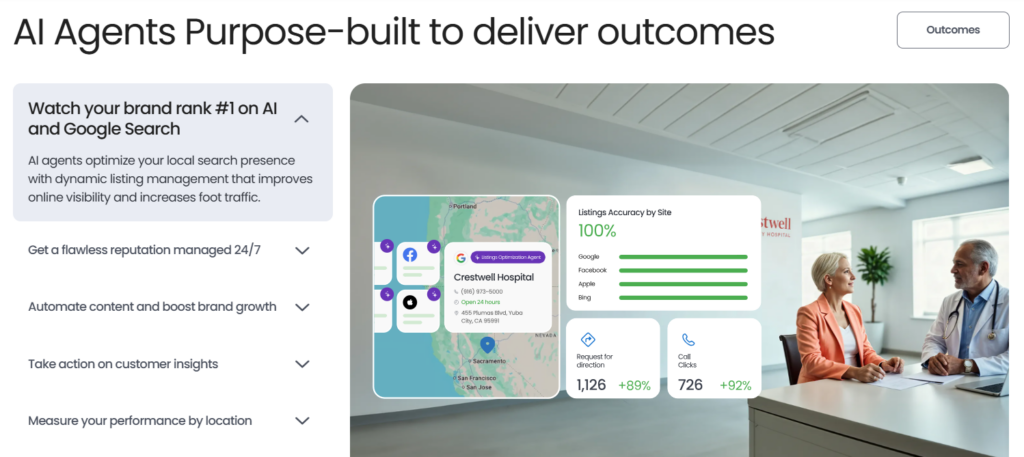
Enterprise teams can define approval workflows, permissions, and brand guardrails centrally, while AI agents execute locally:
- Deep integration ecosystem: Birdeye connects with over 3,000+ CRMs and software systems. While SOCi’s agents are limited by what they see on social media and listing sites, Birdeye’s agents are fueled by your actual sales data and customer history.
- Agent-powered Marketing Automation: Birdeye turns insights into immediate action. Its automation suite uses the Contact Segmentation Agent to trigger hyper-local email and SMS campaigns. It’s the difference between sending a generic blast and sending a “we miss you” offer the moment a customer hits a 6-month lapse.
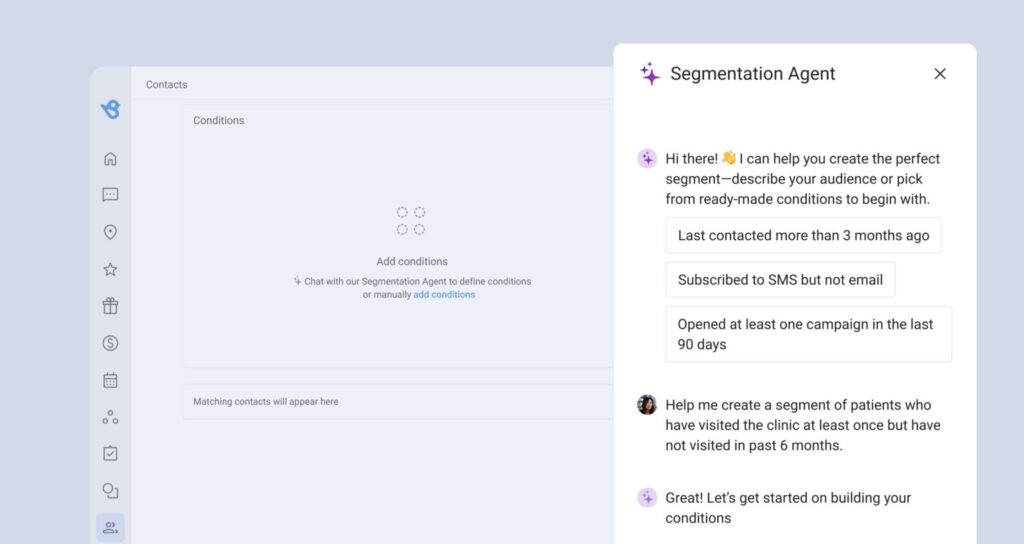
- Next-gen Search AI: The Search AI tool ensures you rank in the new era of Generative Engine Optimization (GEO). While traditional SEO focuses on “blue links,” it ensures your brand is the top recommended answer in AI-generated summaries across ChatGPT, Gemini, and Perplexity.
- Outcome-driven insights: SOCi tells you a task is done. Birdeye tells you why that task mattered. We connect the dots between a review response, a search ranking improvement, and a physical visit.
Awards & recognition
Birdeye isn’t just self-proclaimed; it is the most-awarded and highest-rated platform for multi-location brands.
Birdeye is consistently ranked as a Leader in G2’s Enterprise reports for Agentic AI, Reputation Management, Local SEO, and Customer Service.
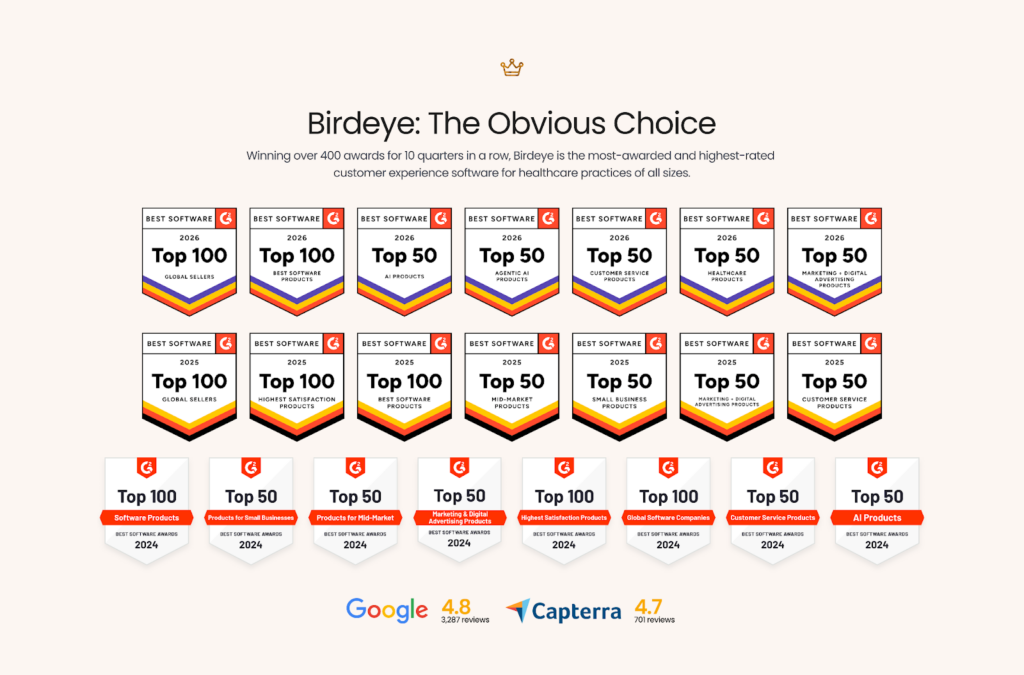
Capterra & Software Advice: Consistently rated 4.7/5 stars. Birdeye is frequently cited as the top choice for multi-location brands due to its Local Intelligence and ease of use.
Google Premier Partner Program: Recognized for enhancing brands’ local search performance.
Unlike point solutions that focus on a single niche, Birdeye is consistently recognized across both enterprise software and AI product categories.
“Earning a Leader position in a G2 Report is highly competitive and rooted in verified customer reviews. Congratulations to Birdeye for achieving this distinction.” — Godard Abel, CEO of G2
Major features where Birdeye excels over SOCi
While SOCi focuses on automating the “work” of marketing, Birdeye is built to automate the outcomes. Here is how Birdeye provides a strategic advantage that goes beyond simple task execution.
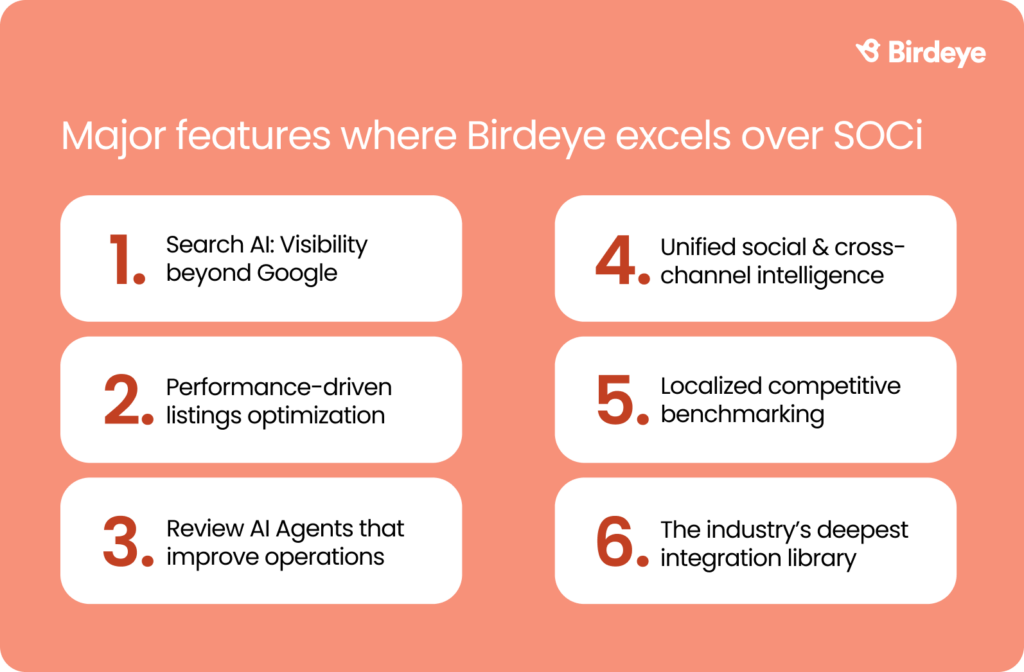
1. Search AI: Visibility beyond Google
Traditional SEO is no longer enough. Customers now use AI-generated summaries in Google’s AI Overviews, ChatGPT, and Perplexity to make decisions.
The Birdeye edge: Search AI tracks how your brand appears in AI search results, identify which sources influence your visibility, and ensure your locations are the top-recommended choice.
You don’t just rank on a map; you win where modern search decisions are actually happening.
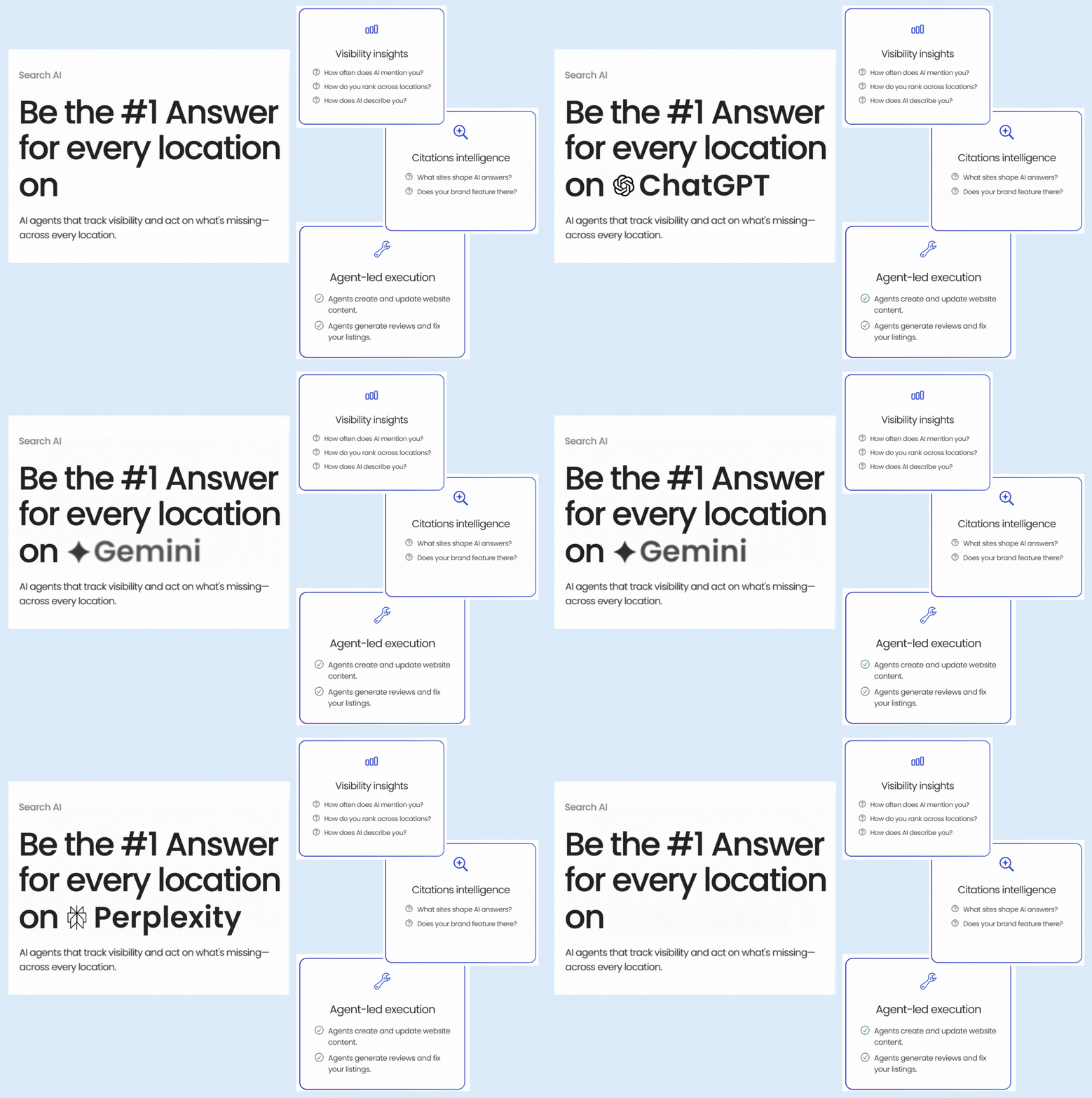
2. Performance-driven listings optimization
SOCi keeps your listings accurate. Birdeye ensures they are competitive.
The Birdeye edge: Listings AI platform identifies SEO gaps at the individual location level and suggests optimizations based on local search trends. It doesn’t just sync data; it tracks how updates directly impact your visibility.
Your listings move from being “accurate” to being a dominant source of local foot traffic.
3. Review AI Agents that improve operations
Review management at SOCi is largely about maintaining response rates. Birdeye treats reviews as business intelligence.
The Birdeye edge: Our Review AI Agents perform deep sentiment analysis to surface emerging operational issues before they escalate. We connect review data to actual outcomes, like search ranking shifts and conversion rates.
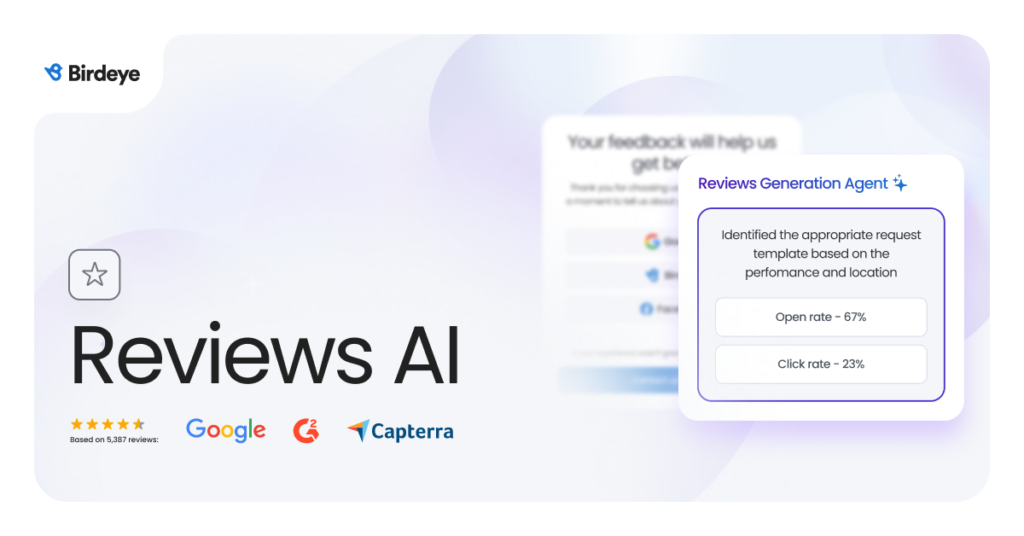
4. Unified social & cross-channel intelligence
Multi-location marketing often fails when channels operate in silos. Birdeye’s Social AI Agents create a unified intelligence loop that SOCi’s task-based model lacks. Your brand feels consistent everywhere, and your social channels actually drive conversions instead of just “likes.”
The Birdeye edge: Birdeye can instantly turn a 5-star review into a localized social post or use messaging data to inform engagement.
5. Localized competitive benchmarking
SOCi’s reporting is inward-facing, showing you what your brand is doing. Birdeye provides an outward lens. You know exactly where you are losing market share and can allocate resources to the locations that need them most.
The Birdeye edge: It shows how every location performs against its local competitors in real time—tracking their share of voice, review velocity, and ranking shifts.
6. The industry’s deepest integration library
AI is only as good as the data powering it. With 3,000+ integrations—including Salesforce, HubSpot, and niche industry CRMs—Birdeye’s agents are fueled by your actual sales and customer history, not just social signals.
Key differences: SOCi vs Birdeye
| Capabilities | SOCi | Birdeye |
| Listings & local SEO | Automated via Local Search Agent | Centralized + performance insights + optimization |
| Reviews & reputation | Automated responses | Automated + sentiment + trends + benchmarking |
| Social media | AI-generated posts & replies | AI agents + performance insights + cross-channel strategy |
| AI Search visibility | Not a core focus | Search AI tracks how your brand appears in AI results |
| Integrations | Limited ecosystem | 3,000+ integrations |
| Intelligence layer | Execution-focused | Execution + insights + competitive benchmarking |
| Search strategy | Search-lite: Focused on Maps and listings | AI-first: Optimized for GEO, ChatGPT, and Google. |
FAQs about why multi-location brands prefer Birdeye over SOCi
SOCi focuses on automating tasks like listing updates, review responses, and social posting. Birdeye combines execution with insights, benchmarking, and AI search visibility. You don’t just complete tasks, you understand what’s working and improve performance across locations.
Birdeye offers nine AI agents across reviews, listings, social, messaging, insights, and search. These agents share data and work together to improve outcomes. Instead of isolated tasks, you get a connected system that drives visibility, trust, and growth.
SOCi is useful for automating execution across locations. Birdeye is better for brands that want to improve performance with insights, benchmarking, and visibility tracking. It helps enterprise teams make informed decisions, not just manage tasks.
Absolutely. Birdeye is designed specifically for complex, multi-location structures. We provide Supervised Autonomy, meaning corporate teams can set global guardrails and approval workflows, while AI agents handle localized execution at each branch.
Choosing between which platform actually drives results: Multi-location brands prefer Birdeye over SOCi
The distinction between the two platforms is a matter of business objective.
SOCi helps multi-location brands automate routine marketing tasks like updating listings, responding to reviews, and publishing social content. For teams struggling with execution gaps, this can bring immediate operational relief.
But execution alone doesn’t drive growth.
As brands scale, the challenge shifts. It’s no longer about keeping up with tasks. It’s about understanding what drives visibility, how customer perception evolves, and where competitors are gaining ground.
Where Birdeye stands apart
Birdeye’s agentic marketing platform is built to improve outcomes across every location. It doesn't just manage your current presence; it uses a unified tech stack and agentic intelligence to identify revenue opportunities you might have missed and take the necessary actions to capture them.
Birdeye’s tools deliver that by combining:
- Execution (AI agents that act)
- Intelligence (insights that explain why)
- Scale (thousands of locations, unified view)
If your goal is to improve visibility, trust, and revenue across locations, Birdeye is the stronger choice.

Disclaimer: The content on this page is based on research compiled from publicly available information. Birdeye does not warrant the completeness or correctness of the information and cannot be held liable for its use.
About the Author

Shruti Dugar
Birdeye
Originally published

![[Feature image] Agentic marketing in 2026-Governed AI execution for large multi-location brands](https://birdeye.com/blog/wp-content/uploads/Feature-image-Agentic-marketing-in-2026-Governed-AI-execution-for-large-multi-location-brands-375x195.png)
![[Feature image] The Best Marketing Platforms for Multi-Location Brands](https://birdeye.com/blog/wp-content/uploads/Feature-image-The-Best-Marketing-Platforms-for-Multi-Location-Brands-375x195.png)