Retail marketing automation is no longer just a campaign execution tool; it’s becoming the system that decides which brands win repeat purchases, store visits, and loyalty sign-ups. Nearly 80% of retailers have already piloted or partially deployed agentic AI to improve operational efficiency and deliver more personalized marketing. This signals a clear move toward systems that act on customer intent in real time rather than after the fact.
Summary

Retail marketing automation is effective only when it reflects real-time customer behavior. Systems built on static segments, delayed campaigns, or disconnected tools struggle to keep up with how shoppers browse, buy, and engage across channels.

Birdeye helps multi-location retailers consolidate customer data, messaging, reviews, and AI insights into a single platform, making it easier to respond with timely, relevant communication at scale.

In this blog, we explain where traditional retail automation falls short, what modern automation requires, and how unified platforms can improve engagement, retention, and revenue.
Table of contents
- What is retail marketing automation?
- Why retail marketing automation matters now
- How to build an effective retail marketing automation strategy
- How to choose the right retail marketing automation tool
- How to measure and optimize retail marketing automation
- How Birdeye powers retail marketing automation at scale
- FAQs on retail marketing automation
- Conclusion: Prepare your retail marketing for what’s next
What is retail marketing automation?
Retail marketing automation uses customer data, behavioral signals, and automated workflows to manage campaigns across channels such as email, social, messaging, and personalized offers. By replacing manual, repetitive tasks with coordinated systems, it ensures consistent communication across channels and guides shoppers through connected journeys, from discovery to repeat purchase.
Key components of retail marketing automation:
- Centralizes customer data from e-commerce, in-store interactions, CRM, and loyalty programs to build a complete view of shopper behavior.
- Automates campaigns and workflows that respond to customer actions with timely, relevant messages across channels.
- Tracks performance across touchpoints to refine messaging, timing, and automation logic over time.
Together, these components help retailers deliver more personalized, efficient, and impactful marketing that drives engagement, loyalty, and sales.
Why retail marketing automation matters now
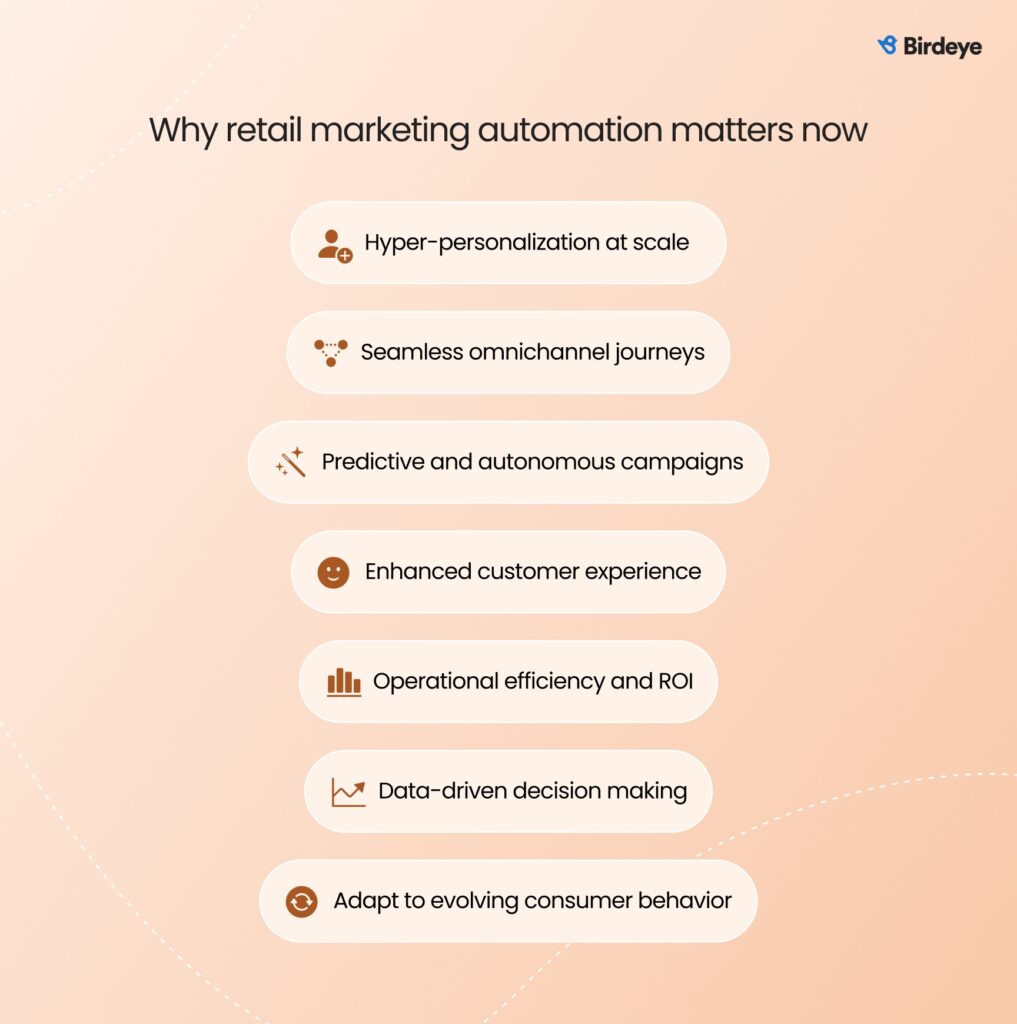
In 2026, retail marketing automation is essential for delivering AI-driven, hyper-personalized experiences. Let’s explore how it helps retailers respond in real time, streamline operations, and drive loyalty, engagement, and sales across all channels.
Hyper-personalization at scale
AI and machine learning analyze vast amounts of data to anticipate customer needs, delivering tailored content, product recommendations, and offers in real time across email, apps, and video.
Seamless omnichannel journeys
Integration across email, social, web, and mobile ensures consistent, unified experiences as customers move between devices and platforms.
Predictive and autonomous campaigns
AI predicts trends, optimizes send times, scales high-performing campaigns, and pauses underperformers, making marketing proactive rather than reactive.
Enhanced customer experience
Automated, behaviorally triggered messages, like cart abandonment reminders or personalized promotions, reduce friction, increase engagement, and strengthen relationships.
Operational efficiency and ROI
By automating repetitive tasks, marketing teams can focus on strategy and generate higher returns through more timely, relevant interactions.
Data-driven decision making
Automation turns raw data into actionable insights for audience understanding, media optimization, and content creation, supporting smarter marketing decisions.
Adapt to evolving consumer behavior
Retailers can meet mobile-first habits, increased streaming/social video usage, and demand for AI-powered search and shortcut-based discovery with faster, more intelligent responses.
By 2026, retail marketing automation will no longer be just a tool; it will be the foundation for intelligent, data-driven experiences that drive growth, loyalty, and competitive advantage.
How to build an effective retail marketing automation strategy
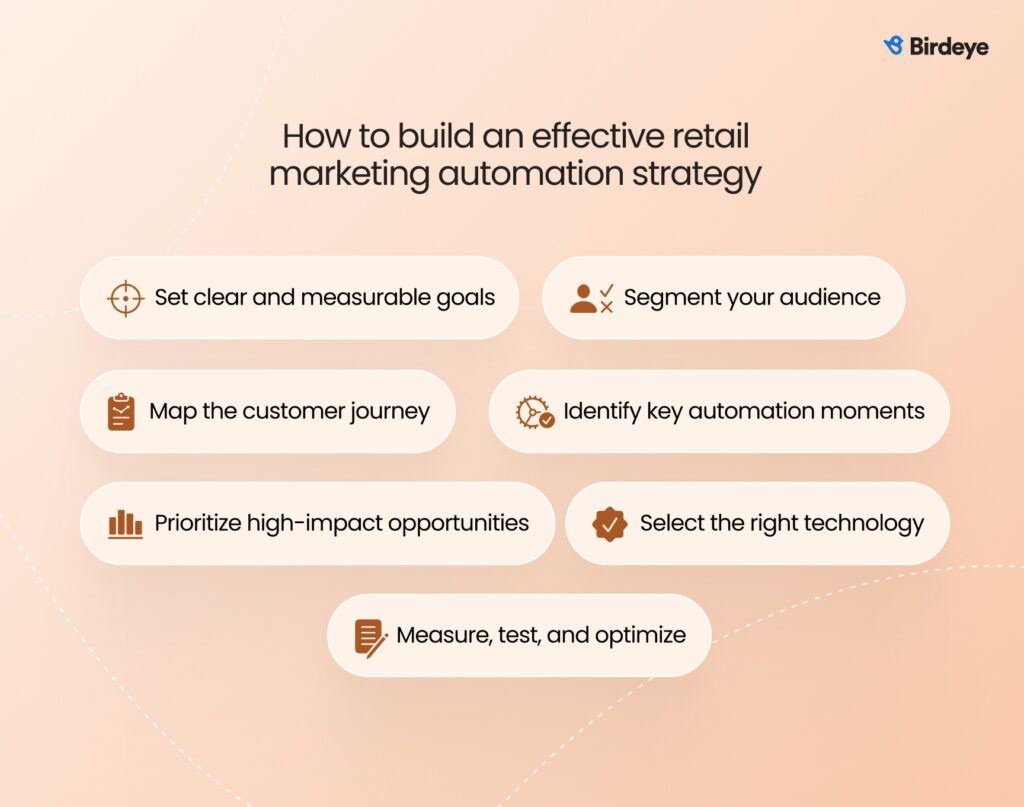
Building an effective retail marketing automation strategy requires a structured approach that connects planning, execution, and continuous optimization. A well-designed strategy engages customers, drives conversions, and boosts loyalty while freeing marketing teams from repetitive tasks.
Set clear and measurable goals
Start by defining SMART objectives, specific, measurable, achievable, relevant, and time-bound for your automation efforts. Focus on metrics that matter most to your business, such as increasing engagement, boosting revenue, or improving customer retention. Clear goals provide direction and allow you to measure the success of each campaign.
Segment your audience
Analyze customer data, including purchase history, browsing behavior, demographics, and loyalty status, to create actionable segments. Effective segmentation allows you to deliver personalized, relevant messages to the right audience, increasing the chances of engagement, conversion, and repeat purchases.
Map the customer journey
Outline the complete customer journey from initial awareness to post-purchase advocacy. Identify key touchpoints and potential friction points where automation can add value, such as welcome sequences, cross-sell opportunities, or win-back campaigns. A mapped journey ensures customers receive timely and relevant messages at every stage.
Identify key automation moments
Pinpoint moments where automation can have the greatest impact. Examples include cart abandonment reminders, post-purchase follow-ups, loyalty program prompts, and behavior-triggered recommendations. Automating these touchpoints helps maintain consistent communication and improves overall customer experience.
Prioritize high-impact opportunities
Focus on automation workflows that drive the most value for your business. High-impact areas often include cross-sells and upsells, re-engagement campaigns for inactive customers, personalized promotions, and real-time responses triggered by customer actions. Prioritizing these ensures your automation delivers measurable results.
Select the right technology
Choose a marketing automation platform that aligns with your goals and integrates seamlessly with your CRM, e-commerce, and analytics tools. Look for platforms that offer cross-channel orchestration, real-time analytics, AI-driven insights, and scalability to support growth.
Measure, test, and optimize
Automation is not a “set it and forget it” process. Regularly monitor performance, run A/B tests, and refine workflows based on results. Tracking key metrics such as engagement rates, conversion rates, and ROI ensures your strategy continues to evolve and deliver maximum impact.
By following these steps, retailers can build a data-driven, scalable, and effective marketing automation strategy that drives engagement, boosts revenue, enhances retention, and creates seamless, personalized experiences that keep customers coming back.
How to choose the right retail marketing automation tool
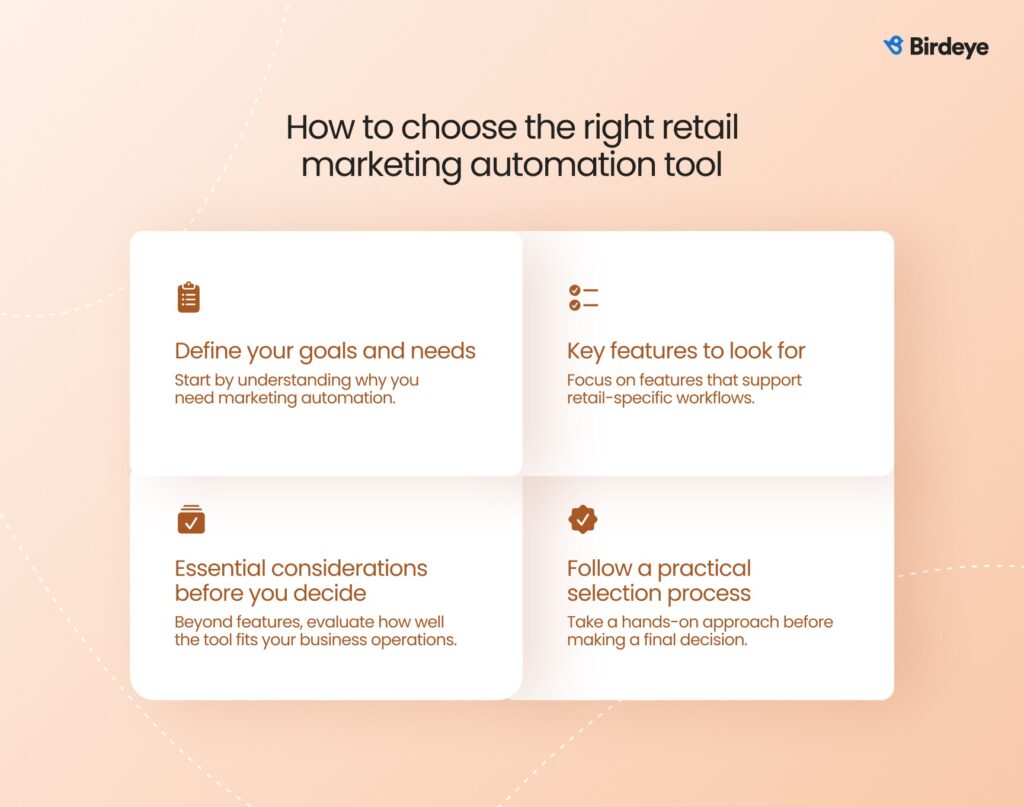
Choosing the right retail marketing automation tool starts with clarity. Define what you want to achieve, evaluate the features that matter most, and ensure the platform fits your team, budget, and existing tech stack.
1. Define your goals and needs
Start by understanding why you need marketing automation.
Identify your primary goals
- Customer retention
- Lead capture and nurturing
- Cart abandonment recovery
- Repeat purchases and loyalty
- Personalized promotions
Decide what to automate
- Welcome and onboarding emails
- Post-purchase follow-ups
- Loyalty and rewards campaigns
- Re-engagement messages
- Product recommendations
Having a clear list of goals and use cases makes it easier to rule out tools that don’t align with your priorities.
2. Key features to look for
Focus on features that support retail-specific workflows.
- Omnichannel support
- E-commerce integrations
- Personalization and segmentation
- Customer data platform (CDP)
- AI and analytics
- Ease of use
Intuitive interface, drag-and-drop builders, and minimal onboarding time.
3. Essential considerations before you decide
Beyond features, evaluate how well the tool fits your business operations.
- Integration compatibility
- Scalability
- Budget and total cost
- Support and training
- Data security and compliance
Explainer videos on pricing models and total cost of ownership can be helpful at this stage.
4. Follow a practical selection process
Take a hands-on approach before making a final decision.
- Request a demo or free trial
- Read real user reviews
- Involve your team
- Set priorities clearly
Separate must-have features from nice-to-haves to avoid unnecessary complexity.
Explore Retail Marketing Automation Strategies That Work
Want to see the impact of Birdeye on your business? Watch the Free Demo Now.
How to measure and optimize retail marketing automation
Tracking performance and making regular improvements ensures your retail marketing automation continues to deliver engagement, retention, and revenue. The table below outlines what to measure and how to optimize effectively.
| Focus area | What to track or improve | Why it matters |
| Performance | Campaign results, workflow completion rates, drop-off points | Shows whether automation is meeting engagement and revenue goals |
| Engagement | Open rates, click-through rates, conversion rates | Reveals how customers interact with automated messages |
| Retention | Repeat purchase rate, churn, customer lifetime value (CLV) | Indicates long-term customer value and loyalty |
| Revenue & ROI | Revenue from automated workflows, average order value, ROI by campaign | Connects automation directly to business impact |
| Testing | A/B testing triggers, timing, content, and offers | Helps improve relevance and campaign performance |
| Segmentation | Refining audience segments using behavior and performance data | Ensures messages reach the right customers |
| Workflow improvement | Updating, removing, or expanding automated journeys | Keeps automation aligned with changing customer behavior |
By tracking the right metrics and continuously refining workflows, retail marketing automation becomes a reliable system for improving customer engagement, retention, and revenue.
How Birdeye powers retail marketing automation at scale
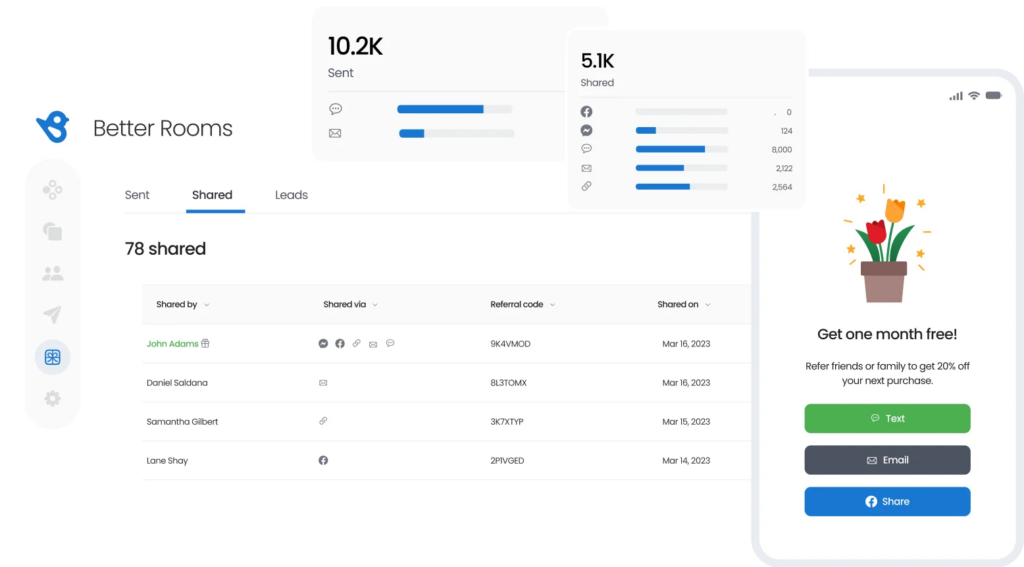
Birdeye gives retailers the infrastructure needed to run intelligent, connected marketing automation across locations and channels. Instead of reacting after the fact, teams can use real-time customer signals to guide communication, visibility, and experience management.
Bring customer signals into one connected system
Birdeye consolidates reviews, surveys, messages, listings, and social activity into a single platform. This shared data layer allows automation to respond to what customers are doing and saying, not static segments or delayed reports.
Trigger timely, on-brand engagement with AI
BirdAI works across Reviews AI, Messaging AI, and Social AI to automate review requests and replies, customer conversations, and social publishing. Each interaction is guided by context and sentiment, helping retailers respond quickly without losing brand consistency.
Strengthen local discovery and store-level performance
Listings AI keeps store information accurate across hundreds of directories, supporting local search visibility and helping customers find the correct location at the right time.
Convert feedback into operational and marketing action
Surveys AI and sentiment analysis summarize customer feedback across locations, making it easier to spot patterns, address issues, and adjust automated journeys based on real customer experience data.
Scale automation without adding complexity
With integrations across thousands of retail, CRM, and e-commerce systems, Birdeye fits into existing workflows and supports multi-location growth without increasing manual effort.
By connecting customer data, AI-driven engagement, and automation in one platform, Birdeye helps retailers build marketing systems that stay aligned with how customers actually shop and interact.
FAQs on retail marketing automation
Retail marketing automation responds to real-time customer behavior across channels rather than relying on static segments and scheduled batch campaigns.
E-commerce activity, purchase history, loyalty data, messaging engagement, and inventory signals are key to timely, relevant automation.
Yes, automation helps smaller teams scale personalized communication, reduce manual work, and improve retention without adding complexity.
Results often appear quickly for triggered workflows like cart recovery, while broader gains in retention and revenue build over time.
Engagement rates, repeat purchases, workflow performance, and revenue tied to automated campaigns show whether automation is working.
Conclusion: Prepare your retail marketing for what’s next
Retail marketing is moving toward systems that think, decide, and respond alongside customers, not after them. The brands that succeed will be those that treat automation as a living capability, continuously informed by behavior, context, and performance. Rather than adding more campaigns, the focus shifts to building connected experiences that adapt to customers. Getting this right now sets the groundwork for sustainable growth, stronger relationships, and marketing that keeps pace with how people actually shop.
See how Birdeye helps retailers turn real-time customer signals into connected, automated marketing—book a demo.

About the Author

Vanjana Sharma
Originally published



![[Feature image] 7 enterprise marketing automation tools designed for multi-location growth](https://birdeye.com/blog/wp-content/uploads/Feature-image-7-enterprise-marketing-automation-tools-designed-for-multi-location-growth-375x195.png)