The following article was written by a guest contributor.
SEO trends for small businesses in 2026 focus on visibility, trust, and discoverability across traditional search, local results, and AI answers. Reviews, structured content, and optimization for conversational and AI-driven search experiences play a central role in helping small businesses get found and chosen online.
Summary
As search behavior continues to evolve in 2026, small businesses must adapt their SEO strategies to match how customers discover information today. While SEO is often overlooked in favor of other channels, effective visibility now depends on trust signals, structured content, and accurate business information across reviews, featured snippets, voice, and AI-powered search. According to one of the leading digital strategy firms of today, IT strategy is based on being disruptive, making SEO a critical part of broader marketing strategies for small businesses. This blog explores practical SEO trends small businesses can use to improve discoverability, compete locally, and convert searchers into customers across modern search experiences.
Table of contents
Key SEO trends shaping small business visibility in 2026
1. Leverage Your Google Reviews
First and foremost, Google reviews are more important than ever before. To start, you’ll need to claim your Google business page through Google My Business. From there, you’ll be able to accept and respond to online reviews. Today, users trust these reviews more than just about anything else. It’s a form of digital referral that can either work for you or against you.
An unsurprising 6 out of 10 customers look to Google My Business for local business reviews. This is where you can really shine. Not only do people read online reviews, but they trust them. Who are you more likely to choose if you’re searching for a business: the business with a few reviews that aren’t very strong or a business with raving, excited reviews? The choice is obvious.
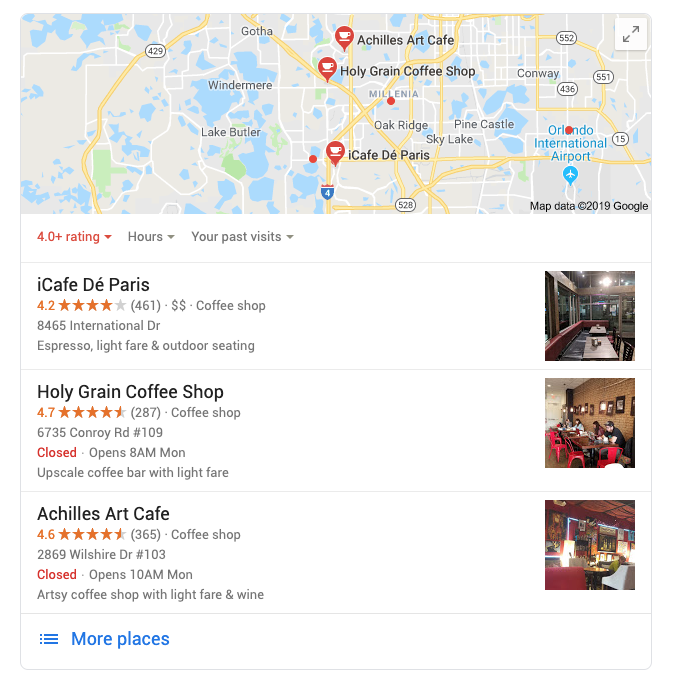
Just look at this example below for local coffee shops around Orlando. Notice how Google prioritizes places with over 4 stars, and this makes it easy for users to navigate to the best small businesses.

2. Utilize the Google Answer Box
Google search has come a long way in the past few years. It’s now a complex place full of a lot of different elements, many of which you might not be familiar with. The more you understand Google search tips, the better you’ll be at targeting these search results.
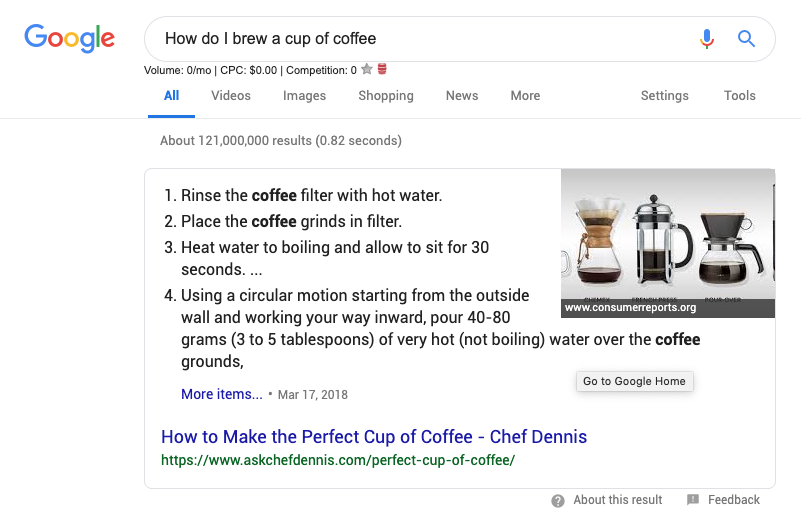
Let’s take a look at the way search results look right now. Let’s say I wanted to search for tips on brewing a cup of coffee. Notice the first thing that pops up is a box with a straightforward answer. This is known as the Google Answer box, and it’s always displayed at the top of the results page.
Generally, to get in this answer box, you need to be careful with how you format your posts on your website. To appear in the answer snippet, follow these best practices:
- Be specific with keywords
- Search for answer boxes that don’t have a good answer and are easy to compete with
- Format your text to answer the question directly
The good news is you don’t’ need to be at the top of the search engine results to appear in the answer box. Take a look at some of the common answers for local businesses like yours and go from there with these tips above. Content is key to rankings. Here are 5 benefits of content localization for small businesses.
3. Optimize for Voice Search
Alexa, where can I find coffee nearby? Amazon’s Alexa, Google Home, and other smart devices have taken us far. These are now smartphone and smart home staples you can find just about anywhere. Voice search is becoming more and more common, and this is something small businesses can use to their advantage.
Most people use voice search to find small businesses near them, so it’s ideal for local places. It’s also an underutilized form of SEO, making it an easy way for smaller businesses to stand out even without a local presence. In 2017, 35 million Americans used a voice-activated device at least once a month. This number is rising rapidly, and it’s truly a search engine revolution.
How do you optimize for voice search? First, start with your Google My Business listing. This is how Google learns more about your business to help users find you. Next, focus on conversational keywords. This is the biggest takeaway from voice search. When people search with their voice, they’re more likely to phrase their question as a full question.
For example, instead of typing “coffee shops” they’ll ask something along the lines of “Hey Google, where can I get coffee on my way to work downtown?” This is conversational and phrased like a question, and that’s what you want to optimize for.
4. Prepare for AI-powered search experiences
Search behavior in 2026 extends beyond traditional rankings, featured snippets, and voice assistants. Customers increasingly use AI-powered search experiences to ask complex questions, compare options, and discover local brands often without clicking through a list of links. These experiences rely on structured business data, reviews, and trusted third-party sources to generate answers.
Birdeye Search AI helps multi-location brands understand how they appear across AI-powered search experiences by measuring visibility in AI-generated answers, analyzing sentiment, and identifying the specific sources that influence how brands are described. By highlighting citation gaps, accuracy issues, and data inconsistencies, Search AI enables brands to improve discoverability and ensure customers find accurate, up-to-date information wherever they search.
You Heard It Here First
There you have it. These are the SEO trends you should be using for your small business if you want to get ahead of the competition. All of these are more relevant than ever as search engines continue to evolve and change our lifestyles.
SEO isn’t just for big businesses. All businesses can benefit from taking these trends seriously and seeing how far they’ll take them. From reviews to voice search, what will you take advantage of next? Your users are out there just waiting to stumble upon your website on the results page.
Birdeye: Helping brands stay visible as search evolves
As SEO continues to evolve, brands need more than website optimization to stay competitive. Visibility increasingly depends on reviews, accurate listings, and how brands are represented across search, maps, and AI discovery engines.
Birdeye is the #1 Agentic Marketing Platform built for multi-location brands, replacing fragmented tools with one unified platform that centralizes customer data and deploys AI-powered agents to drive outcomes.
With Birdeye, multi-location brands can:
- Build trust through reviews: Birdeye Reviews AI helps brands generate, monitor, and respond to customer reviews at scale, strengthening credibility and influencing local search and customer decisions.
- Maintain accurate business information everywhere: Birdeye Listings AI ensures consistent business details across Google and other directories, supporting stronger local, map, and voice search visibility.
- Understand performance and customer sentiment: Birdeye Insights AI provides visibility into review sentiment and performance trends across locations, helping teams prioritize improvements that drive engagement.
- Track visibility in AI-driven search: Birdeye Search AI shows how brands appear in AI-generated answers, identifies the sources shaping those answers, and highlights opportunities to improve accuracy and discoverability.
By unifying reviews, listings, insights, and AI-powered search visibility in a single platform, Birdeye helps multi-location brands stay discoverable and competitive as search continues to evolve.
Watch a free demo to learn how Birdeye helps multi-location brands stay discoverable.

About the Author

Birdeye Staff Writer
Originally published