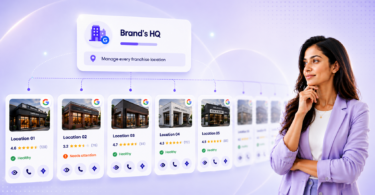
Marketing automation was supposed to make life easier for multi-location brands. But in reality, most teams still juggle disconnected systems and inconsistent customer journeys. A customer might click an ad in one location, receive an email from another, and talk to a team that knows nothing about their history.
Nothing feels connected, and traditional automation can’t fix it because it was built for single-location workflows, not the complexity of dozens or hundreds of branches.
Summary: Effective marketing automation for multi-location brands goes beyond emails and workflows. It requires unified customer data, location-aware personalization, and automation that responds to real-time signals such as reviews, search behavior, and intent.

In this blog, we explain why traditional tools fall short and how Birdeye’s agentic platform enables more adaptive, location-aware marketing across multi-location businesses.
Table of contents
- What does marketing automation look like today for multi-location brands?
- What’s broken in traditional marketing automation platforms
- Why agentic marketing is the new standard for automated marketing
- How Birdeye’s agentic platform transforms marketing automation
- FAQ about marketing automation for multi-location businesses
- Birdeye is the agentic platform built for marketing automation at scale
What does marketing automation look like today for multi-location brands?
Marketing automation has shifted from a simple way to send emails or schedule posts to a system that coordinates customer communication, marketing tasks, and engagement across every location. Traditional marketing automation platforms were built for single-location companies with centralized teams and predictable customer journeys.
Email marketing vs marketing automation: What really happens behind the scenes
That model breaks down quickly when brands operate dozens or hundreds of locations, each with its own demand patterns, teams, and customer expectations.
Why doesn’t traditional marketing automation work anymore?
Traditional marketing automation doesn’t work anymore because it relies on static workflows that can’t keep up with location-level complexity. Older platforms depend on:
- Static sequences
- Manual segmentation
- One-size-fits-all campaigns
- Workflows that take weeks or months to rebuild
Multi-location businesses outgrow this model quickly. Their marketing teams need automation that adapts automatically to customer needs, location changes, and behavioral signals.
Multi-location brands increasingly rely on automation because customer interactions continue to grow exponentially. In fact, as per Birdeye’s State of Online Reviews 2025, total online review volume rose 13% year-over-year, and Google’s share of all reviews climbed to 81% in 2024, making real-time reputation signals impossible to manage manually at scale.
This surge in signals — from search, reviews, and customer actions — is exactly why automation must adapt dynamically rather than rely on static lists or prebuilt workflows.
This is where legacy automation breaks and the need for a new model begins.
What marketing automation really means today
For multi-location brands, marketing automation means using real-time customer data to trigger personalized campaigns across email marketing, SMS, social, chat, and search, with each message tuned to the customer’s location and journey.
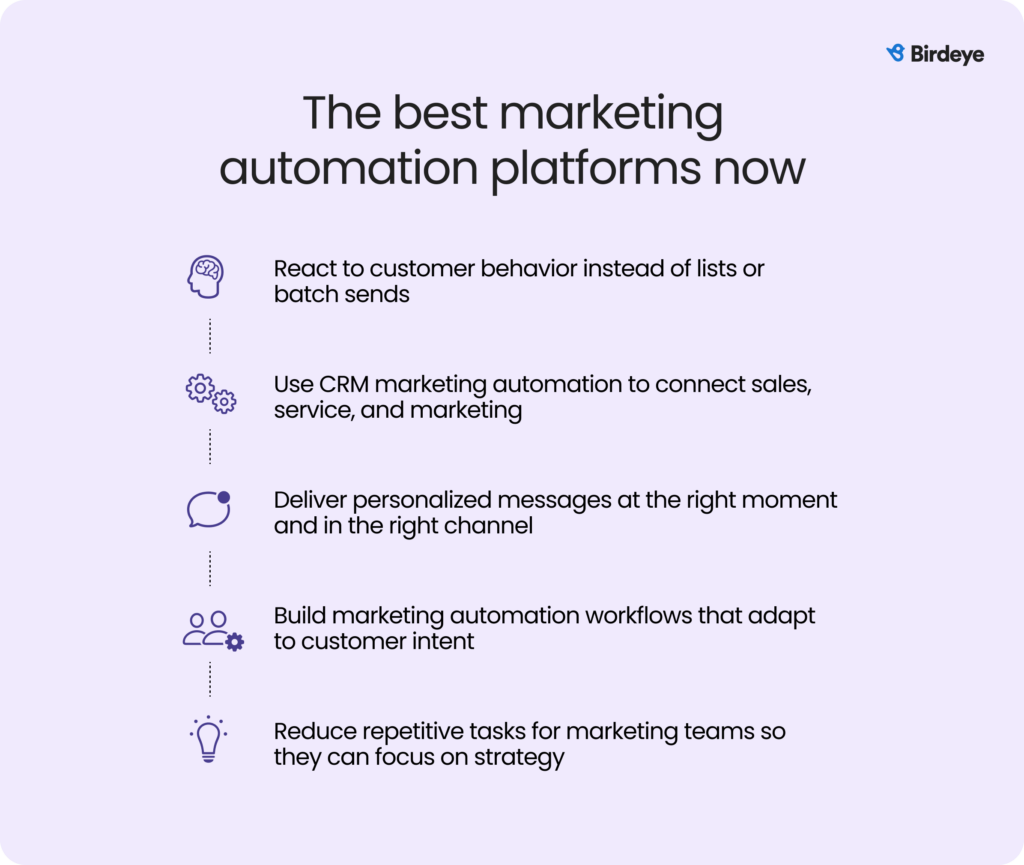
Example: A customer clicks a local Google Business Profile listing, browses inventory at one location, then visits another location. Modern automation recognizes this activity and sends a personalized follow-up with relevant products or services tied to that customer’s journey.
This is the level of precision multi-location brands expect, and customers notice.
Why multi-location brands need more advanced automation than everyone else
The challenges of multi-location businesses are fundamentally different from those of single-location businesses. What works for one store or office doesn’t translate well across dozens or hundreds of locations.
Multi-location brands deal with complexity on multiple fronts:
- Customer data is scattered across many systems and locations
- Teams need consistent messaging without losing local nuance
- Marketing campaigns must reflect each location’s context and demand
- Repetitive marketing tasks multiply as new locations are added
Fragmented customer data creates major performance gaps. When reviews, listings, CRM data, and engagement signals live in separate systems, marketing workflows can’t trigger correctly, and personalization breaks down.
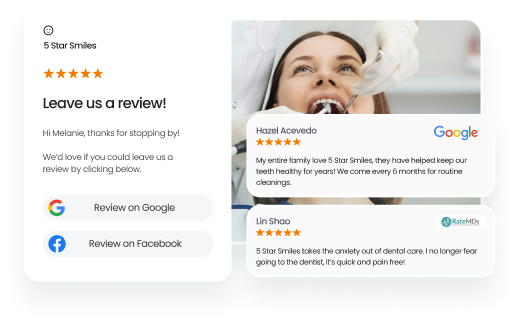
According to Birdeye’s Google Business Profile 2025 Report, verified and complete GBPs drive 4× more website visits, 12% more calls, and 10% more direction requests than unverified listings.
When each location manages listings separately — as many multi-location brands still do — automation can’t reliably trigger the right follow-ups, offers, or nurture sequences because basic customer-intent signals aren’t unified.
Here’s how one multi-location brand experienced these challenges firsthand.
How a multi-location retailer turned feedback into growth with Birdeye
Hudson’s Furniture, a 14-showroom brand, struggled with scattered customer feedback and limited insight into performance across locations. Their previous platform offered basic reputation tools but couldn’t surface meaningful trends or automate review and survey collection. Teams were left guessing where issues originated or how to improve.
For a broader look at marketing tactics for this industry, see our guide to furniture store marketing.
Birdeye solved this by unifying reviews, surveys, and insights into one AI-powered system. With Reviews, Surveys AI, and Insights AI, Hudson’s automated review and NPS requests engaged customers at high-leverage moments and identified location-level performance trends.
The results were substantial:
- 7,200+ new reviews, a jump from 4.5 to 4.7 stars
- 4.6K+ survey responses
- NPS score of 79
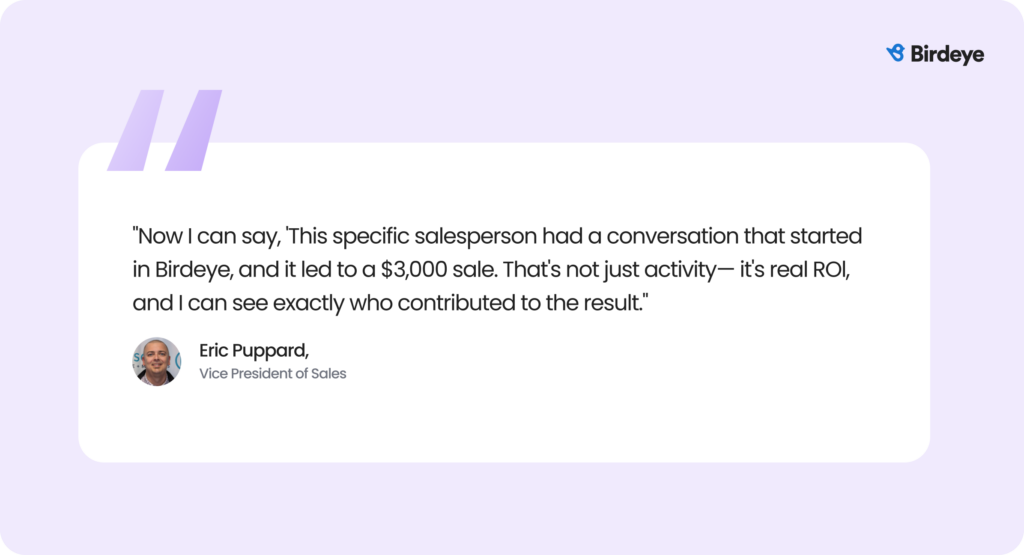
Managers now use AI insights to coach teams, prevent sentiment dips, and link Birdeye interactions to measurable revenue.
Hudson’s shows the core issue: unless feedback and customer signals are unified, automation stays reactive. That’s why multi-location brands need agentic systems that can adapt automatically. That shift is exactly what sets the stage for agentic marketing.
See how Birdeye's AI marketing automation software puts this into practice for distributed brands.
What’s broken in traditional marketing automation platforms
Traditional marketing automation tools were built for brands that had one location, one CRM, one marketing team, and one customer journey.
CRM vs marketing automation is the wrong question. Growth depends on using both. Read this to know more.
Multi-location businesses don’t operate that way. They manage thousands of customer interactions across many markets, each with different expectations and different local conditions. This is where legacy marketing automation platforms fall apart.
Most competitors still focus on workflow builders, email scheduling, segment filters, and CRM marketing automation rules. But none of these systems understand the complexity of running automated marketing across dozens or hundreds of locations.
Across every industry we analyzed, three failure patterns show up repeatedly:
1. Data fragmentation makes automation unreliable
Multi-location brands often have customer data spread across:
- Different CRMs for different locations
- POS and booking tools at each branch
- Review platforms like Google and Yelp
- Social media channels
- Manual spreadsheets or region-level databases
Traditional marketing automation platforms don’t effectively unify this data. They rely on static imports or disconnected APIs. When data isn’t connected, marketing automation workflows can’t trigger correctly, personalization breaks, and teams end up guessing.
Indiana Members Credit Union (IMCU), a 30+ branch network, faced classic data fragmentation: listings, reviews, and member touchpoints lived in different systems. Birdeye centralized listings, reviews, and insights so IMCU could act from one source of truth.
Each location manually updated Google, Apple, and other listings, while reviews and feedback lived in separate systems. This fragmentation made it impossible to deliver reliable, personalized marketing or understand member sentiment across the network.
Birdeye unified this entire ecosystem.
Using Listings AI, IMCU now updates all branch details instantly from one dashboard.
Reviews streamlines review requests through Symitar, driving more positive reviews with QR codes and branch-level tracking.
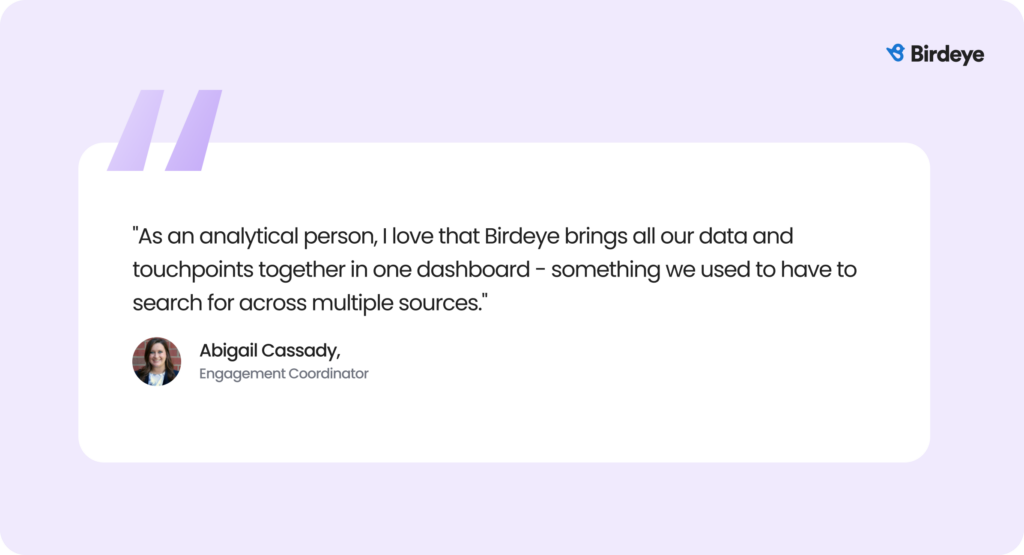
Insights AI transforms thousands of reviews and comments into actionable trends, helping IMCU identify location-level gaps and improve member satisfaction.
The result:
- 4.1 million profile impressions on their GBP
- Increase in average rating, from 3.9/5 to 4.4/5
- 806 new Google reviews, 2,000 new overall
2. Marketing workflows collapse under multi-location complexity
For a single-location business, a marketing automation workflow can work for months without changes. For multi-location brands, workflows break almost immediately because:
- Each location has different hours, promotions, and demand
- Customer behavior varies by region
- Review sentiment differs across markets
- Local competitors shift constantly
Traditional workflow-based marketing automation isn’t built to adapt. Marketers end up cloning workflows for every region, updating rules manually, and managing dozens of versions of the same campaign. It’s operationally impossible to maintain.
This creates inconsistent customer journeys and inconsistent results across locations.
3. Automation that sends, but doesn’t decide
This is the biggest flaw.
Legacy marketing automation platforms automate tasks, but they don’t think.
They can’t:
- Read customer sentiment
- Recognize competitive changes
- Understand location-level patterns
- Adjust message timing or content automatically
- Update segments based on behavior
- Recommend the next best action
So teams spend more time managing automation than benefiting from it.
Traditional marketing automation does the sending. Multi-location brands need automation that makes decisions.
The consequences of disconnected systems show up across social, search, and customer engagement. Birdeye’s State of Social 2026 report highlights that while 73% of consumers actively use YouTube and 44% use TikTok, most brands still over-prioritize Facebook and Instagram — a mismatch that weakens automated marketing performance and reduces ROI.
Without agentic automation that adapts content and channel strategy to real customer behavior, multi-location brands continue to overspend on channels with declining attention while underinvesting in the ones their audiences prefer.
Why agentic marketing is the new standard for automated marketing
Most legacy automation platforms were built on static workflows that don’t evolve unless marketers update them manually. If the customer does X, send Y. If the customer doesn’t respond, send Z. For a long time, that worked. But multi-location businesses now operate in environments where customer behavior changes fast, local dynamics shift constantly, and data lives across dozens of systems. Rule-based automation simply can’t keep up.
Agentic marketing introduces something fundamentally different: automation that makes decisions.
Instead of waiting for marketers to update workflows or create new segments, agentic systems interpret customer signals, spot patterns, and take the right action automatically. It’s automation that behaves more like a teammate than a tool — one that works across every location without losing context.
This is the shift transforming marketing.
Traditional marketing automation relies on marketers to build and maintain every step. Agentic AI removes that burden.
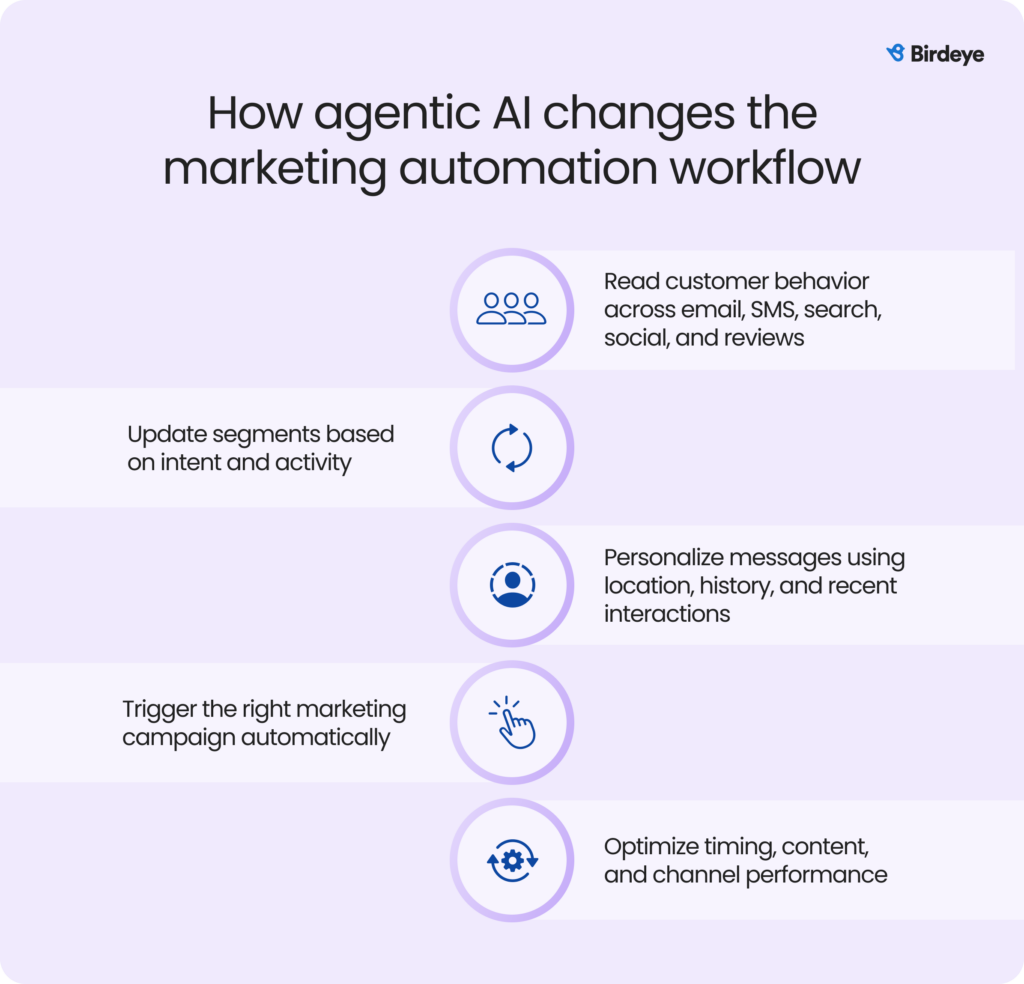
This turns marketing automation from a maintenance-heavy system into an adaptive growth engine.
If engagement drops for a segment at three locations, an agent notices the decline, drafts a winback sequence, tests it in those locations, and expands it if it performs well. No human intervention required.
What agentic automation unlocks for multi-location businesses
Agentic automation solves the problems that rule-based systems were never designed for.
Multi-location brands gain:
- Consistent messaging across all locations
- Localized personalization based on reviews, demand, and competition
- Automated marketing workflows that adjust to real-time changes
- Faster execution with far fewer repetitive tasks
- A unified view of the customer journey across all channels
This is especially valuable for industries where each location competes.
How agentic automation improved resident satisfaction and operational efficiency
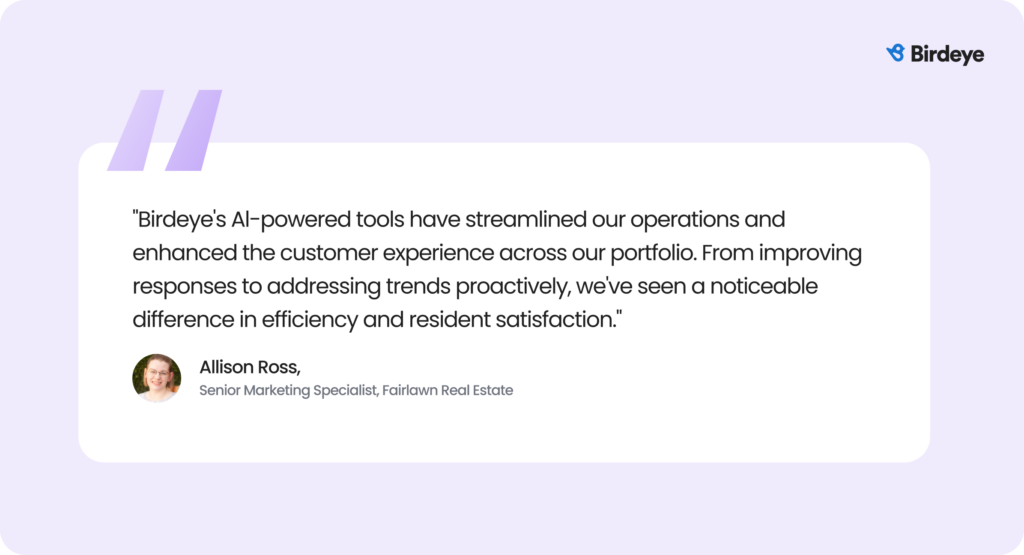
Fairlawn Real Estate managed 20 properties but struggled with slow review responses, fragmented feedback, and no clear way to spot recurring issues across locations. Birdeye changed that. With Reviews, Insights AI, and Competitors AI, Fairlawn automated review responses, surfaced property-level trends, and resolved issues faster through automated ticketing workflows.
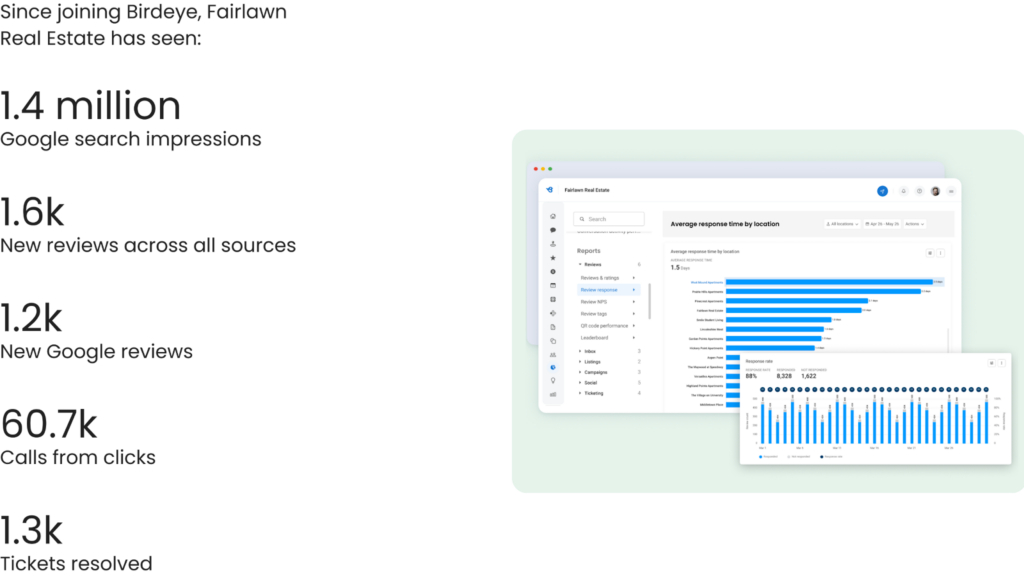
Birdeye’s Insights AI identified patterns such as recurring maintenance concerns and top-performing leasing tours, enabling faster coaching and operational fixes. Residents now receive quicker, more personalized communication, and Fairlawn maintains a stronger, more consistent reputation across its entire portfolio.
How agentic automation closes the multi-location gap
Multi-location brands need automation that understands more than just customer behavior. They need automation that understands each location’s reality.
Agentic systems can:
- Detect location-specific sentiment spikes
- Spot competitive changes in a ZIP code
- Adjust marketing campaigns by region
- Highlight operational gaps at specific locations
- Scale personalized communication without adding headcount
This is the missing layer that traditional marketing automation platforms do not offer — and what sets modern agentic systems apart.
Now that the shift toward agentic marketing is clear, the next step is understanding how Birdeye brings this model to life for multi-location brands.
How Birdeye’s agentic platform transforms marketing automation
Most marketing automation platforms help teams send campaigns. Birdeye helps teams run marketing. There’s a difference. As the #1 agentic marketing platform for multi-location businesses and trusted by the biggest brands globally, Birdeye replaces fragmented tools with a unified system powered by AI agents that think, decide, and execute.
Instead of relying on manual workflows, Birdeye agents understand customer behavior, update segments, personalize communication, and trigger the right marketing action across every location. This turns marketing automation into a scalable process — not a maintenance burden.
Birdeye becomes the infrastructure that connects CRM data, customer conversations, reviews, listings, social engagement, and competitive signals, then activates them inside automated marketing workflows across every digital channel.
Birdeye’s agentic system enables these capabilities. Each AI agent owns a piece of the marketing engine — from discovery to feedback to optimization, so your automation adapts without constant manual work.
Reviews — Turning feedback into automated marketing triggers
Reviews fuels one of the most underrated marketing automation workflows in multi-location environments: experience-driven campaigns.
It automatically:
- Sends review request messages after purchases or appointments
- Identifies negative feedback and triggers service recovery workflows
- Turns positive sentiment into loyalty or referral campaigns
- Surfaces review trends that influence messaging
Because Birdeye pulls reviews from 200+ review sites, each location gains a real-time view of customer sentiment that directly powers automated marketing.
This creates a complete lifecycle loop: experience → feedback → automated action.
Check out the 5 marketing automation trends in 2026!
Search AI and Listing AI — ensuring every location is discoverable and accurate
Marketing automation only works when customers can find and trust your business. Search AI and Listing AI give multi-location brands the visibility and accuracy required to power top-of-funnel demand.
Search AI identifies:
- What customers search for
- What questions do they ask AI assistants
- What topics convert best
- Regional search trends
- Location-level intent signals
Listing AI maintains accurate location data across 50+ major directories.
It updates hours, services, and details automatically — preventing inconsistent or outdated information that hurts conversions.
Together, Search AI and Listing AI strengthen automated marketing at the awareness stage.
Social AI — Ensuring omnichannel consistency across locations
Marketing automation often focuses on email and SMS, but social channels drive massive engagement for multi-location brands.
- Suggests content based on trends and audience interest
- Repurposes high-performing email campaigns into social posts
- Manages comments and replies across locations
- Tracks sentiment and competitive signals
- Ensures each location’s social presence stays active and consistent
This brings true omnichannel automation to the marketing ecosystem.
Competitors AI — Adjusting marketing based on local competition
Multi-location brands operate in hyperlocal markets. Competitors AI monitors local competitors for:
- Rating change
- Price shifts
- Promotions
- Customer sentiment trends
- New entrants
Instead of waiting for a quarterly report, Birdeye spots changes in real time and helps agents adjust marketing automation workflows accordingly.
This gives brands a competitive advantage without requiring constant manual monitoring.
Insights AI + Reporting Agents — Turning data into automated action
Insights AI reads every message, review, chat, survey, and social comment across all locations. It identifies:
- Sentiment shifts
- Operational gaps
- Customer friction points
- Trending topics
- Location-level performance differences
Reporting Agents convert these findings into dashboards, alerts, and automated marketing recommendations.
In many cases, agents can take action automatically — such as adjusting messaging, updating audiences, or triggering new automated workflows.
This closes the loop between understanding customer behavior and acting on it.
Messaging AI — The core engine behind automated customer communication
Messaging AI brings together email, SMS marketing, chat, social messages, and web interactions into one intelligent system. For multi-location brands, this eliminates the chaos of managing conversations across platforms and teams.
Messaging AI can:
- Draft personalized messages using real-time customer context
- Automate follow-ups across channels without human intervention
- Identify buyer intent based on language and behavior
- Route leads or conversations automatically to the right location
- Trigger marketing automation workflows based on actions, sentiment, or outcomes
Template Design Agent — On-brand content at scale for every location
Most multi-location organizations struggle with content bottlenecks. Marketing teams spend hours handling location-level requests, and every new campaign requires fresh creative.
Template Design Agent eliminates this friction.
It can:
- Create marketing templates, newsletters, and campaign flows instantly
- Maintain brand standards while allowing local customization
- Generate variations for A/B testing and regional preferences
- Adapt tone and messaging based on audience context
FAQ about marketing automation for multi-location businesses
Marketing automation is the process of using software to automate repetitive marketing tasks, personalize messages, and manage customer journeys at scale. Birdeye enhances this by using agentic AI to make decisions, not just send campaigns.
It brings consistency across locations, unifies customer data, and automates follow-up, reviews, messaging, and campaigns. Birdeye’s agents ensure each location delivers personalized experiences without manual effort.
Rule-based automation follows pre-built workflows. Agentic automation interprets customer behavior, adapts to local context, and executes the next best marketing action automatically. Birdeye is built on this agentic model.
They need tools that unify customer data, automate communication, personalize at the location level, and adjust campaigns automatically. Birdeye’s Messaging AI, Segmentation Agent, Reviews, and Social AI cover all of these needs in one platform.
Birdeye integrates with 3,000+ CRMs and systems, so it can enhance your existing stack or streamline it. It centralizes customer data and powers automated marketing across every channel and every location.
Birdeye is the agentic platform built for marketing automation at scale
Marketing automation only works when it understands context, adapts to each location, and executes without constant oversight. That’s exactly what Birdeye delivers.
As the #1 agentic marketing platform for multi-location businesses, Birdeye’s AI agents unify customer data, automate communication, personalize every touchpoint, and drive growth across all locations.
With 3,000+ integrations and automation across reviews, messaging, social, and insights, Birdeye turns marketing into a system that runs itself and keeps getting smarter.

About the Author

Shruti Dugar
Birdeye
Originally published