Multi-location brands do not unlock the next phase of growth by running more campaigns. They unlock it by scaling trust—earned one location, one interaction, and one signal at a time across AI search and the local customer experience.
Summary
AI answer engines evaluate brands at the location level, not as a single national entity. When location data, customer signals, or execution are inconsistent, some branches are recommended while others quietly disappear, handing share to competitors.
The personalization paradox—delivering local relevance at scale without creating inconsistency—isn’t solved by more content, tools, or campaigns. It’s solved by scaling trust first. For multi-location leaders, the real shift is moving from “more campaigns” to more trust, built through consistent location truth, clear governance, and a retention-first mindset.
For senior marketing and growth leaders, this is no longer a channel decision. It’s an operating model choice that directly shapes visibility, efficiency, and long-term growth.
Table of contents
- Summary
- AI search & location truth: Why the old growth playbook is fading
- How AI answers create uneven visibility
- Why location truth is a profit lever
- When scale and AI spread inconsistency
- Core concepts: GEO and the personalization paradox
- Operating-model gaps: Why locations drift apart
- Framework: Scaling trust at the location level
- Priority actions: From fragmentation to governed GEO
- The bottom line: Trust is the new multi-location advantage
- GEO FAQs for multi-location leaders
- How Birdeye turns trust into a scalable operating model
AI search & location truth: Why the old growth playbook is fading
For years, multi-location growth was driven by expansion, brand consistency, and centralized marketing scale. If a campaign worked nationally, the assumption was that it would work locally too. That model held when discovery and conversion were largely controlled by humans clicking through search results and ads.
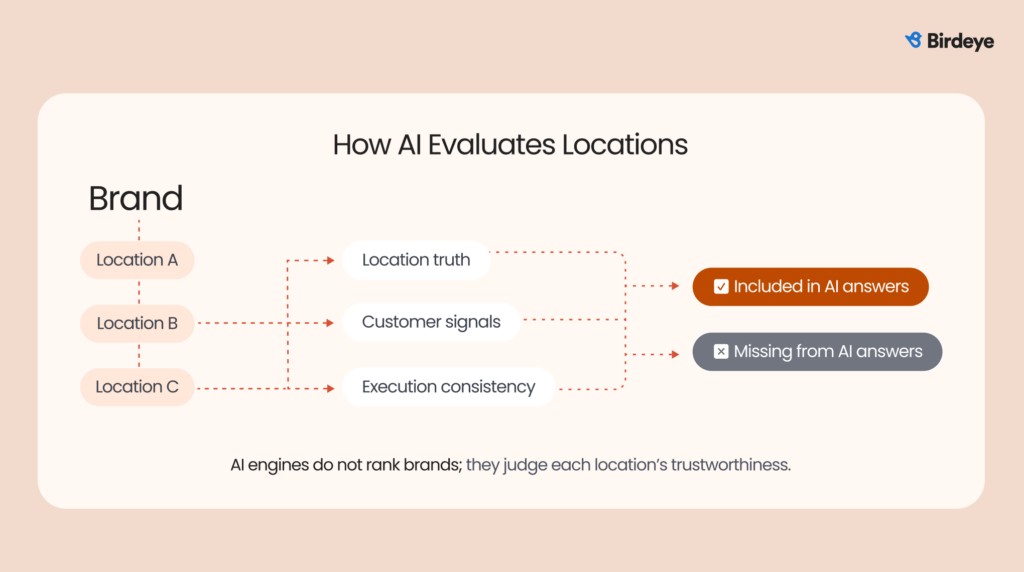
That assumption no longer holds. AI-powered answer engines now sit between brands and customers, deciding which locations are shown, recommended, or ignored—often before a user ever visits a website. These systems don’t evaluate brands as a single entity. They evaluate each location based on its data accuracy, customer signals, responsiveness, and real-world execution.
How AI answers create uneven visibility
AI-generated answers have become a primary discovery surface for local decisions, especially in categories where people ask full questions instead of searching by brand name.
AI engines don’t “average” trust across an entire brand. They evaluate confidence one location at a time. When hours, services, or categories conflict across directories and pages, systems often exclude that branch altogether, creating uneven visibility across locations without warning.
Why location truth is a profit lever
When AI visibility breaks at the location level, the impact isn’t cosmetic; it’s financial. Inaccurate listings, wrong hours, outdated services, or mismatched categories directly lead to:
- Lost visits and missed conversions
- Higher acquisition spend to offset declining organic visibility
- Erosion of trust when the experience doesn’t match the promise
Retention amplifies these effects. Even small gains in repeat business can drive outsized profitability, while inconsistency across locations makes repeat behavior harder to sustain.
In practice, location truth becomes a profit lever, not just a marketing hygiene task.
When scale and AI spread inconsistency
High-performing multi-location brands are already shifting toward local-first strategies, supported by more transparent governance and accountability. At the same time, many are adopting generative AI to scale content, responses, and engagement across locations.
This creates a paradox. AI makes it easier to do more, but when the underlying data layer is inconsistent, AI simply spreads errors faster. Volume without trust increases risk. Trust without volume scales safely.
Core concepts: GEO and the personalization paradox
When AI can amplify both clarity and confusion, the question becomes how brands guide it responsibly. This is where Generative Engine Optimization (GEO) comes into play.
Generative Engine Optimization for leaders
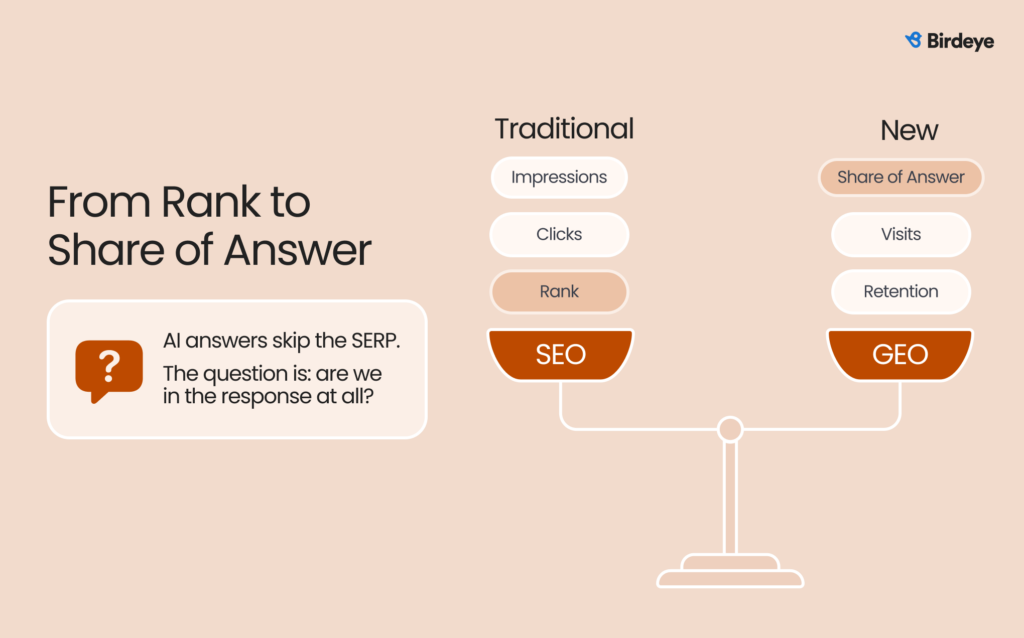
Generative Engine Optimization is the discipline of earning inclusion in AI-generated answers by providing trusted, consistent, and machine-readable local facts, supported by corroborated customer signals.
With GEO, the strategic question changes. Instead of asking, “Where do we rank?” leaders must ask, “How often are we actually recommended when AI answers our customers?” Birdeye refers to this outcome as Share of Answer—the frequency with which a brand appears in AI-driven responses across priority customer journeys.
The personalization paradox in multi-location brands
Multi-location brands are expected to deliver localized experiences at scale, yet many still operate on fragmented systems with unclear ownership and accountability.
Without strong governance, personalization efforts often increase inconsistency instead of improving relevance, producing exactly the opposite outcome that both AI engines and customers reward.
Operating-model gaps: Why locations drift apart
The following challenges often look like marketing problems. In reality, they’re operating-model failures. When ownership is unclear, and data is fragmented, a brand’s “truth” starts to drift—and both AI systems and customers detect that drift quickly.
Challenge 1: Regional data gaps and silent share loss
Small, location-level changes—seasonal hours, new services, updated attributes—accumulate fast.
When those updates aren’t reflected consistently across directories, landing pages, and structured data, AI engines lose confidence. The result is uneven visibility:
- Some locations appear reliably in AI answers
- Others are skipped, despite offering the same services
Competitors with cleaner data win by default, and the brand absorbs silent market share loss without realizing it.
Challenge 2: SEO Habits without GEO mindset
Traditional SEO optimized pages, keywords, and links. AI engines still consider those signals, but they now weigh additional factors:
- Corroborated facts across platforms
- Reputation and review quality at the location level
- Recency and consistency of data across many surfaces, not just the website
GEO doesn’t replace SEO.Iit reshapes priorities. Brands that appear in AI answers tend to have answer-ready location data and strong, specific, and recent reviews.
Challenge 3: Personalization without governance
Most multi-location organizations rely on separate systems for listings, reviews, social, and CRM, often with different processes by region or franchise group.
When teams personalize at scale without clear governance:
- Some locations stay current and responsive
- Others fall behind and drift off-brand
AI engines and customers notice the difference immediately.
Challenge 4: Hybrid structures without explicit rules
Hybrid models—where headquarters and locations share responsibility—can work well when roles are clearly defined.
But when ownership of updates, review responses, or directory accuracy is ambiguous, critical tasks fall through the cracks. Over time, accuracy declines, and confidence erodes.
Challenge 5: Undervalued retention versus campaign volume
Campaign output is easy to measure. Trust is harder to quantify, but far more valuable.
High-performing brands prioritize retention because it reflects whether the experience consistently matches the promise across locations. Inconsistent information and slow responses reduce the likelihood that customers will return, regardless of how many campaigns are launched.
Framework: Scaling trust at the location level
When locations drift apart, the issue isn’t effort. It’s the absence of a system that keeps trust intact as brands scale. Solving this requires shifting focus away from producing more marketing and toward building an operating model where trust is consistent, repeatable, and measurable across every location.
The goal isn’t to do more marketing. It’s to build a system that scales trust reliably across locations, supported by marketing, operations, IT, and franchise leadership.
The trust flywheel for multi-location brands
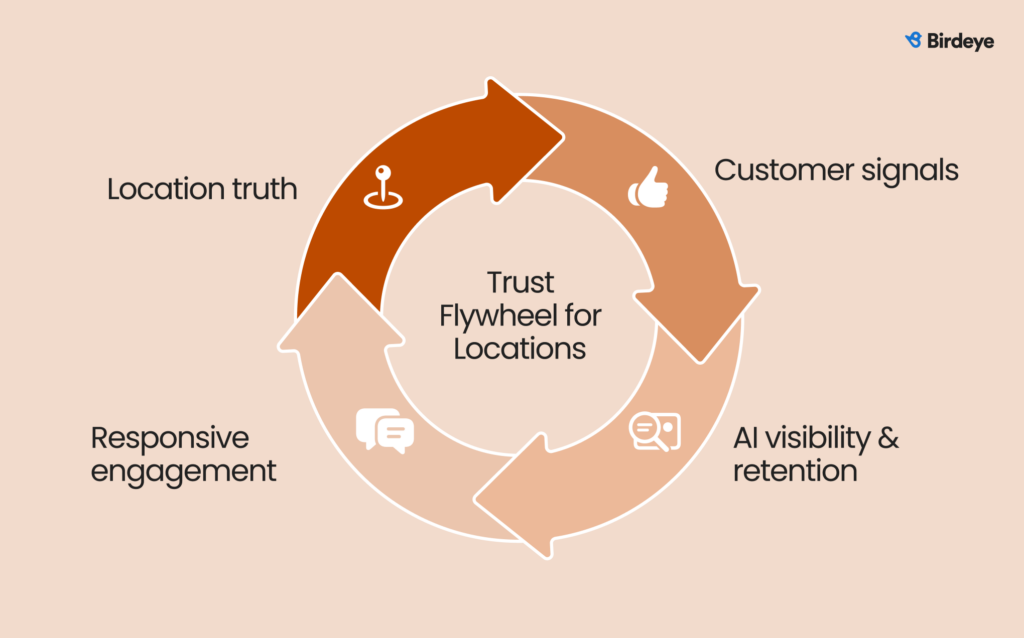
Think of trust inputs and outputs as a simple flywheel:
Trust inputs:
- Accurate location facts
- Consistent presence across directories and pages
- Strong customer signals (reviews, sentiment, response quality)
- Responsive engagement at the local level
Trust outputs:
- Inclusion in AI-generated answers and fewer visibility gaps
- Stronger retention and repeat behavior
- Higher efficiency from every campaign because the experience matches the promise
Priority actions: From fragmentation to governed GEO
Once trust is treated as a system, not a byproduct, the next step is execution. These priority actions help multi-location brands move from fragmented efforts to a governed, scalable GEO.
1. Treat location truth as a managed asset
- Define and centralize standards for hours, services, categories, and attributes.
- Ensure consistency across priority directories and platforms.
- Treat this as ongoing maintenance, not a one-time cleanup. Outdated information compounds quickly, and AI engines lose confidence when signals conflict.
2. Design for GEO, not just SEO
GEO rewards brands that are easy for AI to understand and trust. Designing for it means treating structure and customer proof as core inputs, not afterthoughts.
- Make local knowledge machine-readable and consistent using schema, structured data, and complete profiles
- Encourage authentic reviews that reference specific services, outcomes, and locations
- Recognize that reviews serve a dual purpose: they signal reputation and provide fresh, trusted inputs for AI engines deciding which local brands to recommend
3. Make hybrid governance explicit
Hybrid models work best when they reduce ambiguity.
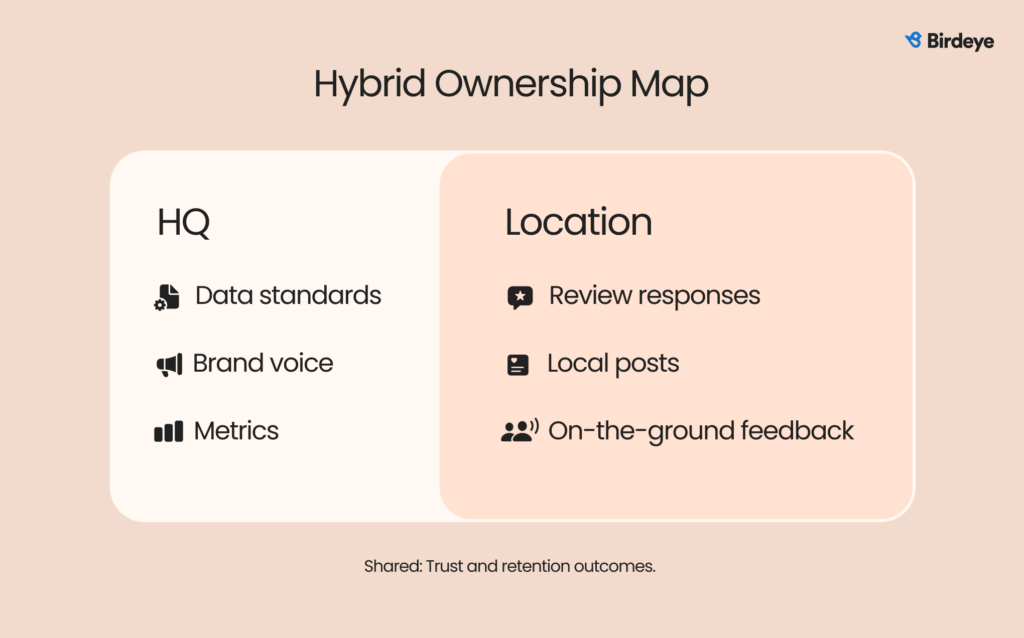
HQ owns:
- Data standards and location truth
- Brand rules and templates
- Measurement and scorecards
Locations own:
- Responsiveness and timeliness
- Community relevance and local execution within guardrails
Simple, visible scorecards, such as listings consistency and response rates, align incentives without adding friction.
4. Reduce data fragmentation at the core
Data fragmentation is the root cause of many GEO failures. Addressing it starts with simplifying and unifying the core systems that power location truth.
- Audit the tech stack across listings, reviews, social, and CRM
- Prioritize integration and consolidation where possible
- Use unified systems as the backbone to maintain a single source of truth and scale personalization safely
5. Rebalance metrics around trust and retention
Shift from campaign-only metrics to location-level trust indicators:
- Listings accuracy and consistency by location
- Review volume, recency, and topics by location
- Response quality and speed for public and private feedback
- Repeat customer behavior where available
These metrics reveal where experience and promise diverge, and where to act first.
6. Build the internal business case with pilots
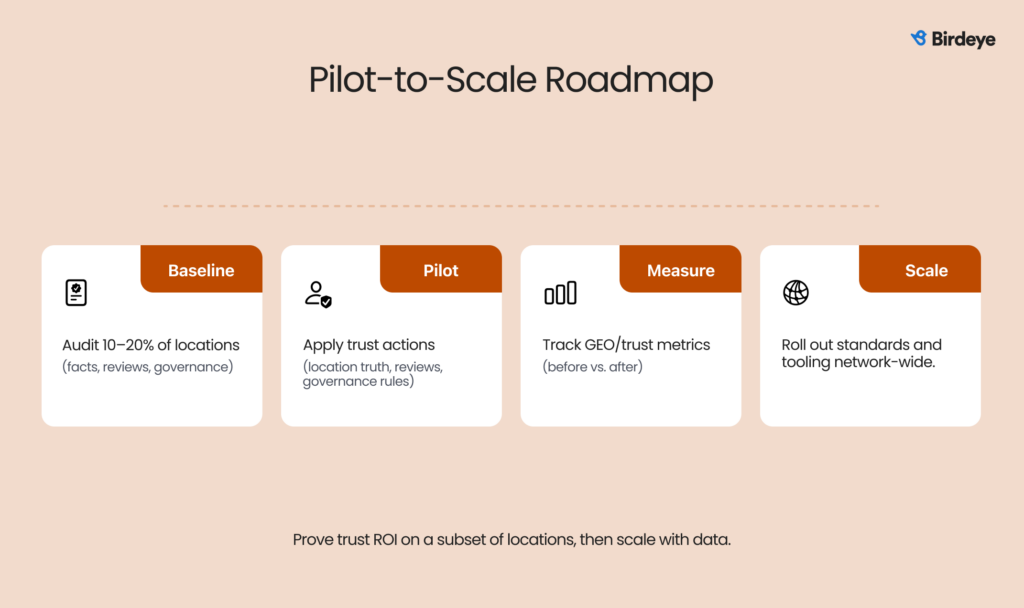
Sustainable change requires proof, not theory. Pilots turn GEO and governance improvements into measurable business outcomes that leaders can act on.
- Quantify lost visibility, wasted acquisition spend, and retention impact tied to inconsistent location truth
- Pilot governance and GEO improvements across 10–20% of locations
- Measure before-and-after performance to unlock budget reallocation rather than relying on net-new spend
Assign clear ownership for data integrity and AI visibility to sustain results over time.
The bottom line: Trust is the new multi-location advantage
AI-driven discovery evaluates brands one location at a time. For multi-location organizations, the biggest risk isn’t lack of scale—it’s uneven location truth, which creates invisible gaps that quietly hand-share with competitors.
The new growth model addresses the personalization paradox by scaling trust locally. It does this through consistent facts, strong customer signals, and clear hybrid governance, with retention serving as the true scoreboard.
A practical next step is to audit 10–20% of locations for accuracy, review health, and governance clarity. Prove the impact on visibility and retention, then scale the trust framework with confidence.
GEO FAQs for multi-location leaders
GEO is the practice of incorporating AI-generated answers using trusted, consistent local facts and customer signals. Compared to SEO, which focuses heavily on page rankings, GEO depends on whether AI engines can confidently reuse your location truth across many surfaces. In Birdeye’s framing, success shows up in Share of Answer—how often your brand is mentioned or recommended when AI answers customers.
This often comes down to regional data gaps. Different locations within the same brand may have conflicting hours, categories, services, or attributes across directories and pages. AI engines want a single, clear set of facts; when they encounter inconsistencies, they lose confidence and may exclude that location from their answers.
A hybrid model usually works best. HQ owns standards, brand rules, and measurement, so every location has the same baseline for accuracy and trust, while locations own responsiveness and local relevance within clear guardrails. Many multi-location brands already operate this way structurally; what is often missing is explicit rules and transparent performance.
Start by reducing data fragmentation. When key systems are disconnected, personalization efforts tend to create more inconsistency instead of better experiences. With a unified truth layer, teams can safely use generative tools to scale content, responses, and local engagement.
How Birdeye turns trust into a scalable operating model
Building a trust-first, GEO-aligned growth model is more of an operational challenge than a content exercise. The real difficulty is coordinating data, teams, and signals across hundreds or thousands of locations without adding more fragmentation.
This is where Birdeye fits. Birdeye helps multi-location brands operationalize trust by unifying the systems that AI engines and customers evaluate at the location level. Instead of managing listings, reviews, responses, and customer signals in silos, teams work from a shared source of location truth—governed centrally and executed locally.
In practice, Birdeye enables this through a set of connected capabilities:
- Listings AI maintains accurate, consistent location facts—hours, services, categories, and attributes—across priority directories and platforms, reducing the data drift that undermines AI confidence.
- Search AI helps brands understand how they appear in AI-generated answers, identify visibility gaps by location, and track Share of Answer across priority customer journeys.
- Reviews AI turns customer feedback into structured trust signals, supporting faster responses, better sentiment management, and stronger inputs for AI engines deciding which locations to recommend.
- Insights AI surfaces location-level patterns across reviews, engagement, and performance data, helping leaders spot inconsistency early and prioritize actions that improve retention and trust.
Rather than treating trust as a byproduct of marketing, Birdeye helps brands manage it as infrastructure—measurable, governed, and scalable across locations.

About the Author

Ruchika Batra
Originally published