Doctor reputation management is the practice of monitoring, improving, and protecting a physician’s online reputation across patient reviews, search results, healthcare directories, social media platforms, and other digital touchpoints that influence patient trust and decision-making.
Summary
A doctor’s reputation in 2026 is shaped across search engines, review platforms, and AI-generated summaries that patients check before choosing a provider. These touchpoints form a physician’s digital identity and shape initial trust. They also influence how patients compare options and decide whom to consult. Maintaining consistency and accuracy across these channels is essential for building credibility and supporting patient acquisition.
In this guide, we will explore online reputation management for doctors and how they can manage reviews, strengthen credibility, and maintain a consistent digital presence in a landscape where AI plays a central role in patient decision-making.
Table of contents
What is doctor reputation management
Doctor reputation management is the strategic process of monitoring, shaping, and improving how a healthcare provider is perceived by patients online. It includes managing Google reviews, Healthgrades listings, social media presence, search results, and AI recommendation engines that influence how patients discover and evaluate healthcare providers before booking an appointment.
A strong healthcare reputation operates on two levels: physician reputation and practice reputation.
- A physician’s reputation reflects how patients perceive a particular doctor, based on expertise, communication, bedside manner, and reviews.
- Practice reputation reflects the broader care experience, including staff interactions, appointment flow, wait times, and consistency across locations.
Patients consider both when selecting a provider, making reputation management essential at both the individual and practice levels.
Why doctor reputation management matters in 2026
In 2026, online reviews, AI search summaries, and patient feedback have moved beyond being “nice-to-haves” and now function as critical trust signals that shape a clinic’s visibility and appointment volume.
This shift is already visible in patient behavior. 26% of patients say AI tools such as AI-generated review summaries and conversational assistants like ChatGPT have directly influenced their choice of healthcare provider, showing how trust is increasingly formed through both traditional reviews and AI-driven interpretation of reputation.
Here is exactly why active doctor reputation management is essential:
Patients trust online reviews
Word of mouth has moved entirely online, making digital reputation a major filter in patient acquisition decisions. According to Birdeye’s State of Online Reviews 2026 report, healthcare review volume grew 36.3% year over year, showing how strongly patient feedback now shapes healthcare discovery.
AI and local search decide visibility
Search behavior has shifted. AI-driven search engines (like Google’s AI overviews, ChatGPT, Gemini, etc) now synthesize web reviews to answer patient queries like “Who is the best cardiologist near me for hypertension?” Birdeye’s State of AI Search 2026 report notes that only 15% of brands secure citation-backed visibility in these AI answers. If a doctor has limited or inconsistent review signals, AI answer engines are less likely to surface or cite them in local recommendations.
Reputation directly impacts revenue and patient experience
Online ratings increasingly reflect both patient satisfaction and doctors’ and practice performance. A study of millions of surgical cases found that higher patient star ratings are associated with lower 30-day complication and readmission rates. This suggests that patient reviews can influence how prospective patients evaluate a healthcare provider’s quality and reliability.
Active review management builds long-term credibility
Patient care does not end at the clinic door. Consistent review monitoring and timely, HIPAA-compliant responses are vital to maintaining patient trust. Leaving negative or inaccurate feedback unmanaged allows a single poor experience to define a doctor’s digital footprint. Active engagement closes this perception gap and demonstrates a commitment to patient satisfaction.
Profile accuracy influences patient confidence
In healthcare, credibility depends heavily on accurate and complete online information. Birdeye’s State of Google Business Profile 2026 report found that 84%–89% of healthcare Google Business Profiles are verified, reflecting the high level of trust, compliance, and profile accuracy patients now expect from providers. Incomplete or outdated listings can reduce both patient confidence and local search visibility.
As healthcare discovery becomes entirely digital and AI-driven, proactive reputation management is no longer a marketing tactic; it is a core operational requirement to protect a doctor’s credibility, visibility, and patient pipeline.
What are the unique challenges doctors face with online reputation
Doctors face unique reputation management challenges because healthcare reviews involve sensitive patient experiences, strict privacy regulations, and high emotional stakes.

✓ HIPAA compliance limits how doctors can respond to reviews, as physicians cannot confirm a patient relationship or disclose protected health information.
✓ Public responses carry legal and ethical risks because doctors cannot confirm a patient's identity, diagnoses, or treatment details.
✓ Fake or retaliatory reviews from non-patients are common in healthcare and are difficult to verify or remove.
✓ Medical board and professional standards require physicians to maintain strict professionalism in all public communication and review responses.
✓ Volume at scale is a major challenge, especially for busy physicians and multi-location practices handling reviews across multiple platforms.
✓ Review platforms such as RateMDs and some Healthgrades listings, which limit a doctor’s ability to take down inaccurate reviews.
✓ Inconsistent moderation policies across review platforms create uneven control, where some reviews are removed quickly while others remain unresolved.
What are the top 10 doctor reputation management strategies?
Managing a doctor’s online reputation effectively requires a structured, continuous system across every patient touchpoint.
The 10 steps below outline how healthcare practitioners can build trust, improve visibility, and strengthen patient experience signals online.
Automate review collection after every appointment
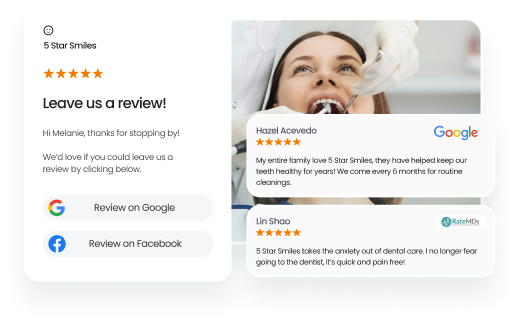
Implement automated SMS and email workflows to collect patient reviews immediately after visits. Timely review requests improve review volume, recency, and overall online visibility while helping doctors capture authentic patient experiences consistently.
Birdeye’s Reviews automates HIPAA-safe review requests via SMS and email, helping doctors consistently generate feedback after every appointment.
Claim and optimize every platform profile
Claim and fully optimize profiles across Google Business Profile, Healthgrades, RateMDs,Vitals, and other healthcare directories. Patients often compare providers across multiple platforms before booking appointments, making profile completeness critical for trust and credibility.
Birdeye’s Listings AI helps healthcare providers manage and synchronize practice information across major directories and search platforms.
Respond to every review using a HIPAA-safe framework
Respond consistently to positive, neutral, and negative reviews using structured, compliant response templates for every patient review without referencing medical details. This strengthens trust, maintains professionalism, and ensures HIPAA compliance across platforms.
✅ Example: “Thank you for sharing your feedback. We strive to provide excellent care to all of our visitors, and we appreciate your support.”
Birdeye’s Review Response Agent helps healthcare teams generate HIPAA-safe responses for positive, neutral, negative, and low-star reviews across multiple platforms.
Ensure NAP consistency across healthcare directories
Maintain consistent Name, Address, and Phone (NAP) data across all directories to improve local SEO rankings. Inconsistent contact details, duplicate listings, or outdated office information can create patient frustration and weaken local SEO performance.
Listings Optimization Agent continuously monitors and optimizes business information across major platforms like Google, Apple, and Yelp by identifying missing details, improving profile completeness, and maintaining listing consistency to strengthen visibility in local search.
Build local content authority through educational content
Search engines and AI platforms evaluate reviews, listings, citations, and website content together to determine provider visibility and trustworthiness. Publish condition-based FAQs, “near me” pages, and location-specific health content to improve local search relevance. This increases authority and strengthens visibility in patient-driven search queries.
Birdeye’s Search AI helps healthcare practices strengthen these signals to improve visibility across Google Search and AI platforms like ChatGPT, Gemini, and Perplexity.
Manage social media for trust signals, not just marketing
Use social platforms for patient education, physician credibility, and community engagement rather than only promotions. Consistent educational and community-focused content builds familiarity and trust over time while helping practices maintain stronger patient relationships outside the clinic setting.
Birdeye’s Social AI centralizes engagement across social channels, including publishing, comments, and messaging.
Use patient satisfaction surveys to catch issues pre-review
Collect structured patient feedback through NPS surveys, post-visit surveys, and service-specific questionnaires before issues escalate into public complaints or negative reviews. Early feedback collection helps practices identify operational problems related to scheduling, communication, billing, wait times, or staff interactions.
Birdeye’s Surveys AI captures structured patient feedback and enables early issue detection through survey insights.
⚠️ Compliance note: Practices must remain strictly compliant with the FTC’s Consumer Review Fairness Rule enforcement actions and Google’s Maps Rating Manipulation policy, which prohibit review gating or any selective review solicitation. Using internal surveys to filter positive patients for public reviews or diverting negative feedback to private channels may trigger enforcement under Google’s 2026 systems, including review removal or profile warnings. Surveys should be used only for internal quality improvement, with all patients given an equal, ungated opportunity to leave public feedback.
Benchmark reputation performance against local competitors
Compare ratings, review volume, patient sentiment, and online visibility against nearby healthcare providers. Competitive benchmarking helps identify gaps in patient experience, communication, responsiveness, and online reputation performance.
Birdeye’s Competitors AI tracks competitor ratings, review trends, and sentiment insights to help healthcare practices measure local reputation performance.
Monitor your online presence in real time
Continuously monitor reviews, social mentions, patient sentiment, and search visibility across platforms to understand how patients perceive your practice as feedback appears. Real-time monitoring helps doctors identify emerging issues early, respond faster to negative experiences, and protect their reputation before problems escalate publicly.
Measure reputation performance with actionable metrics
Track long-term reputation KPIs such as review velocity, average rating trends, response times, sentiment distribution, patient engagement, and local search visibility. Measuring performance over time helps doctors evaluate whether their reputation management efforts are improving patient trust, operational efficiency, and online discoverability.
Birdeye’s Insights AI provides centralized reporting and trend analysis across reviews, listings, social, surveys, and messaging to help doctors measure reputation growth over time.
How much does doctor reputation management cost
Doctor reputation management pricing depends on practice size, number of locations, and the tools included. Most healthcare reputation management platforms typically range from $300 to $600+ per location per month, with pricing increasing with automation, integrations, and multi-location requirements.
Platforms like Birdeye use a custom pricing model based on the number of locations, selected products, review volume, and operational needs. The platform combines:
- Review generation and HIPAA-safe responses
- Listings and directory management
- Patient surveys and sentiment tracking
- Competitor benchmarking
- Reporting and performance analytics
For healthcare organizations, consolidating these capabilities into a single platform helps reduce operational overhead, eliminate multiple software subscriptions, and improve patient acquisition by strengthening online visibility and trust.
Doctor Reputation Management: HIPAA-Safe Guide (2026)
Want to see the impact of Birdeye on your business? Watch the Free Demo Now.
How Birdeye helps doctors manage their online reputation at scale
For doctors and healthcare organizations, maintaining a strong online reputation across multiple providers and locations can be challenging. Birdeye helps healthcare practices manage reviews, patient communication, listings, and online visibility from one platform. It also integrates with EHRs, EMRs, CRMs, and practice management systems to simplify patient feedback and communication workflows.
Birdeye combines centralized customer data, local insights, and automated marketing tools to help healthcare organizations improve patient experience and maintain a consistent digital presence. This approach forms the foundation of Birdeye’s three core pillars:
Full-cycle platform (Consolidate)
Birdeye brings reviews, listings, surveys, messaging, and patient interactions into a single platform. Instead of relying on disconnected tools, healthcare organizations can manage customer signals and communications from a single centralized system.
Local Intelligence (Think)
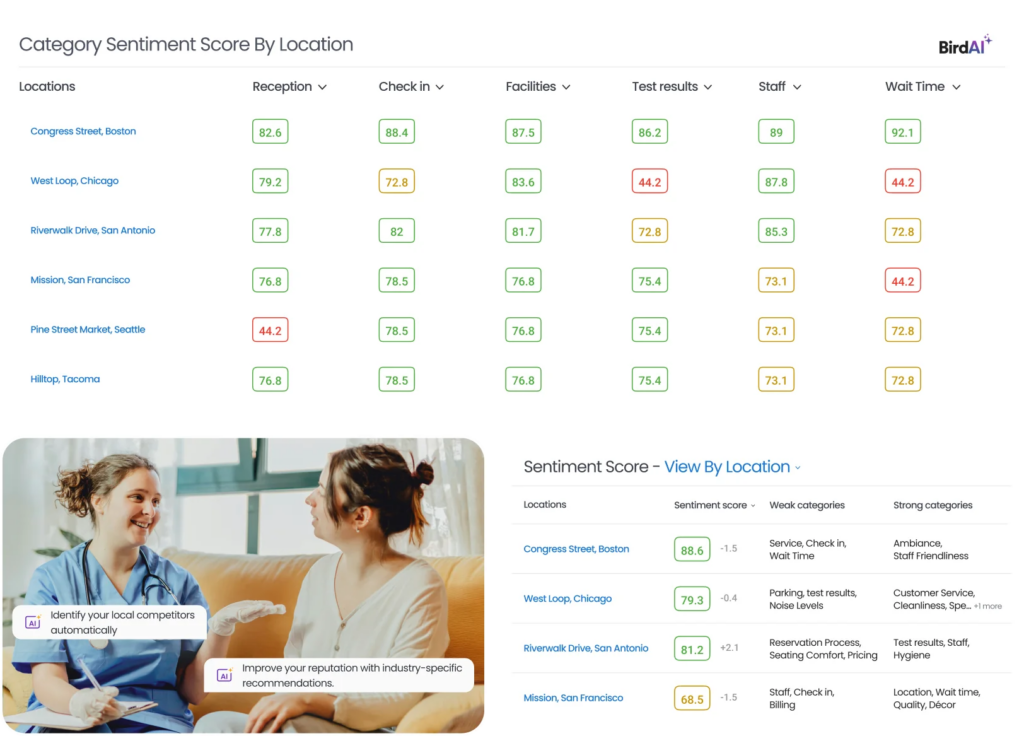
Local Intelligence uses customer and location-level data to surface insights tied to patient experience and operational performance. It helps healthcare organizations understand patient sentiment while maintaining consistent brand standards across providers and locations.
Marketing Agents (Act)
Marketing Agents help healthcare organizations manage reputation and marketing workflows across locations more efficiently. These tools support review management, listings updates, patient communication, content publishing, and online visibility management.
Agents include:
- Review Response Agent for automating review requests and generating personalized review responses
- Listing Optimization Agent for managing provider information across directories and improving local search visibility
“Birdeye has really helped us get our name on the first page of Google and other top sites, improving our discoverability. It’s important for us to be seen in these top directories, and Birdeye boosts our visibility there, making a big difference for us.”
Charley Balbuena
Director of Operations at Quick Care Med
- Insights AI for tracking sentiment trends and operational feedback across locations
- Messaging AI for managing patient conversations across text, email, webchat, and social channels from one inbox
- Social AI for creating and scheduling social media content
- Chatbot AI for answering patient questions and engaging website visitors
- Search AI for monitoring visibility across AI-driven search platforms like ChatGPT, Gemini, and Perplexity
- Competitors AI for benchmarking online performance and reputation against nearby healthcare providers
FAQs
Yes, but responses must remain HIPAA-compliant and should never confirm a patient relationship or disclose medical information. Doctors should use general, professional responses without discussing treatment details.
Doctors can flag fake or policy-violating reviews through Google Business Profile, though removal is not guaranteed. Maintaining consistent review generation helps reduce the impact of isolated fake reviews over time.
Most healthcare providers begin seeing improvements in review volume, ratings, and visibility within 3–6 months of implementing a consistent reputation management strategy.
The best platform depends on practice size, compliance requirements, and automation needs. Birdeye is widely used for review management, listings, surveys, social media, and AI search visibility within a centralized system.
Physician reputation focuses on an individual doctor’s expertise, bedside manner, and patient reviews, while practice reputation management covers the broader patient experience, including staff interactions, operations, and location-level consistency.
Conclusion
In 2026, reputation is no longer just what patients see; it is what AI answer engines decide to show. Doctor reputation management now influences far more than online reviews. It affects patient trust, local search visibility, AI-driven recommendations, and overall practice growth.
As healthcare discovery becomes increasingly digital, providers need consistent systems to manage patient feedback, listings, communication, and reputation across every touchpoint. Birdeye gives healthcare organizations and doctors a centralized way to monitor patient experience, strengthen online presence, and maintain consistency across providers and locations.
Watch a free demo to see how Birdeye helps multi-location clinics manage doctor reputation at scale.

About the Author

Vanjana Sharma
Originally published