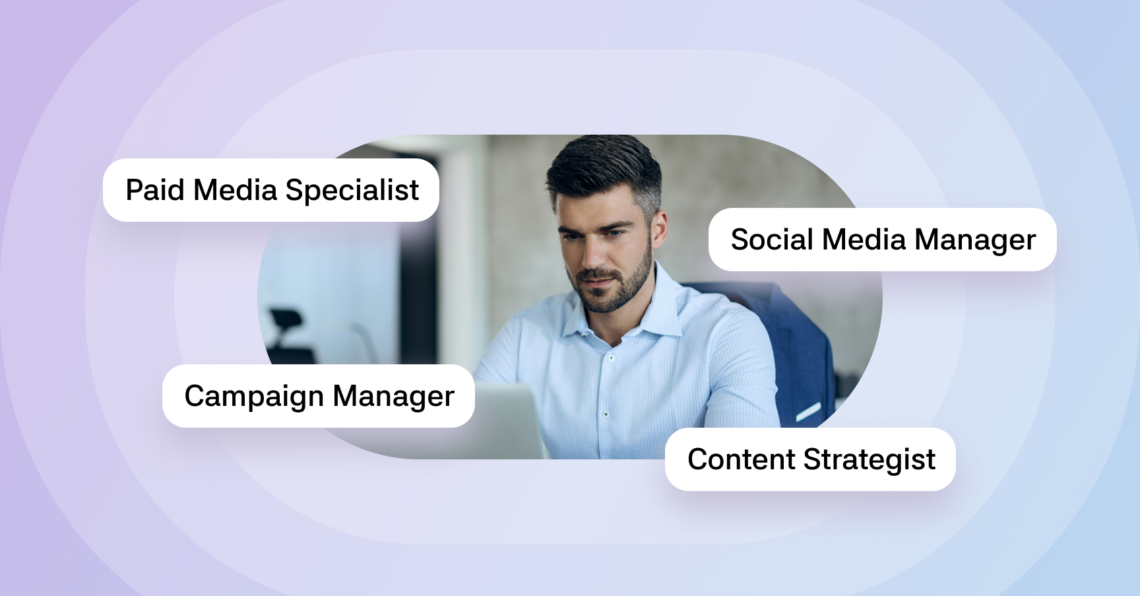
Marketing roles are evolving, even as job titles remain the same. Companies continue to hire for positions like Campaign Managers, Social Media Managers, Content Strategists, Paid Media Specialists, and Marketing Analysts, yet AI agents are rapidly assuming the execution-heavy tasks that once defined these roles. The marketers who learn to leverage AI rather than compete with it will become more strategic, more valuable, and harder to replace.
Summary
The biggest shift in marketing today isn't disappearing job titles, but the transformation of job descriptions. AI agents now handle much of the repetitive work, from campaign execution and reporting to content production and bid optimization, allowing marketers to focus on strategy, business judgment, and cross-functional decision-making.

For CMOs, this changes how teams should be structured, developed, and evaluated. For individual marketers, it changes the skills that lead to career growth and long-term relevance.
This article examines how five core marketing roles are changing, highlighting the responsibilities AI agents now perform, the skills that continue to require human expertise, and how each role is evolving from execution-focused work to strategic decision-making.
Table of contents
- Summary
- How is the Campaign Manager role changing as AI takes over execution?
- How is the Social Media Manager role evolving in the age of AI agents?
- How is the content strategist role changing as AI scales content production?
- How is the Paid Media Specialist role evolving as AI automates optimization?
- How is the Marketing Analyst role changing as AI automates reporting?
- What does the pattern tell us?
- FAQs on how marketing roles are evolving in an AI era
- AI is changing marketing. Your marketing platform should evolve too
How is the Campaign Manager role changing as AI takes over execution?
Reality check: Campaign manager roles aren't disappearing. Campaign execution is.
Not long ago, Campaign Managers spent much of their week building campaigns, coordinating creative assets, managing timelines, and pulling performance reports. Today, AI agents perform these tasks in minutes. As execution becomes automated, the role is shifting decisively toward strategy, oversight, and high-level decision-making.
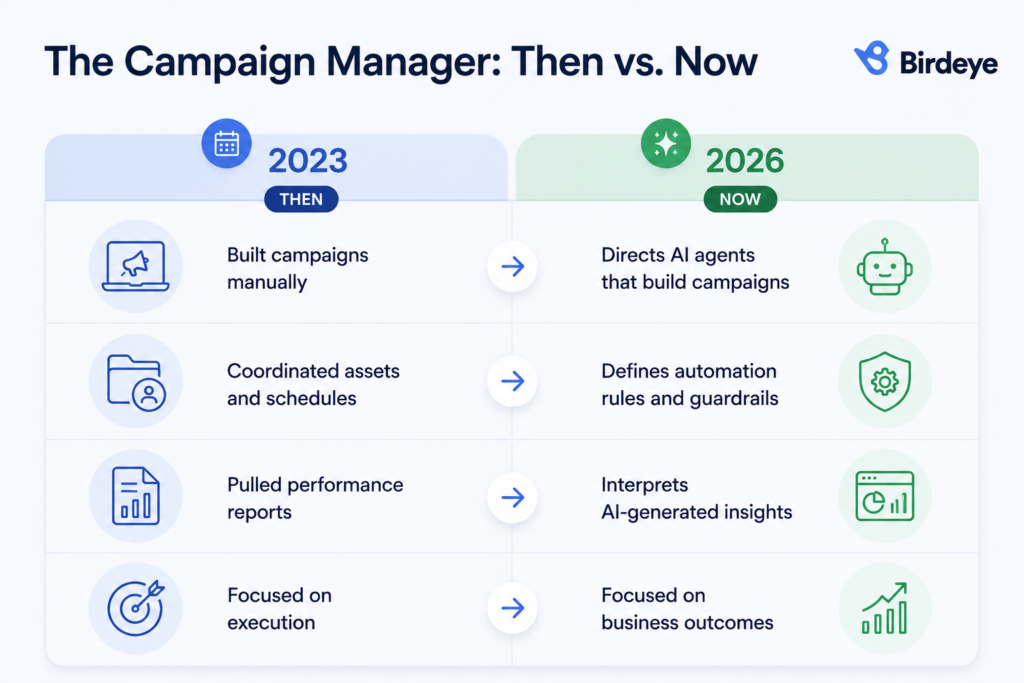
Which campaign management tasks can AI agents now automate?
Modern marketing platforms with AI agents can already create campaign workflows, recommend audience segments, schedule campaigns, monitor performance, surface anomalies, and generate reports.
Gartner’s Marketing GenAI Survey found that 77% of organizations using generative AI already apply it to creative development, while 47% report significant benefits from AI-powered campaign evaluation and reporting. As AI becomes embedded in marketing platforms, execution is becoming less of a competitive advantage.
For the technology driving this shift, see our guide to AI in digital marketing.
Where do Campaign Manager still need to apply human judgment?
Imagine a campaign’s conversion rate drops by 20% overnight.
AI can detect the decline and recommend optimizations. It cannot determine whether the cause is creative fatigue, a competitor’s promotion, changing customer behavior, or shifting market conditions. Those answers require business context, cross-functional collaboration, and judgment.
Gartner’s GenAI survey also found that 87% of CMOs experienced campaign performance issues over the previous year, with nearly half reporting they had terminated campaigns early because they failed to deliver expected results. Launching campaigns is no longer the hardest part. Diagnosing performance and making the right strategic adjustments is.
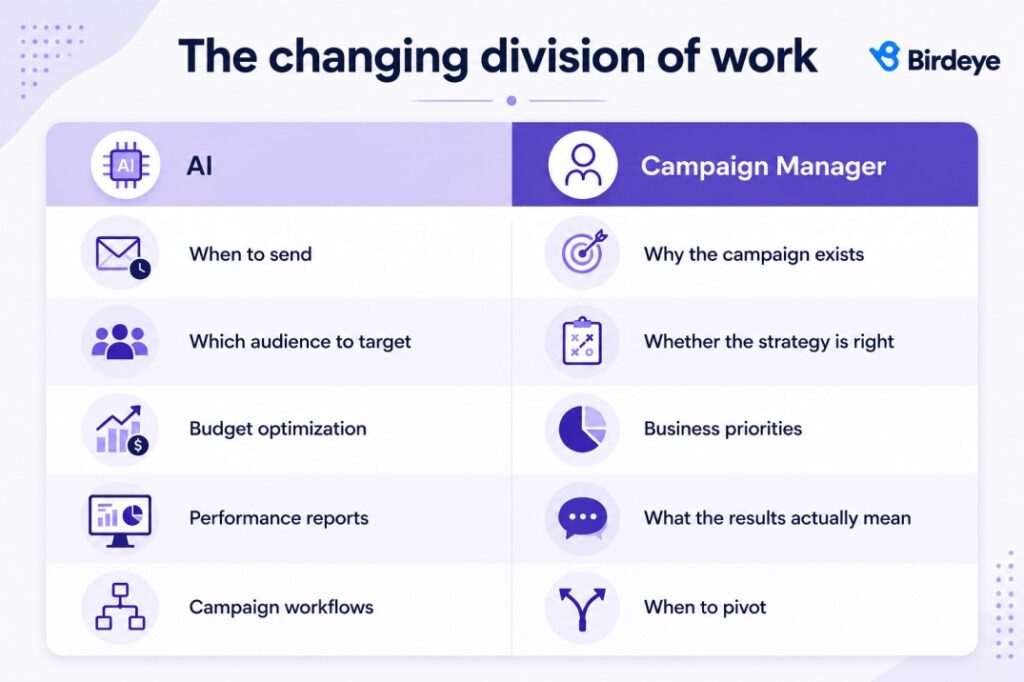
What does the evolved role of a Campaign Manager look like?
As noted in a Think with Google article,
“The era of the tool operator is ending. We are in the age of agent managers.”
That statement describes the modern Campaign Manager perfectly. The title hasn’t changed. The work inside it has.
The Campaign Managers who thrive over the next few years won’t be the ones who execute campaigns the fastest. They’ll be the ones who can define strategy, set guardrails, challenge AI recommendations, and connect marketing performance to business growth.
How is the Social Media Manager role evolving in the age of AI agents?
Today's reality: Publishing content is becoming automated. Building trust is becoming the core mission.
Social media managers once spent much of their week writing captions, scheduling posts, tracking trends, responding to comments, and compiling performance reports. Today, AI agents can automate much of that work, shifting the role from content publisher to brand steward.
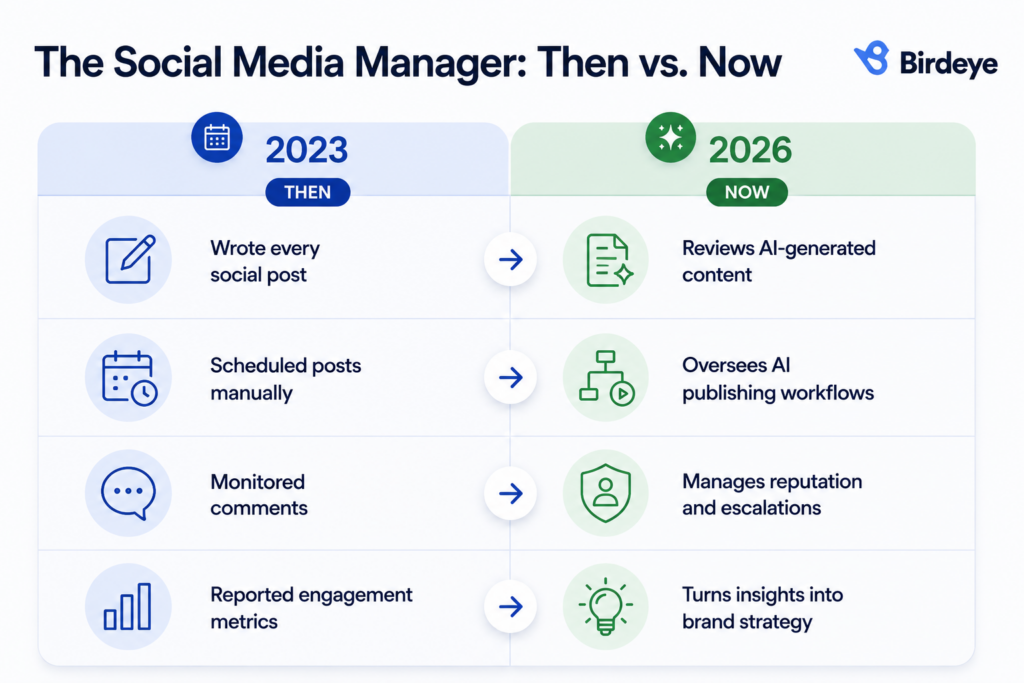
Which social media management tasks can AI agents now automate?
Modern AI tools can already:
- Generate platform-specific captions
- Repurpose long-form content into dozens of social posts
- Recommend posting times
- Schedule content across channels
- Monitor engagement
- Summarize performance reports
According to Microsoft’s 2025 Work Trend Index, 82% of business leaders expect to use agents and AI-powered digital labor to become part of their workforce within the next 12–18 months. Marketing teams are among the earliest adopters because many social media tasks follow repeatable workflows.
AI makes publishing easier. It does not make brand management easier.
Where do Social Media Managers still need to apply human judgment?
Moments like a product recall, an insensitive campaign, or a viral customer complaint define a brand far more than perfectly scheduled content. AI cannot reliably distinguish whether criticism reflects genuine customer frustration, a coordinated attack, or the beginning of a reputational crisis. Nor can it determine whether scheduled posts should be paused during major world events.
Those high-stakes decisions require empathy, context, and judgment.
What does the evolved role of a Social Media Manager look like?
The Social Media Manager is evolving into the organization’s brand guardian.
Instead of measuring success by the number of posts published, they’re responsible for protecting brand voice, defining AI content guidelines, managing crisis communications, and ensuring every customer interaction reflects the organization’s values.
The brands that win won’t necessarily publish more content. They’ll be the ones who earn the most trust.
How is the content strategist role changing as AI scales content production?
The irony: AI can generate unlimited content, but original thinking has never been more valuable.
Every marketing team now uses AI to draft blogs, landing pages, emails, and social posts in minutes. The advantage is no longer producing more content; it’s producing perspectives, expertise, and insights that AI can’t generate on its own.
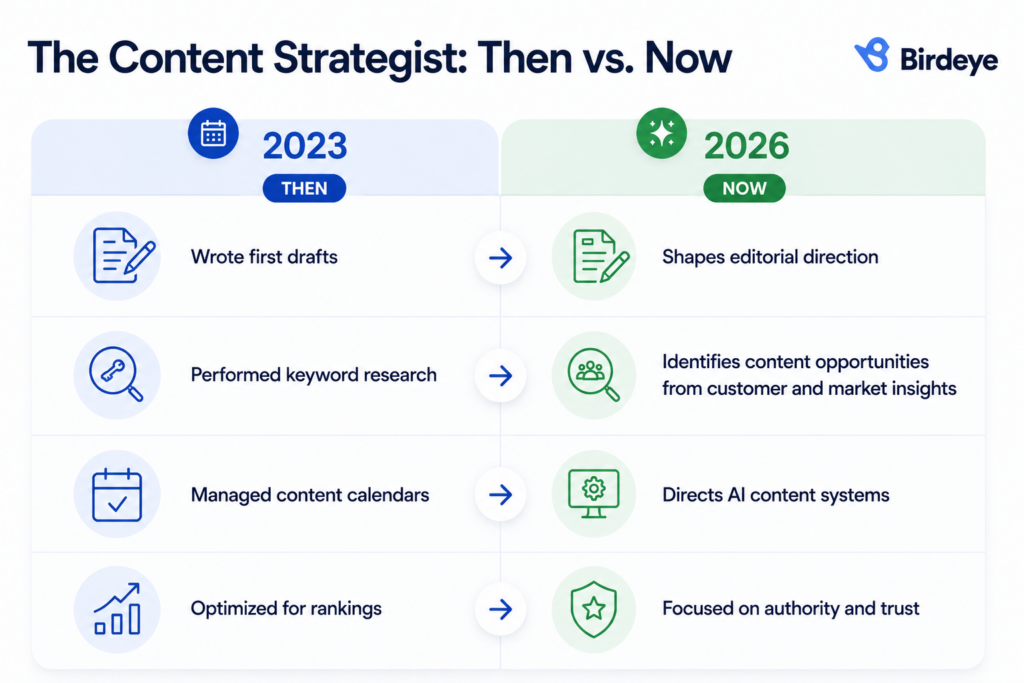
Which content strategy tasks can AI agents now automate?
Today’s AI tools can:
- Produce first drafts
- Repurpose articles into multiple formats
- Generate SEO metadata
- Recommend keywords
- Create content briefs
- Localize content for different audiences
That changes the bottleneck. Creating content is no longer difficult, but creating content worth reading is. Google reinforces this shift in its guidance on AI-generated content. It doesn’t reward content based on whether it was created by humans or AI. Instead, it rewards content that is helpful, original, and demonstrates expertise and experience.
Where do Content Strategist still need to apply human judgment?
AI predicts what readers are likely to click, but it lacks genuine expertise. It cannot interview customers, develop proprietary frameworks, or challenge conventional wisdom.
As generative content floods the internet, the competitive advantage shifts from publishing more content to publishing more credible content.
That is why editorial judgment is becoming one of marketing’s most valuable skills.
What does the evolved role of a Content Strategist look like?
The Content Strategist is becoming an editor-in-chief for AI. They define the audience, shape the narrative, verify facts, protect the brand’s point of view, and ensure every AI-generated draft contributes something genuinely useful.
More importantly, they enrich AI-generated content with insights that only their organization possesses, such as customer interviews, implementation experiences, proprietary research, product expertise, and client success stories. These unique perspectives make content more credible, more useful, and far harder for competitors to replicate.
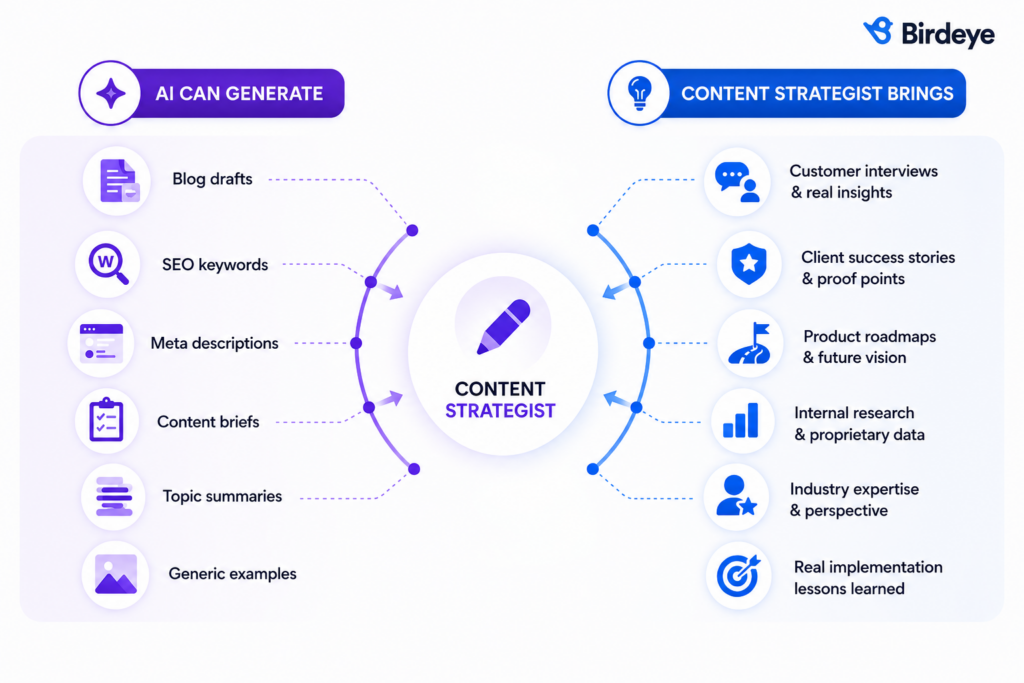
In the AI era, originality is no longer created by writing every sentence yourself. It is created by thinking better than everyone else.
How is the Paid Media Specialist role evolving as AI automates optimization?
The shift: AI is getting better at optimization. Humans still decide where to invest.
Paid media specialists once spent hours adjusting bids, testing audiences, reallocating budgets, and monitoring campaign performance. Today, much of that optimization happens automatically. AI can process thousands of signals in real time, making campaign management faster and more efficient than ever before.
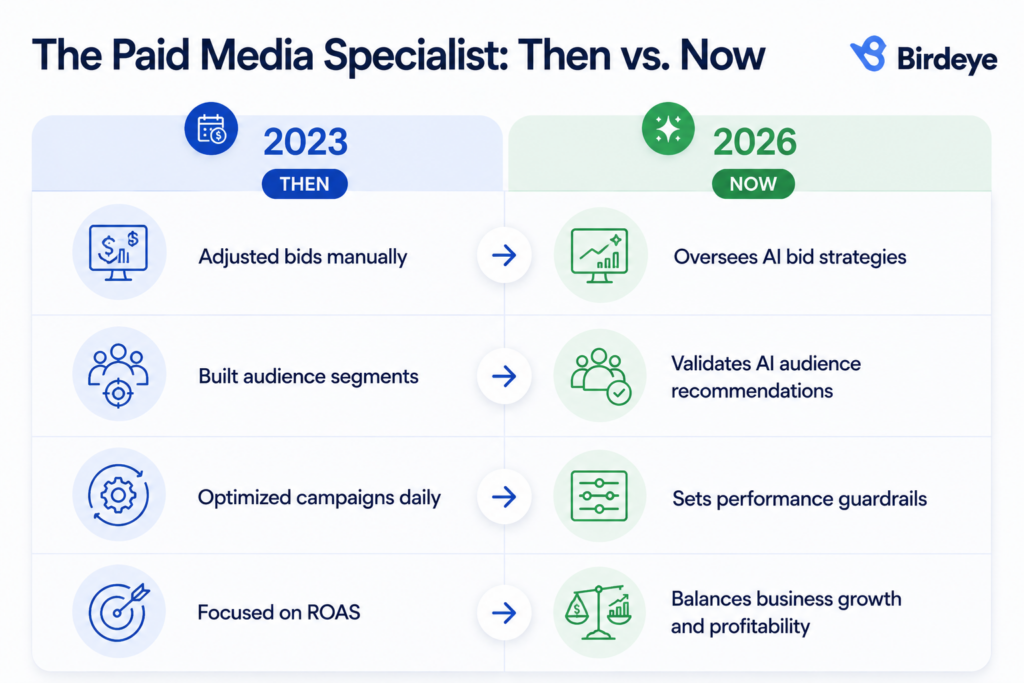
Which paid media tasks can AI agents now automate?
Modern AI-driven advertising platforms increasingly automate:
- Smart bidding and budget allocation
- Audience discovery and expansion
- Creative variation testing
- Performance monitoring
- Predictive budget pacing
- Campaign optimization recommendations
This isn’t simply a Google or Meta trend. According to McKinsey’s State of AI, marketing and sales remain among the business functions seeing the greatest value from generative AI because of its ability to optimize customer acquisition and personalize campaigns at scale.
As optimization becomes increasingly automated, competitive advantage shifts away from operating ad platforms and toward making smarter investment decisions.
Where do Paid Media Specialists still need to apply human judgment?
AI can maximize return on an advertising budget, but it cannot decide whether that budget should exist in the first place.
It doesn’t know whether the company should prioritize awareness over demand generation, shift funds toward a new product launch, or pivot paid media support toward customer retention.
Those decisions depend on commercial priorities, leadership alignment, competitive positioning, and market conditions.
The best Paid Media Specialists no longer spend most of their time inside Google Ads. They spend it helping leadership invest marketing dollars more effectively.
What does the evolved role of a Paid Media Specialist look like?
The Paid Media Specialist is becoming a growth strategist.
Instead of optimizing individual campaigns, they design measurement frameworks, define AI guardrails, evaluate incremental business impact, and ensure advertising supports broader company objectives.
While campaign optimization is becoming automated, marketing investment decisions remain a human responsibility.
How is the Marketing Analyst role changing as AI automates reporting?
The new challenge: Reports are automated. Interpretation isn't.
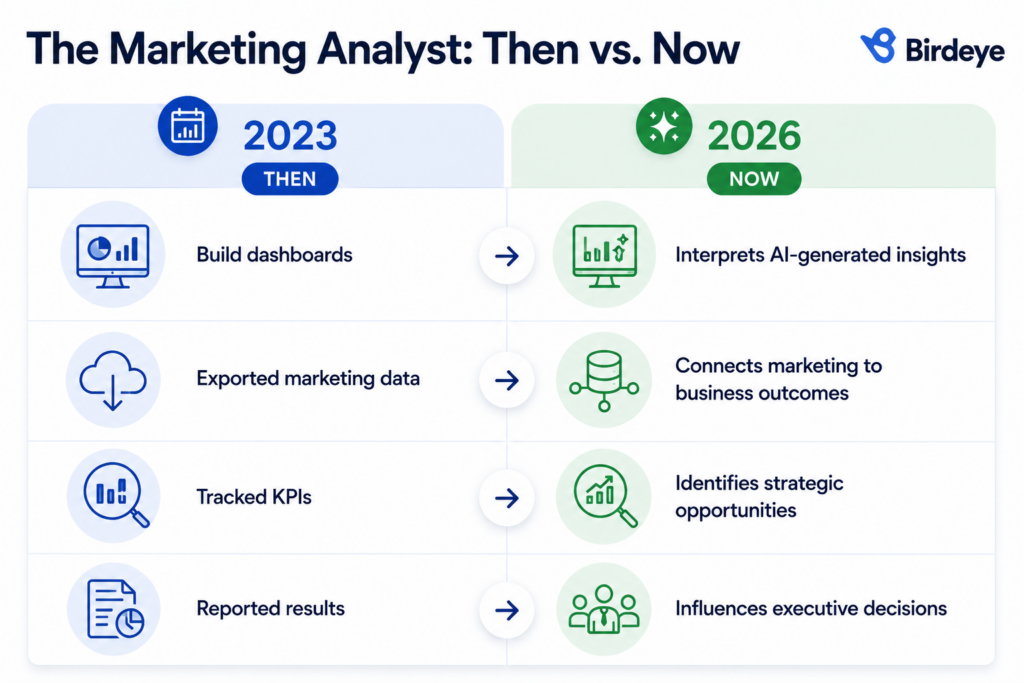
Which marketing analytics tasks can AI agents now automate?
Today’s analytics platforms can:
- Consolidate data across channels
- Detect anomalies automatically
- Generate dashboards
- Produce written performance summaries
- Forecast trends
- Recommend optimization opportunities
According to Deloitte’s 2026 State of Generative AI, organizations are increasingly using AI to automate reporting and analytics, enabling employees to focus on higher-value work such as decision-making and strategic planning rather than manual data preparation.
For analysts, reporting is rapidly becoming the starting point, not the destination.
Where do Marketing Analyst still need to apply human judgment?
Executives rarely ask for more dashboards. They ask for answers:
- Why did revenue slow this quarter?
- Which channels are driving profitable growth?
- Where should we invest next?
- What risks should we prepare for?
AI can generate charts. It cannot confidently answer those questions without business context. The most valuable analysts translate data into decisions that leaders can act on.
What does the evolved role of a Marketing Analyst look like?
The Marketing Analyst is becoming a business advisor.
Rather than measuring marketing in isolation, they connect customer behavior, revenue, competitive trends, and organizational priorities into a single narrative that helps leadership make better decisions.
The spreadsheet no longer defines the role. The story behind the numbers does.
What does the pattern tell us?
By now, a clear pattern has emerged: whether you’re a Campaign Manager, Social Media Manager, Content Strategist, Paid Media Specialist, or Marketing Analyst, AI isn’t replacing the role. It’s replacing the repetitive, rules-based, and execution-heavy tasks within them.
As Jensen Huang, co-founder and CEO of NVIDIA, has observed:
“If you’re not using AI, you’re going to lose your job to somebody who uses AI.”
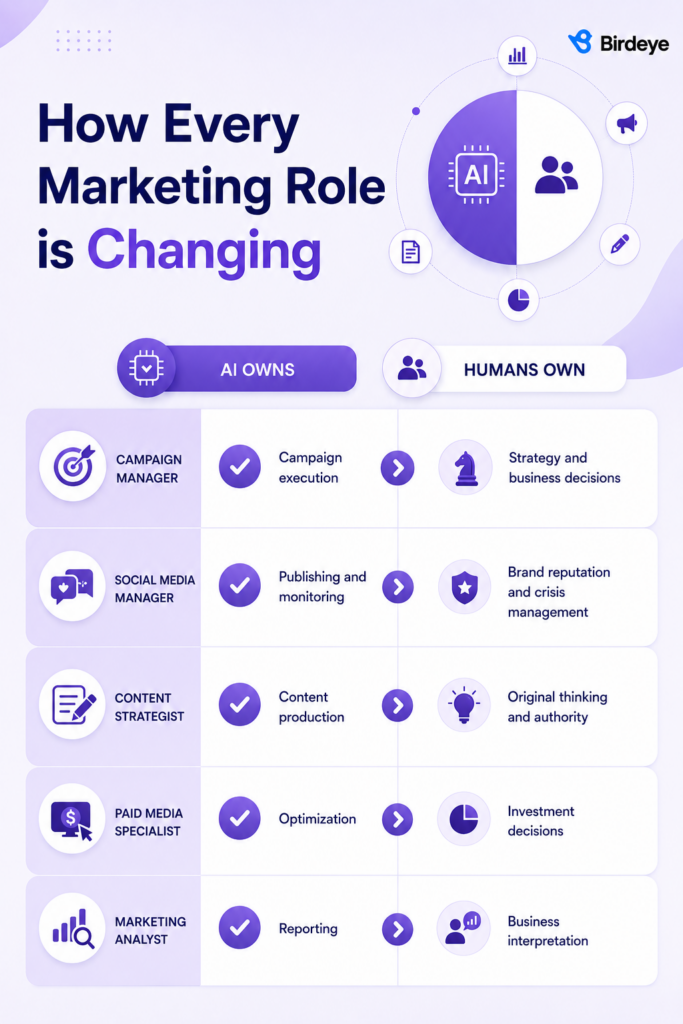
That means the marketers who stand out won’t be the fastest at launching campaigns or building dashboards; AI already does that. The most valuable marketers will be those who ask better questions, challenge AI-generated recommendations, connect marketing to business outcomes, and make decisions when there is no obvious right answer.
FAQs on how marketing roles are evolving in an AI era
No. AI is automating routine marketing tasks, not replacing marketers. Human expertise remains essential for strategy, creativity, business judgment, brand management, and cross-functional collaboration.
CMOs should prioritize AI training, redesign workflows around human-AI collaboration, and hire for strategic thinking, adaptability, and business acumen instead of execution-focused skills alone.
The biggest shift is from execution to strategy. As AI handles more operational work, marketers are increasingly responsible for setting direction, interpreting insights, and driving business decisions.
Use AI to speed up research, drafting, and analysis while reserving human effort for original ideas, storytelling, brand positioning, and strategic decision-making.
AI is changing marketing. Your marketing platform should evolve too
According to Microsoft’s 2026 Work Trend Index, organizational factors account for 67% of AI’s real impact, more than twice the influence of individual mindset and behavior (32%). The report makes one thing clear: organizations create the greatest value from AI not by giving employees more AI tools, but by redesigning workflows, systems, and ways of working around an AI-powered workforce.
That’s where many organizations are falling behind.
While marketers increasingly rely on AI to create content, optimize campaigns, analyze performance, and engage customers, they’re often forced to work across disconnected platforms for reviews, listings, social media, messaging, surveys, and customer feedback. This fragmentation leads to inconsistent customer experiences and to AI that operates in silos rather than as a cohesive engine.
Birdeye builds AI agents for multi-location brands to scale trust, consistency, and control across 100-10,000+ locations. Powered by specialized AI coworkers- Jay for marketing, Robin for operations, and Myna for customer experience- Birdeye goes beyond monitoring. Its AI agents consolidate customer signals, understand your brand and industry context, and take action across reviews, listings, social media, messaging, surveys, and AI search visibility from a single platform.
As marketing teams evolve from executing tasks to managing AI, they need technology designed for that new way of working. Birdeye provides the agentic platform that helps enterprise brands turn AI into measurable business outcomes, without sacrificing governance, consistency, or customer trust.
Request an enterprise demo and see how Birdeye helps teams build an AI-powered organization, not just an AI-enabled workflow.
About the Author

Somya Yesodharan
Originally published