Multi-location brands do not need more dashboards. They need a clearer way to see what is hurting performance, prioritize the right fixes by location, and track whether those actions actually improve business health.
Summary of the blog
Better visibility is useful, but better follow-through is what changes outcomes across hundreds or thousands of locations. For enterprise brands, the challenge isn’t a lack of data. It’s the “insights-to-action” gap that leaves significant growth unrealized.

This blog post explores why that gap exists, what multi-location brands should expect from a modern insights platform, and how Birdeye Insights helps teams start with the score, focus on priorities, and track progress with clear ownership and measurable results.
Table of contents
- Summary of the blog
- Why do multi-location brands still struggle to act on customer feedback?
- Where do most insights platforms fall short?
- How does Birdeye Insights turn insights into action?
- How does the Birdeye Insights workflow work?
- Why does Birdeye Insights matter for enterprise multi-location brands?
- FAQs about Birdeye Insights
- Why follow-through beats more dashboards for multi-location brands
Why do multi-location brands still struggle to act on customer feedback?
According to McKinsey, systematic CX improvements can boost revenue by up to 7%. Yet, for most brands, that value is left on the table because insights never turn into action.
For most multi-location brands, the challenge isn’t a lack of data. It’s a lack of direction. In any given week, a drop in ratings at one site, poor survey results at another, and listing errors at a third can all feel like “top priorities.” This data overload forces teams into a perpetual reactive mode.
Instead of moving with confidence, managers lose time triaging competing issues and comparing locations to see what actually matters. As a brand scales, this “visibility problem” quickly evolves into a “focus problem.” This is the critical gap traditional insight tools leave behind: they show you what is happening, but they don’t tell you where to begin.
Where do most insights platforms fall short?
Most insights platforms are good at surfacing issues. They can highlight that “wait times are long” or “the coffee is cold” across a massive portfolio. But this is where most tools stop, right at the dashboard. They show patterns, but they don’t tell you what to fix first, they don’t help you assign the task, and they don’t show you whether the fix actually moved the needle.
That is the problem many brands are facing today. They have summaries and recommendations, but no clear path from insight to action. Without a clear sense of priorities, teams can end up bouncing between issues rather than fixing the ones with the greatest impact. The data is there. The missing piece is a better, full-cycle way to focus action and measure whether it worked.
How does Birdeye Insights turn insights into action?
Birdeye Insights helps multi-location brands make sense of performance across reviews, surveys, and listings in one place. It gives teams a clear view of business health through scores, summaries, benchmarking, and location-level analysis.
What sets Birdeye Insights apart is what happens after the insight. Instead of stopping at dashboards and summaries, it helps teams identify the highest-impact issues, focus on the locations that need attention first, and turn AI recommendations into actions with owners, timelines, and targets. Teams can then track progress over time and connect that work back to score movement.
Because Insights sits inside the Birdeye Agentic Marketing Platform, it connects signals across modules and agents — from reviews to listings to messaging — creating a full-cycle loop from customer signal to execution and back again.
In simple terms, Birdeye Insights is moving beyond reporting. It is becoming a clearer, more action-focused way for multi-location brands to decide what to resolve first, move faster, and stay accountable to outcomes.
How does the Birdeye Insights workflow work?
1. See where you stand
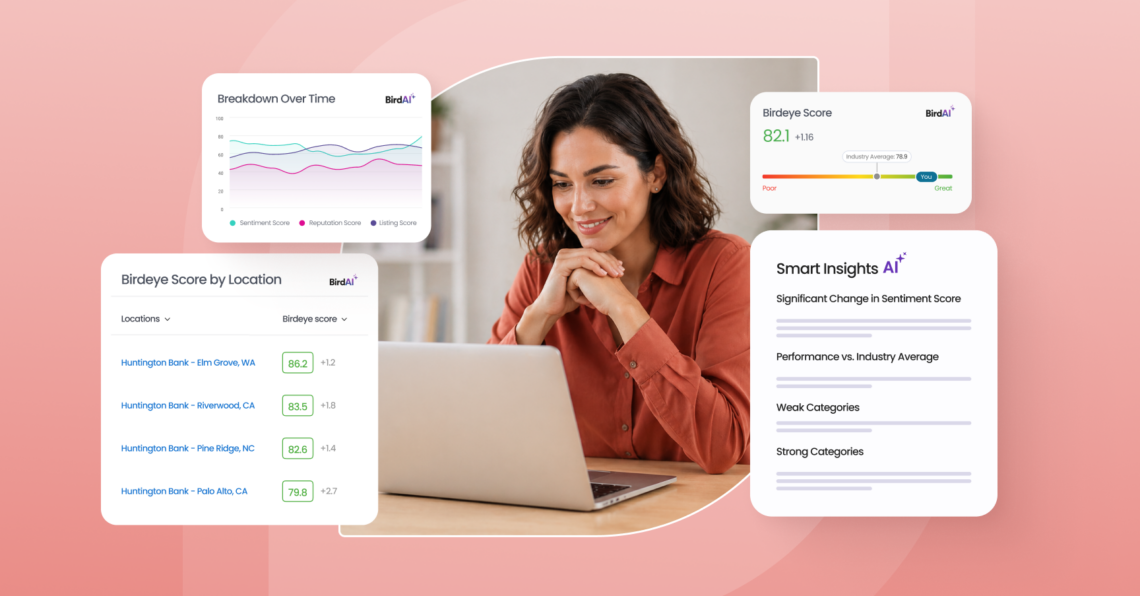
The starting point is to establish a unified North Star: the Birdeye Score. It evaluates exactly where your business stands by analyzing all your data points. It is a single, composite metric that combines your:
- Sentiment Score (how customers feel based on reviews and surveys)
- Reputation Score (ratings, review volumes, and response rates)
- Listing Score (online presence and local discoverability)
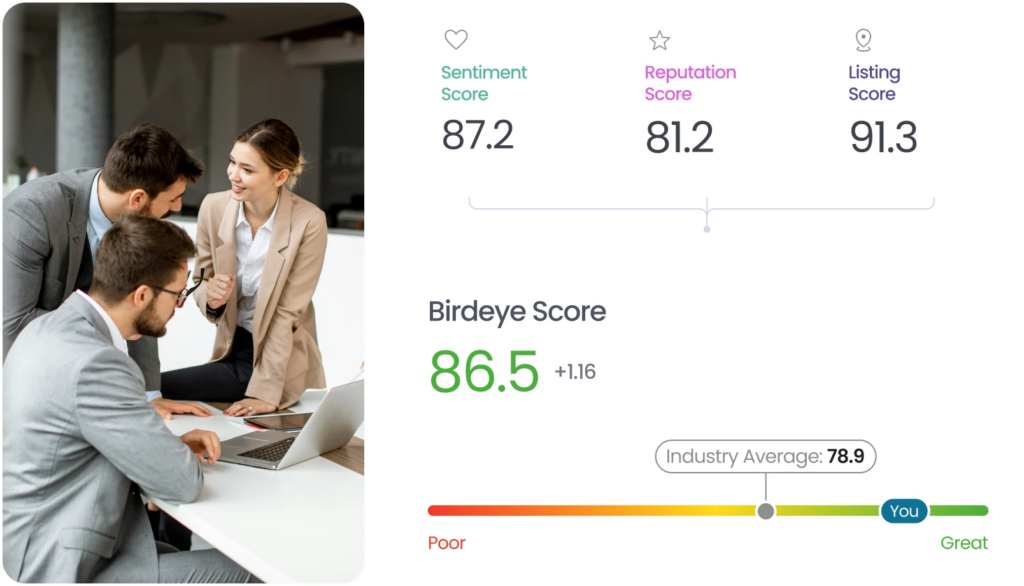
Birdeye Score allows enterprise brands to easily benchmark performance. It tells them precisely what the industry average is, how their closest competitors are performing, and which of their locations rank highest and lowest.
Birdeye’s agentic marketing platform does more than aggregate numbers. It reads performance in the local context. With a unified Customer Data Platform (CDP) at the core, Birdeye AI agents can pick up on the issues affecting each location, whether that is service delays, pricing complaints, poor review response rates, or listing gaps. The result is a North Star metric rooted in local reality, with the context that teams need to act on it.
2. Focus on the right priorities
The next step is prioritization. Instead of merely telling brands what people are saying, Birdeye Insights tells them which specific issues are actively hurting their local SEO rankings, customer sentiment, and revenue the most. It is explicitly designed to prioritize recommendations by impact.
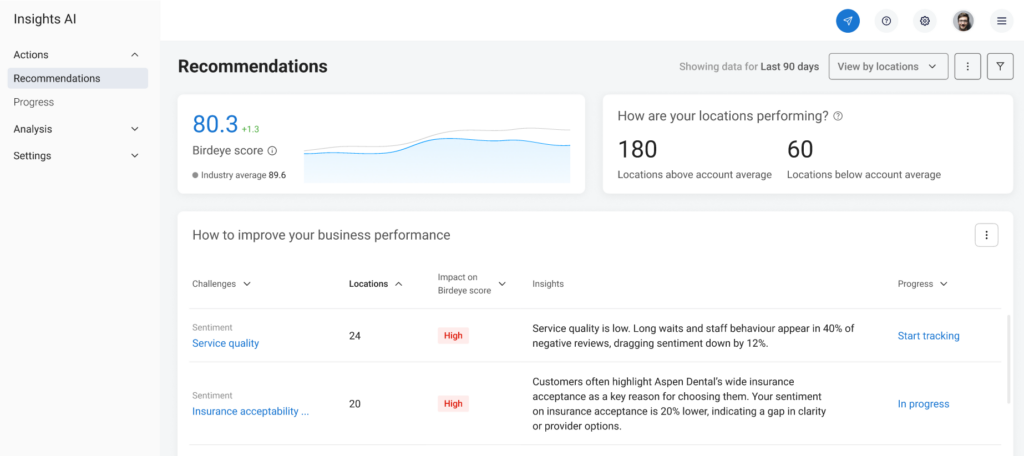
As soon as a user logs into the platform, they are presented with a prioritized recommendations panel front and center. The platform highlights the highest-impact issues, telling teams exactly what to fix first. For instance, instead of overwhelming a regional manager with a list of 50 tasks across dozens of locations, Birdeye Insights analyzes customer feedback data and provides the top recommendations that will have the highest impact on customer sentiment and online reputation.
This approach significantly reduces guesswork. Leaders no longer have to scan reports to decide whether to focus on pricing complaints, front-desk wait times, or parking issues in different markets. The AI instantly ranks the priorities that will drive the most meaningful business improvement across your footprint.
3. Turn priorities into accountable action
In large enterprises, the person analyzing the data is rarely the person executing the fix. If a marketing manager in a multi-location restaurant brand sees recurring complaints about dirty tables across 15 locations, they cannot physically go clean the tables. That is an operations issue. Because ownership is often unclear, insights frequently stall at the dashboard, and teams fail to consistently operationalize their findings.
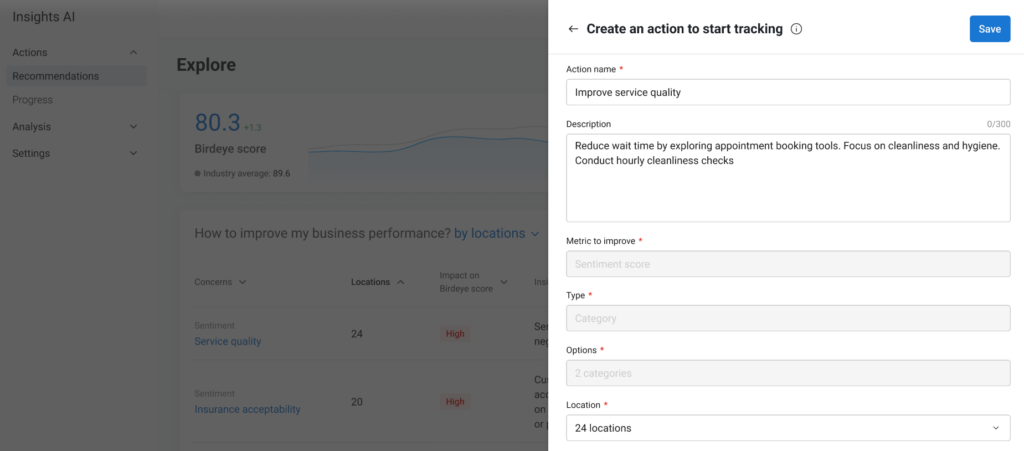
Birdeye Insights closes this loop by allowing teams to turn prioritized recommendations into trackable, owned initiatives. Instead of just reading an AI summary and calling it a day, a user can instantly click “Start Tracking” on a recommendation. The system allows them to:
- Assign an Owner: Route the specific issue (e.g., a cleanliness drive across 15 locations ) to the exact regional or location manager responsible for the fix.
- Set Timelines: Establish clear due dates to ensure the work does not stall.
- Set Target Scores: Define the exact score improvement teams expect to see upon completion.
All of this happens in a human-in-the-loop workflow: AI agents surface and route priorities, while regional and location leaders retain control through approvals, status updates, and built-in governance.
4. Measure what changed
Unlike generic ticketing software, which fails to show if a closed ticket impacted customer sentiment, Birdeye Insights features an outcome dashboard that directly tracks how completed initiatives connect to movement in the Birdeye Score and supporting metrics.
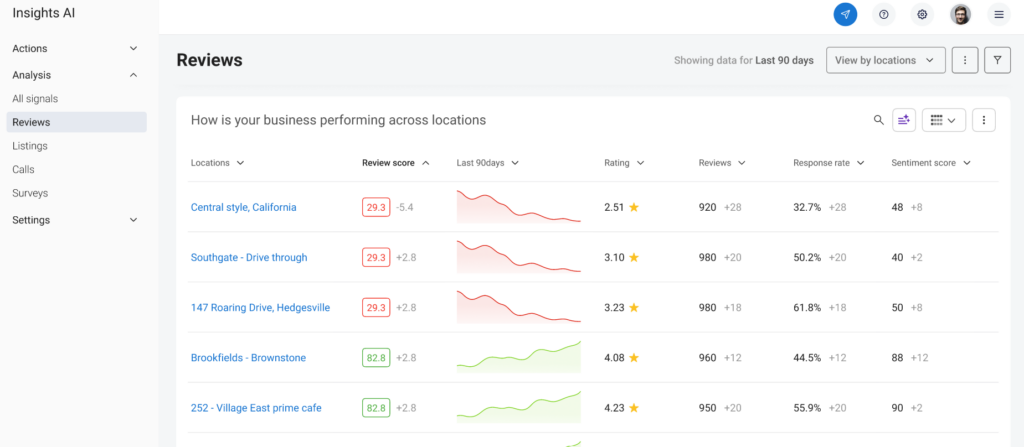
This step closes the loop. Instead of guessing whether an action worked, teams have a clearer way to see if their effort is improving business performance location by location, and over time.
For example, a healthcare system with 400 clinics can see how a wait-time initiative in Phoenix and Dallas affected ratings, review volume, and sentiment within weeks — and compare those changes to regions where the initiative has not yet rolled out.
Why does Birdeye Insights matter for enterprise multi-location brands?
The larger the brand, the harder it becomes to keep teams aligned. Corporate leaders need clear visibility, field teams need focused priorities, and CX teams need confidence that their initiatives are driving impact.
Birdeye Insights delivers this crucial shift. It helps teams focus on location-specific actions rather than chasing scattered signals. This process creates clearer ownership, reduces time spent scanning dashboards, and gives leaders a better way to verify that action is actually improving performance across hundreds or thousands of locations.
Large multi-location brands can use Insights to retain revenue, reduce churn risk, and consolidate CX workflows that once lived across multiple point solutions — all while keeping marketing and CX leaders in control of which actions move forward.
FAQs about Birdeye Insights
It is the difference between “What happened?” and “What now?” Traditional platforms give you summaries and leave the next steps to you. Birdeye is Agentic. It brings signals together, factors in local context, and helps teams act by routing priorities to the right people with human-in-the-loop approvals that keep enterprise teams in control.
For the broader analytics framework this fits into, see our guide to enterprise marketing analytics. The result is one of the most complete full-cycle workflows in the category, connecting customer signals to prioritized action and measurable business outcomes.
Birdeye Insights helps teams start with a trusted view of business health, then surfaces location-level priorities ranked by impact. That makes it easier to focus on the issues and locations that need attention first, rather than sorting through scattered signals manually.
Yes. Birdeye Insights helps teams turn priorities into actions with owners, timelines, and targets, then track progress over time. It also helps connect completed work to movement in Birdeye Score and supporting scores, so teams can see what has improved and report back to executives with confidence.
Birdeye Insights brings together signals from reviews, surveys, and listings to give teams a clearer view of business health across locations. That includes sentiment, reputation, and listing performance, so brands can understand what is driving results without jumping across separate tools or reports.
Birdeye Insights is designed for enterprise governance. AI agents recommend and route priorities, but regional and location leaders approve actions, update status, and manage execution. That means you get the speed of AI with the guardrails, accountability, and auditability enterprise teams require.
For multi-location brands, the problem is rarely a lack of feedback. The harder part is deciding what matters most across hundreds of locations. Prioritization helps teams focus on the highest-impact issues first, direct the right teams to the right locations, and avoid wasting time on less urgent signals.
Why follow-through beats more dashboards for multi-location brands
Operating a multi-location brand requires more than just gathering signals. It requires a dedicated system that seamlessly moves from scoring to setting priorities to tracking initiatives and outcomes.
With Birdeye Insights, enterprise brands can see where the business stands, prioritize the highest-impact issues, drive accountable action with ownership, and measure exactly what changed over time.
Consolidating these steps allows brands to confidently bridge the insights-to-action gap and prove the undeniable ROI of their customer experience efforts. For enterprise brands, the true competitive advantage isn’t just seeing the data. It’s the ability to execute improvements across every location, ensuring the brand promise is delivered consistently to every customer.
Curious to know how Birdeye Insights can transform your multi-location strategy? Book a Demo today.

About the Author

Kukil Bora
Birdeye
Originally published