Restaurant leaders know the story well. One location delivers exceptional service while another struggles with long wait times. One region gets glowing reviews while another sees a spike in complaints about accuracy or cleanliness. And the bigger the brand grows, the harder it becomes to understand what guests are actually experiencing on the ground.
Summary
Restaurant feedback software solves this gap. Instead of relying on scattered surveys, one-off comments, or individual reviews, multi-location brands gain a single source of truth — a system that captures what guests say, interprets what they mean, and shows teams exactly where to take action.

This guide breaks down what enterprise restaurant brands should expect from modern feedback software, how AI is reshaping the guest experience landscape, and compares leading tools and shows why Birdeye is the #1 agentic marketing platform for multi-location restaurant  brands.
Table of contents
- Why restaurant feedback software matters for multi-location brands
- Challenges multi-location restaurants face without centralized feedback management
- What the best restaurant feedback software includes
- Which is the right restaurant feedback software for you
- Why Birdeye is the best restaurant feedback software for multi-location restaurants
- FAQs about restaurant feedback software for multi-location brands
- Birdeye is the leading restaurant feedback software for multi-location brands
What is a restaurant feedback software?
Restaurant feedback software is a system that collects guest input from multiple sources and organizes it into clear, usable insights. It captures surveys, online reviews, delivery feedback, and on-premise comments, then translates them into patterns teams can understand and act on.

For multi-location brands, this software becomes a foundational layer, a reliable, repeatable way to measure guest experience and guide operational decisions across every restaurant, regardless of size or complexity.
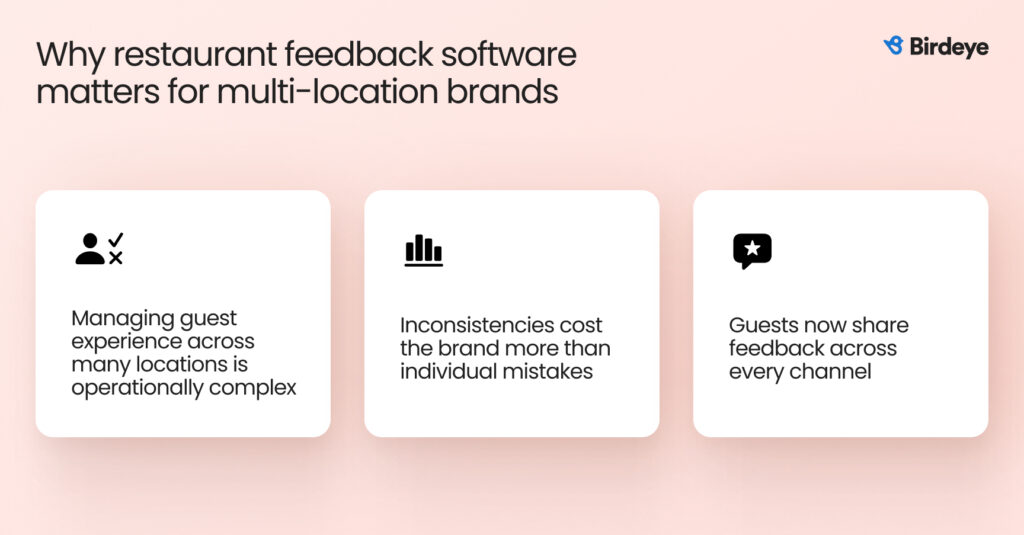
Why restaurant feedback software matters for multi-location brands
As restaurant brands expand, the guest experience becomes harder to see and even harder to standardize. Each location develops its own rhythms: different teams, different demand patterns, different service challenges. Yet guests expect the brand to feel the same everywhere.
Restaurant feedback software helps brands close this gap. It gives leaders a dependable view of how each location performs through the eyes of their guests, and it brings structure to the operational inconsistencies that naturally surface as a brand grows.
From here, the core challenges become clear.
Managing guest experience across many locations is operationally complex
No two locations operate alike. Some see heavy breakfast traffic. Others peak at dinner. Urban stores handle more delivery orders. Suburban stores rely on dine-in.
These differences influence speed, friendliness, accuracy, and overall satisfaction.
Restaurant feedback software helps brands highlight what’s normal, what’s exceptional, and what’s slipping — making it easier for leaders to support teams with targeted, meaningful improvements.
Inconsistencies cost the brand more than individual mistakes
A hiccup at one location can stay local. But when inconsistencies repeat across several stores, the brand reputation absorbs it. Ratings slide. Delivery apps surface competitors instead. Guests choose the safer alternative.
When inconsistencies appear across locations, the effects compound in the form of:
- Lower star ratings
- Weaker search visibility
- Fewer repeat visits
- Declining loyalty
- Higher complaint volume
Feedback software surfaces these inconsistencies early. It doesn’t just show which locations struggle; it helps diagnose why, so teams can improve before guests disengage.
Guests now share feedback across every channel
The modern guest doesn’t wait to be asked. They share feedback through Google reviews, delivery app ratings, social comments, QR codes, and post-visit surveys, often within minutes of the experience.
This creates two challenges:
- Guests expect acknowledgment almost immediately.
- Feedback arrives through channels that aren’t naturally connected.
Restaurant feedback software pulls these signals together so leaders don’t have to rely on isolated comments or local reports to understand what guests truly experience.
Challenges multi-location restaurants face without centralized feedback management
As a restaurant brand expands, visibility gaps widen. Not intentionally — just naturally. Each location starts collecting feedback in its own way, using different tools, different habits, and different levels of operational maturity. Over time, the brand stops learning from its own guests because the signals are scattered, delayed, or incomplete.
Centralized feedback management solves this problem. Without it, these are the patterns most brands run into.
Fragmented guest signals across reviews, surveys, and social
Guests speak across every channel, but the business often hears only fragments of the story. One location monitors Google reviews diligently. Another focuses on point-of-sale surveys. A third relies on word of mouth.
This creates three major issues:
- Incomplete context — Leadership sees outcomes but not contributing factors.
- Uneven accountability — Some locations over-index on guest experience; others under-index simply because no one is tracking.
- Lost learnings — Insights that appear in one part of the brand never reach others.
Slow detection of issues that affect guest satisfaction
Most operational problems start small but become visible only when guests start complaining loudly, or ratings start dropping. Without a centralized system, restaurants often discover issues after they’ve already damaged loyalty.
You typically see:
- A pattern of accuracy complaints across several stores.
- Multiple mentions of slow service before a staffing gap is recognized.
- Recurring feedback about cleanliness or ambiance that never reaches regional leaders.
No scalable way to understand sentiment at the category or location level
Guest sentiment is nuanced. A single review can contain feedback on food temperature, friendliness, speed, and atmosphere. When brands rely on manual reading or local interpretation, that nuance disappears.
Centralized sentiment analysis gives brands the structure they need to examine:
- How food quality varies by location
- Whether drive-thru and dine-in sentiment follow the same patterns
- Which regions struggle with accuracy vs. speed
- Which improvements deliver measurable change
When guest feedback is scattered, slow to surface, or impossible to interpret at scale, even the best restaurant teams end up solving the wrong problems or solving the right ones too late. A lack of care or effort doesn’t cause the limitations; a lack of structure causes them.
That’s why the next question is: If these are the challenges, what should the right restaurant feedback software actually include?
Not a long list of features, but the capabilities that help multi-location brands improve the guest experience.
What the best restaurant feedback software includes
Below are the core elements any multi-location restaurant brand should expect from a best-in-class platform.
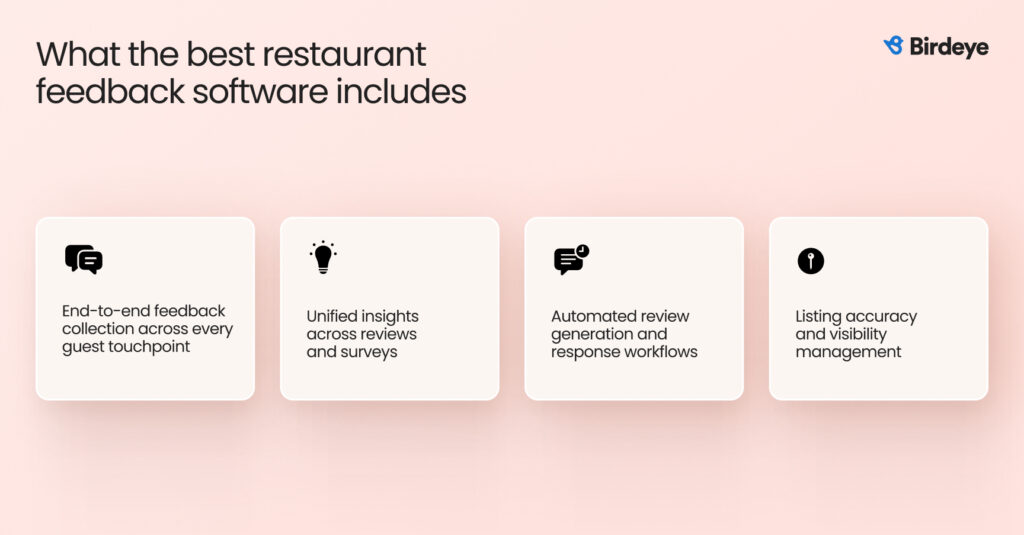
End-to-end feedback collection across every guest touchpoint
Guests no longer follow a predictable feedback path. They respond to surveys, leave Google reviews, comment on delivery apps, scan QR codes at the table, or text the store directly. A strong feedback platform pulls all of these channels into one connected pipeline.
Unified insights across reviews and surveys
Most restaurants track reviews and surveys separately, which means they’re seeing symptoms in one place and context in another. A true multi-location system brings everything together so sentiment can be viewed holistically.
When reviews and surveys sit side by side, teams can see:
- Whether negative reviews correlate with specific operational issues
- Which concerns consistently appear across channels
- Whether guest perception differs between in-store and delivery
- How sentiment trends shift in response to menu or staffing changes
Automated review generation and response workflows
Guest feedback doesn’t end at collection. Restaurants need to close the loop, and that requires reliable, timely follow-up.
Modern platforms, like Birdeye’s AI Agents, the Review Generation Agent, and Review Response Agent, support this by:
- Triggering review requests automatically after each visit
- Shifting outreach between channels based on what performs best
- Generating contextual, brand-aligned review responses at speed
- Escalating sensitive or urgent feedback to managers
Listing accuracy and visibility management
It’s hard to improve guest satisfaction if guests can’t find accurate information in the first place. Hours, phone numbers, drive-thru availability, menu links, and address details must remain correct across every major platform — Google, Yelp, Apple, Facebook, delivery apps, and more.
Platforms like Birdeye use a Listings Optimization Agent to:
- Detect inaccuracies automatically
- Correct information across 200+ sites
- Sync updates instantly when hours or menus change
- Prevent duplicate or outdated listings
Visibility affects discoverability. Discoverability affects traffic. Traffic affects sentiment. Listings aren’t marketing admin — they’re foundational guest experience.
Birdeye is the leading restaurant feedback software for multi-location brands
Want to see the impact of Birdeye on your business? Watch the Free Demo Now.
Which is the right restaurant feedback software for you
Choosing the right platform isn’t about checking boxes. What multi-location restaurant brands really need is a system that scales with the complexity of their operations.
The platforms below appear most often in restaurant tech stacks and industry evaluations. This isn’t an exhaustive list. It’s a spotlight on the tools your peers most frequently evaluate before ultimately choosing a unified platform like Birdeye.
1. Birdeye
Best for: Multi-location restaurant brands that need consistency, automation, and enterprise visibility
Birdeye is built for scale. It unifies reviews, surveys, messaging, listings, insights, and reporting in a single platform, making it easier for restaurant brands to manage guest experience across dozens or hundreds of locations.
Where Birdeye stands out:
- Centralized reviews and surveys across all locations
- AI Agents that automate review generation, responses, listing updates, and insights
- Role-based dashboards for corporate, regional, and location teams
- 3,000+ integrations with POS, CRM, and marketing systems
- Enterprise-grade reporting and benchmarking
2. Ovation
Best for: Small restaurant groups focused primarily on surveys
Ovation is often chosen for its simplicity. It offers lightweight survey workflows that are easy to deploy and manage, making it appealing to smaller teams.
Strengths:
- Simple, easy-to-use survey tools
- Quick setup for collecting guest feedback
Limitations:
- Limited enterprise hierarchy and reporting
- Narrower insights across channels
- Fewer integrations for complex restaurant ecosystems
3. Tattle
Best for: Operations-heavy brands looking for internal performance insights
Tattle focuses heavily on operational analytics, particularly around front-of-house and back-of-house performance.
Strengths:
- Strong operational deep dives
- Detailed FOH and BOH analysis
Limitations:
- Less comprehensive review and reputation management
- Fewer guest-facing feedback touchpoints
- Not designed as a full feedback or CX platform
4. SevenRooms
Best for: Hospitality-first brands with reservation-led experiences
SevenRooms is primarily a hospitality and restaurant CRM and reservation platform, with feedback features as a secondary capability.
Strengths:
- Strong guest profiles and reservation data
- Useful for high-touch hospitality concepts
Limitations:
- Feedback management is not the core product
- Limited review monitoring and cross-location insights
- Less suited for brands focused on reputation at scale
5. Toast
Best for: Restaurants standardized on Toast POS
Toast offers basic guest feedback tools integrated directly into its POS ecosystem.
Strengths:
- Native POS integration
- Automatic post-visit surveys for Toast users
Limitations:
- Limited cross-location reporting
- Minimal multi-channel feedback visibility
- Not designed for enterprise-level sentiment analysis
Why this comparison matters
On paper, many platforms appear similar: they all “collect feedback,” “send surveys,” or “monitor reviews.” But at scale across dozens or hundreds of locations, the differences become obvious:
- Some tools specialize in one slice of feedback but fail to provide a unified picture.
- Others provide strong analytics but little automation.
- And many work well for a single location, but collapse under enterprise reporting and permission models.
Birdeye stands out because it combines all feedback channels, automates the heavy lifting through dedicated AI Agents, and provides a shared operational framework that grows with the brand.
This brings us to the next question…
Why Birdeye is the best restaurant feedback software for multi-location restaurants
Multi-location restaurants don’t just need visibility; they need alignment. They need a system that helps a brand with 15 locations operate like a brand with 150, without drowning teams in dashboards or adding new layers of manual work.
This is where Birdeye consistently leads.
Birdeye’s AI Agents automate the parts of feedback management that overwhelm teams
Birdeye doesn’t rely on generic AI models. It deploys purpose-built Agents, each responsible for a specific part of the guest experience workflow:
- Review Generation Agent to increase reviews at scale
- Listings Optimization Agent to correct and optimize business information across platforms
- Reporting Agent to explain shifts in performance and what caused them
These agents remove repetitive tasks from busy managers, making guest experience work consistent and achievable across every location.
Clarity across every channel: reviews, surveys, messaging, and operations
Birdeye consolidates reviews from all sources, like review sites, survey feedback, and social media. When everything sits together, patterns become easier to see:
- Do negative delivery comments match dine-in concerns?
- Are lunch shifts consistently slower than dinner?
- Does a dip in friendliness correlate with staffing changes?
Insights like these help brands prevent small issues from becoming sentiment trends.
Benchmarks that help multi-location brands coach and grow
Birdeye creates the operational clarity restaurants need. Instead of drowning in dashboards, teams get practical answers:
- What changed
- Why it changed
- What to focus on next
This is the difference between reacting to problems and anticipating them.
How Black Bear Diner transformed its guest experience with Birdeye
Black Bear Diner operates 160+ diners across the U.S., each serving unique communities with their own guest expectations. As the brand continued its rapid expansion, the volume of feedback grew just as quickly — reviews, surveys, direct comments, and social sentiment across more than 150 third-party sites.
The challenge was to:
- Monitor guest sentiment across 160+ locations
- Detect shifts early
- Escalate issues to the right manager
- Give leadership a unified view of operational trends
Birdeye gave Black Bear Diner the operational infrastructure it was missing.
Reviews AI enabled real-time monitoring and issue escalation
- Reviews from 150+ sites pulled into one dashboard
- Automated alerts for negative reviews
- Instant support tickets assigned to the correct location manager
- Mobile access enabling managers to respond quickly
Insights AI uncovered trends that change decisions
Leadership gained a clearer, data-backed view of what guests were actually experiencing.
Insights AI helped them:
- Visualize sentiment themes with sunburst charts and word bubbles
- Filter trends by location, keyword, or timeframe
- Distinguish assumptions from reality
When concerns surfaced about a chicken-fried steak item in Texas, Insights AI revealed twice as many positive mentions as negative. What initially appeared to be a menu issue turned out to be a localized perception, preventing unnecessary operational changes.
Surveys AI tailored feedback that maps directly to operations
Black Bear Diner used Surveys AI to gather feedback on:
- Food quality
- Service timeliness
- Staff interactions
- Atmosphere
With location, district, and region-level visibility, the brand could identify where improvements were needed and where teams excelled. This created a more focused and far less reactive improvement cycle.
Competitors benchmarking performance market by market
For a brand expanding into new communities, context matters. Competitors’ AI helped Black Bear Diner understand how they compared to nearby dining options and what guests valued in each region. Regular reporting cycles made it easier to track progress and intervene early when locations began to slip.
FAQs about restaurant feedback software for multi-location brands
It centralizes reviews, surveys, and guest signals across all locations so leaders can see what’s working, where issues appear, and which improvements will have the highest impact. Automated insights help every store uphold the same high standards.
It centralizes reviews, surveys, and guest signals across all locations so leaders can see what’s working, where issues appear, and which improvements will have the highest impact. Automated insights help every store uphold the same high standards.
AI analyzes sentiment, categorizes themes, detects emerging issues, and automates review responses. In Birdeye, AI agents also fix listing errors, generate reviews, surface root-cause insights, and create faster, clearer decisions across the organization.
Restaurants can gather guest surveys, NPS/CSAT, real-time QR feedback, delivery feedback, and online reviews. Enterprise systems combine all sources into one dashboard for better visibility.
Birdeye unifies surveys, reviews, listings, messaging, AI agents, and reporting in one platform. This reduces vendor sprawl and delivers deeper insights, cross-location consistency, automation, and enterprise scalability that other tools cannot match.
Birdeye is the leading restaurant feedback software for multi-location brands
Restaurant success depends on delivering a consistently exceptional guest experience at every location. And the only way to achieve this at scale is with a platform that unifies feedback, removes operational blind spots, and helps teams act quickly and confidently.
Birdeye is built for this reality. As the #1 agentic marketing platform for more than 200,000 multi-location brands, Birdeye brings together surveys, reviews, sentiment insights, listings, messaging, and reporting. All of these are powered by AI agents that automate the work teams struggle to keep up with.
Restaurant groups like Black Bear Diner have transformed their guest experience by centralizing feedback, increasing review volume, strengthening location-level accountability, and using real-time insights to make better decisions faster.
For restaurant brands that want consistency, visibility, and growth across every market they serve, Birdeye isn’t just a tool — it’s the operating system for the modern guest experience.

About the Author

Shruti Dugar
Birdeye
Originally published