Multi-location marketing doesn’t fail because teams lack ideas. It fails because execution fragments across locations. When you operate across 100 to 10,000+ locations, even small inconsistencies in reviews, listings, messaging, and social presence compound, reducing visibility and revenue.
Now, with AI search shaping customer discovery, that fragmentation becomes even more costly. People are asking platforms like ChatGPT, Perplexity, and Gemini for business recommendations, and the answers depend on data accuracy, reputation signals, and brand sentiment.
Summary:

Birdeye is the #1 Agentic Marketing Platform for multi-location brands because it solves this execution gap end-to-end. Its AI Agents manage real marketing work across every location, with controls, approvals, and consistency that drive visibility across AI and traditional search, social. From listings and reviews to engagement, messaging, and reporting, everything runs in one coordinated system.
In this blog, we’ll break down what “agentic” actually means in practice, how Birdeye AI agents structure and execute its platform across listings and reviews to engagement, messaging, and reporting, as a coordinated system.
Table of contents
- What is Agentic Marketing?
- What are the 5 tests every CMO should do to evaluate “Agentic” claims
- How does Birdeye power Agentic Marketing at scale?
- Can Agentic Marketing run on its own without losing control?
- FAQs about why Birdeye is the #1 Agentic Marketing Platform
- How Birdeye delivers on the promise of being an Agentic Marketing Platform
What is Agentic Marketing?
Agentic marketing is a model in which AI agents own and complete defined marketing tasks end-to-end, within guardrails and across distributed locations.
To clarify what agentic marketing really means, it helps to distinguish it from two other AI approaches that are often grouped.
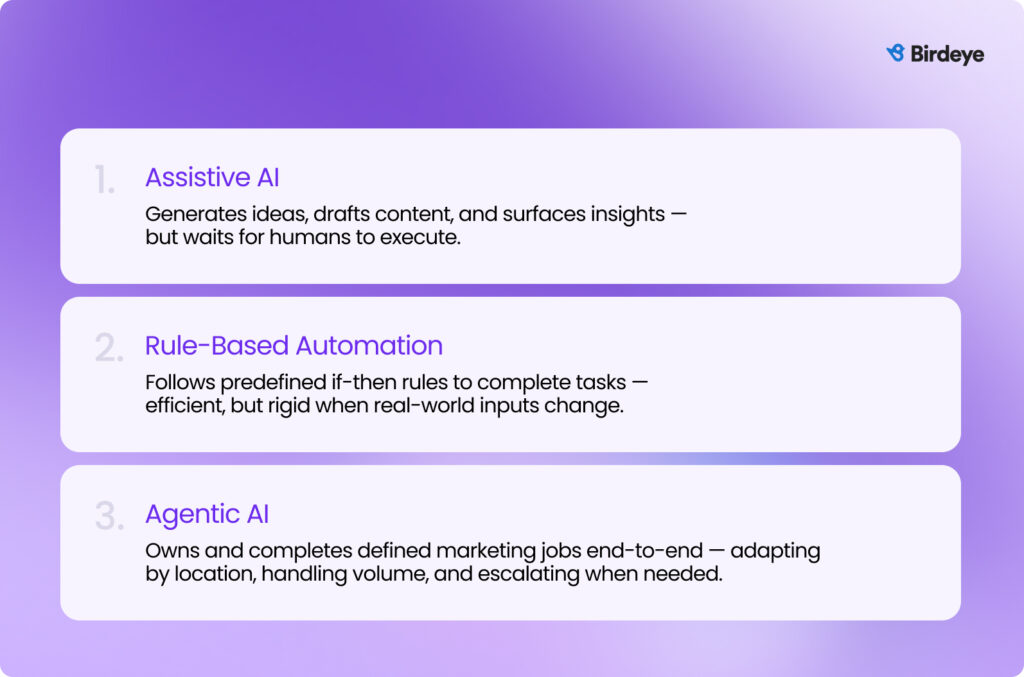
AI Assistive marketing helps you think. It drafts copy, summarizes reviews, suggests optimizations, or highlights trends. A human still has to review, decide, and execute.
Rule-based automation follows predefined logic. If a review contains certain keywords, trigger a response. If a form is submitted, send a follow-up email. These workflows are efficient, but rigid. When inputs vary, which they always do in multi-location environments, they break or require constant maintenance.
Agentic AI is different. It owns a defined marketing job and completes it end-to-end within guardrails. It adapts to context, operates at the location level, handles volume fluctuations, and escalates exceptions when needed.
Agentic Marketing takes ownership of execution
The distinction becomes clear in the case of distributed brands. In a single-location business, assistive AI may be enough. One team reviews suggestions and manually pushes changes. The operational load is manageable.
In a brand with 500 or 2,000 locations, that model collapses.
You are not solving for a single listing update or a single review response. You are solving for:
- Thousands of business profiles
- Uneven review velocity across locations
- Regional competitive pressure
- Fluctuating inbound messaging volume
- AI search visibility that varies store by store
When AI only recommends actions, the burden of repetition falls back on your team. Every insight becomes hundreds of manual tasks. Execution slows. Inconsistency creeps in. Performance fragments by region.
Agentic marketing exists to close that gap between insight and action, especially for multi-location brands where scale amplifies every inefficiency.
Must read: The AI maturity ladder for multi-location brands: Moving beyond AI-assisted marketing
What are the 5 tests every CMO should do to evaluate “Agentic” claims
Agentic has quickly become the new label vendors attach to anything powered by AI.
But for CMOs leading multi-location brands, the stakes are operational. If you’re going to trust a platform with execution across hundreds or thousands of locations, you need clarity.
Before accepting any “agentic” claim, ask these five questions:
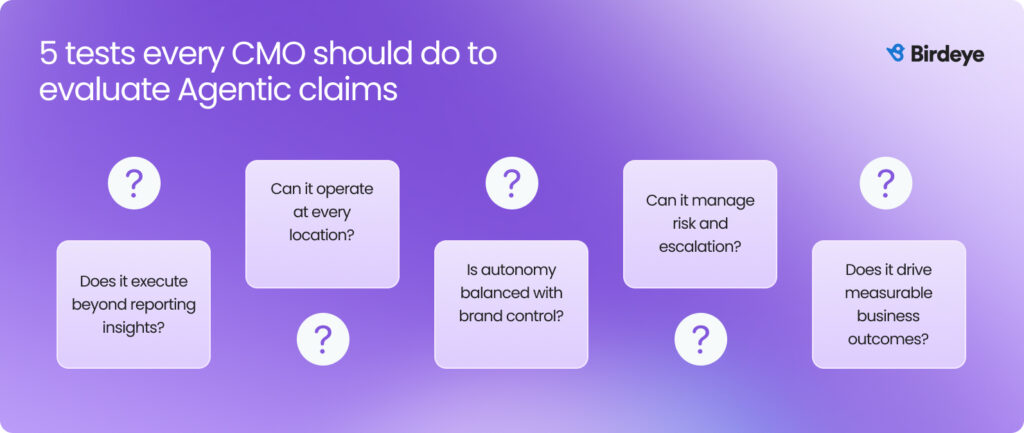
1. Does it actually execute, or only report?
Many platforms surface insights about:
- Your visibility dropped.
- Your sentiment is declining.
- Your competitors are outranking you.
That’s reporting. And it is indeed useful. But it’s not agentic.
Agentic capability means:
- Detecting the issue
- Prioritizing what matters
- Making the update
- Closing the loop
It carries through the task, whether that’s optimizing a listing, sending a review request, updating a profile, or drafting a response.
If your team still has to translate insights into action manually, the tool is assistive. Not agentic.
2. Can it operate at the location level?
AI search engines don’t rank a brand. They evaluate individual locations.
A brand might look strong overall while specific regions underperform in visibility, sentiment, or citation authority. If the platform cannot monitor and execute at the location level, rankings by zip code, sentiment by store, and engagement by region, it cannot manage distributed execution.
Anything less is surface-level control.
3. Can it run autonomously with guardrails?
Automation without governance creates risk. Governance without automation creates bottlenecks.
The real test is balance. Which is why every CMO must assess:
- Can review requests be sent automatically?
- Can first-pass responses be drafted in brand voice?
- Can social content be published within approval workflows?
- Can inquiries be routed intelligently based on intent?
If everything requires manual approval, it won’t scale.
If nothing can be supervised, it won’t be safe.
A credible agentic platform allows you to define where autonomy applies and where oversight is required.
4. Does it manage exceptions and escalations?
Execution is easy when interactions are predictable. It breaks down when they aren’t.
Legal complaints. Refund disputes. Compliance-sensitive messaging. Safety issues.
A true agentic platform doesn’t blindly automate these. It detects risk, flags anomalies, routes appropriately, and escalates when needed. If the system cannot distinguish between a five-star thank-you and a potential legal exposure, such “AI agents” create brand risk.
5. Can it create a measurable impact?
The final test is accountability. Does the agentic execution lead to:
- Faster review response times?
- Higher review volume?
- Improved visibility in AI answer engines?
- Stronger engagement across social?
- Clear ROI reporting across locations?
If “agentic” activity cannot be measured in outcomes that matter to the business, it’s experimentation, not infrastructure.
If those five tests define what agentic marketing should look like, the next question becomes practical: Which platform actually meets that standard at scale?

This is where Birdeye’s approach to Agentic Marketing becomes clear. So, let’s examine how Birdeye applies these principles across its platform.
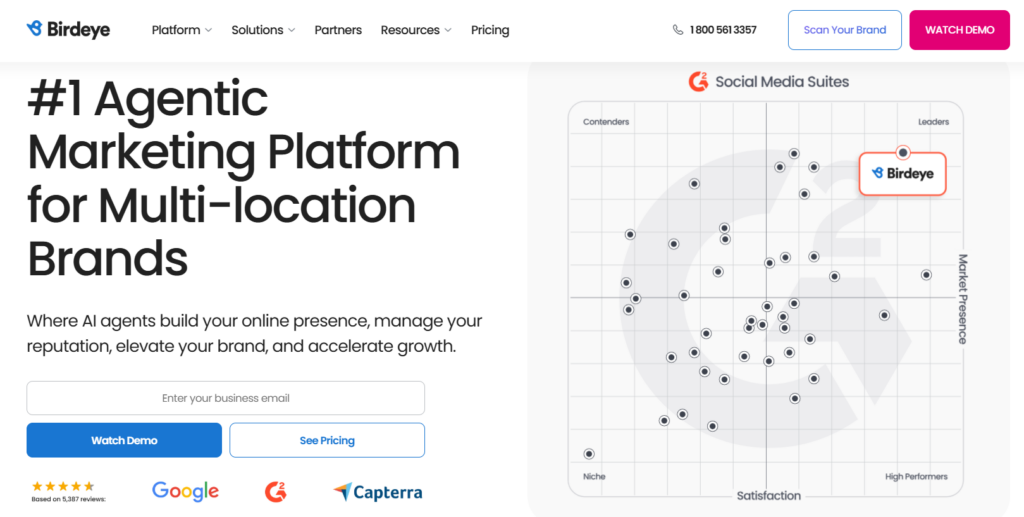
How does Birdeye power Agentic Marketing at scale?
Birdeye is built for multi-location brands managing operations across 100 to 10,000+ locations. The platform integrates with 3,000+ CRM and business systems, including Salesforce, QuickBooks Online, HubSpot, and leading PoS platforms across industries.
Instead of treating marketing tools as separate workflows, Birdeye integrates them into a single, coordinated execution layer. AI agents detect signals, make decisions, and execute marketing tasks across locations, keeping brand guardrails intact.
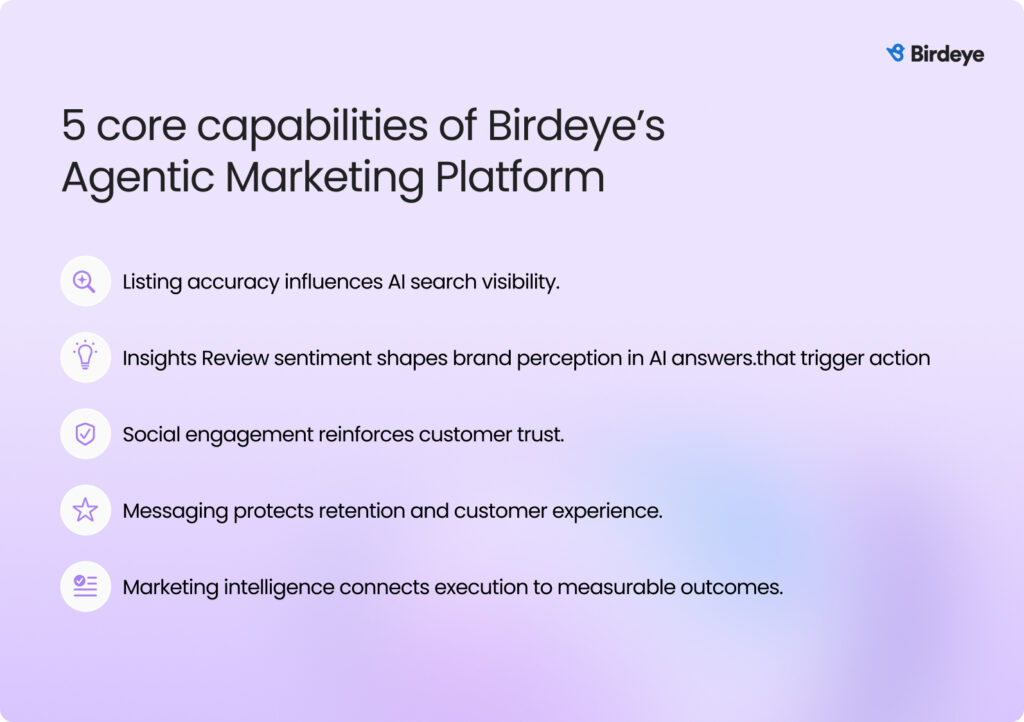
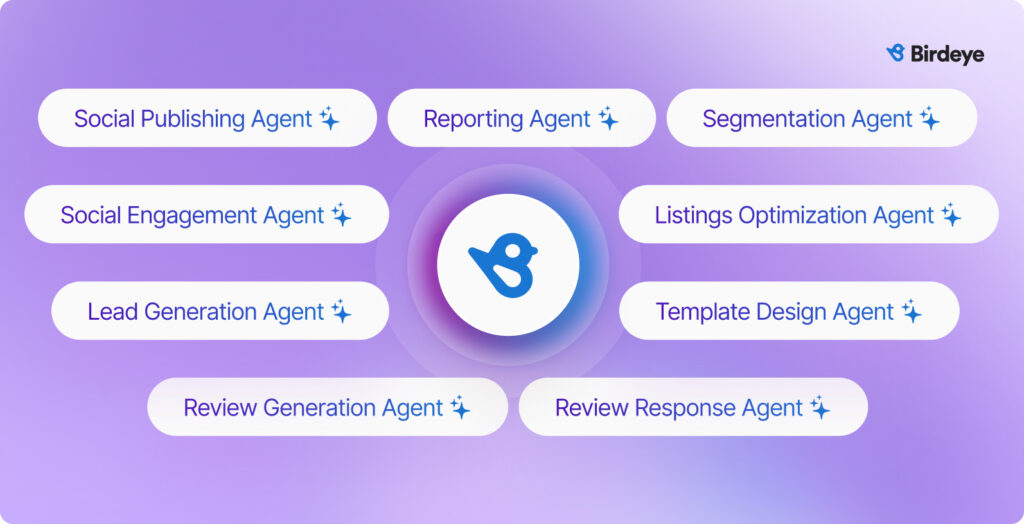
Birdeye’s Agentic Marketing Platform focuses on five core capabilities that power execution for multi-location brands:
Each capability contains AI agents that own specific marketing jobs. Together, they form an operational layer that runs continuously across locations.
The three pillars of the #1 Agentic Marketing Platform
- Full-cycle Platform: This is the flywheel that replaces messy, disconnected tools with one coordinated system. It manages the entire customer journey—from the first review to the final social post—in a single loop.
- Local Intelligence: Birdeye uses a unified Customer Data Platform (CDP) to understand what is happening at each location. It ensures your data is accurate so AI engines can find you locally.
- Marketing Agents: These are brand-trained Marketing AI agents that act like digital teammates. They don’t just follow rules; they reason, draft, and complete marketing jobs at scale while you maintain control.
Let’s look at how that works in practice.
Reviews & reputation: Turning customer feedback into growth
Reputation signals influence both customer decisions and AI search interpretation.
Birdeye’s Reviews AI spans 200+ review sites, enabling brands to manage their reputation consistently across every location.
Several AI agents support this workflow:
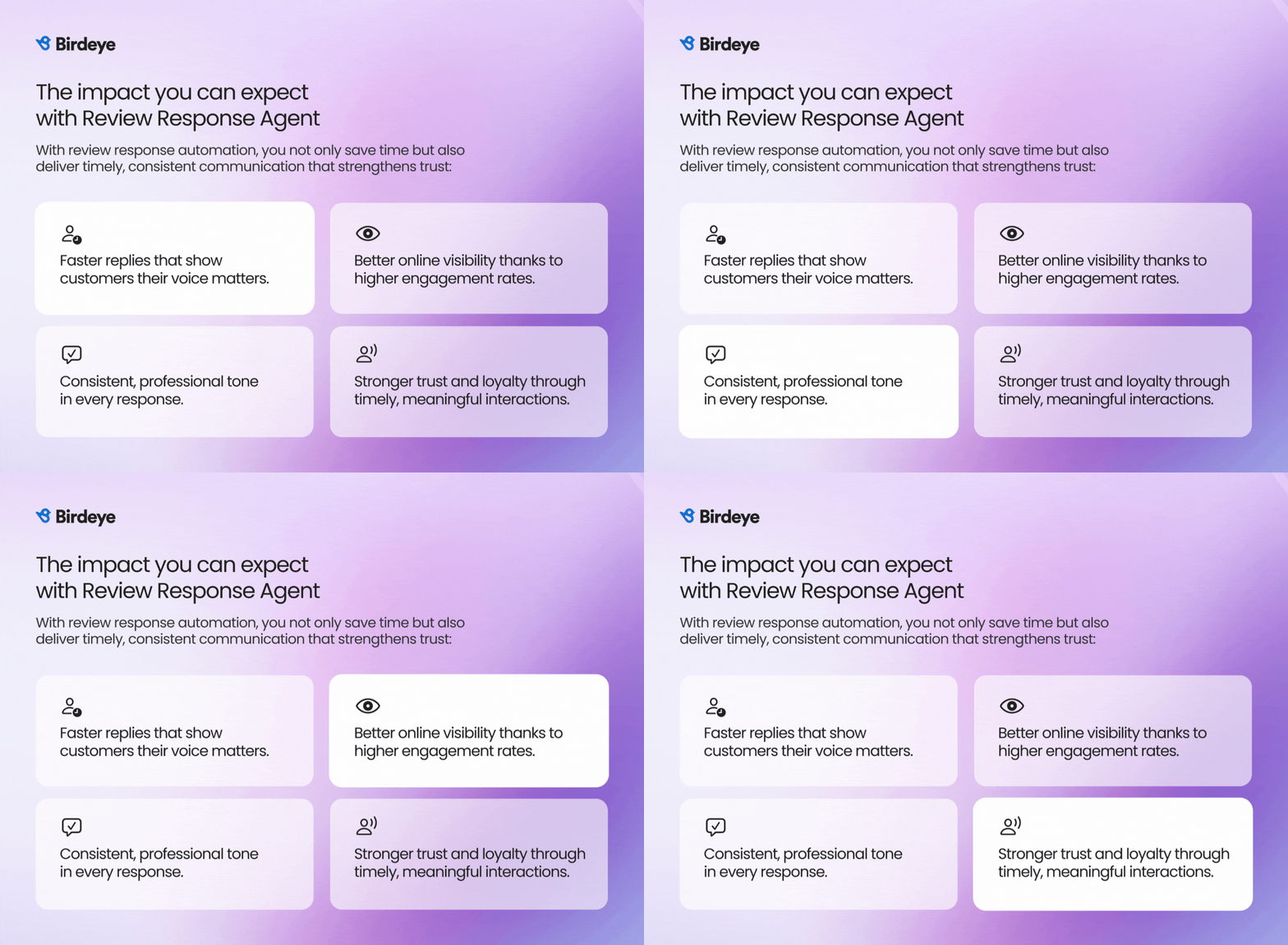
- Review Generation Agent identifies new contacts, selects the optimal review site, schedules requests intelligently, and follows up when necessary.
- Review Response Agent analyzes sentiment, urgency, and images to craft on-brand responses while respecting approval rules.
- Review Reporting Agent surfaces sentiment trends and performance shifts in real time.
This ensures reputation management remains consistent across locations while scaling review generation and response coverage.
Listings & search visibility: Protecting discoverability across platforms
AI answer engines rely on two critical signals: accurate business data and reputation signals. Inconsistent hours, duplicate listings, or outdated contact information weaken authority and reduce discoverability.
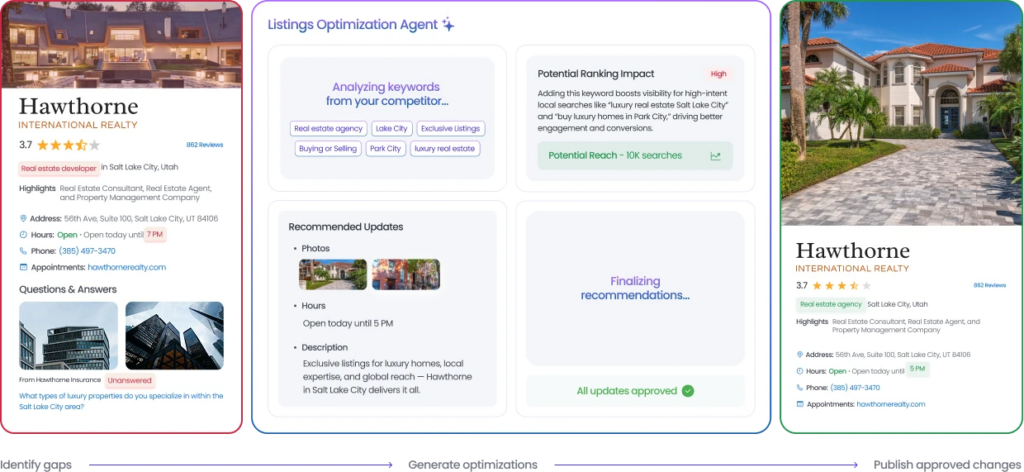
Birdeye’s Listings AI continuously scans profiles across platforms such as Google, Apple, Facebook, and Yelp to identify gaps and inconsistencies. The Listings Optimization Agent flags errors, recommends updates, and applies corrections within defined brand guardrails.
Birdeye’s Search AI complements this by analyzing how locations appear inside AI answer engines such as ChatGPT, Gemini, and Perplexity. It identifies citation gaps, prompt patterns, and visibility opportunities that influence how these engines surface businesses.
Together, listing accuracy and search visibility ensure brands remain discoverable across both traditional search and emerging AI answer engines.
Social engagement: Scaling local presence across locations
Maintaining a consistent social presence across hundreds or thousands of locations is operationally complex.
Birdeye’s Social AI agents support both publishing and engagement:
- Social Publishing Agent analyzes past performance, competitor activity, and trends to generate optimized posts for each location.
- Social Engagement Agent monitors comments and messages, detects intent, routes conversations appropriately, and drafts contextual responses.
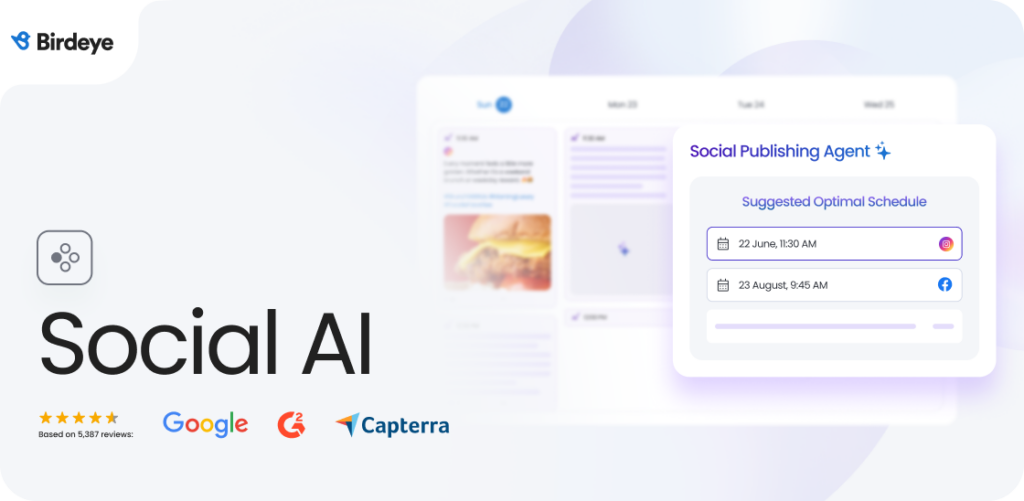
Approval workflows remain configurable, allowing brands to maintain central oversight while enabling local relevance.
Messaging & customer communication: Managing communication across channels
Customer conversations now happen across web chat, social messaging, email, and text.
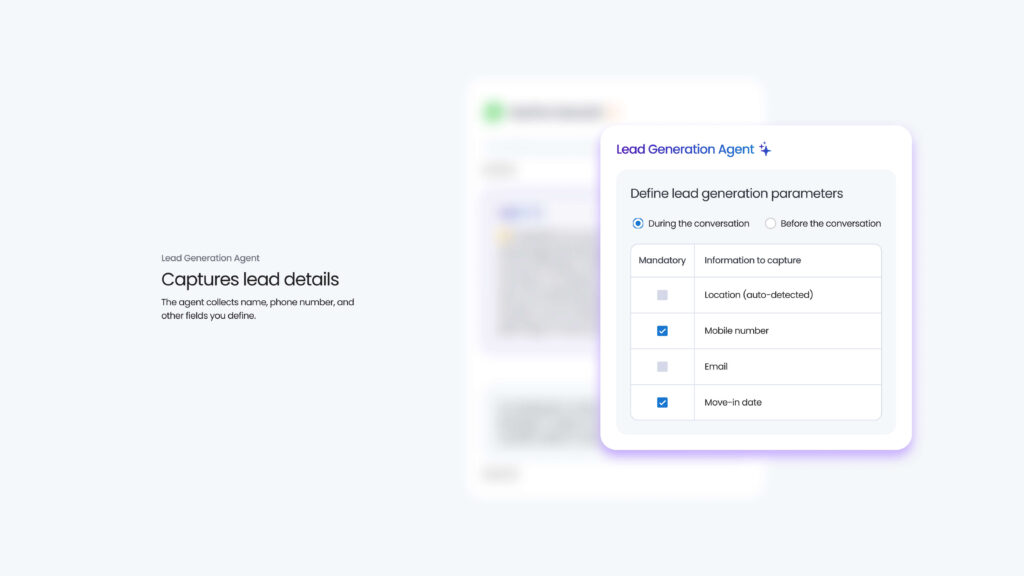
Birdeye’s Messaging AI agents help brands structure and respond to these interactions efficiently. Agents such as Lead Generation, Email Template, and Contact Segmentation can:
- Detect customer intent in real time
- Qualify and route leads to the correct location
- Draft on-brand responses
- Escalate sensitive conversations when needed
Marketing intelligence: Connecting execution to performance
Execution without visibility creates blind spots.
Birdeye’s Reports AI and Insights AI transform operational activity into measurable intelligence for marketing leaders. Instead of static dashboards, the Reporting Agent analyzes performance shifts in real time and explains the factors driving those changes.
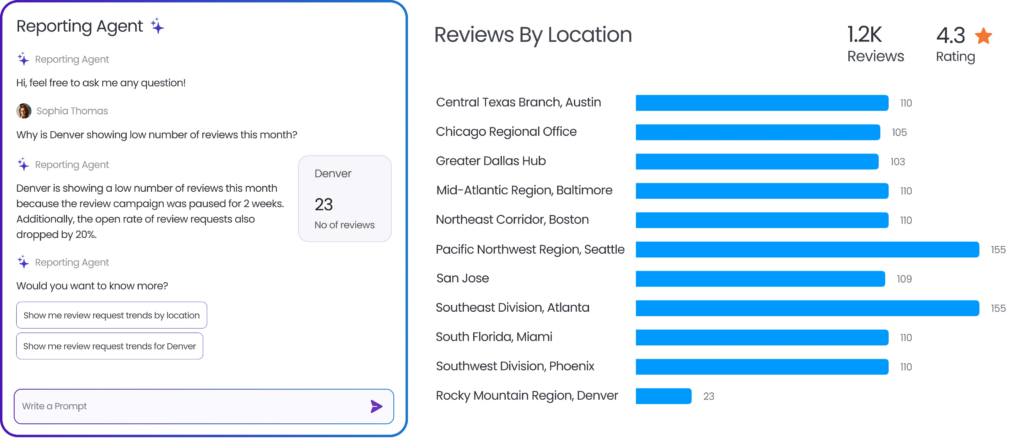
Insights AI consolidates reputation, listings, and sentiment signals into measurable benchmarks, including Birdeye Score, Sentiment Score, Reputation Score, and Listing Score.
This allows brands to understand performance across locations and continuously refine their marketing strategy.
Birdeye does not treat these as disconnected tools. It operates them as a coordinated execution layer for multi-location brands. That is how agentic marketing becomes practical — and scalable — across distributed locations.
Execution at scale raises another important question: how do brands maintain control while delegating repetitive work to AI agents?
Can Agentic Marketing run on its own without losing control?
One of the biggest concerns CMOs have is simple: If AI agents are executing across 100-10,000+ locations, how do we stay in control?
It’s a valid question.
Birdeye’s approach to agentic marketing is not about being unsupervised. It’s about structuring execution inside defined guardrails.
Across multi-location brands, not every marketing task carries the same level of risk. Some workflows are repetitive and low-impact. Others involve legal exposure, compliance sensitivity, or brand reputation.
Birdeye’s Agentic Marketing Platform is built to distinguish among those layers of risk and to allow configurable control at each layer.
Let’s break it down clearly:
| Category | Best fit for | Examples | Who owns the final control |
| Autonomous execution | High-volume, repeatable tasks where speed and consistency matter more than judgment | • Sending review requests after verified interactions (Reviews AI) • Drafting first-pass review responses in brand voice (Review Response Agent) • Monitoring listings for accuracy gaps (Listings AI) • Scheduling social posts within predefined themes (Social Publishing Agent) • Routing basic customer inquiries (Messaging AI) | AI agents execute within defined brand guardrails |
| Supervised execution | Interactions involving legal, compliance, financial, or reputational risk | • Sensitive public complaints • Legal or compliance-related messaging • Refund disputes • Safety concerns • Regulated claims | Humans review, approve, and decide |
| Human accountability | Strategic and governance responsibilities that cannot be delegated | • Brand voice and governance rules• Escalation thresholds• Approval workflows• Customer recovery standards• Compliance requirements | Leadership defines boundaries and policy |
The real strength of Birdeye’s agentic model lies in its configurability. Brands decide where autonomy applies and where supervision is required.
For example:
- Approval workflows can be enforced in Social AI.
- Escalation rules can be defined in Reviews AI.
- Response routing logic can be structured inside Messaging AI.
- Guardrails can be applied to Listings AI updates.
Birdeye’s Agentic Marketing Platform centralizes execution under defined standards while preserving oversight where it matters most.
That balance restores operational speed without compromising brand integrity.
FAQs about why Birdeye is the #1 Agentic Marketing Platform
Birdeye’s AI agents don’t stop at insights or content suggestions. They execute defined marketing jobs across locations — from improving AI search visibility and updating listings to generating reviews, routing messages, and explaining performance shifts. Execution, not assistance, is the differentiator.
Search AI monitors the prompts customers use, tracks visibility and rankings by location, analyzes sentiment and citation sources, and identifies gaps in business information. It then prioritizes and executes updates that improve discoverability across AI search engines.
Yes — where appropriate. Brands can configure which workflows run autonomously and which require supervision. Low-risk tasks, such as review requests or listing monitoring, can run automatically, while sensitive reviews, legal messaging, or compliance-related interactions can be routed for human approval.
Yes. Birdeye is built specifically for multi-location brands managing 100 to 10,000+ locations. It integrates with 3,000+ systems, monitors 200+ review sites, and provides location-level visibility and execution across search, listings, reviews, social, messaging, and reporting.
How Birdeye delivers on the promise of being an Agentic Marketing Platform
Throughout this blog, we’ve defined what agentic marketing should mean: execution, location-level control, configurable oversight, and measurable outcomes.
Today, Birdeye powers marketing and customer experience for some of the largest brands globally, including H&R Block and Caesars Entertainment, as well as thousands of other multi-location enterprises across industries.
The platform supports brands managing thousands of locations, integrates with 3,000+ CRM and business systems, and continuously monitors 200+ review sites. Enterprise deployment also requires governance. Birdeye’s platform includes enterprise-grade controls such as:
- Role-based access control (RBAC) for structured permissions across corporate and local teams
- Single sign-on (SSO) for secure identity management
- SOC 2 Type II compliance to meet enterprise security and data protection standards
These controls ensure AI agents operate within clearly defined policies, approval workflows, and escalation paths.
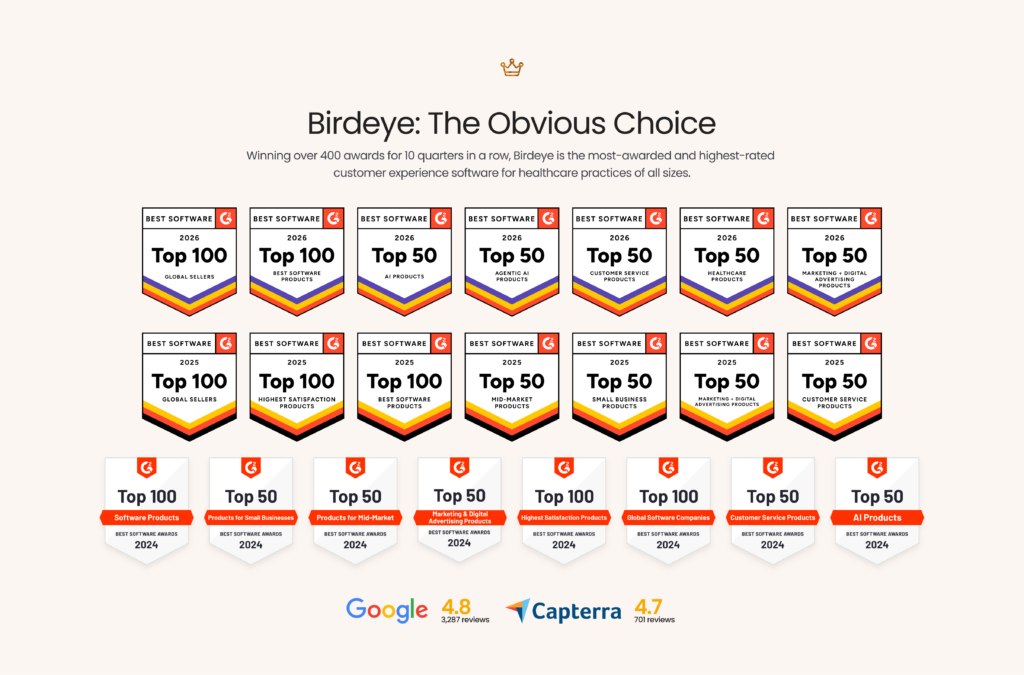
The result is a platform that enterprise teams can trust. Birdeye has been consistently recognized as a Leader on G2 & Gartner, earning top rankings across categories such as Online Reputation Management, Local Marketing, Customer Experience, and Social Media Management.
That is what it means to deliver on the promise of being an Agentic Marketing Platform: not smarter dashboards, but structured execution at scale — with enterprise governance and control intact.

About the Author

Avtar Madan
Avtar Madan
Originally published

![[Feature image] The Best Marketing Platforms for Multi-Location Brands](https://birdeye.com/blog/wp-content/uploads/Feature-image-The-Best-Marketing-Platforms-for-Multi-Location-Brands-375x195.png)