Email marketing vs marketing automation is a comparison that matters for any enterprise looking to scale customer engagement across multiple locations.
Email marketing focuses on one channel and delivers message-based outreach, often using basic email marketing tools and list-driven segmentation.
Marketing automation, on the other hand, analyzes multiple channels, supports email marketing, and connects data from CRMs, webforms, reviews channel, and social media to power more personalized communication.
Summary
As customer journeys become more complex and span more touchpoints, brands need systems that go beyond automated email campaigns.
This blog breaks down the differences, explains how each approach supports modern marketing strategy, and shows how AI-powered automation now helps marketing teams manage marketing processes and campaigns, and deliver measurable results across every location.
Table of contents
- What is email marketing?
- What is marketing automation?
- Why does the email marketing vs marketing automation comparison matter today for multi-location enterprises?
- Email marketing vs marketing automation: A comparison
- The real differences between email marketing and marketing automation
- Why traditional marketing automation no longer meets enterprise needs
- The new era — AI-powered automation that works across every touchpoint
- FAQs about email marketing vs marketing automation
- Birdeye unifies email marketing and marketing automation into one AI-powered engine
What is email marketing?
Email marketing centers on using a single communication channel to reach customers with newsletters, promotions, announcements, and updates. Most programs rely on basic email marketing tools that support scheduled sends, drip sequences, and simple automation.
Segmentation is often static and list-based, which limits personalization and the ability to adapt messaging based on customer behavior across multiple channels.
What is marketing automation?
Marketing automation expands beyond email to manage multi-channel marketing across SMS, chat, social, web, and even review and referral workflows. Marketing automation software uses real-time triggers, customer behavior, and CRM data to deliver more advanced email marketing and coordinated marketing campaigns at scale.
It supports lead scoring, customer lifecycle journeys, and integrations with marketing and sales teams to improve operational efficiency and unify marketing efforts across locations.
With the foundations defined, the real value comes from understanding where these two approaches diverge. Email marketing automation handles one channel well, but marketing automation involves multi-channel marketing, deeper personalization, and complex workflows that support enterprise needs.

The next section breaks down these differences in a clear, structured way so marketing teams can see where each approach fits into a modern marketing strategy.
Why does the email marketing vs marketing automation comparison matter today for multi-location enterprises?
Customer journeys no longer move in a straight line.
According to Birdeye’s State of Social 2026 report, consumers now discover and evaluate brands across multiple platforms simultaneously. Yet, many enterprises still operate channel-specific strategies that fail to reflect how people actually move through the customer journey.
A single interaction can start on social media, shift to email, jump to SMS, and end with a review or support conversation. For national or global brands, this means every channel must work together, not compete for attention.
Email marketing still plays an important role, but it cannot carry the load alone. Modern enterprises need a marketing strategy that coordinates messaging across multiple channels, aligns with marketing and sales teams, and adapts to customer intent in real time.
At the same time, the rise of AI search, automated customer engagement, and complex marketing campaigns has pushed marketers to rethink how they manage marketing processes at scale. This is where the shift from email marketing to marketing automation, and now toward AI-powered automation, becomes essential.
Email marketing vs marketing automation: A comparison
The differences between email marketing and marketing automation become much clearer when you look at how each one performs in day-to-day situations.
Below are scenarios that multi-location brands encounter constantly, along with what each approach can and cannot support.
| Category | Email Marketing | Marketing Automation |
| Channel coverage | Email-only | Multi-channel (email, SMS, chat, web, social, reviews) |
| Segmentation | List-based, static | Dynamic segmentation based on behavior, intent, sentiment, and CRM data |
| Personalization | Limited to fields like name or location | Deep personalization using triggers, actions, and multi-channel signals |
| Automation sophistication | Simple drips, scheduled sends, and autoresponders | Complex workflows, lead scoring, lifecycle nurturing, and logic |
| Data integration | Basic CRM or list uploads | Integrated data from CRM, POS, call center, webforms, reviews, social |
| Customer journey support | One-touch messages | Multi-step journeys across multiple channels |
| Cross-channel coordination | None | Unified messaging across email, SMS, chat, social, and web |
| Operational scale | Manual effort increases with more locations | Centralized workflows with location-level variations and controls |
| Performance measurement | Opens, clicks, deliverability | Multi-channel engagement, revenue attribution, lifecycle performance |
| Team alignment (marketing & sales) | Limited | Shared visibility, automated handoffs, qualified lead routing |
| Experience recovery | Not supported | Trigger-based recovery workflows tied to feedback and behavior |
| Impact on marketing strategy | Good for awareness and retention | Core engine for end-to-end customer journey orchestration |
The real differences between email marketing and marketing automation
Email marketing and marketing automation often get grouped together, but they operate at very different levels. One works as a channel. The other works as a system. For multi-location enterprises, that difference shapes everything from customer engagement to operational efficiency.
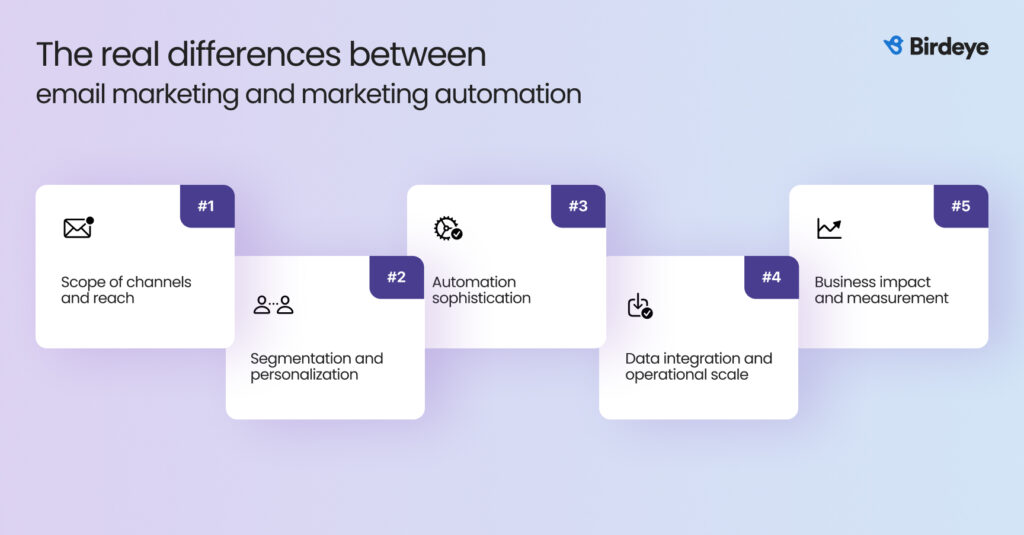
Below, each difference is laid out clearly so marketing and sales teams can see where each approach helps, where it falls short, and when advanced capabilities become essential.
#1. Scope of channels and reach
Email marketing manages a single channel. Marketing automation spans the entire customer journey.
Email marketing includes:
- Newsletters
- Promotions
- Standard updates
Marketing automation includes:
- SMS
- Webchat
- Social media messaging
- Review requests and responses
- Webform follow-ups
- Multi-step, cross-channel workflows
Why it matters for enterprises:
Multi-location brands engage customers across dozens of touchpoints. Marketing automation brings all channels together, ensuring every customer receives timely, unified communication, no matter where the interaction begins.
Take a typical customer interaction. Someone discovers your business through a social post, fills out a form on your website, and then texts you a scheduling question. Email marketing can respond only to one of those steps. Marketing automation ties all three together, ensuring the conversation continues without losing context.
#2. Segmentation and personalization
Segmentation determines relevance. Relevance determines engagement. Birdeye’s “The One” Survey shows that 74% of consumers read reviews before even considering a service provider, reinforcing why segmentation based only on email lists misses critical sentiment and trust signals.
Email marketing segmentation:
- Uploaded lists
- Basic attributes
- Batch-style sends
Marketing automation segmentation:
- Real-time data updates
- CRM, POS, and call center signals
- Intent-, sentiment-, and behavior-driven personalization
CRM vs marketing automation is the wrong question. Growth depends on using both
Consider a customer who leaves a negative review for one of your locations. Marketing automation can immediately adjust the customer experience, pausing promotional emails, notifying the appropriate team, and starting a service recovery workflow. The system adapts to the customer’s needs before the next message goes out. Email marketing cannot adapt at that level.
#3. Automation sophistication
Automation determines how much work a system can handle without teams needing to step in.
Email automation includes:
- Drip campaigns
- Scheduled sends
- Autoresponders
Marketing automation includes:
- Multi-step workflows
- Lead scoring
- Lifecycle nurturing
- Branching logic
- Multi-channel triggers
Think of a prospect who rarely opens emails but responds consistently to SMS. Marketing automation picks up on that behavior, updates their lead score, adjusts the outreach channel to match their preference, and alerts sales when it’s the right moment to follow up.
#4. Data integration and operational scale
Multi-location enterprises run on integrated data. Without it, marketing processes slow, reporting fragments, and decisions rely on guesswork.
Email marketing typically integrates with:
- Basic CRMs
- Standard signup forms
Marketing automation integrates with:
- CRMs
- POS systems
- Call center platforms
- Webforms and chat
- Review platforms
- Social channels
- Appointment systems
When customer information is stored in different systems at each location, teams lose visibility across the customer lifecycle. Marketing automation unifies those data streams so messaging, reporting, and triggers all follow the same customer record, no matter where the interaction happens.
#5. Business impact and measurement
Impact isn’t measured by how many emails are sent. It’s measured by how much revenue, loyalty, and satisfaction those messages generate.
Email marketing measures:
- Opens
- Clicks
- Deliverability
Marketing automation measures:
- Revenue contribution
- Multi-channel engagement
- Location-level performance
- Customer lifecycle movement
- Operational efficiency
A single enterprise campaign might drive email opens, SMS replies, chat questions, store visits, and even new reviews. Marketing automation connects these touchpoints into a single workflow, showing where momentum builds and which channels or locations contribute most to conversions.
With these differences in mind, it becomes clear why email marketing, while still essential, cannot fully manage the depth of modern marketing efforts. The next step for enterprises is understanding where traditional marketing automation falls short and what’s required to support teams operating across many locations.
Why traditional marketing automation no longer meets enterprise needs
Traditional marketing automation was built for a different era. It was designed when customer journeys were linear, teams worked from a central office, and marketing channels operated independently. For multi-location enterprises managing thousands of interactions every day, those assumptions no longer hold.
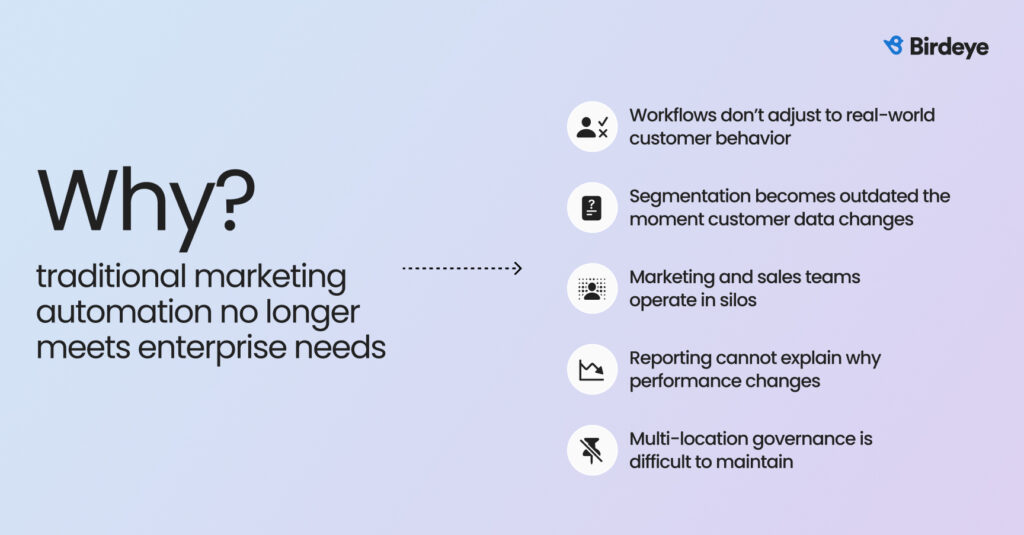
Most marketing automation platforms still rely on static workflows, rigid triggers, and systems that demand heavy manual setup. They automate tasks, but they don’t adapt.
Birdeye’s State of Online Reviews 2024 shows that 42% of review responses were automated, reflecting a clear shift away from manual, rule-based workflows toward scalable automation that adapts to volume and complexity.
They collect data, but they don’t interpret it. And they deliver campaigns, but they rarely provide clarity on what actually drives results across regions, teams, or channels.
Several gaps show up quickly when enterprises operate at scale:
1. Workflows don’t adjust to real-world customer behavior
A journey built around email cannot automatically adjust when customers respond on SMS, chat, or social. Legacy systems follow the script, even when the customer doesn’t.
2. Segmentation becomes outdated the moment customer data changes
With hundreds of locations feeding new data every hour, lists and manual updates cannot keep pace. This creates inconsistent experiences across markets.
3. Marketing and sales teams operate in silos
Traditional platforms lack the deep integrations required to connect CRM, POS, call center systems, reviews, and social channels. The result is fractured data, duplicated work, and missed opportunities.
4. Reporting cannot explain why performance changes
Legacy dashboards show trends but rarely the cause behind them. Marketing teams know what changed, but not why it changed or which actions will improve results.
5. Multi-location governance is difficult to maintain
Local teams often need visibility and control, but traditional automation tools don’t support consistent guardrails, brand standards, or cross-location coordination.
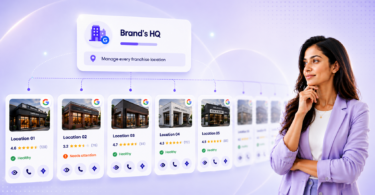
Email marketing vs marketing automation, enterprise insights for multi-location brands
Want to see the impact of Birdeye on your business? Watch the Free Demo Now.
As customer expectations rise and interactions stretch across multiple channels, these limitations become bottlenecks. Enterprises need more than automated email campaigns or conditional workflows. They need systems that interpret signals, connect data across the customer lifecycle, and respond in real time at scale.
All of this makes it clear why traditional marketing automation can only go so far. To support today’s customer journeys, enterprises need something more responsive, more connected, and far more intelligent. That’s where AI-powered automation transforms what marketing automation can deliver.
The new era — AI-powered automation that works across every touchpoint
As customer journeys spread across more channels and locations, traditional marketing automation struggles to keep up. Teams need systems that adapt in real time, connect every signal, and keep communication consistent across hundreds of touchpoints.
This is where Birdeye stands out. As the #1 agentic marketing platform for multi-location businesses, Birdeye is trusted by by the biggest brands globally to unify engagement across email, SMS, chat, social, reviews, and search. With 3,000+ integrations across CRMs and software tools, and the ability to analyze reviews across 200+ sites, Birdeye brings every customer interaction and insight into one connected platform.
Below is how Birdeye’s AI Agents take marketing automation further, helping enterprises scale communication, insights, and execution automatically.
Search AI is future-proofing automation for the AI search era
Today, customers are increasingly turning to AI-generated answers. Search AI helps brands understand how they appear in ChatGPT, Gemini, Perplexity, and other AI platforms, then guides them toward better visibility.
What this brings to marketing automation:
- Discovery of customer prompts and demand signals
- Visibility and ranking analysis across AI search engines
- Accuracy checks for business information
- Automatic updates powered by AI Agents
This prepares enterprises for the biggest shift in search since mobile.
Reviews Agents are turning customer feedback into automated growth loops
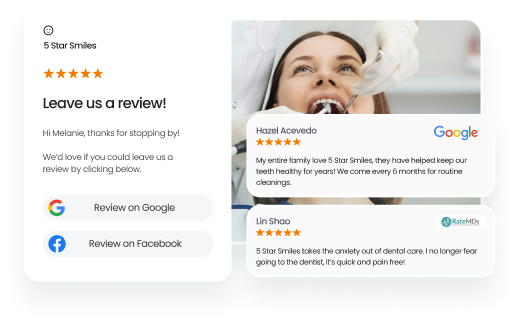
No doubt that today, reviews are one of the most influential signals in a customer’s decision-making process. Reviews Agents automate everything from generating new reviews to responding to them and uncovering sentiment trends.
Where they extend traditional marketing automation:
- Automatically detect new customers and request reviews
- Personalize review replies using tone, context, and sentiment
- Identify patterns across locations and surface insights instantly
- Feed review and sentiment data back into segmentation and workflows
This creates a continuous loop: better reviews lead to a stronger reputation, which improves discoverability, which generates more leads.
Social AI Agents are automating publishing, engagement, and trend detection
Multi-location brands often struggle to maintain a consistent social media presence. Social AI Agents analyze trends, create content, publish at the best times, and respond to comments or messages automatically.
What this adds beyond marketing automation:
- AI-generated posts tailored to each channel
- Scheduling based on predicted engagement
- Automatic replies that reflect brand voice
- Competitor content analysis to guide strategy
Teams no longer need to start with a blank calendar. Social Publishing Agent keeps the content flowing while respecting brand guardrails.
Real-world proof — How GreenEarth Cleaning scaled social reach 8X with Birdeye
Theory is helpful, but real-world examples clearly show the impact. One standout is GreenEarth Cleaning, a leader in eco-friendly dry-cleaning technology with 230+ franchise locations across the U.S. Coordinating social media across hundreds of independently owned locations became a daily challenge.
Franchisees had little visibility into what was being posted on their behalf; posts were often duplicated, and messaging sometimes drifted off-brand.
With Birdeye Social AI, the entire system changed.
- The corporate team gained a unified publishing calendar
- Franchisees finally saw what was scheduled and could add their own content
- Dynamic tagging automatically localizes posts
Since adopting Birdeye, GreenEarth has achieved:
- 8X increase in reach (1.9M impressions, +833.2%)
- 150% growth in total social audience (to 7.6K)
- 29.4K+ post link clicks
- 85.9K+ engagements (+1687.4%)
- New locations growing from 10 followers to 500+ in weeks
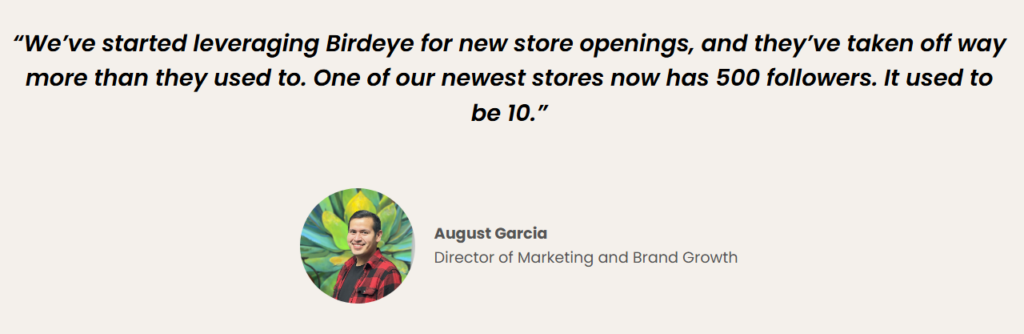
This performance aligns with findings from Birdeye’s State of Social 2026, which shows that consistent, automated publishing and fast engagement significantly improve reach and audience growth for multi-location brands.
Listings AI Agents, automating local discoverability across every market
Accurate listings fuel local SEO. But managing them across hundreds of locations is nearly impossible manually. Listings AI Agents synchronize business information, fix inconsistencies, and strengthen the citations search engines rely on.
How they complement marketing automation:
- Auto-update information across all listing sites
- Identify accuracy gaps and correct them
- Optimize categorization and keywords
- Boost visibility across multiple channels
Insights AI, surfacing real-time intelligence for marketing and sales teams
Marketing automation triggers actions based on data. Insights AI interprets that data, making it easier to understand what customers are saying, what they want, and where friction exists.
How it deepens marketing insights:
- Analyzes sentiment across reviews, surveys, social, and messaging
- Identifies emerging themes and patterns
- Helps teams prioritize actions that impact customer experience
- Provides clarity across all locations with unified intelligence
This turns raw customer feedback into actionable direction for marketing and operations.
Reports AI, automated explanations behind every performance shift
Most analytics tools show what changed. Reports AI explains why it changed. It detects anomalies instantly, identifies root causes, and provides teams with clear next steps.
Key advantages over traditional reporting:
- Real-time detection of spikes, drops, and unusual trends
- Natural language explanations that eliminate guesswork
- Drill-down insights across channels and locations
- Outcome-focused reporting that ties back to revenue and efficiency
Competitors AI, turning competitive analysis into automated advantage
Competitor research is often reactive. Competitors’ AI makes it proactive. It tracks reviews, rankings, visibility, and sentiment for competing brands across locations, then automatically summarizes the insights.
How this strengthens marketing automation:
- Continuous monitoring of competitor performance
- AI summaries identifying strengths, gaps, and opportunities
- Benchmarking across reputation, social, and visibility
- Recommendations that feed into the marketing strategy
Enterprises gain clarity on how they stack up and where to focus for maximum impact.
Messaging AI Agents, automated engagement across email, text, chat, and web
Messaging AI Agents help teams scale conversations without sacrificing personalization. They interpret customer intent, segment audiences instantly, and create email, SMS, and webchat content that feels on-brand at every step.
How they enhance marketing automation:
- Capture every new lead the moment they reach out
- Segment contacts automatically based on behavior and data
- Generate branded email templates in seconds
- Respond across SMS, chat, social, and web with a consistent tone
These capabilities help enterprises move beyond basic email marketing and into unified, multi-channel engagement that doesn’t rely on manual routing or follow-up.
Together, these AI Agents extend marketing automation into something far more adaptive and unified. The next step is to see how email marketing, marketing automation, and AI automation compare when applied to real enterprise scenarios.
FAQs about email marketing vs marketing automation
Email marketing focuses on a single channel and uses basic email marketing tools to send newsletters or promotions. Marketing automation manages multi-channel marketing across email, SMS, chat, social, and web while using triggers, data, and workflows to personalize communication at scale.
Yes. Email marketing plays an important role within a broader marketing automation strategy. Marketing automation expands email marketing by adding segmentation, lead scoring, and coordinated multi-channel engagement so every message fits the customer journey.
Most brands make the shift when they outgrow list-based sends and need real-time personalization, multiple channels, or better coordination between marketing and sales teams. Multi-location businesses typically move sooner because manual processes don’t scale across regions.
No, but enterprises benefit the most. Multi-location brands need automated marketing efforts, deeper integrations, and coordinated messaging across hundreds of touchpoints, which manual email marketing can’t support.
AI brings intelligence to automation by interpreting sentiment, adjusting segments in real time, generating on-brand messages, detecting performance shifts, and improving visibility across search and social. It removes manual work and helps teams move faster with better clarity.
Consistency. Marketing automation ensures every location delivers on-brand, timely, and personalized experiences without relying on manual processes. It keeps customer journeys aligned across regions, teams, and channels while reducing operational effort.
Birdeye unifies email marketing and marketing automation into one AI-powered engine
Most platforms force teams to treat email marketing and marketing automation as separate workflows. Birdeye brings them together, then elevates both with AI Agents. The result is a single, connected system that grows with your business instead of adding more manual work.
Trusted by global businesses to drive growth, Birdeye simplifies marketing and strengthens customer sentiment by scaling seamless communication across every touchpoint.
Here’s how Birdeye simplifies what other platforms complicate:
- Email works as part of a unified engagement engine.
Messaging AI Agents create branded emails, follow up through SMS and chat, and keep every conversation connected. - Segments stay current automatically.
Real-time behavior, sentiment, and customer signals continuously update audience groups, keeping campaigns relevant without list maintenance. - Customer insights strengthen every campaign.
Reviews, Listings AI, and Social AI bring customer feedback and visibility signals into the same system powering your campaigns. - Reporting and data explain themselves.
Instead of digging through dashboards, Insights AI and Reports AI explain performance changes in clear language so teams understand what happened and why. - Competitive and AI search intelligence guide better decisions.
Competitors AI and Search AI show how your brand compares in the market and how it appears in AI search engines like ChatGPT and Gemini.
Together, these capabilities unify the best of email marketing and marketing automation into one AI-powered growth engine that keeps every location consistent, every team aligned, and every customer interaction connected.

About the Author

Shruti Dugar
Birdeye
Originally published