Reputation management is no longer the challenge. Turning it into growth is.
Summary: Today, multi-location brands are flooded with reviews, feedback, and customer signals across every channel. The real challenge is knowing what to act on and how to turn that into visibility, trust, and growth across every location.

This is where the gap between platforms becomes clear.
In this guide, we compare Birdeye vs Reputation to show the difference between managing feedback and building a system that continuously improves performance.
Read on to understand which platform is built for enterprise scale and real business outcomes.
Table of contents
- Reputation vs Birdeye: Two fundamentally different approaches
- Understanding Reputation’s platform (and how it works)
- Where Reputation(dot)com falls short for multi-location brands
- What makes Birdeye a true Agentic Marketing Platform
- Major features where Birdeye excels over Reputation
- FAQs: Birdeye vs Reputation
- Enterprise brands are moving beyond reputation tools and choosing Birdeye
Reputation vs Birdeye: Two fundamentally different approaches
Reputation and Birdeye are often evaluated together because both operate across reviews, listings, surveys, and customer feedback.
But they are built to solve different problems.
Reputation is designed as a reputation performance platform. Its strength lies in capturing feedback, analyzing sentiment, and helping teams act on issues through structured workflows.
Birdeye is built as an agentic marketing platform for multi-location brands.
Instead of organizing capabilities into separate functions, Birdeye connects discovery, reputation, engagement, and conversion into a single system powered by AI agents.
This difference becomes more important at an enterprise scale.
Reputation helps teams manage and act on customer feedback. Birdeye goes further by shaping how customers discover, evaluate, and choose your brand across every location.
Birdeye is a valued partner for our business listings consistency and integrations. Their Listings AI, Social AI, and Reviews are integral to our overall marketing and brand strategy. The team is professional, and the support is best in class! Our team utilizes Birdeye daily for our social strategy and reputation management. Highly Recommended! – Patti M., Vice President of Marketing (5/5, Verified G2 reviewer)
Understanding Reputation’s platform (and how it works)
Reputation(dot)com positions itself as a platform built for reputation performance in the AI era. Its core focus is to help brands capture customer feedback, analyze it, and translate it into operational action across locations.
The platform is organized into a set of tightly connected modules that focus on different stages of the feedback lifecycle.
1. Reputation® IQ and the intelligence layer
Reputation® IQ serves as the platform’s central intelligence layer.
It allows users to ask questions in English and receive answers drawn from reviews, surveys, and competitive data. Instead of navigating multiple dashboards, teams can quickly understand trends, root causes, and performance shifts across locations.
These insights can then be pushed into workflows so teams can act on them without delay.
2. Listings + local SEO and visibility management
Reputation’s listings + local SEO capability focuses on maintaining accurate and consistent business information across directories.
It centralizes business data and distributes updates across platforms to ensure consistency. It also supports structured data formats, so listings are better aligned with modern search environments.
3. Reviews & Review Booster
The Reviews and Review Booster capabilities are designed to increase review volume and manage responses at scale.
Brands can automate review requests after customer interactions, monitor reviews across platforms in a unified feed, and use AI-assisted responses to maintain consistency.
4. Surveys and feedback capture
Reputation extends beyond public reviews by capturing private feedback through surveys.
It uncovers deeper context behind customer sentiment, using AI to analyze open-text responses and identify recurring themes.
Feedback can then be routed into workflows, allowing teams to address issues before they impact brand perception.
5. Insights, Competitive Insights, and RepScore
The Insights layer aggregates signals from reviews, surveys, listings, and engagement data. It enables brands to track sentiment trends, benchmark performance against competitors, and monitor changes across locations.
RepScore acts as a unified metric that reflects overall reputation performance, combining multiple signals into a single, trackable score.
6. Social Suite and Actions
Reputation’s Social Suite centralizes publishing and engagement across platforms, enabling brands to coordinate content and respond to customer interactions at scale.
The Actions capability connects feedback to operations by converting issues into tickets, assigning ownership, and tracking resolution across teams.
Together, these components create a closed-loop system where feedback is captured, analyzed, and resolved.
However, as brands scale, the challenge moves beyond resolving feedback to shaping visibility, engagement, and customer choice across every location.
Where Reputation(dot)com falls short for multi-location brands
Reputation’s model is built around a structured loop:
- Capture feedback across channels
- Analyze sentiment and trends
- Route issues into workflows
- Track resolution and performance
However, enterprise brands are not only trying to manage feedback. They are trying to improve visibility, drive engagement, and influence customer decisions across every location.
As expectations shift from managing reputation to improving performance, certain gaps become more visible. Here are a few limitations of Reputation:
1. Built around feedback, not the full customer journey
Reputation is centered on reviews, surveys, and sentiment.
While it supports listings and social, these capabilities are not tightly integrated with a system that manages discovery, engagement, and conversion.
For enterprise teams, this creates a disconnect between what customers say and how new customers discover and choose the brand.
2. Limited visibility into how discovery is evolving
Reputation supports structured data and local search visibility. However, it does not clearly show how a brand appears across newer discovery experiences, or how perception is shaped beyond traditional channels.
As discovery becomes more dynamic, this limits how much control brands have over their visibility.
3. Capabilities operate as connected modules, not a coordinated system
Reputation brings Reviews, Surveys, Listings, Insights, and Actions together on one platform. But these operate as structured capabilities rather than a continuously coordinated system.
Insights inform action, but execution, optimization, and performance improvement are not fully unified. This makes ongoing optimization more dependent on manual interpretation and intervention.
4. Has operational workflows, but an indirect link to growth
Reputation routes feedback into actions and resolving issues at the location level.
However, the connection between these improvements and outcomes like visibility, engagement, and acquisition is less direct. For enterprise teams, this makes it harder to tie reputation efforts to broader business performance.
What makes Birdeye a true Agentic Marketing Platform
Birdeye is built differently. As a full-cycle agentic marketing platform, it brings together reviews, listings, social, messaging, and insights into a single connected system, rather than focusing solely on reputation management.
At the core is Birdeye’s Local Intelligence layer, which unifies every customer interaction across locations into a single source of truth. It is designed to scale across 100-10,000+ locations without added complexity.
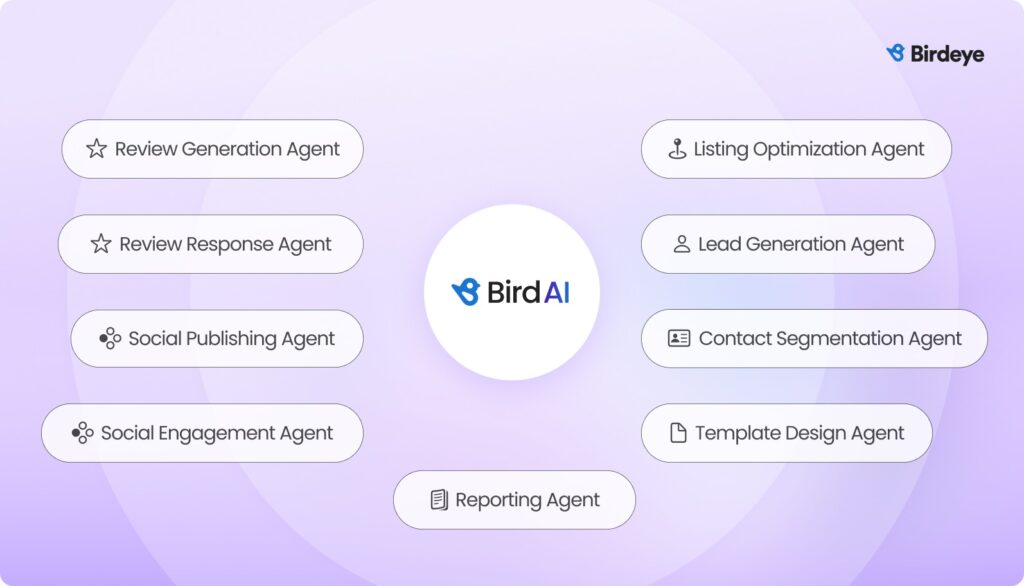
The 9 AI Agents powering Birdeye (and what they actually do)
Reputation structures its platform around modules such as Reviews, Surveys, and Insights, with AI embedded in each.
Birdeye deploys specialized AI agents that operate across the entire system, continuously coordinating actions across discovery, reputation, engagement, and conversion.
Each agent has a defined role, but more importantly, they work together to influence how customers find, perceive, and choose your brand.
| Agent | Core action | Strategic outcome |
| Listings Optimization | Scans profiles for inconsistencies, missing data, and SEO gaps. | Keeps data fresh and aligned with evolving search signals to drive discovery. |
| Review Generation | Identifies the optimal moment to request reviews based on engagement. | Shifts reputation management from manual effort to an always-on growth engine. |
| Review Response | Analyzes sentiment and intent to generate empathetic, on-brand replies. | Ensures 100% engagement and reinforces trust without overloading local teams. |
| Social Publishing | Tailors ready-to-publish posts for each location based on local trends. | Maintains a consistent brand voice while scaling local relevance at speed. |
| Social Engagement | Monitors and triages comments and DMs across all platforms in real-time. | Keeps engagement responsive by distinguishing high-value leads from noise. |
| Lead Generation | Drives 24/7 conversations across webchat, SMS, and social messaging. | Captures lead details and qualifies intent even when the office is closed. |
| Contact Segmentation | Builds precise audience cohorts (e.g., “inactive customers”) via simple prompts. | Enables precision targeting at scale without manual filtering or data exports. |
| Reporting Agent | Analyzes performance data to answer plain-English queries instantly. | Provides immediate context behind trends and anomalies without manual reporting. |
| Template Design | Generates brand-aligned email and SMS templates through a chat interface. | Reduces creative turnaround time while ensuring messaging consistency. |
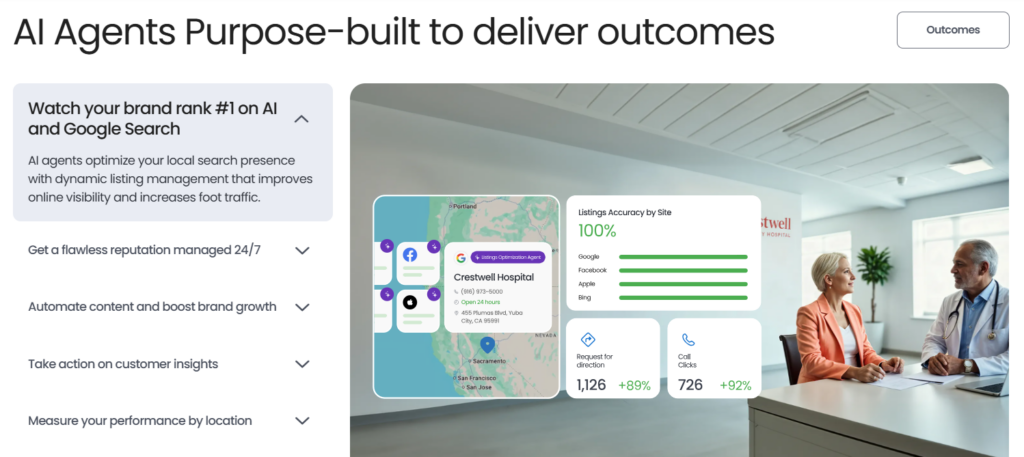
What makes Birdeye different from reputation platforms
Birdeye connects every customer interaction to visibility, engagement, and conversion through a coordinated system of AI agents. That’s what defines an agentic marketing platform:
Governed execution: Enterprise teams define approval workflows, permissions, and brand guardrails centrally, while AI agents execute locally. While traditional platforms like Reputation focus on reporting what happened, Birdeye’s human-in-the-loop agents act on your behalf, capturing leads and resolving issues across every location, 24/7.
Deep integration ecosystem: Birdeye connects with 3,000+ CRMs and industry-specific software systems. While legacy tools are limited to public review signals, Birdeye’s agents are fueled by your actual sales data and customer history.
Ease of use to get solid 5-star reviews from our customers. We are recommending it to all of our customers so they can gain huge improvements in their SEO. – Kris A., Co-Owner, Marketing and Advertising (5/5, Verified G2 reviewer)
Local intelligence & full-cycle automation: While agents handle the execution, they feed into Birdeye’s broader platform. Our Listing Optimization Agent helps improve visibility in AI-driven search (ChatGPT, Gemini, Perplexity), while Marketing Automation uses agent-generated segments to run hyper-local campaigns that traditional tools typically do not trigger as dynamically.
Actionable Insights AI: Legacy systems provide a score; Birdeye provides an action plan. Our Insights AI doesn’t just tell you that sentiment is down, it tells you why it mattered and suggests the exact response strategy to fix it. We connect the dots between a digital interaction and a physical visit.
Awards & recognition
Birdeye is not just positioned as a leader. It is consistently recognized by customers and industry benchmarks.
Birdeye is ranked as a Leader in G2’s Enterprise reports for Agentic AI, Reputation Management, Local SEO, and Customer Service.
Earning a Leader position in a G2 Report is highly competitive and rooted in verified customer reviews. Congratulations to Birdeye for achieving this distinction. — Godard Abel, CEO of G2
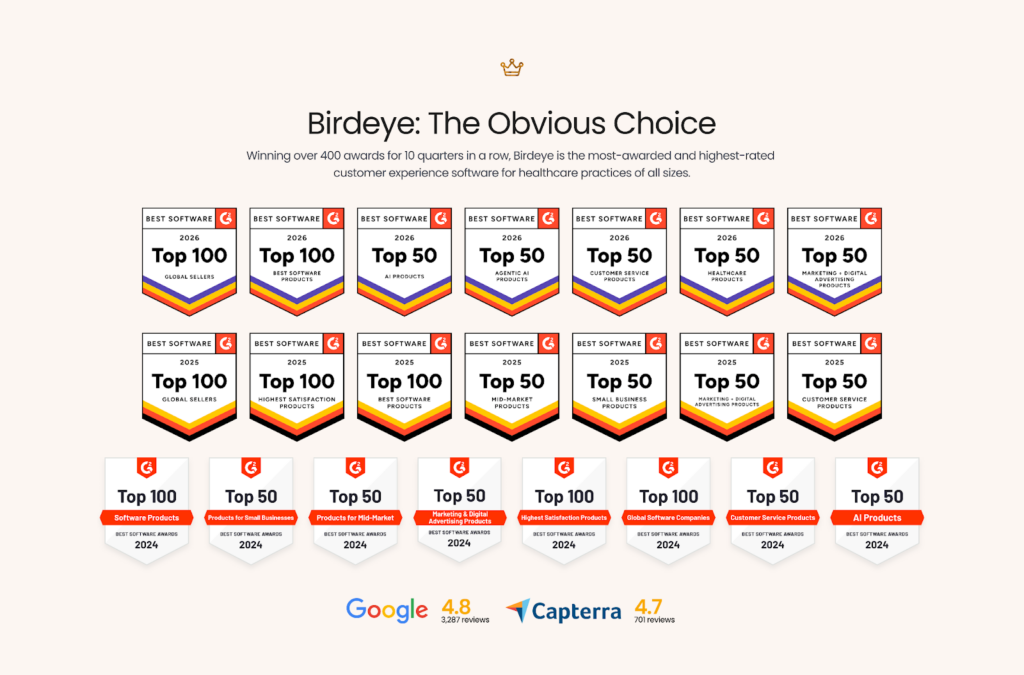
It is also consistently rated highly on platforms such as Capterra and Software Advice, where multi-location brands highlight its ease of use and depth of insights.
Unlike platforms focused primarily on reputation management, Birdeye is recognized across multiple enterprise and marketing categories that reflect its role as a complete system for managing visibility, customer experience, and growth.
Major features where Birdeye excels over Reputation
The difference between Birdeye and Reputation becomes clearer when you look at how each platform translates signals into measurable outcomes.
Reputation is effective at organizing feedback and enabling teams to act on it.
Birdeye extends this by connecting every signal across discovery, engagement, and conversion—so actions lead to visible performance improvements across locations.
1. A connected flow from discovery to customer action
Customer journeys do not start with feedback. They start with discovery.
Birdeye ensures that listings, search visibility, and brand presence are continuously optimized so customers can find the right location at the right time. While Reputation strengthens feedback and sentiment analysis, Birdeye connects that layer directly to discovery and conversion.
2. Execution that improves over time
Listings are refined based on performance signals. Review responses evolve in response to sentiment patterns. Campaigns adapt based on engagement and customer behavior.
Reputation enables teams to act on insights through workflows. Birdeye goes further by ensuring execution continuously improves based on what is actually driving results.
3. Customer interactions that drive revenue
Birdeye treats every interaction as an opportunity. Messages are captured and responded to in real time. Leads are identified and routed efficiently. High-intent conversations are escalated without delay.
Reputation focuses on capturing and resolving feedback. Birdeye extends this into conversations that directly contribute to customer acquisition.
4. Intelligence that guides every decision
Reputation organizes feedback into structured insights. Birdeye connects insights across channels, making them easier to act on in real time.
All customer signals flow into a unified intelligence layer. With Birdeye, teams can understand performance across locations, identify trends, and act on what matters most.
5. A system built for continuous growth
Birdeye’s every action feeds into the next:
- Better listings improve discovery.
- More visibility drives more reviews.
- Stronger reviews increase trust and engagement.
- Engagement leads to more conversions.
Reputation helps teams resolve issues and improve sentiment. Birdeye builds on that by creating a system where every improvement compounds into measurable growth.
Key differences: Birdeye vs Reputation
| Capability | Reputation | Birdeye |
| Platform type | Reputation performance platform | Agentic marketing platform |
| Core model | Feedback collection and resolution | Full-cycle system across discovery, trust, and conversion |
| AI approach | AI embedded within capabilities like Reputation® IQ | Coordinated AI agents acting across the system |
| Primary data | Reviews, surveys, sentiment | All customer interactions across channels |
| Execution style | Workflow and ticket-driven | Continuous, adaptive optimization |
| Customer journey coverage | Feedback and operations | End-to-end from discovery to conversion |
| Business impact | Improves sentiment and resolves issues | Drives visibility, engagement, and growth |
FAQs: Birdeye vs Reputation
Reputation focuses on capturing and acting on customer feedback. Birdeye connects feedback with discovery, engagement, and conversion. This helps brands not just manage their reputation but also improve visibility and drive measurable growth across locations.
Yes. Birdeye integrates listings, reviews, social, and messaging into a single system. It helps brands influence how customers find, evaluate, and choose them, rather than only managing feedback after the experience.
Birdeye’s AI agents continuously monitor signals, take action, and improve outcomes across locations. They optimize listings, manage reviews, drive engagement, and capture leads, ensuring every action contributes to growth.
Reputation is good for feedback and operational workflows. Birdeye is better suited for enterprise brands that need visibility, control, and continuous performance improvement across thousands of locations.
Enterprise brands are moving beyond reputation tools and choosing Birdeye
Reputation helps brands capture feedback and resolve issues at scale. That’s important.
But enterprise brands need more than feedback management. They need a system that improves how customers discover, evaluate, and choose them across every location.
Birdeye delivers that.
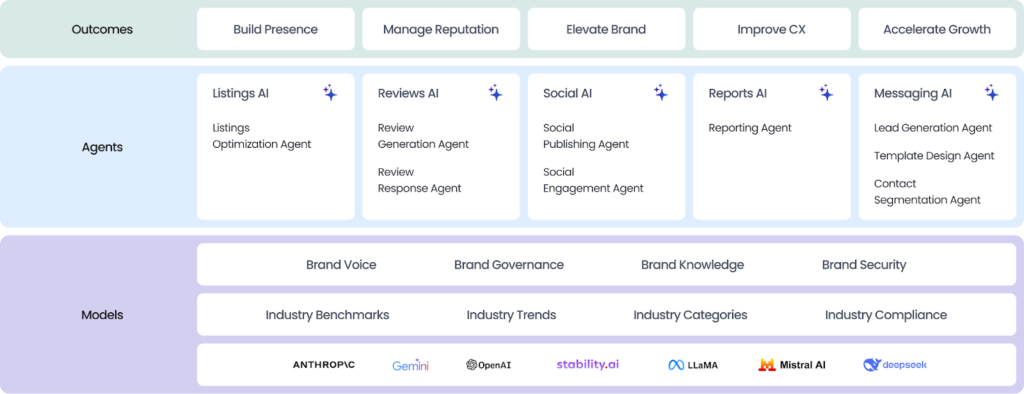
By connecting listings, reviews, social, and messaging through AI agents, Birdeye turns everyday interactions into measurable growth.
If your goal is to improve performance, Birdeye is built for it.

Disclaimer: The content on this page is based on research compiled from publicly available information. Birdeye does not warrant the completeness or correctness of the information and cannot be held liable for its use.
About the Author

Shruti Dugar
Birdeye
Originally published


![[Feature image] The Best Marketing Platforms for Multi-Location Brands](https://birdeye.com/blog/wp-content/uploads/Feature-image-The-Best-Marketing-Platforms-for-Multi-Location-Brands-375x195.png)