AI search visibility tools help brands understand how often they appear in AI-generated answers across platforms like ChatGPT, Gemini, Perplexity, and Claude, and where their information may be missing, outdated, inconsistent, or under-cited.
Summary
AI search creates a new visibility challenge. A brand may rank well in search and still be missing, misrepresented, or under-cited in AI-generated responses. Birdeye’s AI search visibility study shows why this matters as AI-generated answers become a larger part of brand discovery and customer decision-making.

For local and multi-location brands, the challenge is even greater because AI answer engines evaluate each location independently. Birdeye AI Search is the best AI search visibility tool purpose-built to help brands monitor and improve how every location appears across AI-generated answers. It identifies the trust signals that influence recommendations and helps teams strengthen them.
This blog compares 12 AI search visibility tools with pricing, pros and cons, and a scenario-based buyer guide.
Table of contents
- Summary
- What are AI search visibility tools?
- Why AI search visibility matters in 2026
- What to look for in an AI search visibility tool
- Best AI search visibility tools compared (2026)
- Top 12 AI visibility tools in 2026
- How to choose the best AI search visibility tool for your needs
- Frequently asked questions on AI visibility tools
- Make your brand visible where AI decisions happen
What are AI search visibility tools?
AI search visibility tools measure how often, where, and how accurately a brand appears in AI-generated answers across platforms like Google AI Overviews, ChatGPT, Gemini, Perplexity, and other AI answer engines. The best platforms also track brand mentions, citations, prompt-level visibility, sentiment, and competitor presence across AI search experiences.
These tools typically track:
- Brand mentions: How often your brand appears in AI-generated answers for relevant prompts and customer questions.
- Citation sources: Which websites, listings, review platforms, directories, and third-party sources AI engines use when generating answers about your brand or category.
- Visibility score by prompt and locations: Shows how visible your brand and each individual location is across prompts, markets, buyer journeys, and AI answer engines.
- Share of AI Answers: Measures how often your brand appears compared with competitors across tracked AI-generated answers.
- Sentiment: Whether AI-generated answers describe your brand positively, negatively, or neutrally.
- Multi-platform coverage: How your brand appears across AI search platforms such as Google AI Overviews, ChatGPT, Gemini, Perplexity, and other answer engines.
Enterprise and multi-location brands should also evaluate whether a platform provides per-location reporting, prompt-volume insights, and workflows that help improve AI visibility rather than simply report it.
If you are evaluating specialized monitoring platforms across major models, explore our comparison of the best LLM visibility tracking tools.
Why AI search visibility matters in 2026
AI search is rapidly changing how customers find information, compare options, and decide which brands to trust. This shift creates a critical visibility gap that traditional SEO reporting cannot catch. A brand may still rank on page one, but AI-generated answers might cite a competitor, summarize outdated details, or leave the brand out completely.
Birdeye’s State of AI Search 2026 report highlights just how uneven this presence can be. Across AI-generated answers analyzed in ChatGPT, Perplexity, and Gemini, 80% of brands were cited at least once, but only 15% claimed the #1 position as their own. In short, simply appearing somewhere in AI search does not mean your brand owns the recommendation.
To stay visible in this new discovery journey, brands need a strategy that goes beyond standard rankings and accounts for how AI engines find, cite, and recommend information. That starts with understanding how AEO differs from SEO, exploring how large language models rank content, and seeing how generative engine optimization can help brands earn a top spot in AI-generated answers.
What to look for in an AI search visibility tool
The best AI search visibility tools go beyond confirming whether a brand appears in AI-generated answers. They should show where the brand is visible, which sources shape those answers, how competitors perform, and where teams can make improvements.
Here are seven capabilities to evaluate:
1. Multi-platform coverage
Coverage should include the major AI search platforms that matter to your audience, such as ChatGPT, Google AI Overviews, Google AI Mode, Perplexity, Gemini, Grok and Claude. Comparing results across several engines reduces blind spots and gives teams a broader view of their online presence.
2. Real-time, granular insights
Look for timely, prompt-level data on mentions, citations, sentiment, competitor visibility, and recurring themes. Alerts and on-demand reports can help teams identify changes and investigate why visibility has increased or declined.
3. Competitor benchmarking
Benchmarking should compare your brand with relevant competitors across prompts, platforms, markets, and topic clusters. Metrics such as share of voice, citation frequency, and visibility trends can reveal where competitors appear more often and where opportunities exist.
4. Actionable recommendations
Monitoring becomes more useful when findings lead to clear next steps. Recommendations may include addressing content gaps, strengthening citation sources, improving existing pages, or targeting new prompt opportunities.
5. Seamless integration
The platform should connect with systems your team already uses, including CRM, CMS, Google Analytics 4 (GA4), and other marketing and reporting tools. API access, data exports, and automated workflows make it easier to incorporate visibility data into existing processes.
6. Free tier or trial availability
A free tier or trial allows teams to evaluate prompt tracking, citation monitoring, competitor insights, and reporting quality before committing to a paid plan. It can also show whether the available usage limits are suitable for the intended program.
7. Prompt research capability
Prompt research should reveal the questions, comparisons, and buyer-intent queries customers may use. In addition to tracking manually entered prompts, the platform should help teams discover relevant opportunities based on how people search for recommendations, products, services, and local businesses.
The right platform should help your team understand how AI engines interpret your brand, where visibility is being lost, and what steps can improve your presence across AI-generated answers.
For multi-location brands, the risk is even higher. Each location has its own reviews, listings, hours, services, local pages, and citation signals. If that information is incomplete or inconsistent, one location may show up accurately while another is missing from the AI answers customers rely on.

This issue often stems from localized blind spots. For a deeper look at fixing these blind spots, see our detailed guide on regional data gaps in AI search.
Best AI search visibility tools compared (2026)
The best AI search visibility tool depends on what your team needs to measure, how many platforms you want to track, and whether you only need monitoring or a way to act on visibility gaps. Some tools are built for SEO teams, some focus on content optimization, and others are better suited for enterprise or multi-location brands.
Verdict: If you're a multi-location or enterprise brand, Birdeye AI Search is the best AI search visibility platform in this comparison because it is the only solution that combines per-location AI visibility monitoring with AI-powered execution. Instead of only showing where visibility gaps exist, it helps brands improve the listings, reviews, citations, local pages, and business information AI engines rely on when generating answers.
| Tool | Best for | AI engines covered | Price |
| Birdeye AI Search | Multi-location brands with 100 to 10,000+ locations that need location-level AI visibility, citation intelligence, accuracy and sentiment insights, and agent-led execution | ChatGPT, Gemini, Perplexity, Google AI Overviews, Google AI Mode, Claude, and Grok | Custom pricing based on queries to track, locations, and LLMs |
| SE Ranking | SEO teams, agencies, and marketers that want AI visibility tracking inside a broader SEO platform | Google AI Overviews, Google AI Mode, ChatGPT, Perplexity, and Gemini | Entry + add-on / Enterprise |
| Gauge | Growth, content, and SEO teams that want AI visibility tracking, competitor insights, and content recommendations | ChatGPT, Claude, Gemini, Perplexity, Microsoft Copilot, Google AI Mode, and Google AI Overviews | Enterprise-focused |
| OtterlyAI | Brands, agencies, and content teams that need AI search monitoring, citation tracking, and prompt-level reporting | ChatGPT, Google AI Overviews, Perplexity, and Microsoft Copilot; Claude, Google AI Mode, and Gemini available as add-ons | Entry / Mid-market |
| Nightwatch | SEO teams and agencies that want traditional rank tracking and AI visibility tracking in one platform | ChatGPT, Claude, Gemini, Perplexity, Google AI Mode, and Google AI Overviews | Mid-market / Enterprise custom |
| Profound | Marketing, content, and PR teams that want AI visibility monitoring, citation analysis, and AEO content workflows | Starter: ChatGPT; Growth: ChatGPT, Perplexity, and Google AI Overviews; Enterprise: up to 10 answer engines | Mid-market / Enterprise custom |
| Ahrefs Brand Radar | SEO, content, and competitive research teams that want large-scale AI visibility research based on search-backed prompts | Google AI Overviews, Google AI Mode, ChatGPT, Microsoft Copilot, Gemini, and Perplexity; Grok is also included in the indexed prompt database | Mid-market / Enterprise |
| Semrush AI Visibility Toolkit | SEO and marketing teams that want AI visibility tracking alongside Semrush’s SEO workflows | ChatGPT, Google AI, Gemini, Perplexity, and supported prompt-tracking experiences | Add-on / Enterprise |
| ZipTie | Lean SEO and content teams that want focused monitoring across Google AI Overviews, ChatGPT, and Perplexity | Google AI Overviews, ChatGPT, and Perplexity | Entry / Mid-market |
| Amplitude AI Visibility | Marketing, product, and growth teams that want to connect AI visibility with traffic, conversions, and customer behaviour | ChatGPT and Google AI Overview | Free tier available / Enterprise |
| Peec AI | Marketing teams, SEO teams, and agencies that want prompt-based analytics across brands, markets, and competitors | Standard plans let users choose three from ChatGPT, Google AI Mode, Google AI Overviews, Microsoft Copilot, Perplexity, and Gemini; Enterprise adds other models | Entry / Mid-market / Enterprise |
| Clearscope | Content and SEO teams that want AI visibility insights connected to content planning and optimization | ChatGPT and Gemini | Mid-market / Enterprise |
This table gives a fast view of the market, but the right choice depends on your use case. A content team may prioritize prompt tracking and optimization workflows, while an enterprise or multi-location brand may need location-level visibility, citation intelligence, governance, and execution across hundreds or thousands of locations.
Top 12 AI visibility tools in 2026
Below are 12 platforms to compare, including their best-fit use cases, key features, pros, cons, and pricing.
How we evaluated these tools: We compared each platform based on AI search engine coverage, prompt and citation tracking, reporting capabilities, multi-location support, and whether it helps brands improve AI search visibility, not just monitor it.
1. Birdeye AI Search: The best AI visibility platform for multi-location brands
Best for: Multi-location and enterprise brands with 100-10,000+ locations that need AI search visibility tracking, citation intelligence, location-level accuracy monitoring, sentiment insights, and agent-led execution.
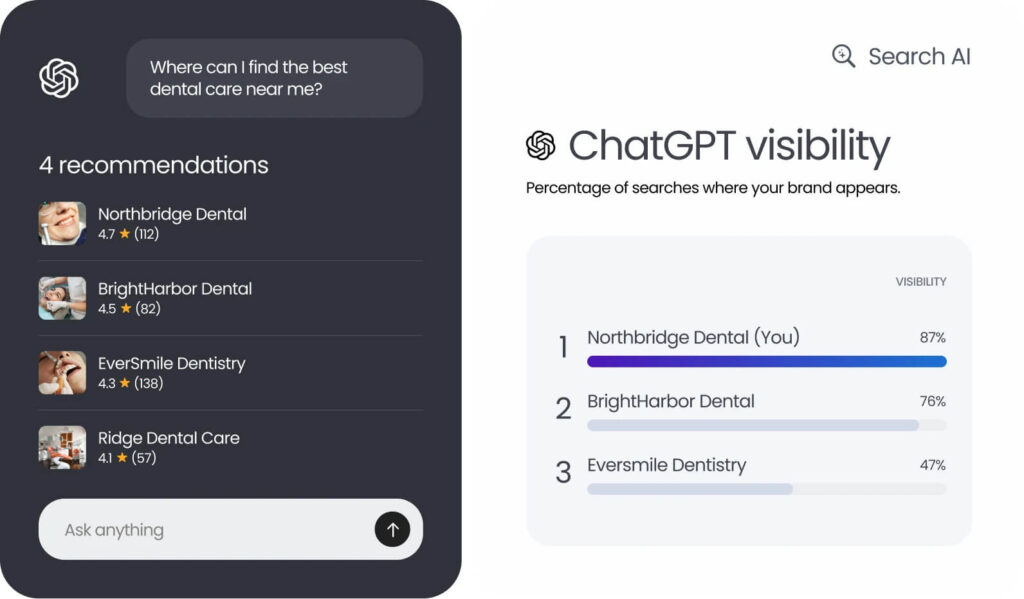
Birdeye AI Search is a purpose-built AI search visibility platform for multi-location brands. It helps businesses understand how they appear across leading AI answer engines while identifying and fixing the issues that limit visibility for individual locations. AI Search tracks brand and location-level visibility, rankings, citations, and sentiment across ChatGPT, Gemini, Perplexity, Google AI Overviews, Google AI Mode, Claude, and Grok. Customer-configured queries are sent to the selected LLMs, and Birdeye AI Search measures visibility from the responses those LLMs return. It helps brands understand, for each location, which AI-generated answers they appear in, which competitors are recommended instead, and which sources AI platforms cite when generating those answers.
AI Search connects visibility insights to agents and workflows that help brands improve the accuracy of listings, reviews, citations, website content, and business information across 100 to 10,000+ locations.
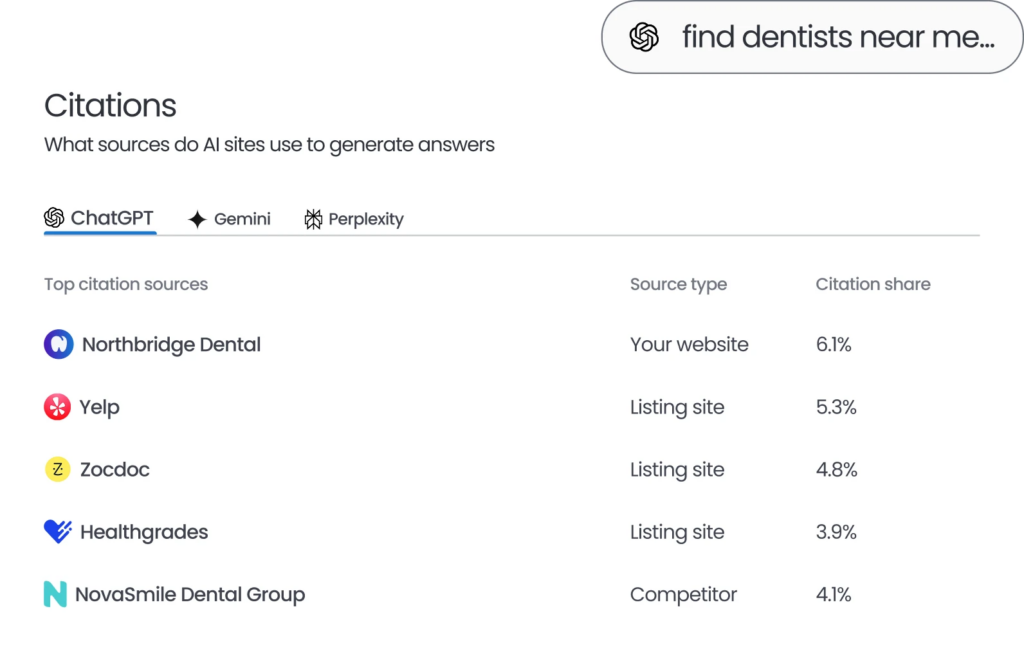
Key features
- AI search visibility tracking: Tracks how your brand and locations appear across AI-generated answers.
- Birdeye AI Visibility Score (0–100): Measures visibility on a 0–100 scale for both brands and individual locations across supported AI answer engines, making it easy to benchmark performance, compare locations, monitor trends over time, and prioritize optimization efforts.
- AI Share of Answers: Measures the percentage of tracked AI-generated answers that recommend your brand compared with competitors, helping teams understand competitive visibility across prompts, markets, and locations.
- Citation intelligence: Identifies the websites, listings, directories, review platforms, and local pages AI engines rely on when generating answers, helping teams strengthen the sources that influence recommendations.
- Sentiment analysis: Shows how AI platforms describe your brand, including strengths, weaknesses, and recurring themes.
- Accuracy monitoring: Helps identify inconsistencies or inaccuracies in business information across locations.
- Agent-led recommendations: Connects visibility gaps to recommended actions, including updating listings, generating reviews, and optimizing website content.
- Content generation agents: The agents generate and publish AEO-friendly content like blogs and FAQs to boost your visibility on AI
Pros
- Built for multi-location brands that need visibility tracking across both brand-level and location-level AI search results.
- Connects AI visibility insights with operational signals such as listings, reviews, citations, sentiment, website content, and business information accuracy.
- Unlike platforms that only monitor AI visibility, Birdeye also helps improve it by identifying visibility gaps and automatically updating listings, strengthening reviews, and optimizing local pages across every location through AI agents.
Cons
- Best suited for multi-location and enterprise brands, so it may be more comprehensive for a small single-location business’s needs.
Pricing: Birdeye pricing is customized based on location count, selected products, and the agents activated.
2. SE Ranking: All-in-one AI brand and competitor tracker
Best for: SEO teams, agencies, and marketers that want AI search visibility tracking inside a broader SEO platform.
SE Ranking is a traditional SEO platform that has expanded into AI search visibility through tools like AI Search Toolkit and AI Results Tracker. It is a practical option for teams that want to monitor AI-generated answers while keeping rank tracking, site audits, reporting, and competitor research in the same SEO workspace.
Key features
- AI Results Tracker: Tracks brand mentions, links, positions, prompts, and visibility changes across AI-generated answers.
- AI competitor research: Compares brand and domain visibility against competitors across supported AI engines.
- Citation and source analysis: Shows which domains, URLs, and source types appear in AI-generated answers.
- Historical visibility trends: Helps teams see how AI search presence changes across prompts and platforms.
Pros
- Useful for SEO teams that want AI visibility monitoring inside an existing SEO platform.
- Helps teams compare traditional search performance with AI-generated answer visibility.
Cons
- AI visibility is an extension of its broader SEO platform, so teams looking for dedicated multi-location AI search management may need additional solutions.
- Advanced AI search tracking limits and broader coverage may require an add-on or higher plan.
Where Birdeye wins: SE Ranking helps monitor AI visibility alongside SEO. Birdeye goes further by helping multi-location brands improve AI visibility through AI-powered listings, reviews, citation management, and local page optimization across every location.
Pricing: Entry-level plans with AI visibility available as an add-on.
3. Gauge: AI search optimization with daily tracking and actionability
Best for: Growth, content, and SEO teams that want AI search visibility tracking, competitor insights, and content recommendations in one workflow.
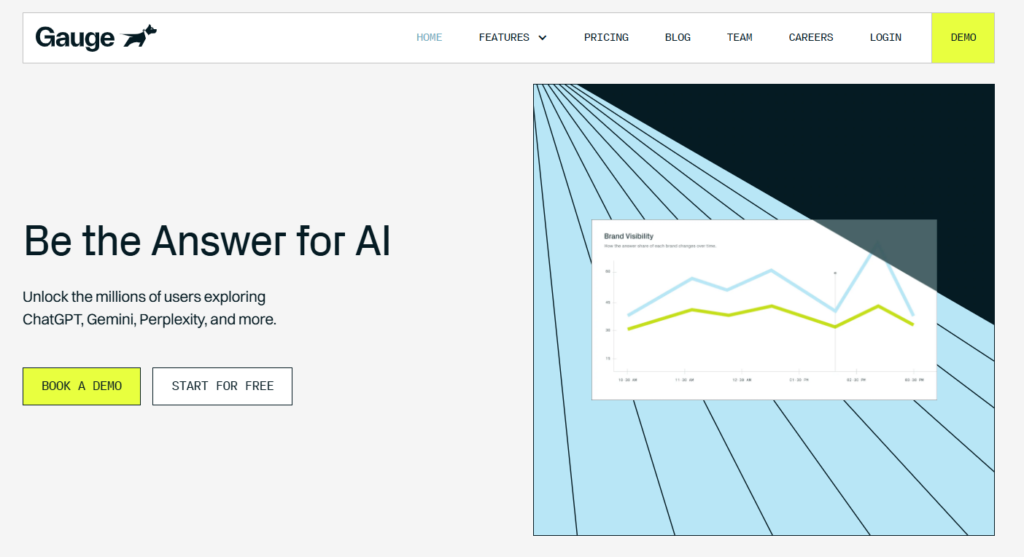
Gauge is an AI visibility and generative engine optimization platform that helps teams understand how their brand appears in AI-generated answers and identify visibility gaps. It is useful for teams that want to connect AI search tracking with content planning, competitor research, organic search data, and performance analytics.
Key features
- Prompt tracking: Monitors how AI platforms respond to tracked prompts over time.
- Brand coverage analysis: Shows how often a brand appears in AI-generated answers.
- Citation analysis: Identifies the sources AI search engines rely on when generating answers.
- Competitor analysis: Compares how competitors appear across tracked prompts and answers.
Pros
- Useful for teams that want AI visibility insights connected to content and growth workflows.
- Helps teams compare brand presence, competitor visibility, and citation patterns across AI-generated answers.
Cons
- Focuses on AI visibility insights and content recommendations rather than operational workflows that improve local visibility signals.
- Does not include dedicated workflows for managing AI visibility across hundreds or thousands of business locations.
Where Birdeye wins: Gauge focuses on AI visibility insights and content recommendations. Birdeye connects those insights to operational improvements by updating listings, strengthening reviews, and improving local content across every location.
Pricing: Custom pricing available.
4. OtterlyAI: AI search visibility and citation monitoring for brands
Best for: Brands, agencies, and content teams that need AI search monitoring, citation tracking, and prompt-level reporting.
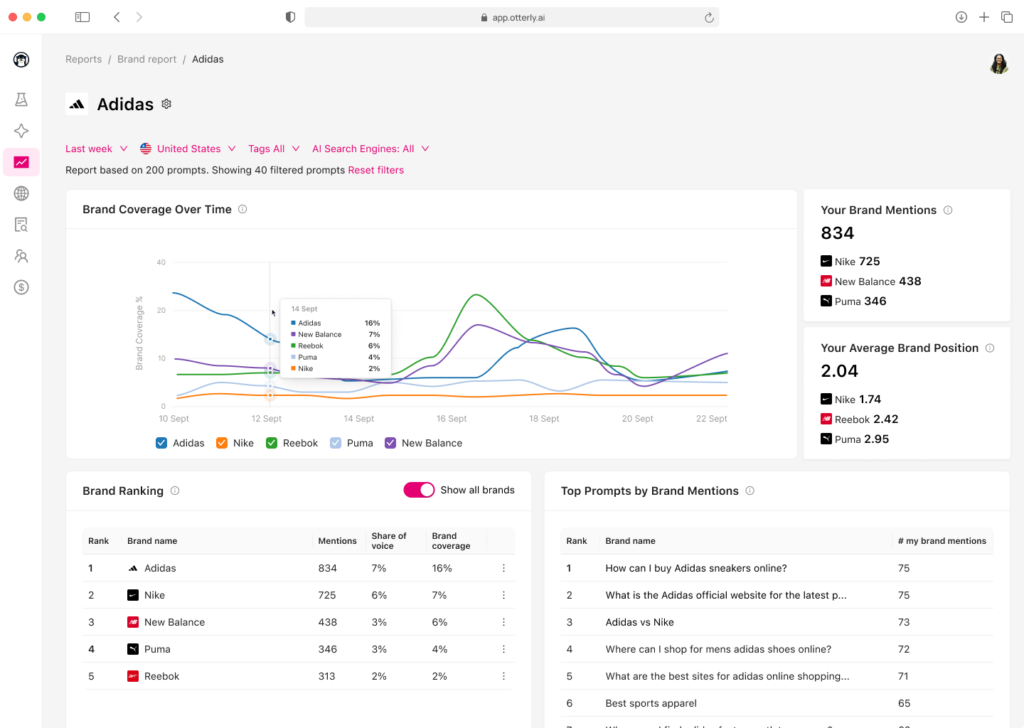
OtterlyAI is an AI search monitoring platform that helps teams track how their brand and website appear across AI-generated answers. It is useful for teams that want to monitor brand visibility, analyze citations, review prompt-level performance, and run GEO audits without using a broader marketing operations platform.
Key features
- AI search monitoring: Tracks brand visibility across ChatGPT, Google AI Overviews, Perplexity, and Microsoft Copilot.
- Prompt tracking: Monitors selected prompts to show where a brand appears and how visibility changes over time.
- Brand Visibility Index: Gives teams a visibility benchmark for tracking AI search performance.
- GEO audit: Reviews URLs for generative engine optimization opportunities.
Pros
- Useful for agencies and content teams managing AI search visibility across multiple prompts or clients.
- Helps teams connect prompt performance with citation sources and content optimization opportunities.
Cons
- Does not provide purpose-built multi-location support, making it less suitable for enterprise brands managing hundreds of locations.
- Primarily designed for prompt monitoring and citation analysis rather than end-to-end AI visibility optimization.
Where Birdeye wins: OtterlyAI helps brands monitor prompts and citations. Birdeye also helps improve the factors AI engines rely on by managing listings, reviews, and local pages from a single platform.
Pricing: Entry- and mid-market plans with optional add-ons.
5. Nightwatch: SEO rank tracking platform with AI visibility monitoring
Best for: SEO teams and agencies that want traditional rank tracking and AI visibility tracking in one platform.
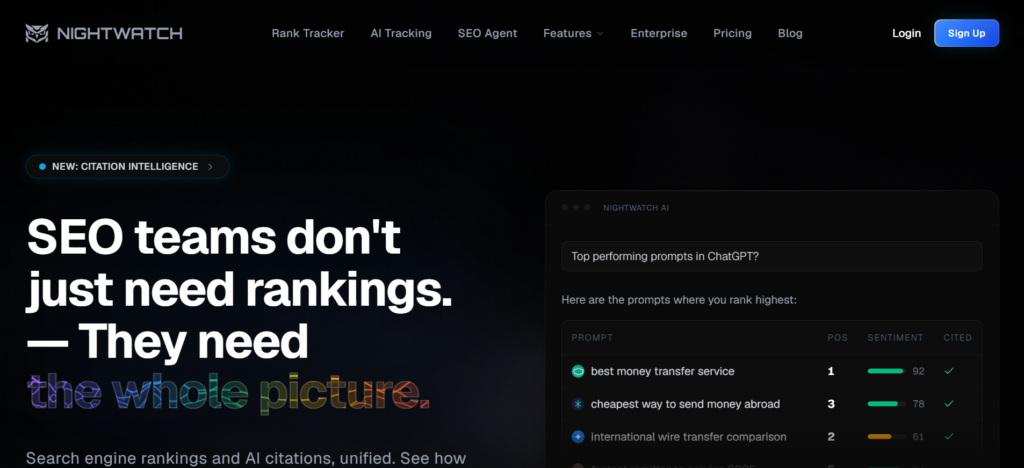
Nightwatch is an SEO rank tracking platform that connects search performance with AI visibility tracking. It helps teams monitor how their brand appears across AI-generated answers while also tracking rankings, citations, competitors, and search performance in the same workspace.
Key features
- AI and LLM tracking: Monitors brand visibility across ChatGPT, Claude, Gemini, Perplexity, AI Mode, and AI Overview.
- Citation Intelligence: Connects search ranking changes with shifts in AI visibility and citations.
- Share of voice tracking: Shows how often a brand appears compared to competitors in AI-generated answers.
- Sentiment analysis: Helps teams understand the tone of AI-generated brand mentions.
Pros
- Useful for SEO teams that want to compare traditional rankings with AI search visibility.
- Helps agencies monitor prompts, citations, competitors, and share of voice from one SEO-focused platform.
Cons
- Stronger for SEO rank tracking than managing the local business signals that influence AI-generated answers.
- More advanced limits, custom integrations, SSO, and dedicated support are tied to Agency or Enterprise plans.
Where Birdeye wins: Nightwatch combines rank tracking with AI visibility monitoring. Birdeye is designed for multi-location brands that need both visibility insights and AI-powered execution across hundreds or thousands of locations.
Pricing: Mid-market plans with custom options.
6. Profound: An AI visibility and answer engine optimization platform
Best for: Marketing, content, and PR teams that want AI visibility monitoring, answer engine insights, citation tracking, and AEO content workflows.
Profound is an AI visibility and answer engine optimization platform that helps teams understand how their brand and competitors appear in AI-generated answers. It is useful for teams that want to monitor AI search visibility, analyze brand sentiment, uncover citation sources, and connect visibility insights with AEO content workflows.
Key features
- Answer Engine Insights: Analyzes how a brand and its competitors appear across AI-generated answers.
- Visibility scores: Measures how often a brand appears in AI answers using visibility score and share of voice metrics.
- Citation authority: Shows which websites influence AI-generated answers about a brand.
- Sentiment and keyword insights: Identifies how AI platforms describe the brand and which themes appear repeatedly.
Pros
- Useful for teams that want detailed AI visibility reporting across prompts, citations, sentiment, and competitor presence.
- Helps content and PR teams understand how AI platforms describe their brand and category.
Cons
- Focuses on monitoring, citation analysis, and AEO insights rather than helping brands implement improvements across multiple locations.
- No dedicated multi-location support for enterprise brands managing hundreds or thousands of locations.
Where Birdeye wins: Profound shows where your brand is cited in AI-generated answers. Birdeye helps improve those citations by updating listings, strengthening reviews, and optimizing local pages across every location.
Pricing: Pricing is custom.
7. Ahrefs Brand Radar: Deep competitor benchmarking
Best for: SEO, content, and competitive research teams that want to analyze AI visibility across a large database of search-backed prompts.
Ahrefs Brand Radar is an AI visibility research tool that helps teams understand how brands, competitors, products, and topics appear across AI-generated answers. It is useful for SEO teams that want broad AI visibility analysis connected to Ahrefs’ search data, competitor research, citation patterns, and share of voice reporting.
Key features
- Search-backed prompt database: Lets teams research brand visibility across hundreds of millions of prompts built from search demand data.
- AI platform coverage: Tracks visibility across major AI search experiences, including AI Overviews, AI Mode, ChatGPT, Gemini, and Perplexity.
- AI Share of Voice: Compares how often a brand appears against competitors across AI-generated answers.
- Citation analysis: Shows which domains and URLs are cited in AI responses.
Pros
- Useful for SEO teams that want large-scale AI visibility research connected to search demand.
- Helps compare brand presence, competitor visibility, citations, and share of voice across AI-generated answers.
Cons
- Best suited for AI visibility research and competitive analysis rather than operational optimization.
- Does not provide dedicated multi-location visibility reporting or workflows for improving location-level AI search performance.
Where Birdeye wins: Ahrefs Brand Radar is built for AI visibility research at scale. Birdeye combines visibility tracking with AI agents that help improve local search signals influencing AI-generated answers.
Pricing: Pricing shown by region on Ahrefs’ pricing page. .
8. Semrush AI Visibility Toolkit: AI visibility tracking within SEO workflow
Best for: SEO and marketing teams that already use Semrush and want AI visibility tracking inside their existing SEO workflow.
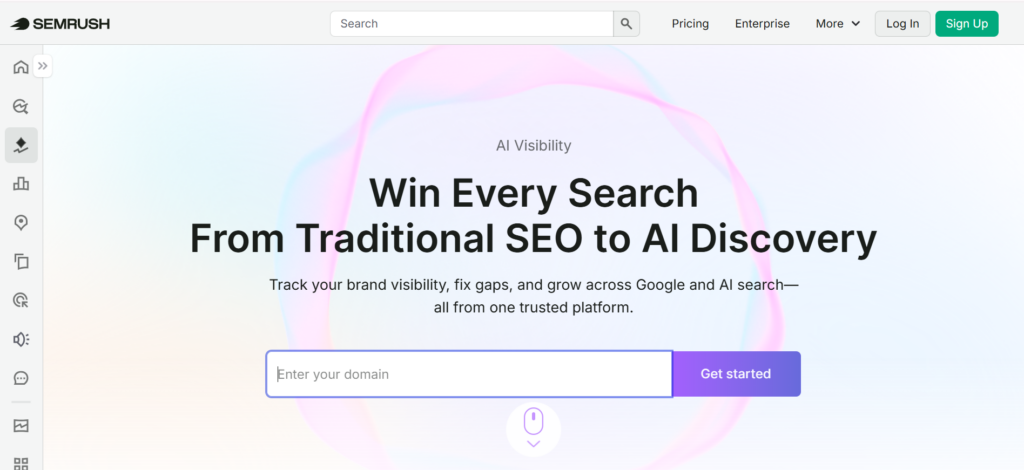
Semrush AI Visibility Toolkit helps teams monitor how their brand is mentioned in AI search and compare that visibility against competitors. It is useful for teams that want AI visibility reporting, prompt tracking, competitor analysis, and AI readiness checks alongside their broader Semrush SEO workflow.
Key features
- AI visibility reports: Show how a domain appears in AI search and where visibility gaps may exist.
- Custom prompt tracking: Tracks daily AI rankings for selected prompts.
- Brand performance analysis: Helps teams understand how their brand is mentioned across supported AI search experiences.
- Competitor analysis: Compares AI visibility, brand presence, and prompt performance against competitors.
Pros
- Useful for SEO teams that want AI visibility data inside the Semrush ecosystem.
- Helps teams compare AI search visibility with traditional SEO reporting and competitor research.
Cons
- Pricing is per domain, so costs can increase for teams managing multiple brands, markets, or client sites.
- Works best for teams already invested in the Semrush ecosystem and focused on SEO reporting.
Where Birdeye wins: Semrush integrates AI visibility into existing SEO workflows. Birdeye extends beyond reporting by helping brands improve listings accuracy, online reputation, and local content that influence AI search visibility.
Pricing: Available as an add-on to eligible Semrush plans. ity change.
9. ZipTie: AI search monitoring tool
Best for: Lean SEO and content teams that want focused AI search monitoring across Google AI Overviews, ChatGPT, and Perplexity.
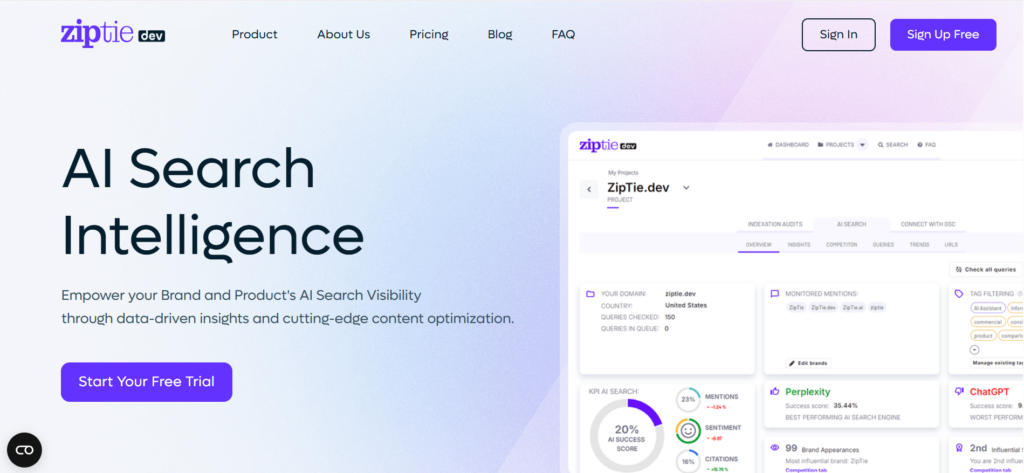
ZipTie is an AI search intelligence and content optimization platform built for SEO and content teams. It organizes performance at the project, category, and query levels, giving users a structured way to review brand presence and identify the searches that need closer attention.
Key features
- AI search monitoring: Tracks brand visibility across Google AI Overviews, ChatGPT, and Perplexity.
- Prompt generation assistant: Helps teams identify relevant prompts and queries to monitor.
- AI Success Score: Helps prioritize which queries need attention first.
- Citation tracking: Shows whether a domain is cited or influencing AI-generated answers.
Pros
- Useful for teams that want focused tracking across Google AI Overviews, ChatGPT, and Perplexity.
- Helps prioritize optimization work through AI Success Score and query-level insights.
Cons
- Platform coverage is focused on Google AI Overviews, ChatGPT, and Perplexity, so teams needing broader model coverage may need another tool.
- Platform coverage is narrower than some competitors and is designed primarily for focused monitoring rather than enterprise-scale management.
Where Birdeye wins: ZipTie provides focused monitoring across key AI search platforms. Birdeye offers broader capabilities for enterprise and multi-location brands by combining AI visibility tracking with location-level optimization workflows.
Pricing: Entry- and mid-market plans with custom options.
10. Amplitude AI Visibility: Provides AI search visibility insights
Best for: Marketing, product, and growth teams that want to connect AI search visibility with traffic, conversions, and customer behavior analytics.
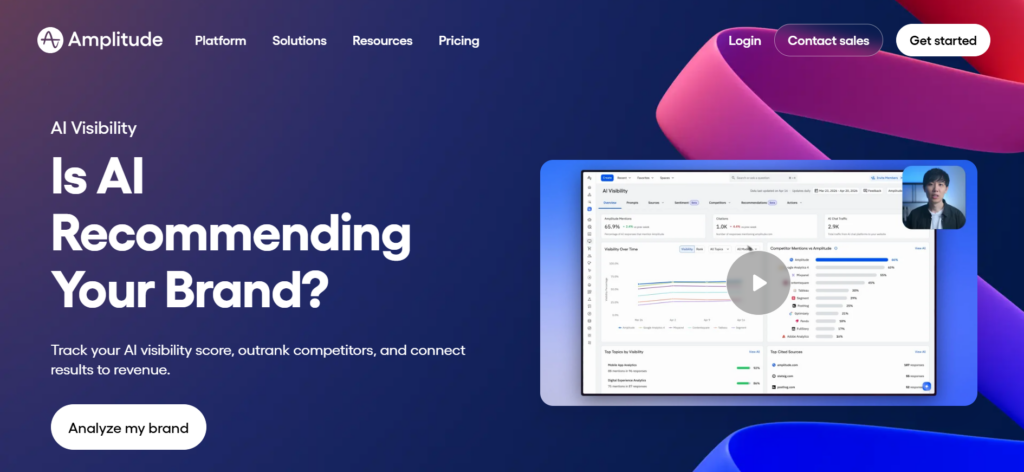
Amplitude AI Visibility helps teams track how their brand appears in AI-generated answers and connect that visibility to downstream customer behavior. It is useful for teams already using Amplitude, or teams that want AI search visibility insights alongside product analytics, conversion analysis, revenue reporting, and experimentation workflows.
Key features
- AI visibility score: Shows how visible a brand is across tracked AI search experiences.
- Competitive rankings: Helps teams see where competitors appear in AI-generated answers.
- Prompt and topic tracking: Tracks critical prompts, competitive topics, and related questions.
- Source analysis: Shows which sources large language models use to generate responses.
Pros
- Useful for teams that want to connect AI search visibility with product analytics and conversion reporting.
- Includes a free plan, which makes it easier for teams to start testing AI visibility tracking.
Cons
- Best suited for teams that use or plan to use Amplitude’s analytics platform.
- Lacks dedicated local search and location-level AI visibility workflows for multi-location brands.
Where Birdeye wins: Amplitude connects AI visibility to customer analytics. Birdeye is purpose-built for improving AI search visibility through listings, reviews, citations, and local content management.
Pricing: Free plan and custom pricing available.
11. Peec AI: AI search analytics platform
Best for: Marketing teams, SEO teams, and agencies that want prompt-based AI search analytics across brands, markets, and competitors.
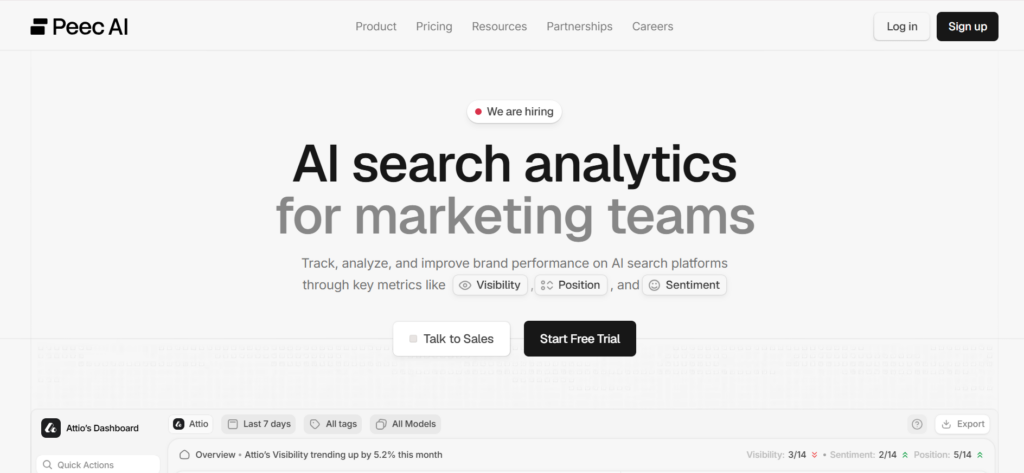
Peec AI is an AI search analytics platform that helps teams track, analyze, and improve brand performance across AI search platforms. It is useful for teams that want to monitor visibility, position, sentiment, prompts, sources, competitors, and rankings in a focused AI search workflow.
Key features
- Prompt tracking: Helps teams set up and monitor prompts that matter for their AI search strategy.
- AI-suggested prompts: Uses AI-suggested prompts and search volumes to help teams prioritize opportunities.
- Brand comparison: Shows how a brand ranks against competitors in its market.
- Visibility, position, and sentiment tracking: Tracks how often a brand appears, where it ranks, and how AI platforms describe it.
Pros
- Useful for teams that want a focused AI search analytics workflow built around prompts, rankings, sources, and sentiment.
- Helps marketing and SEO teams prioritize prompts and understand where competitors appear.
Cons
- Geared toward prompt analytics and reporting, with less emphasis on workflow automation or multi-location management.
- Pricing depends on the number of tracked prompts and models, so costs can increase as teams expand their monitoring.
Where Birdeye wins: Peec AI focuses on prompt-based AI search analytics. Birdeye helps brands translate those insights into action by improving the local signals AI engines use to generate answers.
Pricing: Entry and mid-market pricing available.
12. Clearscope: AI visibility tracker within content optimization platform
Best for: Content and SEO teams that want AI search visibility insights tied to content planning, optimization, and refresh workflows.
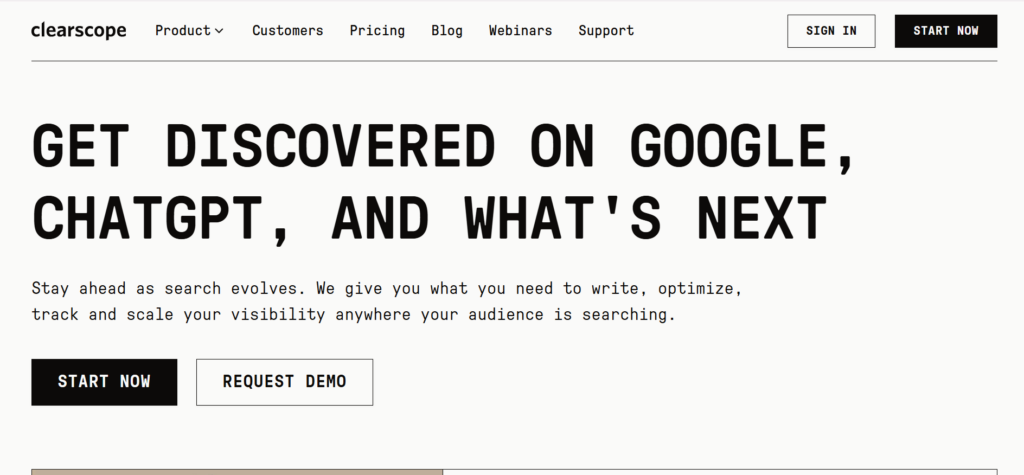
Clearscope is a content optimization platform that helps teams improve discoverability across Google and AI search experiences. It is useful for content teams that want to connect SEO performance, AI visibility, prompt tracking, and content refresh opportunities in one workflow.
Key features
- Prompt tracking: Monitors how content performs across topics and prompts, not just individual keywords.
- AI visibility tracking: Helps teams understand how their brand or domain appears across Google and AI-powered platforms like ChatGPT and Gemini.
- AI Citations: Shows which pages and sources AI search engines use when generating answers.
- Content Inventory: Helps teams track existing pages and identify refresh opportunities.
Pros
- Useful for content teams that want AI search visibility connected to SEO and content optimization.
- Strong fit for teams already using Clearscope for content briefs, optimization, and inventory management.
Cons
- Better suited for content and SEO workflows than broader AI visibility management across listings, reviews, local data, and location-level execution.
- Built primarily for content optimization, so brands looking for broader AI visibility management may need additional platforms.
Where Birdeye wins: Clearscope is built primarily for content optimization. Birdeye provides a broader AI visibility platform that combines content, listings, reviews, citations, and location-level optimization in one solution for multi-location brands
Pricing: Mid-market pricing is available.
How to choose the best AI search visibility tool for your needs
The best AI search visibility tool is not always the one with the longest feature list. The right choice depends on what your team needs to improve: brand visibility, content performance, AI citations, competitor share of voice, location-level accuracy, or revenue and AI search attribution.
Use the guide below to match your use case with the right type of platform.
| Use case | Capabilities to prioritize | Best-fit tools |
| Track and improve AI visibility across locations | Measure brand and location-level visibility, identify citation, sentiment, and accuracy gaps, and connect insights to workflows that improve listings, reviews, citations, website content, and business information accuracy | Birdeye AI Search |
| Competitive benchmarking | See how your locations rank in AI-generated answers relative to named local competitors, by topic, platform, and geography | Birdeye AI Search, Profound |
| Citation analysis | Identify which sources AI trusts to form its answers at a brand and location level | Birdeye AI Search |
| Add AI visibility to an SEO workflow | Connect AI search tracking with rank tracking, audits, keyword research, and competitor analysis | SE Ranking, Nightwatch, Semrush AI Visibility Toolkit, Ahrefs Brand Radar |
| Improve content for AI answers | Identify prompt opportunities, content gaps, citation patterns, and GEO optimization needs | BirdeyeAI Search, Gauge, Clearscope, ZipTie, Peec AI, OtterlyAI |
| Manage AI visibility for clients | Track multiple projects, markets, prompts, and competitor sets with exportable reporting | Birdeye AI Search, Peec AI, OtterlyAI, Nightwatch, SE Ranking |
| Connect AI visibility to conversions | See how AI-referred users behave after discovery and connect visibility to funnel performance | Amplitude |
| Start with a lightweight test | Validate prompts, brand mentions, citations, and competitor visibility before expanding | ZipTie, OtterlyAI, Amplitude, Peec AI |
For smaller teams, a focused AI search-monitoring or content-optimization tool may be enough. For SEO teams, tools that connect AI visibility with rank tracking, audits, and keyword workflows can be easier to adopt.
For enterprise and multi-location brands, the stronger choice is a platform that connects AI visibility insights to the work required to improve them. AI-generated answers are shaped by signals across listings, reviews, local pages, business hours, services, citations, customer sentiment, and business information accuracy. Birdeye AI Search gives teams a location-level view of where the brand appears, which sources influence AI answers, and where inaccurate or inconsistent information may be affecting visibility. By connecting those insights with Birdeye’s AI agents and workflows, teams can move from monitoring gaps to improving the signals answer engines rely on across 100 to 10,000+ locations.
Before choosing a platform, ask:
- Do we need brand-level visibility, location-level visibility, or both?
- Are we trying to monitor AI answers, improve content, or execute operational fixes?
- Which AI platforms matter most to our customers?
- Can the tool show which sources influence AI-generated answers?
- Does it help us understand competitor visibility and share of voice?
- Can our team act on the insights without creating another manual workflow?
Frequently asked questions on AI visibility tools
AI visibility focuses on how clearly AI systems understand, reference, and use your information, while SEO focuses on ranking in traditional search results.
AI search monitoring shows how platforms like ChatGPT, Gemini, Perplexity, and Google AI Overviews describe, cite, or recommend your brand in AI-generated answers. Brand monitoring shows where people mention your brand across social media, news, reviews, forums, and other websites. In simple terms, brand monitoring tracks what people say about you, while AI search monitoring tracks how AI platforms understand and present your brand to customers.
Birdeye AI Search is purpose-built for multi-location brands because it tracks AI visibility at the location level and helps improve the trust signals AI platforms use, including listings, reviews, citations, and local pages.
AI engines rely on the data they can find, so inconsistent profiles, outdated content, or weak citations can lead to incorrect interpretations.
Most brands review quarterly, but high-volume or multi-location businesses benefit from monthly checks to catch gaps early.
Birdeye Search AI tracks how AI engines cite and interpret your brand, while most tools focus only on keyword rankings or traditional SEO metrics.
Birdeye Search AI analyzes each location separately, revealing gaps or inconsistencies that other platforms often miss.
Visibility platforms scan AI responses across engines and track when, where, and how often a brand is referenced in generated outputs.
Yes, clear, consistent, and well-cited information increases the likelihood of being included in AI summaries, suggestions, and task-based responses.
Make your brand visible where AI decisions happen
AI search is changing where brand decisions begin. Customers are no longer relying only on search results or website visits. They are asking AI platforms for answers, comparisons, and recommendations, and those answers can shape which brands make the shortlist.
For multi-location brands, the opportunity is to make every location easier for AI engines to find, trust, cite, and recommend. Birdeye AI Search helps teams understand where they appear in AI-generated answers and turn visibility gaps into action across the signals that matter most.
See where your brand stands in AI search and what you can improve with Birdeye AI Search. Book a demo now.

About the Author

Vanjana Sharma
Originally published