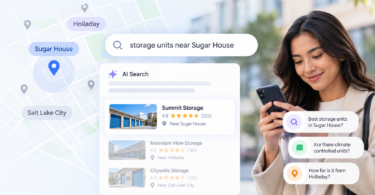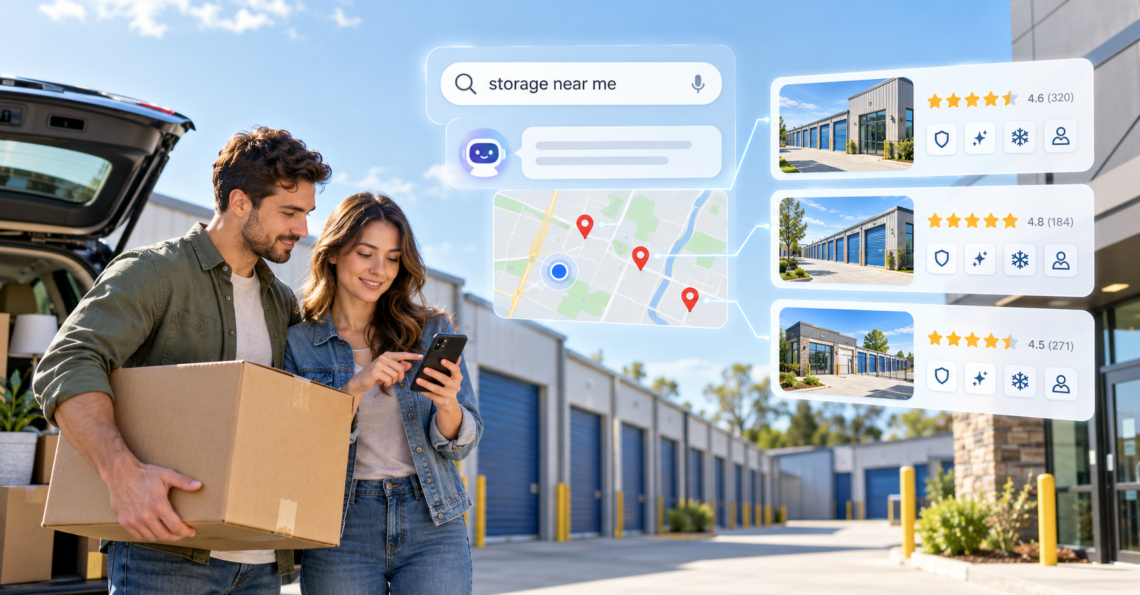
Not literally nobody, but close. “We see 70% of searches for storage still don’t have a brand name,” said Melissa Stiles of Storage Asset Management. Renters want the nearest available unit, and increasingly an AI answer engine decides which facilities make the list.
Summary
At Birdeye View 2026, Melissa Stiles, Chief Growth Officer at Storage Asset Management (600+ facilities), and Dayna Hathaway, CMO at Extra Space Storage (4,000+ locations), explained why AI hasn’t replaced the local search playbook but has raised the bar. Specific reviews, on-brand responses, and a website built for renters who arrive ready to rent are what make a facility look like the answer. This post covers what that looks like and how to tell whether it is working.
Why can’t brand awareness win a storage renter?
Storage is a local, urgent search. Brian Bulkley, who moderated the session for Birdeye, called it a “now decision.” Someone is moving this weekend, or their apartment isn’t ready, and they need somewhere to put their things.
Speed compounds the problem. The Self Storage Association’s Demand Study found that more than half of renters rent from the first facility they contact, and only a small share shop around. With so little shopping around, the facility that gets onto the list has most of the advantage.
AI now sits in front of that list. McKinsey research found that about half of US consumers intentionally use AI-powered search, and a majority of those users call it their top digital source for buying decisions. When a renter has no brand in mind, an AI answer can set the shortlist before anyone visits a website. A facility missing from that answer is not losing a click. It is losing the consideration.
How has the renter journey changed?
Dayna described the shift plainly. Five years ago, a search ended in a click that, in her words, “really was in a lot of ways the end of the journey.” Now a renter asks an AI tool a question, then follows up with two, three, or 10 more, bouncing between video, a local listing, and reviews before deciding. “We’ve gone from one click to multiple touchpoints,” she said, and those touchpoints carry more weight than they did.
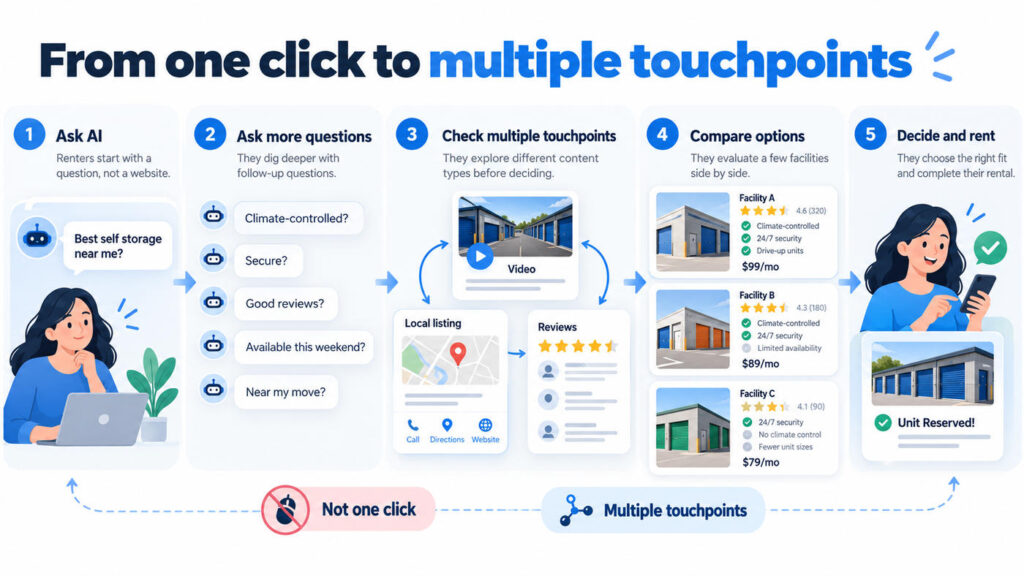
Search intent also varies, from a climate-controlled unit to a local move to a cross-country one. Dayna said Extra Space asks the same question of each intent and each channel: is the brand relevant and present there? It uses its data to decide which questions to answer first, rather than trying to answer everything.
Melissa added that the search radius, once about 10 miles, keeps shrinking, which raises the value of local detail.
What earns a facility a spot on the shortlist?
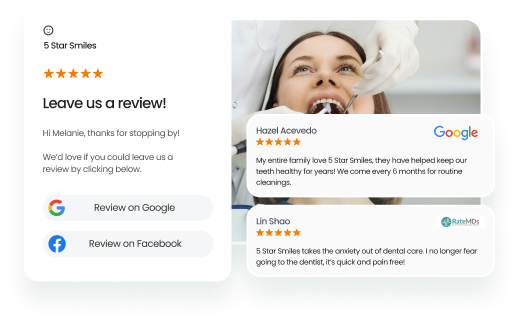
Reviews, and specifically what is inside them. Dayna’s team reads thousands of reviews for recurring themes, and three keep appearing: cleanliness, security, and the power of a good store manager. Melissa wants renters to find the same themes, plus the experience of dealing with a manager or the call center. A detailed, specific review gives an AI engine something to match against a renter’s question, while a bare rating does not. Yelp made the same point in its own Birdeye View session.
Melissa also pointed to the reviews a business would rather not get. Storage has points that some customers find unfavorable, she said, so “it’s more about how we respond and who we are with the brand voice in the response to the reviews.” A thoughtful reply to a complaint tells the next renter more than another five-star review does.
Her broader rule is to be the solution. She said the work that wins traditional local SEO also wins AI visibility, just in a slightly different way, so listings, reviews, and website content should all read as the answer to the renter’s question.
What happens after AI narrows the search?
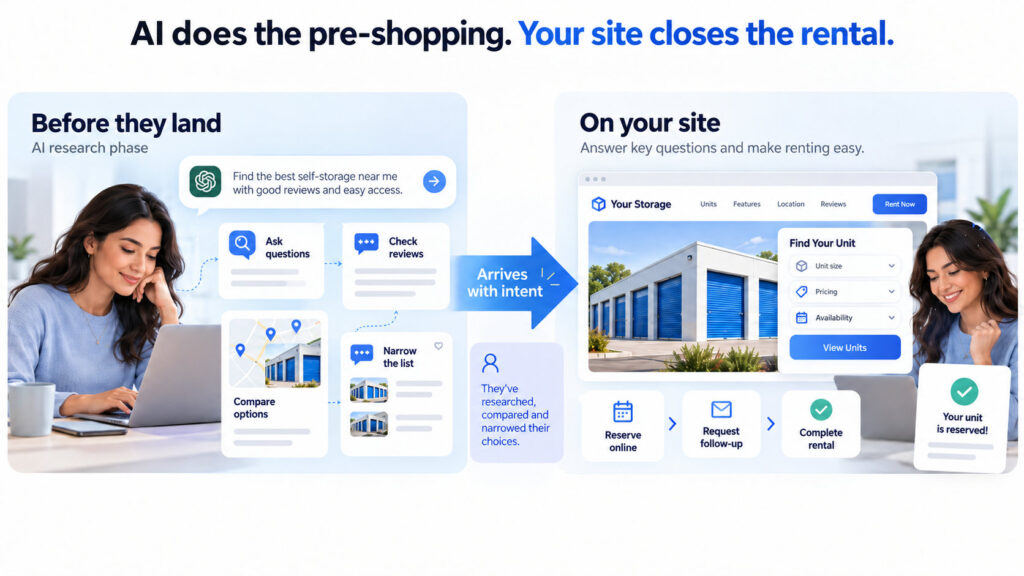
Once a renter reaches the site, behavior changes. “I always say that storage is not Amazon,” Melissa said. “People are not just browsing your website or looking. They’re coming there because they have a need.” Just under 50% of SAM’s rentals are completed entirely online, and the team aims to follow up on leads within an hour. The funnel has to answer what size, what it costs, and what happens next, without friction.
AI-referred visitors may be the most motivated of all. Dayna said consumers use AI to window shop off the brand’s site, so “when they come, they’re ready to buy.” Melissa put numbers on it for SAM: AI-referred traffic is a small share of visits, but it is growing more than 200% and converting at roughly twice the rate of paid traffic. Dayna said Extra Space sees the same pattern in its conversion rates.
A small slice of traffic with outsized value is easy to ignore on a dashboard. It also shows why the page has to be ready before the visitor arrives.
How should storage leaders measure whether it is working?
Melissa starts with the whole funnel: website users, engagement, bounce rates, leads, and rentals. That shows whether a problem sits in lead generation or in conversion. Dayna’s team goes further, looking at every step of the online rental tool and how much traffic moves from one step to the next. It forms a hypothesis, then tests it, because “it’s a 50-50 bet that you have it actually figured out.”
She also added a caution about reading data. “You have to be careful not to read too much into one data point, especially if it changes overnight.” A signal matters when it sticks, so judge AI-referred traffic on the trend, next to leads and rentals, by location.
How does Birdeye help storage brands improve AI visibility?
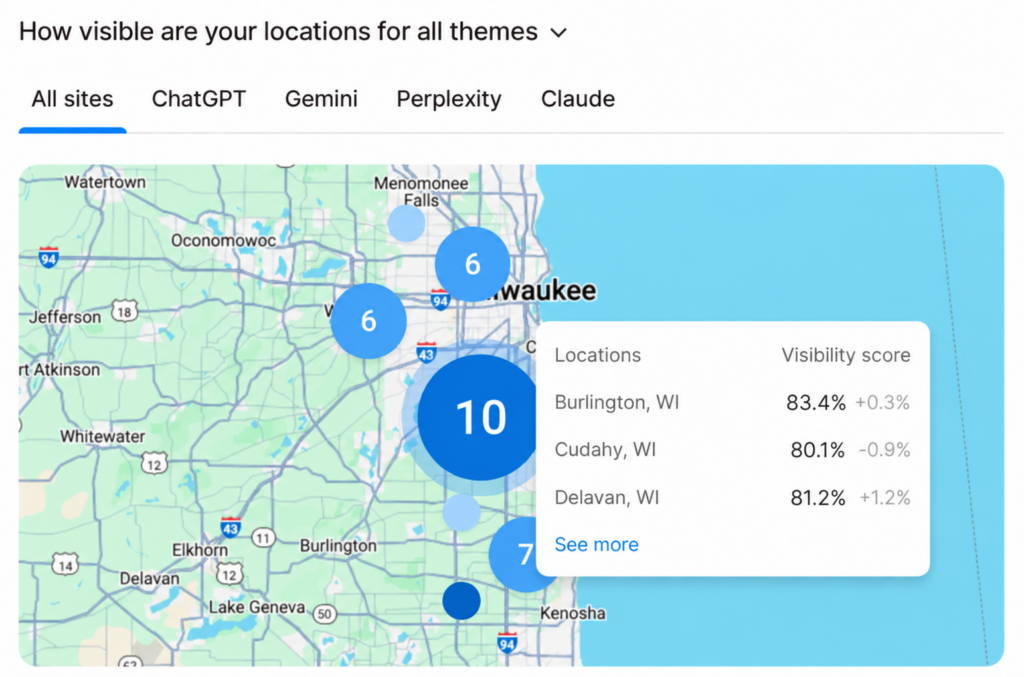
Brand-level tracking is not enough when every facility competes in its own local market. Birdeye AI Search, powered by Jay, the marketing AI coworker, shows how each location appears across AI platforms, identifies what is holding a facility back, and routes the fix to the right agent, whether that means a listing, a review, or a content gap.
- See the full picture: Track Visibility Score and Share of Voice by location, including which competitors AI recommends instead.
- Diagnose the gaps: See whether citations, inaccurate information, or website signals are affecting performance.
- Prioritize the fixes: Rank recommendations by impact instead of treating every issue as equally urgent.
Frequently asked questions
Answer engine optimization, or AEO, is the work of making a storage brand and each of its locations easier for AI answer engines to understand and recommend. For storage, that means accurate listings, local content, specific reviews, FAQs, and clear information about unit features and availability.
At Storage Asset Management, it does. Melissa Stiles said AI-referred visits are a small share of traffic but convert at roughly twice the rate of paid traffic. Dayna Hathaway said Extra Space sees highly qualified visitors who arrive ready to buy.
Reviews should include specific, recurring details, such as cleanliness, security, and a named manager’s service, giving AI engines more to match against a renter’s question than a star rating alone. Responses to negative reviews matter as well, and they should sound like the brand.
Pull AI-referred sessions, leads, and rentals for your 10 busiest facilities over the last 90 days and look at the trend, not a single week. Then read the last 20 reviews at one of them and ask whether they describe what makes the facility worth choosing.

About the Author

Somya Yesodharan
Originally published