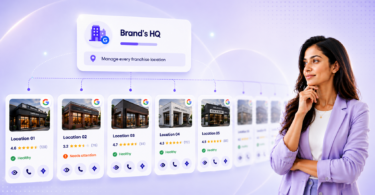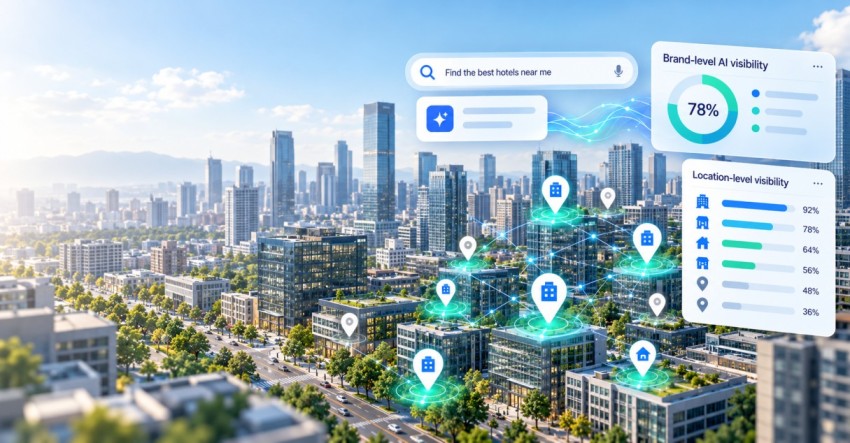
One in five locations never shows up in an AI answer. In Birdeye’s study of 16,240 location-level ChatGPT scans across 1,762 multi-location brands, 18.6% of locations were invisible. Nearly half of brands had a gap of 50 points or more between their best and worst locations. Brand-level dashboards hide this because they average strong locations with absent ones.
Clay McMurray, CMO at Benchmark Mortgage (80 branches), and Lauren Mack, who manages digital marketing for Wyndham Hotels (7,000+ properties), reached the same conclusion at opposite scales: strong brand visibility doesn’t guarantee every location shows up. They also agree on something less obvious. This is less a marketing problem than an ownership problem. Someone has to own the accuracy of every location’s data, and marketing cannot do that alone.
Table of contents
Why does a strong brand score hide weak locations?
Customers rarely search for a brand as a whole. They ask location-specific questions: which mortgage lender near me has strong reviews, or which hotel nearby offers free breakfast. Two locations under the same brand, with the same marketing spend and campaign calendar, can get very different treatment from ChatGPT, Google AI Overviews, Gemini, and Perplexity. One surfaces often. The other never does.
The study shows how much an average can hide. At the brand level, ChatGPT returned an average visibility score of 9.6 out of 100, and 51% of brands scored zero. For local “near me” searches, the average rose to 29.9. A brand-level score can leave leadership feeling fine while individual branches and properties are invisible.
This means being found isn’t enough. A location can appear in an AI answer and still lose the customer if the attached information is wrong. Only 0.6% of locations returned fully accurate information across every measured field. ChatGPT showed the wrong website for 57% of locations and the wrong phone number for 35%. These are data governance failures. They start in how a company maintains location information, not in how it markets.
What did Benchmark Mortgage and Wyndham Hotels find?
Clay McMurray joined Benchmark Mortgage in October of last year and quickly saw a disconnect between traditional search and AI visibility across its roughly 80 branches and loan officers. A branch might have a strong presence in traditional search but appear differently, or not at all, when borrowers use AI to search locally. Clay put it this way:
“This is not so much a brand problem, but it’s more of a visibility problem.”
For a borrower choosing a lender, an invisible or inaccurate branch means lost loan inquiries.
Wyndham sees the same disconnect across more than 7,000 properties. Lauren Mack explained that Wyndham has strong brand-level information about its loyalty program and hotel brands, but visibility becomes less consistent when a search points to a specific property in a specific city. For a traveler choosing a hotel, incorrect information about breakfast or a pool leads to disappointed guests and extra work for franchisees and internal teams.
What are leading multi-location brands doing differently?
Both companies started with the same foundation: make location information accurate, keep it current, and manage it through a scalable system. Their work comes down to four principles.
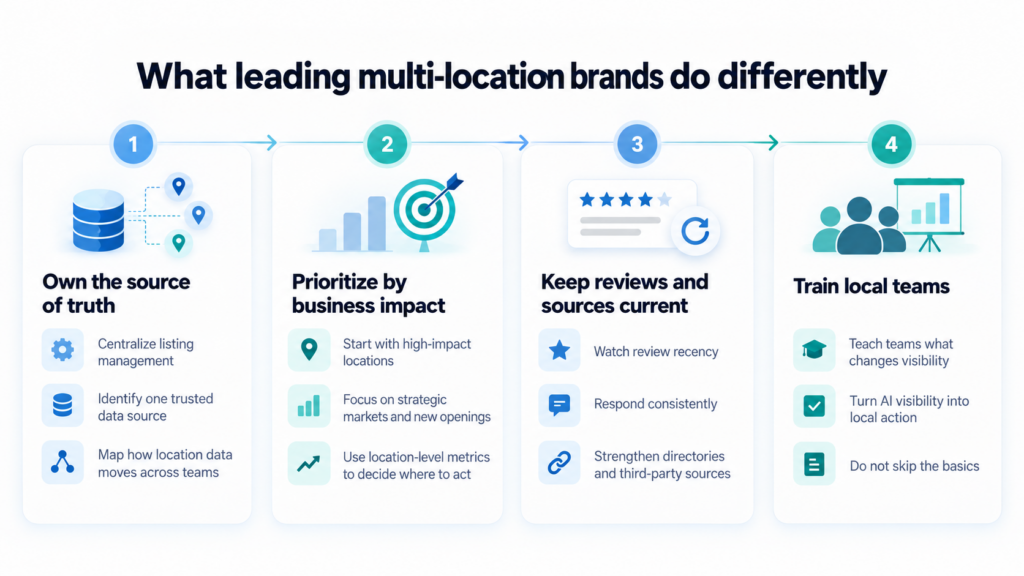
1. Own the source of truth
Before Benchmark worked on visibility, it worked on ownership. The team centralized listing management, identified an internal source of truth for location data, and mapped how information moves across departments and systems before it reaches listings. Clay described the goal this way:
“We wanna make sure that their listing data is accurate, their hours, their reviews, all that, so that we can give them the best chance to succeed.”
Wyndham reached the same place from the other direction. With 7,000+ properties, Lauren Mack said:
“There’s just no possible way our small but mighty team would be able to manually update listings.”
Wyndham manages listings centrally, so updates reach every platform and directory at scale, and keeps property details consistent across sources, since AI may pull from listings, travel sites, and other third parties. New properties are the easiest place to start. Lauren described them as a “fresh, clean start,” because teams can set accurate information and strong local practices before inconsistencies build up.
2. Prioritize by business impact
Birdeye’s research recommends starting with high-impact locations, strategic markets, and new openings, then using location-level metrics to decide where to act first.
The two companies took opposite routes. Benchmark brought all 80 branches into Birdeye at once, which surfaced gaps across the whole network. Wyndham, at 7,000+ properties, cannot review every location one by one, so it groups properties by shared characteristics and priorities, including areas where it wants to test new initiatives.
Every multi-location leader faces this choice: tackle everything at once or triage. The right answer depends largely on how many locations you run.
3. Keep reviews and sources current
Adam Dorfman noted that total review volume is not the whole story. Recent activity, particularly in the last 30 days, can give AI platforms fresher information about a location. Brands should track how recently each location received a review, whether activity is consistent, which locations have gone quiet, and whether customers are getting responses.
Sources matter just as much. Birdeye found that only about 7% of location-level AI citations came from the brand’s own site. This means so much of what AI says about a location comes from sources the brand does not own. Directories are one source brands can influence directly. Their share of citations rises from roughly 11% at the brand level to 25% for location-level queries, so keeping those profiles accurate and complete matters.
4. Train local teams
Technology cannot fix location-level visibility if the people closest to each location do not know what needs to change. Wyndham has made SEO education part of its approach, working with franchisees and internal teams to explain how actions like responding to reviews connect to changing search behavior. Lauren’s advice: do not skip the basics in the rush to adopt advanced AI tactics. The goal is to turn AI visibility from a corporate marketing metric into something local teams can understand and act on.
How does Birdeye help improve AI visibility at every location?
Birdeye builds AI agents for multi-location brands that need trust, consistency, and control at scale. Jay, Birdeye’s marketing AI coworker, orchestrates specialized agents across Reviews, Listings, Social, AI Search, and other workflows to move teams from insight to action.
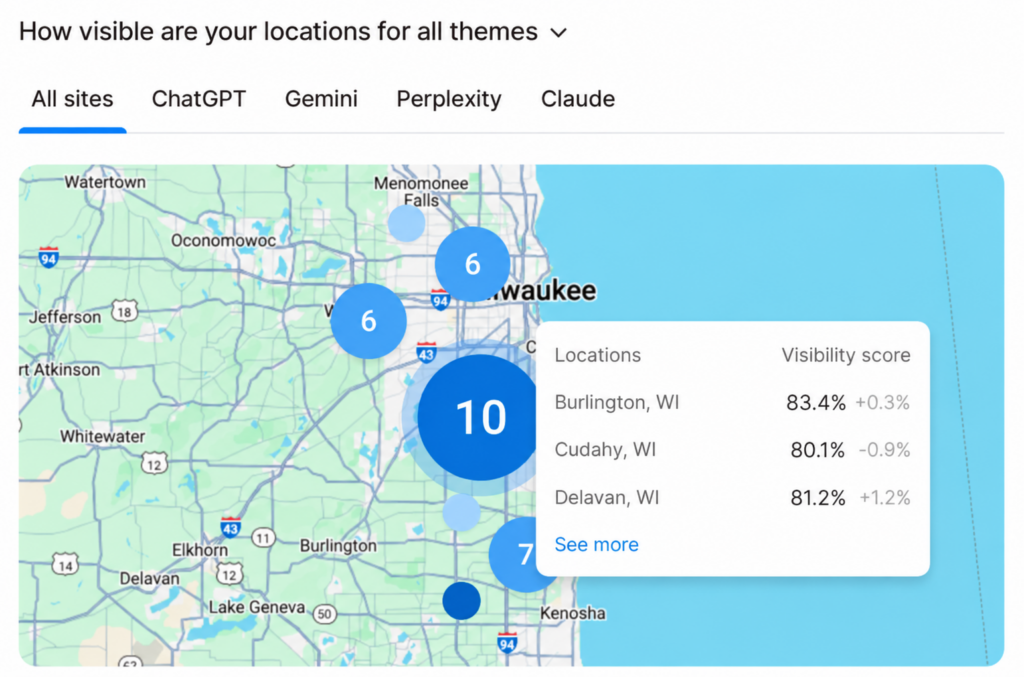
With Birdeye AI Search, multi-location brands can:
- See the full picture: Track Visibility Score and Share of Voice by location instead of relying on a brand-wide average, and see where competitors are recommended instead.
- Diagnose what is costing visibility: Understand the citations, accuracy issues, and website signals behind each location’s performance.
- Prioritize the fixes that matter most: Identify opportunities across listings, reviews, FAQs, blogs, and other signals based on potential impact.
Jay then orchestrates the agents needed to act, whether that means correcting a listing, strengthening reviews, or closing a content gap.
Frequently asked questions
AI visibility shifts as reviews, listings, website content, and competitor activity change. Treat it as an ongoing metric, not a one-time audit. A practical starting point is to review priority locations monthly and the broader footprint quarterly. Increase the frequency for new openings, high-revenue locations, or markets where visibility changes quickly.
Start with the location name, address, phone number, website, hours, services, and relevant attributes. Then check the third-party sources where customers and AI platforms are likely to find that information.
There is no single right answer, but there must be one named owner. Benchmark’s first step was to identify an internal source of truth and map how information flows between departments. Without that, listings drift out of sync, and no team is accountable for fixing them.
Birdeye AI Search helps brands track visibility at the brand and location levels, diagnose what may be limiting it, and identify actions to improve performance. Jay, Birdeye’s marketing AI coworker, can then orchestrate specialized agents across AI Search, Listings, Reviews, and other workflows to help teams act on those opportunities.
How to start improving AI visibility at every location?
Brand-level visibility can hide the locations that need the most attention. The next step is to move beyond the average and understand where individual franchisees, properties, or offices are being overlooked.
Birdeye AI Search helps multi-location brands see those gaps, understand what is causing them, and turn location-level insights into action.
Request a demo of Birdeye →
About the Author

Somya Yesodharan
Originally published