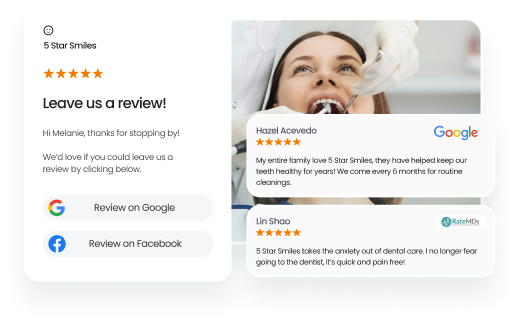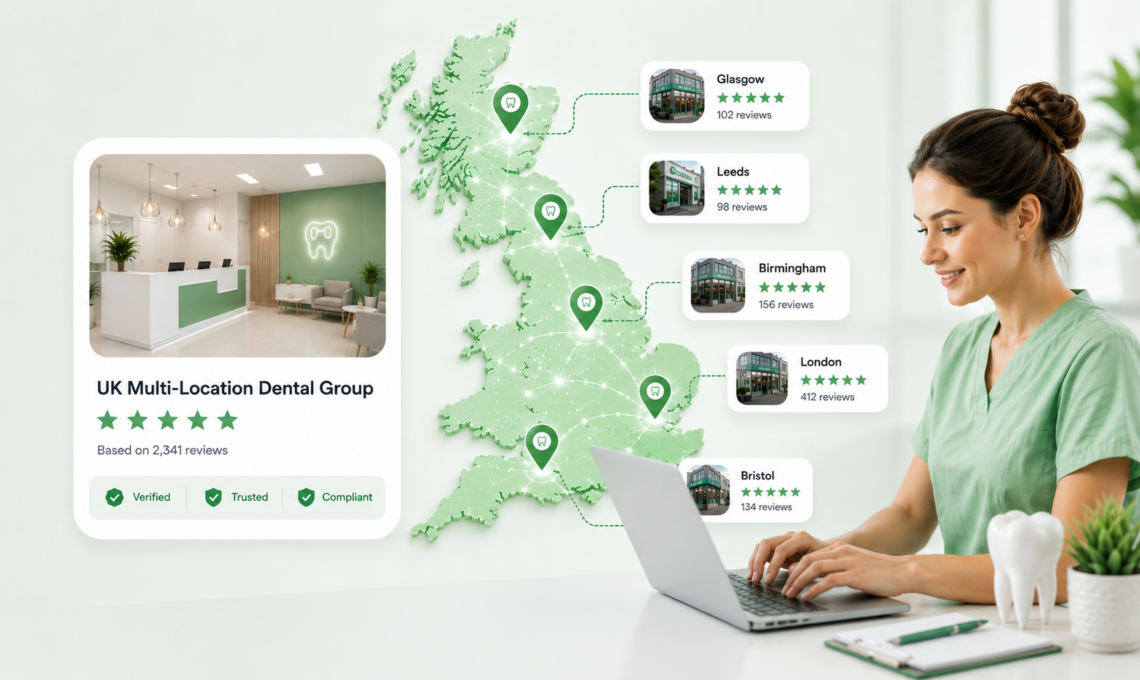
Dental review management is the active process of UK dental practices collecting, monitoring, and responding to patient reviews across Google, NHS.uk, Doctify, Trustpilot and other platforms while staying compliant with the GDC, the CMA Digital Markets Act 2024 and UK GDPR.
Summary – This guide explains how dental practices and multi-location dental groups can manage reviews across review sites and comply with consumer protection rules. It also explores how leading organisations are using technology to streamline review management at scale.
Table of contents
- What is dental review management and why does it matter for UK dental organisations?
- Which review platforms matter most for UK dental practices and groups?
- Which UK regulations affect dental review management?
- How can dental organisations build a compliant review management workflow?
- Why is managing reviews across multiple locations so difficult?
- How did mydentist achieve a 99% Google review response rate across 530 locations?
- What does an enterprise dental review management platform look like?
- Which dental review management software solutions are available in the UK?
- How is AI search changing dental review management in the UK?
- FAQs about dental review management UK
- Simplify dental review management with Birdeye
What is dental review management and why does it matter for UK dental organisations?
Dental review management is the process of collecting, monitoring, responding to, and analysing patient feedback across online review platforms.
For dental organisations, reviews shape patient trust, affect local search visibility, and provide valuable insight into the patient experience. In many cases, reviews are one of the first interactions prospective patients have with a practice.
While these goals apply to healthcare organisations worldwide, dental review management in the UK comes with unique challenges.
How does dental review management differ from reputation management?
Reputation management is the broader discipline of managing how a brand is perceived across all digital channels.
For a deeper look at the wider landscape, see our guide to reputation management companies in the UK.
It includes activities such as:
- Monitoring new reviews
- Responding to patient feedback
- Managing review requests
- Tracking review performance
- Identifying sentiment trends
- Escalating service issues
For dental organisations, review management often becomes the most visible part of reputation management because new dental patients actively rely on reviews when comparing providers.
Why reviews influence patient trust and visibility
Patients rarely choose a dental provider without conducting some form of online research.
Before booking an appointment, they often look at:
- Star ratings
- Review volume
- Recent patient experiences
- Response quality
- Practice information
- Location details
Reviews provide social proof. They help patients understand what they can expect from a practice before making contact.
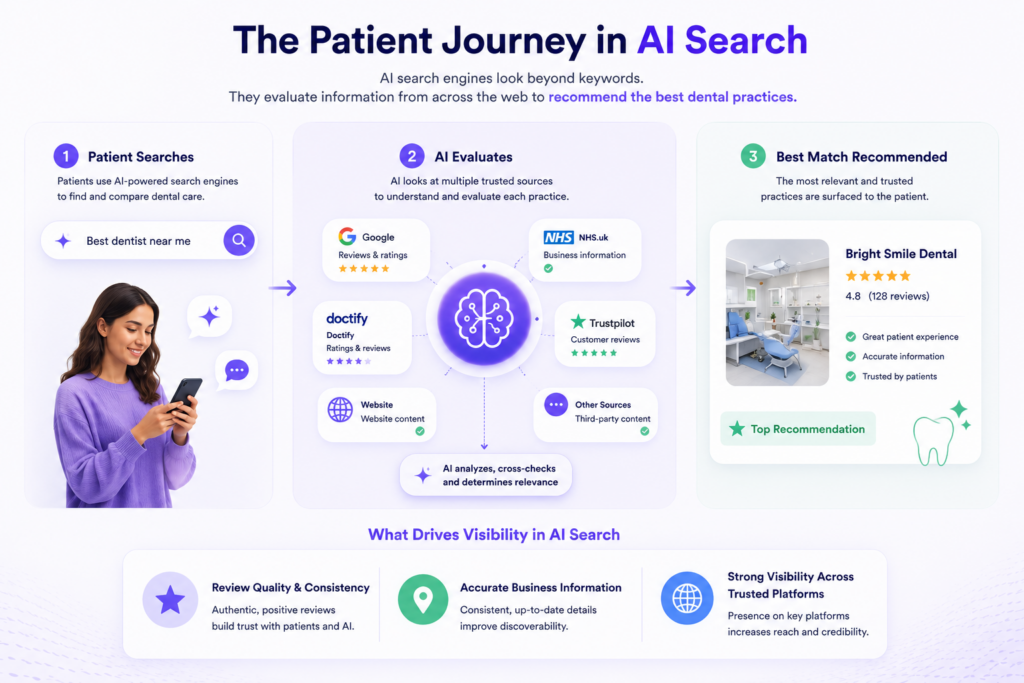
As AI-powered search experiences continue to evolve, review signals are becoming even more important. AI search engines increasingly rely on publicly available information to generate recommendations and summaries. That means review quality, review consistency, and business accuracy are playing a larger role in online discovery.
Why scale creates complexity for dental groups
Managing reviews across hundreds or thousands of locations is a completely different challenge.
Each location generates its own reviews, patient feedback, and operational issues. Different teams may be responsible for responding to reviews. Listings can become inaccurate. Duplicate profiles can appear. Response standards may vary from one practice to another.
As these workflows multiply, dental marketing automation can also help dental groups standardise review requests, patient follow-ups, and other post-visit engagement across locations.
Now, understanding where reviews appear is the next step. The UK dental review landscape extends far beyond Google, and each platform plays a different role in shaping patient perception.
Which review platforms matter most for UK dental practices and groups?
Dental review management in the UK extends beyond Google. Patients use different platforms depending on whether they are looking for NHS care, private treatment, specialist services, or general patient experiences.
For dental organisations, this means monitoring multiple review sources rather than focusing on a single channel.
The table below summarises the main platforms that influence dental reputation in the UK.
| Platform | Why it matters | Key consideration |
| Google reviews | Often the first source patients see when searching for a practice | Influences local visibility and patient trust |
| NHS.uk | Important for NHS patients researching providers | Feedback is publicly visible and can influence patient perceptions |
| Doctify | Popular among patients seeking private healthcare providers | Often used to compare clinicians and practices |
| Trustpilot | Provides broader brand-level reputation signals | Particularly relevant for larger dental groups |
| Enables patients to leave recommendations and engage with practices | Requires active monitoring alongside social engagement |
1. Google reviews
Google reviews remain the most influential trusted source for most dental organisations.
When patients search for a dentist in their area, Google Business Profiles often appear before they visit a website. Star ratings, review volume, photos, and review responses can all influence whether a patient chooses to learn more about a practice.
For multi-location dental groups, maintaining accurate details is just as important as managing reviews. Incorrect opening hours, duplicate listings, or outdated contact details can create a poor patient experience before an appointment is even booked.
2. NHS.uk reviews
NHS.uk plays a unique role in the UK dental landscape.
Patients can leave feedback about their experiences with NHS dental services, making the platform an important source of public sentiment. Unlike commercial review sites, NHS.uk is often viewed as an independent source of patient feedback.
For organisations that provide NHS services, monitoring NHS.uk reviews alongside Google reviews can provide a more complete picture of patient experience.
3. Doctify
Doctify has become an established platform for private healthcare providers, including dental practices.
Patients often use it to compare providers, read detailed experiences, and evaluate treatment options. While not every dental organisation prioritises Doctify, it can be an important reputation channel for practices with a significant private patient base.
4. Trustpilot
Trustpilot is often used to evaluate brands at an organisational level rather than an individual practice level. For larger dental groups, this can influence perceptions of the wider organisation.
5. Facebook
Facebook remains valuable because patients can leave recommendations, ask questions, and engage directly with practices. Reviews and social engagement often sit side by side, making timely monitoring important.
Because patient feedback is spread across multiple platforms, dental organisations need a clear process for collecting, monitoring, and responding to reviews. That process must also align with the regulatory requirements that govern patient communications in the UK.
Which UK regulations affect dental review management?
Dental organisations cannot approach review management in the same way as retailers or hospitality brands.
Patient confidentiality, data protection requirements, and consumer protection laws all influence how reviews are requested, monitored, and responded to.
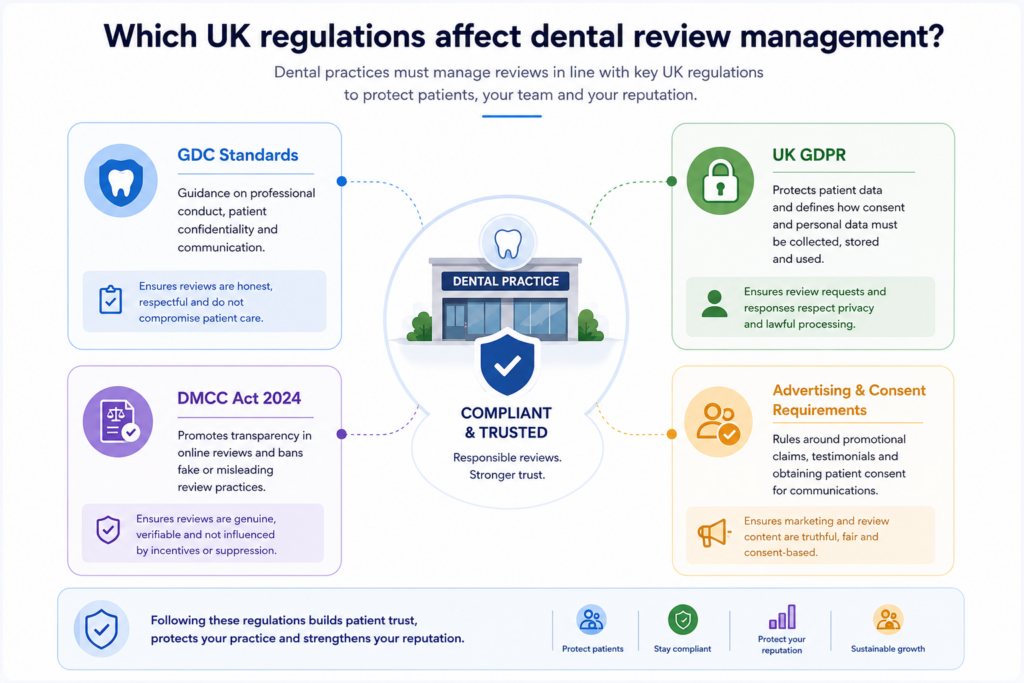
A compliant review programme should account for guidance from the General Dental Council (GDC), UK GDPR requirements, and consumer protection rules.
How do GDC standards influence review management?
The GDC requires dental professionals to maintain patient confidentiality and communicate professionally at all times.
This becomes particularly important when responding to reviews.
Even when a patient publicly shares details about their treatment, practices should avoid discussing personal information or confirming clinical details in a public response. A well-intentioned reply can quickly create confidentiality risks if too much information is disclosed.
For this reason, many dental organisations use standard response frameworks and escalation processes for sensitive reviews.
What does UK GDPR mean for review requests?
Review requests involve personal data, which means organisations must consider their UK GDPR obligations.
Patients should understand why they are being contacted and how their information is being used. Organisations should also ensure contact details are stored securely and communications are sent through approved channels.
For larger dental groups, this often requires consistent processes across every location to reduce compliance risks and maintain a positive patient experience.
How does the DMCC Act 2024 affect review collection?
The Digital Markets, Competition and Consumers Act 2024 places greater emphasis on the authenticity and transparency of reviews.
Organisations should focus on collecting genuine patient feedback and avoid practices that could mislead consumers.
Purchasing reviews or manipulating feedback can create significant compliance risks. Learn more about why buying Google reviews is risky in the UK.
Examples of risky behaviour may include:
- Publishing fake reviews
- Suppressing legitimate negative reviews
- Selectively requesting reviews only from certain patients
- Presenting reviews in a misleading way
The goal should be to create an accurate reflection of the patient experience.
What compliance risks should dental organisations avoid?
Most compliance issues arise from inconsistent processes rather than deliberate actions.
Common risks include:
- Sharing confidential patient information in public responses
- Using unapproved review response templates
- Failing to monitor reviews across all platforms
- Inconsistent review request practices between locations
- Responding emotionally to negative feedback
A clear governance framework can help reduce these risks while ensuring patients receive timely and professional responses.
Compliance is only one part of the challenge. Dental organisations also need a repeatable process for collecting feedback, monitoring reviews, and responding consistently across locations.
How can dental organisations build a compliant review management workflow?
The most effective review programmes are built around a clear workflow.
Without defined processes, review requests become inconsistent, response times vary, and valuable patient feedback can be missed.
A typical dental review management workflow includes five stages:
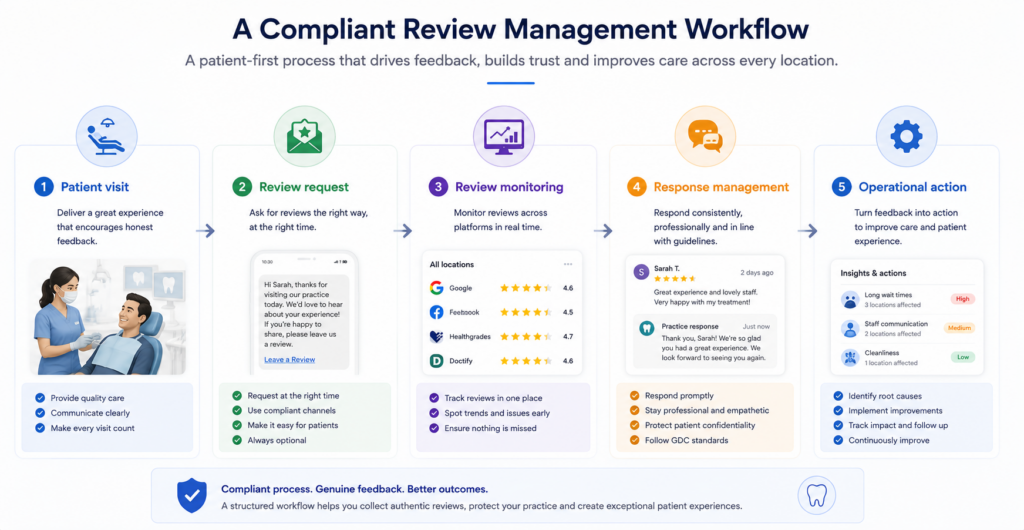
Collect feedback throughout the patient journey
Patients are more likely to leave feedback when the experience is still fresh. Many organisations use automated review generation workflows shortly after an appointment, while the interaction is still top of mind.
The process should be consistent across locations so that every patient has an equal opportunity to share feedback.
Encourage authentic reviews
The objective should be to gather genuine feedback from a broad range of patients.
A healthy review profile reflects both positive experiences and opportunities for improvement. Consistent review collection also helps prevent a small number of reviews from disproportionately influencing public perception.
Address issues before they become public complaints
Not every concern needs to become a public review. When organisations actively monitor patient feedback, they can identify recurring issues and escalate them to the appropriate teams for investigation.
Common themes may include:
- Appointment availability
- Waiting times
- Communication challenges
- Practice accessibility
- Billing or administrative concerns
Resolving these issues early can improve patient satisfaction and reduce future complaints.
Create accountability across locations
As organisations grow, ownership becomes increasingly important.
Teams should understand:
- Who monitors reviews
- Who responds to reviews
- Which reviews require escalation
- How performance is measured
This creates consistency across locations while ensuring patients receive timely responses.
Even with a strong workflow, maintaining consistency across hundreds of locations remains challenging. That complexity is one of the biggest reasons multi-location dental groups invest in dedicated review management processes and technology.
Why is managing reviews across multiple locations so difficult?
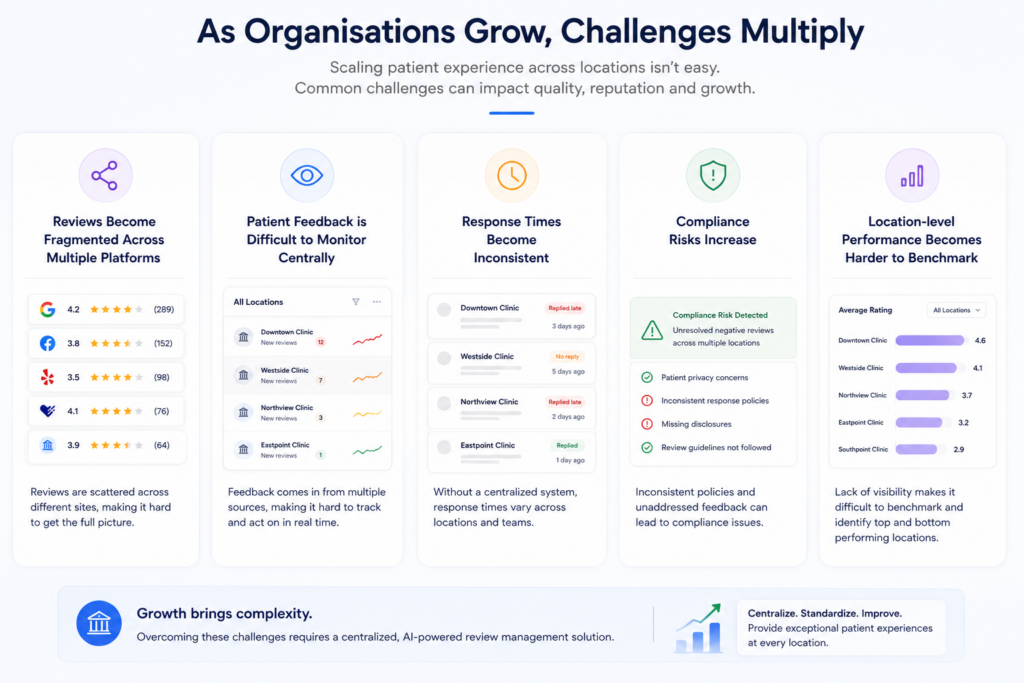
Review management becomes more complex as dental organisations grow.
Each location generates its own reviews, ratings, and patient feedback. Without a central process, it becomes difficult to maintain consistency across the organisation.
Fragmented monitoring across review sites
Patients leave reviews across multiple platforms, including Google, NHS.uk, Doctify, Trustpilot, and Facebook.
Monitoring each platform manually takes time and increases the risk of missing important feedback. This is particularly challenging for organisations managing dozens or hundreds of locations.
Inconsistent response standards
Different locations often have different processes for handling reviews.
Some respond quickly. Others may not respond at all. Over time, this creates an inconsistent patient experience and can affect how the organisation is perceived online.
Duplicate listings and inaccurate information
Reviews and listings are closely connected.
Outdated opening hours, incorrect phone numbers, duplicate profiles, or inaccurate addresses can frustrate patients and generate negative feedback. As the number of locations grows, maintaining accurate information becomes more difficult.
For the most common issues patients raise and how to resolve them, see our guide on dental complaints.
Why is it difficult to identify organisation-wide trends?
When reviews are managed separately by location, valuable insights can be missed.
Recurring issues such as appointment delays, communication problems, or staffing challenges may appear across multiple locations without being recognised at an organisational level.
These challenges are common among large dental groups. mydentist, for example, needed to manage more than 1,500 listings and reviews across 530 locations. Creating visibility and consistency at that scale required a more centralised approach.
How did mydentist achieve a 99% Google review response rate across 530 locations?
As the UK’s largest provider of dental care, mydentist faced a challenge familiar to many multi-location organisations: managing reviews and listings at scale.
Before adopting Birdeye, the organisation was overseeing more than 1,500 online listings across 530 locations. Duplicate profiles, inaccurate information, and fragmented review management made it difficult to maintain consistency across the business.
To address these challenges, mydentist implemented Birdeye’s Listings AI and Reviews solutions. The organisation initially onboarded a small group of locations before expanding the rollout across all 530 practices.
The challenge of managing more than 1,500 listings
The centralised approach gave teams visibility into reviews from multiple sources while making it easier to monitor feedback and respond consistently. Four dedicated team members were trained to manage reviews, identify issues that required follow-up, and maintain a consistent brand voice across locations.
The results were significant:
- 99% response rate to Google reviews
- 98% response rate across all review sources
- 50% increase in reviews year over year
- Average rating improvement from 4.4 to 4.6 within six months
- 10% increase in Google Business Profile interactions
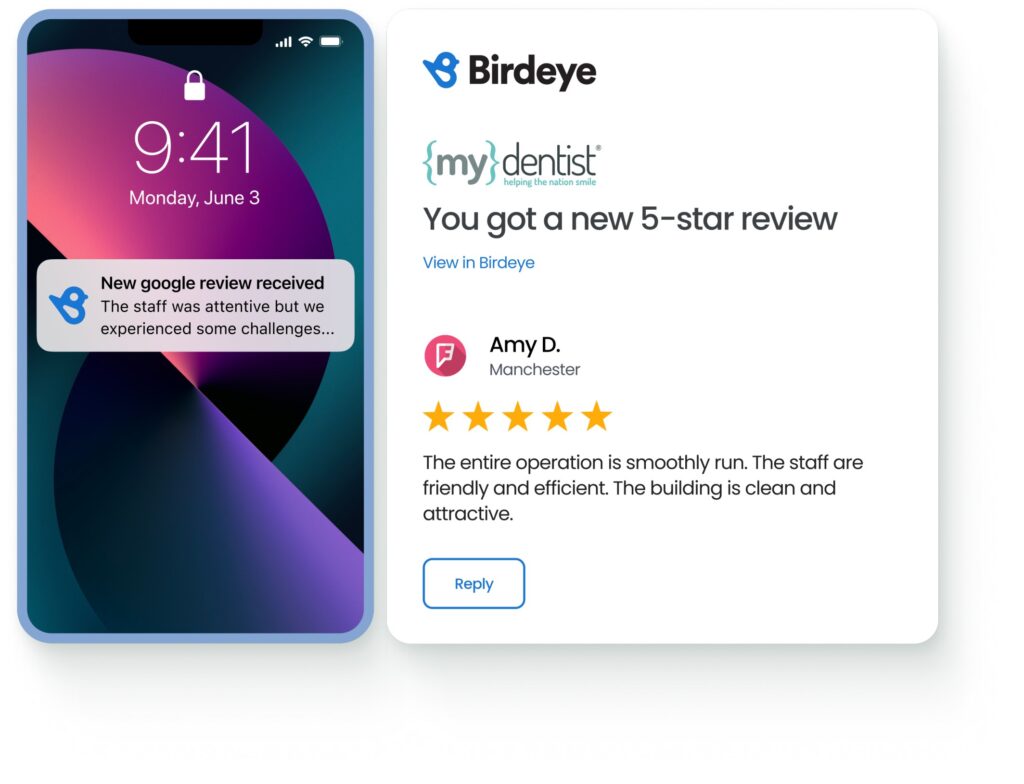
Creating a centralised review management process
The organisation also improved control over its listings, helping patients find accurate information during a period of large-scale practice relocations.
For multi-location dental groups, the lesson is simple. Review management becomes much easier when reviews, listings, and patient feedback are managed through a centralised process rather than individual location workflows.
Related read: See what Aspen Dental’s procurement team looks for in enterprise vendor partnerships.
The next step is to understand which technologies and processes are needed to support review management at enterprise scale.
"It’s fair to say it was challenging at points...but the Birdeye team just kept stepping up. They kept coming back and fixing the blockers at a rate I wasn’t expecting. Within 60 days, we were onboarding another 25 locations...and shortly after, we were able to onboard all 530 locations." – Peter Bailey, Head of Digital
Looking for guidance on choosing a dentist? Our guide to dentist reviews in the UK explains how patients can evaluate reviews and compare providers.
What does an enterprise dental review management platform look like?
Managing reviews across hundreds of dental practices requires more than simple monitoring. Dental organisations need a system that loops reviews, listings, patient communications, reporting, and enterprise governance together. Birdeye builds AI agents for multi-location brands that need trust, consistency, and control at scale.
Instead of relying on legacy software or manual review tracking, enterprise dental brands add AI staff to every clinic. The company provides three specialized AI coworkers—Jay for marketing, Robin for operations, and Myna for customer experience—to execute local department jobs automatically.
Connected to core dental practice management software and CRMs via 3,000+ integrations, these coworkers employ multiple agents that work together through a continuous, autonomous execution framework:
- Consolidate: Specialized agents read every local signal from every system, combining patient reviews, provider listings, clinic messaging history, local surveys, and social interactions into unified customer profiles across 200+ review and business listing sites.
- Reason: Rather than executing generic templates, the agents analyze patient feedback against unique brand guidelines, dental industry context, and location memory.
- Act: The agents execute localized tasks instantly across practices within predefined corporate guardrails to maximize discovery and Local Pack performance.
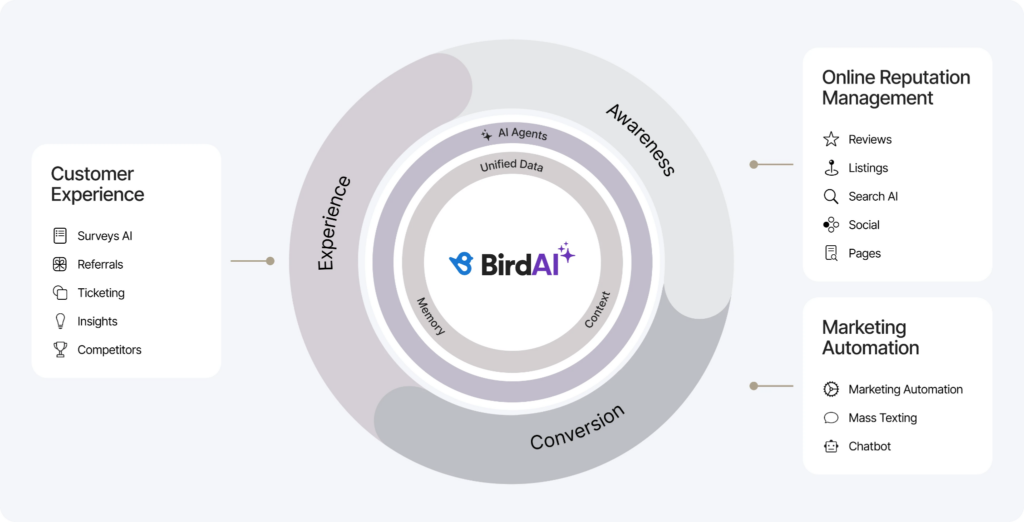
How can organisations consolidate reviews, listings and patient communications?
To transform dental presence into a localized growth engine, Jay coordinates a synchronized network of highly specialized marketing agents to do the heavy lifting:
- Review Generation Agent & Review Response Agent: Request patient reviews at the optimal conversion moment and draft compliant public replies autonomously or via a human-in-the-loop approval workflow.
- Search AI: Tracks AI search rankings, citations, sentiment, and brand mentions across modern platforms like ChatGPT, Perplexity, and Gemini to ensure clinics outrank local competition.
- Listings Optimisation Agent: Scans profiles continuously to keep clinic data, hours, and provider fields perfectly accurate and identical across Google, Apple, Facebook, and Yelp.
- Social Publishing Agent & Social Engagement Agent: Build localized clinic channels and automatically triage comments or DMs to secure long-term patient loyalty.
- Marketing Automation & Lead Generation Agent: Run AI-native campaigns personalized for every clinic line while capturing inbound patient traffic 24/7.
- Reporting Agent & Insights: Translate data anomalies into plain language and track dental network health via a single, comprehensive Birdeye Score across local sentiment, reputation, and listing accuracy.
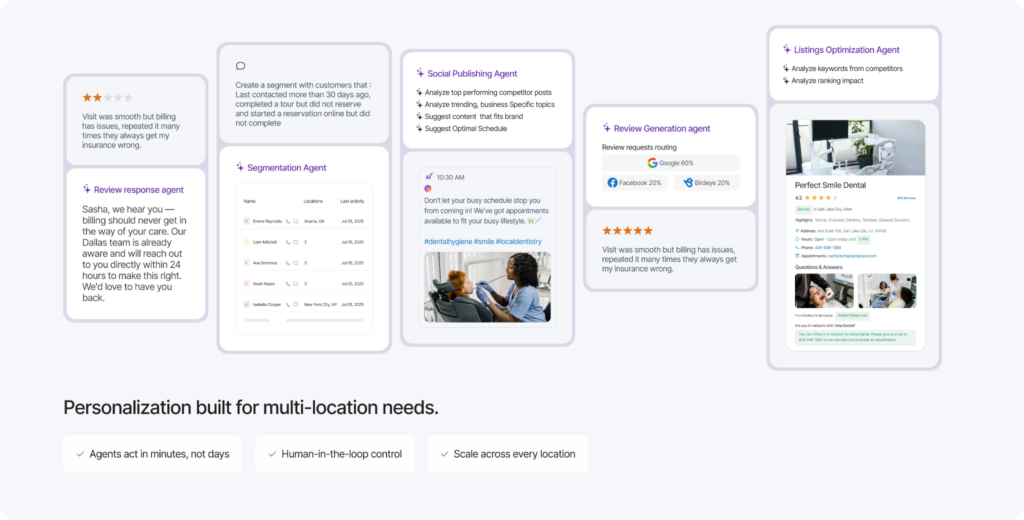
Backed by enterprise governance controls like Role-Based Access Control (RBAC) and Tiered Approvals, corporate teams can safely scale execution across 100 to 10,000+ locations.
Deployed across hundreds or thousands of clinics, Birdeye replaces fragmented point solutions with an autonomous workforce that multiplies marketing capacity without multiplying headcount, trusted globally by enterprise leaders like Sutter Health and Aspen Dental.
The platform also connects to more than 3,000 integrations, including dental CRMs, PMSs, and operational systems such as ABELDent, CareStack, and Curve Dental, as well as Salesforce, HubSpot, and AthenaHealth. This creates a single source of truth across locations rather than multiple disconnected systems.
How can they turn patient feedback into action?
Collecting reviews is only part of the process. Organisations also need to understand what reviews reveal about the patient experience.
Birdeye’s unified customer profiles bring together reviews, messages, surveys, and other customer interactions into a single view. This helps organisations identify trends across locations and uncover recurring operational issues.
Several AI-powered capabilities support this process:
- Reports AI identifies performance trends and explains changes
- Competitors AI benchmarks reputation and sentiment against local competitors
- Search AI tracks visibility across AI-powered search engines, monitors citations, and identifies opportunities to improve discoverability
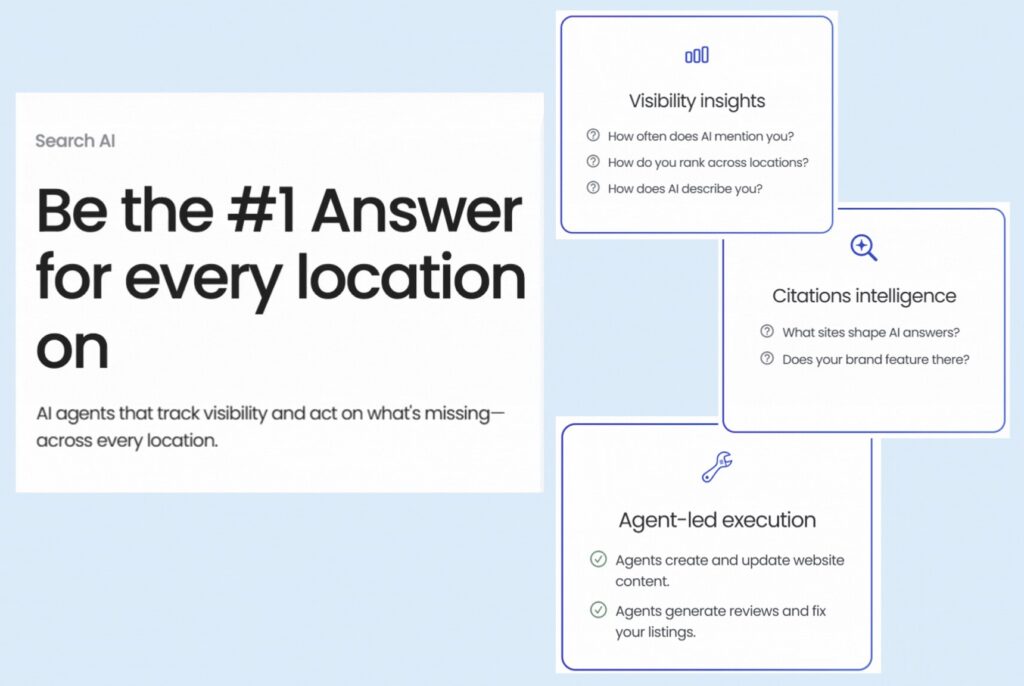
These insights help organisations move beyond individual reviews and understand what is happening across the wider business.
Which dental review management software solutions are available in the UK?
Dental organisations evaluating review management software should look beyond review collection alone. The most effective platforms help manage reviews across multiple channels, support compliance workflows, integrate with practice management systems, and provide visibility across locations.
The table* below compares several platforms that appear in UK search results and AI-generated answers for dental review management.
| Platform | UK review-site coverage* | UK PMS integrations* | AI & sentiment capabilities | Best for |
| Birdeye | Google, NHS.uk, Doctify, and other major review platforms | Integrates with leading healthcare and business systems; verifies specific PMS requirements | Reviews, Listings AI, Search AI, Reports AI, Competitors AI, AI-powered review responses and insights | Multi-location dental organisations (100-10,000) that need reviews, listings, reporting, AI search visibility, and governance in one platform |
| CareStack | Google review management capabilities | Verify PMS integrations | Limited public information available | Practices using the CareStack ecosystem |
| Doctible | Google review management and patient communication tools | Verify PMS integrations | AI-assisted workflows available | Patient communication and review collection |
| Repugen | Review monitoring and reputation management | Verify PMS integrations | Sentiment analysis and reputation reporting | Healthcare reputation management |
| Weave | Reviews, messaging, and patient engagement | Verify PMS integrations | AI-assisted communication features | Practice communication and engagement |
| Doctify | Doctify review ecosystem | Not primarily a PMS integration platform | Reputation and patient feedback insights | Private healthcare and specialist provider reviews |
| Trustpilot Business | Trustpilot review ecosystem | Not primarily a PMS integration platform | Review analytics and reporting | Organisation-level reputation management |
*This is as per information available on the web. Birdeye holds no credibility with them. Integration capabilities and review-site coverage should be verified directly with each vendor before purchase decisions.
Among these platforms, Birdeye’s agentic capabilities stand apart by combining Reviews, Listings AI, Search AI, Social AI, Messaging AI, Competitors AI, and Reports AI within a single platform. This allows multi-location dental organisations to manage reviews, listings, patient communications, reporting, AI search visibility, and governance from one system rather than relying on multiple tools.
How is AI search changing dental review management in the UK?
Patients are increasingly using AI-powered search engines like ChatGPT and Gemini to research healthcare providers, compare options, and ask questions before booking appointments.
These platforms rely on information from across the web, including reviews, listings, websites, and third-party sources. As a result, dental organisations need to think beyond traditional search rankings.
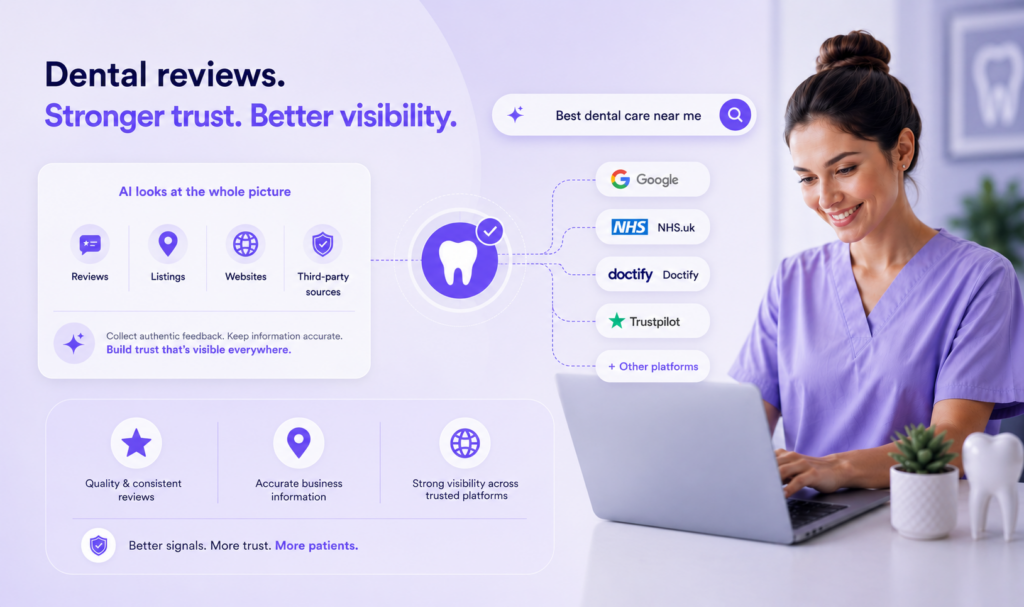
Organisations that actively manage reviews across Google, NHS.uk, Doctify, Trustpilot, and other relevant sources are better positioned to build trust with both patients and search platforms.
This is particularly important for multi-location dental groups. Inconsistent ratings, outdated listings, or unmanaged reviews can create conflicting signals that affect visibility and patient confidence.
As AI search continues to evolve, the fundamentals remain the same. Organisations that collect authentic feedback, respond consistently, maintain accurate listings, and monitor patient sentiment will be in a stronger position to stand out online.
FAQs about dental review management UK
Yes. Dental practices can ask patients for reviews, provided they follow relevant data protection and consumer protection requirements. Review requests should encourage genuine feedback and should not mislead patients or influence the content of reviews.
Yes. However, responses should remain professional and avoid disclosing confidential patient information. Many organisations use approved response guidelines to reduce compliance risks.
Dental organisations should consider GDC standards, UK GDPR requirements, and consumer protection regulations, including the Digital Markets, Competition and Consumers Act 2024.
A centralised approach helps organisations monitor reviews, maintain consistent response standards, track performance across locations, and identify trends more efficiently.
Simplify dental review management with Birdeye
Dental review management has become a core part of patient experience, reputation, and visibility for UK dental organisations.
As organisations grow, managing reviews across Google, NHS.uk, Doctify, Trustpilot, and other platforms requires a structured and compliant approach. The right processes and technology help teams respond consistently, maintain accurate information, and turn patient feedback into action.
With AI search placing even greater emphasis on reviews and trust signals, organisations that invest in review management today will be better positioned to attract and retain patients tomorrow.

About the Author

Shruti Dugar
Birdeye
Originally published


![[Feature image] Law Firm Reputation Management_ The Complete Guide for Attorneys](https://birdeye.com/blog/wp-content/uploads/Feature-image-Law-Firm-Reputation-Management_-The-Complete-Guide-for-Attorneys-375x195.jpg)