Enterprise reputation management is the strategic process through which large, multi-location organizations build, monitor, and protect their brand image across review platforms, business listings, and social media channels at scale.
Summary
For Fortune 500 companies managing hundreds or thousands of locations, reputation does not manage itself. According to the Birdeye State of Online Reviews 2026 report, 88% of consumers trust online reviews as much as personal recommendations, making every unanswered review a direct revenue signal. Enterprise reputation management software must deliver API access, SOC 2 compliance, dedicated customer success support, and a unified multi-location inbox that SMB tools simply cannot provide.
This blog ranks the 7 best enterprise reputation management software tools in 2026 and covers a buying guide, a real-world enterprise case study, and FAQs to support your procurement decision.
Table of contents
- Enterprise reputation management software comparison (2026)
- What is enterprise reputation management software?
- How we evaluated enterprise reputation management tools
- 7 Best enterprise reputation management software in 2026
- How to choose enterprise reputation management software
- What are the key enterprise reputation management strategies
- How Birdeye helped Sutter Health scale enterprise reputation management across 4,000+ locations
- FAQs on enterprise reputation management
- Manage enterprise reputation at scale with Birdeye
Enterprise reputation management software comparison (2026)
| Tool | Best for | G2 Rating | AI automation/AI agents | Compliance certs | Pricing |
| Birdeye | Multi-location enterprises with 100-10,000+ locations | 4.7/5 | Yes | SOC 2, HIPAA, GDPR | Custom enterprise pricing based on locations and features |
| Reputation.com | Regulated industries | 4.5/5 | Yes | SOC 2, HIPAA | Custom pricing |
| Sprout Social | Social reputation monitoring | 4.4/5 | Yes | SOC 2 | Starts at $199/month |
| ReviewTrackers | Review analytics | 4.6/5 | Limited | SOC 2 | Custom pricing |
| Brand24 | Media and social mention monitoring | 4.6/5 | Yes | GDPR | Starts at $199/month |
| Yext | Local listings and reputation | 4.4/5 | Limited | SOC 2, HIPAA | Per-location pricing |
| Grade.us | Enterprise marketing agencies | 4.6/5 | Limited | SOC 2 | Starts at $99/month |
See Birdeye in action, request a custom enterprise demo
What is enterprise reputation management software?
Enterprise reputation management software is a centralized platform that helps large, multi-location organizations generate, monitor, respond to, and analyze reviews, listings, and brand mentions across hundreds or thousands of locations from a single dashboard.
Unlike SMB tools, enterprise-grade platforms deliver API access for custom integrations, SOC 2 Type II and HIPAA compliance, dedicated customer success managers, and role-based permissions that give corporate teams oversight while empowering local managers to act.
The best enterprise reputation management software also uses AI agents to automate review responses, surface sentiment trends across locations, and feed reputation data directly into CRM and reporting systems.
How we evaluated enterprise reputation management tools
Enterprise reputation decision-makers evaluate platforms across multiple departments, from marketing and IT to legal and operations. To reflect that reality, we scored each tool on six criteria that separate enterprise-grade platforms from SMB solutions.
- Multi-location scalability: We assessed whether each platform supports centralized management of 100 to 10,000+ locations, including role-based permissions, location-level reporting, and roll-up dashboards for corporate oversight.
- AI automation and AI agent depth: We evaluated whether each tool uses AI agents to auto-generate on-brand review responses, detect trending feedback themes across locations, and reduce manual workload for distributed teams.
- API integrations and CRM connectivity: We reviewed native integrations with enterprise systems such as Salesforce and HubSpot, as well as API availability for custom data workflows and embedded stack connectivity.
- Enterprise security and compliance: We verified SOC 2 Type II certification, availability of a HIPAA Business Associate Agreement, and GDPR-compliant data processing, as procurement teams at regulated enterprises require all three for vendor approval.
- G2 rating and verified review volume: We referenced G2’s enterprise reputation management category to assess peer-validated performance scores and review depth for each platform.
- Pricing transparency: We noted whether each vendor publishes pricing or uses a custom quoting model, as budget predictability matters for enterprise procurement cycles.
7 Best enterprise reputation management software in 2026
The following seven platforms represent the strongest options for enterprise reputation management in 2026, ranked by their ability to serve multi-location brands.
1. Birdeye
Best for: Multi-location enterprises across healthcare, retail, financial services, automotive, and property management.
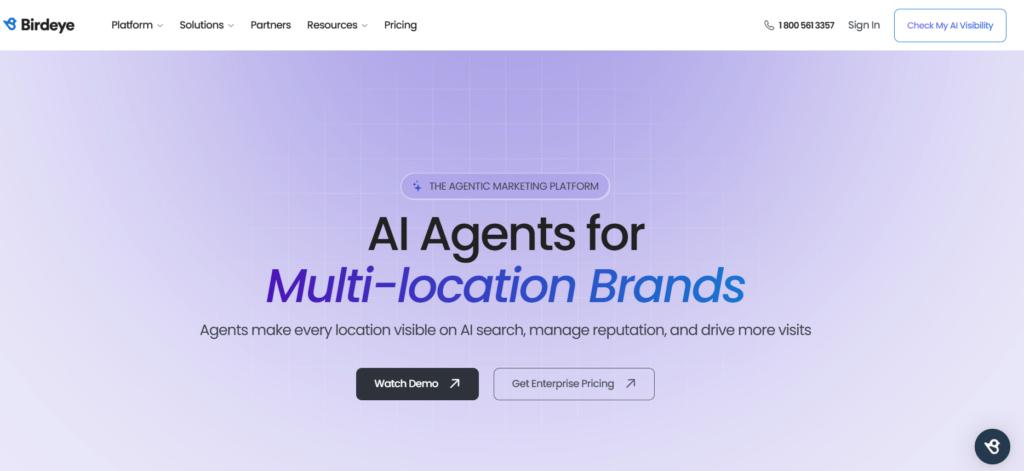
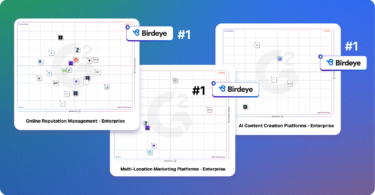
Birdeye builds AI agents for multi-location brands. It integrates review management, business listings, social media, customer communications, and AI-driven insights into a unified dashboard. Birdeye monitors and manages reputation across 200+ review sites and 150+ listing directories, integrates with 3,000+ business systems, and holds SOC 2 Type II and HIPAA certifications. According to G2, Birdeye is No. 1 Enterprise reputation management software; global enterprise brands trust Birdeye to manage reputation at scale across hundreds and thousands of locations.
Key features
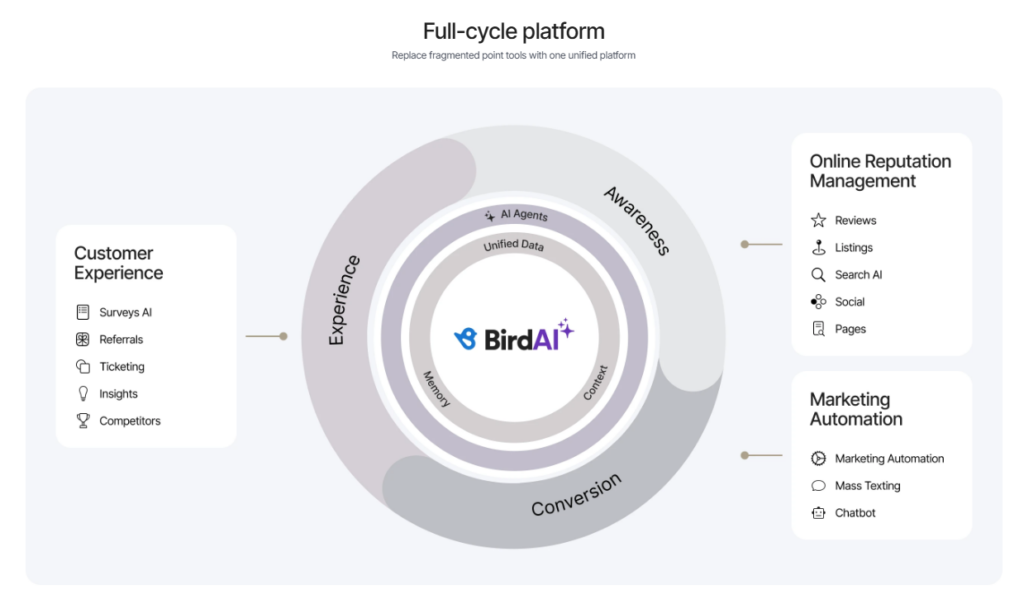
Three core pillars of the Birdeye
- Full-cycle customer data platform: Synchronizes data from 3,000+ operational systems, including CRMs, POS, PMS, and EHRs into a single source of truth per location, eliminating data silos across the enterprise
- Location intelligence: Analyzes real-time local contexts such as review velocity, operating hours, hyper-local offerings, and regional competitor activity to personalize actions by individual storefront
- Agentic automation: Shifts execution from manually constructed workflows to goal-based automation, using specialized AI agents to manage segmentation, messaging, routing, and regional logic within brand guardrails
AI coworkers and specialized execution agents
Jay (Marketing Coworker)
- Search AI Agent that optimizes local profiles for Google, ChatGPT, Copilot, and Perplexity
- Listings Optimization Agent that audits and syncs directory data at scale to remove cross-platform discrepancies
- Reviews Response Agent that drafts contextual, on-brand responses to inbound customer reviews
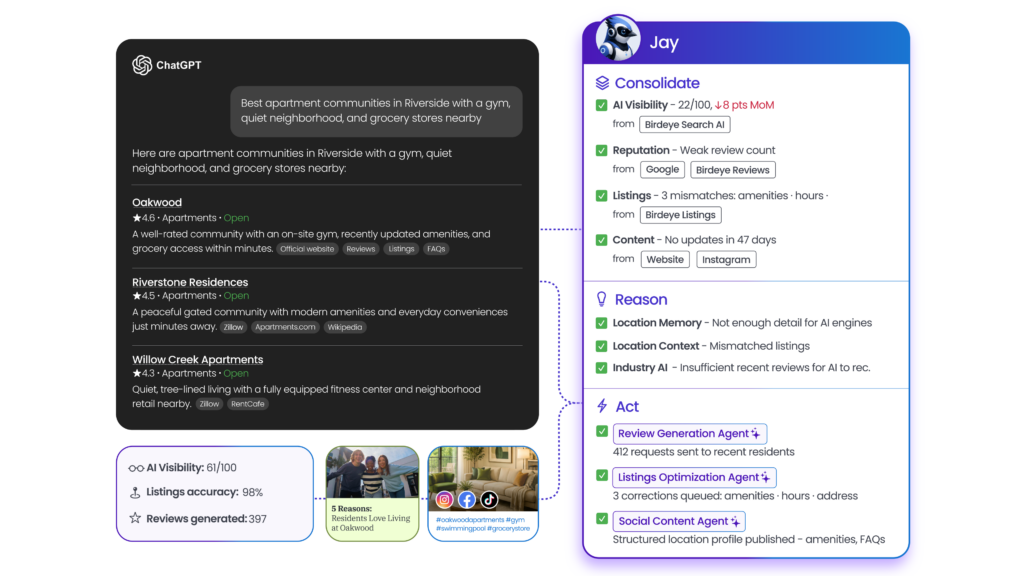
- Birdeye Review Generation Agent that automates SMS and email request campaigns tied to transaction triggers
- Social Publishing Agent that creates and localizes content tailored to individual branch audiences
- Segmentation Agent dynamically groups target audiences for campaigns using real-time database updates and user rules.
- Template Design Agent compiles brand-compliant multi-channel marketing layouts for emails, text messages, and landing pages.
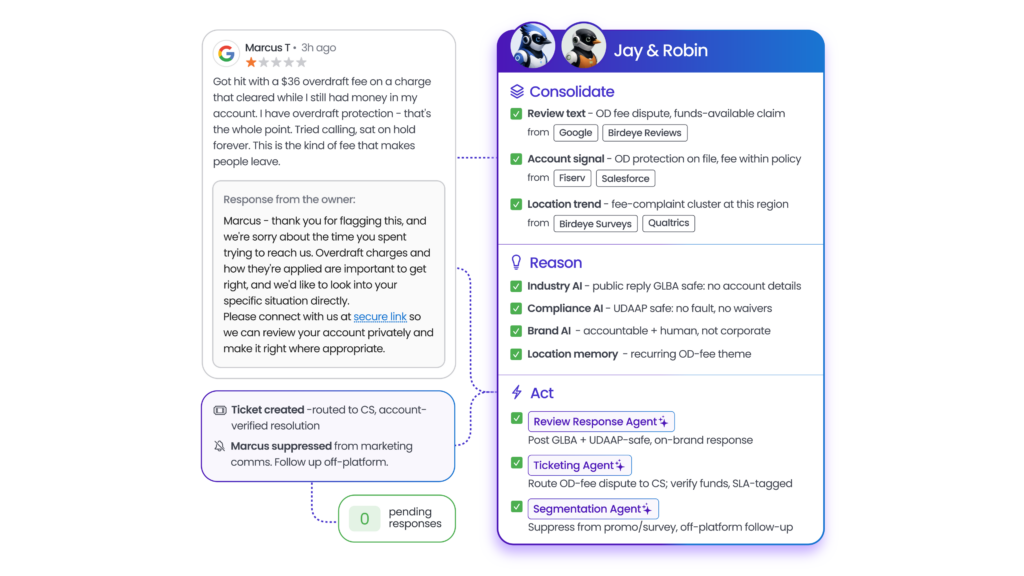
Robin (Operations Coworker)
- Conversational Web Chat Agent that fields customer inquiries, captures leads, and routes queries dynamically
- Appointment Scheduling Agent that processes bookings and manages calendar confirmations
- Reception Automation Agent that reduces missed inbound calls by handling repetitive office communications
- Ticketing Agent automatically captures, routes, and tracks customer issues across all locations.
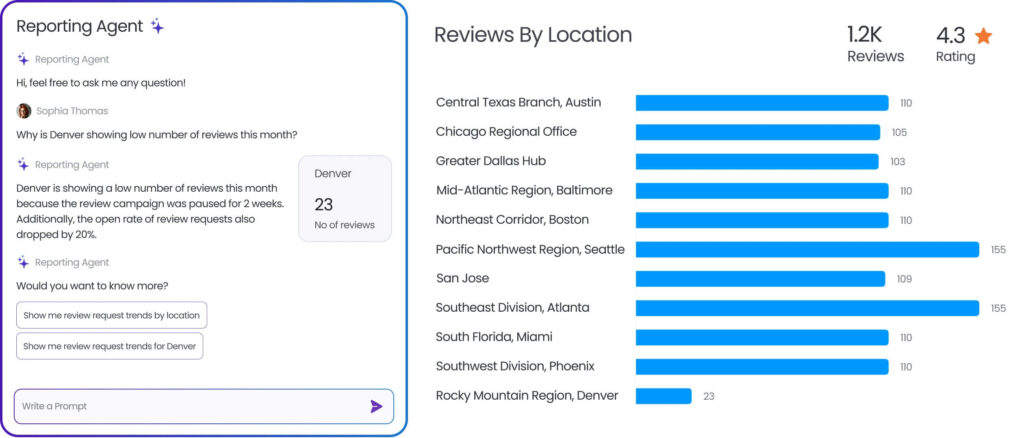
Myna (Customer Experience Coworker)
- Survey Agent that delivers, collects, and categorizes transaction-linked customer surveys
- Routing Agent intelligently routes customer messages from web, social, and text channels to the right team for faster responses.
- Insights and Reports AI Agent that tracks the Birdeye Score, extracts performance patterns, and synthesizes qualitative data across all locations
Pros
- Enterprise-grade platform built specifically for multi-location brands with strong SOC 2 Type II and HIPAA compliance controls
- AI agents automate listings, reviews, social media, and reporting across all locations
- Aggregates reviews and listings across hundreds of locations into one all-in-one dashboard, saving teams hours each week through automation
- Combines reputation, listings, AI search visibility, communications, and customer experience in one platform
Cons
- Niche or industry-specific integrations may require additional configuration, though APIs and connectors are available for most business systems
- The breadth of capabilities across listings, reviews, social media, and AI automation means larger organizations may need time to fully operationalize the platform across all teams and locations
Pricing: Custom enterprise pricing. Request a demo for a tailored quote.
G2 Rating: 4.7/5 (based on 4,101+ verified reviews)
“What I like best about Birdeye is how it centralizes customer reviews, messaging, and online reputation management in one easy-to-use platform. The automated review requests help generate more customer feedback with minimal effort, and the dashboard makes it simple to monitor and respond to reviews across multiple sites. The reporting features provide valuable insights into customer sentiment, helping businesses improve their service and strengthen their online presence. Overall, Birdeye saves time, improves customer engagement, and makes reputation management much more efficient”
[Get a personalized Birdeye demo for your enterprise]
2. Reputation.com
Best for: Regulated industries

Reputation.com is a reputation intelligence platform built for organizations in regulated sectors including healthcare, automotive, and hospitality. It consolidates reviews, surveys, social mentions, and listings into one system, anchored by a proprietary Reputation Score that gives enterprise teams a single performance metric across all locations.
Key features
- Centralized review collection and monitoring with real-time alerts and AI-driven sentiment analysis across multiple platforms
- Proprietary Reputation Score that tracks brand perception across locations and benchmarks performance against competitors
- Survey tools that tie customer feedback to operational metrics for leadership-level visibility
- Social media management including scheduling, publishing, and audience engagement monitoring across locations
Pros
- Consolidates review and social media management into one platform, reducing portal-switching for distributed teams
- AI-driven insights help teams respond faster to customer feedback at scale
- Transparency and ease of use
Cons
- Reporting features can lag, creating confusion when navigating review data across locations
- Social media scheduling tools are less developed compared to dedicated social platforms
- The Reputation Score system lacks clear explanations for score changes, making it harder to act on improvement guidance
Pricing: Custom enterprise pricing. Contact Reputation.com directly for a quote.
G2 Rating: 4.5/5 (based on 2,468 verified reviews)
3. Sprout Social
Best for: Social reputation monitoring
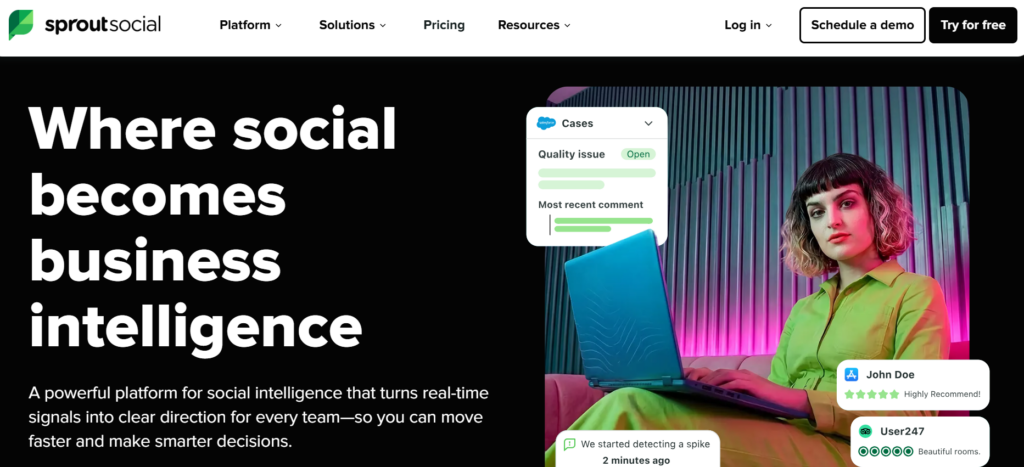
Sprout Social is a social media management platform that combines publishing, social listening, team collaboration, and reputation monitoring into a single dashboard. It suits marketing teams that need deep social analytics and brand-mention tracking at scale, though its local review management capabilities are more limited than those of dedicated ORM platforms.
Key features
- Smart Inbox that consolidates messages, comments, and brand mentions from multiple social networks into one centralized queue
- Real-time social listening engine monitoring brand mentions and sentiment across Twitter/X, Instagram, Facebook, TikTok, Reddit, and YouTube
- Publishing and approval workflows with content calendars, asset libraries, and team collaboration tools for multi-location teams
- Advanced analytics and customizable reporting with cross-channel ROI tracking and competitor benchmarking
Pros
- Content scheduling and ease of use
- Social listening and analytics capabilities for tracking sentiment and trends
- Approval workflows and task assignment make social management scalable across teams
Cons
- Per-seat pricing compounds quickly, with costs potentially exceeding $35,000 annually for a 10-person team before add-ons
- Advanced analytics and social listening are available only as costly add-ons beyond the base plan
- The platform carries a steeper learning curve than simpler alternatives, with some users reporting feature limitations on lower tiers
Pricing: Starts at $199/month. Enterprise pricing available on request.
G2 Rating: 4.4/5 (based on 6,434 verified reviews)
4. ReviewTrackers
Best for: Review analytics
ReviewTrackers aggregates customer feedback from 100+ review sites into a unified dashboard, serving brands that prioritize sentiment analysis, location-level benchmarking, and review performance reporting. Its active review generation capabilities are more limited than full-stack ORM platforms. Note: ReviewTrackers was acquired by Medallia.
Key features
- Review aggregation from 100+ platforms with location-specific performance tracking and competitor benchmarking
- Sentiment analysis tools that classify feedback and surface trending themes across locations
- Smart Response feature with customizable templates and merge tags for personalized, on-brand review replies
- CRM integrations and an Ask tool that automates review request campaigns via SMS and email
Pros
- Centralizes review monitoring across platforms in one place, eliminating the need to log into multiple portals
- Real-time alerts for new reviews enable faster team response at the location level
- Analytics and reporting help enterprise teams track sentiment trends and compare location performance
Cons
- Review notifications can be inconsistent, and the platform would benefit from monitoring a wider range of sources
- Dashboard customization options are limited beyond default templates
- Pricing sits at the higher end of the market, which some users cite as a reason for switching platforms
Pricing: Custom pricing. Contact ReviewTrackers directly for a quote.
G2 Rating: 4.6/5 (based on 161 verified reviews)
5. Brand24
Best for: Media and social mention monitoring
Brand24 is an AI-powered media monitoring and social listening platform that tracks brand mentions across social media, news, blogs, forums, podcasts, and videos in real time. It suits PR and communications teams that need broad earned-media visibility, though it does not offer review generation, listing management, or publishing capabilities.
Key features
- Real-time mention tracking across 25+ million online sources including social media, news, blogs, YouTube, TikTok, Reddit, and podcasts
- AI-powered sentiment analysis that classifies mentions and surfaces share-of-voice data and trending topics
- Influencer identification tools that highlight who drives brand conversations and measure their reach
- GPT-powered AI reports that generate actionable recommendations and summarize brand perception for PR and leadership teams
Pros
- Clean, intuitive dashboard with fast onboarding makes it easy for teams to start tracking mentions and generating reports quickly
- Real-time monitoring and customizable alerts deliver immediate visibility into brand conversations across a wide source range
- AI-powered sentiment analysis and topic trending add strong analytical value for PR and comms teams
Cons
- Brand24 is a listening tool only, with no review generation, listings management, or local reputation management capabilities
- Historical data access is limited on lower-tier plans, and real-time updates are restricted to higher-priced tiers
- Filtering options can surface irrelevant mentions, requiring additional time to configure projects effectively
Pricing: Starts at $199/month (billed annually). Enterprise plan at $1499/month.
G2 Rating: 4.6/5 (based on 350 verified reviews)
Boost your enterprise and gain an edge over your competitors
Want to see the impact of Birdeye on your business? Watch the Free Demo Now.
6. Yext
Best for: Local listings and reputation
Yext is a marketing platform that connects business listings, reviews, pages, and structured data into a single system. Its core strength lies in distributing accurate location data across publishers and AI platforms such as ChatGPT, making it a strong choice for enterprises that prioritize listings accuracy alongside reputation management.
Key features
- Knowledge Graph technology that structures and distributes location data across 200+ directories, search engines, and AI platforms including ChatGPT
- AI-driven review management with automated review requests, generative AI response suggestions, and NLP-powered sentiment analysis
- Yext Pages for building SEO-optimized local landing pages that improve discoverability across traditional and AI-driven search
- Centralized social media management with AI-powered content generation and publishing
Pros
- Centralized listings management syncs location data across directories from one platform, saving significant time for large teams
- Connects reputation management directly to search and AI visibility, a meaningful differentiator for multi-location brands
- Ease of navigation and centralized dashboard
Cons
- Per-location pricing becomes expensive at scale
- Reporting setup is time-consuming for large location portfolios, with users managing 90+ locations noting difficulty maintaining custom reports
- If a brand discontinues Yext, listings may revert to their pre-Yext state, creating dependency risk for enterprise procurement teams
Pricing: Starts at $199/year for basic listings. Enterprise pricing is custom and quote-based.
G2 Rating: 4.4/5 (based on 350 verified reviews)
7. Grade.us
Best for: Marketing agencies
Grade.us is a white-label review management platform built for marketing agencies and SEOs managing reputation campaigns across multiple client brands. It automates review generation, monitors reviews across 100+ sites, and allows agencies to resell the platform under their own brand. It serves agency use cases well but has limited applicability for enterprise brands managing thousands of their own locations.
Key features
- Full white-label capabilities allowing agencies to resell review generation and monitoring services under their own custom domain
- Automated review request campaigns via email and SMS with customizable templates and unique review funnel URLs per client or location
- Review monitoring across 100+ sites with scheduled reporting, real-time alerts, and click-and-conversion analytics to demonstrate ROI
- Review amplification tools that stream positive reviews to client websites and social channels via embeddable widgets and a WordPress plugin
Pros
- White-label capabilities and agency-specific features make it one of the most purpose-built platforms for agencies managing multiple client brands
- Fast client onboarding, with users reporting setup times of under 10 minutes per client, and responsive customer support
- Competitive pricing structure gives agencies room to maintain healthy margins when reselling reputation management services
Cons
- Some users report sudden price increases without advance notice, reducing predictability for agency budget planning
- SMS reliability and support response times have fallen short of expectations for some users
- Lacks the enterprise-direct capabilities, API depth, and compliance certifications that large brands managing thousands of their own locations require
Pricing: Starts at $99/month.
G2 Rating: 4.6/5 (based on 143 verified reviews)
How to choose enterprise reputation management software
Enterprise online reputation management (ORM) software decisions involve multiple stakeholders. Here are the 5 criteria that separate enterprise-grade from SMB tools.
Multi-location scalability
- Ask whether the platform manages 100 to 10,000+ locations from a single unified dashboard
- Confirm it supports location-level permissions so local managers can act without losing corporate oversight
- Look for roll-up reporting that gives leadership a consolidated view of reputation performance across all locations
- Platforms that require separate logins or manual exports per location will not scale with your business
AI automation and AI agents
- Ask whether the platform uses AI agents to auto-generate on-brand review responses across all locations without manual intervention
- Confirm the platform surfaces trending feedback themes across locations so teams can identify systemic issues before they escalate
- Look for agentic automation that handles review generation, social publishing, and sentiment analysis within a single workflow
- AI capabilities should reduce operational workload for distributed teams, not simply repackage basic keyword alerts as AI features
Enterprise security and compliance
- Confirm the vendor holds SOC 2 Type II certification, which validates that their data security controls meet independently audited standards
- Healthcare enterprises must verify that the vendor offers a HIPAA Business Associate Agreement before sharing any patient-adjacent data
- EU and UK operations require GDPR-compliant data processing agreements; confirm the vendor publishes a clear data processing agreement
- Security and compliance certifications are non-negotiable for regulated industries and Fortune 500 procurement teams
API integrations and CRM connectivity
- Ask whether the platform integrates natively with enterprise CRM systems such as Salesforce and HubSpot, and with industry-specific systems such as EHRs, POS, and HRIS platforms
- Confirm API access is available so your IT team can embed reputation data into your existing data stack and automate workflows
- Platforms with 3,000+ pre-built integrations reduce implementation time and custom development costs significantly
- API-first architecture is a key differentiator between enterprise-grade platforms and SMB tools that rely on manual data exports
Dedicated enterprise support and SLA guarantees
- Ask whether your contract includes a named Customer Success Manager or routes all issues through a general help desk ticket queue
- Confirm the vendor publishes SLA response time commitments, as Fortune 500 escalations cannot wait days for resolution
- Look for onboarding support, dedicated implementation specialists, and ongoing training resources for distributed teams across locations
- Enterprise support quality directly affects time-to-value and platform adoption across large, multi-stakeholder organizations
What are the key enterprise reputation management strategies
Managing reputation at scale requires more than reactive responses. The following strategies help multi-location brands build a consistent, trust-driven presence across every channel.
Build a strong review generation program
- Send automated review request campaigns via SMS and email immediately after every customer transaction across all locations
- Consolidate all incoming reviews into a unified dashboard, so corporate teams maintain visibility while local managers handle responses
- Use best enterprise review management tools to track review volume, average ratings, and response rates by location to identify underperforming locations quickly
Maintain accurate listings across all locations
- Audit and sync NAP data across all directories from a centralized platform, prioritizing core sites such as Google Business Profile, Apple Maps, and Bing Places
- Use automated listings management to push real-time updates across all locations simultaneously, eliminating manual entry and data inconsistencies
- Accurate listings data directly supports enterprise reputation monitoring by ensuring customers and AI platforms receive consistent information about every location
Optimize for AI search visibility
- Monitor how each location appears in AI-generated recommendations across ChatGPT, Google AI Overviews, Copilot, and Perplexity, which increasingly shape purchase decisions before customers visit a website
- Ensure each location maintains strong review signals, accurate listings, and location-specific content, as AI platforms pull from these sources when generating local recommendations
- According to Google’s Search Quality Evaluator Guidelines, demonstrating expertise, authoritativeness, and trustworthiness across location-level content strengthens brand presence in both traditional and AI-driven search results
Implement a proactive crisis management plan
- Set up real-time monitoring alerts so teams identify and address negative feedback on review sites and social media before it compounds across locations
- Develop a documented crisis response framework that guides both corporate teams and local managers on how to respond to negative reviews, escalate complaints internally, and communicate resolution publicly
- Assign internal ticketing workflows that route negative feedback to the right department for resolution and track response times across all locations
How Birdeye helped Sutter Health scale enterprise reputation management across 4,000+ locations

The brand
Sutter Health is one of Northern California’s largest not-for-profit health systems, serving more than 100 communities across hospitals, urgent care centers, and specialty clinics. With 4,000+ locations, managing enterprise reputation management at this scale required a purpose-built, AI-powered solution.
The challenge
- A legacy ORM platform with no AI capabilities left the team managing review responses and patient outreach manually across 4,000+ locations
- Slow vendor support and a fragmented review process created operational bottlenecks for the digital marketing team
- The team had no visibility into how Sutter Health appeared in AI search results across ChatGPT, Gemini, and Perplexity, which increasingly influence patient decisions before a website visit
The results
Birdeye replaced Sutter Health’s legacy platform with a unified AI system covering Reviews AI, Listings AI, Insights AI, Competitors AI, and Search AI across all locations. Within four months, Sutter Health achieved:
- 36,200 new reviews across all locations and sites
- 35,400 new Google reviews
- 13.9 million Google profile impressions
- 120% increase in monthly reviews
- 614,300 review requests sent with a 7.5% conversion rate
- Average star rating improvement from 4.7 to 4.8
- 1.3 million direction clicks
- 81% Visibility Score in AI searches
“Birdeye’s customer support and responsiveness have been exceptional. Since we started, they’ve already delivered on the product roadmap and continue to innovate at a pace we hadn’t experienced before. The switch to Birdeye turned out to be easier than we anticipated.”
— Nolan Perry, Director of Online Experience, Sutter Health
FAQs on enterprise reputation management
Enterprise reputation management software is a centralized platform that helps large, multi-location organizations generate, monitor, respond to, and analyze reviews, listings, and brand mentions across hundreds or thousands of locations from a single dashboard. Unlike SMB tools, it delivers API access, compliance certifications, and AI automation at scale
Enterprise reputation management platforms offer role-based permissions, SOC 2 and HIPAA compliance, dedicated customer success managers, and multi-location unified inboxes that handle high review volumes. SMB tools manage reputation for a single or limited number of locations through fewer channels and without enterprise-grade security, API connectivity, or scalable automation.
Pricing is typically custom and quote-based, as costs vary by number of locations, features, and integrations. Most enterprise vendors do not publish flat-rate pricing. Contact vendors directly for a tailored quote.
Birdeye is the leading platform for multi-location enterprise reputation management, trusted by global brands across healthcare, retail, financial services, and automotive. It manages reputation across 200+ review sites with SOC 2 Type II and HIPAA certifications and 3,000+ integrations.
Yes. Platforms that maintain accurate listings, generate consistent review volume, and optimize location-level content directly support local search rankings. Google’s local search documentation confirms that review quantity, quality, and recency all influence local ranking signals.
The best enterprise reputation-tracking solutions integrate natively with Salesforce, HubSpot, and industry-specific systems such as EHRs, POS, and HRIS. API access is essential for embedding reputation data into existing data stacks and automating workflows across locations without manual intervention.
AI agents automate review generation, draft on-brand responses, surface sentiment trends across locations, and optimize listings in real time. Leading enterprise reputation monitoring platforms use AI to reduce manual workload for distributed teams and deliver actionable insights to corporate leadership without requiring manual reporting.
Yes. Birdeye holds SOC 2 Type II certification and offers a HIPAA Business Associate Agreement for healthcare enterprises. Full details are available on Birdeye’s security page.
Implementation typically takes two to six weeks depending on the number of locations, existing system integrations, and onboarding complexity. Platforms with dedicated implementation specialists and prebuilt integrations significantly reduce setup time for large enterprises.
Manage enterprise reputation at scale with Birdeye
Managing reputation across hundreds or thousands of locations requires more than a review monitoring tool. The best enterprise reputation management software in 2026 delivers AI automation, multi-location scalability, enterprise-grade security, and deep CRM integrations on a unified platform.
Across the seven platforms evaluated in this guide, Birdeye ranks as the strongest solution for multi-location enterprises. It combines Reviews AI, Listings AI, Search AI, Insights AI, and Competitors AI into a single platform, backed by SOC 2 Type II and HIPAA compliance, and 3,000+ integrations. Global enterprise brands including Sutter Health trust Birdeye to manage enterprise review management at scale across thousands of locations.
As AI search platforms such as ChatGPT, Gemini, and Perplexity reshape how patients, customers, and clients discover local businesses, enterprise brands that invest in a unified enterprise reputation management platform today build a compounding visibility advantage that competitors without one cannot easily replicate.
Ready to manage enterprise reputation across locations? Request a custom enterprise demo now.

About the Author

Avtar Madan
Avtar Madan
Originally published