Generative engine optimization is the new space of digital visibility for multi-location enterprises. It ensures brands earn authority and presence in the age of AI-powered search engines and generative AI SEO responses.
Summary
Generative engine optimization (GEO) now leads the evolution in search, shifting focus from traditional rankings to citations, context, and structured signals inside generative AI SEO platforms like Google AI Overviews, ChatGPT, and Perplexity. For multi-location enterprises, GEO has become a visibility framework that builds trust and drives conversions across every AI-powered search surface.

Birdeye Search AI elevates this strategy by revealing exactly how AI engines describe your brand, where you appear, and why. It pinpoints gaps in accuracy, sentiment, and citations and recommends fixes tailored for generative engines, enabling enterprise teams to strengthen GEO performance with precision.
Ready to discover Generative engine optimization (GEO)? In this blog, you will uncover how to adapt content optimization for generative engines, strengthen enterprise authority, and measure real impact on user queries and AI-driven search engines.
Table of contents
- What is GEO, and how has search changed?
- Why does GEO matter for multi-location enterprises?
- Why GEO (generative engine optimization) creates new visibility challenges for enterprise brands
- How GEO strategies scale across the enterprise
- Generative engine optimization: Enterprise frameworks and best practices for AI-first visibility
- 9 best practices for generative engine optimization
- How Birdeye helps enterprises dominate generative engine AI results
- FAQs for Generative Engine Optimization (GEO)
- Conclusion: The next step for enterprise visibility
What is GEO, and how has search changed?
In 2026, generative engine optimization (GEO) replaces traditional search engine optimization (SEO) as the primary method for brands to gain authoritative presence in AI search engines, generative engines, and conversational platforms. GEO focuses on how large language models (LLMs) answer user queries, shifting from link-based rankings to direct, context-rich citations in answer blocks and AI overviews.
Traditional SEO’s influence continues to erode as user behavior shifts dramatically. As per a recent report, by March 2025, only 40.3% of U.S. Google searchers clicked on any organic result, down from 44.2% the year prior. This marks a significant turning point: users increasingly expect direct answers instead of visiting websites, accelerating the rise of GEO.
Why does GEO matter for multi-location enterprises?
AI platforms like ChatGPT, Perplexity, Gemini, and Google AI Overviews now generate direct answers built from structured facts, citations, and high-authority sources. Enterprise brands need to ensure that their business data and content are consistently structured, discoverable, and accurate across every surface where AI pulls information.
At the same time, the rise of zero-click searches means users increasingly rely on direct answers from generative engines rather than visiting multiple websites. For multi-location brands, this shift underscores the need for consistent NAP (Name, Address, Phone) signals, uniform service descriptions, and accurate brand representation across all locations.
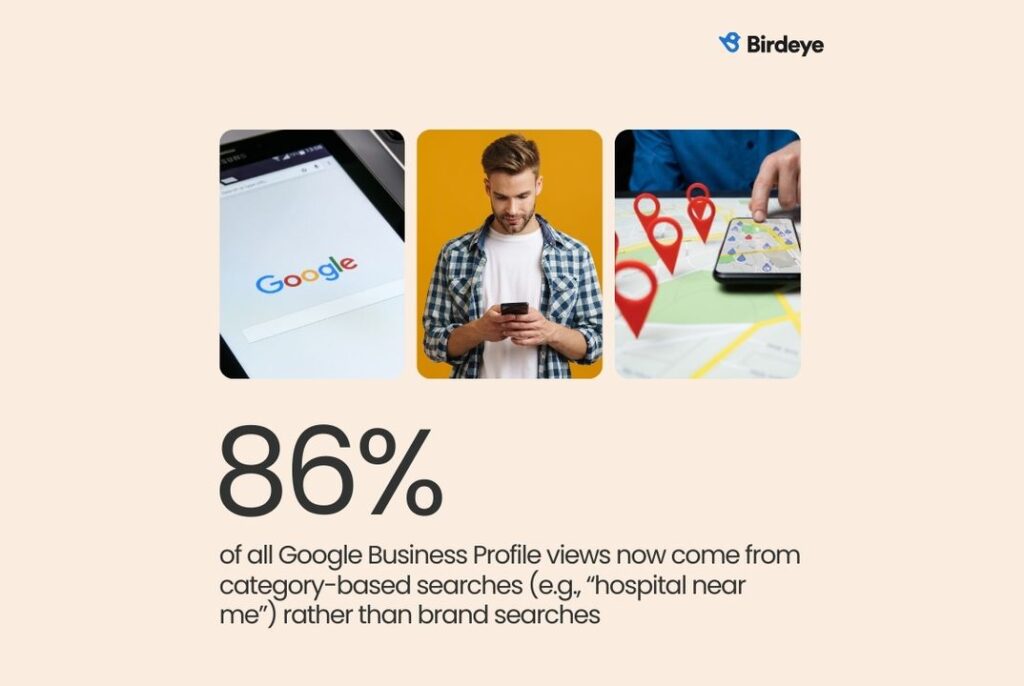
According to the Birdeye State of Google Business Profile 2025, 86% of all Google Business Profile views now come from category-based searches (e.g., “dentist near me”) rather than brand searches. This underscores how generative engines depend on structured, verified business data to deliver accurate recommendations at scale.
“Brands can no longer afford to ignore GEO. The search experience has moved beyond traditional search engines. AI engines now decide what people see.”
— Adam Dorfman, AVP of Product Management and AI Search, Birdeye
This expert insight reflects the urgency for enterprise organizations to transition from legacy SEO frameworks to strategies focused on generative AI and answer engine optimization. Businesses that act now will establish leadership and trust in every AI-powered surface where user queries are answered.
GEO drives national and regional brand consistency when executed well; it ensures your locations are surfaced, recommended, and trusted across generative AI queries, rather than lost in fragmented data or outdated listings.
Quick Definitions

SEO: Optimizes websites and content to rank higher on traditional search engine pages (SERPs) like Google and Bing.
AEO (Answer Engine Optimization): Targets content so search engines can extract direct answers for featured snippets, voice assistants, etc.
GEO: Optimizes your structured data, entity signals, and authority so generative AI platforms use your business information when producing AI-generated answers
Why GEO (generative engine optimization) creates new visibility challenges for enterprise brands
Generative engine optimization (GEO) introduces a new set of visibility, attribution, and authority challenges for large, multi-location organizations. Unlike classic SEO (search engine optimization), which emphasizes keyword research, ranking, and search indexation, GEO demands brands to establish reliable entity data, consistent authority signals, and citation-worthy content across generative AI platforms. This shift exposes several obstacles for enterprise teams. Let’s discuss them below:
1. Inconsistent authority signals across locations weaken E-E-A-T as AI engines pull mismatched NAP data, fragmented reviews, and outdated citations, reducing trust and visibility.
2. Legacy SEO tools can’t measure AI visibility, leaving brands blind to citation frequency, inclusion in AI answers, or how LLMs interpret their entity data.
3. Fragmented content across sites, social, and listings creates noise, making generative engines less likely to cite brands due to disconnected assets and crawlability issues.
4. Lack of proprietary data and verified insights limits a brand’s ability to earn citations in AI answers, where original research and third-party validation are increasingly required.
5. The emerging AI dark funnel complicates attribution, as each generative engine uses different algorithms and standards, creating major measurement and benchmarking gaps.
How GEO strategies scale across the enterprise
Modern GEO strategies go far beyond traditional keyword optimization to ensure enterprises win visibility in both AI-powered search engines and generative engines with strong topical authority and credibility.
Here are some of the GEO strategies that help enterprise teams scale visibility, strengthen authority, and stay accurately represented across AI-driven search experiences
Build enterprise authority with earned media & structured content
- Create a steady cadence of expert-driven PR, thought leadership, and unique research that earns citations not just from traditional search engines but also from AI engines, Birdeye State of Google Business Profile 2025 states that verified Google Business Profiles see 4× more website visits and double-digit gains in calls and direction requests, making verified structured data a core input for AI Overviews and generative engine citations.
- Use structured frameworks: expert quotes, statistics every 150–200 words, and clear comparison tables to make content highly machine-readable.
Engineer content like an API for AI engines
- Organize content with question-based H2/H3s (e.g., “What is generative SEO?”), always following each question with a concise, factual answer of 40–80 words, then depth and context.
- Implement comprehensive, structured data schemas (FAQPage, Article, Dataset) to ensure all primary and secondary keywords, such as “geo seo”, “generative ai seo”, “AI overviews”, and “generative engine optimization geo”, are included naturally and contextually.
- Use llms.txt to signal high-value pages and support efficient crawling.
Expand and centralize your semantic footprint
- Create content clusters that cover both brand-level and location-specific topics.
- Ensure cross-branch data (NAP [name, address & phone number], categories, reviews, FAQs) stays unified to maximize entity clarity and AI trust.
Optimize technical elements for AI discovery
- Monitor Core Web Vitals (speed, responsiveness), AI bots skip slow-loading or script-heavy content.
- Remove crawl barriers and automate schema markup for every significant page or asset, and treat structured data as ‘enterprise infrastructure’.
Make GEO measurement part of the workflow
- Track GEO-specific KPIs: AI Overview Inclusion Rate, Citation Frequency, Query Match Coverage, and Sentiment Index.
- Use dashboards and tools to benchmark progress and share results internally, adapting to changes in how different generative engines surface brands.
- Build workflows for continuous prompt testing, citation monitoring, and quarterly strategy reviews.
Enterprise Insights

AI engines reward brands that pair technical and content excellence with fact density, clear structure, and cross-location data consistency.
Iterative measurement and agile optimization ensure your brand isn’t just present in AI answers, but preferred.
In the next section, the GEO tools for enterprises are discussed in detail. Before that, let’s take a glance at the comparative table.
Generative engine optimization: Enterprise frameworks and best practices for AI-first visibility
Generative engine optimization is the approach brands use to shape how AI systems like ChatGPT, Gemini, and Perplexity interpret, rank, and recommend them. Unlike traditional SEO, which relies on keywords and backlinks, generative engines evaluate a broader set of signals, including citations, structured business data, review sentiment, information freshness, and consistency across locations. These signals help AI models decide which brands to surface inside conversational answers.
For enterprise organizations, this shift requires more than routine search engine optimization (SEO) updates. It demands unified data management, accurate listings at scale, strong review signals, clear local content, and continuous monitoring of how AI engines describe the brand. To stay visible in AI-generated answers, enterprises must build systems that support accuracy, trust, and clarity across thousands of consumer touchpoints.
Now, let’s explore the nine enterprise strategies that drive effective generative engine optimization.
Where AI answers begin with your brand.
Want to see the impact of Birdeye on your business? Watch the Free Demo Now.
9 best practices for generative engine optimization
Below are nine advanced, enterprise-grade best practices designed to strengthen performance across generative engine optimization, generative SEO, and all modern AI discovery surfaces.
1. Standardize brand data across every location
Generative engines treat inconsistent information as a trust issue. Enterprise brands must enforce strict data governance across all markets.
Maintain:
- Fully consistent NAP data for every location
- Verified categories, services, specialties, and attributes
- Accurate hours, insurance participation, and availability details
- Structured location-level data AI systems can parse without ambiguity
A clean, unified data structure ensures generative engine AI models can reference your brand with confidence and improve results across geo SEO.
2. Strengthen and centralize review signals
Generative engines rely heavily on review sentiment to decide which brands appear in answers.
Enterprise teams should:
- Increase review volume and maintain ongoing recency.
- Respond quickly using consistent, brand-aligned language.
- Track recurring themes across regions and service lines.
These signals are foundational to generative AI SEO, where sentiment and pattern clarity directly influence where answers are placed.
3. Build AI-readable local content
AI engines prefer clear, structured content that removes guesswork.
Essential actions include:
- Detailed, structured location pages following a uniform schema.
- Clear service descriptions, specialties, FAQs, and regional relevance.
- Updated content that supports both traditional SEO and generative SEO.
This foundation helps generative engines build accurate narratives about your locations and service strengths.
4. Audit citations and maintain accurate listings across authoritative sources
Generative engines cross-verify your credibility through citations, so outdated or inconsistent directory information can weaken trust and visibility. Enterprise teams should maintain complete alignment across every channel to strengthen generative engine optimization signals.
Key actions include:
- Validating data across Google, Apple, Yelp, Bing, and healthcare-specific directories.
- Removing duplicate profiles that confuse AI engines.
- Updating hours, services, provider details, and insurance information.
- Ensuring all structured fields are consistently filled across locations.
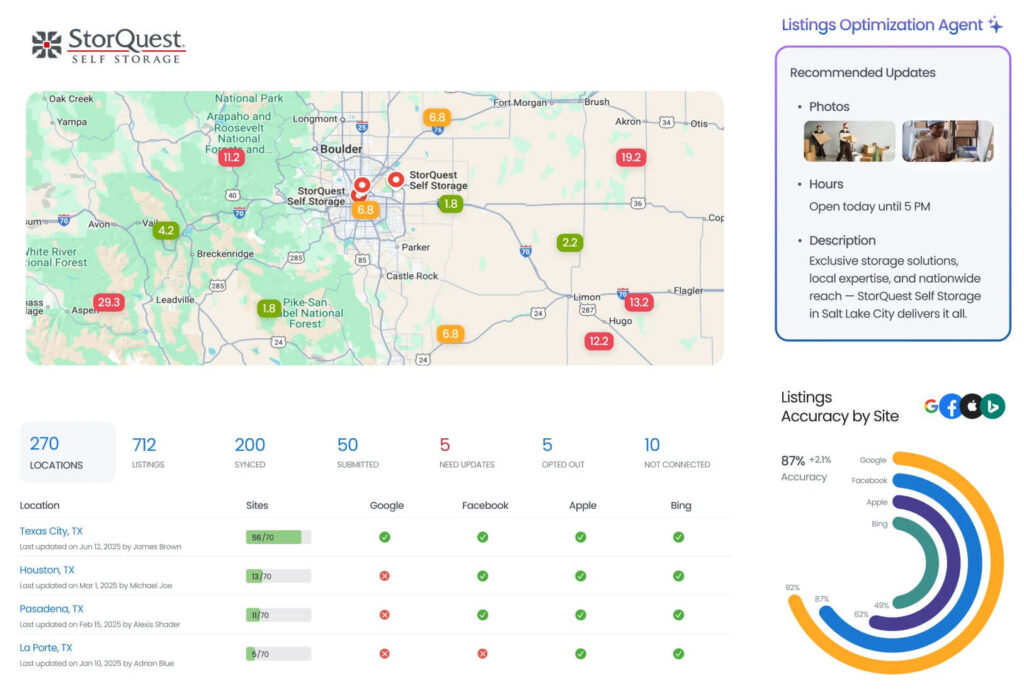
Birdeye’s Listings Optimization Agent and Listings AI Agents automate these steps by removing duplicates, fixing gaps, and keeping every profile complete and accurate at scale—driving stronger visibility, higher traffic, and better performance across both AI engines and traditional search.
5. Monitor how AI engines describe your brand and competitors
Visibility depends on how AI engines summarize your strengths, weaknesses, and relevance for specific prompts. Even minor inaccuracies can cascade into lost opportunities.
With Birdeye Search AI, enterprise teams can:
- Compare visibility by platform, competitor, and prompt type
- Identify which citations each AI engine uses when building answers
This transparency helps brands correct misinterpretations early, a critical part of generative AI and SEO.

6. Optimize for sentiment clarity across all channels
Generative engines prioritize brands with consistent, positive, and easily interpretable sentiment patterns.
Key actions include:
- Identifying negative themes that appear repeatedly
- Resolving service or operational issues causing sentiment declines
- Tracking sentiment shifts by geography, service line, or provider
Improved sentiment strengthens placement in generative answers across all AI surfaces.
7. Use AI-informed competitor benchmarking
Generative engines may recommend competitors even when you outperform them in traditional rankings.
Enterprise benchmarking should include:
- Competitor visibility inside generative answers.
- Prompts where competitors appear but your brand does not.
- Insights from real-world intent data, aligned with trends from SEO marketing news.
This reveals opportunities for improvement in citations, content, sentiment, and service clarity.
8. Build AI-optimized content workflows
Generative engines reward brands with fresh, authoritative, and well-structured content across trusted domains.
Enterprise teams should:
- Publish verified updates across all location pages regularly.
- Maintain detailed service descriptions and category-level content.
- Produce expert insights that reinforce authority signals.
Platforms like Birdeye Search AI can highlight content gaps and suggest improvements specifically aligned with generative engine behavior, strengthening generative AI SEO performance over time.
With these practices in place, we can now explore how enterprises put them into action at scale with the right AI-driven platform.
How Birdeye helps enterprises dominate generative engine AI results
Birdeye stands at the forefront of generative engine optimization for multi-location enterprises, offering a unified platform engineered to maximize AI visibility and citation for national and regional brands.
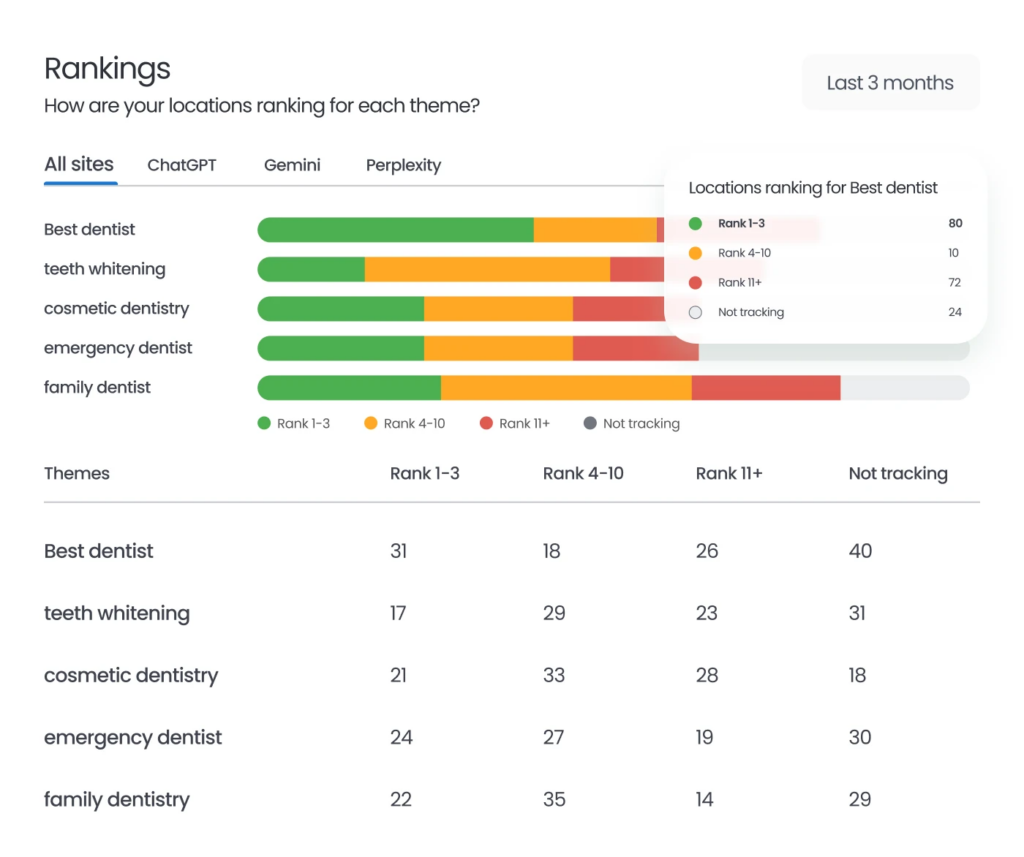
With Birdeye’s AI search optimization platform, organizations gain access to industry-leading dashboards tracking key GEO metrics, LLM Citation Frequency, and Query Match Coverage, allowing teams to understand exactly how their brand surfaces in ChatGPT, Perplexity, Gemini, and emerging generative engines.
Unlike generic SEO solutions, Birdeye is purpose-built for the complexity enterprises face:
- It seamlessly syncs structured business attributes across every branch, location, and review profile.
- Integrates expert-driven content and proprietary data, fueling earned media signals that generative AI engines prioritize.
- Automates schema markup and answer engine optimization, transforming your entire digital footprint into an AI-ready resource for large language models and answer engines.
- Provides real-time reporting and easy workflow tools tailored for cross-functional teams, so PR, SEO, marketing, and digital operations can collaborate on unified search and content strategies.
With Birdeye, enterprise brands can confidently move beyond legacy search engine optimization, proactively shaping their presence and authority within the AI-powered search journey.
FAQs for Generative Engine Optimization (GEO)
Generative engine optimization (GEO) is a suite of search and content strategies custom-designed for enterprises to help their brands appear in AI-generated answers, voice responses, and AI-powered search engines such as ChatGPT, Google AI Overviews, and Perplexity. Unlike traditional SEO that focuses on keywords and organic rankings, GEO adapts enterprise content to maximize mention, citation, and authority signals across both classic search engines and generative engines.
Top GEO tools help brands track how they appear in AI answers and identify the citations and content shaping visibility. Birdeye Search AI leads for multi-location enterprises, while tools like Market Brew, Neuroflash, etc, offer narrower GEO analysis. For full-scale generative engine optimization, Search AI provides the most complete visibility across prompts, platforms, and competitors.
To gain visibility in AI-generated responses, multi-location enterprises should focus on structured, fact-dense content, authoritative third-party validation, and synchronized business attributes (such as NAP) across all branches. Implementing comprehensive schema markup, updating profiles across major review and business directories, and integrating earned media signals are also proven paths to maximize brand inclusion in generative engines.
AI search engines and generative engines value independent validation, media citations, high-quality reviews, structured data, relevant user-generated content, precise business attributes, and clear answers to core user queries. These signals, combined with a robust semantic footprint, are central to optimizing enterprise authority and trust within generative SEO workflows.
GEO emphasizes optimizing content for AI-powered search engines and large language models, where answers are synthesized contextually and citations trump rankings. Traditional SEO targets organic placement on search engine results pages, while GEO aims to maximize inclusion and authority within AI-generated responses, answer blocks, and conversational search flows.
AI engines prioritize structured formats such as FAQ schemas, direct answers, verified data, authoritative testimonials, and multimedia assets that are easily parsed and cited. Content featuring enterprise-grade research, performance statistics, videos with transcripts, and review-rich profiles is preferred for GEO optimization.
Success can be measured by GEO-specific KPIs such as AI Overview Inclusion Rate, LLM Citation Frequency, Query Match Coverage, and Answer-Block Coverage. Integrated analytics should combine traditional search metrics with GEO milestones, attribution benchmarks, and longitudinal monitoring of how enterprise brands appear within generative engine AI responses.
AI engines assess the credibility of a brand by triangulating data points from earned media, user-generated content, authoritative third-party sources, and validated business directories. This mechanism ensures that answers surfaced in generative engines and AI-powered search engines reflect trustworthy, independently verified information.
Conclusion: The next step for enterprise visibility
Generative engine optimization (GEO) is now the catalyst for enterprise discoverability in AI-powered search engines, answer engines, and generative SEO workflows.
Early adopters who align their strategies with GEO best practices, combining technical SEO, advanced schema integration, and ongoing performance measurement, can expect to future-proof their brand against ongoing shifts in user search behavior and evolving AI algorithms.
For multi-location businesses ready to future-proof their digital strategy and control how AI search engines represent their brand, Birdeye delivers the technology, insights, and expertise to win the generative engine optimization race. Start elevating your enterprise visibility and build lasting authority where it matters most—in every AI-powered answer.

About the Author

Sudeepta Bora
Originally published
![[Feature image] How to Get Your Law Firm Found in AI Search](https://birdeye.com/blog/wp-content/uploads/Feature-image-How-to-Get-Your-Law-Firm-Found-in-AI-Search-375x195.jpg)