Local marketing automation in 2026 enables distributed brands to scale local execution without losing control, speed, or accountability. Today, multi-location brands manage hundreds of local touchpoints, and customers increasingly choose businesses based on what they see nearby. As a result, local visibility has become a defining factor in customer acquisition and brand growth.
Summary

As distributed marketing models mature, brands can no longer rely on manual coordination or fragmented tools to support local execution. They need a system that aligns headquarters, local teams, and external partners around shared workflows, permissions, and accountability. Without automation, this balance collapses, leading to bottlenecks, inconsistent brand voice, and lost local revenue opportunities.

Local marketing automation bridges this gap. It gives every location the ability to execute locally relevant campaigns, while HQ still maintains oversight, creative control, and data clarity.

This guide examines how organizations should approach local marketing automation in 2026, what problems it realistically solves, how to evaluate platforms, and how to implement them without disrupting teams.
Table of contents
- What is local marketing automation?
- Why multi-location brands need local marketing automation
- Marketing automation vs local marketing automation
- How to build a local marketing automation strategy
- Core capabilities to look for in a local marketing automation platform
- How to choose the right local marketing automation platform
- How to measure the ROI of local marketing automation
- Local marketing automation trends shaping 2026 and beyond
- How Birdeye enables local marketing automation
What is local marketing automation?
Local marketing automation (LMA) is a specialised marketing system that enables brands to run consistent, on-brand marketing across multiple locations while giving local teams the flexibility to customize campaigns.
It automates core location-based tasks such as:
- Local social posts and ads
- Email and SMS campaigns
- Business listing accuracy
- Review and reputation workflows
- Local landing pages and offers
- Asset and template management
By linking corporate strategy with local execution, LMA ensures campaigns stay relevant, assets are managed efficiently, and brand messaging remains consistent across a distributed network.
Why multi-location brands need local marketing automation
Marketing automation is now a core pillar of enterprise strategy and is projected to grow to USD 15.58 billion by 2030. This rapid expansion highlights a critical reality: distributed brands must maintain central oversight while enabling hundreds of individual locations to market effectively in their local environments.
Local marketing automation helps scale campaigns across locations without losing consistency or flexibility. As customers increasingly rely on nearby search results, reviews, and promotions, automation connects brand strategy with location-level execution.
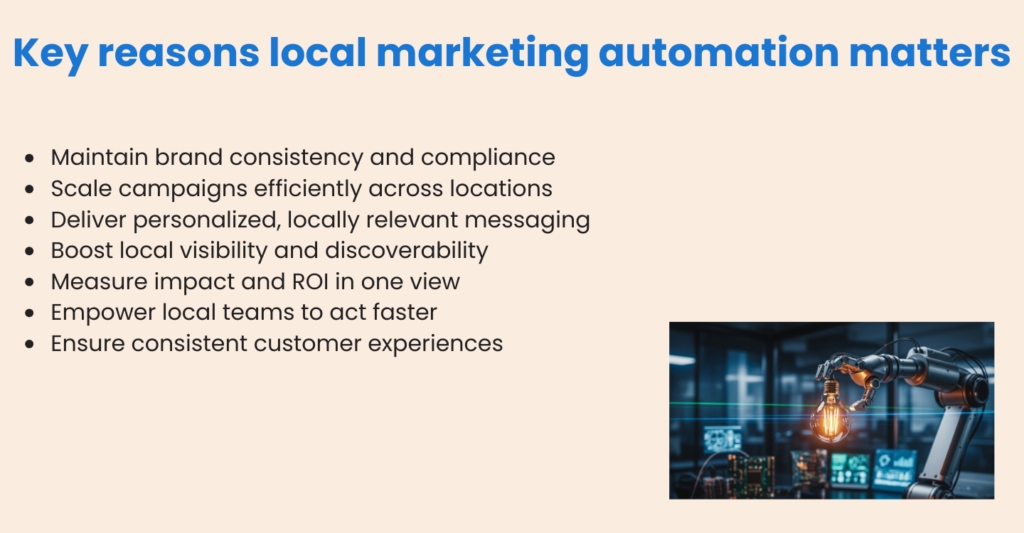
Key reasons local marketing automation matters:
Maintain brand consistency and compliance
Central teams create approved templates, assets, and messaging rules that safeguard brand standards. Local managers customize content within these guardrails to prevent off-brand promotions, compliance issues, and fragmented messaging across markets.
Scale campaigns efficiently across locations
Automation replaces manual, fragmented workflows with repeatable processes for content creation, posting, and campaign management. Brands can launch campaigns across dozens or hundreds of locations without increasing operational strain.
Deliver personalized, locally relevant messaging
Automation uses location data and customer behavior to tailor messages for specific markets. Brands can promote local events, time-sensitive offers, and regional preferences without rebuilding campaigns each time.
Boost local visibility and discoverability
Local marketing automation centralizes listing accuracy, review management, and location-based keyword optimisation. This approach improves accuracy, strengthens local search visibility, and ensures customers find nearby locations when making decisions.
Measure impact and ROI in one view
Automation provides a unified view of marketing performance across all locations. Teams compare results by market, adjust spend faster, and connect local campaigns directly to business outcomes.
Empower local teams to act faster
Local managers use self-serve tools to launch approved campaigns quickly, without waiting for headquarters. This reduces bottlenecks and keeps promotions timely and market-relevant.
Ensure consistent customer experiences
Automated local messaging, review responses, and location updates ensure customers receive accurate, relevant information at every touchpoint. Each location delivers a reliable, consistent experience at scale.
Local marketing automation allows large brands to act with local speed while maintaining a cohesive brand presence. It reduces operational friction, strengthens local relevance, and supports consistent execution across all markets.
Marketing automation vs local marketing automation
Marketing automation and local marketing automation both streamline campaigns, but they differ in scope, targeting, and impact.
| Feature/Aspect | Marketing automation | Local marketing automation |
| Scope | Broad, often national or global campaigns | Hyper-local, city- or neighborhood-level campaigns |
| Audience targeting | Segments based on demographics, behavior, or interests | Segments based on location, local behavior, and proximity |
| Personalization | General personalization (e.g., name, preferences) | Hyper-personalized with local context (events, local deals, nearby stores) |
| Channels | Email, social media, SMS, ads, websites | Local search listings, Google Maps, localized ads, SMS, email |
| Content | Standardized content for a wider audience | Localized content tailored to local events, culture, and community needs |
| Lead nurturing | Focused on moving leads through the general sales funnel | Focused on driving in-store visits, local sign-ups, or appointments |
| Analytics | Broad metrics like CTR, conversion rate, and ROI | Local metrics like store visits, local sales, and regional engagement |
| Automation tools | CRM-based, AI-powered platforms for scale | Tools integrated with local listings, maps, reviews, and neighborhood-specific campaigns |
| Goal | Maximize reach, conversions, and efficiency at scale | Maximize local engagement, foot traffic, and community presence |
| Example | National brand email campaign with discounts | Local boutique promoting a weekend sale to residents within 5 miles |
How to build a local marketing automation strategy
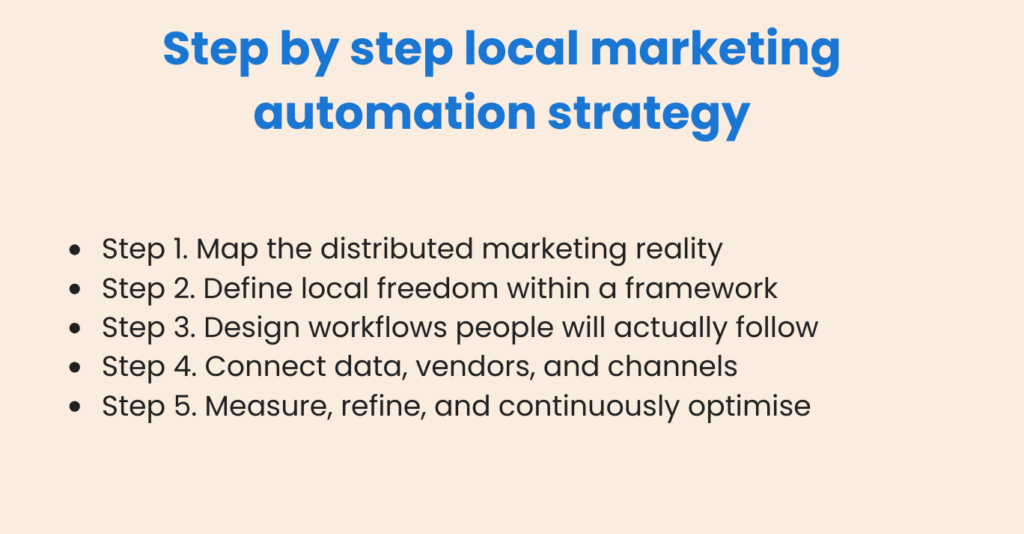
Building a successful local marketing automation strategy requires clarity before technology. Brands need to understand how marketing operates across locations today, define the right balance of control and flexibility, and design workflows that teams will actually use.
Here’s a practical, step-by-step approach.
Step 1. Map the distributed marketing reality
Action:
Audit current tools, workflows, campaign timelines, vendor relationships, and communication gaps across every location to understand how marketing execution truly happens today.
Why it matters:
Automation should solve real fragmentation, not assumed problems. A clear baseline exposes delays, inconsistencies, duplicated work, and technology bloat, helping brands design systems grounded in reality rather than guesswork.
Step 2. Define local freedom within a framework
Action:
Clarify which marketing tasks remain centrally controlled and which can be executed locally. Establish approval rules, templates, and guardrails that give locations autonomy without risking brand dilution.
Why it matters:
Without structured boundaries, local teams either lack flexibility or operate in chaos. Defining this balance ensures campaigns can move faster while protecting brand quality and compliance.
Step 3. Design workflows people will actually follow
Action:
Streamline steps, remove friction, and build processes around real user behaviour. Prioritize simplicity—templates, reusable assets, automated triggers, and minimal manual effort.
Why it matters:
Even the best technology fails without adoption. When workflows feel intuitive and useful, local teams consistently engage, enabling reliable execution at scale.
Step 4. Connect data, vendors, and channels
Action:
Integrate marketing systems—CRM, listings, ads, reviews, social, email, and analytics —so data flows seamlessly and campaigns operate as a single, connected ecosystem.
Why it matters:
Disconnected tools create duplication, blind spots in reporting, and manual rework. Unified data and workflows prevent silos and ensure every campaign contributes to a coordinated multichannel strategy.
Step 5. Measure, refine, and continuously optimize
Action:
Establish KPIs, track usage and adoption data, analyse campaign outcomes, and refine workflows based on local-level performance.
Why it matters:
Automation isn’t “set and forget.” Multi-location ecosystems constantly change, locations mature at different speeds, platforms evolve, and local contexts shift. Ongoing optimization ensures your automation strategy continues to deliver ROI rather than decay under outdated assumptions.
Core capabilities to look for in a local marketing automation platform
Local marketing automation platforms provide distributed brands with a structured way to plan, localize, execute, and control marketing across all locations. Instead of managing disconnected tools and workflows, teams operate within a centralized system designed for local execution at scale.
Here’s how the core capabilities break down.
Local campaign orchestration at scale
Local marketing automation allows central teams to launch national or regional campaigns once and deploy them across locations with built-in variations. Teams adjust offers, messaging, timing, and channels by location without rebuilding assets. Budget controls and co-op funding rules ensure promotions stay aligned with financial and brand guidelines.
Smart local content production
Platforms use brand-approved templates to protect core creative elements while allowing controlled local customization. Automation populates accurate local details, such as addresses, pricing, legal disclaimers, and language preferences. This reduces manual work and ensures every asset reflects the correct location data.
Omnichannel execution built for local marketing
Local marketing automation coordinates campaigns across digital and offline channels from a single system. Teams automate paid search and paid social by location while managing print, in-store signage, and direct mail workflows. Local landing pages, microsites, and store pages stay consistent across all markets.
Reputation, listings, and local SEO foundations
Platforms centralize business listings, hours, and NAP data to keep location information accurate everywhere it appears. Review generation and response workflows help teams manage reputation at scale. Stronger listings and consistent local content support better local SEO performance and improve CPC efficiency.
Governance, permissions, and brand guardrails
According to the Birdeye State of Social 2026, automation is widely used for social publishing, but inconsistent human oversight reduces trust, especially at the local level. Role-based access controls define what central and local users can publish; approval workflows safeguard sensitive updates; and auto-publish rules handle routine execution. Audit trails and compliance reporting improve visibility and reduce risk across distributed teams.
These capabilities turn local marketing automation into an execution system rather than a collection of tools. Brands move faster, maintain control, and deliver consistent local experiences across every market.
How to choose the right local marketing automation platform
Choosing a local marketing automation platform goes beyond feature lists and polished demos. The right platform supports real local execution, scales with your footprint, and works for the teams who use it daily.
Use the following criteria to evaluate local marketing platforms with confidence.
Selection criteria that matter
Start by assessing how easily non-marketers can use the platform. Prioritize a robust template engine that upholds brand standards while enabling local customization. Evaluate digital asset management depth, localization support, scalability, and governance controls that remain effective as locations grow.
Vendor questions beyond the demo
Move past ideal demo scenarios and ask vendors to show real workflows. Request a live example of how a local manager launches a campaign in five minutes. Ask how the platform handles exceptions, off-brand requests, and what changes operationally when you add hundreds of locations.
Local marketing automation vs adjacent tools
Local marketing automation solves a different problem than DAM, MRM, or generic marketing automation tools. DAM manages assets, MRM supports planning, and generic automation focuses on lead workflows. LMA connects these capabilities to localized execution across channels.
When CRM tools are enough and when they are not
CRM tools support centralized lead management and basic campaign automation. They struggle with location-level governance, localization, approvals, and offline execution. Brands need LMA when marketing must operate consistently across many locations with shared standards.
The right local marketing automation platforms scale without complexity. Strong platforms support central control while giving local teams the speed and flexibility they need to execute effectively.
How to measure the ROI of local marketing automation
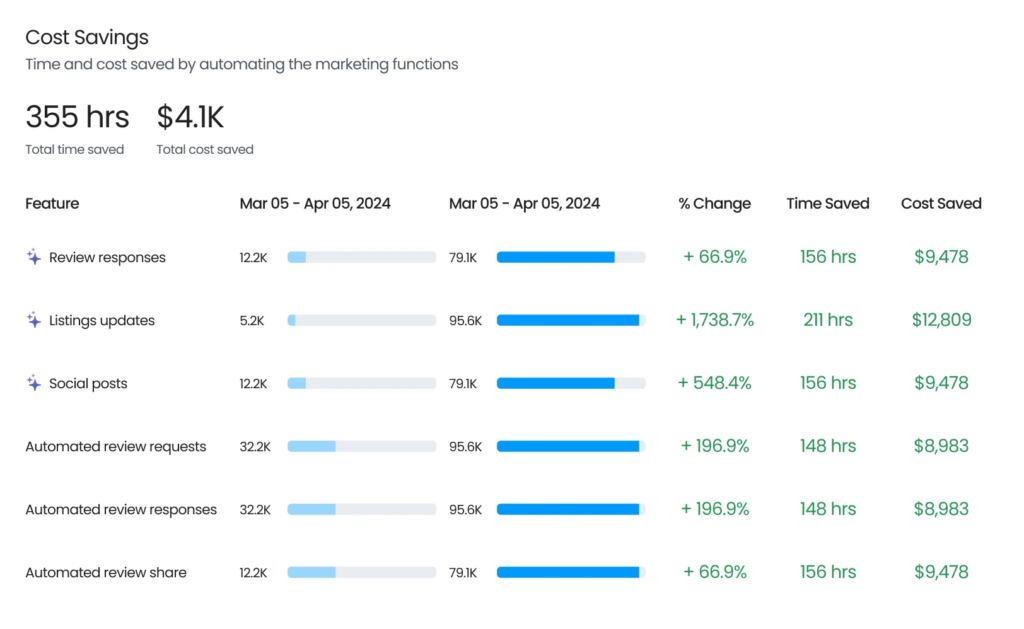
Measuring ROI goes beyond vanity metrics or isolated campaign results. Local marketing automation delivers value through efficiency, consistency, and performance across locations. A clear measurement framework helps teams prove impact and guide smarter decisions over time.
Operational metrics that show efficiency gains
Track how much time headquarters and local teams save per campaign after automation. Measure the reduction in ad-hoc creative requests, manual approvals, and repetitive tasks. These metrics show how automation improves speed, lowers operational cost, and removes internal friction.
Brand and revenue metrics that reflect impact
Monitor brand compliance scores and execution quality across locations to assess consistency. Compare local leads, conversions, store visits, and repeat customers before and after adoption. These indicators connect localized execution directly to business outcomes.
A continuous improvement loop for long-term value
Identify top-performing local campaigns, templates, and offers across markets. Replicate successful executions and refine underperforming ones using shared insights. This feedback loop helps brands improve results continuously while scaling best practices across the network.
Clear ROI measurement turns local marketing automation into a performance engine. When teams track the right metrics, automation supports ongoing optimization, accountability, and sustained growth across locations.
Local Marketing Automation: The Complete Guide (2026)
Want to see the impact of Birdeye on your business? Watch the Free Demo Now.
Local marketing automation trends shaping 2026 and beyond
Local marketing automation continues to evolve as brands push for faster execution, sharper relevance, and stronger accountability at the location level. The following trends indicate where platforms are heading and how teams are adapting their operating models.
AI-driven personalization
AI increasingly supports localized creative and messaging decisions. Modern platforms now recommend copy, visuals, and formats based on location performance, customer behavior, and context. This helps brands personalize at scale without adding manual effort.
Predictive advertising optimization
Predictive models guide how brands allocate budgets and select location-specific channels. Instead of static planning, teams adjust spending based on expected outcomes, local demand patterns, and past performance. This improves efficiency across distributed campaigns.
Connected data and real-time automation
Local marketing systems now connect listings, reviews, CRM, ads, and performance data in real time. Automation triggers updates and campaigns based on changes in availability, customer feedback, or local conditions. This reduces lag between insight and action.
Integration with local search and reviews
Local search visibility and reputation management play a larger role in automation strategies. Platforms integrate listings accuracy, review generation, and response workflows directly into campaign execution. This keeps discovery and engagement aligned at the local level.
These shifts highlight why modern LMA platforms like Birdeye are becoming mission-critical.
How Birdeye enables local marketing automation
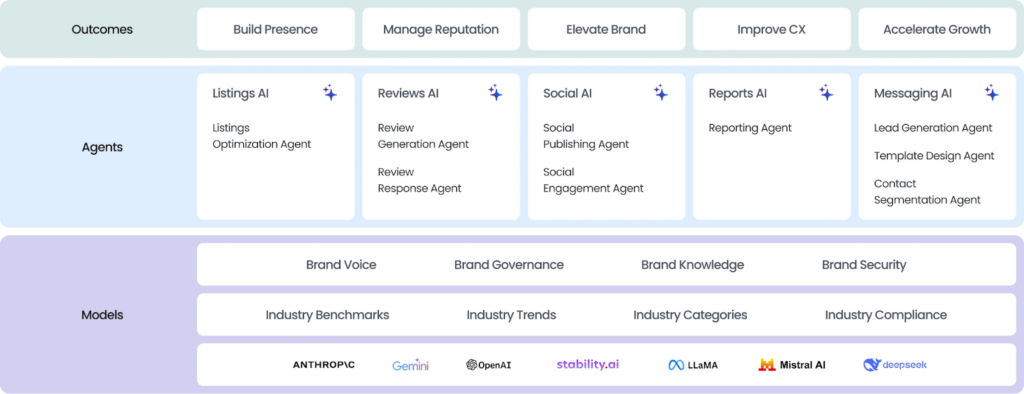
Local marketing automation fails when teams manage discovery, engagement, feedback, and reporting in isolation. Birdeye connects these functions through AI-powered systems that automate execution, surface insight, and support faster decisions without manual coordination.
Here’s how Birdeye makes local marketing automation work end-to-end:
Enhance local discoverability
Listings AI Agents keep business information accurate and optimized across search engines and directories. It updates data automatically, corrects inconsistencies, and aligns categories and attributes by market. This ensures that marketing automation drives local visibility.
Strengthen customer engagement
Messaging AI captures leads instantly and manages conversations across email, SMS, web chat, and social inboxes. It maintains brand consistency while enabling real-time responsiveness. Local marketing becomes continuous, customer-driven communication rather than just scheduled outreach.
Activate customer feedback
Insights AI analyzes reviews, surveys, social content, and messages to identify patterns that matter. It highlights where experience needs attention, and how sentiment varies by market. Teams can use these insights to adjust campaigns and prioritize meaningful actions.
Explain performance changes
Reports AI monitors performance in real time and detects meaningful shifts as they happen. It explains what changed and why in clear language. This way, teams respond faster without digging through dashboards or reports.
Stay ahead of the competition
Competitors AI tracks reputation, visibility, and sentiment across local markets. It automatically summarizes strengths, gaps, and opportunities. Competitive insight becomes part of daily marketing decisions, not a separate analysis step.
Optimize for AI-driven search
Search AI shows how brands appear in AI-powered search experiences. It identifies visibility gaps and optimization opportunities as discovery behavior changes. Local marketing automation stays aligned with how customers search today.
Unify it all into one operating model
Birdeye links discovery, engagement, insight, reporting, and competitive signals into a single operating model. Data moves directly from customer activity to action. Teams gain speed, consistency, and accountability without added overhead.
Together, Birdeye’s AI-powered capabilities make local marketing automation smarter, faster, and more connected, turning insights into action and campaigns into measurable results.
How Birdeye helped National Storage Affiliates scale local marketing automation
National Storage Affiliates (NSA) is a leading self-administered, self-managed real estate investment trust with over 1,100 storage facilities across 37 states and Puerto Rico, totaling 70 million rentable square feet. NSA’s strategy focuses on delivering a seamless customer journey while balancing automation with human touch.
Challenges
With hundreds of locations, NSA faced difficulty managing:
- Consistent customer engagement across local properties
- Timely collection and response to customer feedback
- Data-driven decisions to reduce churn and optimize operations at a local level
Manual processes and fragmented tools limited visibility into customer sentiment and slowed local execution. NSA needed a solution that could automate feedback collection, centralize insights, and scale review management while preserving local nuance.
Solution
NSA leveraged Birdeye’s AI-powered platform to connect discovery, engagement, feedback, and reporting:
- Reviews AI: Automated review requests after key touchpoints, monitored reviews across hundreds of platforms, and used on-brand AI responses to maintain consistent, human-sounding engagement.
- Surveys: Captured customer sentiment at pivotal moments, with AI-generated summaries and sentiment scoring to highlight trends and risks.
- Insights AI: Provided AI-powered dashboards to benchmark locations, understand sentiment by category or channel, identify churn risks, and surface opportunities for growth.
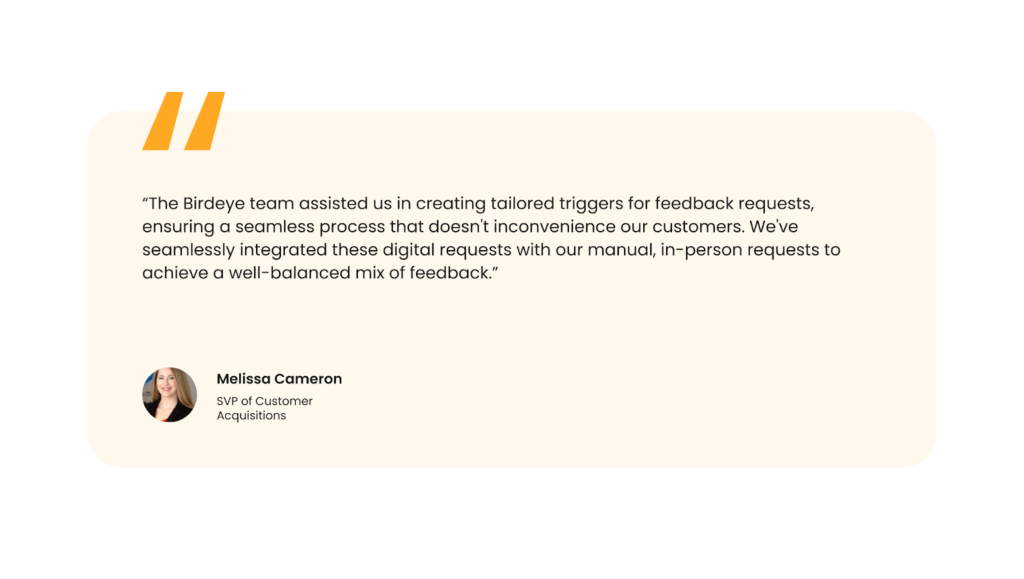
- Automation integration: Combined digital feedback requests with in-person follow-ups, ensuring seamless processes without inconveniencing customers.
Results
By implementing Birdeye:
- NSA increased review volume and customer engagement across all locations with minimal manual effort
- Negative feedback followed structured escalation for faster resolution, turning friction into trust-building opportunities
- Insights AI enabled data-driven decisions on pricing adjustments, local operations, and broader engagement strategies
- Birdeye Score and benchmarking tools gave a unified view of brand health and actionable recommendations for local teams
Key takeaway
Birdeye enabled NSA to scale local marketing automation without sacrificing control or local relevance. By connecting customer feedback, AI insights, and automated engagement, NSA built a reliable feedback loop that links centralized strategy with local execution, improving retention, loyalty, and operational efficiency.
FAQs
LMA delivers the most value when businesses manage multiple locations or partners. Single-location businesses often benefit more from simpler tools.
No. LMA supports execution and governance, but strategy, planning, and local insight still require human ownership.
Teams track time saved, brand compliance, local performance lift, and consistency across locations rather than isolated campaign metrics.
Birdeye is a leading local marketing automation platform that helps multi-location businesses manage reviews, listings, messaging, and customer insights in one unified, AI-powered dashboard.
Conclusion
Local marketing automation matters because it solves the operational reality of distributed marketing. It helps brands scale execution, maintain consistency, and support local relevance without adding complexity.
For teams getting started, the next step is simple: assess how local marketing runs today, identify where friction exists, and build a strategy that balances control with flexibility before selecting a platform.
Watch a Birdeye demo to see local marketing automation in action.

About the Author

Vanjana Sharma
Originally published





![[Feature image] The Best Marketing Platforms for Multi-Location Brands](https://birdeye.com/blog/wp-content/uploads/Feature-image-The-Best-Marketing-Platforms-for-Multi-Location-Brands-375x195.png)