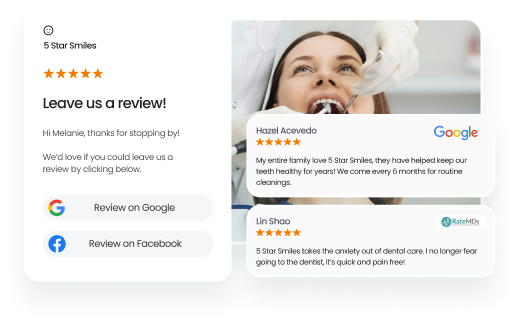
A review manager supports review management, the process of generating, monitoring, and responding to customer reviews across platforms. Reputation management is broader: it shapes how people perceive your brand by aligning reviews, listing accuracy, social presence, customer conversations, and customer experience signals.
Summary
Review management and reputation management are used interchangeably, but they solve different problems. Review management focuses on collecting, tracking, and responding to reviews, while reputation management covers the bigger brand picture, including accurate listings, consistent presence across channels, and using feedback to drive real improvements. For multi-location teams, that distinction matters because you need a system that scales without losing control. Birdeye helps unify reviews, listings, messaging, social, and insights in one connected platform. We will also explore how Birdeye Search AI measures AI search visibility and helps teams take action to improve how locations are discovered and recommended.
This blog covers the differences between review management and reputation management and where they overlap. We will then explore how Birdeye and Birdeye Search AI support scalable, consistent reputation performance across locations.
What is a review manager?
A review manager is a process of tracking incoming customer reviews from various review sites and responding to them when necessary. Businesses often choose online review management software that lets them see all their reviews from all sites in one place. Numerous tools exist that provide this basic service.
What is reputation management?
Hold tight, this one’s not as simple. Reputation management, in a business context, refers to consistently monitoring, optimizing, and responding to all company-related information across all channels in order to build a positive brand perception online.
In short, review management is just one layer of a comprehensive reputation management strategy.
What is included in my online reputation?
Your online reputation is determined by all the publicly available information that’s been posted or published about your business online. This includes:
- Online presence: Local listings, particularly your NAP (name, address, phone) on all consumer sites, social media pages and business directories
- Reviews and ratings: Quantity of reviews, recency of reviews, breadth of review sites, star ratings from reviews
- Social media: Likes, comments, shares, hashtags, check-in’s
- Discussion forums: Large sites like Reddit as well as niche industry forums
- Blogs: Article mentions, follower count, comments
- News articles: Article mentions, comments, shares
What would a comprehensive reputation management strategy look like?
For reputation management to be effective, it must be continuous. Successful businesses today know that to build a stellar online reputation, you have to cover all the bases:
- Maintain consistent online presence: Ensure your NAP is correct and up-to-date everywhere. Birdeye lets businesses fix, update, and enhance listings on 70+ sites from one place.
That same consistency now influences whether AI platforms include your brand in their recommendations. Birdeye Search AI helps you see how often your locations show up in AI-generated answers, how those answers describe you, and what sources shape them. Then it helps you take action by pointing you to the biggest fixes, like correcting listings, strengthening review volume and quality, and improving site content, so both AI visibility and traditional local SEO move in the right direction. In other words, it connects the “what AI says” to the “what your team should do next” across every location.

- Monitor and respond to all customer feedback: It’s important to respond to both positive and negative reviews to establish trust and transparency. Services like Birdeye send automatic new review alerts to your employees so they can solve problems instantly and thank happy customers for their feedback
- Consistently generate new reviews: Ratings are important, but so is the amount of reviews, how recent they are, and the variety of sites they’re on. All of these factors contribute to SEO and your overall online reputation. Birdeye makes it easy to automatically get new reviews from all your customers on the sites you care about most.
- Analyze insights: Dive deep into customer feedback to discover key drivers of customer satisfaction using a tool like Birdeye’s Business Insights.
- Competitive benchmarking: Keep tabs on the industry and local competitors to identify strengths and weaknesses and discover opportunities to capture market share. With Birdeye Benchmarking, businesses can have the same level of insights into their competitors’ customer feedback that they have for their own.
Reputation management reviews – Many companies live and die by online reviews, so don’t leave this to chance. We all know the importance of reputation in business. And these days it’s your online reputation that matters the most.
What is reputation management? Reputation management (sometimes referred to as rep management or ORM) is the practice of attempting to shape public perception of a person or organization by influencing information about that entity, primarily online.
You may also want to read Why online reputation management should be your #1 marketing priority
It would be tedious and time-consuming to use multiple tools to cover all these areas. Birdeye lets you do it all using one dashboard. With Birdeye, you can wear the cardigan AND the parka, and stay fully protected against any storms that come your way.
About the Author

Birdeye Staff Writer
Originally published

![[Feature image] The best review management software UK businesses trust for growth](https://birdeye.com/blog/wp-content/uploads/Feature-image-The-best-review-management-software-UK-businesses-trust-for-growth-375x195.jpg)

![[Feature image] The Best Marketing Platforms for Multi-Location Brands](https://birdeye.com/blog/wp-content/uploads/Feature-image-The-Best-Marketing-Platforms-for-Multi-Location-Brands-375x195.png)