Google Business Profile in 2026 has evolved into a high-impact conversion surface, where verification, data accuracy, and alignment with high-intent search directly influence visibility and customer actions for multi-location enterprises.
Summary
Google Business Profile (GBP) has evolved into a critical growth channel for multi-location enterprises, shaping how customers discover, evaluate, and choose businesses directly within search.

Based on analysis of the largest global brands across 30+ industries, Birdeye’s State of Google Business Profile 2026 report shows that verification is now the baseline, with 76% of profiles verified, while category-based “near me” searches drive the majority of discovery.

At the same time, AI-powered search is reducing overall impressions but maintaining high-value customer actions, signaling a shift toward more qualified, intent-driven engagement. What began as AI-assisted discovery in 2025 has now evolved into a zero-click, intent-driven search environment in 2026, where structured, accurate data directly influences visibility.

Enterprises that treat GBP as a managed performance channel, focusing on data consistency, reviews, content, and optimization across all locations, are achieving stronger visibility, higher conversions, and measurable business outcomes.
In this blog, we break down the latest Google Business Profile trends, benchmark performance across industries, and outline enterprise strategies to optimize visibility and engagement.
To understand what’s driving these shifts, it’s important to look at the key trends shaping Google Business Profile success in 2026.
Table of contents
- What changed in 2026: Key trends shaping GBP
- What operational challenges come with managing Google Business Profile across multiple locations?
- What industry-specific engagement trends in Google Business Profile mean for enterprise strategy
- How do reviews, content, and visuals impact Google Business Profile (GBP) rankings?
- How to optimize your Google Business Profile for AI-driven search
- How enterprises scale Google Business Profile performance with Birdeye
- FAQs about Google Business Profile 2026
- Survey methodology
- Winning Google Business Profile in 2026 requires scale, accuracy, and execution
What changed in 2026: Key trends shaping GBP
Google Business Profile performance in 2026 is defined by a shift toward intent-driven discovery, stricter platform standards, and AI-influenced search behavior. Visibility is no longer determined by presence alone. It depends on how accurately, consistently, and strategically each location is managed.
Verification has become the baseline
Verification is now a standard requirement for visibility, with 76% of businesses verified in 2025, up from 71% in 2024. This signals a mature ecosystem where incomplete or unverified profiles are increasingly excluded from high-intent search moments.
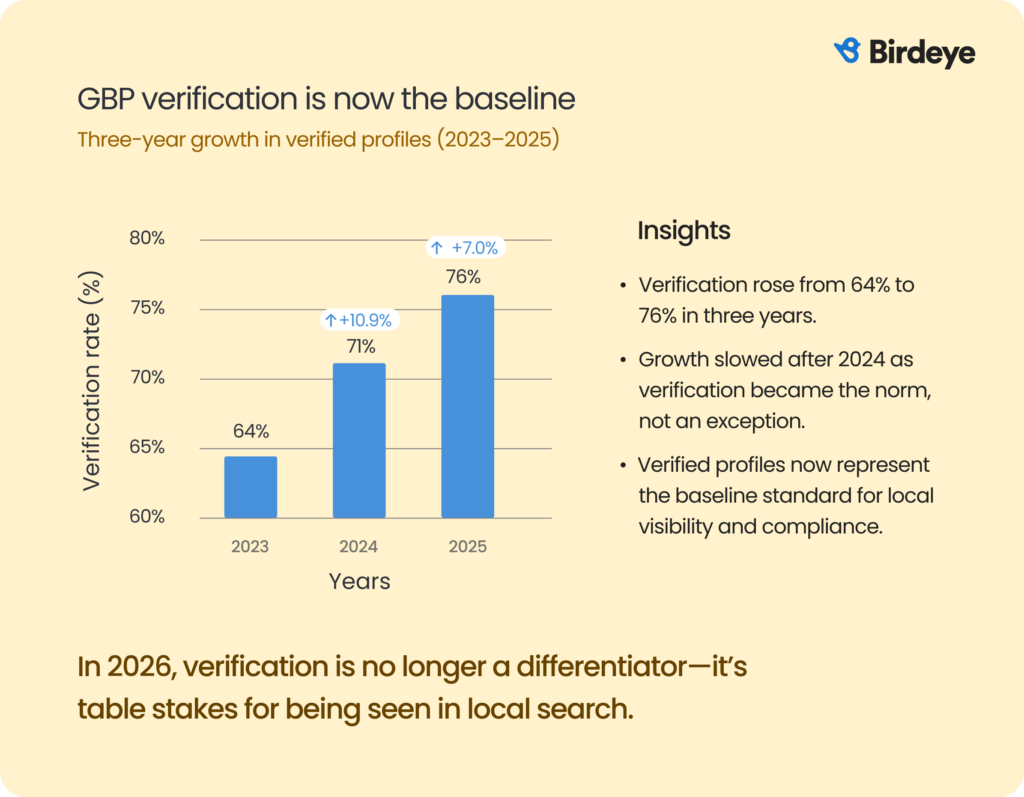
Verified profiles don’t just appear more often; they perform significantly better. Brands with verified profiles generate up to 4× more website visits and double-digit increases in calls and direction requests.
The performance gap is clear: unverified profiles increasingly lose visibility and miss high-intent customer actions.
🔎 Last year’s benchmark: Verified profiles also drove ~12% more calls and ~10% more direction requests, reinforcing the consistent performance impact of verification.
Discovery is dominated by category-based searches
Customer discovery is overwhelmingly intent-led, with 86% of GBP impressions coming from category-based searches rather than branded queries, according to Birdeye’s State of Google Business Profile 2026 report. This shift places greater importance on categories, attributes, and profile accuracy for capturing demand.
AI is reshaping visibility and engagement
Search behavior is changing as AI-powered results reduce overall exposure. Impressions per location have declined by 53.8%, while customer actions have dropped by only about 5%. This creates a clear stability signal: while visibility is shrinking, high-value customer actions remain largely intact, indicating a shift toward more qualified, intent-driven interactions.
Customer engagement remains focused on high-value actions
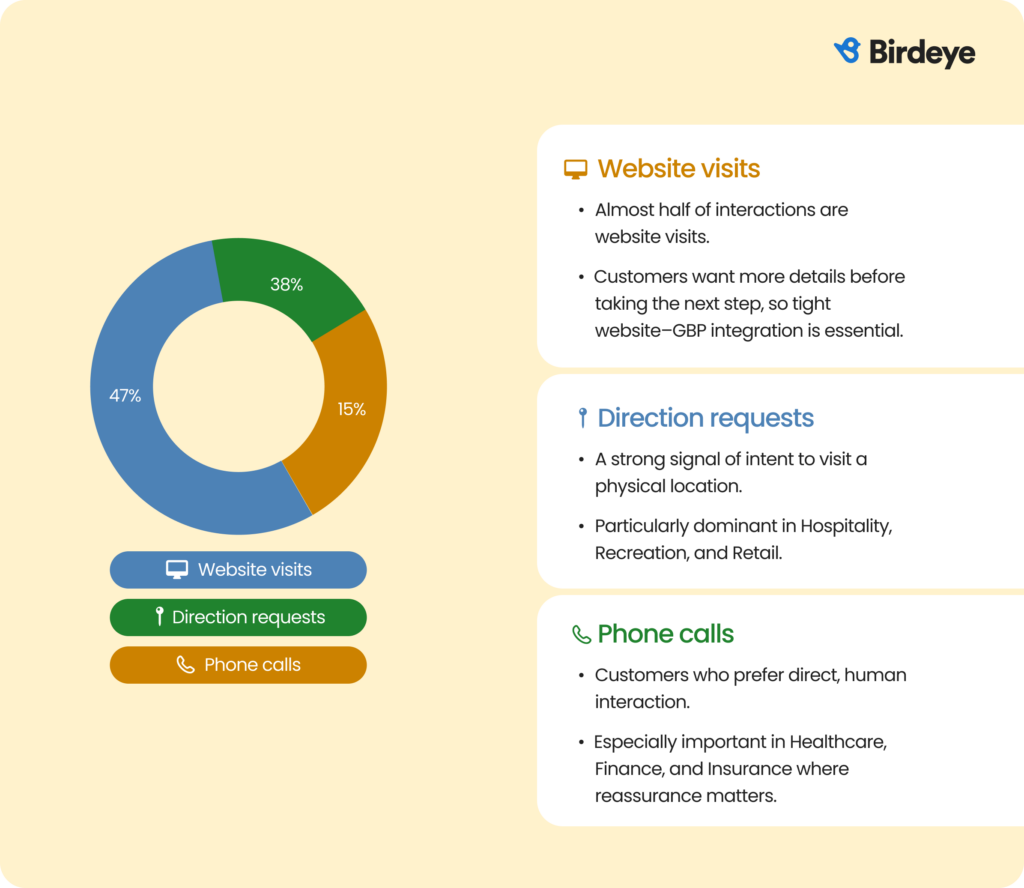
Customer engagement centers on a small set of high-value actions. Most interactions begin with website visits, followed by high-intent actions like directions and calls.
Overall, website visits drive 47% of engagement, direction requests account for 38%, and phone calls contribute 15%.
These actions reflect different stages of the customer journey and reinforce GBP’s role as both a discovery and conversion channel.
🔎 Compared to last year: Direction requests have increased (34% → 38%), while phone calls have slightly declined (17% → 15%), signaling a stronger shift toward in-person intent and location-driven behavior.
What operational challenges come with managing Google Business Profile across multiple locations?
The shifts in Google Business Profile are not just changes in search behavior; they are operational challenges for multi-location enterprises. As the role of GBP evolves, brands now face the challenge of staying accurate, consistent, and competitive across every location not just simply getting listed.
For enterprise organizations, scale introduces complexity. Each location represents a separate data point in Google’s ecosystem, and even small inconsistencies, such as outdated hours, incorrect categories, or incomplete profiles, can impact visibility and customer trust. Managing this level of precision across hundreds or thousands of locations requires more than manual updates or decentralized workflows.
In an environment shaped by intent-driven and AI-powered discovery, these gaps don’t just reduce visibility; they lead to missed high-intent customer actions.
Key challenges enterprises face include:
- Data inconsistency across locations: Incorrect categories, outdated hours, or incomplete profiles reduce visibility in high-intent searches.
- Fragmented tools and workflows: Multiple systems, local teams, and manual processes lead to inconsistent updates and slower execution.
- Limited visibility into performance: Enterprises often lack a unified view of how individual locations are performing across search, engagement, and conversions.
- Rising customer expectations: Customers expect accurate, real-time information and seamless interactions across every location and touchpoint.
These challenges compound at scale. As Google Business Profile becomes a primary conversion surface, enterprises can no longer rely on reactive updates or decentralized management.
Performance now depends on centralized control, consistent data, and the ability to manage customer experience across every location with precision.
How customers engage with Google Business Profile (GBP) in 2026
The State of Google Business Profile 2026 report shows that a small set of high-value actions drives most customer engagement on Google Business Profile and directly reflects user intent. Once users discover a business, they quickly move from evaluation to action within the same interface.
Most interactions begin with research, followed by high-intent actions that signal readiness to visit or connect.
Core engagement actions
The report highlights three primary ways customers interact with Google Business Profiles:
- Website visits (47%): Customers are in the evaluation phase, looking for more details before making a decision.
- Direction requests (38%): A strong signal of intent to visit a physical location, especially for retail, hospitality, and service-based businesses.
- Phone calls (15%): High-consideration interactions, where customers seek direct communication, are common in industries like healthcare and finance.
What this means for enterprises
Google Business Profile now supports the full customer journey within a single surface:
- Discovery: Customers find businesses through search and maps
- Evaluation: Users visit websites or review profile details
- Conversion: Actions like directions and calls drive real-world outcomes
For multi-location enterprises, performance depends on optimizing each of these stages consistently across locations.
Because engagement is concentrated around just a few high-value actions, even small gaps, such as a poor website experience, inaccurate location data, or missed calls, can significantly impact conversion outcomes.
What industry-specific engagement trends in Google Business Profile mean for enterprise strategy
Customer engagement on Google Business Profile varies across industries. Each category shows a distinct pattern of user interaction, shaped by customer intent, decision complexity, and the role of physical locations.
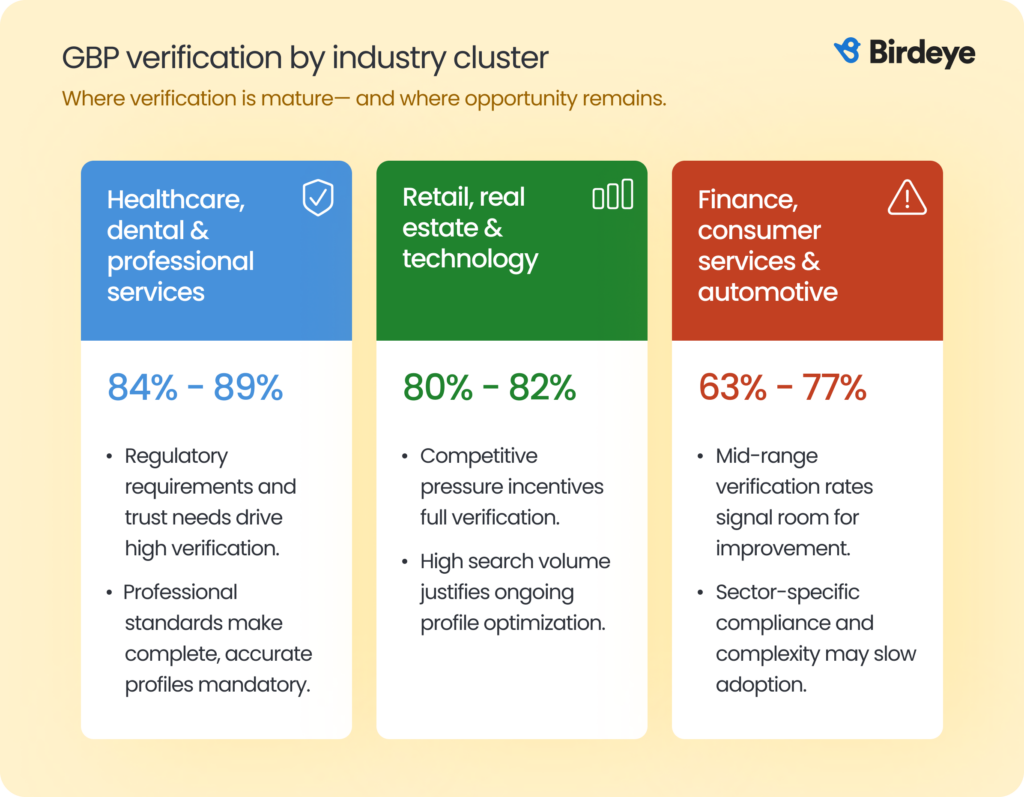
Engagement behavior is not one-size-fits-all. Understanding these differences is critical for multi-location enterprises, as performance depends on aligning each location’s profile experience with how customers prefer to engage.
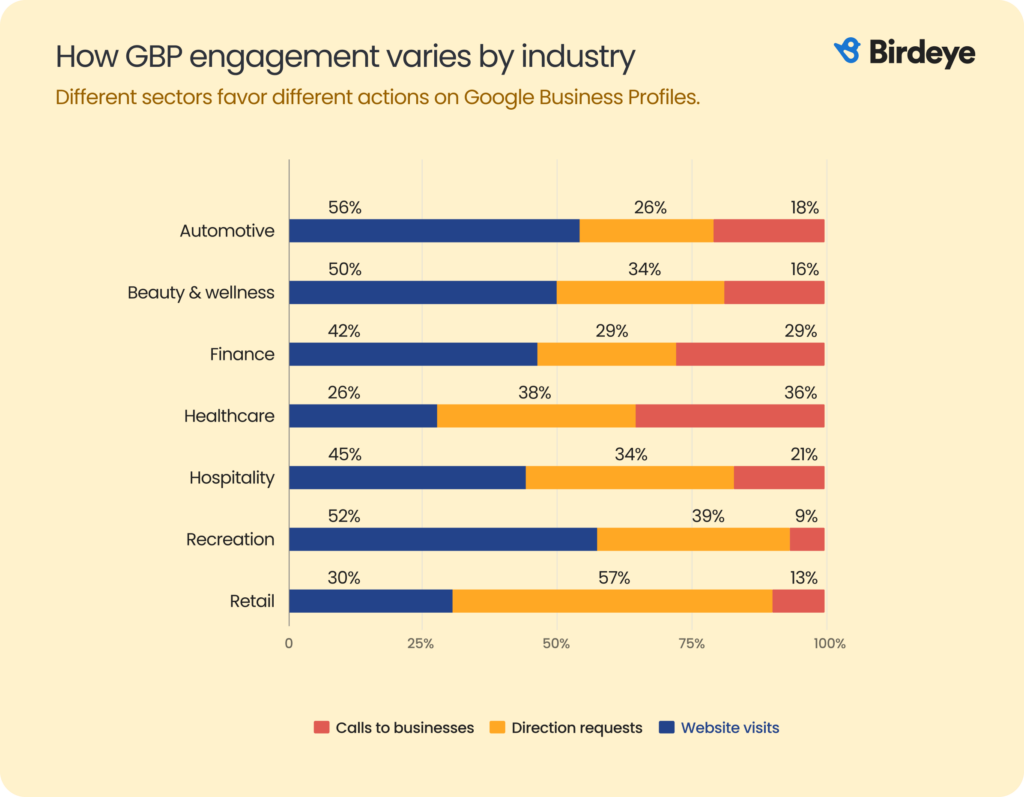
Automotive – Automotive businesses see the highest share of website visits (56%), indicating that customers spend more time evaluating options before making a decision.
Retail – Retail generates a high volume of direction requests at 57%, signaling strong in-store intent. Accurate location data, store hours, and accessibility directly impact foot traffic.
Healthcare – Healthcare shows 36% of phone calls, reflecting the need for reassurance and direct interaction before choosing a provider.
Recreation – Recreation sees a high share of website visits at 52%, indicating that customers actively explore options, offerings, and experiences before visiting.
Hospitality – Hospitality shows a balanced engagement pattern, with 45% website visits, 34% direction requests, and 21% calls. This reflects a mix of research, planning, and immediate booking or visit intent.
What this means for enterprises
Enterprises must align each location’s profile with the primary engagement behavior of its category.
- Research-heavy sectors: prioritize website experience and content
- Location-driven sectors: ensure mapping accuracy and operational details
- Call-driven sectors: optimize availability and response handling
Performance at scale depends on adapting to these patterns consistently across all locations.
How do reviews, content, and visuals impact Google Business Profile (GBP) rankings?
Google Business Profile visibility is increasingly shaped by trust signals and content quality. Beyond basic profile completeness, reviews, visual content, and ongoing updates now play a central role in how businesses are ranked, discovered, and selected.
Key signals shaping GBP performance
Google dominates review volume
Google accounts for 77% to 90% of reviews across industries, consistent with last year’s finding of ~81% share. This reinforces Google as the primary platform influencing both visibility and customer decision-making.
Review quality has improved
Following stricter moderation and cleanup efforts, review volume declined by 36.7% in 2024, with a 0.9% recovery in 2025, resulting in a more authentic and reliable review ecosystem.
Visual content remains underutilized
The average verified profile has fewer than one photo. This highlights a major opportunity for differentiation, especially in visually driven industries where content directly influences customer decisions.
🔎 Last year’s benchmark: Profiles with 15+ photos consistently saw stronger engagement across clicks, calls, and direction requests.
🔎 What we saw in 2025: Even incremental improvements in reviews can drive meaningful results. Last year’s data showed that one additional review could generate 600+ search impressions, 80+ website visits, 63+ direction requests, and 16+ calls, reinforcing the direct impact of review velocity on customer actions.

Note:The impact of “one additional review” on engagement metrics will vary by industry and market competitiveness. These figures reflect averages and should not be interpreted as guaranteed results.
Reviews and content are active drivers of both visibility and conversion. For multi-location brands, consistency in managing these signals across all locations is critical to maintaining both visibility and brand trust at scale.
How should multi-location enterprises optimize Google Business Profile?
As Google Business Profile evolves into a performance channel, optimization requires more than tactical updates. Enterprises need a clear framework to ensure every location is accurate, competitive, and aligned with how customers search and engage.
In an environment defined by intent-driven and AI-powered discovery, even small gaps in execution can limit visibility and conversion outcomes.
1. Own the foundation
Strong performance starts with accuracy and consistency across every location.
- Achieve near-100% verification across all profiles
- Ensure consistent business data (name, address, hours, categories, attributes)
- Maintain alignment across Google, directories, and owned channels
2. Win high-intent moments
Visibility alone is not enough; profiles must convert when customers are ready to act.
- Align profile content with search intent for each category
- Optimize calls-to-action, offers, and attributes to support decision-making
- Ensure key information is clear, accurate, and easy to access
3. Match engagement channels to industry behavior
Customer interaction patterns vary by industry, and optimization must reflect those differences.
- Website-driven sectors: improve landing pages and content handoff
- Location-driven sectors: optimize maps, hours, accessibility, and directions
- Call-driven sectors: ensure availability, routing, and response efficiency
4. Operate GBP as a performance channel
Google Business Profile should be managed with the same rigor as other marketing channels.
- Track engagement metrics by location (visits, calls, directions)
- Monitor reviews, sentiment, and response performance
- Set quarterly optimization goals and continuously refine strategy
Enterprises that apply this framework consistently across locations are better positioned to improve visibility, capture high-intent demand, and drive measurable business outcomes at scale.
Platform shifts enterprises must prepare for
Google Business Profile is undergoing fundamental platform shifts that are redefining visibility, engagement, and control within search. Enterprises that fail to adapt to these changes risk losing visibility in increasingly AI-driven and zero-click environments.
These changes have accelerated over the past two years, moving from feature simplification in 2024 to AI-driven discovery and stricter enforcement in 2025 and beyond.
- AI Overviews are driving zero-click behavior: Customers increasingly get answers directly within search, reducing clicks while increasing the importance of accurate, structured profile data.
- Messaging is moving to external channels: Native chat and API-based Q&A have been deprecated, and interactions are shifting to SMS and WhatsApp. This shift moves control away from in-profile interactions and toward structured data and AI-generated responses.
- Stricter enforcement on verification and compliance: Google has increased checks for incomplete or duplicate profiles, raising the risk of suspension for non-compliant listings.
- Simplification of the GBP interface and features: With the removal of in-platform tools, Google is positioning Business Profiles as a structured data layer that powers search, maps, and AI-generated answers rather than a standalone engagement interface.
How to optimize your Google Business Profile for AI-driven search
Google’s AI Overviews now pull answers directly from Google Business Profiles. When the algorithm builds these summaries, three key factors determine whether your business appears:
| What AI looks for | Why it matters | Quick win |
| Structured data (hours, services, attributes, product lists) | AI Overviews read machine-friendly fields first; blank or sloppy entries get skipped. | Fill every field and review it monthly. |
| Recently updated content | Out-of-date hours or stale photos push you down the pack. | Schedule a quarterly content refresh. |
| Real customer feedback with prompt responses | Google’s model treats recent, answered reviews as proof of quality and relevance. | Ask every happy customer for feedback and answer within 24 hours. |
As AI-driven discovery expands beyond Google, brands also need to know how they show up in tools like ChatGPT, Gemini, and Perplexity when someone asks, “best option near me.”
Birdeye Search AI helps you track whether each location appears in AI answers, how it is described, and which sources are shaping that output. It can also surface accuracy issues (like incorrect hours or a “closed” claim) and point you to the fixes that matter most, such as correcting listing details and strengthening recent review signals.

Profiles that are well-maintained are more likely to appear in AI-generated summaries and be chosen by customers.
How enterprises scale Google Business Profile performance with Birdeye
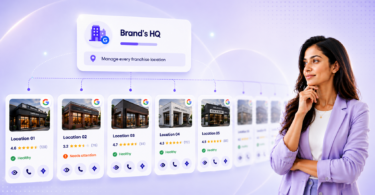
As Google Business Profile becomes a primary conversion surface, managing it effectively requires more than manual updates or fragmented tools. Enterprises need a centralized platform that ensures accuracy, consistency, and performance across every location.
Birdeye, the #1 Agentic Marketing Platform for multi-location brands, is purpose-built for enterprises operating across 100 to 10,000+ locations. It replaces disconnected tools with a unified platform where AI works as an execution layer, not just for insights, but for driving outcomes across listings, reviews, content, and search visibility.
At the core of this approach is BirdAI, which powers a system of AI agents that continuously optimize local presence, keeping listings accurate, responding to reviews, publishing content, and surfacing insights across every location. Unlike traditional automation, these agents act proactively, executing tasks and improving performance in real time based on brand, industry, and customer context.
- Ensure accuracy and consistency across every location: Birdeye Listings AI continuously scans business profiles across Google Business Profile and other key platforms to identify gaps, errors, and missed opportunities. It delivers recommendations that help enterprises keep listings accurate, consistent, and optimized for visibility at scale.
- Strengthen reviews and reputation management: Birdeye Reviews helps enterprises generate more reviews, monitor feedback across 200+ sites, and respond with context using AI Agents. It automates review generation, crafts on-brand responses based on sentiment, and surfaces insights, helping improve ratings, build trust, and strengthen local SEO performance at scale.
- Improve discovery in search and AI-driven environments: Birdeye Search AI helps enterprises track and improve their visibility across Google Search and AI platforms like ChatGPT, Gemini, and Perplexity. It identifies gaps in how brands are surfaced, analyzes the sources shaping AI answers, and uses AI agents to recommend and execute improvements, boosting visibility and helping brands become the #1 answer across locations.
- Scale content and engagement across locations: Birdeye Social AI helps enterprises create, schedule, and monitor social posts across locations. Its Social AI agents support both publishing and engagement, helping brands maintain a consistent multi-location presence without increasing operational complexity.
Birdeye enables organizations to move from fragmented, reactive management to a structured, scalable approach to Google Business Profile. By combining AI, automation, and centralized control, enterprises can improve visibility, drive engagement, and convert more high-intent customers across every location.
“One thing I love about Listings AI is the ability to ‘set it and forget it.’ We recently updated the open hours for all our storage properties, and being able to make mass updates in a single spreadsheet, without having to log into Google, Apple, and other platforms separately—was a game-changer. Birdeye handled the updates seamlessly, ensuring the changes were reflected accurately across all platforms. This streamlined process has been an incredible time-saver for our team.”
– Ashley Levy, Senior Marketing Manager, Morningstar Properties, LLC
FAQs about Google Business Profile 2026
Multi-location businesses must centralize GBP management, maintain consistent data across all locations, automate review workflows, and track performance metrics to ensure visibility and operational efficiency.
Birdeye Listings AI continuously scans business profiles across Google Business Profile and other key platforms to identify gaps, errors, and inconsistencies. It provides recommendations that help enterprises keep listings accurate, consistent, and optimized for visibility across all locations.
Verification and profile completeness form the foundation, while reviews, content freshness, and category relevance drive ongoing visibility and customer engagement.
AI reduces traditional clicks by surfacing answers directly in search, increasing the importance of accurate, structured profile data for visibility and conversion.
Birdeye Search AI helps enterprises track and improve their visibility across Google Search and AI platforms like ChatGPT, Gemini, and Perplexity. It identifies visibility gaps, analyzes the sources influencing AI-generated answers, and uses AI Agents to recommend and execute improvements, helping brands become the #1 answer across locations.
Stronger moderation has improved review quality, making reviews a critical signal for both search visibility and customer trust.
For businesses managing multiple locations, Birdeye is a leading choice. It allows companies to sync listings across hundreds of platforms while also managing reviews, social posts, and reputation insights at scale. This ensures that each location maintains consistent and accurate details while driving engagement. Other platforms like Yext and Synup offer strong syncing capabilities, but Birdeye’s added layer of customer experience management makes it uniquely effective for multi-location brands.
Show Up Where Your Customers Search
Want to see the impact of Birdeye on your business? Watch the Free Demo Now.
Survey methodology
This study analyzes data from biggest global brands using Birdeye across various industries, ensuring a broad representation. The study, compiled and examined at an industry-wide level, strictly maintains the confidentiality of proprietary information.
Winning Google Business Profile in 2026 requires scale, accuracy, and execution
Google Business Profile has evolved into a central growth engine for multi-location enterprises, shaping how customers discover, evaluate, and choose businesses in real time. As search becomes more intent-driven and AI-powered, visibility alone is not enough; performance depends on how effectively brands convert high-intent interactions into outcomes.
With category-based discovery driving the majority of visibility and customer actions concentrated around a few high-value interactions, success depends on precision, consistency, and speed across every location.
Enterprises that move beyond basic listing management and treat GBP as a strategic, continuously optimized channel will be better positioned to capture demand, deliver consistent customer experiences, and drive measurable business results across all locations.
The next phase of local search will be defined by accuracy, speed, and scalability. Organizations that invest in unified data, AI-driven optimization, and structured workflows will not only maintain visibility but also gain a competitive advantage in an increasingly complex and dynamic search environment.
See how leading multi-location brands are turning Google Business Profile into a performance channel. Watch a free demo to explore how leading brands improve visibility, engagement, and conversions across every location.

About the Author

Shaifali Parihar
Originally published