![[Feature image] Buy Google reviews UK- The truth behind quick fixes and smarter reputation solutions](https://birdeye.com/blog/wp-content/uploads/Feature-image-Buy-Google-reviews-UK-The-truth-behind-quick-fixes-and-smarter-reputation-solutions-1140x596.jpg)
“Buying Google reviews in the UK” refers to paying for Google reviews to boost ratings and reputation, and it is a high-risk tactic that can backfire with penalties, lost trust, and long-term brand damage.
Summary
UK businesses, from independent shops to local service providers, know how quickly a few negative reviews can hurt demand. When customers decide in seconds, the difference between a 3.9 and a 4.5 rating can affect calls, bookings, and footfall. That pressure makes buying reviews feel like a shortcut to rebuild trust or improve visibility. But a polished five-star surface can hide serious risks, including customer backlash, platform enforcement, and legal consequences that damage credibility far more than a negative review ever could. Birdeye offers the compliant alternative, helping businesses grow authentic reviews and boost trust without resorting to risky shortcuts.
This blog explains what it means to buy Google reviews in the UK and why this practice carries serious risks in 2026. It provides an in-depth breakdown of the relevant UK laws, Google’s handling of fake reviews, and the actual SEO costs involved. It also shows how Birdeye helps UK businesses grow genuine reviews the right way, with real case studies and practical steps.
Table of contents
- What “Buying Google reviews UK” actually looks like and what you’d get
- Is it legal to buy Google Reviews in the UK? (2026 Update)
- What Google actually does when it detects fake reviews
- The real SEO cost of fake reviews (how it hurts your Google rankings)
- Why trusted UK businesses are leaving fake reviews behind
- The smarter alternative: How to get genuine 5-star Google reviews in the UK
- UK businesses that transformed their reputation with Birdeye (case studies)
- FAQs about buying Google reviews UK
- The brands that win are the brands people trust
What “Buying Google reviews UK” actually looks like and what you’d get
If you have ever searched for “buy Google reviews UK,” you have likely come across services that make the process sound simple and low-risk. Most providers offer packages of 5-star reviews priced between £5 and £50 per review, with gradual delivery timelines designed to avoid triggering Google’s detection systems.
A typical service offering includes:
- Reviews custom-written to match your business tone and industry
- Staggered posting over days or weeks to simulate organic flow
- Reviewer profiles that look credible and have some account history
- Tiered packages ranging from 10 reviews for a quick boost to 50 or more to outrank local competitors
It is precisely this pressure that makes these services attractive. UK businesses, from independent tradespeople in Birmingham to multi-location brands in London, know how quickly a gap in star ratings can affect customer decisions and enquiries.
However, what these services actually deliver is a manufactured surface on top of significant risk. The reviews are fabricated. The reviewers have no real experience of your business. And the consequences, ranging from Google profile penalties to UK regulatory action, can cause far greater damage to your reputation than any negative review you were hoping to offset.
Before you go any further, it is worth understanding exactly what UK law says about it in 2026.
Is it legal to buy Google Reviews in the UK? (2026 Update)
Many UK brands assume that buying Google reviews sits in a legal grey area. It does not. In 2026, purchasing or commissioning fake reviews is a clear violation of multiple UK consumer protection laws, and enforcement has never been more active.
Here is what the law says:
Consumer Protection from Unfair Trading Regulations 2008 (CPRs)
The Consumer Protection from Unfair Trading Regulations 2008 prohibit businesses from engaging in misleading commercial practices. Commissioning or publishing fake reviews to influence purchasing decisions falls directly under this legislation. Businesses found in breach can face severe penalties, including unlimited fines and, in serious cases, criminal prosecution.
The Digital Markets, Competition and Consumers Act 2024 (DMCCA)
The Digital Markets, Competition and Consumers Act 2024 marked a significant shift in UK consumer law enforcement. Since April 2025, a range of review-related practices have been explicitly banned under this Act. This includes obtaining and posting fake reviews, paid-for reviews that are not clearly marked as incentivised, hiding negative reviews, and presenting star ratings that give an inaccurate picture.
Crucially, the DMCCA empowers the CMA to enforce consumer protections directly through administrative proceedings, bypassing the need for court action, and to impose fines of up to 10% of a business’s global annual turnover.
CMA Enforcement Action in 2026
The Competition and Markets Authority has moved well beyond guidance into active enforcement. On 27 March 2026, the CMA launched five new consumer law investigations targeting fake and misleading reviews, opening cases against Autotrader, Feefo, Dignity, Just Eat, and Pasta Evangelists, spanning funerals, food delivery, and car sales.
In January 2026, the CMA’s Executive Director for Consumer Protection stated that companies should “expect further action” regarding fake reviews. The investigations launched in March 2026 form a direct part of this ongoing commitment.
The CMA has already demonstrated its willingness to use these powers, having issued a car park provider with a £473,000 fine for failure to comply with a legal information notice, the first major fine of its kind under the new regime.
Advertising Standards Authority (ASA)
The ASA mandate requires that any paid-for or incentivised endorsement must be clearly disclosed. The ASA has online endorsements firmly on its radar and is actively monitoring endorsements using its AI-driven active ad monitoring system, naming and shaming influencers who are routinely in breach of its labelling rules. Fake Google reviews, by their nature, are neither genuine nor disclosed, placing brands in direct breach of ASA guidelines.
The legal landscape in the UK has tightened considerably. What may have seemed like a low-risk tactic in previous years now carries direct financial and reputational consequences that no business can afford to ignore.
For a deeper look at how that trust system holds up, see are Google reviews reliable.
What Google actually does when it detects fake reviews
Many businesses that purchase fake Google reviews operate under the misconception that the worst outcome is a quiet removal of a handful of posts. In 2026, the consequences are considerably more serious and more visible.
Google’s detection systems have advanced significantly
Google’s enforcement is no longer a manual, complaint-driven process. According to Google’s official 2025 Trust and Safety Report, Google’s advanced systems and expert analysts blocked or removed over 292 million policy-violating reviews in 2025, while publishing more than 1 billion helpful reviews. That amounts to roughly one in five submitted reviews being classified as a violation.
Google placed posting restrictions on more than 782,000 policy-violating accounts and removed over 13 million fake Business Profiles in 2025 alone.
Under Google’s Prohibited and Restricted Content policy, fake engagement is not allowed and will be removed. This includes content that is not based on a real experience, reviews or ratings that have been paid for directly or in kind, and content posted from multiple accounts by or at the request of one person.
Google’s systems now continuously monitor for:
- Sudden spikes in review volume over a short period
- Reviews posted from shared devices or clustered IP addresses
- Coordinated posting patterns across multiple accounts
- Account age, activity history, and profile completeness
- Content similarity across multiple submissions
What happens to your business profile
When Google identifies suspicious review activity, the response is structured and escalating. According to Google’s official Business Profile restrictions page, businesses that violate the Fake Engagement policy may have their Business Profile restricted in addition to having violative reviews removed.
Possible restrictions include the profile being unable to receive new reviews or ratings for a set period, existing reviews or ratings being unpublished, and the Business Profile displaying a warning to inform consumers that fake reviews were removed.
That warning is publicly visible to every potential customer searching for your business on Google Maps and Search, immediately eroding consumer trust
For repeated or severe violations, Google’s Business Profile policies make clear that if a merchant displays a pattern of violating them, their Business Profile access may be restricted, and all Business Profiles associated with that account may be permanently suspended.
A UK-specific warning
In a UK-specific move, Google piloted a “fake reviews detected” badge, visibly warning customers when a business is suspected of manipulating reviews. For any UK business that has invested in building its local reputation, having this badge appear on a Google Business Profile can jeopardise months of legitimate customer relationship work within days.
The broader risk to your profile
Businesses that purchase fake reviews are not simply risking the removal of those specific posts. They are placing their entire Google Business Profile under active scrutiny. If you have had reviews removed due to policy violations, the impact on your local rankings typically shows within two to four weeks.
Purchasing fake reviews does not strengthen a profile. It creates a sustained risk and vulnerability that Google’s systems are now well-equipped to detect and act on.
The real SEO cost of fake reviews (how it hurts your Google rankings)
Purchasing fake reviews does not just carry legal and platform risk. More importantly, it directly undermines the very outcome you were trying to achieve. Understanding why requires looking at how Google uses review signals to determine where local businesses rank in 2026.
How Google officially defines the role of reviews in local rankings
Google’s official documentation on how local results are ranked states that local search results are determined by three core factors: relevance, distance, and prominence. Reviews are prominent, and Google explicitly states that businesses with more reviews and positive ratings are more likely to rank higher in local results.
This is not a speculative claim. Google confirms directly in its support documentation that review count and review score are factored into local search ranking. Additionally, Google’s Local Services Ads support page confirms that star ratings and the number of reviews affect how a business is ranked, with providers who have higher ratings and more reviews consistently performing better.
The specific review signals Google reads in 2026
Google’s review evaluation goes well beyond a simple star rating. The crucial signals its systems now assess include:
- Review volume and velocity, whether the frequency of new reviews reflects natural, ongoing customer activity
- Review recency, with fresh reviews carrying more weight than older ones
- The content of review text, including mentions of specific services, locations, and experiences
- Owner response patterns, which Google treats as an active engagement and trust signal
- Reviewer credibility, including account history, activity across other businesses, and location data
Fake reviews cannot authentically replicate any of these signals. Purchased content, generated from aged accounts or emulators, fails contextual verification. Detailed, genuine reviews from real customers provide richer, more durable ranking signals than inflated ratings with no substance.
The trust dimension that fake reviews miss entirely
Beyond algorithmic signals, review authenticity directly affects purchasing behaviour. According to Forrester’s 2026 Business Buyers Predictions, fake reviews and inaccurate data are increasingly slipping through AI-generated content systems, and trust is becoming the defining currency in buying decisions. For UK local businesses, this matters beyond rankings. A business that appears credible in search results but delivers an inauthentic review profile loses consumer confidence at the very moment it has captured attention.
What happens to your rankings when fake reviews are removed
When Google removes fake reviews from a profile, the immediate effect is a dual penalty: a reduction in review count and, in most cases, a drop in average star rating. Both directly affect local pack visibility. A profile that has had reviews removed for policy violations is subsequently subject to heightened algorithmic scrutiny, which can suppress its visibility in local search results even after the violating content has been cleared.
For UK businesses competing in local search, whether in legal services, dental practices, home services, or retail, the compounding effect is significant. A genuine, consistently growing review profile is one of the few ranking signals a business can actively build over time. Purchasing fake reviews does not accelerate that process. It resets it.
Why trusted UK businesses are leaving fake reviews behind
More UK businesses are moving away from fake review tactics and investing instead in authentic customer feedback that builds long-term trust. The Baileys case study reflects a broader shift happening across local businesses: sustainable review growth now comes from consistent, compliant outreach to real customers, not purchased reviews or shortcuts.Industry research reinforces this shift.
According to the Birdeye State of Online Reviews 2026 report, review volume surged by 30.7%, the fastest growth rate since 2021, driven largely by automation and improved review-request workflows.
Think again before buying Google reviews in the UK
Want to see the impact of Birdeye on your business? Watch the Free Demo Now.
The UK market context makes this even more significant. According toStatista’s research on UK online shopping behaviour, more than half of UK consumers conduct research online before making a purchase, and reading customer reviews is among the most valued parts of that process. For local UK businesses, an authentic and growing review profile is therefore non-negotiable. It is a core factor in how customers decide whom to trust.
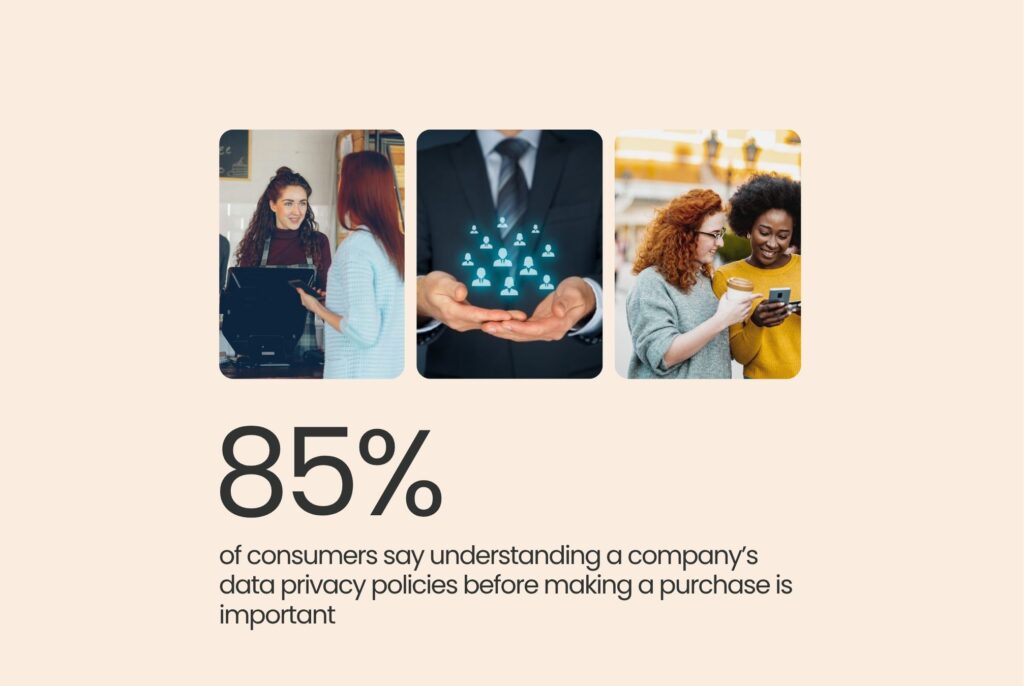
According to McKinsey’s 2026 research on digital trust, 85% of consumers say understanding a company’s data privacy policies before making a purchase is important, underscoring how trust now strongly influences buying decisions. This makes fake reviews especially damaging, since even small credibility issues can impact customer acquisition and long-term loyalty.
How Baileys boosted trust and conversions with Birdeye
The Brand
Baileys Domestic Appliances, an Euronics partner based in Salisbury specialising in domestic appliance sales and repairs, is a clear example of what structured, authentic review generation produces in practice.
The Challenge
Before adopting Birdeye, Baileys faced a familiar challenge. Despite providing quality products and reliable service, their online presence did not reflect that reputation. Their review-generation efforts consisted of QR codes and manual email requests, resulting in just 23 reviews over an entire year. That limited volume was insufficient to build the online credibility needed to compete with larger national retailers appearing in the same local search results.
The Result
After implementing Birdeye solutions, the results were measurable and immediate:
- Baileys nearly doubled their entire previous year’s review count within just two months, surpassing 23 reviews in under 60 days
- Their Google Business Profile garnered nearly 3,700 impressions within the first two months
- Birdeye Webchat captured 41 new webchat leads and 79 new leads from all sources within 60 days
- Social media engagement increased by 39.7% after streamlining their posting and response workflow through Birdeye Social
- When searching “appliance shop Salisbury,” Baileys appeared prominently at the top of the results, with competitors only visible after scrolling to the bottom of the page
As Damon McNally, Director of Baileys Domestic Appliances, noted:
“Last year, we managed to get 23 reviews with a lot of effort. With Birdeye, we have already surpassed this in less than 2 months.”
None of these results required purchasing a single review. They required the right process, applied consistently, at the right moment in the customer journey.
For UK businesses looking to build a review profile that genuinely strengthens local search visibility and consumer trust, Baileys demonstrates what is achievable when authentic review generation is treated as a structured business activity rather than an afterthought.
Learn more about Birdeye and Baileys Domestic Appliances case study
The smarter alternative: How to get genuine 5-star Google reviews in the UK
The most effective review strategies for UK brands in 2026 are not complicated. They are consistent. The brands that build strong, credible review profiles do so by making review generation a structured part of their operations, not an occasional afterthought.
This section outlines the specific tactics, UK-relevant channels, and step-by-step approach that produce sustainable results, all within Google’s official guidelines.
Step 1: Ask at the right moment
Timing is the single most important variable in review generation. According to Google’s own guidance on getting more reviews, the most effective approach is to ask customers directly after a positive interaction, when their experience is fresh, and their satisfaction is at its peak.
For UK businesses, the right moment varies by sector:
- For tradespeople and home service providers: immediately after job completion, via an automated SMS while on-site or within the same day
- For dental and healthcare practices: following a successful appointment, via a post-visit SMS or email
- For retail businesses: at the point of purchase, in-store, using a QR code on the receipt or counter
- For professional services such as legal or financial advisers: after a key milestone or positive outcome is reached
- For restaurants and hospitality: via a follow-up message sent the same evening
The key principle is that the request should feel natural, not transactional. Customers who are genuinely satisfied are willing to share that, provided they are asked at the right time and given a frictionless way to do so.
Step 2: Make it as easy as possible
Google allows businesses to create a direct review link and QR code that takes customers straight to the review form. Removing unnecessary steps significantly increases completion rates.
Practical ways to share this link across UK-relevant channels include:
- SMS follow-up messages sent within 24 hours of a service or purchase
- Post-purchase email sequences with a single, clear call to action
- Printed QR codes on receipts, packaging inserts, or at point-of-sale displays
- Staff verbally directing customers to leave a review, paired with a QR code on a card
- Review prompts embedded in post-appointment confirmation emails
What these have in common is simplicity. The fewer steps a customer has to take, the more likely they are to complete the action.
Step 3: Respond to every review, positive and negative
Google’s official guidance on managing reviews is clear: responding to reviews demonstrates that customer feedback matters to your business. It also functions as an engagement signal within Google’s local ranking systems.
For UK businesses managing reviews effectively, the standard to aim for is:
- Respond to all positive reviews within 48 hours, with a personalised acknowledgement
- Respond to negative reviews promptly, professionally, and without being defensive
- Never share a reviewer’s private information or engage in personal criticism
- Keep responses concise, genuine, and relevant to the specific feedback given
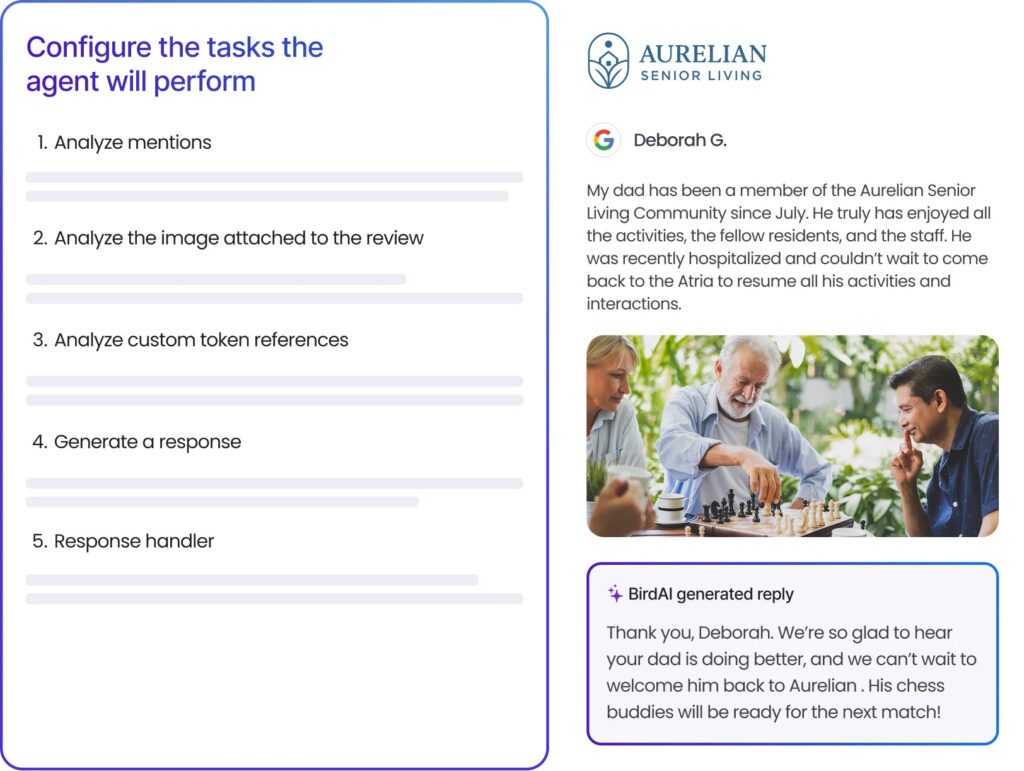
Birdeye’s data shows that businesses using its Review Response Agent achieve an average review response rate of 71%. That level of consistent engagement is visible not only to Google’s algorithm but to every prospective customer reading your profile.
Step 4: Build review generation into your operations
The businesses with the strongest review profiles in local search do not rely on one-off campaigns. They treat review generation as a repeatable business process, integrated into their existing customer communications.
A structured approach looks like this:
- Identify the two or three customer touchpoints in your journey where satisfaction is highest
- Create a review request template for each channel, whether SMS, email, or in-person
- Establish a weekly or fortnightly cadence for sending review requests to recent customers
- Monitor incoming reviews and ensure responses go out within a defined timeframe
- Review performance monthly and adjust messaging or timing based on what is converting
Step 5: Use automation to maintain consistency at scale
For UK businesses managing multiple locations, or simply looking to remove manual effort from the process, automation delivers consistent results without adding workload.
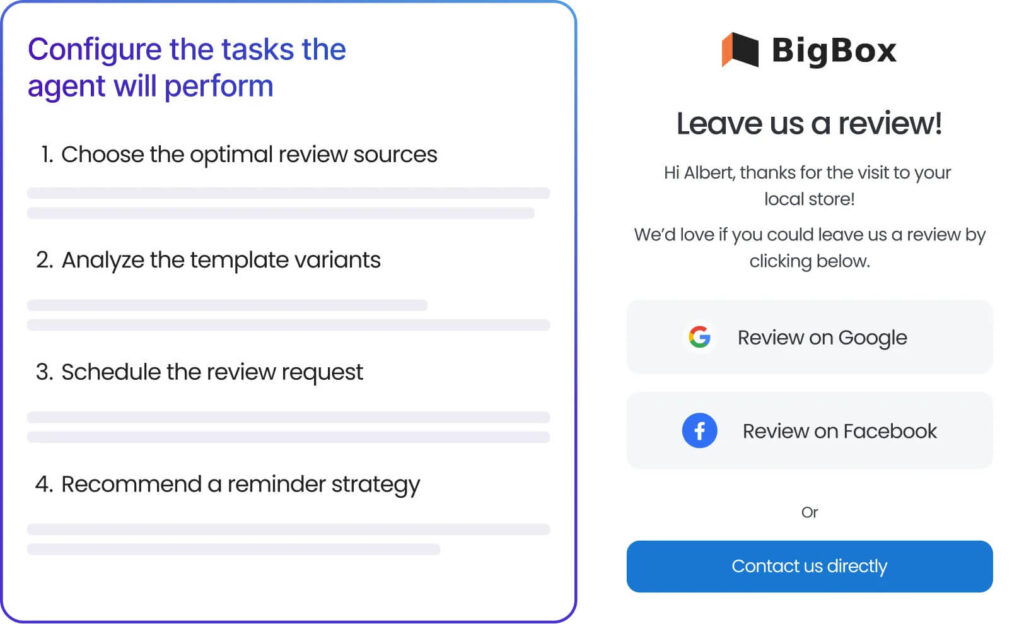
Birdeye’s Reviews handles this end-to-end. Its AI agents send review requests automatically via the optimal channel and at the optimal time for each customer, run A/B tests across subject lines, templates, and channels to continuously improve performance, and ensure that every customer receives a timely, compliant request without requiring manual intervention from your team.
What not to do
For clarity, and in line with both Google’s policies and UK consumer law, the following practices are prohibited and carry real consequences:
- Offering incentives, discounts, or gifts in exchange for reviews
- Asking only selected customers to leave reviews, to filter out negative feedback
- Posting reviews on behalf of customers or directing staff to post fake reviews
- Using third-party services that generate reviews from fabricated accounts
Google’s Prohibited and Restricted Content policy explicitly prohibits all of the above. Under the Digital Markets, Competition and Consumers Act 2024, these practices also carry regulatory consequences in the UK.
The smarter path is clear. A structured, compliant, and consistently applied review generation process builds the kind of review profile that genuinely improves local search visibility, earns consumer trust, and compounds in value over time.
Platforms like Birdeye further strengthen this process through AI-driven capabilities like the Review Generation Agent, which automatically identifies the best timing, channel, and messaging for review requests while continuously optimizing performance across SMS and email campaigns.
UK businesses that transformed their reputation with Birdeye (case studies)
Buying fake reviews might seem like a quick fix, but the businesses below took a different path entirely. They invested in structured, compliant reputation management and saw measurable results across visibility, trust, and growth.
Here is what that looks like in practice across two very different UK sectors.
How Birdeye helped mydentist improve listings accuracy and review management across 530 locations
The brand
mydentist is the largest provider of dental care in the UK, serving approximately 4 million active patients across more than 530 locations. With an ongoing programme of relocating practices to high-street and retail sites, the business needed a reputation management solution capable of operating at a significant scale.
The challenge
Before adopting Birdeye, mydentist faced major challenges with listings and reputation management across its locations. Many Google Business Profile listings had been created by patients or competitors, resulting in inaccurate business information and inconsistent customer experiences.
Key issues included:
- Incorrect phone numbers and duplicate listings
- Outdated addresses during relocations
- Inconsistent review response management
- Limited visibility into patient feedback and sentiment
After an unsuccessful 18-month effort with a previous vendor, mydentist needed a more scalable solution to manage local visibility and reputation across locations.
The results
After piloting Birdeye with a small group of locations, mydentist migrated all 530 locations in just a few days. The outcomes were both immediate and sustained:
- 530 locations migrated and consolidated within days, an achievement unattainable over 18 months with their previous vendor
- 99% Google review response rate achieved through Birdeye’s automated review response system
- Reviews up 50% year on year, well above their historical trend
- Average star rating climbed from 4.4 to 4.6 within 6 months
- 10% uplift in year-on-year Google Business Profile interactions, particularly in onward actions such as website visits and direction requests
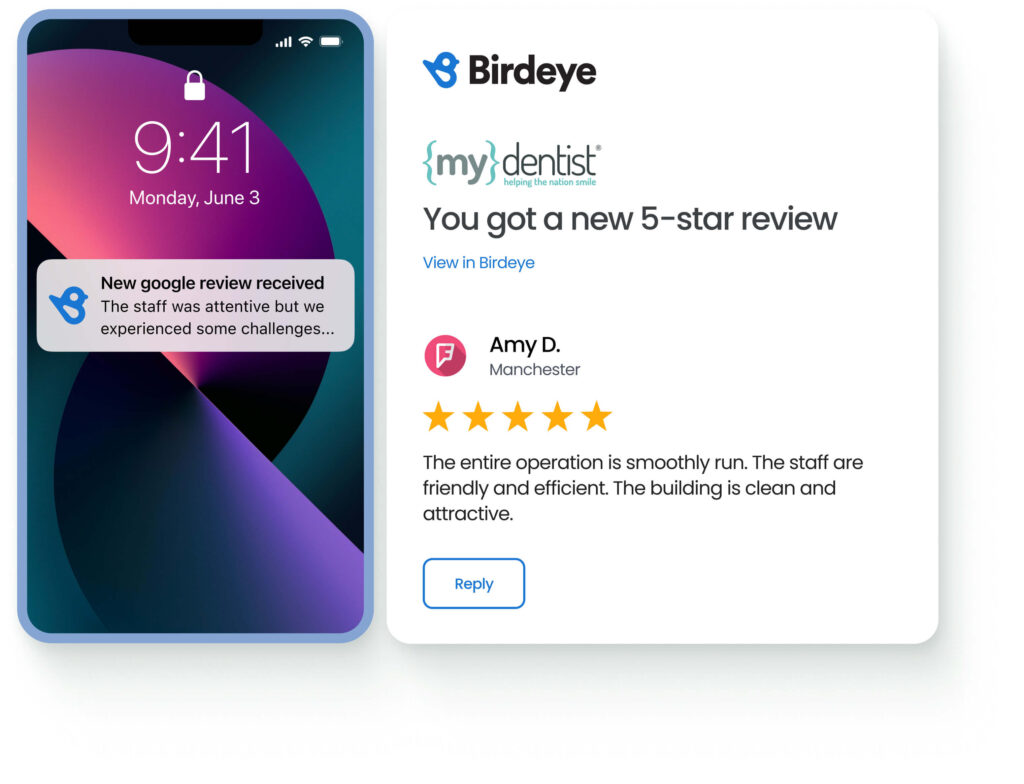
Peter Bailey, Head of Digital, mydentist, shares:
“It’s fair to say it was challenging at points…but the Birdeye team just kept stepping up. They kept coming back and fixing the blockers at a rate I wasn’t expecting. Within 60 days, we were onboarding another 25 locations…and shortly after, we were able to onboard all 530 locations.”
FAQs about buying Google reviews UK
Briefly, yes, but the gains are superficial. Purchased reviews may temporarily inflate a star rating, but they do not generate the authentic behavioural signals Google evaluates for local rankings. Any short-term lift is typically reversed once Google’s systems flag the activity, often within weeks.
Yes, this is known as a negative reputation attack or review bombing. If you suspect this, report the reviews directly through your Google Business Profile using the flag function. Google investigates flagged content and has systems to identify coordinated inauthentic activity targeting business profiles.
No. Google can remove reviews at any time if they are found to violate its policies, whether posted by customers, competitors, or purchased through third-party services. Reviews removed due to policy violations are not reinstated.
Indirectly, yes. While Google primarily evaluates signals from its own platform, a consistent presence across trusted review directories contributes to the broader prominence signals Google uses to assess a business. Diversifying genuine reviews across platforms also strengthens AI search visibility.
Respond promptly and professionally through your Google Business Profile, acknowledge the experience, and invite the customer to resolve the matter offline. Do not share personal details or respond defensively. A well-handled response is visible to prospective customers and reflects positively on your business.
Research consistently shows UK consumers are hesitant to engage with businesses rated below 4.0 stars. A rating below 3.5 can actively suppress enquiries, as many consumers apply star rating filters when searching locally.
Yes. Asking every customer immediately after a positive interaction, using a direct Google review link, and automating outreach through a compliant platform removes the friction that prevents review generation. New businesses that implement a structured process from the outset build review velocity faster than established businesses relying on manual methods.
The badge appears publicly on a Google Business Profile when Google suspects review manipulation. It signals distrust to every potential customer viewing the profile before they read a single review, and can significantly reduce enquiries, calls, and footfall until the issue is resolved.
The brands that win are the brands people trust
Buying Google reviews in the UK carries consequences that far outweigh any short-term gain. With active CMA enforcement, Google’s advanced detection systems, and the risk of a public-facing warning on your Business Profile, there is no viable shortcut. A genuine, consistently growing review profile is the only approach that delivers lasting local search visibility and consumer trust.
UK businesses across dental, franchise, and retail sectors are already proving that the right process, applied consistently, produces measurable and sustainable results without a single purchased review.
Start building a reputation that works for your brand long term. Book a free demo with Birdeye today.
About the Author

Sudeepta Bora
Originally published