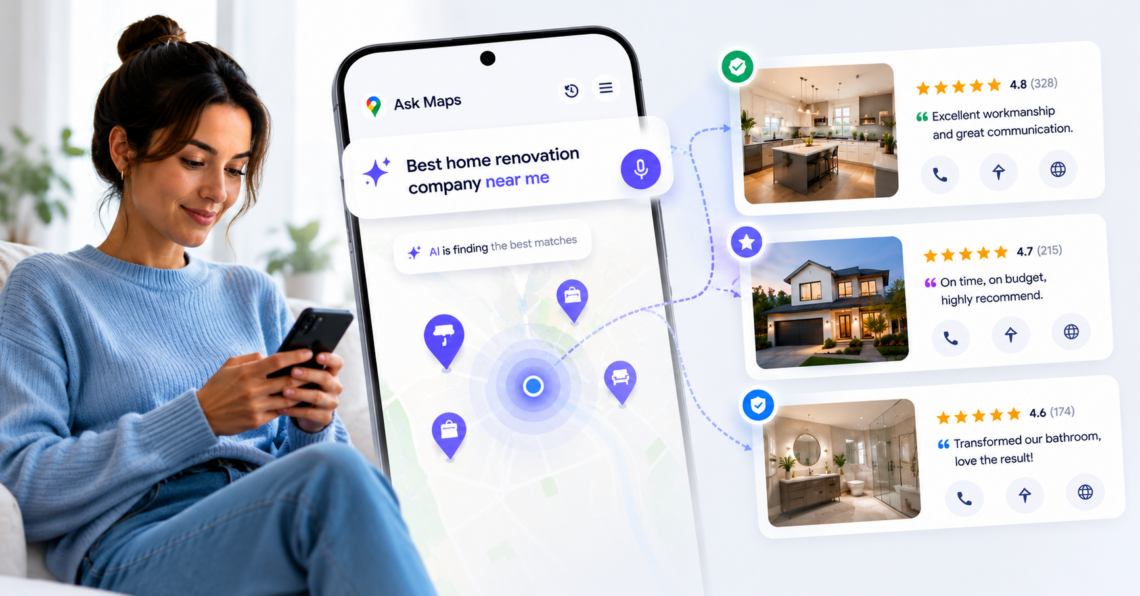
Google has launched Ask Maps, a new AI-powered feature inside Google Maps that lets people search in plain language and get back AI‑generated recommendations, not just a list of pins.
Summary of the blog
Ask Maps is a sign that local search is shifting from short keyword queries to intent-based, conversational discovery. People can now describe what they want, including when they need it, how far they’re willing to go, and what kind of experience they’re after - in the same natural language they would use with a local expert.
For multi-location brands, this raises the importance of accurate listings, recent and detailed reviews, and well-managed location content across every Google Business Profile.

This shift is also part of the broader rise of AI search and Generative Engine Optimization (GEO), where AI search engines increasingly influence which local businesses customers discover and choose.

It also connects directly to answer engines and LLM‑style search: the clearer your locations look to AI, the more often they will be recommended.
In this blog, you’ll see what Ask Maps changes, why it matters for multi-location enterprise brands, and what practical operational steps to take now to stay visible in AI‑driven local discovery.
Table of contents
- Summary of the blog
- What are the new Google Maps updates?
- How Google Maps is becoming an AI-powered local discovery engine
- How Ask Maps rewrites the rules of local discovery
- What’s changed since Ask Maps launched
- Why is Ask Maps a bigger operational shift for multi-location brands?
- What should multi-location brands do to optimize for Ask Maps?
- FAQs about the new Ask Maps in Google Maps
- How Birdeye helps you win in the AI era
What are the new Google Maps updates?
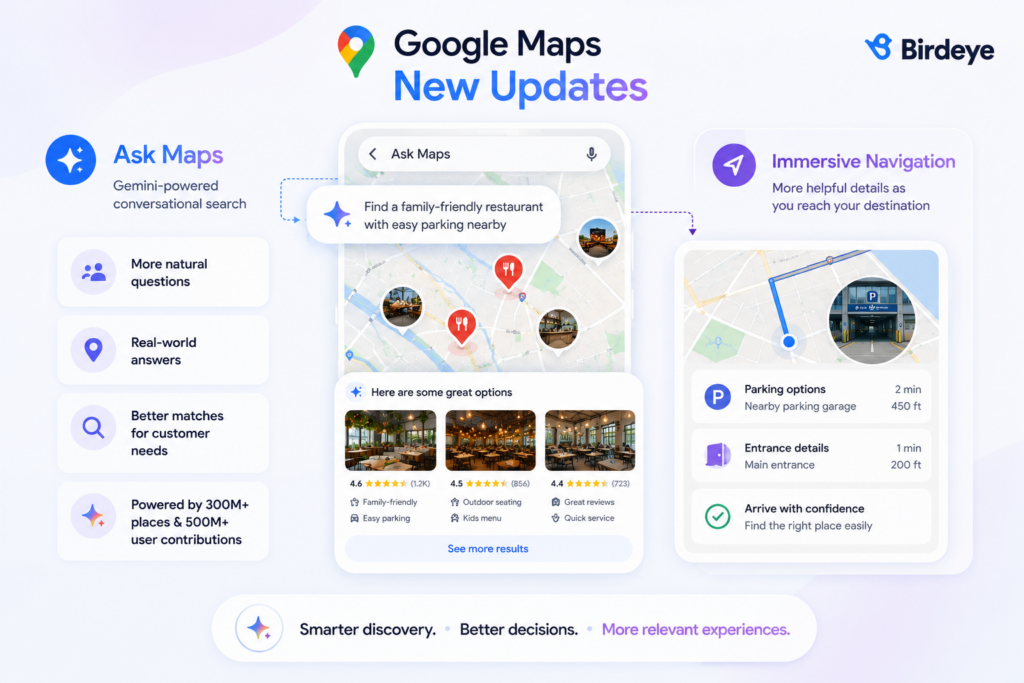
Google announced two major updates to Maps: Ask Maps and Immersive Navigation. Both are substantial changes to how the platform works and how people discover and evaluate local businesses.
For multi‑location brands, “Ask Maps” is the bigger strategic shift because it changes which locations get recommended for complex, real‑world questions.
Today @GoogleMaps is getting its biggest upgrade in over a decade. By combining our Gemini models with a deep understanding of the world, Maps now unlocks entirely new possibilities for how you navigate and explore. Here’s what you need to know 🧵 pic.twitter.com/p6zhbkbvwY
— Google (@Google) March 12, 2026
Ask Maps
Ask Maps is the bigger strategic story for marketers. It’s a Gemini-powered conversational feature inside Google Maps that helps users ask more detailed, real-world questions. Google says the system pulls from over 300 million places and draws on contributions from more than 500 million users.
The feature is an important update for multi-location brands because it changes the kinds of searches they need to show up in. A customer might now ask for:
- A family-friendly restaurant with easy parking
- A dentist open late near work
- A salon with strong reviews and a certain vibe
- A place nearby that feels convenient for a quick stop
None of these is a simple “near me” query. They’re specific, intent-driven prompts, and Google is trying to answer them like a knowledgeable local, not just a directory.
Immersive Navigation
“Immersive Navigation” focuses more on the drive itself. Google says it adds more realistic route views, clearer lane guidance, easier route comparisons, and better help near the destination, including parking and entrance details.
How Google Maps is becoming an AI-powered local discovery engine
For years, local SEO was about owning the right keywords. If you ran a dental practice, you would fight to rank for “dentist near me.” That game is changing fast.
As the search transitions from “Keyword Mode” to “Intent Mode,” people describe specific situations in natural language instead of just picking a category. Because Gemini can now reason through reviews, photos, and listing data, prompts can be incredibly nuanced.
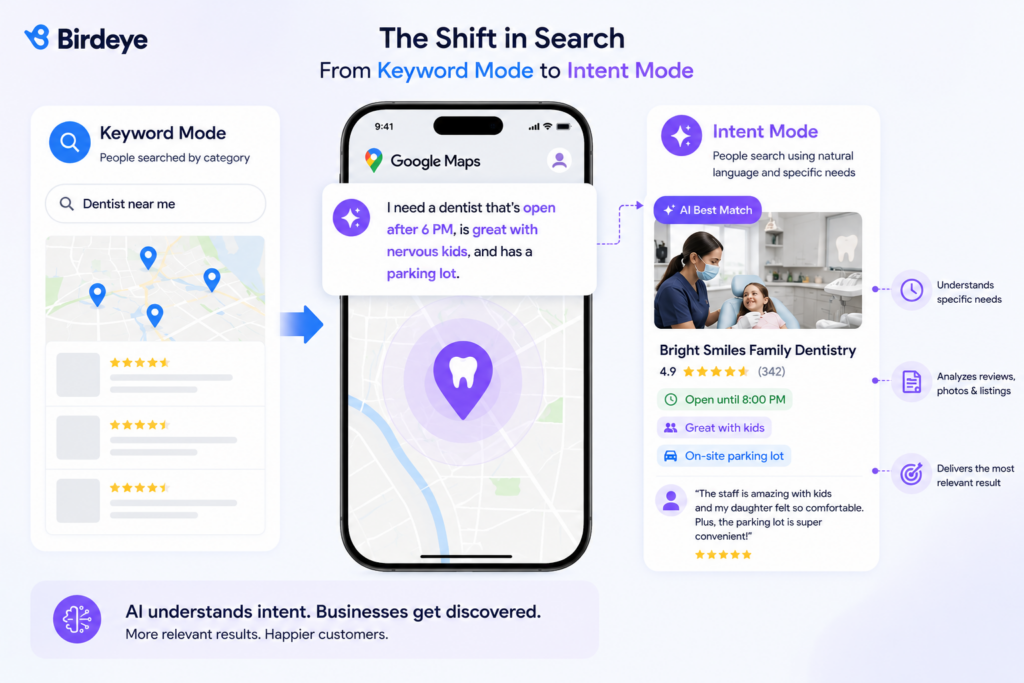
For multi-location brands, proximity and brand name are no longer enough. You’re competing on how well the AI understands what each of your locations is actually like – and how consistently that story shows up in your Google Business Profiles and reviews.
How Ask Maps rewrites the rules of local discovery
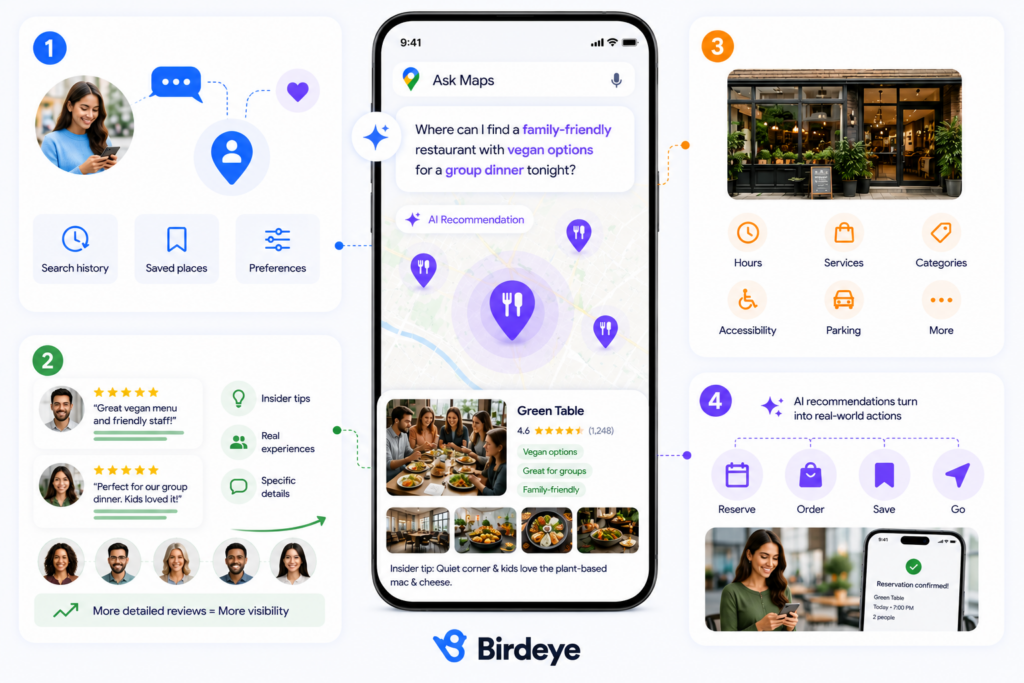
Your Google Business Profile (GBP) and reviews are becoming key inputs that Google uses to understand and recommend your business. That changes the rules of discovery in four major ways:
1. Discovery is conversational and personalized
Location alone no longer wins. Ask Maps combines a user’s Maps history (such as searches and saved places) with the context of their prompt — things like time, constraints, and preferences.
If a user asks for restaurant suggestions for a group dinner, the AI may already know they prefer vegan options and will filter recommendations accordingly. For multi-location brands, each location needs clear signals in reviews, photos, and GBP attributes that map to scenarios like “family‑friendly,” “vegan‑friendly,” or “good for groups.”
2. Reviews are one of the most valuable signals in AI-driven local discovery
Gemini reads reviews like a researcher, looking for specifics that match what someone asked for. It pulls “insider tips” from review text (such as a hidden parking entrance or a quiet corner table) and uses them to populate features like “Know before you go.”
Locations with thin or vague online reviews give the AI very little to go on. For multi-location brands, generating high volumes of detailed, attribute‑rich reviews at every location becomes a visibility task, not just a reputation task.
Photos matter too. Google increasingly uses visual signals alongside reviews and business information to understand what a location looks like, what services it offers, and whether it matches a user’s intent. Locations with recent, high-quality photos (whether Google Business Profile photos or by customers) provide richer context for AI-powered recommendations.
3. Profile accuracy is non-negotiable
When Ask Maps generates a recommendation, it works entirely from what’s in the profile and what customers say about you. Outdated hours, missing services, or wrong categories directly affect whether you get recommended — especially when a query includes constraints like “open now,” “wheelchair accessible,” or “offers curbside pickup.”.
4. Optimizing for direct action
Ask Maps doesn’t just suggest places. It helps users execute their plans. From an AI response, users can book a reservation, place an order, save a location, or start navigation in a few taps. If those buttons are broken or missing, you lose the lead even after being recommended.
What’s changed since Ask Maps launched
The March 2026 launch was just the starting point. In the weeks since, Ask Maps has evolved from an initial rollout in the US and India into a feature Google is actively expanding and integrating across its AI ecosystem.
Here is what has changed and why it matters for multi-location brands:
Google is treating Ask Maps as a long-term product shift
At Google I/O 2026, Sundar Pichai highlighted Ask Maps alongside the company’s biggest AI announcements. He noted that users are increasingly submitting longer and more complex queries than traditional Maps searches. That visibility suggests Ask Maps is becoming a foundational part of Google’s vision for conversational discovery.
For multi-location brands, this means the window to build a competitive advantage is narrowing.
Conversational discovery is expanding beyond real-time local searches
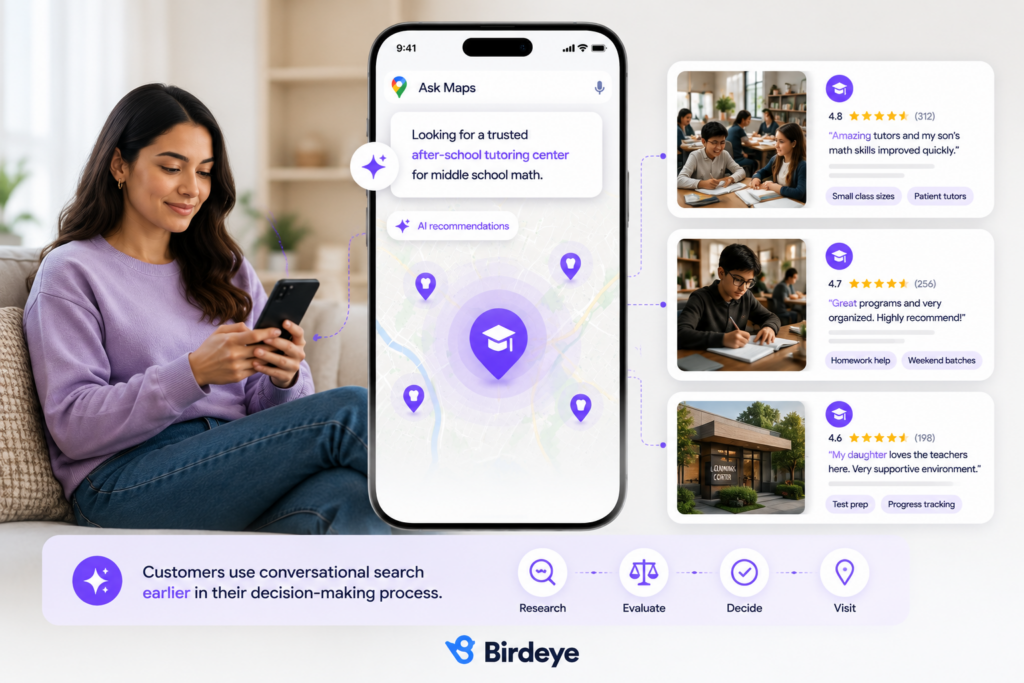
Ask Maps introduced a new way for users to discover businesses using natural language instead of keywords. As Google continues investing in conversational search experiences, consumers are increasingly using AI-powered recommendations earlier in their decision-making process.
Customers researching healthcare providers, restaurants, service businesses, or retail locations can use conversational search during the evaluation stage, not just when they are ready to visit.
Ask Maps is now connected to AI Mode in Google Search
One of the biggest developments is the growing connection between Google Maps and AI-powered search experiences.
Google has demonstrated how Maps data can support AI-generated planning and recommendation experiences. As a result, Google Business Profile data, reviews, photos, and attributes may influence visibility across multiple Google surfaces.
For brands, incomplete profiles, outdated hours, weak review signals, or missing attributes can affect discoverability well beyond the Maps app.
International expansion raises the stakes for global brands
Google continues expanding AI-powered discovery experiences across markets, although availability varies by region.
Multi-location brands should treat staggered rollouts as preparation time rather than waiting time. Businesses that maintain accurate listings, current photos, detailed reviews, and complete profiles today will be better positioned as conversational search expands.
Data quality directly influences AI recommendations
Like any AI-powered recommendation system, Ask Maps depends on the quality of the underlying business data. Outdated hours, incorrect services, missing attributes, incomplete profiles, or location changes can reduce the quality of recommendations and create poor customer experiences.
For enterprise brands managing hundreds or thousands of locations, listing accuracy is no longer just a local SEO task. It is becoming a core requirement for visibility in AI-driven local discovery.
Why is Ask Maps a bigger operational shift for multi-location brands?
For a single-location business, adapting to Ask Maps is relatively simple. There is one profile to update, one stream of reviews to manage, and one local market to watch.
Multi-location brands have a much bigger challenge. Every location has its own review history, competitive landscape, and data gaps. That means thinking less about overall brand presence and more about whether each individual location is ready to be found.
Some questions worth asking across your portfolio:
- Does each location have enough recent, detailed reviews that mention what makes it unique?
- Are services, hours, and attributes accurate across all branches with clear ownership?
- Do photos reflect the real experience at each location, including exterior, interior, and parking?
AI-driven discovery makes location-level gaps easier to see and easier for competitors to exploit. A strong national brand name helps, but a location with stale reviews or missing details can quietly drop off the radar even while others in the same brand are gaining share.
What should multi-location brands do to optimize for Ask Maps?
Here’s a practical checklist for multi-location brands adapting to Ask Maps:
1. Audit every Google Business Profile
Review hours, categories, phone numbers, website links, booking links, services, attributes, and photos across every location. Fix anything outdated, incomplete, or inconsistent. Ask Maps depends on strong underlying place data, so profile quality is now a bigger discovery lever, not just a maintenance task, especially when you manage hundreds or thousands of profiles.
2. Improve review recency and review detail
Reviews have become one of the richest sources of context for AI-powered discovery. When customers describe specific experiences, services, amenities, wait times, staff interactions, accessibility features, or location advantages, they give Google’s AI more information to match the business with real-world customer needs. Consistently generating detailed reviews across all locations helps improve visibility in conversational search experiences like Ask Maps.
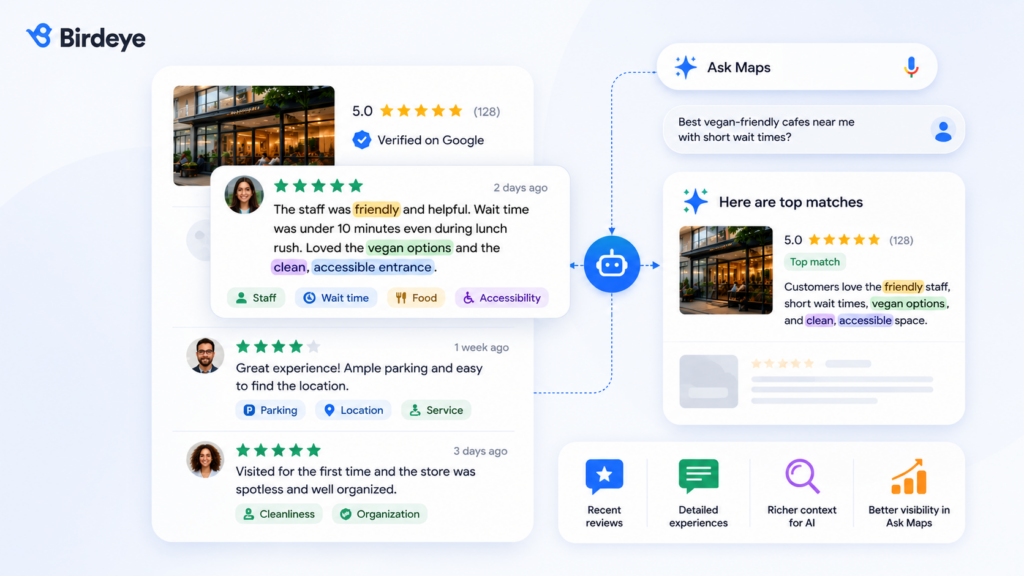
3. Identify the themes customers repeat most often
Pay attention to the words that keep appearing across your reviews. Those patterns tell you how customers experience a location and how Google interprets it in conversational discovery. Words like “convenient,” “family-friendly,” “fast,” “helpful”, or “easy to reach” aren’t just sentiment signals anymore – they’re the phrases that get a location matched to real‑world questions.
4. Add richer location details wherever possible
Fill in services, specialties, amenities, accessibility details, and photos for each location. The more complete the profile, the more confidently Google can match it to a specific, multi-constraint request.
5. Make every profile easy to act on
Ask Maps is built to move people from question to action fast. Make sure calls connect, directions are accurate, booking links work, and websites load. When discovery happens in seconds, a broken link ends the journey before it starts.
6. Monitor location-level performance trends as rollout expands
Track changes in calls, direction requests, and profile views by location as the feature rolls out. Locations with strong profiles may start pulling ahead, and that data tells you where to focus next.
Over time, sudden lifts or drops in these metrics — when you haven’t changed anything else — can act as a proxy signal for how often Ask Maps is recommending a given location.
For multi-location brands, the takeaway is simple: the easier you are for Google to understand, the easier you are to recommend.
FAQs about the new Ask Maps in Google Maps
Ask Maps is Google’s AI-powered conversational search experience inside Google Maps. Instead of searching with keywords, users can describe what they need in natural language and receive personalized recommendations generated from reviews, photos, business information, and location data.
Ask Maps increases the importance of accurate business information, detailed reviews, and complete Google Business Profiles. Businesses that provide stronger signals about their services and customer experience are more likely to appear in AI-generated recommendations.
Yes. Detailed and recent Google reviews can help Ask Maps understand what a location is like, including service quality, convenience, and customer experience.
Google Business Profiles provide much of the information Ask Maps uses to evaluate businesses, including categories, services, attributes, hours, photos, and contact information. Incomplete or outdated profiles can reduce visibility in AI-powered discovery experiences.
Multi-location brands should focus on maintaining accurate listings, generating detailed reviews, updating photos and attributes, monitoring location-level performance, and ensuring every Google Business Profile reflects the current customer experience.
How Birdeye helps you win in the AI era
As Google shifts toward conversational discovery experiences like Ask Maps, visibility depends on more than rankings. AI search experiences now evaluate reviews, listings, photos, customer sentiment, business attributes, and engagement signals to determine which locations to recommend.
Birdeye is the #1 agentic marketing platform built for multi-location brands that need trust, consistency, and control to manage 100–10,000+ locations. Powered by AI coworkers at every location, Birdeye consolidates signals from across your business, reasons with your brand and industry context, and takes action across reviews, listings, social media, messaging, surveys, reporting, and AI search visibility.
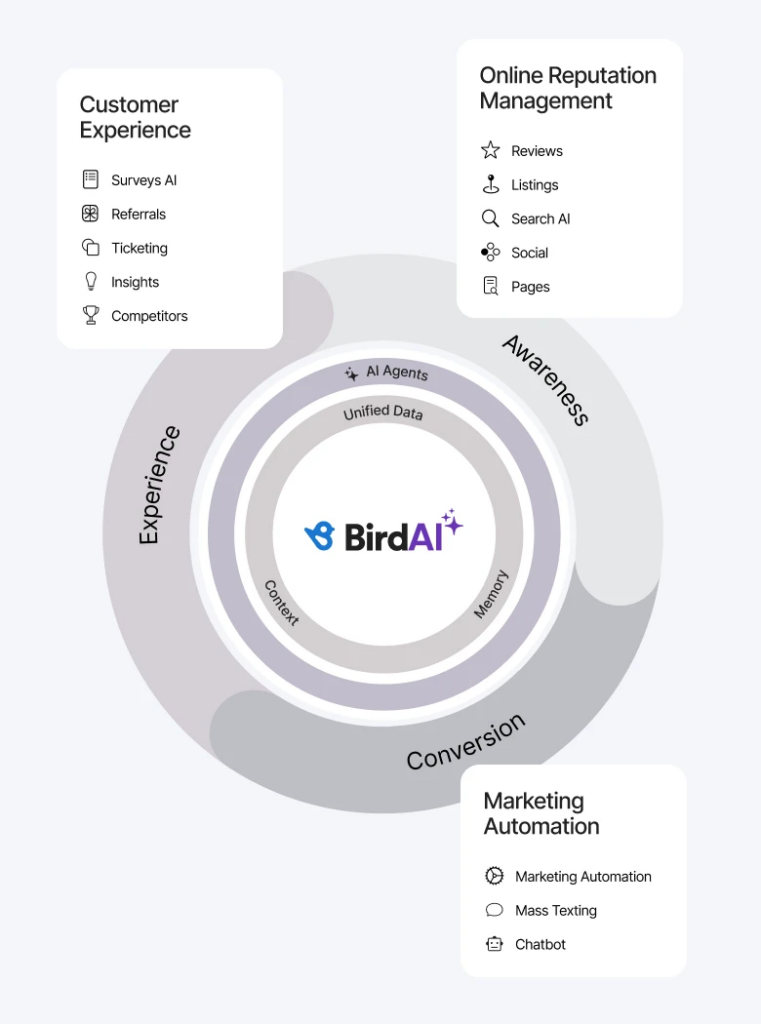
Here’s how Birdeye Agents helps multi-location brands stay visible:
- Review Generation Agent automatically requests reviews at the right moment and on the right platform, helping every location build the detailed, high-quality review content AI systems use to understand customer experiences.
- Review Response Agent drafts and publishes personalized, on-brand responses that strengthen customer trust while maintaining consistency across locations.
- Listings Optimization Agent continuously monitors and improves business information, helping ensure hours, services, attributes, photos, and location details remain accurate everywhere customers search.
- Search AI helps brands understand how they appear in AI-powered search experiences by tracking rankings, citations, sentiment, and visibility across platforms such as ChatGPT, Gemini, and Perplexity.
- Social Publishing Agent creates and schedules localized content at scale, while the Social Engagement Agent helps brands respond quickly to customer interactions across channels.
- Lead Generation Agent captures, qualifies, and routes leads around the clock, helping brands convert interest generated through AI-powered discovery into real customer conversations.
- Insights combines reputation, sentiment, and listing performance into a unified Birdeye Score, helping teams identify opportunities and prioritize improvements across locations.
- Reporting Agent explains performance changes, surfaces anomalies, and delivers actionable insights in plain language, enabling teams to understand what drives results without digging through dashboards.
Trusted by enterprise brands including Sutter Health, Sun Auto, Caesars Entertainment, and Aspen Dental, Birdeye covers 200+ review sites and more than 3,000 integrations.
As AI becomes the new gatekeeper of local discovery, the brands that win will be the ones that provide AI systems with the most accurate, complete, and trustworthy signals. Birdeye helps make that happen at scale.

About the Author

Shruti Dugar
Birdeye
Originally published