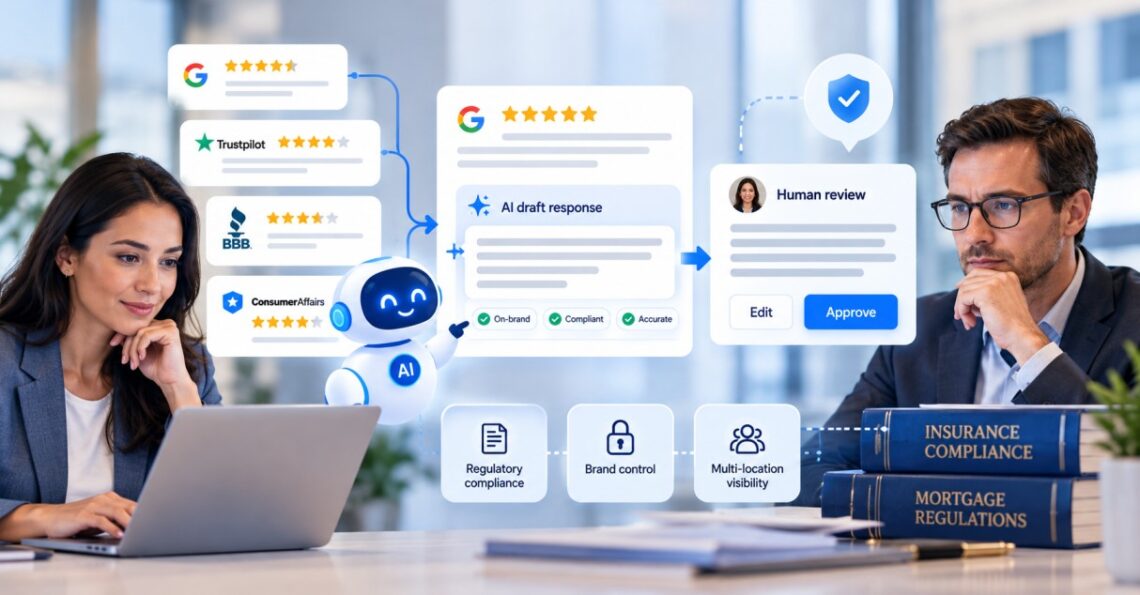
“You’re not going to let a brand-new employee just speak for your brand right off the bat,” said Corey Jones of Globe Life. “AI is gonna be the same way.” In insurance and mortgage lending, a reply that says the wrong thing carries legal weight, and if AI posts it, Corey said, “that’s still on us.”
Summary
At Birdeye View 2026, Kristyn Clark, VP of Media Relations and External Communications at PennyMac, and Corey Jones, SVP of Digital Marketing and Branding at Globe Life (17 million policyholders), explained how two regulated brands let AI answer reviews without losing control. They set a line for what AI handles alone, keep central visibility across every site and office, and stay ready to pivot when AI search changes which review sites matter. This post covers each of those and what AI does for them without replying to a customer.
How do they decide what AI can answer alone?
Corey described Globe Life as conservative. Insurance is about mitigating risk, so the team asks what can go right and what can go wrong. It is taking “baby steps” and using “training wheels,” letting AI prove itself on small tasks before widening its role.
PennyMac has a clear threshold. Four- and five-star reviews get an AI reply on its own. For one- to three-star reviews, the agent drafts the response and a person approves it before it posts. Kristyn said that keeps AI trusted while still saving time, since the reply is already written.
Voice is part of the control. PennyMac trained its agents on its brand guidance so they speak the way the company wants, and the team approves the messaging before it goes into responses. Kristyn also urged talking to legal teams about what AI should and should not do, and treating the tool like “a very, very smart intern” whose work still gets checked.
Both would tell a hesitant brand to start somewhere. Corey said waiting too long puts you far behind, and Kristyn put the goal this way: “The agent doesn’t replace the brand voice, but it scales it.”
How do they keep a view of every office and every site?
Control starts with seeing everything. At Globe Life, about 300 agency offices manage their own reputations, but the corporate team monitors them centrally. Birdeye pulls the reviews together, so the team can spot a problem on a site it does not normally watch. Before, someone had to notice and send an email.
Visibility also changed behavior. When Globe Life began monitoring about 10 years ago, Corey said, it surfaced discipline issues at some agencies. Once owners knew corporate was watching, they acted the way they wanted the public to see.
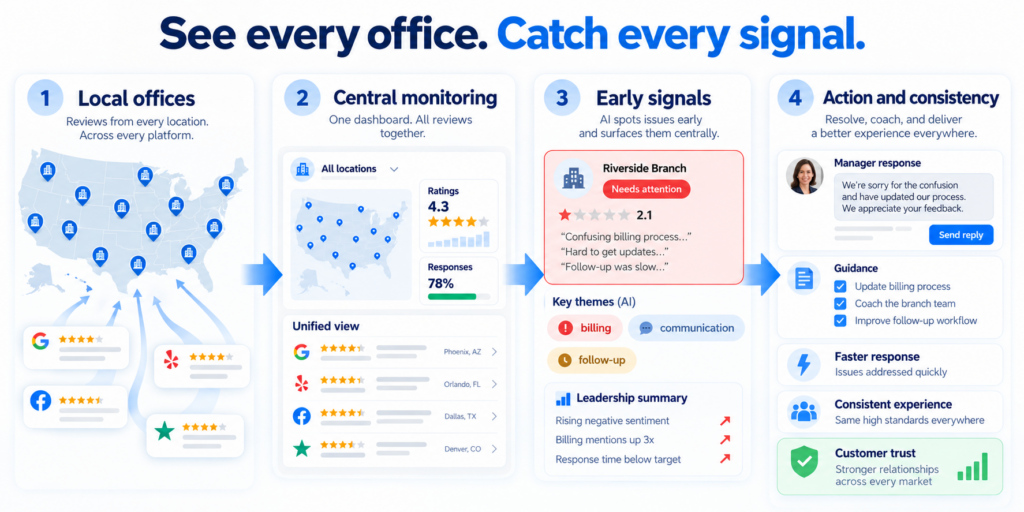
The stakes are high because of how people choose. Kristyn calls online reviews “the new word of mouth,” especially for a first home or a second mortgage. Listings can get a brand found, she said, but “reviews and responses are really what helps you get recommended,” and AI is reading both. PennyMac also uses reviews, positive and negative, as a listening channel for leadership, to see where the customer experience needs to shift.
What do they do when AI changes which sites matter?
Before AI search, Corey said, Globe Life’s reputation work looked like traditional SEO. Things changed slowly, and the team collected reviews on the sites Google was showing. Now it is “more of a game of whack-a-mole.” Sites such as Trustpilot or Consumer Affairs pop up because AI treats them as credible, and “we didn’t care about this previously” no longer holds.
Kristyn sees the same fragmentation. Ask Claude or Gemini about PennyMac’s refinancing, she said, and the answer draws on Trustpilot, the BBB, Wikipedia, and other review sites.
Both teams built the ability to move. PennyMac’s response rate has gone from around 15% to more than 95%, with a rating around 4.7, after starting with a capacity problem. Its platform lets the team focus on Wallet Hub one month, then point customers to a survey link for another initiative.
Globe Life split its review requests across Google, Trustpilot, and Consumer Affairs, directing volume where it was strategically needed. Some sites moved from one star to about three and a half within a few months. The next challenge, Corey said, is getting more volume. The goal is “control over what we look like” on the sites AI might use.
The moderator, Leigh Sansone of Birdeye, closed the session on the same point: the brands that win will not chase every site by hand. They will be set up to pivot quickly across every location.
What can AI do without ever replying to a customer?
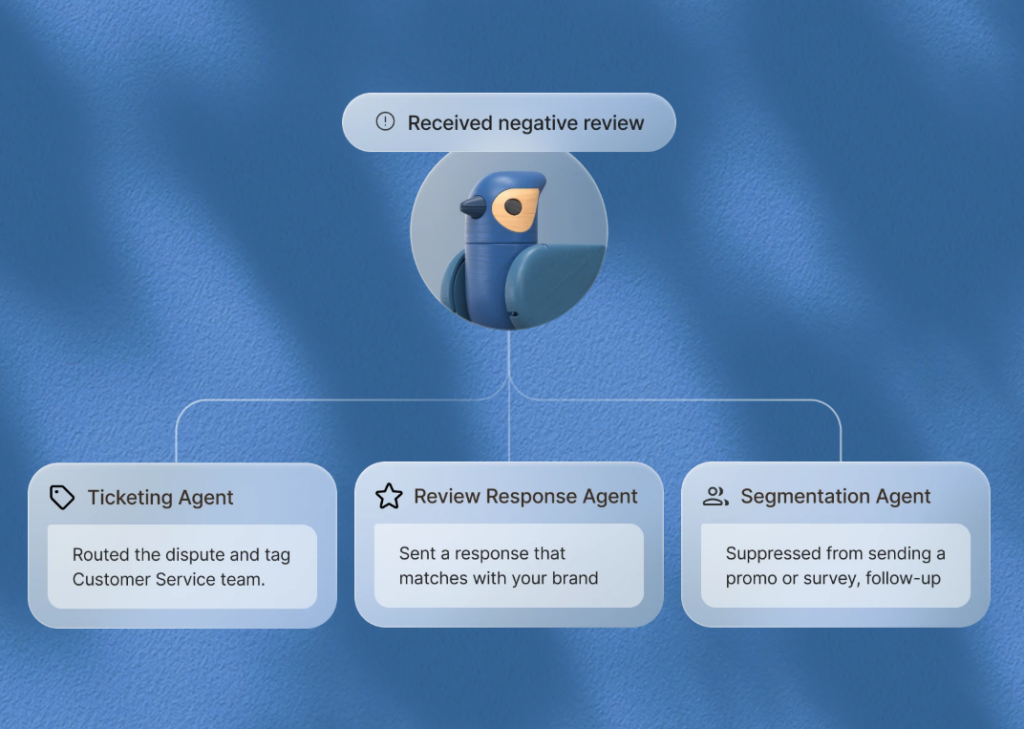
PennyMac runs three agents. A response agent drafts on-brand replies, a tagging agent categorizes reviews so leadership can see what is trending, and a ticketing agent routes complaints to the production or servicing team that can fix them. Kristyn said that replaces drafting another email by hand. She estimated the agents save about a day’s worth of work.
At Globe Life, 12,000 captive agents help generate more than 300 reviews a day, Corey said. Most executives on the daily email are not reading them. So the team sends a weekly AI summary by company and division, covering almost 2,000 reviews.
How does Birdeye help regulated brands keep control?
Birdeye Reviews, powered by Jay, the marketing AI coworker, is built for teams that need control as well as speed.
- Set the line: Draft replies in the brand’s voice and decide what posts automatically and what waits for a person.
- See every site: Bring ratings and reviews from different sites into one place, and send review requests where they matter this month.
- Tag and route: Categorize reviews, summarize trends, and send complaints to the right team.
Frequently asked questions
Not necessarily. PennyMac lets AI reply to four- and five-star reviews alone, and it reviews the drafts for one- to three-star reviews. Globe Life is more conservative. The right model depends on a company’s risk tolerance and legal guidance.
Yes. Globe Life uses AI summaries to make hundreds of reviews a day readable for executives. PennyMac uses agents to tag reviews and route complaints to the right team.
Corey said many people inside Globe Life fear it, but in his experience, when the company asks for a review, it is usually positive.
Ask two or three AI assistants about your brand and list every review site they pull from. Check your rating and response rate on each, then decide which reviews AI may answer alone and which need a person first.

About the Author

Somya Yesodharan
Originally published