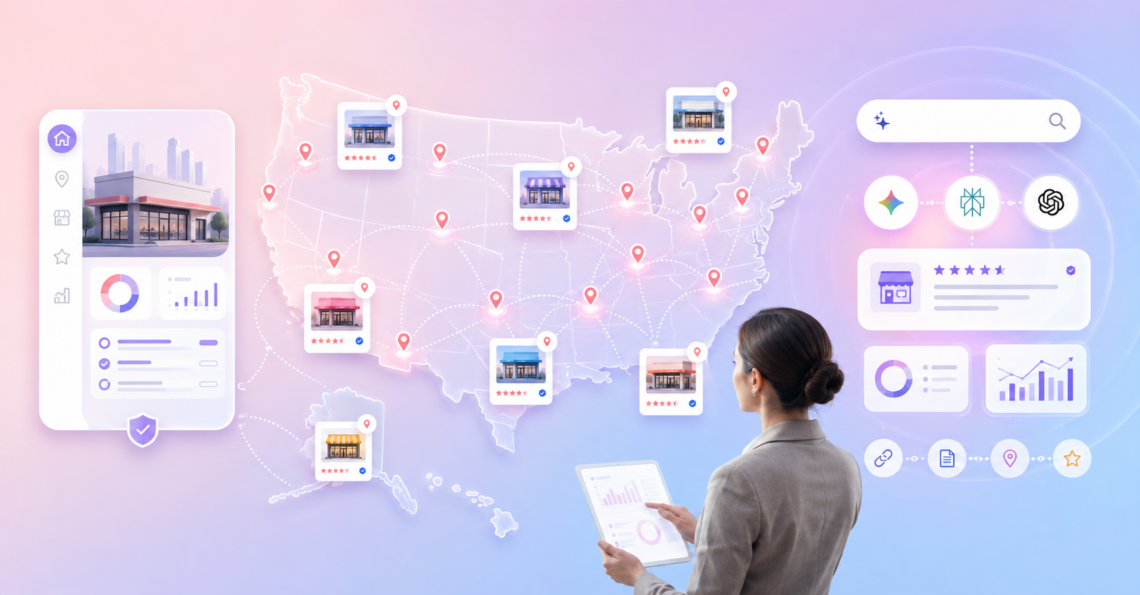
Answer Engine Optimization (AEO) for franchises means structuring your brand and every franchise location so AI search engines understand, trust, and cite the right location in local answers. These include Google AI Overviews, Gemini, ChatGPT, Perplexity, and other AI search experiences. When someone asks, “Where’s the best [brand] near me?”, the goal is for AI to surface the most relevant franchise location with accurate business details, strong reviews, and useful information that helps the customer choose you.
Summary
AI search is already changing how customers discover local businesses, and for franchises, AI search visibility is no longer a brand-level goal, it must be won consistently across every location. The Birdeye AEO Playbook for Multi-Location Brands provides a framework for tackling this challenge through five pillars: accurate business information, reputation strength, local content depth, AI visibility monitoring, and governance & operations.

Together, these pillars help franchises identify location-level gaps, prioritize what needs fixing, and build a consistent approach to AI visibility across their entire network.
Table of contents
- Summary
- What is AEO for franchises?
- Why does AI search matter for franchises in 2026?
- AEO vs. traditional SEO for franchise businesses
- The franchise AI visibility problem: Why scale makes AEO harder
- How to win AI visibility across every franchise location
- How to measure AI search visibility across locations
- How Birdeye helps franchises win AI visibility
- FAQs on AEO for Franchises
- Make every franchise location visible in AI search
What is AEO for franchises?
Answer engine optimization (AEO) for franchises is the practice of optimizing the parent brand and every franchise location so AI-powered search engines understand and recommend them for local, conversational queries.
- It spans Google AI Overviews, ChatGPT, Perplexity, Gemini, Bing Copilot, and voice assistants.
- AI engines use signals from location pages, business profiles, reviews, maps, and directories to build local recommendations.
- Unlike traditional SEO, which focuses on rankings and clicks, AEO focuses on being the source AI engines cite and recommend.
- Franchises have an advantage through their strong brand authority and local footprint, but each location needs consistent AI visibility signals to benefit from it.
Why does AI search matter for franchises in 2026?
AI search is changing local discovery, with customers increasingly using conversational queries to find, compare, and choose nearby businesses. Instead of scanning traditional search results, a customer might ask, “Which fitness franchise is open now near me?” or “What’s the best pediatric dentist near Dallas that takes Aetna?” AI engines would provide a direct recommendation based on factors such as location, services, hours, reviews, and other business information.
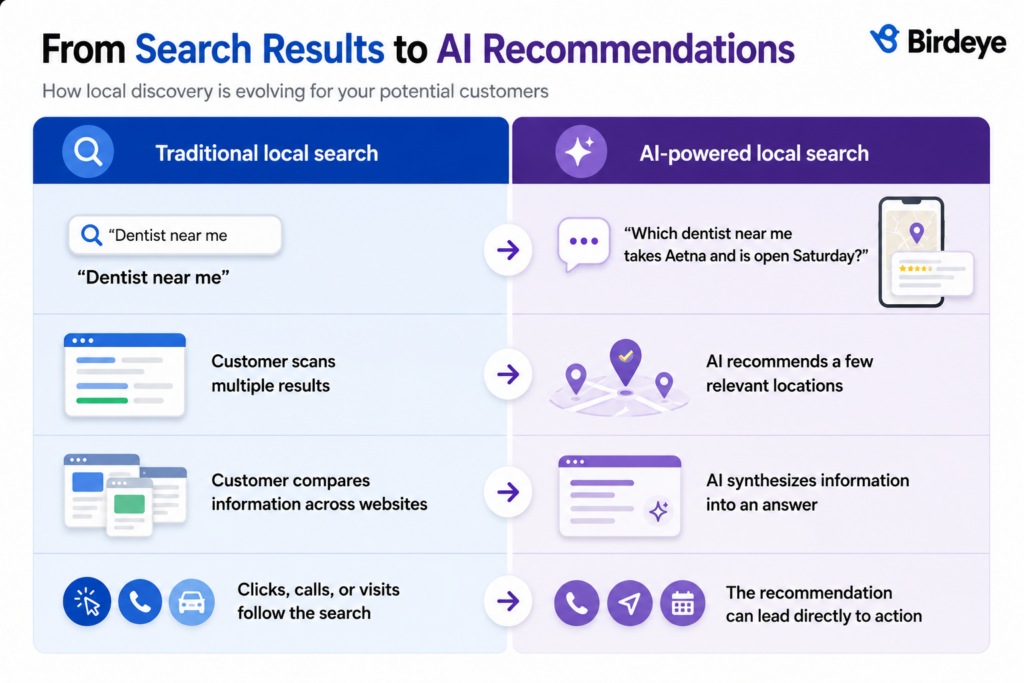
For franchises, these AI-driven recommendations influence discovery and action at the individual location level. If a location has incomplete information, inconsistent listings, outdated details, or weak local signals, AI platforms will have less reliable information to work with and rely on third-party sources instead.
For franchise brands, being visible in traditional search is no longer enough. Every location needs accurate, consistent signals that help AI engines understand and confidently recommend it.
AEO vs. traditional SEO for franchise businesses
Traditional SEO focuses on helping franchise pages rank in search results, while AEO focuses on making locations understandable, AI trustworthy, and citable in AI-generated answers. Both work together, but AEO changes what you optimize for, from rankings and clicks to question intent, entity clarity, citations, and answer accuracy.
Traditional rankings also don’t guarantee AI visibility. Only 17% of AI Overview citations come from pages ranking in the organic top 10, according to BrightEdge’s analysis. This shows that the factors influencing AI citations differ from traditional search rankings.
| Aspect | Traditional SEO | AEO for franchises |
| Intent | Targets keywords and search queries to improve rankings. | Targets conversational, question-based queries and direct answers. |
| Content | Builds topical depth through long-form pages and keyword-focused content. | Uses clear, answer-shaped content, FAQs, service details, and location-specific information. |
| Entities | The brand or website rank for relevant searches. | AI must understand whether the answer should feature the franchise brand or a specific location. |
| Authority | Relies heavily on rankings, backlinks, and traditional search signals. | Requires consistent business information, reviews, local content, and reliable third-party sources. |
| Measurement | Tracks rankings, organic traffic, and impressions. | Tracks AI citation presence, Share of Answer, owned-content citation share, and answer accuracy. |
💡 Did you know?

AEO doesn’t replace SEO, it builds on it. Crawlable location pages, strong technical foundations, and structured content still help AI platforms understand your locations. But ranking well in traditional search doesn’t guarantee AI visibility; AI platforms still cite third-party sources instead of your own pages. Learn more about how AEO and SEO differ in our AEO vs. SEO guide.
The franchise AI visibility problem: Why scale makes AEO harder
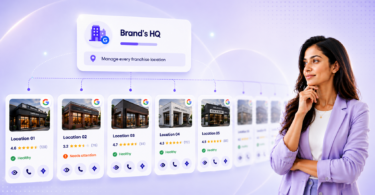
The biggest AEO challenge for franchises is coordinating consistent execution across every location. Each franchise location has its own business profiles, listings, reviews, local content, and operational information. As the network grows, managing these signals across locations becomes increasingly complex.
Where franchise AEO breaks down
- Thin local content: Repetitive location pages with little local detail give AI engines less useful information to cite and make it harder to differentiate one location from another.
- Fragmented information: Different hours, services, categories, or other business details across listings and directories create conflicting signals and reduce AI confidence in the location’s information.
- Weak review coverage: Sparse, outdated, or unanswered reviews leave trust signals uneven across locations and fail to reinforce the brand’s strengths.
- Operational gaps: Changes to hours, closures, services, or availability are not updated quickly across sources, increasing the risk of outdated information appearing in AI-generated answers.
- Distributed ownership: When SEO, listings, reputation, operations, and local teams work in separate workflows, issues take longer to identify, and fixes do not consistently reach every location or channel.
- Incomplete profiles: Missing categories, services, attributes, photos, booking links, or other location details give AI platforms less context to understand and recommend a franchise location.
For a franchise, AI visibility is only as strong as the signals available for each individual location.
How to win AI visibility across every franchise location
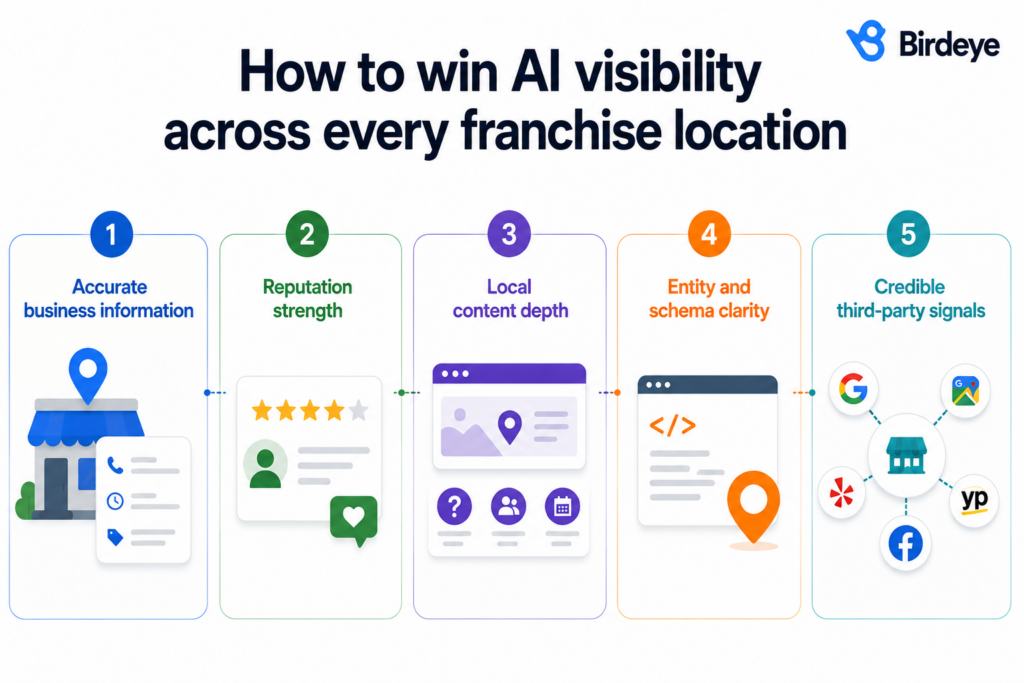
Winning AI visibility starts with giving AI engines consistent, useful, and location-specific signals they understand and cite. For franchise brands, that means strengthening five connected areas.
1. Keep business information accurate everywhere
Every franchise location should have a consistent name, address, phone number, hours, categories, services, and attributes across its website, business profiles, directories, and other major sources. A structured listings management strategy for franchises helps keep that information accurate and synchronized across the entire location network.
This consistency matters because AI platforms compare information across location pages, business profiles, directories, and other sources when forming an answer. Conflicting information forces AI engines to decide which source to trust, thereby trusting a less accurate third-party source.
2. Build a strong reputation at every location
Reviews give AI engines additional evidence about what customers experience at each location. Consistent review volume, recency, responses, ratings, and sentiment strengthen the reputation signals associated with a location.
Reviews also reveal what customers care about most. Recurring themes around services, staff, pricing, or availability inform location-page content, FAQs, and profile details.
3. Create local content that AI can cite
A franchise location page should offer meaningful local information, answer the questions customers ask before choosing, and give AI engines useful content to cite. The Birdeye AEO Playbook for multi-location brands recommends building location pages around:
- Accuracy
- Local relevance
- Customer clarity
- Trust signals, and
- Extractability
That means including location-specific details such as provider or staff information, areas served, services, practical FAQs, appointment options, and relevant customer proof, rather than simply swapping the city name on a templated page.
4. Make every location easy to understand
Clear entities and structured data help AI engines distinguish the franchise brand from individual locations and understand what each location offers. For franchise brands, Birdeye can serve as a single source of truth for location data, helping teams keep business information accurate and distribute consistent details across every location and key directory.
Use appropriate LocalBusiness schema for location entities and FAQ schema where the page genuinely contains eligible FAQs. The website, listings, business information, and structured data should all reinforce the same location entity, giving AI engines clearer signals about each location and what it offers.
5. Strengthen third-party trust signals
AI engines don’t rely only on a franchise’s website when forming an answer. They draw from business profiles, listings, reviews, directories, aggregators, and other third-party sources.
That makes consistency across the broader local ecosystem important. Your location should be represented accurately not only on owned pages, but also across the sources AI engines use to verify it.
How to measure AI search visibility across locations
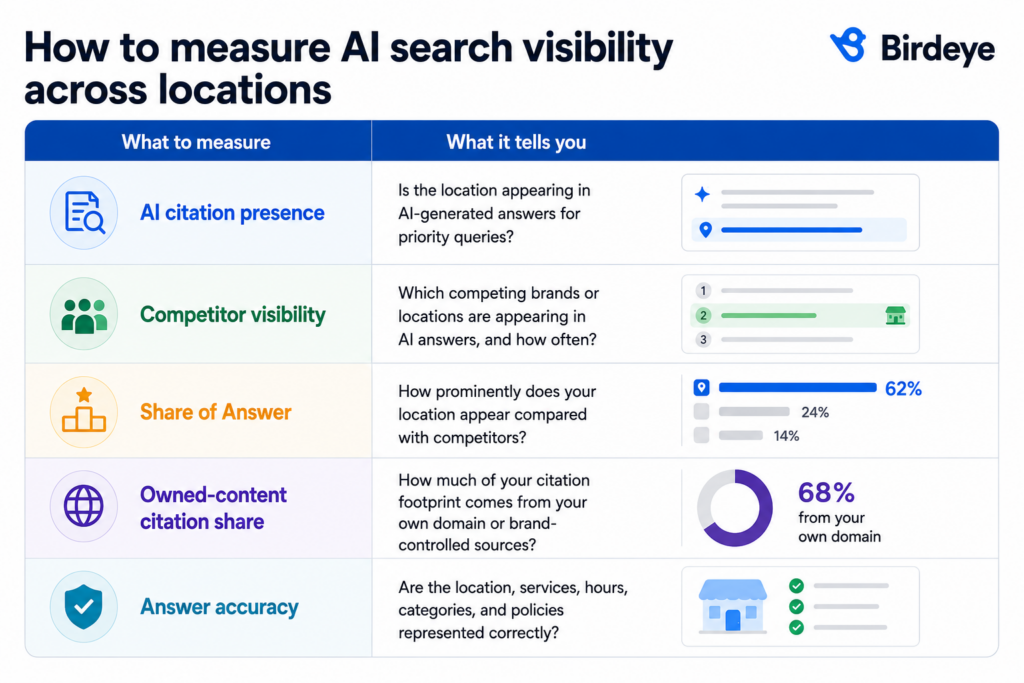
Measuring AEO means tracking whether each location appears in AI-generated answers, how prominently it appears, what sources AI engines cite, and whether the information they provide is accurate.
Birdeye’s State of AI Search 2026 report found that 22% of brands had high owned-content citation share, 31.7% were mid-tier, 24.4% were low-tier, and 22% had no owned-domain citations at all. For brands in that last group, measuring owned-content citation share is critical to identifying where AI engines are overlooking the brand’s own sources and where location-level visibility needs to improve.
Track visibility at the location level
For a franchise network, measuring brand-level visibility isn’t enough. For example, a dental franchise might appear in AI answers for “best dentists near me” in Dallas, while its Austin locations do not appear at all, or are recommended for different queries, such as “pediatric dentist near me”.
Tracking visibility at the prompt level shows not only where each location appears, but also which AI engine cited it and which source influenced the answer. Tracking visibility by location, market, service, category, prompt, engine, and citation source helps franchise teams uncover visibility gaps and understand what is driving discovery across AI search.
Measure how AI engines represent your locations
Appearing in an AI answer is only one part of visibility. Franchise teams also need to understand how each location is represented: whether it is cited, how often it appears compared with competitors, which sources AI engines rely on, and whether the information they surface is accurate.
Measuring these signals helps reveal whether AI engines consistently present each location with the right information and where inaccurate, weak, or competitor-led answers may limit visibility.
Monitor the sources and engines shaping your visibility
Knowing a location was cited is only half the picture; you also need to know which AI engines cited it, which sources they relied on, and whether the information was accurate. For example, a dental franchise that appears in ChatGPT for “best dentist near me” but not appear for the same query in Google AI Overviews or Perplexity. Tracking these differences helps franchise teams identify visibility gaps, influential sources, and competitor presence across locations.
Go deeper: See why being visible at the brand level doesn’t always mean being visible at every location. Explore why in The Location Blind Spot in AI Search report.
How Birdeye helps franchises win AI visibility
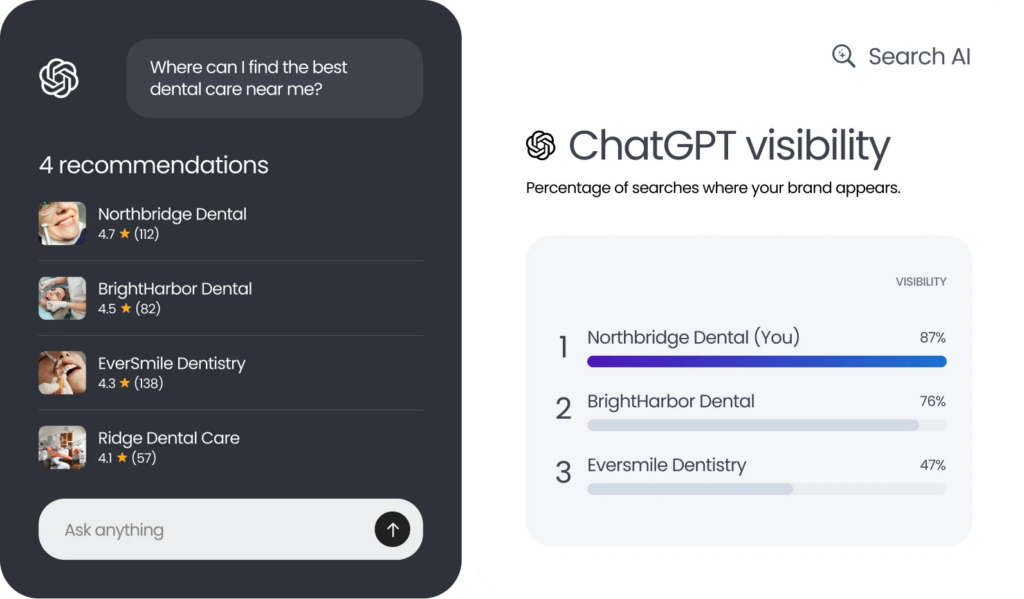
Birdeye AI Search is a purpose-built AI search visibility platform for multi-location brands that helps track how you surface across every major AI engine and identify and fix what is holding each location back. It enables franchise brands to monitor, understand, and improve AI search visibility across every location.
Birdeye measures the actual answers AI engines return to real users, not just API samples. It shows which locations appear, how they are represented, which sources AI engines cite, and where competitors are winning.
More importantly, Birdeye is the only AI visibility platform that goes beyond tracking. It connects AI visibility insights directly to the cited sources that influence those answers, including listings, reviews, and local pages, so franchise teams can fix weak or inaccurate signals across every location. Other tracking tools can show you where visibility breaks down; Birdeye helps close the loop between finding the problem and fixing it.
See how every location appears in AI search
Birdeye AI Search tracks how often and where your franchise locations appear in AI-generated answers across platforms such as Google AI Overviews, AI mode, Gemini, Claude, Perplexity, ChatGPT, and Grok. This helps franchise teams to monitor visibility by location, market, prompt, and competitor.
Birdeye also surfaces the real conversational prompts customers ask for each location, helping teams discover visibility opportunities beyond the prompts they already track. This makes it easier to see which locations are being recommended, what customers are asking, and where gaps exist across AI search.
- AI search visibility tracking: Monitors how your brand and individual locations feature in AI-generated responses.
- Birdeye AI Visibility Score (0–100): Rates visibility on a 0–100 scale for both the overall brand and each location across supported AI answer engines. This enables performance benchmarking, location-to-location comparisons, and trend tracking.
- AI Share of Answers: Calculates the share of tracked AI-generated responses that recommend your brand versus competitors, giving teams clarity on competitive visibility across prompts, markets, and locations.
Strengthen the signals behind AI visibility
Visibility tracking is only useful when franchise teams can act on what they find. Birdeye connects AI search insights with Birdeye Listings and Birdeye Reviews, helping brands keep location information accurate, strengthen review signals, and improve the content AI engines use to understand each location.
- Citation intelligence: Pinpoints the websites, directories, review sites, and local pages that AI engines depend on when generating answers. Franchise teams can also see which AI agents crawled each location’s pages, helping them understand both the sources influencing recommendations and how AI systems are discovering their content.
- Sentiment analysis: Reveals how AI platforms describe your brand, highlighting strengths, weaknesses, and themes.
- Accuracy monitoring: Detects inconsistencies or errors in business information across locations.
Manage AEO at franchise scale
For brands managing 100-10,000+ locations, the advantage is having these workflows connected rather than managing AI visibility, listings, and reviews separately. Birdeye gives franchise teams a location-level view of AI visibility and the signals that shape it, so they identify gaps and prioritize action through AI agents.
Jay, Birdeye’s AI marketing coworker, employs these agents across Search AI, reviews, and listings, helping teams move from insight to action across every location.
- Agent-led recommendations: Ties visibility gaps to suggested actions, such as updating listings, collecting reviews, and refining website content.
- Content generation agents: These agents create and publish AEO-optimized content like blog posts and FAQs to enhance your franchise’s visibility on AI platforms.
Real results: How Sutter Health achieved an 80%+ Birdeye AI visibility score across 4,000+ practices and providers
The brand: Sutter Health is a large nonprofit health system serving communities across Northern California, with 4,000+ practices and providers.
The challenge: Managing listings, reviews, and AI visibility across thousands of locations was difficult to scale, with manual processes limiting efficiency and visibility.
The solution: Sutter Health used Birdeye to:
- Manage listings: Keep location and provider information accurate across major platforms and healthcare directories.
- Strengthen reputation: Automate review generation and response workflows.
- Monitor AI visibility: Track how Sutter Health appeared across ChatGPT, Gemini, and Perplexity and benchmark visibility against other health systems.
The results (over 4 months):
- 81% Birdeye AI Visibility Score
- 35.4K new Google reviews
- 120% increase in monthly reviews
- 1.3M direction clicks
FAQs on AEO for Franchises
Traditional SEO focuses on helping franchise pages rank in search results, while AEO focuses on surfacing and citing locations in AI-generated answers. AEO places greater emphasis on conversational queries, entity clarity, citations, and answer accuracy alongside the traditional SEO foundations that help AI engines discover your locations.
Franchise locations can improve their chances of being cited by maintaining accurate business information, strong reviews, useful local content, and clear location entities. Consistent information across location pages, business profiles, directories, and other trusted sources gives AI engines reliable signals to use when generating local answers.
Schema helps AI engines understand what a franchise location is and the information associated with it, but it does not guarantee an AI citation. Using appropriate markup, such as LocalBusiness schema and eligible FAQ schema reinforces the relationship between the location, its services, and its content.
Birdeye AI Search helps franchise brands track and improve AI visibility across ChatGPT, Gemini, Google AI Overviews, Claude, AI mode, Perplexity, and Grok. It provides location-level visibility and citation insights, helping teams compare locations and competitors across AI search platforms
Track AI visibility by location, query, market, and AI platform rather than relying only on brand-level metrics. Key measures include AI citation presence, competitor visibility, Share of Answer, owned-content citation share, and answer accuracy.
Make every franchise location visible in AI search
AEO is still emerging, but AI is already changing how people discover local businesses. For franchise brands, the opportunity is to understand where each location appears in AI search and act on the gaps.
Birdeye AI Search helps multi-location brands turn AI visibility insights into action across their locations. As AI becomes a larger part of local discovery, the brands that start building this capability now gain a meaningful competitive advantage.
Schedule a Birdeye demo to find out where your franchise locations appear across AI search and where visibility gaps exist.
About the Author

Somya Yesodharan
Originally published