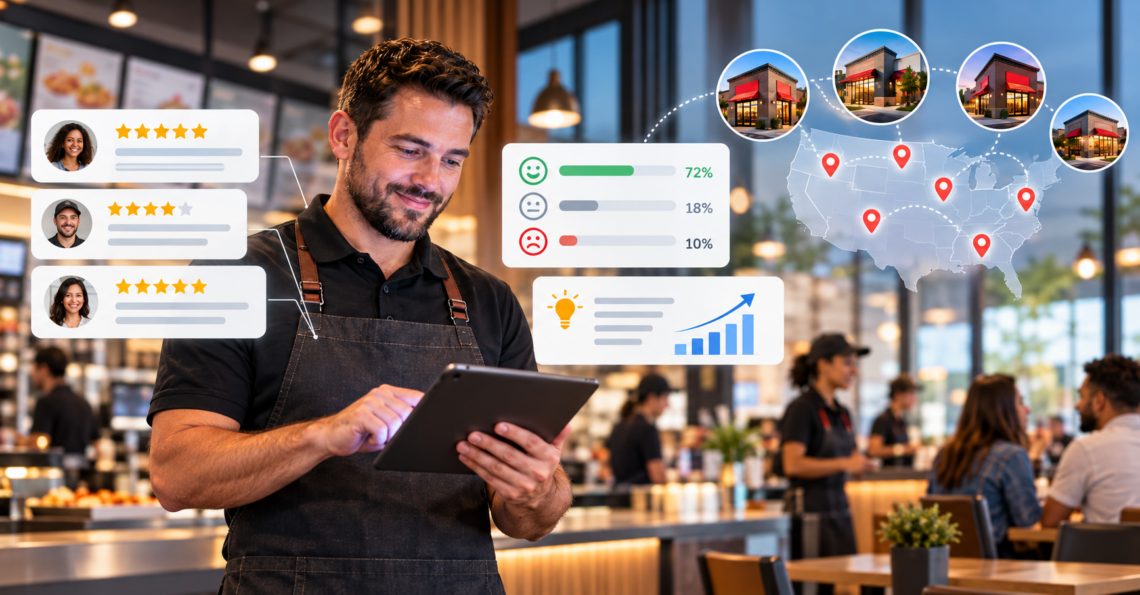
“Good reviews and good sentiment have an ROI,” said Jim Bitticks, CEO of Dave’s Hot Chicken. At Dave’s, he said, locations averaging 4.6 stars or higher sell about 10% more. That is why a brand that grew from four locations to about 475 treats guest feedback as an operating tool.
Summary
At Birdeye View 2026, Jim Bitticks, CEO of Dave’s Hot Chicken, joined Jim Mizes, a restaurant industry veteran who worked alongside him to grow Blaze Pizza, to discuss how guest feedback and operational consistency drive franchise growth. They explained how Dave’s grew to about 80 franchise companies and about 700 locations, with more in sight for next year. Their approach is to read guest feedback closely, keep operations simple, hold every franchisee to the same standard, and make sure unit economics work before scaling. This post covers each of those, and where AI can help turn feedback into action.
Why does Dave’s Hot Chicken treat guest sentiment as a business metric?
Bitticks joined Dave’s in 2020 as president and chief operating officer, when the brand had four restaurants open. He brought in Birdeye almost immediately because, in his view, guest sentiment is the best measure of how well a restaurant operates. Mizes had made the same call at Blaze Pizza around 2014. Bitticks said that helping franchisees reach high sentiment has been key to the brand’s growth.
The 4.6-star pattern gives that view weight. By Bitticks’s account, it is Dave’s own observation, not a published study, but he uses it as a persuasion tool. Once franchisees see the return, it is easier to get them to put real effort into reviews.
Mizes has believed this for decades. In 1990, he said he had managers at Taco Bell anonymously survey guests at neighboring stores because no feedback system existed. His zone moved from last among 10 to second in 18 months “because we had data.”
What can a stack of reviews tell a restaurant?
For a long time, Bitticks said, sentiment work depended on managers reading their own reviews, negative ones especially, and working out the root cause themselves.
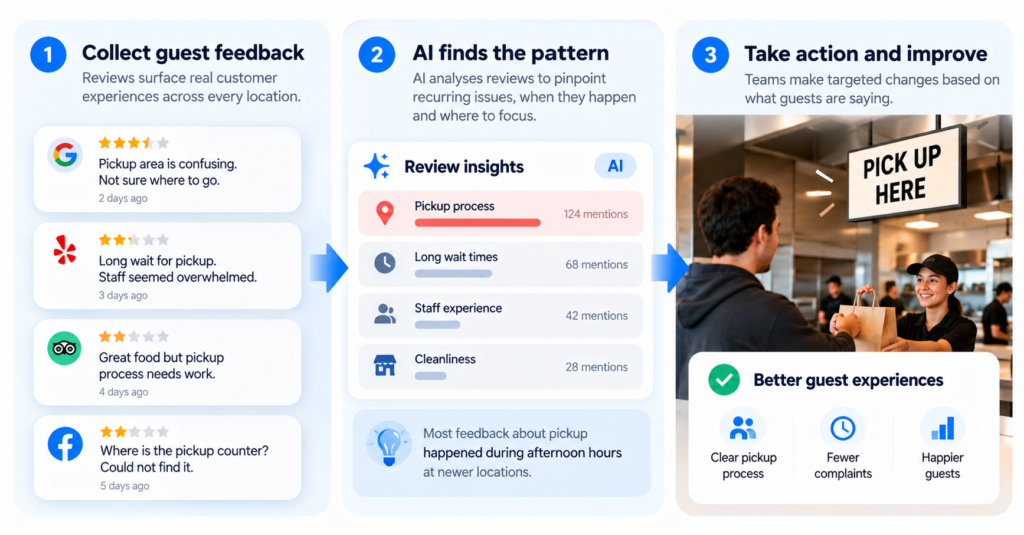
One newer Dave’s restaurant was taking a beating in its reviews. After reading a couple hundred of them with the franchisee and the team, the pattern was clear: pickup was a mess. Guests could not tell where to go in the crowd, and nothing marked the pickup area. The team hung a sign over it and trained staff to call out for pickup customers. The fix came straight from what guests wrote.
What should AI do with all that feedback?
Feedback now arrives daily and can be split by day part, Mizes said. The next step is turning it into direction. Instead of a chart, a general manager hears that over the last five days complaints have clustered in the afternoon shift and concern order accuracy, so that is where to work with the team. Over time, he added, it could point to which team members need support.
Mizes put it bluntly: restaurants do not need more charts or more data. Bitticks added, “What we need is actionable information.”
Bitticks sees that promise at two levels. For the brand, a system could scan thousands of reviews and flag a recurring problem. For one restaurant, it could tell an owner what to do more of to lift sentiment. He is candid that this is mostly still ahead. AI at the restaurant level is not very developed yet, he said, and many tools labeled AI-powered are a watered-down version.
How do 80 franchise operators deliver one experience?
Dave’s has about 80 franchise companies, Bitticks said. Each has a record of success and ideas of its own. Two things hold the system together.
The first is simplicity: A lesson from Blaze, Bitticks said, was to do the work up front so operations are basic enough that consistency is easier to reach. That starts with deciding what the brand is supposed to be, then training people to deliver it.
The second is a clear split of responsibility: As per Mizes, the franchisor owes the training, tools, systems, marketing, and new products, and it tests new ideas to prove a return before rolling them out. Franchisees and their managers execute the standards.
Bitticks put it as a script:
“The brand writes it and sets the scene, and the operators act it out.”
What do franchise brands learn too late?
Accountability, Bitticks said. Franchise systems fail when they do not push franchisees to perform at a high level, and that is hard when you like the people involved. He admits he tends to give the benefit of the doubt, so he relies on his right-hand, Juan Lopez, to push hard on standards. If he could start over, he said, he would require more from franchisees from the beginning, because performing franchisees make a better brand.
Mizes added a lesson about timing. A brand should not begin to scale until its unit-level economics consistently deliver a return on invested capital when executed well.
Bitticks closed by recalling a line Mizes used at Blaze Pizza:
“If you want to go fast, go alone. If you want to go far, go together.”
How does Birdeye help restaurant brands act on guest feedback?
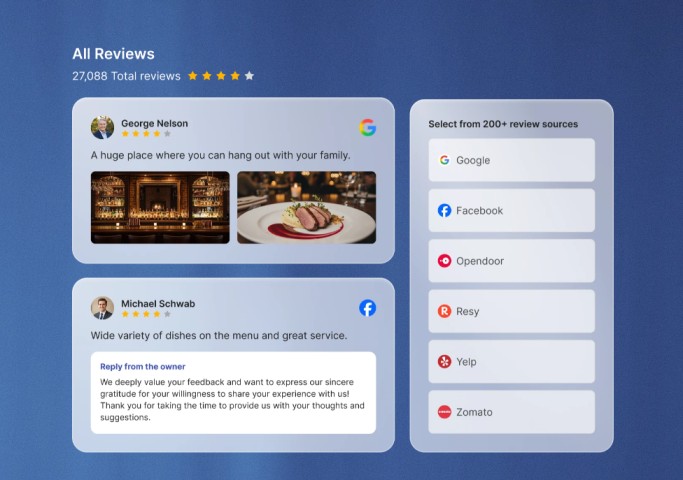
Dave’s is a Birdeye customer, and the lesson from its story is that feedback only pays off when someone acts on it. Birdeye Reviews, powered by Jay, the marketing AI coworker, helps multi-location teams do that.
- See the pattern: Analyze sentiment and recurring themes across locations and compare location-level performance.
- Respond in the brand’s voice: Reply to reviews at scale without losing the brand’s tone.
- Act on the signal: When feedback points to a deeper issue, Jay can coordinate the agents that help address it.
Frequently asked questions
Mizes said that at one company he works with, a real estate site report that took hours now takes five to 10 minutes. He also noted that technology cut a two-week manager schedule from four to six hours to four to six minutes, and he expects AI to improve on that. Bitticks said Dave’s finance team uses AI to pull together reports, such as new product performance.
Mizes said it is jumping in because everyone expects AI to make a difference. Brands should name the specific problem they need solved, then confirm a provider can solve that problem, not one it has solved for someone else.
Only once the unit-level economics work. Mizes said that if a restaurant doesn’t consistently deliver a return on invested capital, scaling will struggle, and a brand shouldn’t begin until it knows it can.
Read the last 200 reviews at your lowest-rated location and find the one operational problem guests keep naming. Then check whether the operator knows the standard that fixes it, and whether anyone is holding them to it.

About the Author

Somya Yesodharan
Originally published