Dental industry trends no longer just influence the market. They now determine who gets discovered, who gets chosen, and who gets left behind. If your dental organization still grows mainly through word-of-mouth, manual marketing, or disconnected systems, you are already at a disadvantage.
Summary:
Today’s dental industry is being reshaped by patient behavior, digital trust, AI-driven discovery, and experience-led decision-making. Patients no longer choose practices solely on proximity. They choose based on visibility, reputation, speed, clarity, and confidence.

This shift is forcing CMOs, CEOs, and growth leaders to rethink how patient acquisition, retention, and revenue actually work in modern dentistry. If you are searching for dental industry trends, you are not looking for surface-level updates. You are looking for strategic signals.

This blog breaks down what is changing, why it matters to growth, and how leading dental organizations are responding.
Table of contents
What is driving the shift in the dental industry and dental market today
Before we break down the most important dental industry trends, it is critical to understand what is actually forcing this change. These are not surface-level shifts. They are structural forces redefining how dental practices attract patients, compete, and scale.
Patients now behave like consumers when choosing dental care
Dental patients no longer choose providers solely on proximity. They evaluate dentists the same way they assess any service brand. Search results, reviews, response speed, online presence, and peer validation all shape perception before the first call. This shift has turned patient acquisition into a pre-visit trust evaluation, not a clinical decision.
Online reviews now influence nearly every healthcare decision. In 2023, 94% of healthcare patients used online reviews to evaluate providers, and Google hosted 94% of all healthcare-related reviews. Source: State of Online Reviews 2024
Patient expectations for dental care have fundamentally changed
Speed, convenience, clarity, and emotional comfort now directly influence whether a dental visit even happens. Long hold times, delayed follow-ups, unclear pricing, and poor communication now cost practices real revenue. Talent burnout quietly worsens this problem. When teams are stretched thin, experience degrades long before leadership sees the numbers drop.
Competition across dental practices and group practices is intensifying
More dental offices, more group practices, and more location-based competition are fighting for the same patient demand. Marketing costs are rising. Differentiation is harder. Standing out now depends less on offering services and more on consistently delivering trust and experience across every location and channel.
Data, automation, and artificial intelligence are no longer optional
Patient feedback, scheduling behavior, reputation data, and engagement signals are now core growth inputs. Practices that rely on manual workflows and disconnected tools cannot respond at market speed. The dental industry is quietly dividing into organizations that run on insight and those that run on instinct.
These forces explain why the market is shifting. Below are the five most important dental industry trends shaping growth, patient acquisition, and revenue across the dental market right now, starting with the most commercially critical shift.
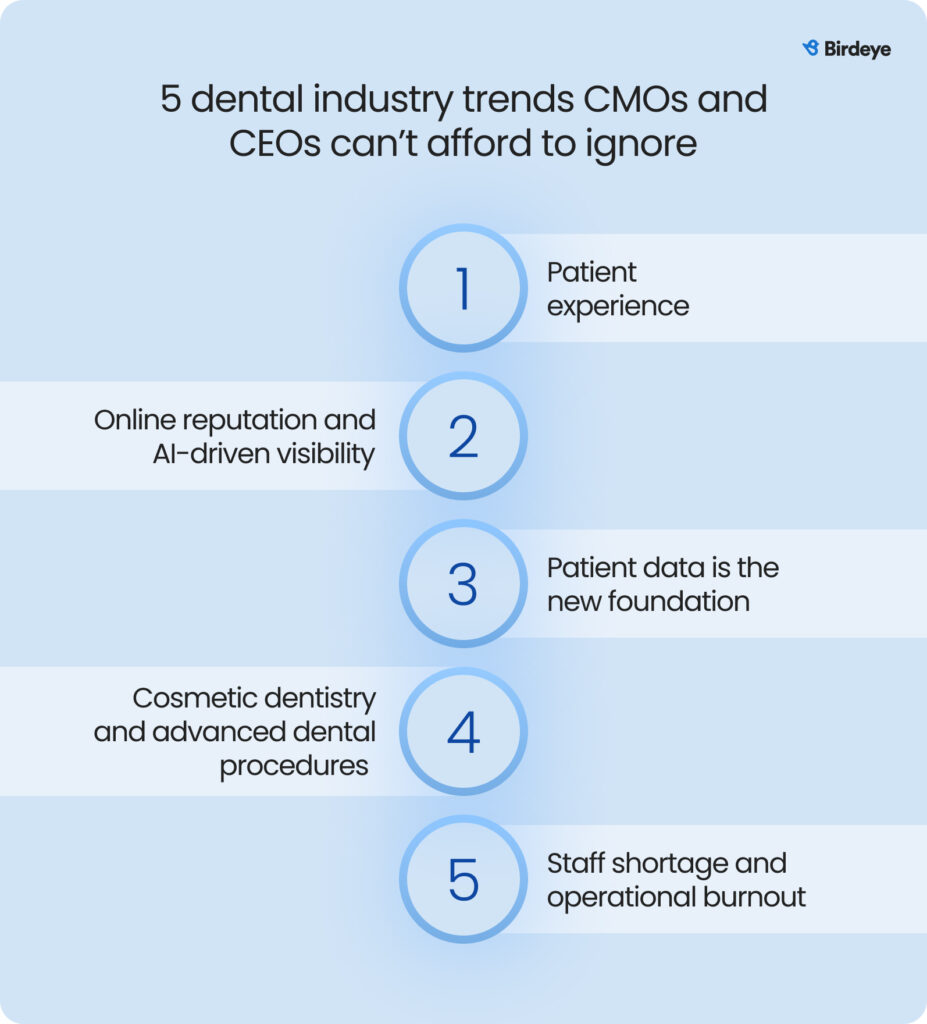
Top 5 dental industry trends for 2026
1. Patient experience is now a primary driver of growth
This is the most commercially important shift in today’s dental industry. Patient experience is no longer a “service quality” metric. It now directly controls acquisition efficiency, case acceptance, retention, reviews, and long-term brand equity for dental practices.
Why patient satisfaction now determines whether dental practices grow or stall
Growth used to be driven by location, referrals, and provider reputation. Today, it is driven by how patients feel at every step of the journey. From the first website visit to post-treatment follow-up, every interaction shapes whether a patient returns, refers, or leaves a public review. High patient satisfaction now compounds revenue. Poor satisfaction compounds churn.
How dental anxiety quietly suppresses demand and increases cancellations
Fear remains one of the biggest invisible barriers to consistent oral health care. When practices fail to address anxiety through communication, clarity, and comfort, patients delay visits, cancel appointments, or avoid elective procedures entirely. The result is lost production, lower lifetime value, and unstable schedules that hurt both revenue and staff morale.
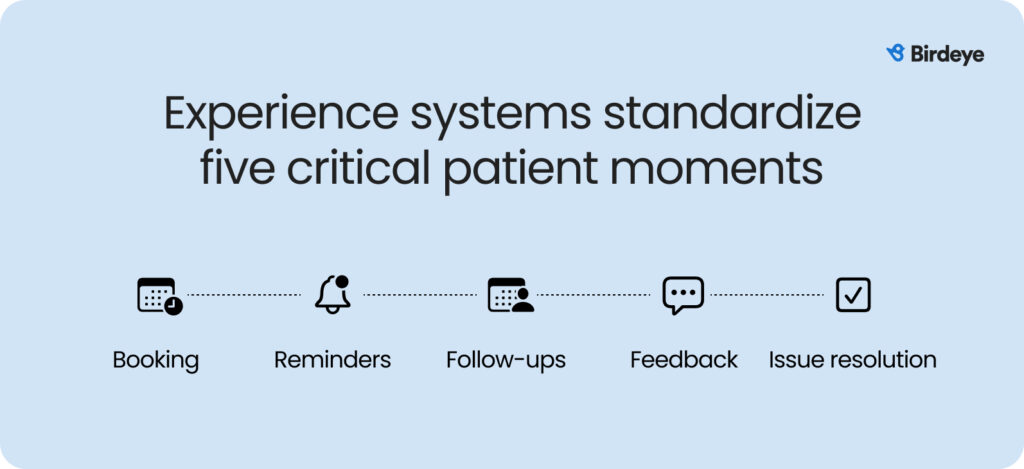
Experience systems are replacing traditional dental marketing campaigns
Ads and promotions can attract attention. They cannot fix a broken experience. Leading dental organizations now invest in structured experience systems instead of one-off marketing pushes.
What this trend means for marketing and operations leaders in dental organizations
Patient experience is no longer owned by one department. Marketing drives expectations. Operations delivers on them. When those two drift apart, acquisition costs rise while conversion drops. The most effective dental organizations now manage patient experience with the same discipline they apply to revenue operations.
But experience alone does not create demand. Patients must first discover a practice, assess its credibility, and decide whether it is even worth contacting. That is where visibility and reputation now determine who gets chosen.
2. Online reputation and AI-driven visibility are redefining patient acquisition
This is one of the fastest-moving trends in the dental industry today. Visibility no longer means just ranking on Google. It now includes how dental practices appear across reviews, maps, voice search, and AI-generated answers.
For many dental patients, the decision to shortlist a dental practice is made digitally before the first dental visit.
Dental patients now trust online reviews as much as referrals
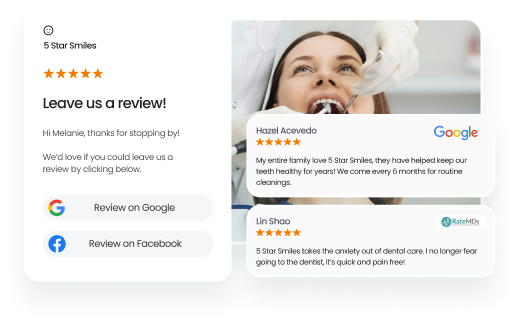
What used to be private word-of-mouth is now public and permanent. Star ratings, review volume, sentiment, and recency directly influence whether patients even consider a dental practice.
Google now accounts for 81% of all online reviews, up from 79% the year prior — making it the dominant platform controlling visibility for dental practices, as per Birdeye’s State of Online Reviews 2025.
This shift affects private practices, group practices, and dental service organizations equally. Strong patient satisfaction now fuels discoverability across the dental market.
Dental industry visibility inside AI answers, not just Google rankings
Patients are increasingly asking AI assistants where to find dental care, cosmetic dentistry, or dental implants near them. Practices that only optimize for traditional search are already behind. The next phase of dental marketing trends is about being visible inside AI-generated recommendations and conversational search results.
Why inconsistent listings and slow responses damage patient trust
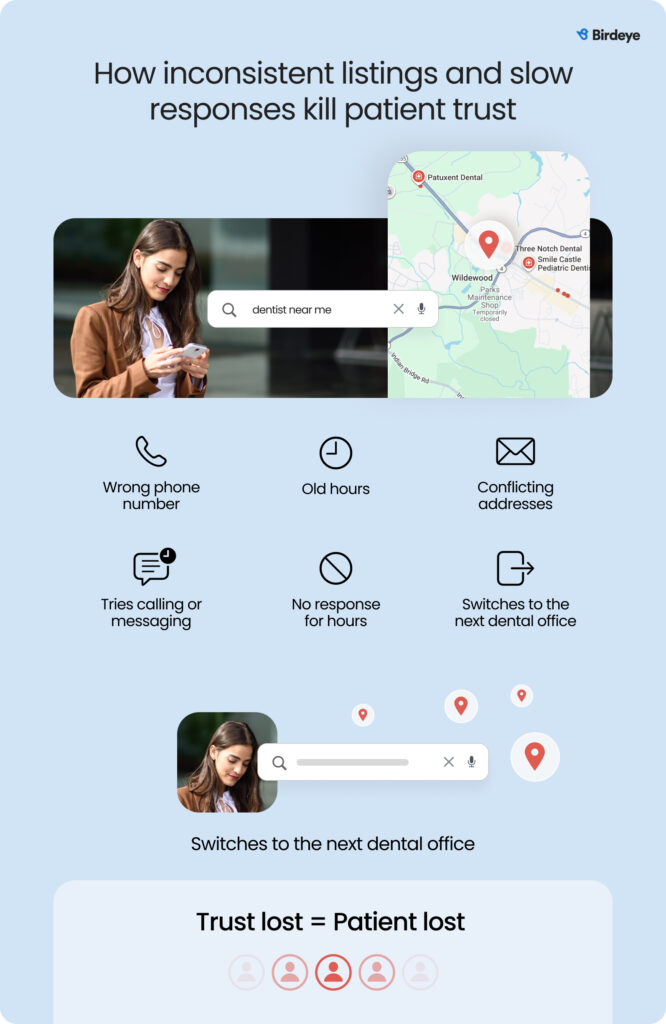
When dental offices display different phone numbers, hours, or locations across platforms, trust erodes instantly. Add slow response times to calls, messages, or reviews, and many dental patients simply move on to the next option. In a market with many dental practices, speed and accuracy are not nice-to-haves. They directly influence demand.
High-value dental treatments depend heavily on digital trust
Elective services like cosmetic dentistry and dental implants amplify this effect. Patients researching advanced dental procedures compare reviews, before-and-after proof, communication quality, and transparency long before they commit. Digital trust now determines whether premium dental treatments convert or stall.
Once patients choose a practice, the next growth constraint is no longer visibility. It is decision quality. This is where patient data and artificial intelligence begin to reshape how dental organizations operate.
3. Patient data is the new foundation of modern dental growth
This is one of the most important current trends in dentistry, yet one of the least visibly understood. Not because every dental practice is suddenly “AI-driven,” but because growth decisions that were once based on instinct are now shaped by real patient behavior.
From appointment patterns to review sentiment to case acceptance, patient data now determines how predictable growth becomes across the dental industry. Practices that use data well grow with control. Those who ignore it grow with volatility.
At the same time, data accuracy has become a visibility risk. In Birdeye’s Local Search Accuracy Benchmark report, AI engines were found to surface incorrect or outdated business information, including misclassified practices, permanently closed locations, and listings placed miles off-target. This reinforces a new reality. Clean data, accurate listings, and strong review signals now directly influence AI-driven patient discovery.
How analyzing patient data improves acquisition, retention, and patient satisfaction
Most dental practices sit on massive amounts of patient information. Very few actually use it.
When data is appropriately connected, leaders can see:
- Which dental visits lead to repeat care
- Where cancellations increase and why
- Which locations struggle with patient satisfaction
- What patient needs emerge across oral health care journeys
This directly improves:
- Patient care quality
- Retention rates
- Revenue predictability
Why artificial intelligence is already influencing trends in the dental industry
Artificial intelligence is not replacing practicing dentists. It is replacing delays, blind spots, and manual bottlenecks.
Right now, AI is being used for:
- Patient review sentiment analysis
- Reputation trend detection
- Patient communication automation
- Demand forecasting for dental treatments
The risk of disconnected systems in modern dental practices
Here is where many dental offices struggle.
Your scheduling tool does not talk to your reputation system. Review platform does not talk to your marketing stack. CRM does not reflect real patient feedback.
The result:
- Missed follow-ups
- Delayed issue resolution
- Fragmented patient experience
- Inconsistent patient care
For group practices and dental service organizations, this fragmentation multiplies with every new location.
What this means for CMOs, CTOs, and growth leaders in dental organizations
Data maturity is no longer an IT initiative. It is now a growth-control requirement. If leaders cannot answer basic questions like:
- Why are cancellations rising at one dental office but not others?
- Which dental marketing trends are actually converting?
- Where does patient trust break inside the funnel?
Then growth becomes reactive instead of predictable. Better decisions change more than marketing efficiency. They also change which services scale profitably. That shift is now visible in how revenue is evolving across the dental market.
4. Cosmetic dentistry and advanced dental procedures are reshaping the dental services revenue mix
This is one of the most visible dental industry trends across both private practices and group practices. Preventive care still anchors the business. But growth and margin are increasingly driven by higher-value dental treatments.
Patients are not just fixing problems anymore. They are investing in outcomes.
Why does the demand for dental implants reflect a major shift
Dental implants are no longer seen as extreme or a last resort. They are becoming a mainstream solution for long-term oral health and confidence.
What is driving this shift:
- Better patient education
- Higher aesthetic expectations
- Greater awareness of long-term oral health care outcomes
For practicing dentists and dental professionals, this changes the revenue curve. One successful implant case now carries the revenue weight of multiple routine dental visits.
5 Dental Industry Trends To Watch in 2026
Want to see the impact of Birdeye on your business? Watch the Free Demo Now.
How cosmetic dentistry now functions as both treatment and growth engine
Cosmetic dentistry is no longer just a service line. It has become a demand generator.
Think about how patients choose today, they:
- Browse results
- Scan reviews
- Look for before-and-after proof
- Assess how confident other dental patients sound
This makes cosmetic dentistry both:
- A clinical offering
- A brand marketing asset
This is why cosmetic dentistry sits at the intersection of patient satisfaction, dental marketing trends, and revenue growth.
Where many dental practices misjudge ROI on premium services
This pattern appears across many dental practices:
They invest in:
- New imaging equipment
- Advanced implant tools
- Cosmetic technology
But they underinvest in:
- Patient communication
- Digital trust
- Follow-ups
- Financing clarity
- Experience consistency
As a result, utilization stays low even when demand exists. Premium services only scale when marketing, experience, and operations move together.
As those premium services grow, operational pressure compounds. Revenue increases, but so do staffing strain, burnout risk, and execution complexity across dental practices.
5. Staffing, burnout, and operational scale are shaping the future of dental practices
This is one of the least discussed yet most destabilizing trends in the dental industry. Demand may be rising. But growth still breaks when people and processes cannot keep up.
You can market faster than you can staff.
And that gap is now widening.
How staffing shortages directly limit patient access and revenue growth
Across the dental market, many dental practices face the same constraint.
When there are not enough hygienists, assistants, or front-desk coordinators:
- Appointment backlogs grow
- Dental visits get delayed
- Patient care quality becomes harder to sustain
Why burnout has become a hidden patient experience and retention risk
Burnout rarely shows up in dashboards. It shows up in tone, speed, and consistency.
Patients feel it when:
- Calls go unanswered
- Follow-ups are delayed
- Front-desk interactions become rushed
- Treatment explanations feel transactional
Burnout does not just affect dental professionals. It quietly reshapes patient behavior.
The execution gap between single-location practices and scaled dental organizations
What works at one dental office often breaks at five or fifty.
Single-location private practices rely on:
- Personal relationships
- Informal processes
- Manual coordination
Group practices and dental service organizations need:
- Centralized workflows
- Standardized patient care experiences
- Consistent patient communication
- Unified performance visibility
What high-performing dental organizations do differently at scale
The most resilient dental organizations build systems that protect both patients and teams.
They focus on:
- Predictable staffing models
- Clear role ownership
- Consistent patient communication standards
- Centralized reputation and feedback management
- Transparent performance data across locations
This is how they protect:
- Patient experience
- Brand consistency
- Long-term growth
When you zoom out, every major dental industry trend covered so far points to the same failure point. Disconnected execution across visibility, experience, data, and operations. This is where most dental organizations struggle to unify. And this is where a solid platform like Birdeye streamlines everything.
How Birdeye helps dental organizations compete across today’s dental industry trends
By now, the pattern is clear. The most important dental industry trends all point to the same challenge:
- Patients discover dental offices digitally
- Trust is formed through reviews and visibility
- Experience determines retention and referrals
- Data drives smarter decisions
- Scale breaks without unified execution
Most dental practices struggle not because they lack effort, but because these functions live in disconnected tools, teams, and workflows. Birdeye was built to unify them.
Turn online reputation into a measurable growth engine
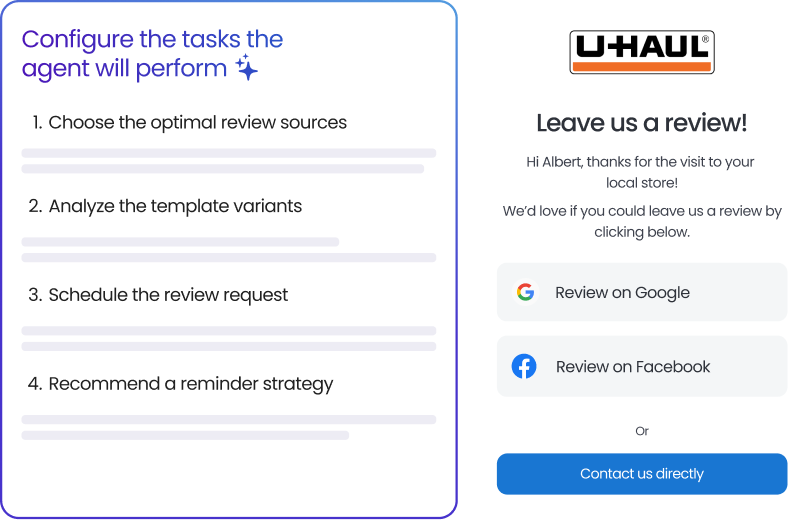
Birdeye Reviews AI helps dental practices actively generate, manage, and analyze patient reviews across all major platforms. This shifts reputation from a passive outcome into a controlled growth lever.
Instead of:
- Chasing reviews manually
- Reacting late to negative feedback
- Letting sentiment remain invisible
Dental organizations gain:
- Automated review generation after every dental visit
- Real-time alerts on patient satisfaction issues
- Centralized reputation control across many dental practices and locations
This directly improves:
- New patient acquisition
- Conversion for cosmetic dentistry and dental implants
- Trust for first-time dental patients
Win visibility inside AI search
Search behavior in the dental industry is shifting fast. Dental patients are no longer relying only on Google. They now ask ChatGPT, Gemini, and Perplexity where to find the best dentist, emergency dental care, cosmetic dentistry, or dental implants near them. Birdeye Search AI is built specifically for this new search layer.
With Search AI, dental organizations can:
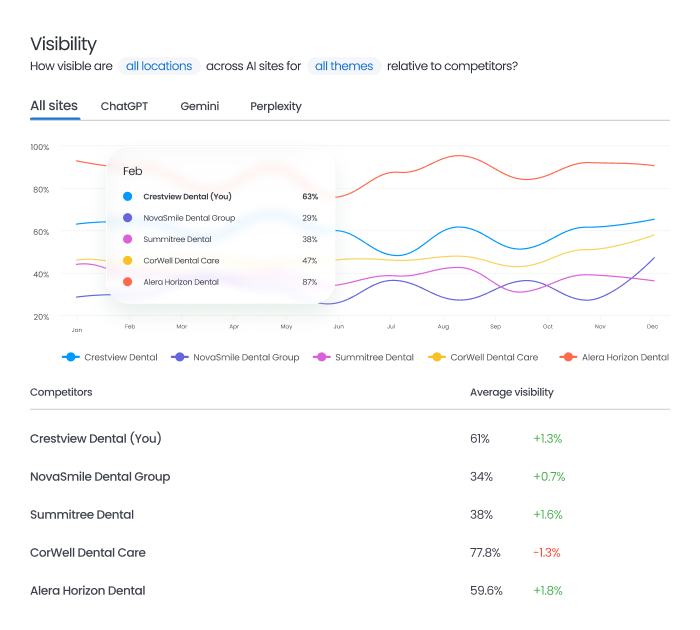
- Track how often their brand and dental offices appear inside AI-generated answers across ChatGPT, Gemini, and Perplexity
- Monitor AI visibility by theme, location, and competitor to see where they lead and where they are invisible
- Understand how AI platforms describe their brand, including sentiment, strengths, weaknesses, and trust signals
- See which citations AI engines rely on most and strengthen authority through high-impact citation sources
- Use AI agents to automate execution, not just insights, across locations
Visibility across search and maps
Birdeye Listings AI centralizes listing accuracy across Google, Maps, and dozens of high-impact directories. This ensures every dental office shows correct hours, locations, phone numbers, and services.
For private practices, this protects local demand.
For multi-location practices, this prevents visibility chaos at scale.
Scaling patient experience through communication, not manual follow-ups
Birdeye helps dental organizations systemize patient communication across:
- Appointment reminders
- Follow-up messages
- Feedback collection
- Review requests
- Ongoing engagement
Using patient feedback and sentiment data to guide leadership decisions
Birdeye converts unstructured patient feedback into actionable insights through analytics and artificial intelligence.
Leaders can now see:
- Which locations struggle with experience
- Where staff responsiveness affects trust
- How patient needs evolve across services
- Which dental marketing trends actually drive quality demand
Birdeye tools close the loop between: Marketing. Operations. Patient care. Growth.
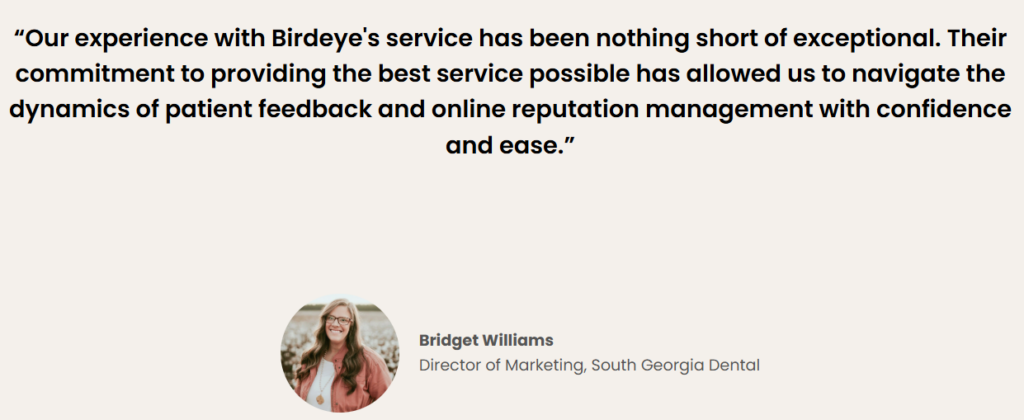
Real-world proof: How South Georgia Dental turned reputation and experience into a growth advantage
South Georgia Dental is a multi-location dental organization operating in a highly competitive regional dental market. Like many growing practices, they faced challenges around:
- Review volume and consistency
- Patient communication at scale
- Visibility across locations
- Managing patient satisfaction across teams
By adopting Birdeye, they centralized reputation, listings, and patient feedback across their locations. The result was not just higher ratings. They:
- Generated 13.9k new reviews across all sources.
- Overall average rating rose to 4.8 stars.
- Review volume increased by roughly 1,673%
This is the shift many dental organizations aim for:
Not chasing growth through spend alone.
But earning it through visibility, experience, and trust.
FAQs on dental industry trends
The most important dental industry trends include the rise of experience-led care, AI-driven search visibility, reputation-first patient acquisition, data-led decision-making, growing demand for cosmetic dentistry and dental implants, and mounting staffing and burnout pressure across many dental practices.
Dental marketing trends are shifting away from isolated campaigns toward always-on experience systems. Online reputation, AI visibility, automated patient communication, and real-time feedback now drive higher conversion and long-term patient value than traditional ads alone.
Patients increasingly use ChatGPT, Gemini, and voice search to find dental offices. If dental organizations are not visible inside AI-generated answers, they lose high-intent demand even if their Google rankings look strong.
Birdeye helps organizations lead these dental industry trends
Today’s dental industry trends point to one clear reality. Growth now depends on visibility, trust, patient experience, and data working as one system. Dental patients compare faster, decide earlier, and rely more on digital proof than ever before. At the same time, staffing pressure and operational complexity make consistency harder to sustain across many dental practices.
Birdeye unifies reputation, listings, patient communication, feedback, and AI search visibility into a single growth platform for dental organizations. This way, modern dental brands move from reactive growth to controlled, scalable performance.
If you want to turn today’s dental trends into measurable growth, explore how Birdeye helps dental organizations lead with confidence.

About the Author

Shruti Dugar
Birdeye
Originally published