Dental marketing automation is no longer optional for multi-location dental brands trying to grow without exhausting their teams. Patient inquiries now come in nonstop, and expectations for fast replies are unforgiving.
Birdeye’s 2025 State of Online Reviews report confirms: Google now hosts 81% of all online reviews, and review volume grew 13% year over year, meaning patients are researching faster, comparing options earlier, and relying on reputation signals long before they ever call or schedule.

For multi-location businesses, this reality makes day-to-day execution feel chaotic. Messages go out late. Reviews pile up faster than teams can respond. Booking gaps appear without warning. And leaders still can’t see clearly which efforts are actually driving new patients.
This is exactly why dental leaders are turning to automation — not to replace their teams, but to stabilize demand before it slips into lost revenue.

This blog breaks down how automation reshapes patient demand and why leaders are prioritizing it more than branding. You will also see where platforms like Birdeye make the biggest impact.
Read on. This will change how you think about growth.
Table of contents
- Why dental marketing automation now decides who wins patient demand
- Where most dental practices fail with marketing automation
- How Birdeye powers dental marketing automation across the entire business
- FAQs about dental marketing automation
- Scale dental marketing automation with Birdeye across every location
Why dental marketing automation now decides who wins patient demand
Dental marketing automation now sits at the point where patient intent either becomes a booked appointment or disappears. For multi-location dental businesses, automation plays a different role than it does for single practices. It must coordinate inquiries, bookings, reputation, and visibility across dozens or hundreds of locations simultaneously. Without centralized control, demand fragments instead of scaling.
To understand why this shift is happening, three structural changes matter:
Patient decisions now happen faster than manual response cycles
Birdeye's 2025 State of Google Business Profile report shows that 86% of discovery now happens through non-branded, “near me” searches, and nearly 48% of patient interactions begin with a website visit from the profile. With patients comparing options in seconds, slow or inconsistent response cycles directly cause demand loss.
Patients submit inquiries, scan reviews, and compare locations in short bursts. If confirmation or follow-up does not happen quickly, the patient does not wait. Automation now exists to protect that shrinking decision window.
Multi-location brands feel the pressure first
At scale, what feels manageable at one location turns unstable across many. Missed calls, delayed texts, and uneven follow-ups compound into systemic leakage. Automation replaces fragile human sequencing with controlled execution.
Demand is being lost before patients ever book
Birdeye’s 2024 Google Business Profile's benchmark found that verified, complete profiles receive 4× more website visits and significantly more calls — meaning most of a dental organization’s demand is won or lost before a patient ever interacts.
What this means for leadership: Growth now depends on how reliably your systems turn interest into booked appointments, not just how visible your brand is.
Once demand capture becomes the true bottleneck, the next question becomes practical. Which parts of the patient journey actually need automation to stop the leaks?
What dental marketing automation really covers across the patient journey
Dental marketing automation is often mistaken for the same automation used in retail or SaaS. In reality, it operates under different constraints because patient intent, trust, and scheduling friction are tightly linked.
In simple terms, traditional marketing automation focuses on promotions and campaigns, while modern dental marketing automation focuses on inquiry capture, booking control, reputation signals, and patient retention.
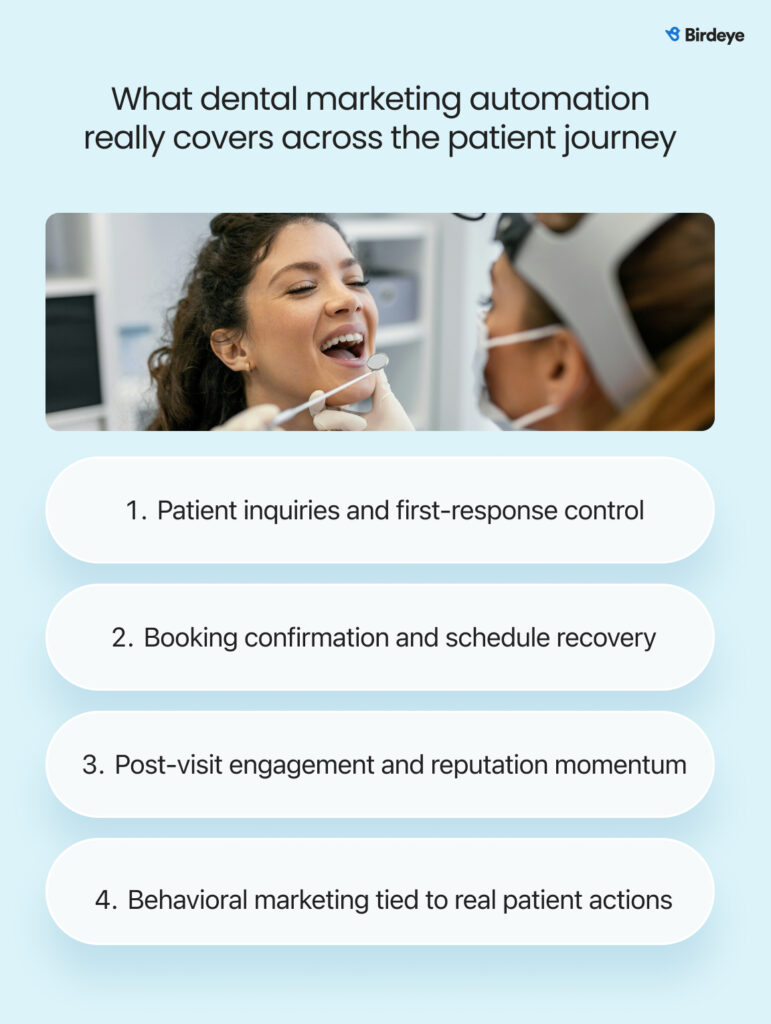
Here is where automation now plays a direct operational role:
Patient inquiries and first-response control
Automation now manages what happens in the first minutes after a patient reaches out. This includes web forms, missed calls, chat, and text inquiries. The goal is to stop demand from expiring before a real conversation begins.
Booking confirmation and schedule recovery
Automation now stabilizes the schedule after intent is captured. Confirmations, reminders, cancellations, and rebooking flows now run in the background. This reduces no-shows, protects chair utilization, and limits reliance on manual call-back cycles.
Post-visit engagement and reputation momentum
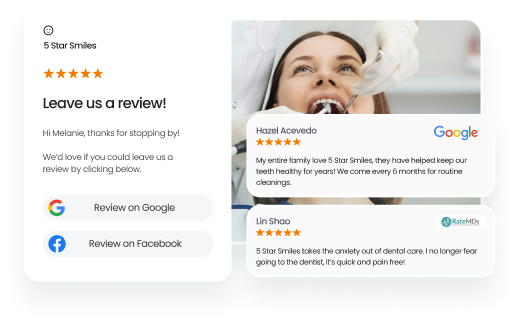
After the visit, automation now drives review requests, feedback collection, and patient follow-ups. This stage directly impacts online reputation, which now feeds back into the next wave of patient demand.
Behavioral marketing tied to real patient actions
Modern automation no longer runs on static campaigns. It responds to real behavior such as completed visits, delayed treatments, and missed appointments. This keeps outreach relevant and avoids broad, untargeted messaging.
Even with this expanded coverage, most dental businesses still struggle to see real impact. The reasons sit in how automation is implemented, not in what it is capable of.
Where most dental practices fail with marketing automation
Most dental teams do not fail at automation because they lack effort. They fail because the experience breaks in places they cannot easily see. On paper, everything looks automated. In reality, patients feel the gaps.
Picture this. A patient fills out a form on your website at night. They get no reply until the next afternoon. By then, they have already booked elsewhere. The tool worked. The system failed.
Here is where that breakdown usually starts.
Automation tools do not talk to each other
One system handles forms. Another handles scheduling. A third handles reviews. None of them shares context. Patients repeat information. Staff rechecks details. Delays pile up. What feels like a small handoff problem quietly slows the entire journey.
Check out the top 5 reliable HIPAA-compliant marketing automation tools.
Messages go out on schedule, not based on patient behavior
Many automations run on fixed timers. A patient receives reminders even after they cancel. Another gets a promotion for a service they already completed. Over time, patients stop paying attention. Automation becomes background noise.
Leaders cannot clearly see what automation is fixing or losing
Teams see activity. Leaders need outcomes. Without clear visibility into booked appointments, recovered cancellations, or review-driven conversions, automation creates motion without confidence.
High-performing dental businesses fix this by rebuilding automation as one connected system instead of stacking disconnected tools.
How high-performing dental businesses build automation into a growth system
High-performing dental businesses do not add automation in pieces. They design it as one connected flow. The difference shows up in how predictable their growth feels. Instead of chasing gaps, they control the full patient journey from first click to repeat visit.
Imagine this flow working end to end. A patient searches for a nearby dentist. They:
- See accurate listings
- Book instantly.
- Get reminders without calling
- Leave a review without being asked twice.
That is not a stack of tools. That is a system at work.
Automation as a tool vs automation as a system
Automation as a tool
A reminder here. A chatbot there. A campaign once a month. Each piece works on its own, but nothing connects. Teams stay busy. Growth stays uneven.
Automation as a system
Search, inquiries, booking, follow-ups, reviews, and reactivation all move together. Each step triggers the next. Patients feel continuity instead of handoffs. Teams feel control instead of chaos.
This is where dental automation stops being a marketing function and becomes infrastructure for growth.
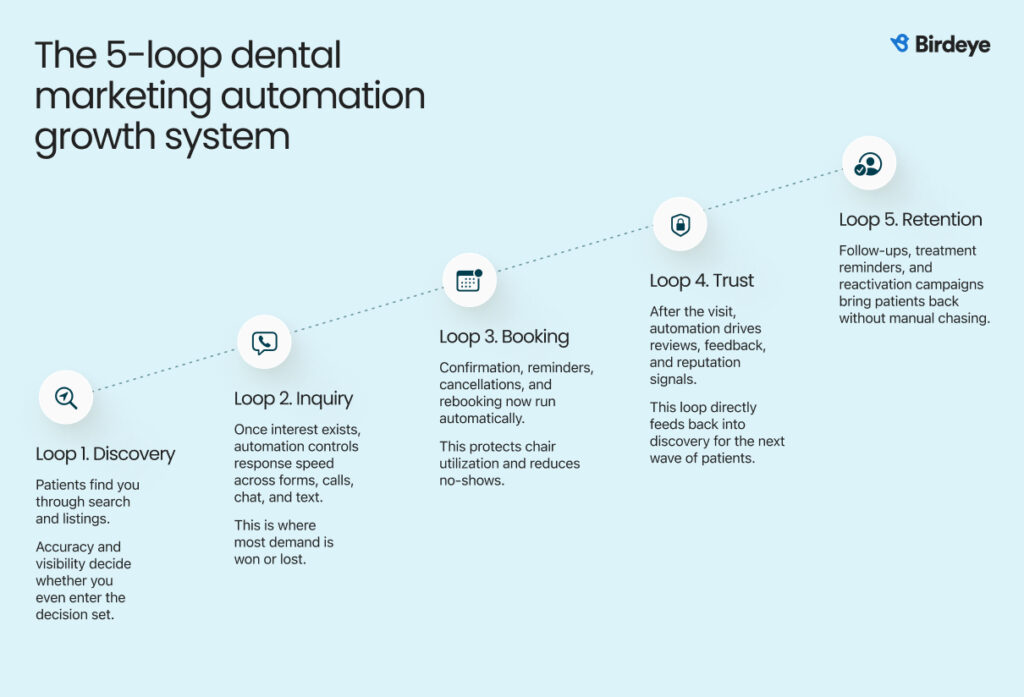
When these loops stay connected, growth feels steady instead of reactive. When one loop breaks, pressure shifts back to front desks and marketing teams.
This level of system design requires a platform that can coordinate trust, visibility, engagement, and reporting across every location. That is where Birdeye enters the picture. Birdeye maps directly to every loop in this system, from discovery and inquiry through trust, retention, and executive reporting.
Dental marketing automation matters more than branding in 2026
Want to see the impact of Birdeye on your business? Watch the Free Demo Now.
How Birdeye powers dental marketing automation across the entire business
Most platforms handle one part of the patient journey. Birdeye is built to connect the whole system. For multi-location dental businesses, that difference matters because growth does not break in one place. It breaks across visibility, trust, communication, and reporting.
Birdeye operates as the control layer that keeps all five automation loops working together. This is why it is trusted by brands globally, built for multi-location brands, and connected through 3,000+ CRM and POS integrations. It is also recognized as the #1 agentic marketing platform for multi-location businesses.
Here is how that shows up in real business outcomes.
Review agents turn patient experiences into steady demand
After visits, Birdeye’s Review agents automatically request feedback, route sentiment, and trigger timely responses. This keeps the reputation current across all locations without manual chasing.
Business outcome: Stronger reviews improve search visibility and directly influence patient choice at the moment of comparison.
Listing agents protect local discovery at scale
Birdeye’s Listings optimization agent keeps business information accurate across search platforms and directories in real time. Address errors, hour changes, and location updates sync automatically.
Business outcome: Patients find the right location faster. Fewer missed calls. Fewer wrong-location bookings. More clean demand.
Search AI shows how patients actually find and choose locations
Birdeye Search AI reveals where high-intent searches originate, which locations gain visibility, and where demand is leaking.
Business outcome: Leaders stop guessing which locations need support. Decisions become evidence-based instead of reactive.
Reporting agents connect marketing activity to growth outcomes
Birdeye’s Reporting agent unifies reviews, listings, sentiment score, and search data into executive-ready dashboards.
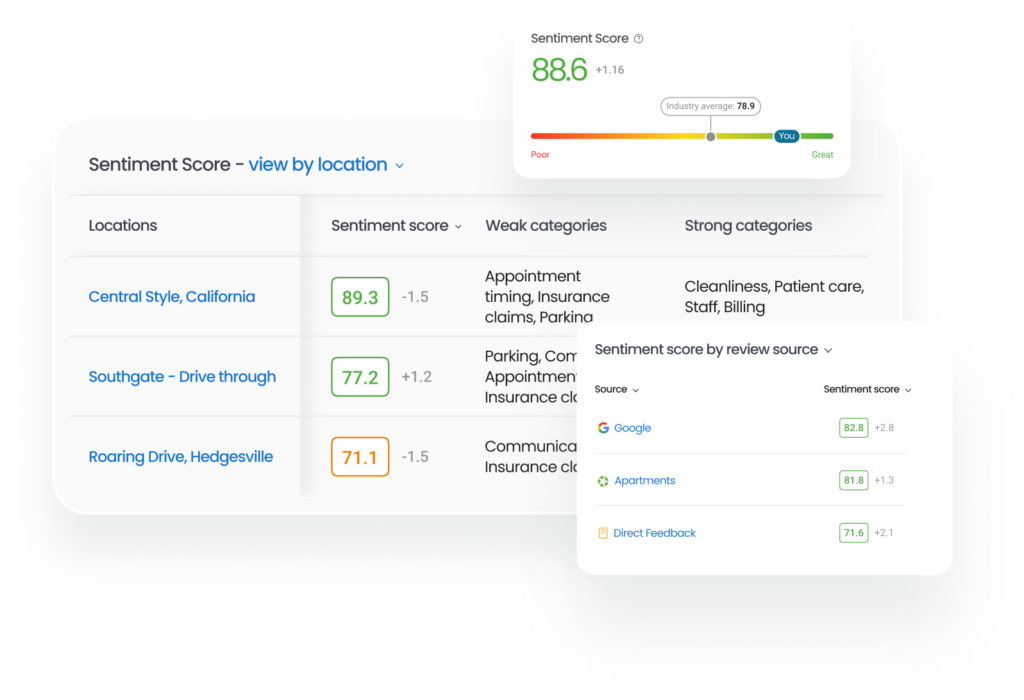
Business outcome: Marketing performance becomes measurable across locations. Leaders see what is driving booked appointments, not just activity.
Insights AI gives leaders real visibility into what is actually happening
Birdeye Insights AI pulls signals from reviews, surveys, and local SEO into one place and turns them into clear performance intelligence across sentiment, reputation, and discoverability. Leaders see location-level strengths, weak spots, and category-level issues without digging through raw data.
D4C Dental Brands used Birdeye Insights AI to gain centralized visibility across hundreds of locations. Leadership could benchmark locations, track sentiment by category, and surface operational issues early, rather than react location by location.
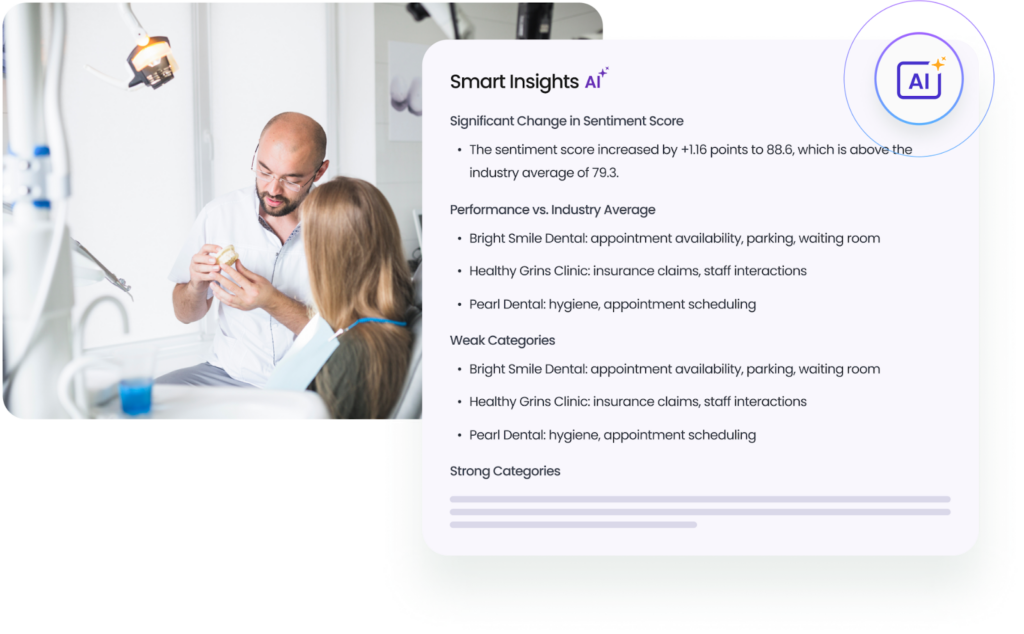
This gave leadership a way to correct performance patterns across the network instead of reacting to individual complaints.
FAQs about dental marketing automation
It replaces manual follow-ups, review requests, booking reminders, and basic reporting. Teams shift from chasing tasks to supervising performance through systems like Birdeye.
It is both. Automation now sits between marketing, front desk operations, and patient experience. Platforms like Birdeye connect everything into one workflow.
By keeping reviews fresh, listings accurate, and responses fast across every location. Birdeye automates these trust signals so patients see consistency before they ever book.
Yes, but only with centralized control and local execution. Birdeye is built for centralized control with local execution across large dental networks.
Leaders should measure booked appointments, recovered cancellations, review volume, and location-level search visibility. These metrics show whether automation is driving revenue, not just activity.
Scale dental marketing automation with Birdeye across every location
Dental marketing automation only creates real value when it works the same way across every location. Without that consistency, teams stay busy, but growth stays uneven. Multi-location dental businesses now need a single, connected system that maintains visibility, trust, patient communication, and performance across locations.
Birdeye solves that visibility and control problem as the #1 agentic marketing platform for multi-location businesses. In practice, agentic means Birdeye’s AI agents continuously monitor reviews, listings, search visibility, and performance signals, then act in real time without relying on constant manual input.
If you want automation to reduce risk early, scale performance evenly, and give leadership real control, Birdeye is built for that.

About the Author

Shruti Dugar
Birdeye
Originally published



![[Feature image] 7 enterprise marketing automation tools designed for multi-location growth](https://birdeye.com/blog/wp-content/uploads/Feature-image-7-enterprise-marketing-automation-tools-designed-for-multi-location-growth-375x195.png)