If your Google reviews are disappearing or never showing up, your QR code strategy may be part of the problem. Linking QR codes directly to your Google Business Profile (GBP) review form skips critical engagement signals like search, clicks, and profile interactions that Google now uses to verify review authenticity. Without these signals, reviews are more likely to be filtered or never published, even if they are legitimate.
Summary
In 2026, the challenge for businesses is not only getting more Google reviews. It’s making sure those reviews actually appear and stay visible. Across industries, a growing pattern is emerging: customers say they left a review, receive a confirmation, but the review never appears on the profile. No notification. No warning. No appeal. And in many of these cases, the common thread is surprisingly simple: QR codes linked directly to the Google Business Profile review form. What was once considered a best practice is now quietly undermining review generation strategies.
This blog explains why direct QR-code review links may increase filtering risk, how Google’s trust model has evolved, and what a modern, compliant review journey looks like.
Table of contents
- Summary
- Why the real issue is not just disappearing reviews, but how reviews are being generated
- What pre-review engagement signals may strengthen review trust?
- How can QR codes increase review filtering risk?
- Why does Google remove even real reviews?
- What kind of review journey does Google actually trust?
- How should businesses rethink their QR code review strategy in 2026?
- How Birdeye helps multi-location brands manage reviews in a stricter Google environment
- FAQs about disappearing Google reviews
Why the real issue is not just disappearing reviews, but how reviews are being generated
Missing Google reviews are often treated as a platform glitch. But in many cases, the bigger issue is the review journey itself.
Google’s moderation systems have become stricter, faster, and more automated. Reviews can be filtered before they appear publicly, or removed later if Google’s systems re-evaluate them against newer trust and safety signals.
Industry observers have also reported a sharp rise in review removals, including an analysis highlighted by Ben Fisher that points to a 600% increase in review deletions during 2025. While Google has not shared every detail of how its systems work, the pattern is clear: review-generation tactics that once worked may now carry greater risk.
If your review count has suddenly dropped or previously visible feedback has vanished, understanding why Google reviews disappear can help you identify the likely cause and determine what to do next.
How has Google shifted from content trust to behavioral trust?
For years, businesses mostly thought about review quality in terms of the review content:
- Is the review relevant?
- Is it appropriate?
- Does it violate any obvious policy?
That still matters. But today, the context around the review may matter too.
Google’s systems appear to look for signals that help confirm whether a review came from a real customer journey. These may include:
- How the reviewer discovered the business
- Whether they interacted with the profile
- If the overall behavior looks natural
This shift from content-based trust to behavior-based trust is one reason legitimate reviews may still get filtered.
What pre-review engagement signals may strengthen review trust?
A natural customer journey usually includes some form of discovery or interaction before a review is submitted. For example, a customer may:
- Search for the business on Google or Maps
- Visit the business profile
- Check directions
- Visit the website
- Call the business
- Look at photos, hours, services, or other profile details
These actions help create a more complete behavioral footprint. They show that the customer did not arrive at the review form out of nowhere.
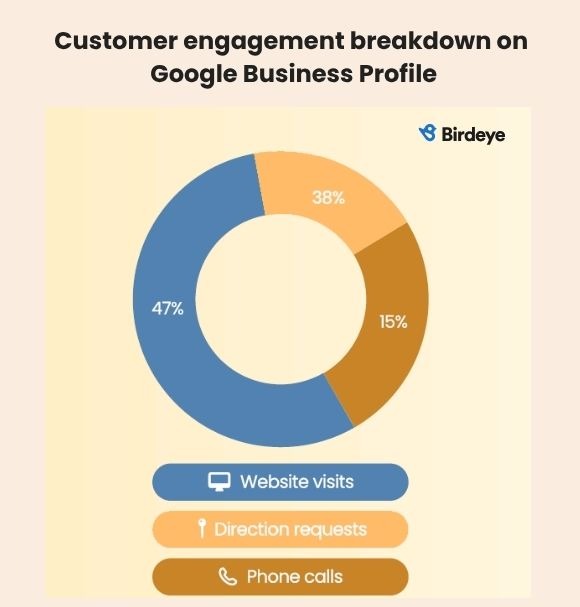
This aligns with how people already use Google Business Profiles. According to Birdeye’s Google Business Profile 2026 report, users typically engage with listings before taking action, 47% visit the website, 38% request directions, and 15% make calls.
Why reviews with “no prior interaction” can look less trustworthy
When a user leaves a review without any prior interaction history, it creates a weak trust signal. In practice, this means:
- Reviews from users with no prior Maps or profile interaction are more likely to be filtered
- Direct-to-review flows (like QR codes) remove this relationship entirely
From Google’s perspective, there’s no evidence that the user actually engaged with the business, and the review appears disconnected from a real journey. This is why QR-driven reviews often face a higher risk of filtering; they bypass the natural sequence of discovery → interaction → action.
This gap between submission and visibility is one of the biggest drivers of silent filtering, where reviews appear submitted but never go live.
What is silent review filtering?
Silent review filtering happens when a customer submits a review, but the review never becomes publicly visible. Here’s how it usually plays out:

1. The customer writes and submits a review
2. Google shows a confirmation to the customer
3. The customer assumes the review is live
4. The business never sees the review on its profile

From the customer’s perspective, everything appears to have worked. From the business’s perspective, the review doesn’t exist. This isn’t an isolated issue. Many businesses report that customers complete reviews and receive confirmation, only for those reviews to never appear. It’s pointing to a growing gap between submission and visibility that’s becoming increasingly common across industries.
How can QR codes increase review filtering risk?
QR codes are not the problem by themselves. The risk comes from where they send the customer. When a QR code links directly to the Google review form, the journey becomes extremely short: Scan → Land on review form → Submit.
That shortcut removes the steps that usually show natural engagement. The customer may never search for the business, open the profile, view the listing, check directions, or take any other action before reviewing.
As a result, the review lacks any pre-review engagement signals. From a pattern-detection standpoint, this creates a review with no behavioral footprint, which is increasingly treated as low trust.
In a LinkedIn post, Claudia Tomina, a Platinum Product Expert on the Google Forum community, has also pointed to a similar pattern, noting that reviews submitted without prior interaction on Google, such as searches, profile views, or clicks, may be more likely to be filtered. That said, Google has not publicly confirmed whether engagement history is directly used as a factor in evaluating review quality.
Why in-store QR code review requests can create risky patterns
Many QR codes are placed in high-traffic physical locations, such as:
- Checkout counters
- Restaurant tables
- Receipts
- Waiting rooms
- Front-desk signage
These placements can unintentionally create patterns that look unnatural to moderation systems, such as:
- Multiple reviews submitted from the same location
- Several reviews coming through the same Wi-Fi network
- A sudden spike in review activity after a staff prompt
- Reviews submitted immediately after service, with little or no prior profile engagement
None of this proves the reviews are fake. But when these patterns repeat, they may increase the chance that legitimate reviews get filtered.
Convenience vs credibility: the review trade-off no one talks about
For years, review generation focused on one goal: reducing friction, making it easy, fast, and almost effortless for customers to leave feedback. This approach still has value. But in 2026, a completely frictionless review journey can also look overly engineered, rather than organic.
A small amount of natural friction, such as asking customers to search for the business first or open the profile before reviewing, may help the journey look more authentic.
The trade-off is simple:
- Maximum convenience can increase filtering risk
- A slightly more natural journey can strengthen credibility
Why does Google remove even real reviews?
Google’s systems don’t evaluate whether a review is “honest”; they assess whether it matches patterns of authentic user behavior. For example, reviews may be at higher risk when they involve:
- Multiple submissions within a short timeframe
- Similar wording or structure across many reviews
- Repeated mentions of the same staff names or phrases
- Review activity spread across several locations in a coordinated way
- Reviews submitted immediately after a prompt, with little supporting engagement history
In these cases, the issue may not be whether the review is honest. The issue is whether the review looks similar to patterns Google associates with lower trust.
The rise of false positives in review moderation
False positives happen when legitimate reviews are treated as suspicious because they resemble risky patterns.
This can happen when reviews are:
- Submitted in clusters
- Written in similar language
- Posted from the same physical location
- Too short to provide useful context
- Connected to a highly repetitive review request flow
Did you know? Reviews with little or no content, such as rating-only submissions, often carry weaker signals and may be more vulnerable to filtering. In fact, Birdeye’s State of Online Reviews 2026 report shows that reviews with detailed comments are becoming the norm, with 79.8% of reviews now including written feedback, reinforcing the importance of depth and context in review quality.
What kind of review journey does Google actually trust?
Tactics like direct review links, bulk campaigns, and scripted or coached reviews are becoming less effective because they create predictable patterns. Google’s systems are now designed to detect and suppress these patterns.
In some cases, reviews that were previously published can also be re-evaluated later. Edits or changes may trigger a fresh review check under newer moderation systems, which can lead to older reviews being removed.
Google favors journeys that resemble real behavior:
- A user searches for your brand
- Explores your profile
- Engages with your listing
- Then leaves a review
This sequence creates context before the review is submitted. It shows that the review is connected to a real discovery and decision-making journey.
Businesses should also remember that review moderation does not always happen once. Reviews that were previously published may be re-evaluated later, especially if they are edited, flagged, or associated with broader suspicious activity.
Why adding one step can help reviews look more natural
Adding one small step to the review journey can make the process feel more organic. Instead of sending customers straight to a review form, ask them to:
- Search for your business on Google
- Open your profile
- Confirm they are on the right location page
- Leave a review from there
This may add a few seconds to the process. But it also creates a more natural path and reduces dependence on direct-to-review links.
For multi-location brands, this step is especially important. It helps customers find the correct location before submitting a review, reducing the risk of reviews being attached to the wrong profile.
How should businesses rethink their QR code review strategy in 2026?
A modern review strategy must align with how platforms like Google Business Profile evaluate trust, behavior, and ongoing engagement. This means rethinking not just whether you use QR codes, but how they fit into the overall review journey.
1. Stop linking QR codes directly to the review form
The biggest shift is simple: avoid sending users straight to the review submission page. Direct-to-review QR codes skip critical engagement signals like search, profile views, and interactions, making reviews more likely to be filtered.
Instead, QR codes should guide users into a broader journey, not a final action. This approach should also be standardized across locations to avoid inconsistent patterns that can trigger filtering at scale.
Ensure that:
- All QR codes follow the same linking logic (no direct review links)
- Messaging is consistent across locations
- The timing of requests is controlled
2. Redesign QR codes to support discovery, not shortcuts
QR codes shouldn’t act as a shortcut to reviews, they should act as an entry point. Instead of linking directly to the review form, consider routing users to:
- Your homepage
- A location page
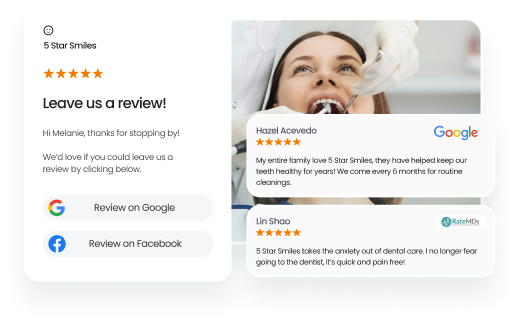
- A “leave us a review” page with instructions
From there, prompt users to:
- Search your business on Google
- Open your profile
- Then leave a review
This creates the behavioral signals that Google increasingly relies on.
3. Avoid high-risk QR code placements and patterns
Where and how QR codes are used matters as much as the link itself. High-risk patterns include:
- QR codes placed at checkout counters
- On-table prompts in restaurants
- Review requests immediately after service
- Multiple customers submitting reviews from the same location or network
These setups can lead to:
- Review spikes
- Location clustering
- On-site submission patterns
All of which increases the likelihood of filtering, even for real customers.
4. Introduce light friction in QR-based review flows
QR codes were designed to remove friction. But, in 2026, too little friction can make the journey look overly manufactured.
Instead of using a one-scan, one-review flow, add a simple instruction such as:
- “Search for us on Google to leave a review.”
- “Find us on Maps and share your experience.”
- “Open our Google Business Profile and tell us how we did.”
This small step helps customers follow a more natural path. It also gives them a moment to confirm they are reviewing the right location.
5. Balance QR codes with off-site review channels
Over-reliance on QR codes, especially in-store, can create unnatural review patterns. Balance your strategy by combining QR codes with:
- SMS follow-ups
- Email requests
- Post-visit reminders
This spreads review activity across different times, channels, and customer journeys. It also reduces the risk of sudden spikes from one physical location.
Birdeye’s State of Online Reviews 2026 report shows that review volume grew 30.7% year-over-year in 2025, with SMS driving 54.6% of review requests. This points to a broader shift toward distributed, post-interaction review journeys that feel more natural than on-site prompts alone.
How Birdeye helps multi-location brands manage reviews in a stricter Google environment
In 2026, review management is not just about generating more reviews. It is about making sure reviews are requested consistently, monitored closely, and managed in a way that reduces avoidable filtering risk.
For multi-location brands, this requires more than a QR code or a direct review link. It requires centralized control, location-level visibility, and compliant review journeys across every channel.
As a leading agentic marketing platform for multi-location brands, Birdeye helps businesses move beyond one-off review tactics and manage the full review journey across locations, channels, and teams.
Birdeye Reviews helps brands do this by making review management more consistent, measurable, and scalable.
Standardize review requests to reduce risk
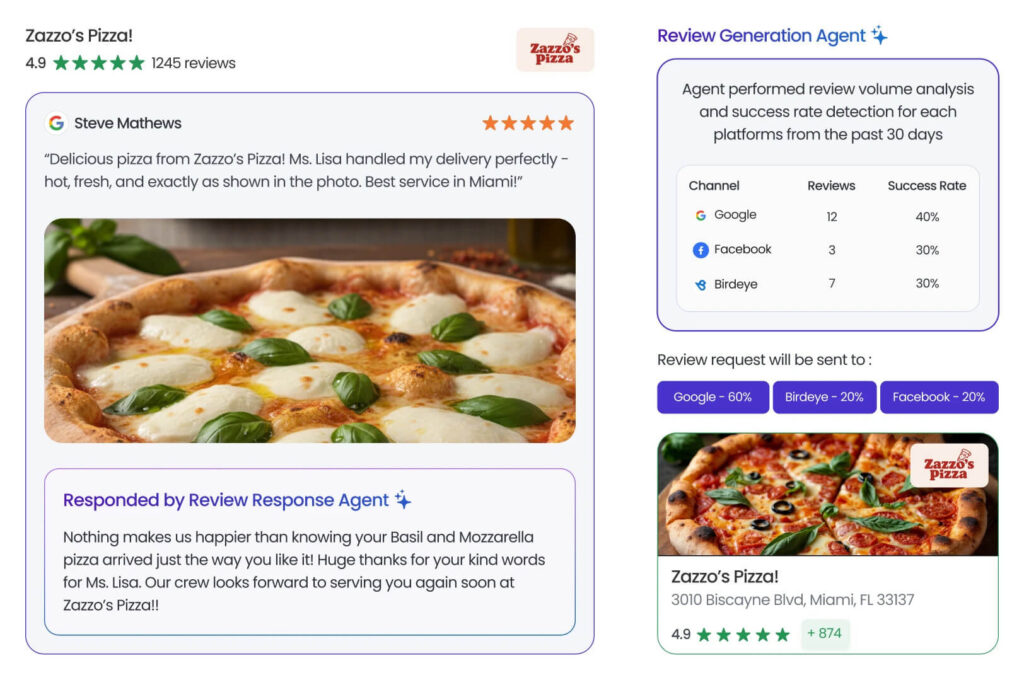
Inconsistent review collection, including how QR codes are used across locations, can create patterns that can trigger filtering. Birdeye’s Review Generation Agent automates review requests using controlled, policy-aligned templates across SMS, email, and other channels, ensuring consistency across all locations.
Get real-time alerts and respond faster
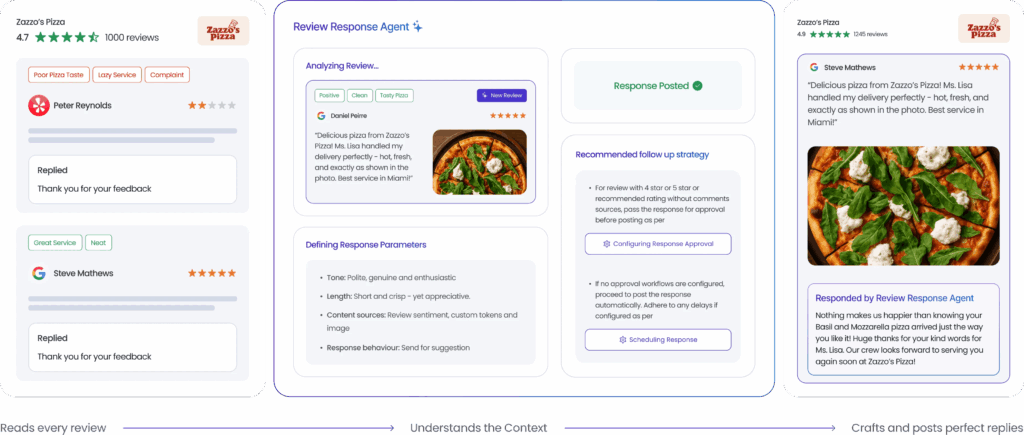
With instant alerts for new reviews and unusual activity, the Review Response Agent helps teams act quickly, respond on time, and maintain engagement signals, which are increasingly important for review visibility.
Monitor review trends across locations
Birdeye Reviews gives you a centralized view of drops, spikes, and anomalies by location, helping you quickly identify where reviews may be getting filtered, including patterns linked to QR code usage or in-store collection.
Build compliant, multi-channel review journeys
Instead of relying only on QR codes or direct links, Birdeye helps you design balanced review flows across channels and timing. This reduces over-reliance on in-store prompts and aligns with how platforms like Google Business Profile evaluate trust signals.
Close the gap between requests and published reviews
Most businesses don’t track how many reviews actually go live. Birdeye provides visibility into review requests vs. published reviews, helping you identify gaps caused by filtering and optimize accordingly.
FAQs about disappearing Google reviews
This is often referred to as silent filtering. It happens when a customer submits a review, but the review does not appear publicly on the business profile. The review may have failed pre-publication checks because of weak trust signals, suspicious patterns, or other moderation factors.
Not every QR-code review gets filtered. Some reviews may still appear if the reviewer has prior engagement history, the review includes useful detail, and the overall pattern does not look suspicious. The risk increases when direct QR-code review links are used repeatedly across many customers or locations.
The safest approach is to encourage a natural review journey. Ask customers to search for your business on Google, open the correct location profile, and leave an honest review about their experience. Avoid scripted language, bulk review pushes, or direct-to-review shortcuts that create repetitive patterns.
No. QR codes are not banned. The risk comes from linking QR codes directly to the Google review form. A safer approach is to use QR codes as an entry point to a broader review journey, such as a location page or review instructions page.
Yes. Reviews submitted in sudden bursts, from the same physical location, or immediately after an in-store prompt may be more likely to look suspicious. This does not mean the reviews are fake, but it may increase filtering risk.
Not necessarily. Businesses should rethink how QR codes are used. Avoid direct review-form links, reduce over-reliance on in-store prompts, and balance QR codes with SMS, email, and post-visit review requests.
The bottom line: review visibility depends on trust-first journeys
The way reviews are evaluated has fundamentally changed. According to Statista, online reviews are a major influence on purchase decisions. This means missing reviews don’t just affect perception; they directly impact revenue.
Google’s review ecosystem increasingly favors reviews originating from organic discovery. The businesses that win in 2026 will be those that shift from fast review generation to credible, behavior-driven review journeys.
A review that never appears publicly cannot improve your rating, influence a customer, or support local visibility. Birdeye helps multi-location brands manage that shift with standardized review requests, location-level monitoring, multi-channel workflows, and visibility into review performance across every location.
Talk to a Birdeye Enterprise Specialist and build a review strategy designed for how Google works today.
About the Author

Somya Yesodharan
Originally published