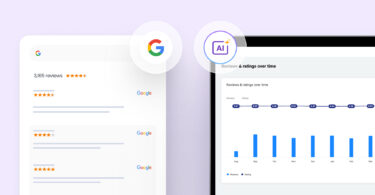
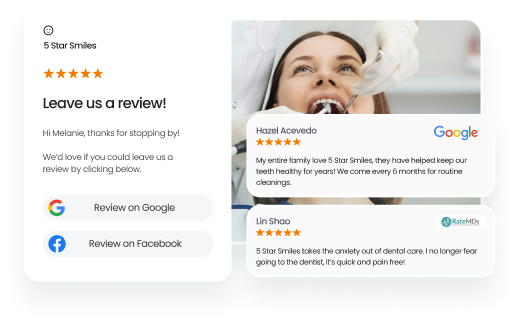
Healthcare review management is the strategic process UK NHS and private providers use to collect, monitor, and respond to patient feedback across Google, NHS.uk, Care Opinion, Doctify, and other platforms, under CQC governance, GMC/NMC/GDC/GPhC/HCPC professional codes, and UK GDPR.
Summary
For UK healthcare providers, managing patient reviews is not simply about maintaining a strong star rating. It is about operating within a layered regulatory environment that includes CQC fundamental standards, GMC Good Medical Practice 2024, NMC Code obligations, and ICO guidance on special category data under UK GDPR, while still using feedback to improve patient experience and organisational reputation.
This blog covers the full UK healthcare review management landscape, from the platforms where patients leave feedback to the compliance workflows that keep NHS trusts and private providers on the right side of their regulators. It explores how tools like Birdeye fit alongside NHS-specific platforms such as NHS.uk and Care Opinion, and what a safe, scalable review management process looks like in practice.
What does the UK regulatory landscape mean for healthcare review management?
Every UK healthcare provider that operates a review management process must comply with a defined set of regulatory obligations. Unlike the US, where HIPAA governs patient data privacy, the UK framework is built around a different set of bodies and legislation entirely. HIPAA does not apply in the UK. The relevant regulators are CQC, GMC, NMC, GDC, GPhC, HCPC, and the ICO, each with specific guidance that affects how providers collect, respond to, and act on patient reviews.
CQC fundamental standards and the single assessment framework
TheCare Quality Commission sets the baseline for all registered health and social care providers in England. Under Regulation 17 of the Health and Social Care Act 2008 (Regulated Activities) Regulations 2014,
Under Regulation 17 of the Health and Social Care Act 2008 (Regulated Activities) Regulations 2014 providers must have effective systems in place to assess, monitor, and improve the quality of care. This includes how they handle complaints and patient feedback.
CQC’s Single Assessment Framework, introduced in 2023, uses online reviews from platforms such as Google, NHS.uk, and Care Opinion as one source of evidence when assessing a provider’s responsiveness, caring, and service safety. CQC does not grade providers directly on their review scores, but persistent negative sentiment across platforms can inform inspection focus and frequency.
GMC Good Medical Practice 2024
The General Medical Council’s Good Medical Practice 2024 sets out the standards expected of all registered doctors in the UK. Paragraphs 100 to 104 cover online conduct specifically. Doctors must not respond to patient reviews in a way that identifies the patient, reveals details of their consultation, or discloses their treatment. A factual, non-identifying reply to a review is acceptable. Anything beyond that risks a breach.
NMC Code Section 20
The Nursing and Midwifery Council Code, Section 20, addresses advertising and how registrants present themselves professionally. Nurses and midwives must not use testimonials or endorsements in a way that could be misleading. This has direct implications for how review content is used in marketing materials.
GDC, GPhC, and HCPC guidance
The General Dental Council, General Pharmaceutical Council, and Health and Care Professions Council each publish advertising and social media guidance that applies to how their registrants interact with patient reviews. While the language differs slightly across bodies, the consistent principle is the same: responses must be professional, must not confirm or deny a patient relationship, and must not disclose clinical information.
NHS constitution
The NHS Constitution for England enshrines the right of patients to give feedback about their care and for that feedback to be used to improve services. This gives formal weight to patient experience collection as a core function of NHS providers, not a marketing activity.
ICO and UK GDPR Article 9
Patient data is classified as special category data under UK GDPR Article 9. This means any process that involves identifying a patient in connection with their care, including sending a post-appointment review request, requires a clear lawful basis. For most providers, this will be legitimate interests or explicit consent, supported by a Data Protection Impact Assessment where necessary. The ICO’s guidance on special category data is the authoritative reference here.
Providers must also ensure that any third-party review management platform they use is covered by a Data Processing Agreement that meets UK GDPR standards, and that patient data is not transferred outside the UK without appropriate safeguards.
Where do UK patients leave healthcare reviews?
Understanding which platforms matter is the starting point for any effective review management strategy. UK patients use a mix of NHS-specific and general consumer platforms, and each one works differently in terms of who can use it, what it feeds into, and how providers can respond.
NHS.uk

NHS.uk is the official NHS website and the primary platform where patients rate and review GP practices, hospitals, dentists, and pharmacies. Reviews are publicly visible and feed directly into NHS service listings. Providers can respond to healthcare reviews through the NHS website, but responses must never confirm a patient relationship or include any clinical detail. NHS.uk reviews are monitored by CQC as part of its evidence gathering under the Single Assessment Framework.
Birdeye’s monitoring capability for NHS.uk is worth confirming with your UK integrations team before publication, as platform access policies for third-party tools can change.
Care Opinion
Care Opinion is the UK’s leading independent patient feedback platform, formerly known as Patient Opinion. It is used by NHS trusts, GP practices, mental health services, and some private providers. Stories posted on Care Opinion are moderated and are visible to both the provider and the public. Providers are encouraged to respond, and many NHS trusts have dedicated staff who manage their Care Opinion presence. Care Opinion also shares anonymised feedback with NHS England and CQC.
iWantGreatCare

iWantGreatCare is a verified review platform used by a number of NHS trusts and private providers. It collects feedback on individual clinicians and services, making it particularly relevant to consultants and specialists in private practice. Because reviews are linked to verified appointments, the feedback carries additional credibility with both patients and commissioners.
Doctify

Doctify is the leading private healthcare review platform in the UK. It is used primarily by consultants, specialists, private hospitals, and dental practices. Doctify verifies reviews through appointment confirmation and is widely used by providers affiliated with Bupa, Spire, Nuffield Health, Circle Health Group, HCA UK, and Ramsay Health Care. For private providers, Doctify is a core reputation asset and should be treated as such in any review management workflow.
Google Business Profile

The Google Business Profile remains the highest-visibility review platform for most healthcare providers, particularly GP practices, dental practices, pharmacies, and private clinics. Google reviews appear prominently in local search results and are increasingly used by AI search tools such as ChatGPT, Gemini, and Perplexity when generating responses to patient queries. For more on managing your presence across these platforms, see our guide to Google reviews UK.
Birdeye supports Google Business Profile monitoring and response, including agentic response generation with healthcare-appropriate guardrails.
Trustpilot
Trustpilot is used primarily by private providers in cosmetic surgery, aesthetics, and the dental sectors. It is a general consumer platform rather than a healthcare-specific one, which means it does not have the same clinical moderation that Care Opinion or iWantGreatCare provides. Providers using Trustpilot must ensure their use of review content in marketing is consistent with GMC, GDC, and GPhC advertising guidance.
HealthUnlocked

HealthUnlocked is a social network for peer health communities rather than a direct review platform. However, it is worth monitoring as patients frequently discuss their experiences with providers and treatments in condition-specific communities. Sentiment analysis across HealthUnlocked can surface early signals about patient concerns that may later appear as formal reviews or complaints.
| Platform | Who uses it | Provider response | CQC relevance | Birdeye support |
| NHS.uk | NHS providers | Yes | High | Confirm with UK team |
| Care Opinion | NHS + some private | Yes | High | Confirm with UK team |
| iWantGreatCare | NHS + private specialists | Yes | Medium | Confirm with UK team |
| Doctify | Private providers | Yes | Low | Yes |
| Google Business Profile | All providers | Yes | Medium | Yes |
| Trustpilot | Private (cosmetic, dental) | Yes | Low | Yes |
| HealthUnlocked | Patient communities | No direct response | Low | Monitoring only |
Note: Review management UK offers a broader perspective on reputation management practices across UK businesses and sectors.
How do private providers balance commercial reputation goals with regulatory compliance?
Private providers operate in a more commercially competitive environment and can actively request patient reviews following treatment. However, this does not mean the process is unregulated. GMC Good Medical Practice 2024, NMC Code Section 20, GDC advertising guidance, and GPhC standards all require that any use of patient feedback in marketing is honest, not misleading, and does not imply outcomes that cannot be guaranteed.
For private hospitals and clinic groups such as Bupa, Spire, Nuffield Health, Circle Health Group, HCA UK, and Ramsay Health Care, review volume and average star rating on platforms like Doctify and Google directly influence patient acquisition. A consistent, high-volume review presence builds trust with patients, comparing providers, and supports visibility in both organic search and AI-generated responses.
The key performance indicators for private providers are:
- Doctify and Google star rating, typically benchmarked against local and national competitors
- Review volume and recency, as both Google and Doctify weight recent reviews more heavily in their ranking algorithms
- Response rate and response time, as unanswered reviews signal poor patient relations
- Sentiment score across platforms, used to identify recurring clinical or service themes before they escalate to formal complaints
What both have in common
Regardless of whether a provider is NHS or private, the rules around responding to reviews are the same. Responses must never confirm that the reviewer is a patient, must never reference clinical details, and must always direct unresolved concerns to the appropriate channel, whether that is PALS for NHS providers or the provider’s own complaints team for private organisations.
For more on how Birdeye supports healthcare providers across both settings, visit our UK healthcare page.
| Review management factor | NHS providers | Private providers |
| Can they request reviews? | Feedback invitation only, no star solicitation | Yes, post-treatment review requests permitted |
| Primary platforms | NHS.uk, Care Opinion, FFT | Doctify, Google, Trustpilot |
| Key regulator | CQC, NHS England | GMC, NMC, GDC, GPhC, HCPC |
| Primary KPI | FFT score, complaint resolution | Star rating, review volume, conversion |
| Marketing use of reviews | Not permitted | Permitted with advertising guidance compliance |
| Response rules | Never identify the patient or the treatment | Same |
What does a compliant UK healthcare review management workflow look like?
A structured workflow is what separates providers who manage reviews reactively from those who use feedback systematically to improve care and protect their reputation. For UK healthcare providers, that workflow must be built around patient administration system integration, UK GDPR-compliant consent capture, safe request timing, and a response protocol that keeps clinical information out of public view.
Step 1: Integration with patient administration systems
The starting point for any automated review management process is connecting your review platform to the system that holds appointment and discharge data. The most widely used patient administration systems in the UK are:
- SystmOne supports many GP practices, community services, and mental health providers
- EMIS Web is used by GP practices and community pharmacy
- Vision used by GP practices across the UK
- Cerner Millennium powers clinical operations at numerous acute NHS trusts.
- Epic is used by a growing number of NHS foundation trusts, including University College London Hospitals and Cambridge University Hospitals
Birdeye integrates with a range of practice management and healthcare systems. Providers should confirm which specific integrations are available in the UK with the Birdeye UK team before building their workflow.
Step 2: Consent capture under UK GDPR Article 9
Patient contact details and appointment data are special category data under UK GDPR Article 9. Before sending any review request, providers must establish a lawful basis for processing. For most providers, this will be legitimate interests or explicit consent, supported by a privacy notice that clearly explains how patient data is used after treatment.
The ICO’s guidance on legitimate interests requires providers to complete a three-part test: purpose, necessity, and balancing. A Data Protection Impact Assessment is strongly recommended for any new review request workflow, particularly where a third-party platform is involved.
Any third-party platform used in the workflow must be covered by a Data Processing Agreement that meets UK GDPR standards, and patient data must not be transferred outside the UK without appropriate safeguards in place.
Step 3: Review request timing and channel
Timing a review request correctly improves both response rate and the quality of feedback received. Best practice for UK healthcare providers is:
- Post-discharge: send within 24 to 48 hours for outpatient and elective procedures, once the patient has had time to reflect on their experience
- Post-appointment: send same day or next day for GP, dental, and pharmacy consultations
- Channel: SMS has consistently higher open rates than email for healthcare review requests. Paper-based requests remain appropriate for older patient demographics or settings where digital access is limited
Providers must ensure that the review request itself does not reference the nature of the appointment or treatment. The message should invite feedback on the patient’s experience only, without confirming any clinical details.
Step 4: Multi-platform monitoring
Once reviews begin arriving across NHS.uk, Care Opinion, Doctify, Google, and Trustpilot, providers need a centralised review monitoring process. Checking each platform manually is not scalable for multi-site organisations. Birdeye’s Reviews AI provides a unified dashboard that aggregates reviews across supported platforms, flags new reviews in real time, and uses sentiment analysis to identify recurring themes across locations.
For NHS providers, Care Opinion sends email alerts for new stories by default, and the platform has its own response interface. Providers should ensure that their Care Opinion account is actively managed alongside any third-party monitoring tool.
Step 5: Response protocol
Responding to reviews in a healthcare setting requires a stricter approach than in most other sectors. The following protocol applies to all UK healthcare providers regardless of setting:
- Never confirm or deny that the reviewer is a patient of your organisation
- Never reference clinical details, diagnoses, treatments, or appointment dates in a public response
- Thank the reviewer for their feedback in general terms
- Direct unresolved concerns to PALS for NHS providers, or to the provider’s complaints team for private organisations, with a named contact or email address
- Escalate internally any review that references a potential clinical safety concern, safeguarding issue, or serious complaint to the appropriate clinical governance lead
- Document all responses as part of your Regulation 17 governance records
For private providers, responses should also be reviewed against GMC Good Medical Practice paragraphs 100 to 104 and the relevant advertising guidance from GDC, GPhC, or HCPC before publication.
Step 6: Escalation pathways
Not every negative review can be resolved with a public response. Providers should have clear escalation pathways in place for reviews that indicate a serious concern:
- PALS (Patient Advice and Liaison Service) for NHS providers handling unresolved patient concerns
- Formal complaints process under the NHS Complaints Regulations 2009 for NHS organisations
- Medical indemnity providers, including MDU, MPS, and MDDUS for private providers dealing with reviews that have potential legal or regulatory implications
- Platform removal requests for reviews that contain defamatory content, in line with the Defamation Act 2013
Beyond healthcare, the principles discussed here align with broader trends in local business directories UK and online reputation management.
How does the Friends and Family Test fit into a review management strategy?
The Friends and Family Test is a mandatory NHS feedback mechanism, not a review platform in the traditional sense. However, it generates patient sentiment data that intersects directly with review management, and understanding how it works is important for any NHS provider building a structured feedback process.
What is the Friends and Family Test?
The Friends and Family Test requires most NHS-funded services to ask patients whether they would recommend the service to friends and family. Responses are collected on a scale from “extremely likely” to “extremely unlikely” and must be submitted to NHS England monthly. Results are published publicly on the NHS website, making them visible to patients choosing between providers and to CQC as part of its evidence gathering.
The FFT is not a star rating system. It produces a net promoter-style score based on the proportion of positive to negative responses, alongside free-text comments that often contain the most actionable insight for service improvement teams.
How does FFT data connect to review management?
FFT free-text responses frequently mirror the themes that appear in public reviews on NHS.uk and Care Opinion. A provider that monitors both FFT comments and public review platforms together will get a more complete picture of patient sentiment than one that treats them as separate data streams.
Birdeye’s sentiment analysis capability can help multi-site NHS providers identify patterns across free-text feedback at scale, flagging recurring themes around waiting times, communication, cleanliness, or staff conduct before they surface as formal complaints or CQC inspection evidence.
It is worth noting that FFT data itself is submitted through NHS England’s own reporting system and is not a platform that third-party tools can connect to directly. The value of integrating FFT into a review management strategy comes from aligning the themes and language of FFT responses with what is being said publicly, rather than from technical integration.
How can private providers adapt FFT principles?
Private providers are not required to run the Friends and Family Test, but the underlying principle of asking patients whether they would recommend the service translates directly into a post-appointment survey process. Many private hospital groups and clinic networks use a similar question as part of their patient satisfaction surveys, with results tracked internally as a net promoter score.
Birdeye Surveys AI allows private providers to build customised post-appointment surveys that capture this type of sentiment data alongside a review request, giving operations teams both a quantitative score and a public review from the same patient interaction. This approach aligns with the spirit of FFT while remaining within GMC, NMC, and GDC advertising guidance on the use of patient testimonials.
What are the five key performance indicators in healthcare?
The five most widely referenced KPIs in UK healthcare patient experience are:
- Safety outcomes: Measures incidents, near misses, and infection rates to assess the safety of care delivered
- Clinical effectiveness: Tracks treatment outcomes and adherence to NICE guidelines to ensure care meets evidence-based standards
- Patient experience scores: Includes Friends and Family Test results, NHS.uk ratings, and Care Opinion story sentiment; these are the most directly relevant KPIs for review management purposes
- Access and waiting times: Measures how quickly patients can access care, tracked against NHS constitutional standards
- Staff engagement: monitoring workforce satisfaction and retention, as staff experience is strongly correlated with patient experience outcomes
What does a GMC-compliant response to a patient review look like?
Responding to patient reviews is one of the highest-risk activities in healthcare review management. The content of a response can constitute a breach of GMC Good Medical Practice, NMC Code obligations, or UK GDPR if it reveals clinical information, confirms a patient relationship, or discloses anything that could identify the reviewer as a patient.
The three templates below cover the most common response scenarios UK healthcare providers face. Each is written to be safe for public publication under GMC Good Medical Practice 2024 paragraphs 100 to 104, NMC Code Section 20, and ICO guidance on special category data.
The golden rules of review before responding
Before using any template, every person responding to a review on behalf of a UK healthcare provider must apply the following checks:
- Do not confirm or deny that the reviewer has used your service
- Do not reference any clinical detail, diagnosis, treatment, or appointment date
- Do not use the reviewer’s name in a way that links them to your organisation
- Always offer a private channel for follow-up, whether that is PALS, a complaints email, or a direct phone number
- Keep the tone professional, warm, and non-defensive (preformatted box content)
Template 1: Responding to a positive review
“Thank you so much for taking the time to share your feedback. We are really pleased to hear that you had a positive experience. Your kind words mean a great deal to our team, and we will make sure they are passed on. We look forward to welcoming you again.“
This response acknowledges the feedback, thanks the reviewer, and does not confirm any clinical relationship or detail.
Template 2: Responding to a negative review
“Thank you for taking the time to share your experience with us. We are sorry to hear that your visit did not meet your expectations. We take all feedback seriously and would welcome the opportunity to better understand your concerns. Please do not hesitate to contact our patient experience team directly at [email address] so that we can look into this for you.”
This response acknowledges the concern, avoids any defensive language, and directs the patient to a private channel without confirming clinical details. For NHS providers, the contact detail should be the PALS team in line with NHS complaints guidance.
Template 3: Responding to a complaint-style review
“Thank you for bringing this to our attention. We are concerned to read your comments and want to assure you that we take all feedback of this nature very seriously. We would strongly encourage you to contact our dedicated patient experience team at [email address or phone number] so that we can give your concerns the attention they deserve. We are committed to learning from every piece of feedback we receive.”
This response is appropriate where the review indicates a serious concern that may require formal investigation. It does not minimise the concern, does not make any admission, and creates a clear pathway to a private resolution channel. For NHS providers, serious concerns should also be escalated internally to the clinical governance lead and, where appropriate, to the provider’s indemnity contact atMDU,MPS, or MDDUS.
What does a review manager do?
A review manager in a UK healthcare setting is responsible for monitoring patient feedback across all relevant platforms, coordinating timely and compliant responses, escalating clinical concerns to governance leads, and reporting review sentiment trends to operations and quality improvement teams. In larger NHS trusts and private hospital groups, this role sits within the patient experience or digital marketing function and works closely with the PALS team and the data protection officer.
These principles align with broader discussions around UK reviews, patient experience, and reputation management in healthcare.
How can AI support healthcare review management without breaching patient confidentiality?
Artificial intelligence is increasingly being used across UK healthcare operations, and review management is no exception. However, the application of AI in this context must be carefully considered. Any AI tool that processes patient-related data, even indirectly through review content, must operate within the boundaries set by UK GDPR Article 9, ICO guidance on AI and data protection, and the relevant professional codes.
Used correctly, AI does not replace human judgment in healthcare review management. It reduces the administrative burden of monitoring and responding at scale, surfaces insights that would otherwise be missed across large volumes of feedback, and helps multi-location organisations maintain consistency in their response quality.
Agentic review response with healthcare guardrails
Birdeye’s Reviews AI generates suggested responses to patient reviews using AI, with guardrails specifically designed for healthcare settings. The system does not automatically publish responses. It presents a draft for human review and approval, ensuring that a trained staff member applies the compliance checks outlined in the GMC and NMC guidance before any response goes live.
Critically, the AI is configured to avoid any language that could confirm a patient relationship, reference clinical details, or include personally identifiable information in a public response. This is not a general-purpose AI tool repurposed for healthcare. It is designed with the specific constraints of regulated healthcare communication in mind.
Sentiment analysis for early warning of clinical safety themes
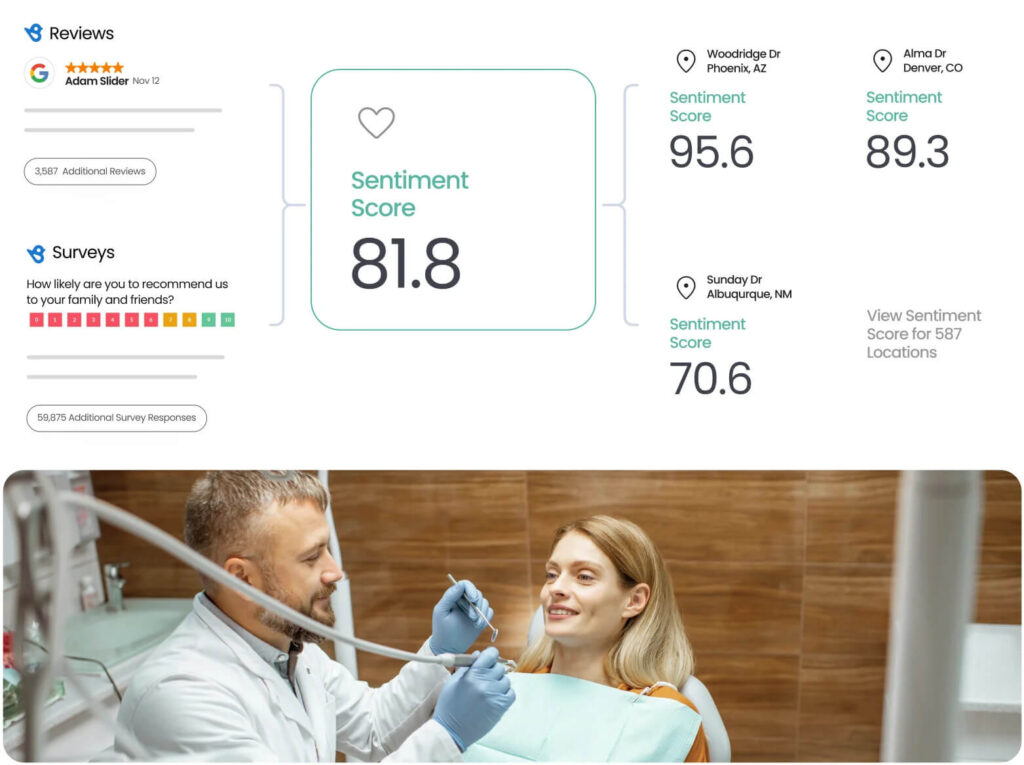
One of the most valuable applications of AI in healthcare review management is sentiment analysis across large volumes of feedback. Birdeye sentiment scoring capability analyses review content across platforms and locations, identifying clusters of negative sentiment around specific themes such as waiting times, communication, medication queries, or staff conduct.
For NHS trusts and private hospital groups operating across multiple sites, this provides an early warning system for issues that might otherwise take weeks to surface through formal complaints channels. Where sentiment analysis flags a potential clinical safety theme, the escalation protocol should be followed immediately, with the clinical governance lead notified as a priority.
It is important to note that AI sentiment analysis tools process review text, not clinical records. Providers should nonetheless ensure that their use of such tools is covered within their Data Protection Impact Assessment and that the tool vendor’s data processing practices are documented in a compliant Data Processing Agreement.
AI search visibility for UK healthcare providers
Patients are increasingly using AI-powered search tools such as ChatGPT, Gemini, and Perplexity to find healthcare providers. Queries such as “best private GP in Manchester” or “top-rated dental practice in Edinburgh” are now generating AI-compiled responses that draw on review data, listing accuracy, and online presence.
Birdeye Search AI helps UK healthcare providers understand how they appear across these AI search platforms, identifying gaps in listing accuracy and review presence that may be affecting their visibility in AI-generated responses. For private providers in particular, appearing in AI search responses is becoming as commercially important as appearing in traditional Google search results.
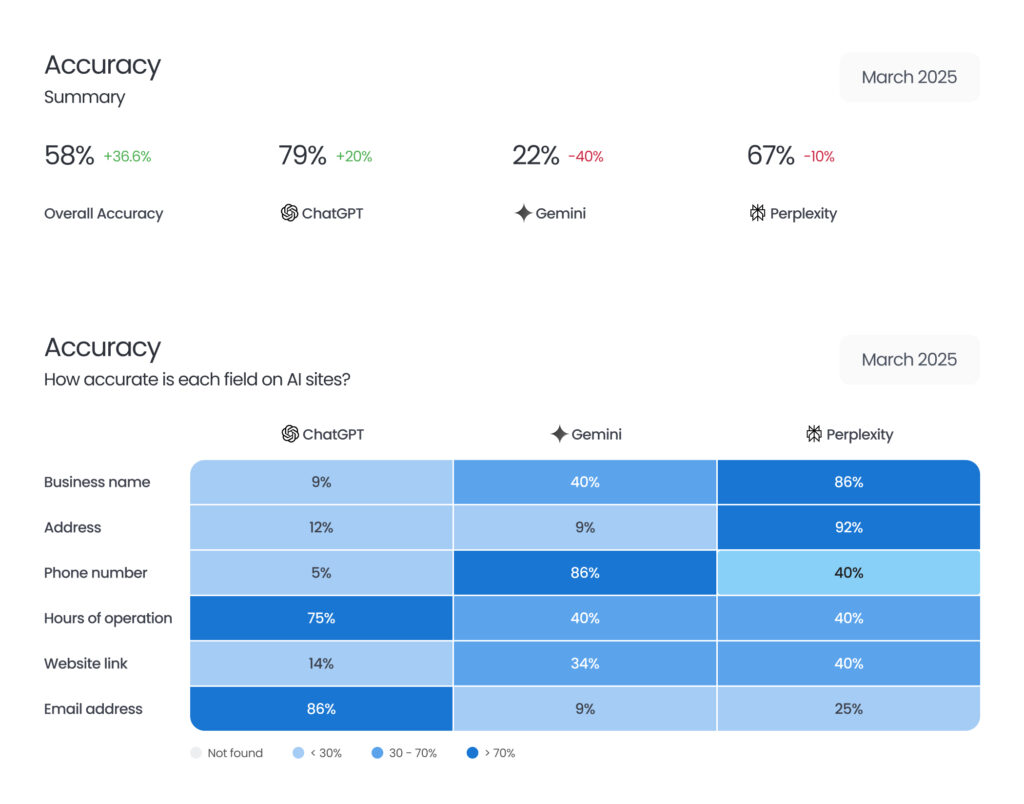
For NHS providers, AI search visibility matters in a different way. Patients searching for information about NHS services, waiting times, or how to access care are increasingly receiving AI-generated summaries. Accurate, up-to-date listings and a strong review presence on NHS.uk and Care Opinion contribute to the quality of information that AI tools surface.

The core pillars of Birdeye for UK healthcare providers
Birdeye brings together a set of capabilities that are directly relevant to the compliance and operational needs of UK healthcare providers:
- Full-cycle platform: Connects listings, reviews, messaging, surveys, and patient insights in one centralised dashboard, helping multi-location teams manage their review management process without switching between systems
- Local intelligence: Listings AI keeps provider information accurate and synchronised across Google, major directories, and AI discovery platforms; Competitors AI benchmarks review performance and visibility across locations; Search AI monitors how providers appear across AI search engines, including ChatGPT, Gemini, and Perplexity
- Marketing agents: Review Generation Agent automates review requests in line with the consent and timing protocols; Birdeye Review Response Agent creates compliant draft responses at scale for human approval; Surveys AI transforms patient feedback into actionable operational insights
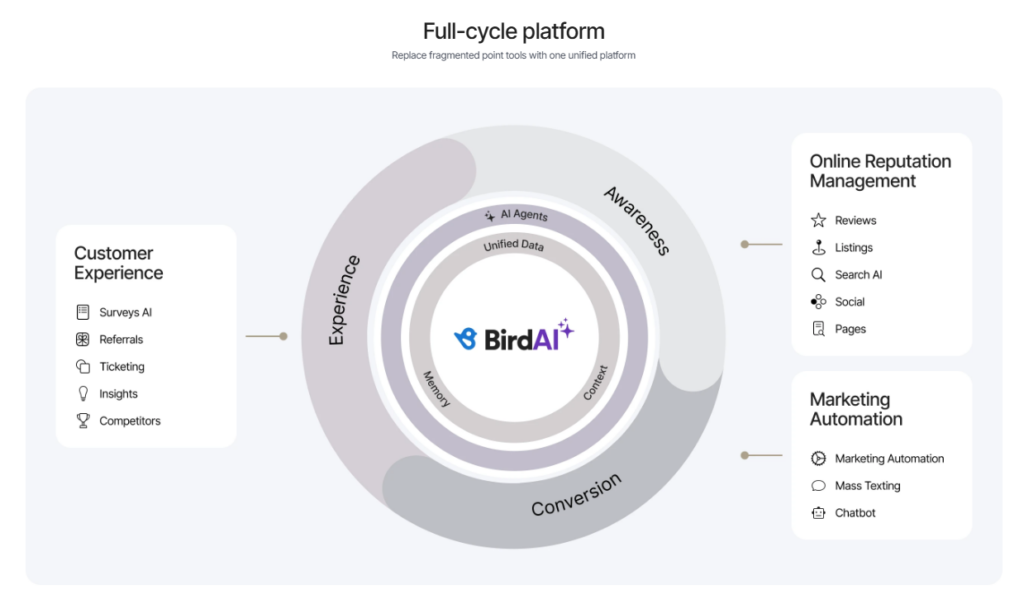
Together, these capabilities give NHS trusts, private hospital groups, GP federations, pharmacy chains, and dental groups a scalable foundation for review management that is built around UK regulatory requirements rather than around US-market assumptions.

Which review management software is best suited for UK healthcare providers?
Choosing the right review management software is a significant decision for any UK healthcare provider. The platform you select must support the specific mix of NHS and private review channels relevant to your organisation, integrate with your existing patient administration systems, and operate within the compliance boundaries set by CQC, GMC, and the ICO.
The comparison below covers the six most relevant options for UK healthcare providers, from full-service platforms to NHS-specific tools.
| Platform | NHS + CQC fit | Private fit | Regulator compliance features | Integrations | Best for |
| Birdeye | Good | Excellent | Healthcare response guardrails, sentiment analysis, DPA available, AI search visibility | Google, Doctify, Trustpilot, major PMS systems | Private hospital groups, dental groups, pharmacy chains, GP federations managing 100-10,000+ locations |
| Doctify | Low | Excellent | Verified appointment reviews, GMC-aware profile management | Private PMS systems | Private consultants, specialists, and private hospital groups |
| iWantGreatCare | High | Medium | Verified reviews, NHS trust-ready reporting, CQC-relevant data | NHS PAS systems | NHS trusts, community services, individual consultants |
| Care Opinion | Excellent | Low | Moderated stories, direct CQC evidence feed, NHS England data sharing | NHS systems natively | NHS trusts, mental health services, community providers |
| ReviewTrackers | Low | Good | General compliance features, not healthcare-specific | Google, Trustpilot, Facebook | Private providers already using ReviewTrackers for non-healthcare locations |
| Manual baseline | Variable | Variable | Entirely dependent on internal process | None | Very small single-site providers with limited review volume |
What this table tells us
No single platform covers every requirement for every UK healthcare provider. The right choice depends on your organisation type, the platforms your patients use most, and the scale at which you need to operate.
For NHS providers, Care Opinion and iWantGreatCare are purpose-built for the NHS environment and carry direct credibility with CQC. They should form the foundation of any NHS review management process.
However, they do not cover Google or private platforms, which means NHS providers with any private patient activity or a strong Google presence will need an additional tool.
For private providers, Doctify is the dominant platform for verified clinical reviews and should be a non-negotiable part of the stack. However, Doctify alone does not provide the multi-platform monitoring, AI search visibility, or operational analytics that larger private hospital groups and multi-site organisations need.
Birdeye sits alongside these NHS-specific platforms rather than replacing them. For multi-location private providers and large GP federations managing reputation across Google, Doctify, Trustpilot, and beyond, Birdeye provides the centralised operational layer that individual platforms cannot offer on their own.
How did Mydentist achieve a 99% Google review response rate across 530 locations?
The Brand

mydentist is the largest provider of dental care in the UK, serving approximately 4 million active patients across more than 530 locations. With a mission to make dental care affordable and accessible, the group was undergoing a major transformation, relocating practices to high-street and retail locations while scaling its digital operations.
The challenges
- Over 1,500 online listings across platforms, many of which were inaccurate, duplicated, or created by patients and competitors without oversight
- Patients were being misdirected to incorrect locations or encountering outdated closure notices during large-scale practice relocations
- No centralised view of reviews across Google, Trustpilot, NHS, and Indeed, making timely responses and brand protection difficult
- Despite 25% of web traffic originating from Google Business Listings, the channel was not receiving the same investment as paid advertising
The results
- 99% response rate to Google reviews achieved and maintained across 2023 and 2024
- 98% response rate across all review sources
- Reviews up 50% year on year, well above the historical trend
- Average rating climbed from 4.4 to 4.6 within six months of implementation
- 530 locations successfully migrated to Birdeye in a matter of days, an outcome that had been unachievable over 18 months with a previous vendor
- 10% uplift in year-on-year interactions on Google Business Listings, with more patients taking onward actions to visit the mydentist website

As Peter Bailey, Head of Digital at mydentist, shares:
“We have been able to work with the team to make continued optimisations. We still have plenty of work to do, but it feels like we’re building on a stable foundation again.”
The strategies discussed here can also be adapted by brands for dental practices, where dental review management UK plays a key role in maintaining patient trust and visibility.
What is the difference between healthcare reputation management and review management?
Review management is the operational layer that collects, monitors, and responds to patient feedback across platforms. Reputation management is the broader strategic outcome, encompassing accurate listings on the NHS Choices directory, visibility on the GMC register, organic search performance, and how a provider appears in AI-generated search responses. Effective review management is one of the most important inputs into a strong healthcare reputation, but it is one component of a wider strategy.
How do UK healthcare privacy laws apply to review management?
The following numbered framework sets out the privacy obligations that directly affect how UK healthcare providers collect, request, respond to, and manage patient reviews.
1. UK GDPR and the Data Protection Act 2018
The UK GDPR, retained in UK law through the Data Protection Act 2018, is the primary data protection legislation governing all UK healthcare providers. It replaced the EU GDPR in the UK following Brexit and is enforced by the Information Commissioner’s Office.
For review management, the key obligations under UK GDPR are:
- Patient contact details used to send review requests are personal data and must be processed under a clear lawful basis
- Any data that connects a patient to their care or treatment is special category data under Article 9 and requires additional protection
- Third-party review platforms must be covered by a signed Data Processing Agreement before any patient data is shared with them
- Patient data must not be transferred outside the UK without appropriate safeguards, such as UK adequacy regulations or standard contractual clauses
2. UK GDPR Article 9: special category data
Article 9 of the UK GDPR classifies health data as special category data, which carries stricter processing requirements than ordinary personal data. This applies directly to review management in two ways.
First, sending a post-appointment review request inherently connects a patient to a healthcare interaction, which the ICO considers to involve special category data processing. Providers must document their lawful basis for this processing, typically explicit consent or legitimate interests supported by a legitimate interests assessment.
Second, any review response that reveals clinical information, confirms a treatment, or identifies a patient in connection with their care constitutes unauthorised disclosure of special category data and is a potential breach reportable to the ICO under UK GDPR Article 33.
3. GMC Good Medical Practice 2024: paragraphs 100 to 104
GMC Good Medical Practice 2024 sets out specific obligations for doctors responding to online reviews and feedback. Paragraphs 100 to 104 make clear that:
- Doctors must not respond to reviews in a way that identifies the patient or discloses clinical details
- Doctors must not post content online that could damage public trust in the profession
- Doctors must take steps to have inaccurate or misleading information about them corrected through appropriate channels rather than through public disputes in review responses
These obligations apply to individual doctors, not just the organisations they work for. A consultant responding personally to a Doctify review is subject to the same GMC standards as one responding through their hospital’s communications team.
4. NMC Code Section 20: Advertising and testimonials
NMC Code Section 20 requires nurses and midwives to ensure that any advertising they engage in is accurate and does not mislead patients. This has direct implications for how review content is used in marketing materials. A testimonial that implies a clinical outcome, guarantees a result, or could create unrealistic expectations about care is inconsistent with NMC Code obligations.
5. CQC Regulation 17: Good governance
CQC Regulation 17 requires registered providers to maintain effective systems for assessing, monitoring, and improving the quality and safety of services. This includes how providers handle patient feedback and complaints. A provider without a documented process for monitoring and responding to online reviews may find this raised as a governance concern during a CQC inspection, particularly where negative review trends suggest systemic service issues.
6. GDC, GPhC, and HCPC advertising standards
The General Dental Council, the General Pharmaceutical Council, and the Health and Care Professions Council each publish standards governing how their registrants use patient feedback in public-facing communications. The consistent principle across all three bodies is that patient testimonials must be genuine, not selectively presented to create a misleading impression, and not imply clinical outcomes that cannot be guaranteed.
7. The Defamation Act 2013
Where a review contains false statements of fact that have caused or are likely to cause serious harm to a provider’s reputation, the Defamation Act 2013 provides a legal framework for seeking removal or redress. However, legal action under the Defamation Act is a last resort. Providers should first request removal through the platform’s own process, document all steps taken, and consult their indemnity provider at MDU, MPS, or MDDUS before considering litigation.
A summary of what applies and what does not
| Legislation or standard | Applies in UK | Applies in US | Relevant to review management |
| UK GDPR and Data Protection Act 2018 | Yes | No | Yes, core obligation |
| HIPAA | No | Yes | Never applies to UK providers |
| GMC Good Medical Practice 2024 | Yes | No | Yes, response conduct |
| NMC Code Section 20 | Yes | No | Yes, advertising and testimonials |
| CQC Regulation 17 | Yes | No | Yes, governance and feedback systems |
| GDC, GPhC, HCPC standards | Yes | No | Yes, advertising guidance |
| Defamation Act 2013 | Yes | No | Yes, defamatory review removal |
Managing online presence within healthcare regulations often involves a combination of reputation, review, and engagement workflows, which are explored further on Birdeye UK healthcare( dental).
FAQs about healthcare review management in the UK
NHS providers can invite honest feedback, and the Friends and Family Test is a mandatory part of that process. However, they cannot incentivise patients to leave positive reviews or filter out negative responses before publication. CQC frames patient feedback as a service improvement function, not a marketing activity.
CQC uses online reviews on platforms such as Google, NHS.uk, and Care Opinion as one source of evidence under its Single Assessment Framework. It does not grade providers directly on review scores, but persistent negative sentiment can influence the focus and frequency of inspections.
Replying to a review is not a breach in itself. The breach occurs if the response confirms the reviewer is a patient, references their treatment, or discloses any clinical detail. Responses must remain general, professional, and direct; unresolved concerns should be directed to a private channel.
Birdeye supports monitoring and response across Google, Doctify, Trustpilot, and a range of other platforms. For NHS.uk and Care Opinion specifically, we recommend confirming current integration capability directly with the Birdeye UK team, as platform access policies for third-party tools can change.
The first step is to document the review and request removal through the platform’s own process. If removal is refused and the content meets the threshold for serious reputational harm under the Defamation Act 2013, providers should consult their indemnity provider at MDU, MPS, or MDDUS before considering legal action.
Review management is the operational process of collecting, monitoring, and responding to patient feedback across platforms. Reputation management is the broader strategic outcome, covering listing accuracy, search visibility, AI search presence, and how a provider is perceived across all digital touchpoints. Review management is one of the most important inputs into a strong healthcare reputation, but it is one component of a wider strategy.
The five C’s in a hospital setting are care, compassion, competence, communication, and courage. These are the values underpinning the NHS Constitution and form the foundation of how NHS providers are expected to deliver and be assessed on patient experience.
Better review management starts with getting the basics right
Effective healthcare review management in the UK sits at the intersection of patient experience, regulatory compliance, and digital visibility.
The obligations that matter are UK GDPR Article 9, GMC Good Medical Practice 2024, NMC Code Section 20, CQC Regulation 17, and the advertising standards of GDC, GPhC, and HCPC. Providers that build their review management process around these obligations will stay compliant and build the kind of patient trust that translates into stronger ratings and better care outcomes.
Birdeye brings together listings management, review monitoring, agentic responses, sentiment analysis, and AI search visibility on a full-cycle agentic marketing platform, giving multi-location healthcare providers the foundation they need to manage patient feedback consistently and compliantly across every site.
Ready to see Birdeye in action? Book a free demo today and find out how Birdeye helps UK healthcare providers manage reviews, maintain listing accuracy, and stay visible across Google, Doctify, and beyond.

About the Author

Sudeepta Bora
Originally published