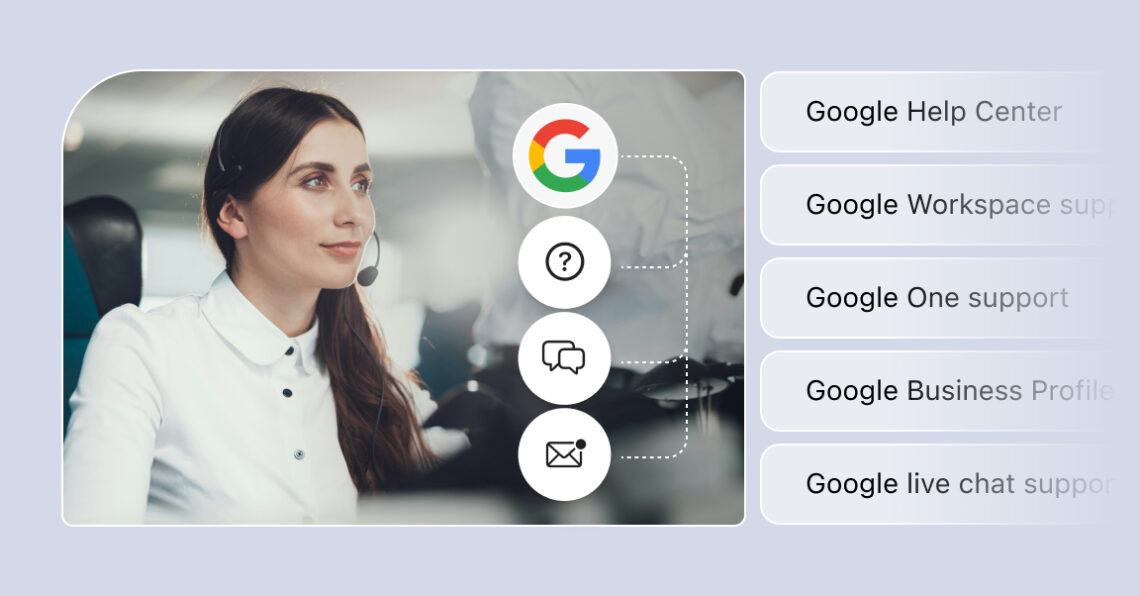
Google customer service for business support can be reached through the Google Help Center, Google Workspace support, Google One support, live chat, product-specific support forms, community forums, and official Google social channels. Choosing the right support channel can help businesses resolve issues related to Google Business Profile, reviews, ads, listings, and account access more efficiently.
Summary
Unlike traditional support teams, Google often routes users to product-specific help centers, community forums, and authenticated support channels rather than a single customer service line.
This guide explains the fastest ways to contact Google customer service, when live support is available, how to troubleshoot common Google issues, and what businesses can do to reduce recurring support problems across search and reputation management workflows.
Table of contents
- What is the fastest way to contact Google customer service?
- How can you use the Google Help Center for support?
- How can you contact Google support through live chat?
- Does Google offer email support?
- Can you contact Google customer support by phone?
- How can businesses get help from Google product communities?
- Can social media help you contact Google support?
- How can you get better results when contacting Google customer service?
- How is AI search changing business reputation management on Google?
- How multi-location brands reduce Google support issues with Birdeye?
- FAQs about Google customer service
- Prevent recurring Google support issues and stay in control of your online presence with Birdeye
What is the fastest way to contact Google customer service?
The fastest way to contact Google customer service depends on the Google product you are using and the type of account connected to it. Google does not offer one universal support team for all products, so support options vary across Google Business Profile, Google Ads, Google Workspace, YouTube, Gmail, and other services.
For most businesses, the quickest support channels are:
- Google Help Center
- Google Workspace support
- Google One support
- Google Business Profile support forms
- Google live chat support for eligible accounts
Businesses with paid Google products or verified business accounts typically receive faster access to support options like live chat, callback requests, or priority case handling.
Before contacting Google support, gather:
- Account email addresses
- Business Profile details
- Screenshots of the issue
- Error messages or case IDs
- Links to affected listings or pages
Providing detailed information early usually helps reduce back-and-forth communication and speeds up issue resolution.
For urgent Google Business Profile or listing-related issues, businesses should also use product-specific support channels instead of general Google help forums whenever possible.
How can you use the Google Help Center for support?
Google Help Center is usually the fastest starting point for troubleshooting Google-related issues. It provides product-specific guidance, support documentation, troubleshooting steps, and access to official support channels across Google products.
To find support more efficiently:
- Open the Help Center for the specific Google product you need help with.
- Search using direct, issue-based keywords rather than broad questions.
- Review Google’s recommended troubleshooting steps carefully.
- Use linked support forms or escalation options if the issue remains unresolved.
For example, instead of searching:
- “Google issue”
- “Google problem”
search:
- “Google Business Profile suspended.”
- “Google reviews not showing up.”
- “Google Ads account disabled.”
Specific searches usually surface more accurate troubleshooting guidance and faster escalation paths.
For urgent Google Business Profile or listing-related issues, businesses should also use product-specific support channels instead of general Google help forums whenever possible.
How can you contact Google support through live chat?
Businesses can contact Google via live chat by signing in to eligible Google accounts, such as Google Workspace, Google One, Google Ads, or verified Google Business Profiles, and selecting the “Contact support” option when chat is available.
Google offers live chat support for selected products and account types. However, live chat is not available for every Google service or issue type. Availability may depend on subscription status, account verification, region, business category, and support demand
Live chat support is most commonly available for:
- Google Workspace
- Google One
- Google Ads
- Selected Google Business Profile issues
Birdeye’s State of Google Business Profile 2026 report found that 76% of businesses now operate verified Google Business Profiles, up from 71% in 2024. Verification has become increasingly important not only for local visibility but also for accessing faster support options and account recovery assistance.
To access Google live chat support through Google Workspace:
- Sign in to your Google Workspace account.
- Open the Google Admin Console.
- Click the Help icon.
- Select Contact support.
- Choose live chat if available.
Google One members can also access live support directly through their Google One account dashboard.
Before starting a live chat session, prepare:
- Business account details
- Screenshots of the issue
- Verification information
- URLs or listing links
- Previous support case IDs
This helps representatives understand the issue faster and reduces the need for repeated troubleshooting steps.
For Google Business Profile issues, live chat availability may vary depending on:
- Account status
- Verification level
- Region
- Business category
- Issue type
If live chat is unavailable, Google may redirect users to:
- Support forms
- Callback requests
- Help Center documentation
- Community support channels
Does Google offer email support?
Google does not provide a universal customer support email address. Businesses typically need to use product-specific support forms, authenticated support channels, or Help Center workflows rather than emailing Google directly.
Support access usually depends on:
- The Google product involved
- Account type
- Verification status
- Subscription level
For example, businesses using Google Workspace, Google Ads, and Google One may receive access to email-based case communication after opening a support request through official channels.
For most Google Business Profile, listing, or review-related issues, Google directs users to:
- Support forms
- Help Center articles
- Verification workflows
- Community forums
- Live chat or callback requests when eligible
Businesses should avoid relying on unofficial email addresses claiming to provide Google support. Many third-party listings and scam websites publish outdated or inaccurate support information.
The safest approach is to start with Google’s official Help Center or a product-specific support portal before escalating issues further.
Can you contact Google customer support by phone?
Google provides phone support for some products and business accounts, but phone access is not available for every issue or user type. Most phone support is tied to paid services, verified business accounts, or product-specific support programs.
In many cases, Google prefers that users request callbacks through official support portals rather than calling general support numbers directly.
Before requesting phone support, businesses should prepare:
- Account information
- Business Profile details
- Billing information
- Case IDs or support ticket numbers
- Screenshots and error details
This helps reduce delays during troubleshooting and escalation.
Businesses should also be cautious of unofficial “Google support” phone numbers listed on third-party websites. Google support scams are common, especially around Google Business Profiles, verification issues, and listing suspensions.
For most business-related issues, Google’s official Help Center and authenticated support channels remain more reliable than public phone listings.
How can businesses get help from Google product communities?
Google product communities help businesses troubleshoot issues by connecting users with Product Experts, business owners, and other users who have experienced similar problems.
These communities are commonly used for issues related to:
- Google Business Profile
- Google Ads
- Google Maps
- Gmail
- YouTube
- Google Workspace
Businesses can use Google Communities to:
- Search existing discussions
- Find troubleshooting steps
- Learn escalation paths
- Understand policy-related issues
- Track widespread outages or platform bugs
Google Product Experts are experienced contributors who help moderate discussions and guide users toward official support resources. While they are not Google employees, they often provide useful troubleshooting guidance for common platform issues.
To get better responses in community forums:
- Use the exact product name
- Clearly explain the issue
- Include screenshots when possible
- Add relevant URLs or listing details
- Mention the troubleshooting steps already completed
Specific questions usually receive faster and more accurate responses than broad support requests.
For complex listing, verification, or reputation-related issues affecting multiple locations, businesses should still rely on official support channels and internal documentation rather than on public forums alone.
Can social media help you contact Google support?
Social media is not a primary channel for Google customer support, but it can help businesses stay informed about major outages, product disruptions, or widespread platform issues.
Google teams sometimes post updates through official social channels for products like:
- Google Workspace
- Google Ads
- YouTube
- Google Maps
- Google Business Profile
Businesses also use social media platforms like Reddit, YouTube, X (formerly Twitter), and Google community forums to find troubleshooting discussions, workaround suggestions, and updates from other users experiencing similar issues.
Social platforms can be especially useful when:
- Google services are down
- Verification delays affect many businesses
- Reviews disappear unexpectedly
- Listing suspensions impact multiple accounts
However, businesses should avoid sharing sensitive account information publicly while seeking help on social channels.
For account-specific issues, official Google support channels and authenticated support portals remain the safest and most reliable option.
Check Out These Ways to Contact Google Customer Service
Want to see the impact of Birdeye on your business? Watch the Free Demo Now.
How can you get better results when contacting Google customer service?
Google support cases are usually resolved faster when businesses provide clear and complete information from the beginning. Vague issue descriptions often lead to longer troubleshooting cycles and repeated verification requests.
Before contacting Google customer service, prepare:
- The exact product involved
- Account email addresses
- Business Profile links or URLs
- Screenshots of the issue
- Error messages or case IDs
- Dates and timestamps related to the problem
Businesses should also keep support requests focused on one issue at a time. Combining multiple unrelated problems into a single case can slow escalation and create confusion during troubleshooting.
When reporting issues, use direct descriptions such as:
- “Google Business Profile suspended after verification.”
- “Google Ads billing account disabled.”
- “Duplicate business listing showing in Maps”
- “Reviews not showing up on Google.”
Specific issue descriptions help support teams route requests more accurately.
For recurring listing issues, businesses should document:
- Previous support tickets
- Verify their GBP account
- Listing edits
- Ownership changes
- Review activity
Maintaining internal records makes it easier to escalate unresolved issues across teams and locations.
Businesses managing multiple locations should also standardize support workflows internally so that regional teams follow the same escalation and documentation processes across all locations.
How is AI search changing business reputation management on Google?
Google search is evolving beyond traditional rankings and blue links. AI-generated search experiences now summarize businesses using reviews, listings, customer sentiment, and online reputation signals pulled from multiple sources across the web.
Birdeye’s State of AI Search 2026 report found that discovery is rapidly shifting from traditional rankings to AI-generated, citation-backed answers. The report also found that while 80% of brands were cited at least once by AI engines, only 15% controlled the top-cited position with their own content.
When customers search for:
- “best dentist near me”
- “top-rated restaurant in Chicago”
- “trusted HVAC company”
Google’s AI-generated search experiences may summarize businesses directly in search results, rather than only showing links to websites.
This changes how businesses manage Google visibility and online reputation.
Google’s reputation management now depends on maintaining strong signals across:
- Google reviews
- Business listings
- Customer responses
- Review recency
- Ratings consistency
- Website accuracy
Inconsistent listings, unanswered reviews, or outdated business information can affect how businesses appear across both traditional search and AI-generated search experiences.
For multi-location brands, reputation management becomes even more operationally complex because visibility issues across multiple locations can influence how the overall brand is perceived in AI-driven search experiences.
Many businesses are also beginning to focus on Generative Engine Optimization (GEO), which helps improve how brands appear across AI assistants and AI-powered search platforms beyond traditional SEO.
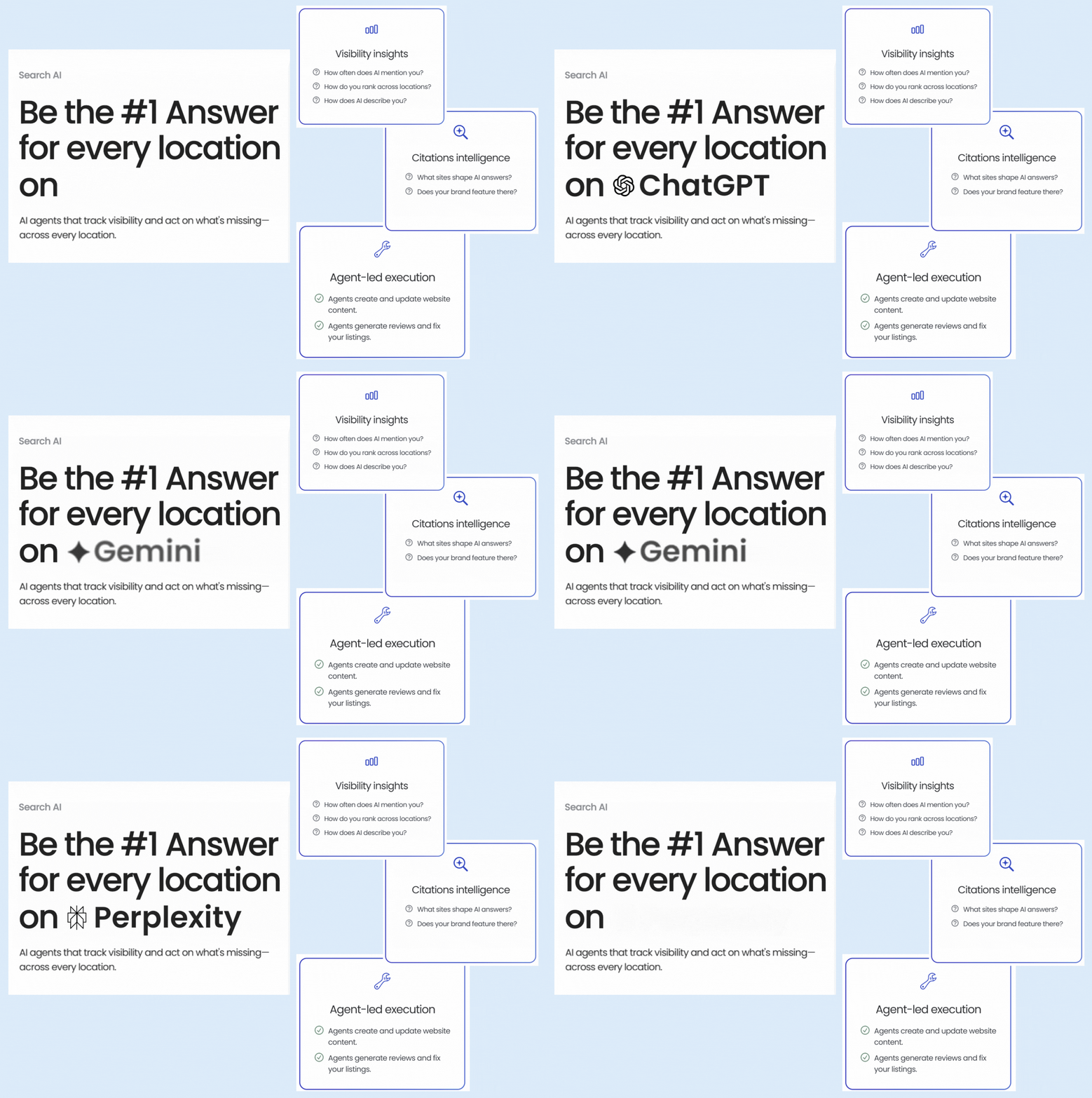
Tools like Birdeye Search AI help businesses monitor how locations appear in AI-generated search experiences, identify reputation gaps, and track the signals that influence AI visibility across modern search engines.
How multi-location brands reduce Google support issues with Birdeye?
Many recurring Google support issues happen because business information, reviews, listings, and customer interactions are managed across disconnected systems.
Birdeye’s agentic marketing platform helps brands centralize these workflows so teams can identify and resolve visibility issues earlier, rather than reacting after rankings, reviews, or listings are affected.
Birdeye helps brands:
- Monitor reviews across platforms
- Maintain listing accuracy across 100-10,000+ locations
- Track customer sentiment trends
- Manage customer communication centrally
- Monitor AI search visibility
- Standardize workflows across teams and locations
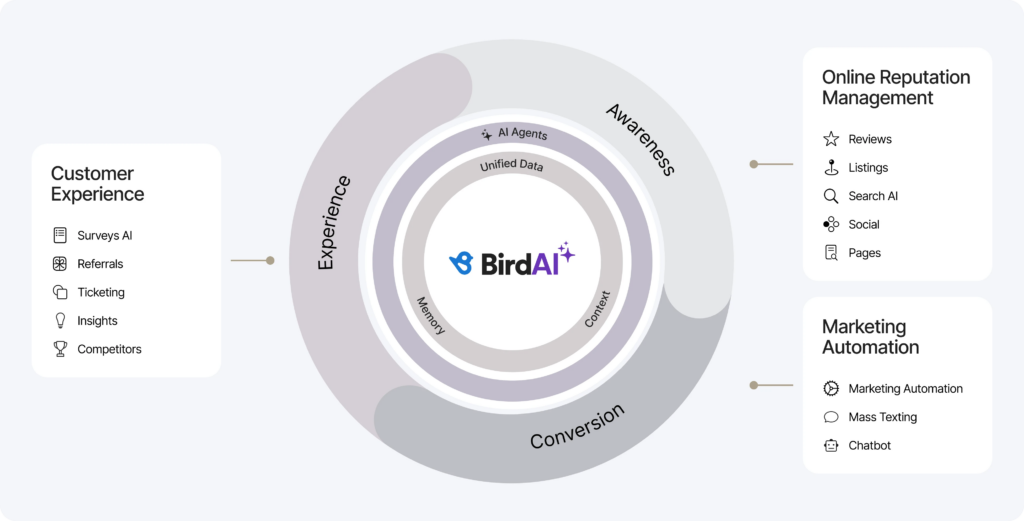
Birdeye’s AI agents help reduce operational gaps that often lead businesses to contact Google support repeatedly:
- Review Generation Agent helps businesses consistently collect recent customer reviews.
- Review Response Agent helps teams respond faster while maintaining brand consistency.
- Listings Optimization Agent helps maintain accurate business information across search platforms and directories.
- Review Reporting Agent helps businesses identify recurring customer issues and operational trends earlier.
A specialized workforce of AI Agents
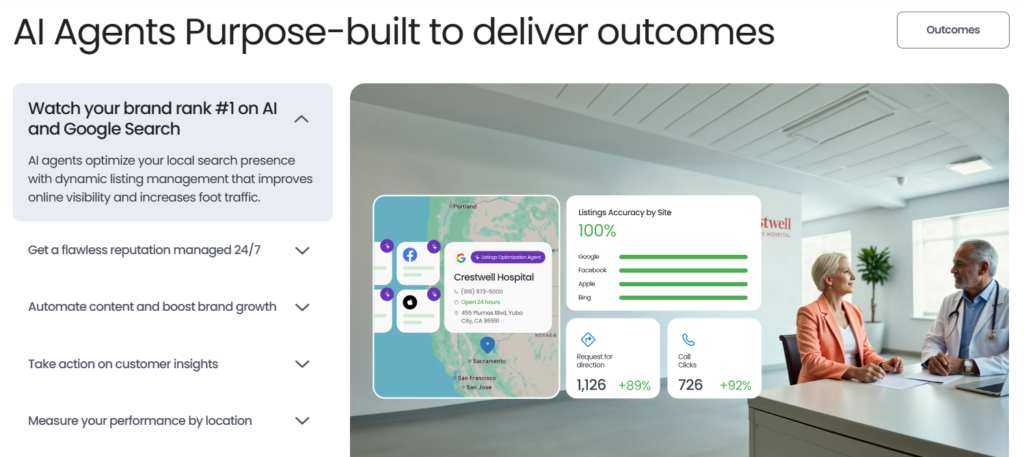
Birdeye’s full-cycle platform is built on a unique Consolidate, Think, Act framework designed specifically for the complexity of multi-location brands.
- Consolidate: Unlike point solutions that fragment data, Birdeye unifies your entire marketing stack—reviews, listings, social, messaging, and automation—into one full-cycle platform.
- Think: It uses Local Intelligence from a unified Customer Data Platform (CDP). Agents don’t just follow rules; they reason using 13 years of multi-location data, industry benchmarks, and brand-specific knowledge to make store-by-store decisions.
- Act: Agents serve as an autonomous workforce, executing tasks such as drafting personalized campaigns, responding to reviews, and optimizing search visibility without manual intervention.
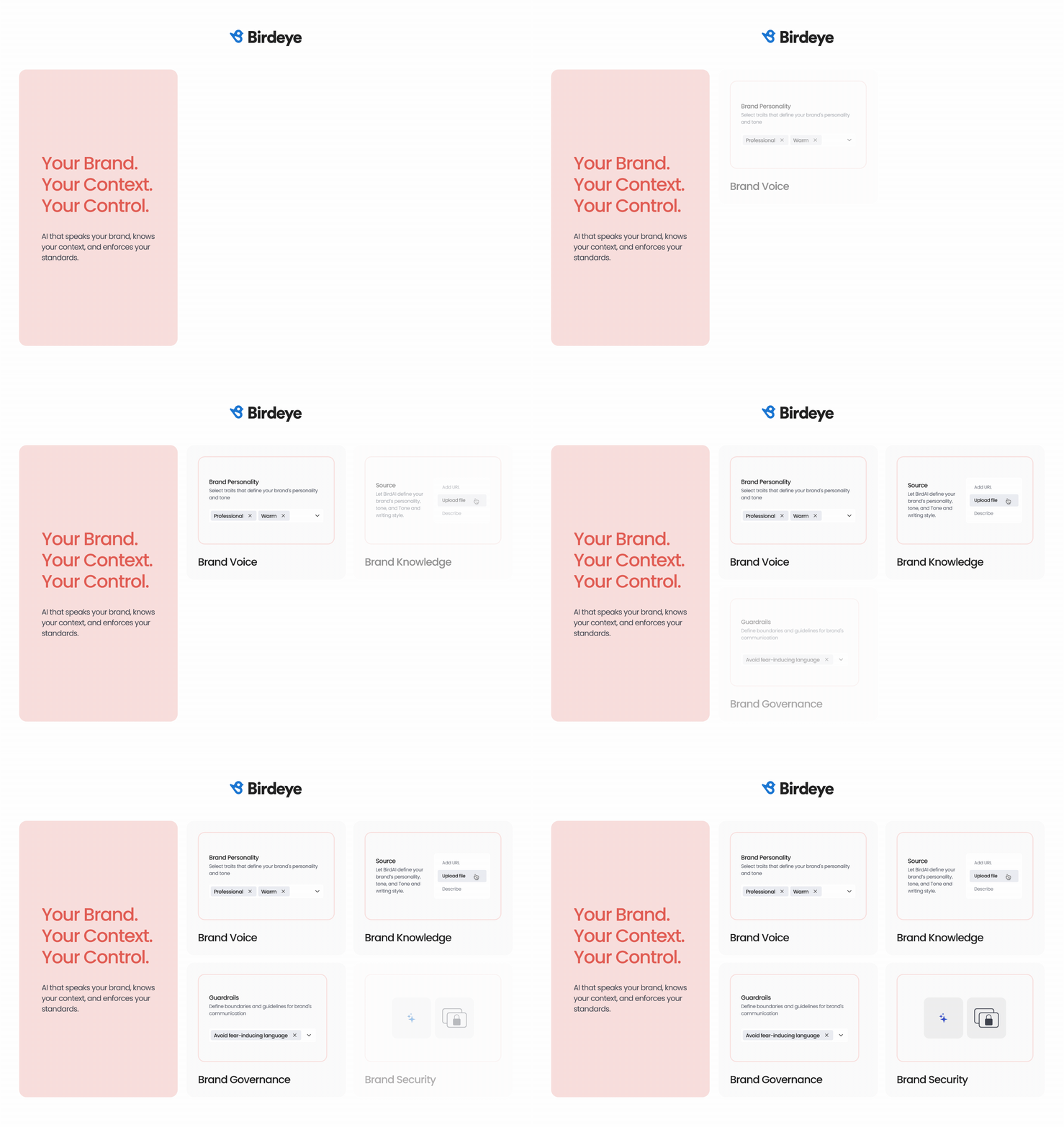
Enterprise-grade governance
Birdeye’s agentic model keeps marketers in control with human-in-the-loop governance. It provides the control complex brands need through:
- Brand-Trained Intelligence: Agents are trained on your unique brand voice, kit, and governance rules to ensure every interaction is on-brand.
- Industry Compliance: Built-in guardrails ensure AI outputs pass strict industry standards (e.g., HIPAA for healthcare or FINRA for finance).
- Human-in-the-Loop: Marketers stay in control with tiered approval workflows, allowing agents to act autonomously where trusted and pause for review where sensitive.
By consolidating signals and deploying a brand-trained autonomous workforce, Birdeye allows multi-location teams to 10x their capacity. Instead of managing tools and data stitching, teams can focus on strategy while agents handle execution across thousands of locations.
FAQs about Google customer service
Businesses can reduce recurring support issues by maintaining accurate listings, consistently monitoring reviews, and documenting support cases. Platforms like Birdeye centralize the entire reputation management workflow across 100-10,000+ locations.
Yes. Businesses can request reinstatement for suspended Google Business Profiles through Google’s official appeal and verification process. Providing accurate business information, supporting documents, and consistent listings usually improves reinstatement success rates.
Platforms like Birdeye help businesses improve negative search visibility by managing reviews, listings, customer feedback, and reputation signals across search engines and AI-generated search experiences.
Birdeye is a top-rated enterprise ORM software for multi-location brands, offering review management, listings, messaging, social engagement, reporting, and AI-driven reputation workflows from one platform.
To contact Google, visit the Google Help page and navigate to the specific product you’re having issues with. If chat, email, or phone support options are available, that will be noted in the support documentation.
Prevent recurring Google support issues and stay in control of your online presence with Birdeye
Most recurring Google support issues, like listing suspensions or disappearing reviews, happen because business data is fragmented across disconnected systems.
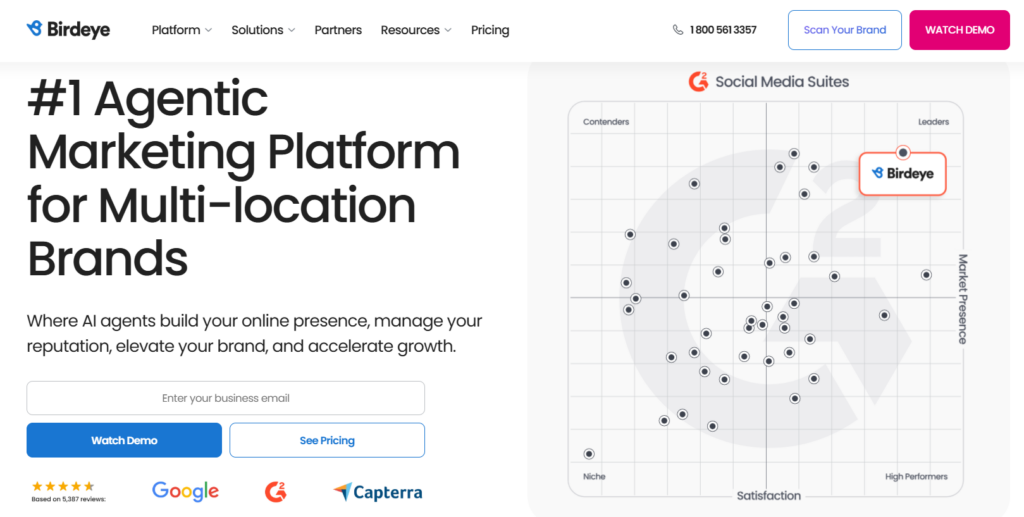
Birdeye’s agentic prowess is defined by a specialized workforce of autonomous AI agents that act as an extension of your marketing team. Unlike traditional software, these agents are purpose-built to execute complex workflows across the full marketing flywheel.
Below is the complete specialized workforce of Birdeye AI Agents:
| Category | AI Agent | Agentic prowess |
| Presence & Search | Listings Optimization Agent | Automatically syncs and protects business data across 200+ sites to eliminate manual support tickets. |
| Reputation | Review Generation Agent | Autonomously requests reviews via SMS/Email at the moment of peak customer satisfaction. |
| Review Response Agent | Drafts on-brand, empathetic replies based on sentiment analysis; ready for human-in-the-loop approval. | |
| Social & Leads | Social Publishing Agent | Scans local trends to create and schedule platform-specific content across 1,000s of locations simultaneously. |
| Social Engagement Agent | Monitors comments and mentions 24/7, drafting contextual responses to maintain community health. | |
| Lead Generation Agent | Conducts human-like, omnichannel conversations to capture lead data and book appointments on autopilot. | |
| Automation | Contact Segmentation Agent | Dynamically organizes your CDP into high-intent lists without manual database queries. |
| Template Design Agent | Instantly generates brand-compliant emails and landing pages from simple text prompts. | |
| Insights | Review Reporting Agent | Analyzes thousands of reviews to identify operational gaps (e.g., “Service is slow at the Chicago branch”). |

About the Author

Shruti Dugar
Birdeye
Originally published
![this is a 1 / 1 – [Feature image] of the blog about 31 irresistible car sales email templates to close more deals.](https://birdeye.com/blog/wp-content/uploads/Feature-image-31-irresistible-car-sales-email-templates-to-close-more-deals-375x195.jpg)