Retail customer experience isn’t defined by ambience or store design anymore — it’s the sum of hundreds of micro-moments across search, discovery, visit, service, and follow-ups. And today, both customers and AI answer engines judge those instantly.
Summary
Today’s shoppers only have a few seconds to decide whether to say yes or no to your brand. And it rarely happens inside your store. It happens much earlier, in small, fast decisions: a quick search, a quick scan of reviews, a quick check of your hours, a quick scroll through your photos.

That’s what decides everything. This blog breaks down how modern retail customer experience (CX) is actually shaped today. If you want to understand why some stores keep winning traffic and trust while others fall behind, keep reading.
Table of contents
- What is retail customer experience?
- The 5 shopper questions that define your retail customer experience
- The three customer experience gaps quietly affecting your retail
- How do people and algorithms actually evaluate your retail customer experience?
- The modern retail customer experience strategy: AI for efficiency, humans for loyalty
- How Hudson’s Furniture used experience signals to drive real results
- FAQs about retail customer experience
- Birdeye: A retail customer experience platform loved by customers, favored by AI
What is retail customer experience?
Retail customer experience is how customers feel when they try to shop with you — before, during, and after the visit. It includes every interaction and every impression that influences whether they choose your brand, trust it, buy from it, and return.
It’s shaped by experiences like:
- Finding your business online
- Understanding what you offer
- Comparing you with competitors
- Walking into your store
- Getting help from staff
- Getting problems solved
- How supported they feel after the purchase
What retail customer experience used to be
For years, retail marketing was mostly about what happened inside the four walls of the store:
- Friendly staff
- Clean stores
- Clear signage
- Good checkout experience
If you delivered these well, you were considered a customer-centric brand. Stores were the center of the experience, and everything else supported it.
Why did it change?
The shopper changed before the industry did.
Today:
- Most decisions start online.
- Shoppers compare brands before they leave home.
- They trust real experiences more than marketing.
- Their patience is lower.
- Convenience matters as much as price.
- And AI is becoming the “first assistant” people ask for recommendations.
Experience now begins long before someone steps into a store.
So the traditional “in-store-only” definition no longer reflects how retail actually works.
What retail CX is now?
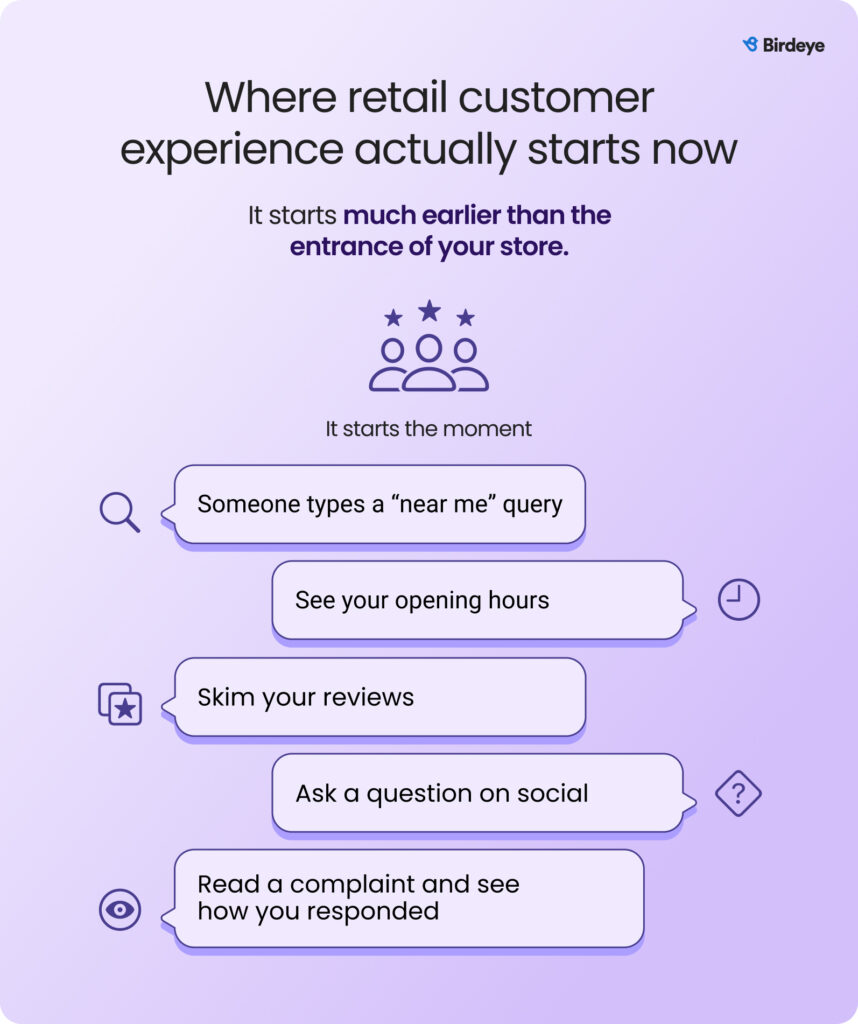
Retail CX today is everything a customer notices, interacts with, or judges while shopping with you — across digital and physical touchpoints.
It includes:
- Whether they can find your business quickly
- Whether your information is correct everywhere
- Whether people say good things about you
- Whether the in-store experience matches what was promised online
- Whether help is available instantly when something goes wrong
- Whether the brand stays useful even after the purchase
Modern retail CX is a journey, and customers evaluate you at each step.
Discoverability is part of the customer experience.
Accuracy is part of the customer experience.
Even what AI says about your brand is part of the customer experience.
And accuracy now matters even more because AI systems often misinterpret local business data. Birdeye’s 2025 Local Search Accuracy Benchmark found that LLMs frequently produced major errors — including listing permanently closed locations, misplacing businesses by more than 15 miles, and confusing service categories.
These mistakes directly impact whether AI recommends your brand or sends shoppers to a competitor. That’s why it’s important to ask a few questions to understand if your brand is actually fulfilling your customer expectations.
The 5 shopper questions that define your retail customer experience
Every retail journey today has two layers:
- Digital journey a customer goes through before they visit you, and
- Physical journey they experience when they do.
Most retailers still focus heavily on the physical part—store design, staff training, checkout speed. That still matters, but it’s no longer where customers begin forming their impression. Their judgment of your brand starts much earlier, through digital signals: search results, map listings, reviews, photos, social replies, and now even what AI assistants say when someone asks a product or store question.
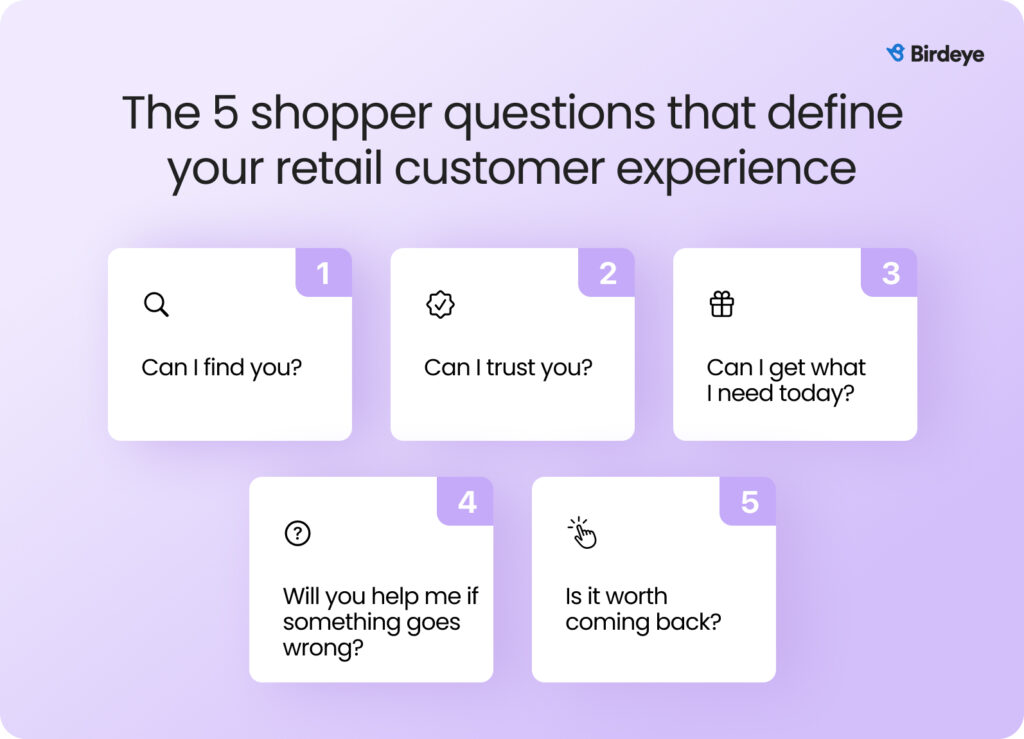
Before walking into a store, a customer is making dozens of micro-judgments without consciously thinking about them. Their mind is trying to answer:
- Is this brand worth my time, my trust, and my money?
If a retailer fails just one of these questions, the customer pauses.
If they fail two, the customer leaves.
If they fail three, the customer switches brands entirely.These questions also reveal something very important:

CX is no longer controlled by the retailer alone.
Customers, platforms, and algorithms shape it, and now AI systems — all interpreting how consistently your brand shows up across locations.
Q1 – Can I find you?
Before trust, before interest, before desire — a customer must simply be able to find you.
In a digital-first environment, “finding you” doesn’t just mean knowing your address. It means:
- You appear in the right local searches.
- Your store shows up accurately on Google and Apple Maps.
- Your brand is mentioned in AI-generated answers when someone asks a product or service question.
- Your profiles don’t confuse people with old hours or outdated information.
This is the foundation of retail CX. If customers can’t locate the right information quickly, they assume your brand will be just as inconsistent in-store. A shopper cannot begin their journey if your digital presence is scattered or incomplete.
Q2 – Can I trust you?
Once customers find you, the next question is immediate:
“Should I choose you?”
This is where digital trust plays a defining role. Customers look for:
- Ratings that feel recent and representative
- Reviews that sound authentic
- Real photos taken by real shoppers
- Thoughtful responses to complaints
- Consistency across all locations
And today, customers aren’t just searching by brand name.
In 2024, 86% of Google Business Profile impressions came from “near me” and category searches—not branded searches. This means shoppers are comparing you to every competitor in the area, even if they weren’t specifically looking for you.
This matters even more because Google’s AI Overviews now pull information directly from your GBP, and only businesses with structured, accurate, and regularly updated profiles qualify for prominent placement in these AI-generated summaries.
So even if your in-store experience is excellent, weak digital trust can block people from ever giving you a chance. Reviews and ratings now act as a pre-selection filter—customers want proof that their time won’t be wasted, and they rely on the experiences of other shoppers to make that decision long before they arrive.
Q3 – Can I get what I need today?
This question reflects the modern expectation of immediacy. Customers want to know—quickly and confidently—that you can solve their need now.
Digitally, they are checking whether:
- Your product is in stock
- Your hours are accurate
- Your pickup options are clear
- Someone answers their questions quickly on social media
- You actually offer what your profile says you do
If digital signals say “maybe,” “not sure,” or “confusing,” the customer interprets that as “too much effort.” And in a world with so many alternatives, effort feels expensive.
This question forces retailers to evaluate:
Are we making it easy for customers to take the next step right now?
Q4 – Will you help me if something goes wrong?
Shoppers don’t just choose brands based on features—they choose them based on how safe they feel in the event something breaks, arrives damaged, doesn’t fit, or doesn’t meet expectations.
Digitally, customers evaluate this through:
- How you reply to complaints
- Do you resolve issues publicly
- Do you sound human and fair
- Whether refund and returns policies are easy to find
- How quickly you respond when someone reaches out for help
This has nothing to do with perfection. It has everything to do with accountability.
In modern retail, a visible pattern of fairness and responsiveness is a powerful CX signal.
This question asks: If something goes wrong, will this brand take me seriously?
Q5 – Is it worth coming back?
The final judgment isn’t just about the transaction—it’s about the relationship.
Customers ask themselves:
- Was the experience consistent from online to in-store?
- Did I feel valued or ignored?
- Did the brand follow up after the purchase in a human way?
- Do I trust the experience enough to repeat it?
This is where loyalty is built—not through points or discounts but through dependability across all touchpoints. Retail CX is not about one good moment; it’s about a pattern of good decisions that make returning feel effortless.
This question asks: Did this brand earn a second chance, a second visit, or a second purchase?
Why these five questions matter
These five questions don’t function independently—they build on each other:
Find → Trust → Decide → Experience → Return.
If customers can find you, they trust you.
Once they trust you, they check whether you can serve them today.
If that looks promising, they decide whether engaging with you feels safe.
And if all of that works, they mentally bookmark your brand for next time.
The questions create a chain.
Break one link, and the customer breaks away.
This is why digital retail CX is no longer optional.
It’s the backbone of how shoppers make decisions, and your brand’s job is to answer each question with clarity, consistency, and confidence before they ever walk into your store.
The three customer experience gaps quietly affecting your retail
Even strong retail brands lose customers because of a few gaps that rarely show up on dashboards but have a massive impact on footfall, satisfaction, and loyalty. These gaps occur when the digital and physical parts of the journey drift apart. When that happens, customers feel confused or disappointed — and they quietly switch to a competitor.
Here are the three experience gaps every retailer should watch for.
1. The visibility gap
This gap exists when your digital presence doesn’t reflect your real-world strengths.
Your stores might deliver great service, but online, you may appear outdated, inconsistent, or simply less visible than competitors. Customers never see your best work because they don’t get past the first step.
2. The consistency gap
This gap happens when your brand experience varies too much across locations or channels.
Customers expect a national or multi-location brand to deliver a similar, reliable experience everywhere. When store A is excellent but store B is slow or disorganized, or when online promises don’t match in-store reality, customers don’t know what to expect next time.
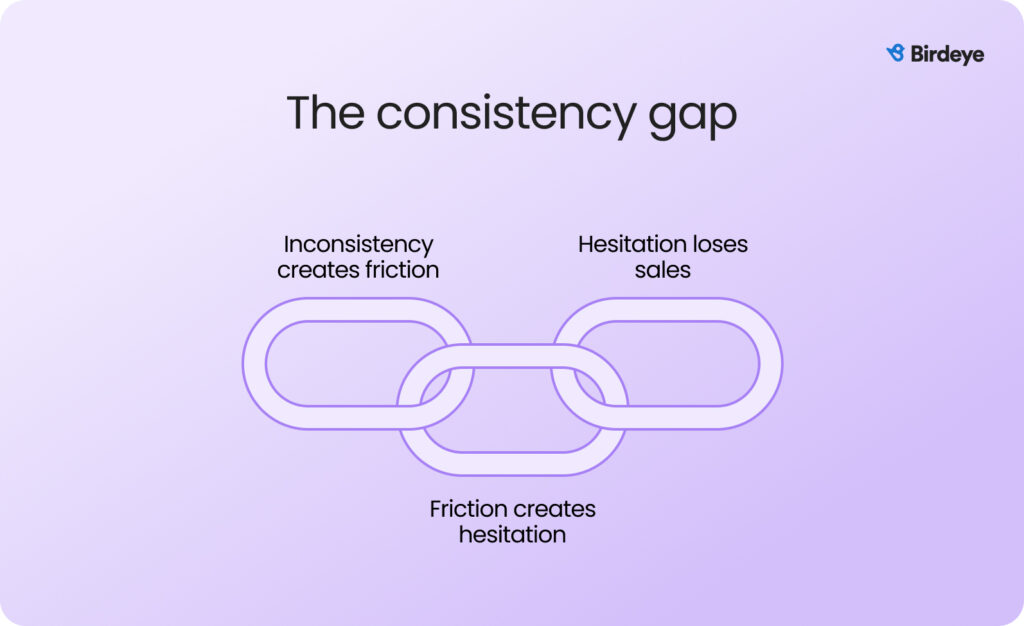
This gap drains performance because it weakens your brand’s dependability — and dependability is what drives repeat visits.
3. The follow-through gap
This is the gap most retailers don’t realize they have.
The follow-through gap appears after the purchase — when the brand stops engaging, stops listening, or stops learning from customer feedback.
It shows up as:
- Missed opportunities to turn good experiences into advocacy
- Unresolved issues that quietly damage sentiment
- No signals that the brand cares beyond the transaction
This is about momentum.
A brand that doesn’t follow through loses the momentum needed to build loyalty, reviews, and repeat customers.
Why these gaps matter more than ever
Because these gaps are silent, Customers rarely complain about them — they choose someone else.
Fixing these gaps stabilizes the entire customer journey:
– Visibility brings customers in
– Consistency keeps the experience predictable
– Follow-through brings them back
Before we can improve retail CX, we need to understand how it’s judged.
Customers don’t evaluate your experience based on slogans, promises, or campaigns. They judge it through what they can see and verify, and so do the platforms, search engines, and AI systems that influence their decisions.

This brings us to the next section: how both people and AI search engines interpret your brand.
How do people and algorithms actually evaluate your retail customer experience?
Most retailers judge their customer experience based on what happens inside the store — staff behaviour, service quality, queues, cleanliness, and product availability. But the outside world evaluates you very differently. Customers and algorithms don’t base their judgment on strategy decks, internal messaging — they judge based on the signals your brand sends out every day.
These signals determine whether a shopper chooses you, and whether platforms like Google, Apple Maps, and AI search engines highlight you.
Here’s what truly gets noticed and how Birdeye’s AI tools help retailers strengthen each signal:
1. Freshness signals: How active your brand appears online
People and platforms both trust brands that look current. Recency signals — like new reviews, recent photos, updated hours, and consistent social posts show that a retailer is attentive and present. A stale presence signals neglect, even when the stores themselves are strong.
How Birdeye strengthens this signal:
Reviews AI maintains a steady flow of authentic new reviews and responses.
Listings AI continuously updates hours, attributes, and photos across dozens of platforms.
Social AI keeps each location active with fresh, on-brand content, ensuring your digital storefront never goes quiet.
2. Responsiveness signals: How reliably your brand engages
Customers and algorithms assess not just whether you respond, but how consistently and how well. Tone, speed, and clarity all matter. Slow replies, generic templates, or unanswered comments suggest a brand that treats engagement as an afterthought.
How Birdeye strengthens this signal:
Review Response Agent crafts thoughtful, context-aware replies to every review.
Social Engagement Agent handles comments, questions, and DMs across every location instantly — detecting intent and routing high-priority issues to the right teams.
This creates a dependable pattern of responsiveness at scale.
3. Accuracy signals: How trustworthy and dependable your information is
Customers rely heavily on basic facts — hours, phone numbers, services offered, availability notes — and expect them to be correct everywhere. Even one incorrect detail raises doubt. For algorithms, accuracy is a quality marker that influences local rankings and visibility.
How Birdeye strengthens this signal:
Listings AI constantly monitors and corrects business information across listing sites, directories, and maps, ensuring every platform shows consistent, up-to-date details.
Search AI extends that accuracy into AI engines, identifying incorrect descriptions and misinformation that AI systems may be spreading.
4. Pattern signals: What your data repeatedly says about you
Customers don’t judge retailers by one review or one visit — they judge by patterns. Algorithms do the same. Consistency in sentiment, recurring themes, regional differences, and store-by-store performance all contribute to your perceived reliability.
How Birdeye strengthens this signal:
Insights AI analyzes themes, sentiment shifts, and recurring issues across every location, category, and channel.
Birdeye Score and Reputation Score make these patterns visible in one view, helping retailers understand what’s repeating, what’s improving, and what’s slipping.
5. Recovery signals: How your brand behaves when things go wrong
Your most powerful reputation signals come from how you handle the difficult moments — complaints, damaged items, delays, misunderstandings. Customers and algorithms both watch how you respond to friction, because that reveals the true quality of your service.
How Birdeye strengthens this signal:
Review Response Agent answers negative reviews with empathy and clarity, improving sentiment without escalation.
Reports AI explains why ratings or sentiment shifted, connecting recovery performance to real outcomes.
Together, these tools create a unified system that strengthens every outward-facing signal — making your brand more discoverable, more trusted, and more consistently chosen.
The modern retail customer experience strategy: AI for efficiency, humans for loyalty
AI is transforming retail operations, but not in the “replace your staff” way people imagine. The real power of AI takes over the constant, repetitive, attention-heavy tasks so teams can focus on the moments that require judgment, empathy, and human decision-making.
In retail, this balance is what creates scalable CX.
AI handles the volume.
People handle the nuance.
Here’s how that division of work makes multi-location retail stronger:
| What AI Agents do better | What people do better |
| Monitor every channel at once — reviews, listings, social, messages, sentiment, AI search visibility. AI never misses a signal. | Set the brand’s CX standards — defining what “great experience” looks like, choosing priorities, shaping culture. |
| Respond instantly and consistently — no delays, no tone changes, no missed messages. AI handles the volume. | Handle emotional or complex situations — empathy, judgment, and nuance that customers trust. |
| Keep information accurate everywhere — hours, attributes, descriptions, closures, corrections across platforms. | Deliver in-store service and advisory — human warmth, product expertise, and personal connection. |
| Spot patterns and issues at scale — recurring complaints, sentiment shifts, store-by-store differences. | Solve root causes operationally — staffing, training, merchandising, workflow changes. |
| Explain why performance changes — showing the drivers behind drops, spikes, and trends. | Build relationships — loyalty, trust, reassurance, and memorable interactions. |
How Hudson’s Furniture used experience signals to drive real results
Hudson’s Furniture — a multi-location home furnishings brand — transformed its digital CX by strengthening the exact signals customers and algorithms look for.
After implementing Birdeye’s AI-powered platform, Hudson’s saw:
- 8,750+ new reviews generated
- A jump in average rating from 4.6 to 4.7 stars
- 21% more customer interactions handled on social and messaging channels

These improvements weren’t “marketing wins.”
They were upgrades to core experience signals — recency, responsiveness, accuracy, patterns, and recovery — the things customers look for before choosing a store.
By improving these signals, Hudson’s not only elevated brand perception but also made each store more discoverable, more trusted, and more competitive.
FAQs about retail customer experience
Both matter, but digital now decides whether customers even reach your stores.
Shoppers judge you through listings, ratings, and search visibility before they judge your store layout or service. The in-store experience only becomes relevant after digital signals pass the first evaluation.
By removing manual tasks from stores. Expecting teams to monitor reviews, update listings, respond to comments, and analyze feedback is unrealistic.
Birdeye solves this by automating:
Review collection and responses
Listing accuracy
Social engagement
Sentiment analysis
Store-level reporting
Look at these early indicators:
A dip in review velocity
slower response times
No new photos or updates across store profiles
Rising sentiment issues (e.g., “wait time,” “service,” “out of stock”)
More customers are asking basic questions on social or chat
They directly affect sales.
Customers choose stores based on three things:
Visibility (can they find you?)
Reputation (can they trust you?)
Consistency (will the experience be predictable?)
AI changes how people discover retailers and how platforms rank them.
AI engines now answer real questions like:
Where can I get a sofa delivered fastest?
Which mattress stores near me have the best service?
What furniture store handles returns well?
Birdeye: A retail customer experience platform loved by customers, favored by AI
The businesses winning right now are the ones who’ve stopped treating their retail customer experience as a one-off initiative and started treating it as a connected system:
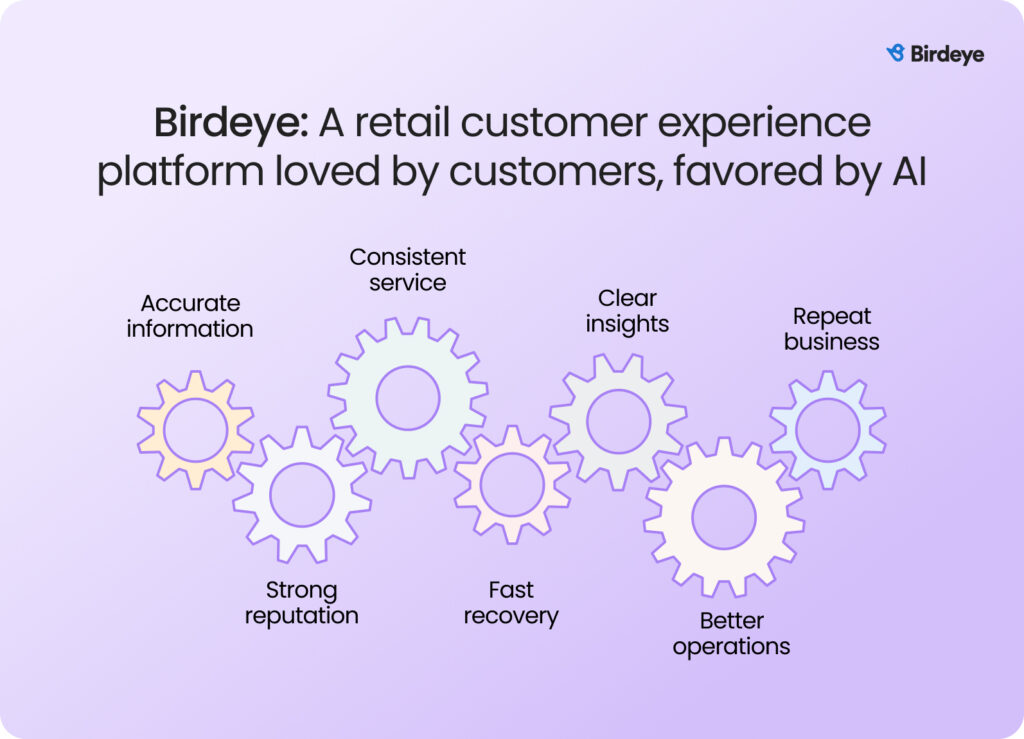
This system doesn’t rely on guesswork. It relies on visibility, accountability, and the ability to improve continuously across every location.
That’s exactly where Birdeye’s retail reputation management creates a real competitive edge.
→ Get your retail brand found in AI search. Try Birdeye’s AI Agents.

About the Author

Shruti Dugar
Birdeye
Originally published