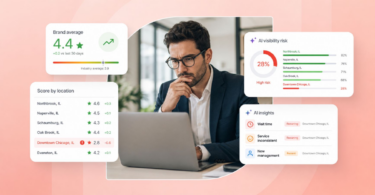
Generative search experience changes how search engines deliver answers by generating summaries and recommendations directly in the results. For multi-location businesses, this shifts visibility from “ranking for links” to “being included and described correctly” across every location.
Summary
Search is changing quickly, and multi-location brands feel it first. With search generative experience, customers often receive a ready-made answer that influences decisions before they click on a website, which raises the bar for accurate listings, strong review signals, and clear location-level content. Brands that strengthen these trust signals can appear more often and more consistently, while brands with scattered data risk being skipped or misrepresented. Birdeye helps multi-location teams centralize these signals and take action at scale across locations.
In this blog, we will explain what search generative experience means for multi-location discovery. Then we will explore practical ways to improve visibility and trust signals across every location.
What is SGE?
Search Generative Experience, or SGE, is Google’s generative AI approach to search. It was introduced as an experimental Search Labs experience and has since influenced newer Google search features such as AI Overviews and AI Mode.
SGE goes beyond matching keywords with links. It uses generative AI to interpret detailed questions, synthesize information from multiple sources, and present conversational answers directly within the search experience.
It can help users:
- Ask more complex and descriptive questions
- Receive summarized answers without opening multiple pages
- Explore related topics through follow-up questions
- Find recommendations based on context, intent, and location
- Review supporting links and sources for more detail
SGE guides you straight to the answers you need quickly and easily. Here are a few examples to show how SGE works:
- You type “best hiking trails near me.” Instead of endless lists, SGE shows you curated options based on difficulty, scenery, and even your past hikes.
- You ask “Is this recipe healthy?” SGE analyzes the ingredients, suggests healthier alternatives, and explains why they’re better.
- You wonder, “What’s happening in Ukraine?” SGE provides a clear summary of current events tailored to your interests and understanding.
It’s like having a personal research assistant who truly gets you, saving you time and frustration while leading you to the perfect information.

What is the difference between SGE and traditional search?
| Traditional search | Search Generative Experience (SGE) | |
| Handling complex queries | Handles simple keyword-based queries effectively but may struggle with complex or context-dependent questions. | Uses generative AI to interpret longer, more descriptive questions and synthesize relevant information into a conversational response. |
| Presentation of results | Results are displayed as a list of links on the search engine results page (SERP) where users click on relevant links to access detailed information from various websites. | Presents an AI-generated overview alongside supporting links and sources, helping users understand a topic before exploring individual webpages. |
| User interaction | User interaction involves clicking, reading, and navigating to external websites. | Interaction happens within the search interface, where users can ask follow-up questions or explore related topics seamlessly. |
| Visibility and authority | Businesses compete for visibility through relevance, content quality, technical SEO, backlinks, and local search signals. | Businesses also need information that AI systems can find, understand, and support with trusted sources. Accurate listings, strong reviews, and useful location content can all contribute to this. |
| Evolution and uncertainty | Well-established and understood by marketers and users because consistent rules govern the search rankings. | Still evolving, and its impact remains uncertain. Therefore, businesses need to stay informed about SGE updates. |
Why SGE matters for multi-location businesses
SGE presents a powerful tool for multi-location businesses to enhance their local SEO strategy and reach customers like never before. Here’s how:
- Hyper-local visibility: SGE understands the importance of location. It tailors information delivery based on the user’s specific location, ensuring your business appears in relevant searches even if you have multiple branches.
- Targeted engagement: Imagine a potential customer asking, “What restaurants are open near me with vegan options?” SGE delivers results specific to the user’s location, potentially including your restaurant along with relevant details like opening hours and vegan menu highlights.
- Personalized interactions: With its conversational nature, SGE allows users to refine their search through follow-up questions. This opens up opportunities for personalized interactions, directing users to the specific branch or service that best suits their needs.
The evolution of Search Generative Experience
SGE began as a limited Search Labs experiment, but generative AI is now part of Google’s broader search experience through features such as AI Overviews and AI Mode.
The underlying shift remains the same: search engines are moving beyond lists of links and toward synthesized, conversational answers.
For multi-location brands, this evolution may lead to:
- More location-specific recommendations based on detailed customer intent
- AI-generated summaries of reviews, services, and business attributes
- Follow-up questions that help customers compare nearby options
- Greater reliance on accurate listings, trusted citations, and location-level content
- Increased importance of monitoring how each location is described in AI-generated results
The terminology may evolve, but the business challenge introduced by SGE remains relevant: brands need to ensure that AI search experiences can find, understand, and accurately represent every location.
How to prepare for the search revolution
Although the original SGE experiment has evolved, the preparation principles remain relevant for AI Overviews, AI Mode, and other generative search experiences.
Keep local listings accurate
Maintain complete and current information for every location, including addresses, phone numbers, hours, services, categories, links, photos, and other important attributes across business listings, including Google Business Profile.
Strengthen review signals
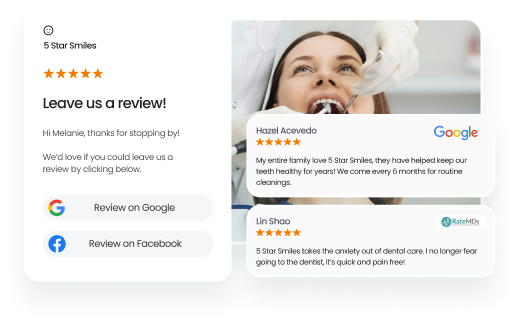
Generate a steady flow of recent, authentic reviews and respond consistently. Review content can help search systems and customers understand the strengths, weaknesses, and experience associated with each location.
Create useful location-specific content
Publish pages and content that clearly explain why each location is relevant. Include services, expertise, local attributes, common questions, and information that reflects actual customer needs.
Maintain consistent source information
Review the business website, listings, directories, and other trusted sources for conflicting or outdated information. AI-generated answers can reflect inconsistencies found across these sources.
Monitor how locations appear
Track whether each location is included in AI-generated answers, how it is described, and whether inaccurate details or negative sentiment are affecting visibility
Consumer behavior is shifting from keywords to AI-powered questions. When customers ask AI tools for “best options near me,” the answer often comes from the same trust signals you build here: accurate listings, strong reviews, and clear location-level content.
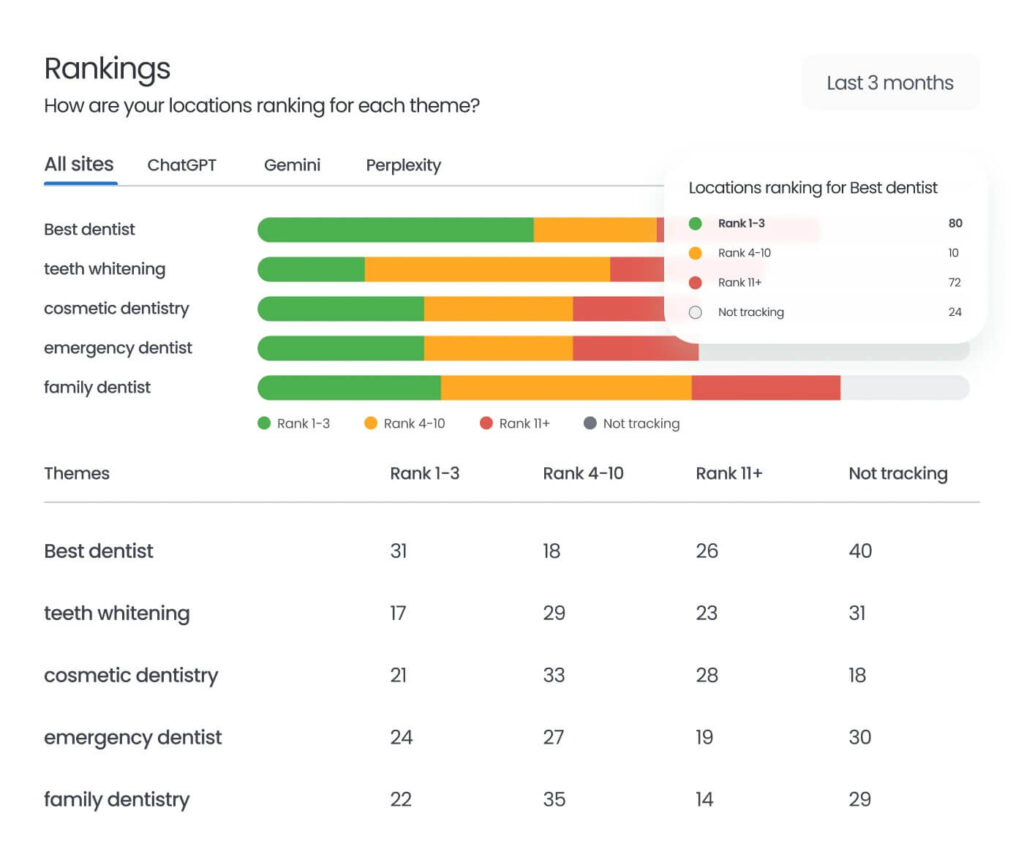
Birdeye Search AI helps multi-location teams stay visible on next-generation engines by tracking how often locations appear in AI-generated answers, monitoring how AI describes the brand, and flagging inaccurate business details that can lead to missed opportunities.
Birdeye – all-in-one platform
Automate Reviews, Ratings, Listings & Reputation Management with Birdeye.
Voice search optimization is key
Conversational optimization remains important because both voice search and generative search are shaped by natural-language questions. However, voice search and SGE should not be treated as the same technology.
To support both types of discovery:
- Write headings and FAQs around real customer questions
- Provide direct, useful answers in natural language
- Keep business and location details accurate
- Use clear descriptions of services, products, and attributes
- Create location-specific content rather than duplicating generic brand copy
- Make important information easy for search engines and customers to understand
These practices can improve content clarity across traditional search, voice assistants, AI Overviews, AI Mode, and other answer-driven experiences.
Beyond the hype: limitations and considerations
It’s important to approach SGE with a balanced perspective. While its potential is vast, it’s not a magic bullet. Some limitations to consider include:
- Accuracy and bias: Like any AI system, SGE can be susceptible to bias and errors. Staying informed about its development and limitations is crucial.
- Ethical considerations: Responsible AI implementation is paramount. As SGE evolves, ethical considerations regarding data privacy and responsible information delivery must be addressed.
Embrace the change, and stay ahead of the curve
The world of search is changing rapidly, and SGE is a major driving force. For multi-location businesses, understanding this technology and adapting your strategies is essential to remain competitive and connect with customers in meaningful ways. Embrace the change, stay informed, and be ready to revolutionize your business with the power of SGE.
How Birdeye helps multi-location brands prepare for SGE and AI-driven search
Search Generative Experience changes discovery from ranking a list of links to being included and described accurately in an AI-generated answer. For multi-location brands, that means every location needs accurate business information, strong customer feedback, and trusted source coverage.
Birdeye is the #1 agentic marketing platform for multi-location brands. Powered by BirdAI and a unified data platform, Birdeye connects the location and reputation signals that influence SGE and other AI-driven search experiences.
Search AI
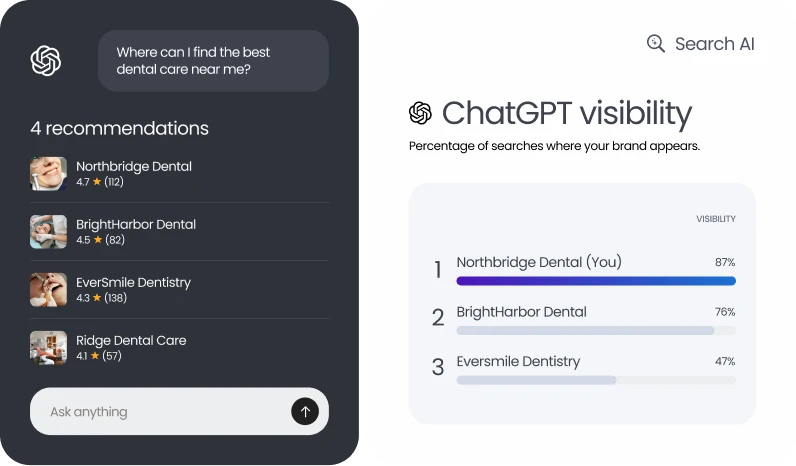
Search AI agents help teams understand how their locations appear across AI-generated answers.
- Track location-level visibility across ChatGPT, Gemini, Perplexity, and other AI search platforms
- Analyze how AI describes the brand and individual locations
- Identify citations and sources influencing those answers
- Compare visibility with local and brand-level competitors
- Detect inaccurate business details and gaps in location coverage
- Surface recommended actions involving listings, reviews, citations, FAQs, and local content
Listings AI
Listings AI agents helps maintain complete, accurate, and competitive profiles across high-impact platforms such as Google, Apple, Facebook, and Yelp.
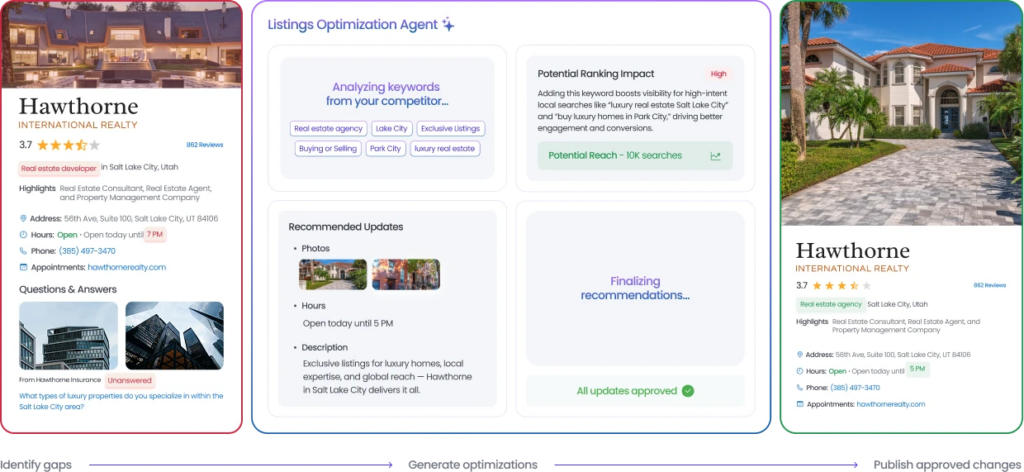
- The Listings Optimization Agent monitors profiles for missing or outdated information
- It analyzes local keywords, industry trends, and competitor profiles
- It recommends improvements to descriptions, photos, Q&As, services, and other profile details
- Teams can approve updates before they are applied within brand guardrails
Reviews AI
Reviews AI agents help strengthen the customer feedback signals that influence trust and AI-driven discovery.
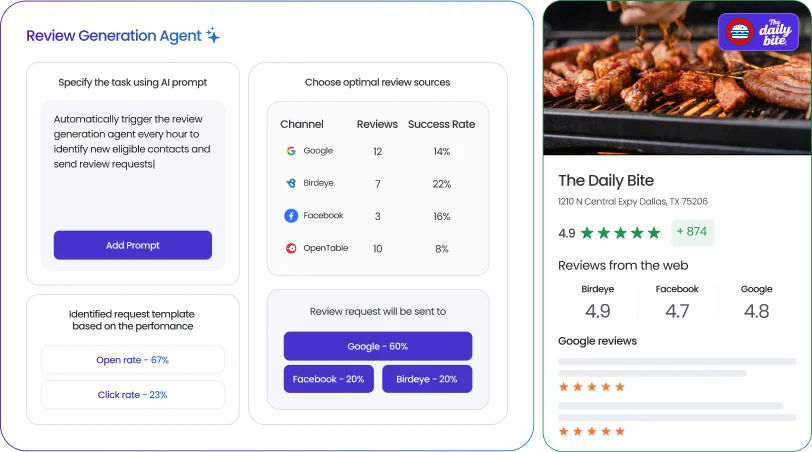
- The Review Generation Agent optimizes the review site, channel, messaging, and timing for requests
- The Review Response Agent drafts personalized, on-brand responses using sentiment and customer context
- The Review Reporting Agent helps teams identify recurring themes and location-level reputation trends
Ready to explore more about Birdeye? Watch our free demo today.

About the Author

Ruchika Batra
Originally published